RF-Care: Device-Free Posture Recognition for Elderly
People Using A Passive RFID Tag Array
Lina Yao
1, Quan Z. Sheng
1, Wenjie Ruan
1, Tao Gu
2,
Xue Li
3, Nickolas J.G. Falkner
1, and Zhi Yang
11School of Computer Science, The University of Adelaide, Adelaide, SA 5005, Australia
{lina.yao, michael.sheng, wenjie.ruan, nick.falkner, zhi.yang}@adelaide.edu.au
2School of CS & IT, RMIT University, Melbourne, VIC 3000, Australia
3School of ITEE, The University of Queensland, Brisbane, QLD 4072, Australia
ABSTRACT
Activity recognition is a fundamental research topic for a wide range of important applications such as fall detection for elderly people. Existing techniques mainly rely on wearable sensors, which may not be reliable and practical in real-world situations since
peo-ple often forget to wear these sensors. For this reason,
device-freeactivity recognition has gained the popularity in recent years.
In this paper, we propose an RFID (radio frequency identifica-tion) based, device-free posture recognition system. More specif-ically, we analyze Received Signal Strength Indicator (RSSI) sig-nal patterns from an RFID tag array, and systematically examine the impact of tag configuration on system performance. On top of selected optimal subset of tags, we study the challenges on pos-ture recognition. Apart from exploring pospos-ture classification, we specially propose to infer posture transitions via Dirichlet Process Gaussian Mixture Model (DPGMM) based Hidden Markov Model (HMM), which effectively captures the nature of uncertainty caused by signal strength varieties during posture transitions. We run a pi-lot study to evaluate our system with 12 orientation-sensitive pos-tures and a series of posture change sequences. We conduct exten-sive experiments in both lab and real-life home environments. The results demonstrate that our system achieves high accuracy in both environments, which holds the potential to support assisted living of elderly people.
Categories and Subject Descriptors
C.4 [Special-Purpose and Application-Based System]: Realtime
and RFID-based system
Keywords
Activity Recognition, Device-Free, Passive RFID, Posture Detec-tion, Posture Transition
.
1.
INTRODUCTION
Activity recognition is one of the most promising research topics in pervasive computing applications. With recent advances in em-bedded sensors and wireless technologies, it has become possible to develop a wide range of applications such as surveillance [9], ambient assisted living [20, 6], and remote health monitoring and intervention. For instance, by monitoring the activities of an older adult with dementia, we can track how completely and consistently her/his daily routines are performed and determine when assistance is needed.
Over the years, significant research work has been devoted to recognize human activities. Computer vision based approaches are one of such key solutions. However, such solutions usually de-mand high computational cost, and the performance depends much on lighting conditions (e.g., does not work well at night). In ad-dition, user privacy is a big concern as camera is often considered
intrusive. With the growing maturity of sensor, radio-frequency identification (RFID), and wireless networking technologies, activ-ity recognition based on inertial, unobstrusive sensor readings has become popular [13, 11, 27, 26, 19, 5]. Sensor-based approaches require user to wear sensor devices which also need regular main-tenance such as replacing batteries. In addition, these approaches may not be reliable, especially for older people with cognitive dis-ability since they tend to forget wearing them. Recent years, we
have seen a growing interest indevice-freeactivity recognition, in
which sensors are deployed to environments rather than worn by users. Radio signal fluctuations induced by user’s movements can be analyzed to recognize activities [28, 21, 30, 23, 29]. Existing device-free systems depend on dense deployment of Zigbee devices in the environment, which can be costly, and still require battery maintenance. For example, in [10], the authors set up a system where a Zigbee transmitter is placed in the center of a room, and receivers (i.e., sensor array) are placed around the room and close to wall.
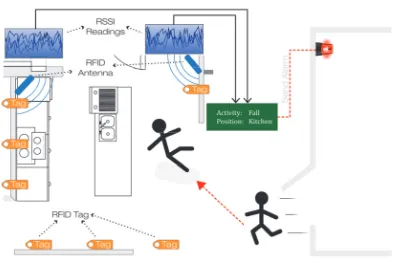
In this paper, we propose a novel device-free posture recogni-tion system based on RFID. We use passive RFID tags which have some advantages than battery-powered sensors due to low cost and maintenance free. Figure 1 illustrates our system setup. First, we are interested in investigating RFID tag configuration issues from the system design point of view, particularly the issues on RFID tag placement (i.e., where and how to place tags) and tag selection (i.e., finding an optimal set of tags). Due to the complex nature of radio signals in an indoor environment, these issues can be crucial to system performance. Existing research findings show that
pas-MOBIQUITOUS 2015, July 22-24, Coimbra, Portugal Copyright © 2015 ICST
Figure 1: System overview: a user performs different postures in a room setting equipped with an RFID array.
sive RFID tags can cause some unpredictable effects if they are not placed properly, e.g., significant signal loss or fading if two tags are put in a certain distance [8]. Similar studies have been done to explore the optimal tag configuration in indoor localization. For example, a recent study by Wagner et al. [25] shows an optimal tag placement to alleviate inaccuracy caused by the variability of RSSI. In our work, we focus on the study in the context of posture recognition which requires capturing fine-grained body movement compared to indoor localization. We first study the best possible tag placement, and examine and eliminate the redundant correla-tions of tags to find an optimal set of tags. Second, to evaluate the performance of our pure passive RFID system handling highly dy-namic variations of RSSI during posture transitions, we propose a Dirichlet Process Gaussian Mixture Model (DPGMM) with Hid-den Markov Model (HMM) model to detect a sequence of different postures (e.g., from sitting to standing to falling), respectively. The main contributions of this paper are summarized as follows.
• We propose a novel device-free posture recognition system
based on passive RFID tags, which is low-cost, unobtrusive, and maintenance free. The proposed system has many poten-tial applications, especially for elderly people or people with cognitive impairment.
• We investigate both tag placement and selection issues,
aim-ing to discover the basic design principle for deployaim-ing our system in indoor settings. The study determines an optimal setting of tag array to achieve the best system performance with less computational demand. We propose and compare various tag selection techniques (e.g., F statistics, relief F, random forest, etc) to identify and eliminate redundant tags.
• We deploy our system in an indoor setting, and conduct
ex-periments to validate our system. The experimental results with a single subject in both a lab and a home settings show that the system achieves an accuracy of 98% on average for 9 tags and one reader in dealing with steady posture recog-nition, and over 70% accuracy in dealing with a sequence of posture transitions, which result in more disturbance and noisy data of RSSI. Our experimental results demonstrate that the proposed system has good potential to be developed further and deployed in practice.
The rest of the paper is organized as follows. In Section 2, we discuss some potential applications, and present our key
observa-Figure 2: An illustraton of fall of an older resident
tions to motivate our work. We describe the system design in Sec-tion 3. In SecSec-tion 4, we report our experimental results. We review the related work in Section 5 and wrap up the paper in Section 6.
2.
BACKGROUND
In this section, we first discuss several representative applica-tions that can benefit from our system. We then formulate the re-search problem.
2.1
Application Scenario
The system we present in this paper can be applied to posture monitoring and activity recognition in general, particularly for el-derly people or people with cognitive impairment. Figure 2 illus-trates a home scenario where an older adult accidentally falls down, and the system detects this abnormal action and sends an alarm im-mediately to caregiver for assistance.
2.2
Observations and Problem Formulation
Figure 1 depicts a typical system setup in a room setting, where an RFID tag array is deployed on the wall, and RFID antenna are placed on the other side, facing these tags. When a person performs different activities in the room, the system collects RSSI values and discovers varied fluctuation patterns. The motivation of our work arises from the following observations.
It is known that RSSI signal exhibits a variety of complicated phenomena in indoor environments due to signal reflection, diffrac-tion, and scattering. This is often affected by the propagation en-vironment, the tagged object properties, and human movements in the signal coverage area. It is difficult to model RSSI signal approx-imately by a location-dependent path loss model. Figure 3 shows RSSI signal values of passive RFID tags, which fluctuate with dif-ferent postures. Although RSSI shows uncertainty and non-linear distributed patterns, we discover that the variations of RSSI val-ues allow us to distinguish different postures. Figure 4 shows the distinctive changes of RSSI values of the tag array (e.g., 9 passive RFID tags) according to different postures that a subject performs. From these observations, we believe that RSSI signals of passive RFID tags embody different patterns for different postures, which can be further exploited for our posture recognition task. We there-fore formulate our problem in this work as follows.
LetO ⊂Rd(dis the number of tags) be the domain of
observ-able RSSIoandL ∈ {1, ..., K} ⊂ Rbe the domain of output
posture labell. Suppose we havenRSSI and posture label pairs
{(oi, li)|oi∈ O, li∈ L, i= 1, ..., n}. The training dataset can be
represented as:
O= [o1, ...,on]∈Rd×n
0 2000 4000 6000 8000 10000 12000 14000 0
10 20 30 40 50 60 70 80
Frequency
RSS
(a)
0 2000 4000 6000 8000 10000 12000 0
10 20 30 40 50 60 70 80
Frequency
RSS
(b)
Figure 3: (a) Histogram of RSSI from posturesitting leaning left; (b) Histogram of RSSI from posturesitting leaning right
Figure 4: Different RSSI patterns of different postures
In this paper, we are interested to investigate the following two questions.
PROBLEM1 (TAGPLACEMENT ANDSELECTION). Given an
RFID tag array, how to place them in a room setting and find the optimal subset of tags to achieve the best performance.
PROBLEM2 (POSTURERECOGNITION). Given the RSSI
val-ues we observe, how to recognize a subject’s postures.
3.
THE PROPOSED APPROACH
In this section, we first present the tag placement and selection, followed by the technical details on the posture recognition.
3.1
Tag Placement and Selection
Tag Placement. To realize posture recognition, the first essential challenge for us is how to set up tags in an indoor setting to
ob-tain the best performance. We first describe some intuitions oftag
placementin this work. There are two main reasons why we place tags as an array:
• We conduct empirical studies on different forms of placing
tags, such as arranging tags as a single line on the wall. Ac-cording to our results, single-line tag placement is capable of capturing signal variations, but it may fail to detect fine-grained body movements, such as sitting leaning right or left. Furthermore, it is also not sensitive to capture the signal vari-ations caused by subjects with different heights.
• To achieve better accuracy and higher sensitivity, we increase
single-line tag placement to multiple lines, eventually
form-ing anarray. Different lines correspond to different parts
of human body. For instance, the upper line of tags would be expected to reflect the variations from upper human body like waving arms or shaking head, and the middle line of tags would be more sensitive to movements of torso, and the bot-tom line of tags are supposed to have more response to lower
0 20 40 60 80 100 120 140 160 180 200 0
1000 2000 3000 4000 5000 6000
Time Stamp
RSSI
(a)
0 20 40 60 80 100 120 140 160 180 200 0
500 1000 1500 2000 2500 3000 3500 4000
Time Stamp
RSSI
(b)
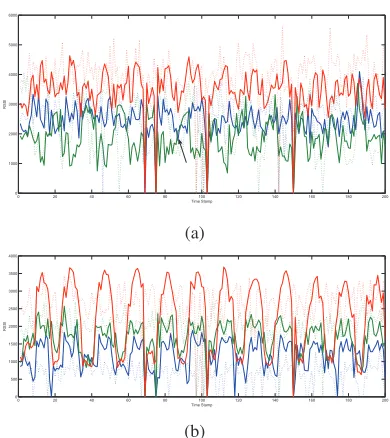
Figure 5: Illustration of RSSI fluctuations of falling right and falling left: RSSIs of tag 1, tag 2 and tag 3 (top) and RSSIs of tag 7, tag 8 and tag 9.
body movements such as falling etc. In this way, we may perform more robust posture recognition with the collected
full spectrumof RSSI variations.
As shown in Figure 5, the top one shows the RSSI fluctuations of three tags (tag 1, tag 2 and tag 3 are placed as a single line shown in Figure 13) and the lines indicate RSSI variations of falling right, and dash lines indicate RSSI variations of falling left. The bottom one shows the RSSI fluctuations of three tags (tag 7, tag 8 and tag 9 are arranged as a single line) and the solid lines indicate RSSI variations of sitting right, and dash lines indicate RSSI variations of sitting left. We can observe the fluctuations of tag 1, tag 2 and tag 3 are not quite helpful for reflecting different orientation falls as they do not show significant difference, on the other hand, tag 7, tag 8 and tag 9 can distinguish falling right and falling left better. The reason lies in fall action happens on the lower body, the lower location of tag 7, tag 8 and tag 9 can be more sensitive to such actions compared with tag 1, tag 2 and tag 3 in upper location. To capture the RSSI variations in all aspects, we use multiple lined up tags forming a tag array in this work. Existing works such as [10] also show that placing sensors as an array can realize activity recognition with good accuracy.
Tag Selection. With the placement of tag array on the wall, we now focus on studying the correlations between tags while detect-ing postures. As shown in Figure 6 (a), the RSSI values of tag 1 and tag 2 are highly correlated with each other, implying that one of them is redundant. Figure 6 (b) illustrates that RSSI values of tag 1 and tag 9 successfully divide the RSSI data space from the series of postures likestanding straight,sitting straight, andlying on bed. We also examine the redundant correlations among three tags. For example, Figure 6 (d) shows that the RSSI values of tag 3, tag 5 and tag 9 can distinguish the listed postures, while the RSSI values of tag 3, tag 4 and tag 6 are highly correlated, as shown in Figure 6 (c).
0 1000 2000 3000 4000 5000 6000 7000 8000 5000 6000 7000 8000 9000 10000 11000 12000 13000 14000
RSS of Tag 1
RSS of Tag 2
Stand straight Sit straight Sit right Lie in bed Lie on ground
(a)
0 1000 2000 3000 4000 5000 6000 7000 8000 1000 2000 3000 4000 5000 6000 7000 8000 9000
RSS of Tag 1
RSS of Tag 9
Stand straight Sit straight Sit right Lie in bed Lie on ground
(b) 0 5000 10000 15000 0 1000 2000 30000 2000 4000 6000 8000 10000
RSS of Tag 3 RSS of Tag 4
RSS of Tag 6
Stand straight Sit straight Sit right Lie in bed Lie on ground
(c) 0 5000 10000 15000 0 1000 2000 3000 40000 2000 4000 6000 8000
RSS of Tag 3 RSS of Tag 5
RSS of Tag 9
Stand straight Sit straight Sit right Lie in bed Lie on ground
(d)
Figure 6: Illustrative examples of tag correlations
the optimal tag array configuration in our system.
F-Statistics.It is to measure the discrimination of multiple sets of real numbers and is calculated using:
Fi=
l
j=1(¯oji−o¯i)2 l
j=1
1 nj−1
nj
k=1(ojk,i−o¯ji)2
(2)
wherelis the number of posture classes,njis the number of
sam-ples injthposture class.o¯
idenotes the mean value of tagiin the
training dataset.o¯ji is the mean value ofithtag in thejthposture class. The numerator indicates the discrimination between posi-tive and negaposi-tive sets, and the denominator indicates the one within each of the two sets. The larger the F-score is, the more likely this tag is discriminative in posture recognition.
Relief F.This technique estimates the relevance of features accord-ing to how well their values distaccord-inguish between the data points of the same and different posture classes that are close each other. It computes a weight for each tag to quantify its merit. This weight is updated for the RSSI samples presented in each posture class, according to the evaluation function:
wi=wi+
j∈L,j=l(oi)
P(lj)
1−P(lj)|oi−nearmiss j i(oi)|
− |oi−nearhiti(oi)|
(3)
wherel is the number of posture classes. nearmissj(oi) and
nearhiti(oi)denote the nearest RSSI samples tooifrom the same
and different posture classes, respectively.
Random Forest.Random forest (RF) is a classification method [4], which also provides feature importance. The basic idea is that a forest contains many decision trees, each of which is constructed by instances with randomly sampled RSSIs. The prediction is made by a majority vote of decision trees. To obtain tag importance, we split the training sets into two parts. By training the first part and
predicting the second, we obtain an accuracy value. For thejthtag,
we randomly shuffle its values in the second set and obtain another accuracy value. The difference between the two accuracy values indicate the importance of thejthtag.
Multinomial Logistic Regression with1Regularization. 1
regu-larization uses a penalty term that shapes the sum of the absolute values of parameters to be small, which usually leads to a sparse
pa-rameter vector. In this work, we integrate the1regularization into
linear classifier in the objective term. Given our multi-class posture
recognition problem, we combine the1regularization with
multi-nomial logistic regression, which models the conditional probabil-ityPw(lj=∓1|o). The prime problem with1regularization can
be calculated by optimizing the log likelihood:
min w
K
k=1
||wk||1− n i=1 K k=1
likwTkoi+ n i=1 log K k=1
exp(wTkoi)
(4) RFID tags can then be selected by considering the obtained weight vectorw.
Least Square with1Regularization.It can be represented as:
min w∈Rd
1
2||l−Ow||22+λ||w||1 (5)
wherel ={l1, ..., ln}is the posture labels of training RSSI
sam-ples,O={o1, ...,on}is all training RSSI samples,w= [w1, ..., wd]T
denotes the regression coefficients,wicorresponds to the
regres-sion coefficient of theith tag,λis the regularization parameter.
Same as the multinomial case,||w||1 regularization tends to
pro-duce a sparse solution (i.e., the regression coefficients of irrelevant tags are or close to zero), which indicates the importance of each
tag. We also study the2,1regularization, which is formulated as:
min w∈Rd
1
2||l−Ow||22+λ||w||2,1 (6)
where||w||2,1=ni=1Kj=1w2ij.
After performing the selection process, all tags are ordered based on their importance and a subset of tags is selected based on a user-defined threshold of top-N(N < d) tags.
3.2
Steady Posture Recognition
We now move to the posture recognition. We use SVM (support vector machine) with linear kernel to perform steady posture classi-fication. SVM aims at finding the decision boundary via maximiz-ing the distance from the closet sample to the boundary hyperplane. When there are limited training data available, SVM usually out-performs the traditional parameter estimation methods which are based on the Law of Large Numbers. This is mainly due to the fact that SVM benefits from the structural risk minimization prin-ciple and the avoidance of overfitting by its soft margin. For pos-ture recognition, SVM classifies pospos-tures based on the fact that the smaller the distance between two RSSI samples, the higher proba-bility they belongs to a same posture. SVM method works directly with RSSI using the kernel functions. The topology implicit in sets of RSSI and the postures can be exploited in the construction of possibly non-Euclidean function spaces that are useful for posture estimation. Given the sequence of training RSSI and correspond-ing posture labelsO={(o1, li), ...,(on, ln)}, whereo∈Rdand
l∈ {1, ..., K}, the objective function can be formulated as:
min w,b,ξw
Tw+Cn i=1
ξi
s.t.li(wTφ(oi) +b)≥1−ξi, i= 1,2, ..., n
ξi≥0, i= 1,2, ..., n
(7)
whereξiis a slack variable,Cis the penalty of error term,K(oi,oj) =
The prime problem of optimization in Equation 7 can be con-verted to solve its duality using Lagrange multiplier. Thus, Equa-tion 7 can be reformulated as:
L(w, b, ξ, α, μ) =
wTw+
C
n
i
ξi− n
i=1
αi(li(woi+b)−1 +ξi) + n
i=1
μiξi
(8)
whereα= (α1, ..., αn)T andμ= (μ1, ..., μn)Tis the Lagrange
multipliers. To solve Equation 8, we can maximize the minimiza-tion of duality as:
max
α,μ wmin,b,ξL(w, b, ξ, α, μ) (9)
The technical details and the mathematical theory can be found in [7]. Three widely used kernels are explored in our work, including thelinear kernel, thepolynomial kernel, and theGaussian kernel:
• Linear kernel.K(oi,oj) =oTioj
• Gaussian kernel.K(oi,oj) =exp(− ||oi−oj|| 2
2σ2 )
• Polynomial kernel.K(oi,oj) = (oi·oj+ 1)p
With the model learned, we can recognize the posture class for a given testing RSSIo∗.
3.3
Posture Transition Detection
Apart from evaluating recognition accuracy of identifying static postures using passive tag array, we specially study the perfor-mance of detecting posture transitions as RSSI values become harder to interpret due to more disturbance and noise during posture tran-sitions (e.g., from standing straight to falling to the ground). We propose a HMM based approach, which has shown a powerful per-formance in handling posture sequences. Specially, our goal is to determine the conditional probabilityP(lk|oi)given a new coming
sampleo.
Given observation sequences of RSSIO = {o1, ...,oT}, and
posture states denoted by posture label sequencel={l1, ..., lT},
the HMM models the sequence of observable RSSIO={o1, ...,oT}
by assuming that there is an underlying sequence of different pos-turesl={l1, ..., lT}drawn from a finite posture set. In our
pos-ture transition recognition problem, each observationotis the RSSI
vector, and each stateltis the posture label (e.g.,sitting).
HMM makes two assumptions: i) each posture performed att
only depends on its immediate previous posture at timet−1, and
ii) each observable RSSIotonly depends on the current performed
posturelt, which are formulated respectively as:
p(lt|lt−1,ot−1, ..., l1,o1) =p(lt|lt−1), t= 1,2, ..., T (10)
p(ot|lT,oT, ..., lt+1,ot+1, ..., l1,o1) =p(ot|lt) (11)
With the assumptions, we can model the joint probability of
pos-ture sequenceland observable RSSI sequenceOas:
p(l,O) =
T
t=1
p(lt|lt−1)p(ot|lt) (12)
wherep(lt|lt−1)is the transition probability indicating the
likeli-hood the subject changes from posturelt−1 to posturelt, which
is defined by considering the predefined posture transitions
appli-cations. For example, people can transit fromsittingtostanding,
but can not transit fromlying in bedtofalling on grounddirectly,
Figure 7: Comparison on traditional GMM with DPGMM over two dimensional RSSI
whilst they can transit fromlying in bedtosittingthen tofalling on ground. We denote the state transition probability distribution as A={aij}:
aij=p(lt+1=lj|lt=li) (13)
On the other hand,p(ot|lt)denotes the observation distribution
drawn by different postures. We assume RSSI distribution gen-erated by each posture as a Gaussian mixture model, which is a
weighted sum ofmcomponent Gaussian densities. It can be
de-fined asB={bt(i)}:
bt(i) =p(ot|lt=li)
=
Mi
m=1
πi,mN(ot, μi,m,Σi,m)
=p(ot|μm,Σm) =
1 (2π)D/2Σ1/2m
exp
−12(ot−μm)TΣ−1m(ot−μm)
(14)
whereoisddimensional continuous RSSI observations (dis the
number of tags in the deployment) andπis the mixture weights
andp(ot|μm,Σm)is the component Gaussian distribution.
The traditional GMM learning process with Expectation - Maxi-mization (EM) limits to determination of how many gaussian com-ponents in the GMM. We adopt the Dirichlet Process Gaussian Mixture Model (DPGMM) in observation probability distribution in this work. It uses the Dirichlet process as a prior over the dis-tribution of the parameters and there is no need to explicitly de-clare the number of components. The approximate inference algo-rithm uses a truncated distribution with a fixed maximum number of components, but almost always the number of components actu-ally used depends on the data.
We use two-dimensional RSSI from our dataset to show the ad-vantage of DPGMM over GMM (in Figure 7). GMM with EM learning splits Gaussian components arbitrarily, for example, the two clusters are eventually divided into five clusters in some con-vergences. Thus it does not reach a good fit even we use AIC (Akaike Information Criterion) [1] as model selection criteria, while the Dirichlet Process GMM model effectively only uses as many as needed for a good fit without defining number of guassian compo-nents, it can accurately nail down two clusters and converges to a good fit automatically in this case. More details can be referred to [3].
Our goal of detecting postures in the context of HMM is as
fol-lows. Given a sequence of RSSI observationso1, ...,oT, what is
(a) (b)
Figure 8: (a) RFID tags/reader/antenna (b) Lab setting (left) and Bedroom setting (right)
sequence in HMM. Formally, given a continuous sequence of RSSI
observationso1...oT and learned HMM (shown in Equation 12),
we aim to find the most likely posture sequencel1...lT:
δt(j) = max l1...lt−1p
(lt=j, lt−1, ...l1,ot, ...,o1|A,B) (15)
whereA andB can be calculated from Equation 13 and
Equa-tion 14. By inducEqua-tion, we can have:
δ1(j) =b1(oj)
δt+1(j) = max
1≤j≤Nδt−1(j)aijbt(ot+1), j= 1, ..., K
(16)
4.
EXPERIMENTS
This section reports our experimental studies in both lab and real-world residential environments. First, we describe the experimental settings, and then we report the results.
4.1
Experimental Settings
Hardware Setup. We used one Alien 9900+ RFID reader, one cir-cular antenna and Squig inlay passive RFID tags in our experi-ments (see Figure 8 (a)). The tag array containing nine tags was
placed at a3×3grid points on a wall where each grid is roughly
0.58m×0.58m. We name this wall theactive testing areain this
paper. The antenna was arranged in≈1.3mheight facing the
ac-tive testing area in≈70◦(see Figure 8 (b)). The subject performed
different predefined postures between the wall and the antenna, and the corresponding sequence of RSSI were collected at a sampling rate of 0.5 second.
Sampling Rate. Passive RFID tags tend to be noisy even in a lab environment. For example, one challenge in existing RFID systems is false negative readings, caused by missed detections (i.e., a tag in the antenna’s reading range not detected). In addition, RSSI data is much sensitive to environments, e.g., some disturbance from envi-ronment can cause RSSI fluctuations. Appropriate sampling rates can reduce the aforementioned problems. Too small sampling rates make our method more sensitive to the noise of RFID readings, while too big sampling rates blur the inter-class posture bound-aries. In our implementation, we collected the continuous RSSI data streams at the sampling rate of≈0.5second.
Data Acquisition.We ran a pilot study to evaluate the performance of our system. For collecting the training dataset, we conducted a series of experiments in which a subject entered the active testing
area and performed various pre-arranged postures, such as
stand-ing,lying on ground,lying in bed, andfalling. Three subjects (two males and one female) participated in the experiments and each per-formed the set of 12 fine-grained postures (Figure 9). The subjects
Figure 9: Predefined orientation-sensitive postures
Figure 10: An example of posture transition sequence
also performed different predefined posture sequences for evaluat-ing posture transition detection. The timevaluat-ing of all the movements was determined beforehand so that the data can later be compared to the actual timing of the postures.
The task of the steady posture classification is to model how the signal strengths are distributed when the subject performs different postures. Each subject stands in the active testing area which is between the antenna and the wall deployed with passive RFID tags. We first measured the RSSI values for all tags when the testing area is empty. Then each subject stood in the area and performed the 12 predefined postures.
Figure 11: System interface
30 seconds and then performed next posture in the order as prede-fined in the sequence. In the second strategy, the subject performed and held each posture for 60 seconds and then performed the next posture in the order as predefined in the sequence. Figure 11 shows a system interface for our proposed approach, which integrates data collection, annotation and monitoring.
4.2
Results
To evaluate the effectiveness of the proposed tag selection, we adopted a person-dependent 10-fold cross-validation strategy. For the person-dependent evaluation, we use partial samples of a sub-ject for testing and use the remaining samples of the same partici-pant for training.
4.2.1
Impact on Tag Selection
To evaluate the impact of tag selection, we sorted the tag im-portance calculated from six selection approaches (Section 3.1) in descend order, and compared the recognition accuracy using SVM
with linear kernel by choosing topNtags (Nis from1to9(full
set)). Figure 12 (a) shows the comparison results over topN tags
in the lab environment, and Figure 13 (b) shows the results in the bedroom environment.
In both cases, the performance is influenced by the selected tags. Posture classification accuracy does not improve much after top 5 selected tags using all selection criteria, and reaches the best point
(99.18%) with Relief-F selection when top-7tags are selected
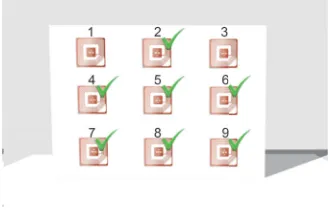
com-pared to 99.04% without tag selection (full set of tags). In the bed-room case, the impact of tag selection on performance is more ob-vious. The accuracy is the best when only seven tags are selected, and the performance even slightly drops when more tags are added. From the results, we can see that the tag selection does improve the overall performance in both lab and bedroom environments by dis-tinguishing the salient tags, only subset of intuitively placed tags shows their usefulness and discrimination via implicating the intra-person variability on different postures. The rest of tags degrade the overall performance due to failing to capture the inter-class and intra-class variability. Figure 13 shows an example of optimal tag deployments from our experiments.
4.2.2
Steady Posture Classification
To study the feasibility of our approach and its sensitivity to the size of training data after selecting tags, we further evaluated the posture classification with varying training ratios in terms of tag selection and no tag selection. As shown in Figure 14, our
ap-proach performs well even only with10% the training size, the
accuracy reaches over 90% in both cases. The accuracy increases with larger training size. However, when the training size is around
1 2 3 4 5 6 7 8 9 0
0.1 0.2 0.3 0.4 0.5 0.6 0.7 0.8 0.9 1
Top N Tags
Accuracy
F statistics Relief−F L21Regularization Random Forest L1Regularization MultinomialL1
(a) Lab environment
1 2 3 4 5 6 7 8 9 0
0.1 0.2 0.3 0.4 0.5 0.6 0.7 0.8 0.9 1
Top N Tags
Accuracy
F statistics Relief−F L21Regularization Random Forest L1Regularization MultinomialL1
(b) Bedroom environment
Figure 12: Posture classification comparison with TopN tag selection in (a) lab and (b) bedroom environments
Figure 13: An example on tags selection
60%∼70%, the accuracy begin to decrease. We can see that the
overall accuracy is consistently better with the tag selection strat-egy compared with the case without tag selection.
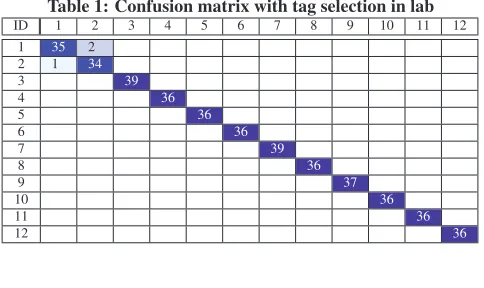
We look closely at the results of the confusion matrices in both lab and bedroom cases with the selected subset of tags and 10% training ratio given in Table 1 and Table 2, respectively. Generally,
only a few samples of postures, i.e.,standing free(with ID of 1)
andstanding straight(with ID of 2), misclassified in the lab
en-vironment. In the bedroom environment,falling right(with ID of
11) andfalling left(with ID of 12) are misclassified, whilst they are accurately classified in the lab environment. It should be noted that the performance on classifying orientation-sensitive postures still reaches over 98% in the bedroom environment.
4.2.3
Posture Transition Detection
0.1 0.2 0.3 0.4 0.5 0.6 0.7 0.8 0.9 0.92
0.93 0.94 0.95 0.96 0.97 0.98 0.99
Training Ratio
Accuracy
Lab
Without Tag Selection With Tag Selection
(a) Lab environment
0.1 0.2 0.3 0.4 0.5 0.6 0.7 0.8 0.9
0.92 0.93 0.94 0.95 0.96 0.97 0.98 0.99
Training Ratio
Accuracy
Bedroom
Without Tag Selection With Tag Selection
(b) Bedroom environment
Figure 14: Accuracy comparison with and without tag selection using different training sizes: (a) lab and (b) bedroom
performed posture classification over a series of posture transitions and measured how accurately our approach can recognize a posture given new coming RSSI values, as well as how timely our approach can recognize the posture.
Passive RFID tags are highly sensitive to disturbance, especially when posture changes. The RSSI fluctuation result from posture transition exhibits some uncertainty. To cope with the impact of
this disturbance, we adopted aforward calibrationmechanism to
calibrate the RSSI streams before detecting posture change [22]. We used a sliding time averaging window to smooth RSSI values.
The calibrated RSSI streamotat timetcan be calculated as:
ˆ
ot=
t+|w|−1 i=t oi
|w| (17)
where|w|is the window size. To determine the best window size
in this work, we evaluated the performance of both lab and bed-room settings with and without tag selection strategy by varying the window size. Figure 15 shows the results.
From the figure, we can see that the performance does not con-sistently improve when increasing window size, instead, when the
window size is2, the performance in both settings reached the best
result. We further compared the performance in terms of differ-ent duration a posture is held. Figure 15 shows the results under two durations (30 and 60 seconds) with and without tag selection. From the results, we can see that the longer the posture is held by the subject, the better accuracy can be achieved. The reason is that a longer posture holding time can eliminate both inter-class and intra-class variations, to which RSSI are especially sensitive in
rec-Table 1: Confusion matrix with tag selection in lab
ID 1 2 3 4 5 6 7 8 9 10 11 12
1 35 2
2 1 34
3 39
4 36
5 36
6 36
7 39
8 36
9 37
10 36
11 36
12 36
Table 2: Confusion matrix with tag selection in bedroom
ID 1 2 3 4 5 6 7 8 9 10 11 12
1 35 1
2 1 34
3 36
4 36
5 36
6 36
7 39
8 36
9 37
10 36
11 35 2
12 1 35
ognizing postures. We also can see that the performance using the tag selection strategy significantly outperforms the one without tag selection. The results from steady posture classification and posture transitions detection consistently indicate that an optimal subset of tags can more discriminatingly recognize postures compared with full set of tags. The subset tags have the dominant impact.
Fast detecting posture transition is critical, particularly for aged care applications. For example, for fall detection, we can send an alert and notify caregivers as quickly as possible to offer medical assistance for elderly people when a fall occurs. The results from our experiments show that the proposed method promptly detects posture transition. Interested readers are referred to our demo1.
4.2.4
Recognition Delay
We now evaluate how quickly our system detects the transition of
a person from one posture to the other. Our system has3.5seconds
recognition latency, which results from two main factors. Firstly, our system evaluates subject’s postures every 0.5 seconds using the
latest 2seconds of RSSI stream. In other words, if the current
system time is at timestampt, our system will produce the predicted
posture in the[t−2, t−1]seconds, and[t−1, t]seconds is used to backtrack check if the predicted label complies with predefined
rules. For instance, assume that the label is estimated as: lying on
bedat[t−2, t−1]interval, if the predicted label in interval[t−1, t]
isnobody, our system will determine the subject is stilllying on
bed. Secondly, the RSSI collector is programmed with a timer to
poll the RSSI with a predefined order of transmission, which needs
to take around1second to complete a new measurement with no
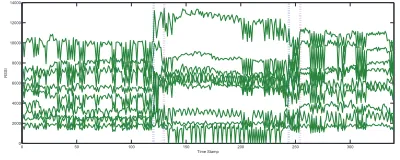
workarounds. From Figure 16, we can see that our system promptly detects posture transition with slight latency.
We can see that the overall performance at home environment is a little bit lower than the lab environment (due to furnitures etc). However, it still achieves over 98% accuracy for steady posture classification and 70% for the overall posture transition detection.
1
1 2 3 4 5 6 7 8 0
0.1 0.2 0.3 0.4 0.5 0.6 0.7 0.8 0.9 1
Window Size
Accuracy
30s no selection 60s no selection 30s with selection 60s with selection
(a)
1 2 3 4 5 6 7 8
0 0.1 0.2 0.3 0.4 0.5 0.6 0.7 0.8 0.9 1
Window Size
Accuracy
30s no selection 60s no selection 30s with selection 60s with selection
(b)
Figure 15: Performance comparison on different window sizes using 30s and 60s strategies without and with tag selection in (a) lab environment, (b) bedroom environment
0 50 100 150 200 250 300
0 2000 4000 6000 8000 10000 12000 14000
Time Stamp
RSSI
Figure 16: Recognition latency: blue dot vertical line indicates the ground-truth time point of posture transition, pink dot ver-tical line indicates the recognition time point detected by our system.
5.
RELATED WORK
The goal of activity recognition is to detect human physical ac-tivities from the data collected through various sensors. There are generally two main research directions: i) to augment people, on whom sensors and RFID tags are attached, and ii) to augment the environment, where sensors are deployed inside the environment and people do not have to carry them.
Wearable sensors such as accelerometers and gyroscopes are com-monly used for recognizing activities [15, 2, 18]. For example, the authors in [12] design a network of three-axis accelerometers distributed over a user’s body. Activities can then be inferred by learning information provided by accelerometers about the
orien-tation and movement of the corresponding body parts. However, such approaches have obvious disadvantages including discomfort of wires attached to the body as well as the irritability that comes from wearing sensors for a long duration. Recently, researchers are exploring smart phones equipped with accelerometers and gy-roscopes to recognize activities and gesture patterns [16, 17]. Kr-ishnan et al. [14] propose an activity inference approach based on motion sensors installed in a home environment.
Apart from sensors, RFID has been increasingly explored in the area of human activity recognition. Some research efforts propose to realize activity recognition by combining RFID passive tags with traditional sensors (e.g., accelerometers). In this way, daily activ-ities are inferred from the traces of object usage via various clas-sification algorithms such as Hidden Markov Model, boosting and Bayesian networks [24, 5]. Other efforts dedicate to exploit the potential of using “pure” RFID techniques for activity recognition. For example, Wang et al. [26] use RFID radio patterns to extract both spatial and temporal features, which are in turn used to char-acterize various activities. However, these research efforts require people to carry RFID tags or even readers (e.g., wearing a bracelet).
There are recent research efforts focusing on exploring
device-freeactivity recognition. Such approaches exploit radio
transmit-ters installed in environments, and people are free from carrying any receiver or transmitter. Most device-free approaches concen-trate on analyzing and learning distribution of received signal strength or radio links. Youssef et al. [28] propose to localize people by analyzing wireless signal strength moving average and variance. Zhang et al. [29] develop a tag-free sensing approach using RFID tag array. However, most of these efforts focus on localization and tracking, not on activity recognition. Only very recently, the au-thors of [10] and [23] propose device-free activity recognition using sensor arrays. Compared to these work, our passive RFID-based system has many advantages such as low cost and maintenance free. To the best of our knowledge, our work is the very first of few on investigating device-free human activity recognition using passive RFID tags.
6.
CONCLUSION
In this paper, we proposed a device-free posture monitoring sys-tem for elderly people, by exploiting low-cost passive RFID tags. We focus our study on tag configuration issues, especially tag place-ment and selection, for achieving the best trade-off between per-formance and cost. We systematically study these issues by using different configuration settings and applying various tag selection methods. We also propose a Dirichlet Process Gaussian Mixture Model with the Hidden Markov model to recognize different pos-tures. We conducted extensive empirical studies and our findings are briefly summarized as follows.
• Our system detects 12 orientation-sensitive postures (see
Fig-ure 9), with an accuracy of99%and72%in terms of steady
posture recognition and posture transition detection,
respec-tively, in a lab environment, and over98%and70%, in a
real-life home environment.
• It is interesting to find out that more tags deployed in the
testing area do not help improve the performance, which ac-tually decreases the recognition accuracy. From our knowl-edge, our work is the first to investigate a number of possible techniques for tag configuration in posture recognition.
used to build a more robust tag coverage model. Secondly, we view our work presented in this paper the first step toward recognizing high-level activities. There are in general three types of activities on top of postures: i) action, which consists of multiple postures for a single person with temporal dimension, e.g., “walking”; ii) interaction, which involves two or more persons, e.g., two people are shaking hands; and iii) group activity, which is performed by a group of people, e.g., having a meeting. Identifying these complex activities is another main goal of our future work.
7.
REFERENCES
[1] H. Akaike. A new look at the statistical model identification.
Automatic Control, IEEE Transactions on, 19(6):716–723, 1974.
[2] L. Bao and S. S. Intille. Activity recognition from
user-annotated acceleration data. InProceedings of 2nd
International Conference on Pervasive Computing (PERVASIVE), pages 1–17. Springer, 2004.
[3] D. M. Blei, M. I. Jordan, et al. Variational inference for
dirichlet process mixtures.Bayesian analysis, 1(1):121–143,
2006.
[4] L. Breiman. Random forests.Machine Learning, 45(1):5–32,
2001.
[5] M. Buettner, R. Prasad, M. Philipose, and D. Wetherall.
Recognizing daily activities with rfid-based sensors. InProc.
of 11th ACM Intl. Conference on Ubiquitous Computing (UbiComp), pages 51–60, 2009.
[6] D. Cook and M. Schmitter-Edgecombe. Assessing the
quality of activities in a smart environment.Methods of
Information in Medicine, 48(5):480, 2009.
[7] C. Cortes and V. Vapnik. Support-vector networks.Machine
Learning, 20(3):273–297, 1995.
[8] J. Han, C. Qian, D. Ma, X. Wang, J. Zhao, P. Zhang, W. Xi, and Z. Jiang. Twins: device-free object tracking using
passive tags. InProc. of IEEE Intl. Conference on Computer
Communications (INFOCOM), 2014.
[9] T. He et al. Vigilnet: An integrated sensor network system
for energy-efficient surveillance.ACM Transactions on
Sensor Networks (TOSN), 2(1):1–38, 2006.
[10] J. Hong and T. Ohtsuki. Ambient intelligence sensing using
array sensor: device-free radio based approach. InProc. of
ACM Conference on Pervasive and Ubiquitous Computing Adjunct Publication, 2013.
[11] S. Intille et al. Using a live-in laboratory for ubiquitous
computing research. InProc. of Intl. Conf. on Pervasive
Computing (PERVASIVE). 2006.
[12] N. Kern, B. Schiele, H. Junker, P. Lukowicz, and G. Tröster.
Wearable sensing to annotate meeting recordings.Personal
and Ubiquitous Computing, 7(5):263–274, 2003.
[13] N. Kern, B. Schiele, and A. Schmidt. Multi-sensor activity
context detection for wearable computing. InProc. of the 1st
European Symposium on Ambient Intelligence (EUSAI), pages 220–232. 2003.
[14] N. C. Krishnan and D. J. Cook. Activity recognition on
streaming sensor data.Pervasive and Mobile Computing,
10:138–154, 2014.
[15] N. C. Krishnan and S. Panchanathan. Analysis of low resolution accelerometer data for continuous human activity
recognition. InProceedings of IEEE International
Conference on Acoustics, Speech and Signal Processing (ICASSP), pages 3337–3340. IEEE, 2008.
[16] J. R. Kwapisz, G. M. Weiss, and S. A. Moore. Activity
recognition using cell phone accelerometers.ACM SIGKDD
Explorations Newsletter, 12(2):74–82, 2011.
[17] N. D. Lane et al. Bewell: A smartphone application to
monitor, model and promote wellbeing. InProc. of 5th Intl.
ICST Conference on Pervasive Computing Technologies for Healthcare, pages 23–26, 2011.
[18] P. Lukowicz, H. Junker, M. Stäger, T. von Bueren, and G. Tröster. Wearnet: A distributed multi-sensor system for
context aware wearables. InProceedings of ACM
International Conference on Pervasive and Ubiquitous Computing (UbiComp), pages 361–370. Springer, 2002. [19] D. Minnen, T. Starner, I. Essa, and C. Isbell. Discovering
characteristic actions from on-body sensor data. InProc. of
10th IEEE International Symposium on Wearable Computers (ISWC), pages 11–18, 2006.
[20] M. Philipose et al. Inferring activities from interactions with
objects.IEEE Pervasive Computing, 3(4):50–57, 2004.
[21] M. Seifeldin, A. Saeed, A. E. Kosba, A. El-Keyi, and M. Youssef. Nuzzer: A large-scale device-free passive
localization system for wireless environments.IEEE
Transactions on Mobile Computing (TMC), 12(7):1321–1334, 2013.
[22] M. Seifeldin and M. Youssef. A deterministic large-scale device-free passive localization system for wireless
environments. InProc. of the 3rd Intl. Conference on
Pervasive Technologies Related to Assistive Environments, 2010.
[23] S. Sigg, M. Scholz, S. Shi, Y. Ji, and M. Beigl. Rf-sensing of activities from non-cooperative subjects in device-free
recognition systems using ambient and local signals.IEEE
Transactions on Mobile Computing (TMC), 13(4):907–920, 2014.
[24] M. Stikic et al. Adl recognition based on the combination of
rfid and accelerometer sensing. InProc. of Intl. Conference
Pervasive Computing Technologies for Healthcare, 2008. [25] S. Wagner et al. On optimal tag placement for indoor
localization. InProc. of IEEE Intl. Conference on Pervasive
Computing and Communications (PerCom), pages 162–170, 2012.
[26] L. Wang, T. Gu, H. Xie, X. Tao, J. Lu, and Y. Huang. A wearable rfid system for real-time activity recognition using
radio patterns. InProc. of the 10th International Conference
on Mobile and Ubiquitous Systems: Computing, Networking and Services (MobiQuitous), 2013.
[27] J. A. Ward et al. Activity recognition of assembly tasks using
body-worn microphones and accelerometers.IEEE Trans. on
Pattern Analysis and Machine Intelligence (TPAMI), 28(10):1553–1567, 2006.
[28] M. Youssef, M. Mah, and A. Agrawala. Challenges: device-free passive localization for wireless environments. In
Proc. of 13th ACM Intl. Conference on Mobile Computing and Networking (MobiCom), 2007.
[29] D. Zhang, J. Zhou, M. Guo, J. Cao, and T. Li. Tasa: tag-free
activity sensing using rfid tag arrays.IEEE Transactions on
Parallel and Distributed Systems (TPDS), 22(4):558–570, 2011.
[30] D. Zhang et al. Rass: A real-time, accurate and scalable
system for tracking transceiver-free objects. InProc. of IEEE