https://doi.org/10.5194/esd-10-473-2019 © Author(s) 2019. This work is distributed under the Creative Commons Attribution 4.0 License.
Different response of surface temperature and air
temperature to deforestation in climate models
Johannes Winckler1,2, Christian H. Reick1, Sebastiaan Luyssaert3, Alessandro Cescatti4, Paul C. Stoy5, Quentin Lejeune6,a, Thomas Raddatz1, Andreas Chlond1, Marvin Heidkamp1,2, and Julia Pongratz1,7
1Max Planck Institute for Meteorology, Hamburg, Germany
2International Max Planck Research School on Earth System Modeling, Hamburg, Germany 3Faculty of Science, Vrije Universiteit Amsterdam, Amsterdam, the Netherlands
4Institute for Environment and Sustainability, Joint Research Centre, European Commission, Ispra, Italy 5Department of Land Resources and Environmental Sciences, Montana State
University, Bozeman, MT, USA
6Institute for Atmospheric and Climate Science, ETH-Zürich, Zurich, Switzerland 7Ludwig-Maximilians-Universität München, Munich, Germany
acurrently at: Climate Analytics, Berlin, Germany
Correspondence:Julia Pongratz ([email protected])
Received: 30 August 2018 – Discussion started: 9 October 2018 Revised: 23 May 2019 – Accepted: 15 June 2019 – Published: 19 July 2019
1 Introduction
Afforestation has been proposed as a tool to mitigate climate change globally (UNFCCC, 2011), mainly because forests can store large amounts of carbon (Luyssaert et al., 2008; Le Quéré et al., 2017). In addition, changes in forest cover can cause a warming or cooling via an alteration of the exchange of energy and water between the Earth’s surface and the at-mosphere, i.e., the so-called biogeophysical effects (Bonan, 2008). Earth System models have been employed to assess how these biogeophysical effects affect the temperature of the surface (e.g., Bala et al., 2007; Pongratz et al., 2010; Davin and de Noblet-Ducoudré, 2010; Boisier et al., 2012; Devaraju et al., 2015; Li et al., 2016) and the temperature of the near-surface air (usually air temperature 2 m above zero-plane displacement height) (e.g., Claussen et al., 2001; Gib-bard et al., 2005; Findell et al., 2006; Pitman et al., 2009; Bathiany et al., 2010; de Noblet-Ducoudré et al., 2012; Jones et al., 2013; Luyssaert et al., 2018). The different temper-ature variables that are considered in studies about defor-estation effects are relevant for different questions and ap-plications. Satellite-based studies on changes in radiometric surface temperature provide important information about the biophysical mechanisms of surface energy partitioning and thereby surface–atmosphere interactions (Duveiller et al., 2018). Compared to changes in surface temperature, changes in air temperature may be considered more relevant for hu-man living conditions because of their importance, e.g., for the perceived temperature (e.g., Staiger et al., 2011). Within-and below-canopy air temperature (which is not included in this study) is the most relevant variable for many organ-isms that live within forests (e.g., De Frenne et al., 2013; De Frenne et al., 2019). The coupling between ground temper-ature and air tempertemper-ature is strongly influenced by the type of vegetation that covers the surface (Baldocchi, 2013; Melo-Aguilar et al., 2018), but it remains unclear whether surface temperature and near-surface air temperature respond differ-ently to deforestation in climate models. This is the focus of the present study.
An answer to this question could help to reconcile appar-ent inconsistencies in observation-based studies on the ef-fects of deforestation on surface temperature and air tem-perature. Studies based on satellite observations investigated changes in radiometric surface temperature resulting from deforestation (Li et al., 2015; Alkama and Cescatti, 2016; Duveiller et al., 2018). These studies reported that deforesta-tion results in a local cooling in the boreal regions (north of approximately 45–55◦N) and a warming in lower
lati-tudes, highlighting that the contributions from changes in surface albedo and other surface properties vary with lati-tude (Bright et al., 2017). Studies based on observations of air temperature from weather stations and FLUXNET tow-ers (Lee et al., 2011; Zhang et al., 2014) also reported a deforestation-induced boreal local cooling and a warming for lower latitudes, but they indicated that the transition between
cooling and warming is located further south (at approxi-mately 35◦N). It remains unclear whether part of this
ap-parent inconsistency can be attributed to the different heights above the surface at which temperature changes are consid-ered. In contrast to observations, climate models allow us to assess the biogeophysical effects on surface temperature, on near-surface air temperature, and on the temperature of the atmosphere within a single consistent framework, rendering climate models suitable tools to investigate this question.
Here, we investigate how deforestation in the MPI-ESM (Max Planck Institute Earth System Model) affects surface and air temperature differently and analyze this separately for the local and nonlocal effects. A previous study contrasted the response of surface temperature only with the response of near-surface air temperature and found mainly differences between surface and air temperature for the local effects (Ap-pendix C in Winckler et al., 2017). We go beyond this previ-ous study by additionally analyzing the effects on tempera-ture in the lowest atmospheric layer and by using simulations with an interactive ocean which enables us to better cap-ture the nonlocal temperacap-ture effects of deforestation from the surface to the lower atmosphere (Davin and de Noblet-Ducoudré, 2010). To further analyze the mechanisms that are responsible for differences in these three temperature vari-ables, we investigate the local effects separately for the re-sponse in mean daily minimum and maximum temperature. To test the robustness of our results for this particular climate model, we compare the simulation results of the MPI-ESM to existing simulation results from multiple climate models from the Climate Model Intercomparison Project CMIP5. In this inter-model comparison, we contrast the response of the local effects on near-surface air temperature and surface tem-perature.
2 Methods
2.1 Simulations of large-scale deforestation in the MPI-ESM
Using the fully coupled climate model MPI-ESM (Giorgetta et al., 2013), the temperature response to deforestation at the surface, at 2 m and the lowest layer of the atmosphere are obtained from simulations of large-scale deforestation. Sim-ulations are performed at T63 atmospheric resolution (about 1.9◦) for 550 years, and the last 200 years (which are free of substantial trends in the investigated variables, not shown) are used for the analysis. Two simulations are performed: a first simulation (“forest world”) with forest plant functional types on all areas that can potentially be covered with veg-etation (i.e., forests do not exist in deserts, etc., Fig. S1 in the Supplement). These vegetated areas are taken from a pre-vious study (Pongratz et al., 2008), which derived a map of potential vegetation from remote sensing (Ramankutty and Foley, 1999). The non-forest plant functional types were re-placed by the forest types occurring in that grid cell (pre-serving the relative fraction of the different forest types). In a second simulation forests in the forest world are completely replaced by grasslands in three of four grid boxes in a regular spatial pattern (Fig. S1, equivalent to simulation “3/4” in a previous study; Winckler et al., 2019a). In both simulations, atmospheric CO2concentrations are prescribed at
preindus-trial level in order to obtain only the biogeophysical effects of deforestation. The total, i.e., local plus nonlocal,
biogeophys-ical deforestation effects are then computed as the differences (e.g., in temperature) between these two simulations.
Following the approach in Winckler et al. (2017), the total effects can be separated into the local and nonlocal effects of deforestation as follows:
1 Ttotal=1 Tlocal0 +1 Tnonlocal, (1)
where 1 Ttotal are the temperature changes that are
sim-ulated at a deforested grid box and 1 Tlocal0 =1 Tlocal+
1 Tlocal×nonlocalincludes both the local effects and possible
interactions between local and nonlocal effects. However, such interactions were found to be small across a wide range of deforestation scenarios (Winckler et al., 2017), and in the following we refer 1 Tlocal0 as “local effects”. The nonlo-cal effects are determined from non-deforested grid boxes, where only the nonlocal effects are present. The nonlocal ef-fects are spatially interpolated to the deforested grid boxes using bilinear interpolation. The local effects at deforested grid boxes can thus be obtained by subtracting the nonlocal effects from the simulated total effects:
1 Tlocal0 =1 Ttotal−1 Tnonlocal. (2)
The local effects that are obtained this way are similar to the local effects that were obtained in previous studies by com-paring temperatures in sub-grid tiles (Malyshev et al., 2015; Schultz et al., 2017; Meier et al., 2018). In contrast to their methods, the method that is applied in this study includes lo-cal feedbacks between the surface and the atmosphere lead-ing, for example, to local changes in clouds or precipitation. In addition, the method used in this study allows us to as-sess the local effects on the temperature of the lowest layer of the atmosphere (which in most models is not calculated separately for sub-grid tiles) and to assess nonlocal effects on temperature. The choice of deforesting three of four grid boxes is to some extent arbitrary; varying the spatial extent of deforestation influences the magnitude of the nonlocal ef-fects on surface temperature (Winckler et al., 2019a), but the local effects on surface temperature within a grid box are largely insensitive to deforestation elsewhere (Winckler et al., 2017). A detailed description and discussion of the sep-aration approach can be found in Winckler et al. (2017).
2.2 Temperature of the surface, the lowest atmospheric layer, and near-surface air in the MPI-ESM
This study investigates the response of three types of tem-perature to deforestation in the MPI-ESM: surface tempera-ture (Tsurf), the temperature of the lowest atmospheric layer
(Tatm), and near-surface air temperature (T2 m, called “tas”
The surface temperature Tsurf in the MPI-ESM is
deter-mined by solving the surface energy balance equation in a bulk canopy layer. For simplicity this layer has a heat ca-pacity that is independent of the vegetation type. This bulk canopy layer exchanges heat with deeper soil layers via the ground heat flux.
It is not possible to assign one geometrical height to the surface layer in the MPI-ESM because there is an internal inconsistency between the two different aspects that are in-volved in the process of solving the surface energy balance equation: the calculation of the surface radiative budget (ab-sorption of solar radiation and emission of terrestrial radi-ation to the atmosphere) and the calculradi-ation of the turbulent heat fluxes (latent and sensible heat). From the perspective of the radiative budget, the surface is where this radiative bud-get is calculated (i.e., where the energy balance is solved). In the presence of vegetation this is somewhere in the canopy, but geometrically its exact height cannot be specified. From the perspective of turbulent fluxes, the geometrical height d+z0above the surface is where the wind speed would
be-come zero in the wind profile based on Monin–Obukhov the-ory (Leclerc and Foken, 2014). Here,z0denotes the
aerody-namic roughness length anddis the zero-plane displacement height. Thisdtakes into account the displacement effect ex-erted by vegetation (Leclerc and Foken, 2014; Campbell and Norman, 1998). Geometrically the heightd+z0may differ
from the height where the radiative budget is calculated. What does this inconsistency imply for the comparison be-tween Tsurf in the MPI-ESM and satellite-based products?
For comparison with satellite observations only the radia-tive perspecradia-tive is relevant – because satellites estimate tem-perature based on the emissions of terrestrial radiation. That the Monin–Obukhov theory provides a different definition of surface height must be considered as a special approxima-tion to solve the energy balance but has no consequences for comparison with satellite observations ofTsurf.
The “atmospheric temperature”Tatmis defined here as the
temperature of the lowest of the 47 atmospheric layers in the MPI-ESM (Stevens et al., 2013). The thickness of this layer is around 60 m (at 15◦C), and the temperature is volume-averaged in this layer. This temperature is used for the calcu-lation of the turbulent heat fluxes andTsurf.
The near-surface air temperatureT2 m is estimated in the
MPI-ESM as temperature of the air at 2 m aboved+z0.
Be-cause it is unclear (and irrelevant for the calculations) where within the canopy this d+z0is, a comparison of T2 m
be-tween the MPI-ESM and observations is challenging, espe-cially in forests (see Sect. 4). The MPI-ESM does not have a representation of within-canopy air temperature or separate temperatures of the surface and the vegetation canopy.
In the MPI-ESM, following Geleyn (1988), T2 m is
ob-tained via a procedure based on Monin–Obukhov similarity theory that uses the values at the surface and the lowest at-mospheric layer. This procedure employs dry static energy instead of temperature because dry static energy is a
con-served quantity in an adiabatic process.
szaero=cpTzaero+g zaero, (3)
wherecpis the heat capacity of moist air, andgis the
gravi-tational acceleration of the Earth, andszaero andTzaero are the
dry static energy and temperature at the aerodynamic height zaero=z−(d+z0) wherezis the height above the surface.
At 2 m aboved+z0, the dry static energy is then obtained
as follows:
s2 m=ssurf+(satm−ssurf)γ
2 m
z0
, Ri
, (4)
where ssurf and satm denote the dry static energy at the
surface and the lowest atmospheric layer, and γ is a non-linear function based on Monin–Obukhov similarity the-ory with values ranging between 0 and 1 that depends on the roughness lengthz0 and on the bulk Richardson
num-ber Ri, which is closely related to the temperature
gradi-entTsurf−Tatm. Different functions forγ are used for
near-surface neutral (Ri ≈0), stable (Ri<0), and unstable
con-ditions (Ri>0) (Geleyn, 1988; ECMWF Research
Depart-ment, 1991, Sect. 3.1.3). Note that bothssurfandsatm, but also
Ri andz0are affected by deforestation. After this procedure,
T2 mis obtained asTaerofrom Eq. (3) by settingzaero=2 m.
2.3 Isolation of local effects across CMIP5 models The response ofTsurfandT2 mto deforestation in the
by construction largely independent of the changes due to the nonlocal greenhouse gas forcing and nonlocal deforestation effects (given by theyintercept of the regression).
We consider here the difference between the last 30 years (1971–2000) of historical simulations for which data in all models are available and 30 years of the preindustrial control simulations (piControl), from which the temporal changes in both temperature variables and forest fraction since 1860 are computed. The historical simulations consist of several en-semble members for each model, where each enen-semble mem-ber experiences the same forcings but starts from different initial conditions. The moving-window method is applied to several combinations of ensemble members from the histor-ical simulations and time slices from the piControl simula-tions for each model, and the number of analyzed ensemble members is shown in Table S1 in the Supplement.
For this inter-model comparison, we focus on the local effects for two reasons. (1) The nonlocal deforestation ef-fects cannot be isolated from the analyzed set of simulations because the nonlocal deforestation effects cannot be distin-guished from nonlocal greenhouse gas forcing in these sim-ulations. (2) The local effects exhibit a better signal/noise ratio compared to the nonlocal effects (e.g., Lejeune et al., 2017). This is important because the climate variability can be large compared to the nonlocal effects for the short time spans (30 years) that are analyzed here (Winckler et al., 2019a). Furthermore, climate variability is especially large in the midlatitudes (Deser et al., 2012) that are analyzed in the inter-model comparison.
3 Results
3.1 Different temperature response of surface and air temperature in the MPI-ESM
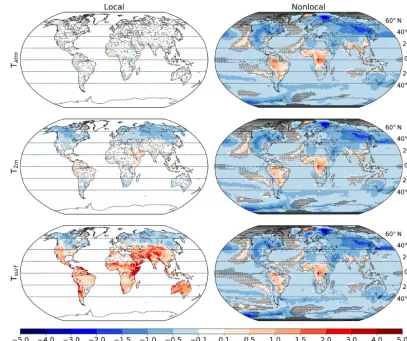
In the MPI-ESM, deforestation in three of four grid boxes triggers substantial nonlocal cooling in most regions (Fig. 1). This happens because deforestation locally reduces the in-put of latent and sensible heat from the surface to the at-mosphere (Winckler et al., 2019a). Thus, the atat-mosphere becomes cooler and drier (not shown), and this leads to a reduction in Tsurf in many regions, mainly because of
re-duced longwave incoming radiation (Davin and de Noblet-Ducoudré, 2010; Winckler et al., 2019a). The spatial pattern of these nonlocal effects is very similar for Tsurf,T2 m, and
Tatm.
In contrast to the nonlocal effects, the local effects differ strongly betweenTsurf,T2 m, andTatm. Deforestation strongly
influences the local surface energy balance: the imposed changes in surface properties in the model (surface albedo, evapotranspirative efficiency and surface roughness) cause a surface warming for the local effects in most regions, except for the high northern latitudes where the local effects cause a surface cooling (Fig. 1). The changes in surface properties influence not only the localTsurfbut also the flux of
sensi-ble heat from the surface into the lower boundary layer (not shown). Intuitively one would expect that the change in sen-sible heat flux altersTatm; e.g., an increased input of
sensi-ble heat into the atmosphere could raise the temperature of the atmospheric air above a deforested location. However, in our model resultsTatmis largely unaffected by the local
ef-fects of deforestation (Fig. 1). We interpret this lack of local effects inTatm as follows: it takes long enough for the
low-est atmospheric layer to warm up (due to the deforlow-estation- deforestation-induced increase in sensible heat flux) for the heated air to be transported to higher atmospheric layers and the neighboring grid boxes. Due to the advection, the change inTatmis hence
not only seen in a deforested location but also in nearby grid boxes that are not deforested. Thus, this warming or cooling is accounted for in the nonlocal effects. In the nearby grid boxes, the change inTatm and/or atmospheric moisture can
then also influenceTsurfvia changes in longwave incoming
radiation (Davin and de Noblet-Ducoudré, 2010; Winckler et al., 2019a), which could explain why the nonlocal effects are similar forTatm andTsurf. While inTatm, advection can
lead to a direct exchange of heat between neighboring grid cells, the same is not possible forTsurf; there is no direct
hor-izontal exchange of heat between the surface of neighbor-ing grid cells, and this difference (advection forTatmbut not
Tsurf) may explain why local effects can be seen inTsurfbut
not inTatm.
BecauseT2 m is an interpolation betweenTsurfandTatm,
we expected that the local response ofT2 m would also lie
in between the response of Tsurf and Tatm. In a lot of
re-gions this is the case, but in other rere-gions, most notably those that show a cooling, the local effects onT2 m seem to cool
more thanTsurf, and in some regions even the sign differs
be-tween1 Tsurfand1 T2 m(e.g., parts of the US and regions in
the southern extratropics; Fig. S3). The different response of TsurfandT2 min relation to the observation-based findings is
discussed in Sect. 4.
To better understand the apparent discrepancy between 1 Tsurfand1 T2 m, we separately analyze the local
temper-ature response for boreal winter (DJF) and summer (JJA) and the response of mean daily minimum temperature (Tmin,
which approximately corresponds to nighttime conditions) and maximum temperature (Tmax, which approximately
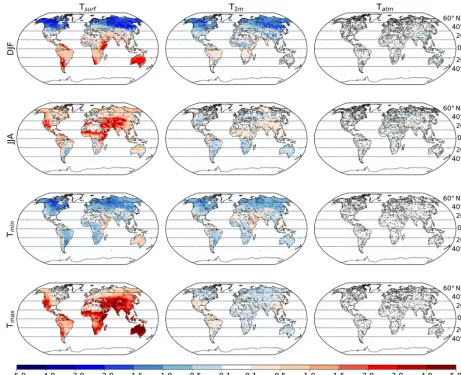
cor-responds to daytime conditions). ForTsurf, the response to
deforestation locally differs strongly between DJF, JJA,Tmin,
andTmaxvalues (Fig. 2). For Northern Hemisphere DJF and
Tmin, deforestation leads to a local Tsurf cooling, while for
JJA andTmax, deforestation leads to a localTsurfwarming.
This is qualitatively in good agreement with observation-based studies that show a local cooling in the boreal regions in DJF (Alkama and Cescatti, 2016; Bright et al., 2017; Du-veiller et al., 2018) and in agreement with the local increase in the diurnal amplitude due to deforestation (Li et al., 2015; Alkama and Cescatti, 2016; Schultz et al., 2017). Similarly as in the case of long-term mean temperature (Fig. 1),Tatm
Figure 1.The deforestation-induced annual mean response of temperature in the lowest atmospheric layer (Tatm), near-surface air (T2 m), and at the surface (Tsurf). Deforestation was applied to three of four grid boxes (Fig. S1). Stippling indicates where results are not statistically significant at a 5 % level for a Student’sttest accounting for lag-1 autocorrelation (Zwiers and von Storch, 1995). Zonal averages are shown in Fig. S2.
JJA,Tmin, norTmax(Fig. 2). For bothTsurfandT2 m, the
an-nual mean response then depends on the balance between the daytime and nighttime response and on the balance between the responses in different seasons.
For near-surface air temperature, theTmaxresponse is
sub-stantially weaker, and in many areas of opposite sign, than for the surface, similar to the lowest atmospheric layer (land mean absolute changes forTmax: 1.62 K forTsurf, 0.19 K for
T2 m, and 0.10 K forTatm). On the contrary, most regions
ex-hibit a strong Tmin cooling of T2 m, similar to the Tmin
re-sponse ofTsurf(land mean absolute changes forTmin: 0.67 K
forTsurf, 0.48 K forT2 m, and 0.10 K forTatm).
Tmaxresponds differently forTsurfandT2 mnot only for
an-nual meanTmax, but in some tropical or subtropical regions
also forTmaxduring DJF and JJA (Fig. S9). We interpret this
as follows: during the daytime whenTmaxoccurs, theTsurfis
higher than the temperature of the lowest atmospheric layer (Fig. S4) because the surface is heated by incoming radiation. In accordance with previous studies (e.g., Li et al., 2015), de-forestation further increases Tsurf (Fig. 2) and thus also the
difference betweenTsurf andTatm (illustrated in Fig. S5b).
Intuitively, one would expect that an increase in this dif-ference would result also in an increase in T2 m. But by
the increased surface temperature, the well-mixed zone in the boundary layer not only extends to larger heights, but also extends further down. Accordingly, the cooler air from above mixes further down, and if this affects heights below 2 m, T2 m is lowered. In the model’s calculation of T2 m, a
deforestation-induced increase inTsurf increases the
differ-ence betweenTatmandTsurfand thus leads to an even more
negative Richardson number Ri. This Richardson number
enters the similarity function for the calculation ofs2 m (γ
in Eq. 4; see underlying report; ECMWF Research Depart-ment, 1991) such that the vertical profile of s2 m becomes
more nonlinear and the calculatedT2 m approachesTatm. As
a result, daily maximumT2 min the model may decrease
al-thoughTsurfincreases.
During nighttime whenTminoccurs, the surface loses
Figure 2.Seasonal and diurnal temperature response to the local effects of deforestation, separately for boreal winter (DJF) and summer (JJA) and daily maximum (Tmax) and minimum temperature (Tmin). Stippling indicates where results are not statistically significant at a 5 % level for a Student’sttest accounting for lag-1 autocorrelation (Zwiers and von Storch, 1995).
accordance with previous studies (e.g., Schultz et al., 2017), deforestation further decreasesTsurfand thusTsurf andTatm
further diverge. ForT2 m, one expects that less vertical
mix-ing than durmix-ing the daytime results inT2 m tending towards
Tsurf. In the model’s calculation ofT2 m, this behavior is a
result of theγ in Eq. (4) being less nonlinear in stable com-pared to unstable conditions (for the concrete form of theγ function, see ECMWF Research Department, 1991) with the consequence thatT2 mat deforested locations stays closer to
Tsurfcompared to daytime conditions (Fig. S5a). As a result,
in most regions the calculatedT2 mfollows the
deforestation-induced nighttime surface cooling but not necessarily the deforestation-induced daytime surface warming.
The differentT2 mresponses for DJF and JJA in the model
may be caused by the same mechanism that may be respon-sible for the different behaviors for Tmin andTmax. In JJA,
when the surface is often warmer than the overlying atmo-sphere, deforestation leads to a further local Tsurf warming
(Fig. 2). Similar to the case ofTmax,T2 mbarely responds or
even responds with a cooling in some regions. In DJF, when the surface is often cooler than the overlying atmosphere, de-forestation leads to a localTsurfcooling. Similar to the case of
Tmin,T2 malso shows a substantial cooling in most Northern
Hemisphere regions. The reason whyT2 mresponds similarly
toTsurfin Northern Hemisphere DJF but not JJA may be
sim-ilar to the reason whyT2 mresponds similar toTsurfforTmin
but not forTmax, as described in the previous two paragraphs.
Our findings are in qualitative agreement with the findings of Meier et al. (2018) (their Fig. 9), who found a strong deforestation-induced daytimeTsurf warming and a
moder-ateT2 mcooling in many regions using the CLM (Community
Land Model). Whether or notTsurfandT2 mrespond similarly
to deforestation may strongly depend on howT2 m is
of TsurfandT2 m are compared across climate models from
CMIP5 in the following.
3.2 Different temperature response of surface temperature and air temperature across climate models
While the above results refer only to the MPI-ESM climate model, quantitatively the local effects onTsurfandT2 m also
differ in other climate models (Fig. 3). We analyze the lo-cal effects of historilo-cal deforestation and the average over midlatitude areas (40–60◦N) that have experienced intense deforestation (≥15 %) since 1860. We choose the northern midlatitudes for two reasons. (1) This is where most his-torical deforestation happened, and regions with intense de-forestation are required in the moving-window approach for isolating the local effects across models (see Sect. 2.3), and (2) the midlatitudes are a suitable test case because there the local effects onTsurfhave a different sign in the winter (DJF)
and summer season (JJA) (Fig. 2).
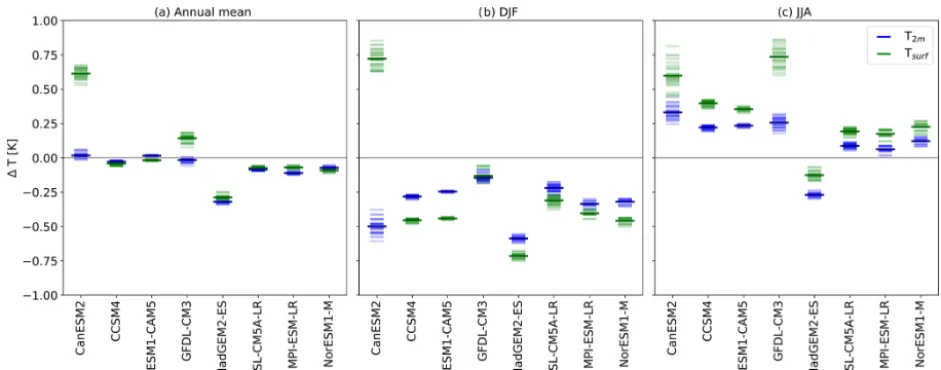
In the areas considered, in most models (with the excep-tion of CanESM2 and GFDL-CM3) TsurfandT2 m respond
similarly for changes in annual means (Fig. 3a). This is also true for the MPI-ESM – Tsurf and T2 m respond similarly
when averaged over the respective regions (midlatitude ar-eas (40–60◦N) that have experienced intense deforestation (≥15 %) since 1860). A difference in response betweenTsurf
andT2 mbecomes apparent also for the midlatitudes when
an-alyzing seasons (DJF and JJA separately) instead of annual means. Almost all of the tested models show substantial dif-ferences betweenTsurfandT2 mat a seasonal scale (Fig. 3b–
c).
In JJA (Fig. 3c), all but one model show a surface warm-ing locally, with theTsurfresponding more strongly thanT2 m
by a factor of around 2 (Table S1). Only the HadGEM2-ES climate model is an outlier: there,Tsurf responds to
de-forestation with a local cooling (−0.13 K), which is not in agreement with observation-based studies (Li et al., 2015; Alkama and Cescatti, 2016; Bright et al., 2017; Duveiller et al., 2018), and in the HadGEM2-EST2 mcools even more
strongly (−0.27 K) thanTsurf. This inter-model comparison
confirms that the local deforestation responses of Tsurfand
T2 mquantitatively differ strongly in JJA, but in contrast with
the MPI-ESM results shown above (Fig. 2), all models in Fig. 3 show the same sign of the JJA responses forTsurfand
T2 m.
In DJF (Fig. 3b), all but one model show a surface cool-ing locally, again withTsurfresponding stronger thanT2 min
most models. An exception is the CanESM2 model, which locally responds to deforestation with a strongTsurf
warm-ing and T2 m cooling. In some of the other climate
mod-els (CCSM4, CESM1-CAM5, NorESM1-M, all sharing the same land surface model CLM4), theTsurfcooling is
approx-imately twice the cooling of T2 m, analogous to the JJA
re-sponse. In other models (GFDL-CM3, HadGEM2-ES,
IPSL-CM5A-LR, MPI-ESM-LR), the two variables respond more similarly in DJF compared to JJA.
Overall, the inter-model comparison suggests that the quantitatively different response ofTsurfandT2 mis not
spe-cific to the MPI-ESM model. In agreement with previous studies (Pitman et al., 2009; Boisier et al., 2012; de Noblet-Ducoudré et al., 2012; Lejeune et al., 2017), the inter-model spread in the temperature response in Fig. 3 is large (e.g., in JJA inter-model (excluding the HadGEM2) standard de-viation 0.20 K, inter-model mean 0.38 K). However, the in-vestigated models agree better concerning the ratio between theT2 m andTsurfresponse (JJA inter-model (excluding the
HadGEM2) standard deviation 0.11, inter-model mean 0.50). Both for DJF and JJA (Table S1), and for most of the inves-tigated models, the ratio of changes inT2 m andTsurfof 0.5
(range 0.35–0.65, excluding HadGEM2) is largely indepen-dent of the magnitude and sign of theTsurfresponse. The
tem-perature response ofT2 m is between zero and the response
ofTsurfwith a ratio that depends on the exact way in which
T2 m is calculated in the respective models (but most likely
all models use a Monin–Obukhov approach). Further studies may investigate to what extent the calculation ofT2 mdiffers
across models.
4 Discussion and conclusions
This study shows that in climate models, surface temperature (Tsurf) and near-surface air temperature (T2 m) respond
differ-ently to deforestation. In the MPI-ESM, the nonlocal cooling in most regions (present also in locations that were not defor-ested) ofTsurfandT2 mis similar, while the local warming in
the tropics and cooling in the higher latitudes (present only in locations that were deforested) differs. In the northern mid-and high latitudes, the annual mean local cooling ofT2 mcan
be stronger than the local cooling ofTsurf, but in most regions
Tsurfresponds more strongly thanT2 m. Across most models,
the local effects of deforestation onTsurfandT2 min the
mid-latitudes differ by a factor of 2, for both local warming during summer and local cooling during winter.
This study illustrates that the conclusions concerning the effects of deforestation can depend on the considered tem-perature measure. The differences in magnitude and pattern between1 Tsurf(e.g., Li et al., 2015; Alkama and Cescatti,
2016; Duveiller et al., 2018) and 1 T2 m (e.g., Lee et al.,
2011; Zhang et al., 2014) obtained from observation-based studies largely agree with our findings (more cooling forT2 m
than forTsurfin the midlatitudes for the local effects in the
Figure 3. Local effects on near-surface air temperature (T2 m) and surface temperature (Tsurf) for CMIP5 models. Values are averaged over midlatitude areas (40–60◦N) that have experienced intense deforestation (≥15 %) since 1860. Positive values indicate a deforestation-induced warming. Each transparent marker denotes one combination of ensemble members from the historical and piControl experiments, respectively. The solid markers denote the mean values. The corresponding maps are shown in Figs. S6–S8. The local effects are isolated as in the study by Lejeune et al. (2018).
surface (Jin and Dickinson, 2010), satellite-based data sets usually report changes in radiometric surface temperature, which represents a combination of temperature at the top of the vegetation and the soil (through gaps in the canopy). Satellite-based direct estimates of air temperature (based on the intensity of upwelling microwave radiation from atmo-spheric oxygen) are available only for broad vertical layers of the atmosphere and at a coarse spatial scale (Von Engeln and Bühler, 2002). Instead of direct observations, air temperature was derived from surface temperature by empirical meth-ods (Alkama and Cescatti, 2016) or process-oriented models (i.e., by solving the surface energy budget) (Hou et al., 2013). More direct observational investigations on the effects of de-forestation on air temperature were based on recordings from weather stations and FLUXNET towers, which measure tem-perature at different heights. For instance, weather stations, e.g., in forest clearings, recorded temperatures at a height of between 1.2 and 2.0 m above ground level (WMO, 2008), while FLUXNET sites recorded temperatures typically 2– 15 m above forest canopies (Lee et al., 2011; Zhang et al., 2014). The different measurement height may lead to system-atic differences because of the steep vertical temperature pro-file that develops near the surface under stable atmospheric conditions (e.g., at night) especially over open land (Schultz et al., 2017). In contrast to satellite-based products, which are available at a high spatial resolution, the spatial distribution of FLUXNET towers and weather stations is biased toward developed countries and there is a relatively poor geograph-ical coverage of rural areas in developing countries where deforestation has occurred recently (Hansen et al., 2013). To perform a meaningful comparison, near-surface air temper-ature would have to be available at the same height above
canopy top (preferably multiple heights) for the various land cover types and with a good geographical coverage.
The comparison of deforestation effects in observations and climate models is even more challenging. First, the re-spective variables in the models are only a proxy of the vari-ables that were recorded in observation-based data sets (see Sect. 2.2 for the MPI-ESM). Second, model-based studies usually analyzed the combination of local and nonlocal ef-fects (especially relevant for simulations of large-scale de-forestation where the nonlocal effects can be large), while observation-based studies only analyzed local effects, for whichTsurfandT2 mrespond differently (Fig. 1). Any
nonlo-cal effects are excluded from the observations because pos-sible nonlocal effects are present both in forest locations and nearby open land, and thus the nonlocal effects can-cel out when looking at the difference between forests and open land, which is acknowledged by these studies (e.g., Li et al., 2015; Alkama and Cescatti, 2016; Bright et al., 2017; Duveiller et al., 2018). Note that Earth system models con-sider further climate effects when simulating deforestation-induced releases of land carbon into the atmosphere (e.g., Pongratz et al., 2010; Le Quéré et al., 2017). Because CO2is
a well-mixed greenhouse gas, the resulting warming can be expected to act essentially nonlocally and likely influences surface and air temperature similarly.
The different response of surface temperature (Tsurf) and
near-surface air temperature (T2 m) is relevant for climate
policies. Strategies that aim at adapting locally to warming air temperature may focus on perceived temperature and thus T2 m, but this study shows that the local effects onT2 mmay
substantially differ from those onTsurf. Our results for the
is particularly strong for mean daily maximum temperature (see Fig. 2). Further studies may investigate whether this is also true for other climate models and observation-based data sets. Consequently, strategies in the agricultural sector that aim at adapting locally to warming soil and canopy temper-atures may focus on the local effects on surface temperature because this variable is relevant for the organisms that live there. On the other hand, for international policies that aim at mitigating global warming, what matters is not only temper-ature at the location of deforestation but also in nearby and in remote regions. Thus, international policies may addition-ally consider the nonlocal effects. For the nonlocal effects, the responses of Tsurf andT2 m are rather similar (Fig. 1),
and a distinction between the two temperature measures is therefore less relevant. To sum up, this study emphasizes that the local biogeophysical effects of deforestation influence TsurfandT2 mdifferently, and thus, a careful choice based on
the respective application has to be made regarding whether a study should focus on changes in surface temperature or near-surface air temperature.
Data availability. Data, scripts used in the analysis, and other supporting information that may be useful in reproducing the authors’ work can be found here: http://hdl.handle.net/21.11116/ 0000-0002-CCA1-2 (Winckler et al., 2019b).
Supplement. The supplement related to this article is available online at: https://doi.org/10.5194/esd-10-473-2019-supplement.
Author contributions. JW, CHR, and JP designed the research; JW performed the simulations with the MPI-ESM, analyzed the data, and drafted the paper. All authors contributed to the interpre-tation of the data and revision of the paper.
Competing interests. The authors declare that they have no con-flict of interest.
Acknowledgements. Our simulations were performed at the German Climate Computing Center (DKRZ). We want to thank all groups who provided data for the inter-model comparison and Vivek Arora for discussions of the results for the CanESM2.
Financial support. This research was supported by the Deutsche Forschungsgemeinschaft (grant no. PO1751). Paul C. Stoy ac-knowledges support by the US National Science Foundation (grant nos. DEB-1552976 and EF-1702029).
The article processing charges for this open-access publication were covered by the Max Planck Society.
Review statement. This paper was edited by Somnath Baidya Roy and reviewed by four anonymous referees.
References
Alkama, R. and Cescatti, A.: Biophysical climate impacts of re-cent changes in global forest cover, Science, 351, 600–604, https://doi.org/10.1126/science.aac8083, 2016.
Bala, G., Caldeira, K., Wickett, M., Phillips, T. J., Lobell, D. B., Delire, C., and Mirin, A.: Combined climate and carbon-cycle effects of large-scale deforestation, P. Natl. Acad. Sci. USA, 104, 6550–6555, https://doi.org/10.1073/pnas.0608998104, 2007. Baldocchi, D.: How will land use affect air temperature in the
surface boundary layer? Lessons learned from a compara-tive study on the energy balance of an oak savanna and annual grassland in California, USA, Tellus B, 65, 19994, https://doi.org/10.3402/tellusb.v65i0.19994, 2013.
Bathiany, S., Claussen, M., Brovkin, V., Raddatz, T., and Gayler, V.: Combined biogeophysical and biogeochemical effects of large-scale forest cover changes in the MPI earth system model, Bio-geosciences, 7, 1383–1399, https://doi.org/10.5194/bg-7-1383-2010, 2010.
Boisier, J. P., de Noblet-Ducoudré, N., Pitman, A. J., Cruz, F. T., Delire, C., van den Hurk, B. J. J. M., van der Molen, M. K., Müller, C., and Voldoire, A.: Attributing the impacts of land-cover changes in temperate regions on surface temperature and heat fluxes to specific causes: Results from the first LU-CID set of simulations, J. Geophys. Res.-Atmos., 117, 1–16, https://doi.org/10.1029/2011JD017106, 2012.
Bonan, G. B.: Forests and climate change: forcings, feedbacks, and the climate benefits of forests, Science, 320, 1444–1449, https://doi.org/10.1126/science.1155121, 2008.
Bright, R. M., Davin, E. L., O’Halloran, T. L., Pongratz, J., Zhao, K., and Cescatti, A.: Local temperature re-sponse to land cover and management change driven by non-radiative processes, Nat. Clim. Change, 7, 296–302, https://doi.org/10.1038/nclimate3250, 2017.
Campbell, G. S. and Norman, J. M.: An Introduction to Environmental Biophysics, Springer-Verlag, New York, https://doi.org/10.1007/978-1-4612-1626-1, 1998.
Claussen, M., Brovkin, V., and Ganopolski, A.: Biogeophysical ver-sus biogeochemical feedbacks of large-scale land cover change, Geophys. Res. Lett., 28, 1011–1014, 2001.
Davin, E. L. and de Noblet-Ducoudré, N.: Climatic impact of global-scale deforestation: radiative ver-sus nonradiative processes, J. Climate, 23, 97–112, https://doi.org/10.1175/2009JCLI3102.1, 2010.
De Frenne, P., Zellweger, F., Rodríguez-Sánchez, F., Schef-fers, B. R., Hylander, K., Luoto, M., Vellend, M., Verheyen, K., and Lenoir, J.: Global buffering of temperatures under forest canopies, Nature Ecology & Evolution, 3, 744–749, https://doi.org/10.1038/s41559-019-0842-1, 2019.
de Noblet-Ducoudré, N., Boisier, J.-P., Pitman, A., Bonan, G. B., Brovkin, V., Cruz, F., Delire, C., Gayler, V., van den Hurk, B. J. J. M., Lawrence, P. J., van der Molen, M. K., Müller, C., Reick, C. H., Strengers, B. J., and Voldoire, A.: Determin-ing robust impacts of land-use-induced land cover changes on surface climate over North America and Eurasia: Results from the first set of LUCID experiments, J. Climate, 25, 3261–3281, https://doi.org/10.1175/JCLI-D-11-00338.1, 2012.
Deser, C., Knutti, R., Solomon, S., and Phillips, A. S.: Communication of the role of natural variability in future North American climate, Nat. Clim. Change, 2, 775–779, https://doi.org/10.1038/nclimate1562, 2012.
Devaraju, N., Bala, G., and Modak, A.: Effects of large-scale defor-estation on precipitation in the monsoon regions: Remote ver-sus local effects, P. Natl. Acad. Sci. USA, 112, 3257–3262, https://doi.org/10.1073/pnas.1423439112, 2015.
Duveiller, G., Hooker, J., and Cescatti, A.: The mark of vegetation change on Earth’s surface energy balance, Nat. Commun., 9, 1– 12, https://doi.org/10.1038/s41467-017-02810-8, 2018. ECMWF Research Department: Research Manual 3, ECMWF
fore-cast model, Physical parametrization, 3rd Edition, ECMWF, Reading, England, 1991.
Findell, K. L., Knutson, T. R., and Milly, P. C. D.: Weak simulated extratropical responses to complete tropical deforestation, J. Cli-mate, 19, 2835–2850, https://doi.org/10.1175/JCLI3737.1, 2006. Geleyn, J.-F.: Interpolation of wind, temperature and humidity val-ues from model levels to the height of measurement, Tellus 40A, 4, 347–351, 1988.
Gibbard, S., Caldeira, K., Bala, G., Phillips, T. J., and Wickett, M.: Climate effects of global land cover change, Geophys. Res. Lett., 32, 1–4, https://doi.org/10.1029/2005GL024550, 2005. Giorgetta, M. A., Roeckner, E., Mauritsen, T., Bader, J., Crueger,
T., Esch, M., Rast, S., Kornblueh, L., Schmidt, H., Kinne, S., Hohenegger, C., Möbis, B., Krismer, T., Wieners, K.-H., and Stevens, B.: The atmospheric general circulation model ECHAM6 – Model description, Tech. Rep. 135, Max-Planck-Institute for Meteorology, Hamburg, 2013.
Hansen, M. C., Potapov, P. V., Moore, R., Hancher, M., Tu-rubanova, S. A., and Tyukavina, A.: High-resolution global maps of 21st-century forest cover change, Science, 342, 850–853, https://doi.org/10.1126/science.1244693, 2013.
Hou, P., Chen, Y., Qiao, W., Cao, G., Jiang, W., and Li, J.: Near-surface air temperature retrieval from satellite images and influ-ence by wetlands in urban region, Theor. Appl. Climatol., 111, 109–118, https://doi.org/10.1007/s00704-012-0629-7, 2013. Jin, M. and Dickinson, R. E.: Land surface skin temperature
clima-tology: Benefitting from the strengths of satellite observations, Environ. Res. Lett., 5, 044004, https://doi.org/10.1088/1748-9326/5/4/044004, 2010.
Jones, A. D., Collins, W. D., and Torn, M. S.: On the additivity of radiative forcing between land use change and greenhouse gases, Geophys. Res. Lett., 40, 4036–4041, https://doi.org/10.1002/grl.50754, 2013.
Lague, M. and Swann, A.: Progressive Midlatitude Afforestation: Impacts on Clouds, Global Energy Transport, and Precipitation, J. Climate, 29, 5561–5573, https://doi.org/10.1175/JCLI-D-15-0748.1, 2016.
Leclerc, M. and Foken, T.: Footprints in Micromete-orology and Ecology, Springer Berlin Heidelberg, https://doi.org/10.1007/978-3-642-54545-0, 2014.
Lee, X., Goulden, M. L., Hollinger, D. Y., Barr, A., Black, T. A., Bohrer, G., Bracho, R., Drake, B., Goldstein, A., Gu, L., Katul, G., Kolb, T., Law, B. E., Margolis, H., Meyers, T., Monson, R., Munger, W., Oren, R., Paw U, K. T., Richardson, A. D., Schmid, H. P., Staebler, R., Wofsy, S., and Zhao, L.: Observed increase in local cooling effect of deforestation at higher latitudes, Nature, 479, 384–387, https://doi.org/10.1038/nature10588, 2011. Lejeune, Q., Seneviratne, S. I., and Davin, E. L.: Historical
land-cover change impacts on climate: Comparative assessment of LUCID and CMIP5 multimodel experiments, J. Climate, 30, 1439–1459, https://doi.org/10.1175/JCLI-D-16-0213.1, 2017. Lejeune, Q., Davin, E. L., Gudmundsson, L., Winckler, J., and
Seneviratne, S. I.: Historical deforestation increased the risk of heat extremes in northern mid-latitudes, Nat. Clim. Change, 8, 386–390, https://doi.org/10.1038/s41558-018-0131-z, 2018. Le Quéré, C., Andrew, R. M., Canadell, J. G., Sitch, S.,
Kors-bakken, J. I., Peters, G. P., Manning, A. C., Boden, T. A., Tans, P. P., Houghton, R. A., Keeling, R. F., Alin, S., Andrews, O. D., Anthoni, P., Barbero, L., Bopp, L., Chevallier, F., Chini, L. P., Ciais, P., Currie, K., Delire, C., Doney, S. C., Friedlingstein, P., Gkritzalis, T., Harris, I., Hauck, J., Haverd, V., Hoppema, M., Klein Goldewijk, K., Jain, A. K., Kato, E., Körtzinger, A., Land-schützer, P., Lefèvre, N., Lenton, A., Lienert, S., Lombardozzi, D., Melton, J. R., Metzl, N., Millero, F., Monteiro, P. M. S., Munro, D. R., Nabel, J. E. M. S., Nakaoka, S.-I., O’Brien, K., Olsen, A., Omar, A. M., Ono, T., Pierrot, D., Poulter, B., Röden-beck, C., Salisbury, J., Schuster, U., Schwinger, J., Séférian, R., Skjelvan, I., Stocker, B. D., Sutton, A. J., Takahashi, T., Tian, H., Tilbrook, B., van der Laan-Luijkx, I. T., van der Werf, G. R., Viovy, N., Walker, A. P., Wiltshire, A. J., and Zaehle, S.: Global Carbon Budget 2016, Earth Syst. Sci. Data, 8, 605–649, https://doi.org/10.5194/essd-8-605-2016, 2016.
Li, Y., Zhao, M., Motesharrei, S., Mu, Q., Kalnay, E., and Li, S.: Local cooling and warming effects of forests based on satellite observations, Nat. Commun., 6, 1–8, https://doi.org/10.1038/ncomms7603, 2015.
Li, Y., De Noblet-Ducoudré, N., Davin, E. L., Motesharrei, S., Zeng, N., Li, S., and Kalnay, E.: The role of spatial scale and background climate in the latitudinal temperature response to deforestation, Earth Syst. Dynam., 7, 167–181, https://doi.org/10.5194/esd-7-167-2016, 2016.
Luyssaert, S., Schulze, E.-D., Börner, A., Knohl, A., Hes-senmöller, D., Law, B. E., Ciais, P., and Grace, J.: Old-growth forests as global carbon sinks, Nature, 455, 213–215, https://doi.org/10.1038/nature07276, 2008.
Luyssaert, S., Marie, G., Valade, A., Chen, Y.-y., Djomo, S. N., Ryder, J., Otto, J., Naudts, K., Lansø, A. S., Ghat-tas, J., and Mcgrath, M. J.: Trade-offs in using European forests to meet climate objectives, Nature, 562, 259–262, https://doi.org/10.1038/s41586-018-0577-1, 2018.
land-use-change-induced heterogeneity on historical climate: Analysis with the GFDL Earth system model, J. Climate, 28, 5448–5469, https://doi.org/10.1175/JCLI-D-14-00586.1, 2015.
Meier, R., Davin, E. L., Lejeune, Q., Hauser, M., Li, Y., Martens, B., Schultz, N. M., Sterling, S., and Thiery, W.: Evaluating and im-proving the Community Land Model’s sensitivity to land cover, Biogeosciences, 15, 4731–4757, https://doi.org/10.5194/bg-15-4731-2018, 2018.
Melo-Aguilar, C., González-Rouco, J. F., García-Bustamante, E., Navarro-Montesinos, J., and Steinert, N.: Influence of radiative forcing factors on ground–air temperature coupling during the last millennium: implications for borehole climatology, Clim. Past, 14, 1583–1606, https://doi.org/10.5194/cp-14-1583-2018, 2018.
Pitman, A. J., de Noblet-Ducoudré, N., Cruz, F. T., Davin, E. L., Bonan, G. B., Brovkin, V., Claussen, M., Delire, C., Ganzeveld, L., Gayler, V., van den Hurk, B. J. J. M., Lawrence, P. J., van der Molen, M. K., Müller, C., Reick, C. H., Seneviratne, S. I., Strengers, B. J., and Voldoire, A.: Uncertainties in cli-mate responses to past land cover change: First results from the LUCID intercomparison study, Geophys. Res. Lett., 36, 1– 6, https://doi.org/10.1029/2009GL039076, 2009.
Pongratz, J., Reick, C. H., Raddatz, T., and Claussen, M.: A reconstruction of global agricultural areas and land cover for the last millennium, Global Biogeochem. Cy., 22, 1–16, https://doi.org/10.1029/2007GB003153, 2008.
Pongratz, J., Reick, C. H., Raddatz, T., and Claussen, M.: Biogeo-physical versus biogeochemical climate response to historical anthropogenic land cover change, Geophys. Res. Lett., 37, 1–5, https://doi.org/10.1029/2010GL043010, 2010.
Ramankutty, N. and Foley, J. A.: Estimating historical changes in global land cover: Croplands from 1700 to 1992, Global Bio-geochem. Cy., 13, 997–1027, 1999.
Schultz, N. M., Lawrence, P. J., and Lee, X.: Global satellite data highlights the diurnal asymmetry of the surface temperature re-sponse to deforestation, J. Geophys. Res.-Biogeo., 122, 903–917, https://doi.org/10.1002/2016JG003653, 2017.
Staiger, H., Laschewski, G., and Graetz, A.: The perceived temper-ature – a versatile index for the assessment of the human thermal environment. Part A: Scientific basics, Int. J. Biometeorol., 56, 165–176, https://doi.org/10.1007/s00484-011-0409-6, 2011. Stevens, B., Giorgetta, M., Esch, M., Mauritsen, T., Crueger, T.,
Rast, S., Salzmann, M., Schmidt, H., Bader, J., Block, K., Brokopf, R., Fast, I., Kinne, S., Kornblueh, L., Lohmann, U., Pin-cus, R., Reichler, T., and Roeckner, E.: Atmospheric component of the MPI-M Earth System Model: ECHAM6, J. Adv. Model. Earth Sy., 5, 146–172, https://doi.org/10.1002/jame.20015, 2013.
Swann, A. L. S., Fung, I. Y., and Chiang, J. C. H.: Mid-latitude afforestation shifts general circulation and tropi-cal precipitation, P. Natl. Acad. Sci. USA, 109, 712–716, https://doi.org/10.1073/pnas.1116706108, 2012.
Taylor, K. E., Stouffer, R. J., and Meehl, G. A.: An Overview of CMIP5 and the Experiment Design, B. Am. Meteorol. Soc., 93, 485–498, https://doi.org/10.1175/BAMS-D-11-00094.1, 2012. UNFCCC: The Cancun Agreements: Land use, land-use change and
forestry in Report of the Conference of the Parties serving as the meeting of the Parties to the Kyoto Protocol on its sixth session, United Nations Framework Convention on Climate Change (UN-FCCC), Cancun, 1–32, 2011.
Vanden Broucke, S., Luyssaert, S., Davin, E. L., Janssens, I., and Lipzig, N.: New insights in the capability of climate models to simulate the impact of LUC based on temperature decomposition of paired site observations, J. Geophys. Res.-Atmos., 120, 1–20, https://doi.org/10.1002/2015JD023095, 2015.
Von Engeln, A. and Bühler, S.: Temperature profile de-termination from microwave oxygen emissions in limb sounding geometry, J. Geophys. Res.-Atmos., 107, 1–15, https://doi.org/10.1029/2001JD001029, 2002.
Winckler, J., Reick, C. H., and Pongratz, J.: Robust identifi-cation of local biogeophysical effects of land-cover change in a global climate model, J. Climate, 30, 1159–1176, https://doi.org/10.1175/JCLI-D-16-0067.1, 2017.
Winckler, J., Reick, C. H., Lejeune, Q., and Pongratz, J.: Nonlocal effects dominate the global mean surface temperature response to the biogeophysical effects of deforestation, Geophys. Res. Lett., 46, 745–755, https://doi.org/10.1029/2018gl080211, 2019a. Winckler, J., Reick, C. H., Raddatz, T., Pongratz, J., Kauhs, C.:
Supplementary material and data for the manuscript ‘Differ-ent response of surface temperature and air temperature to de-forestation in climate models’, MPG Publication Repository, http://hdl.handle.net/21.11116/0000-0002-CCA1-2 (last access: July 2019), 2019b.
WMO: Guide to Meteorological Instruments and Methods of obser-vation, vol. I & II, World Meteorological Organization (WMO), Geneva, Switzerland, ISBN 978-92-63-100085, 2008.
Zhang, M., Lee, X., Yu, G., Han, S., Wang, H., Yan, J., Zhang, Y., Li, Y., Ohta, T., Hirano, T., Kim, J., Yoshifuji, N., and Wang, W.: Response of surface air temperature to small-scale land clearing across latitudes, Environ. Res. Lett., 9, 034002, https://doi.org/10.1088/1748-9326/9/3/034002, 2014.