POPULATION GENETICS, SELECTION, AND EVOLUTION
INTRODUCTION
A common misconception is that individuals evolve. While individuals may have favorable and heritable traits that are advantageous for survival and reproduction, the impact of selection is only apparent in the changes in phenotypes and genotypes observed in the population over time. The study of population genetics determines allele and genotype frequency distributions to deduce whether the population is evolving and, if it is, to what extent it is evolving. In 1908, two researchers independently derived the Hardy-Weinberg principle, which states that the allele and genotype frequencies in a population will remain constant from generation to generation only if Mendelian segregation and recombination of alleles are at work. If the major conditions of the Hardy-Weinberg principle are not met, then there is a departure from Hardy-Weinberg equilibrium, which indicates that the population is evolving.
In this hands-on activity, you will apply what you have learned about the Hardy-Weinberg principle and population genetics to understand how a deadly genetic disease—sickle cell disease—can be maintained in a population.
MATERIALS
• container for the parent population
• container of stock population beads:
100 beads of one color
100 beads of a second color
• calculator
• felt-tipped marking pen
•
colored pencils•
graph paper (optional)PROCEDURE
PART 1
1. The Hardy-Weinberg principle and its equations predict that frequencies of alleles and genotypes remain constant from generation to generation in populations that are not evolving. What five conditions does this prediction assume to be true about such a population?
a. _________________________________ d. _________________________________ b. _________________________________ e. _________________________________ c. _________________________________
2. Before beginning the activity, answer the following general Hardy-Weinberg problems for practice (assume that the population is at Hardy-Weinberg equilibrium).
a. If the frequency of a recessive allele is 0.3, what is the frequency of the dominant allele? ____________ b. If the frequency of the homozygous dominant genotype is 0.36, what is the frequency of the dominant allele?
____________
d. In a certain population, the dominant phenotype of a certain trait occurs 87% of the time. What is the frequency of the dominant allele? ____________
e. If the frequency of the homozygous dominant genotype is 0.49, what is the frequency of the homozygous recessive genotype? ____________
f. If the frequency of an autosomal recessive disease is 1 in 1,500 births, what are the allele and genotype frequencies in a population of 3,000?
p = _______ q = _______ p2 = _______ 2pq = _______ q2 = _______
PART 2
3. Watch the Howard Hughes Medical Institute’s short film The Making of the Fittest: Natural Selection in Humans. Pay close attention to the genetics of sickle cell disease and the connection to malaria infection.
From the film, you learned that sickle cell disease is caused by a mutation in the gene that encodes hemoglobin. Hemoglobin, a protein found in red blood cells, transports oxygen throughout the body. Individuals who are homozygous for the normal hemoglobin allele are designated AA. Individuals who receive one normal hemoglobin allele from one parent and one mutant hemoglobin, or sickle cell, allele from the other parent are heterozygous and said to have sickle cell trait. Their genotype is AS. People with sickle cell disease are homozygous for the sickle cell allele (SS genotype).
4. Perform simulation 1, which examines the Hardy-Weinberg principle. a. Label a container “parent population.”
b. Designate one color of bead as “allele A” and the other color as “allele S.” Write this information below. (Example:
A = red, S = white) Allele A _________ Allele S _________
c. From the stock population container, select 15 individuals homozygous for normal hemoglobin (AA). Place them in the parent population container. Be sure to count one bead per allele per individual. For example, in this step you need 30 beads of the allele A color.
d. From the stock population container, select 30 individuals heterozygous for sickle cell trait (AS). Place them in the parent population container. (Be sure to count one bead per allele.)
e. From the stock population container, select 15 individuals homozygous for sickle cell disease (SS). Place them in the parent population container. (Be sure to count one bead per allele.)
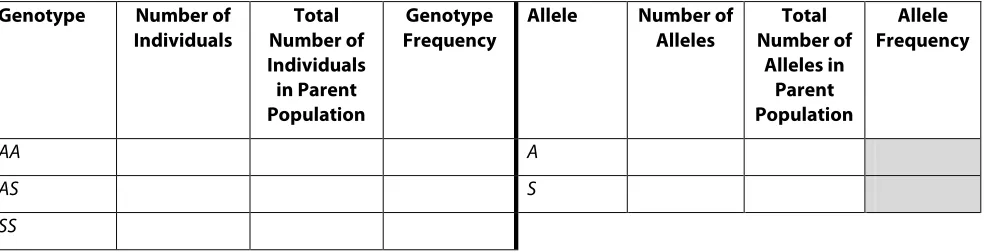
f. Record the number of individuals with each genotype in this population in Table 1.1. For example, there are 15
AA individuals.
g. Count the number of alleles (A and S) in this population. Record this information in Table 1.1. For example, there should be 60 allele A beads in the parent population.
Table 1.1. Parent Population
Genotype Number of
Individuals Number of Total
Individuals in Parent Population
Genotype
Frequency Allele Number of Alleles Number of Total
Alleles in Parent Population
Allele Frequency
AA A
AS S
SS
i. Using the allele frequencies from Table 1.1 (allele frequencies of A and S in the shaded boxes), use the Hardy-Weinberg equation to calculate the expected frequencies of each genotype for the parent population. (Show your work.)
p2 = _______ 2pq = _______ q2 = _______
As you can see, the observed genotype frequencies (Table 1.1) and the expected genotype frequencies calculated using the Hardy-Weinberg equation (Step 4i) agree. This indicates that the parent population could be in Hardy-Weinberg equilibrium.
If the population is in Hardy Weinberg equilibrium, each subsequent generation should maintain the genotype and allele frequencies calculated above.
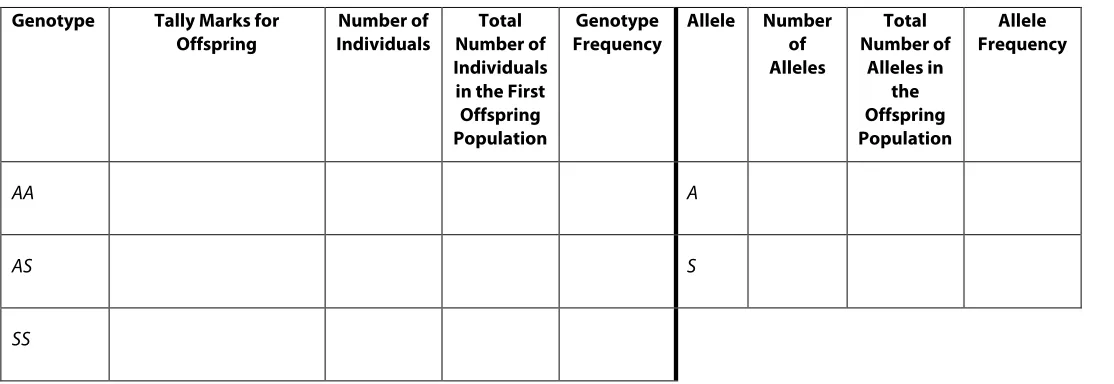
j. For this simulation, assume that the A and S alleles have no selective advantage or disadvantage; they each survive 100% of the time. Using the parent population established in Steps 4c–4e, simulate random mating of individuals in the population by randomly selecting two beads (alleles) from the parent population container. These two beads represent the first offspring. Determine the genotype of the individual by looking at the color of the two beads. Record the genotype of this individual by entering a tally mark in Table 1.2 under “tally marks for offspring.” Once you have entered the result, return the two beads (alleles) to the parent population container and mix.
k. Repeat Step 4j until 60 offspring are produced.
l. Convert the tally marks to numbers and record the result in the “number of individuals” column. Next, calculate the genotype frequencies based on the number of individuals you recorded and the total population. Record the calculations in Table 1.2.
m. Calculate the number of alleles. You need to count each allele (bead) in the population. For example, in order to calculate the number of As, use the following equation:
(number of AA× 2) + (number of AS× 1).
Table 1.2. First Generation of Offspring
Genotype Tally Marks for
Offspring Individuals Number of Number of Total
Individuals in the First Offspring Population
Genotype
Frequency Allele Number of
Alleles
Total Number of
Alleles in the Offspring Population
Allele Frequency
AA A
AS S
SS
n. The Hardy-Weinberg principle predicts that the genotype frequencies of the offspring will be the same as those of the parent population if the population is not evolving. Were the allele and genotype frequencies that you calculated in the parent population and in the first generation of offspring the same? _____ (yes or no)
i. If yes, then the population is said to be at ___________________________________, and all five conditions were followed.
If no, then at least one of the conditions of the Hardy-Weinberg principle was violated. In this simulation, which condition or conditions were violated?
______________________________________________________________________________________ ______________________________________________________________________________________ ii. If a million more offspring were produced from this parent population, predict how the genotype and allele
frequencies would compare with the frequencies calculated in Table 1.1.
______________________________________________________________________________________ ______________________________________________________________________________________
5. Perform simulation 2 to examine a 100% negative selection pressure.
a. In the parent population container, establish the same population that you used in simulation 1, Table 1.1. b. For this simulation, assume that the SS genotype represents individuals who have sickle cell disease. Sickle cell
disease is a lethal disease caused by a genetic mutation. In East Africa, children born with sickle cell disease often die. In this simulation, we assume that sickle cell disease is 100% selected against. This means that all children born with this disease die before reproductive age and do not pass their genes on to the next generation. c. Using the same mixing and selecting procedure as in simulation 1, produce offspring from this population by
randomly picking two alleles to represent an individual offspring. If the offspring is AA or AS, place a tally mark in Table 2.1 in the appropriate genotype row. Return the alleles to the population and mix. If the offspring is SS, do
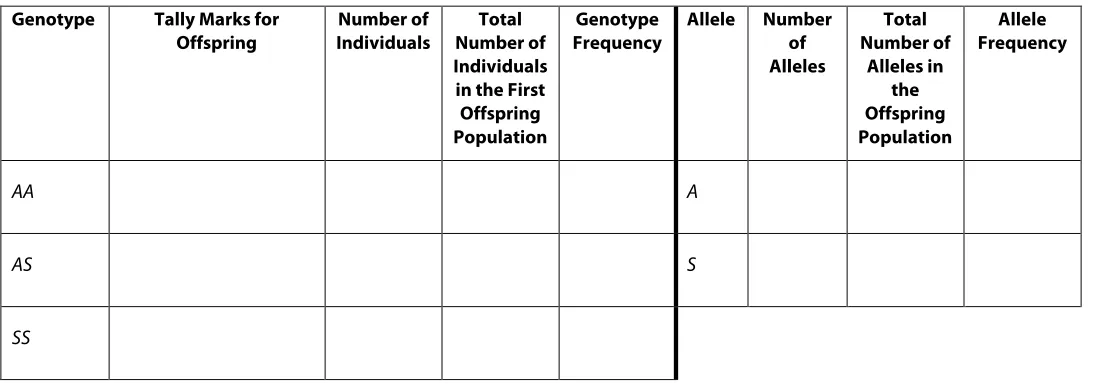
d. Calculate the genotype frequencies for this first population of offspring directly from the number of individuals you recorded in Steps 5b and 5c. Record the calculations in Table 2.1. If you need help, refer back to simulation 1. e. Calculate the number of alleles and the allele frequencies. Remember, to calculate the number of alleles, you
need to count each allele (bead) in the population. Refer to calculations provided in simulation 1 if needed. Record the calculations in Table 2.1.
Table 2.1. First Generation of Offspring
Genotype Tally Marks for
Offspring Individuals Number of Number of Total
Individuals in the First Offspring Population
Genotype
Frequency Allele Number of
Alleles
Total Number of
Alleles in the Offspring Population
Allele Frequency
AA A
AS S
SS
f. In order to produce the next generation of offspring, change the number of beads in the parent container to reflect the gene pool of the first generation of offspring (Table 2.1). In other words, the number of alleles (beads) in the parent container should match the numbers calculated in Table 2.1 (“number of alleles”). For example, if the number of alleles in Table 2.1 were A = 76 and S = 44, place 76 beads of allele A and 44 beads of allele S into the container. You may need to obtain more beads from the stock population.
g. Repeat Steps 5b and 5c above to produce the second generation of 60 offspring. Tally the results and fill in Table 2.2.
Table 2.2. Second Generation of Offspring
Genotype Tally Marks for
Offspring Individuals Number of Number of Total
Individuals in the First Offspring Population
Genotype
Frequency Allele Number of
Alleles
Total Number of
Alleles in the Offspring Population
Allele Frequency
AA A
AS S
h. You began simulation 2 with the same parent population as in simulation 1. What were the frequencies of the A
and S alleles of the parent population in simulation 1?
A = _______ S = ________
In simulation 2, what happened to the frequency of the sickle cell allele (S) with each successive generation of offspring? Explain your observation.
__________________________________________________________________________________________ __________________________________________________________________________________________ i. In simulation 2, was the change in frequency of the sickle cell allele (S) from the parent generation to the first generation of offspring similar to the change from the first generation to the second generation of offspring? Explain your answer.
__________________________________________________________________________________________ __________________________________________________________________________________________ j. Do the genotype frequencies of the parent population equal the genotype frequencies calculated in Table 2.2?
___________ (yes or no)
k. Is this population at Hardy-Weinberg (genetic) equilibrium? ___________ (yes or no) Explain your response. __________________________________________________________________________________________ __________________________________________________________________________________________ l. If this population is not at Hardy-Weinberg equilibrium, which Hardy-Weinberg condition or conditions were
violated in simulation 2?
___________________________________________________________________________________________ ___________________________________________________________________________________________ ___________________________________________________________________________________________ 6. Perform simulation 3, which examines heterozygous advantage.
a. Establish the same parent population that you used in simulation 1.
b. Using the same mixing and selecting procedure as in simulation 1, produce offspring from this population by randomly picking two alleles to represent an individual offspring. Follow the instructions below.
i. If the offspring is AS, place a tally mark in Table 3.1, return the alleles to the population, and mix. Individuals who are AS have two genetic advantages: they do not have sickle cell disease and they are resistant to malaria infection. Therefore, in this simulation, sickle cell trait (the heterozygous state) is selected for, and individuals with the AS genotype survive 100% of the time.
ii. If the offspring is AA, place a tally mark every other time one of these individuals is selected. You will need to develop a system to keep track of this 50:50 chance of survival. Individuals with the AA genotype do not have sickle cell disease but are more susceptible to malaria. This simulation models a 50% selection against this trait: people with the AA genotype have a 50% chance of surviving and passing on their genes to the next generation of offspring.
iii. If the offspring is SS, do not place a tally mark in the table; simply return the alleles to the population and mix as you did in simulation 2. The SS genotype represents individuals who have sickle cell disease. Sickle cell disease is a lethal disease caused by a genetic mutation. In East Africa, children born with sickle cell disease often die. We assume that sickle cell disease is 100% selected against. This means that all children born with this disease die before reproductive age.
c. In order to keep the population size consistent from generation to generation, you must repeat Step 6b until 60 viable offspring have been produced (the tally marks should total 60). Record the tallies and calculate the frequencies in Table 3.1.
Table 3.1. First Generation of Offspring
Genotype Tally Marks for
Offspring Individuals Number of Number of Total
Individuals in the First Offspring Population
Genotype
Frequency Allele Number of
Alleles
Total Number of
Alleles in the Offspring Population
Allele Frequency
AA A
AS S
SS
d. In order to produce the next generation, change the number of beads in the parent container to reflect the gene pool of the first generation of offspring, as you did in simulation 2. In other words, the number of alleles (beads) in the parent container should match the number calculated in Table 3.1 (“number of alleles”). Again, you can obtain more alleles from the stock population if you need them.
e. Repeat Steps 6b and 6c to produce the second generation of 60 offspring. Record the tallies and calculate the frequencies in Table 3.2.
Table 3.2. Second Generation of Offspring
Genotype Tally Marks for
Offspring Individuals Number of Number of Total
Individuals in the First Offspring Population
Genotype
Frequency Allele Number of
Alleles
Total Number of
Alleles in the Offspring Population
Allele Frequency
AA A
AS S
f. What happened to the frequency of the sickle cell allele (S) with each successive generation? Remember to refer to the parent population established in simulation 1 when interpreting your data.
________________________________________________________________________________________ ________________________________________________________________________________________ g. Was the change in the frequency of the sickle cell allele (S) from the parent population to the first generation of
offspring the same as the change from the first to the second generation of offspring? Explain your answer. ________________________________________________________________________________________ ________________________________________________________________________________________ h. Do the genotype frequencies of the parent population equal the genotype frequencies calculated in Tables 3.1
and 3.2? ___________ (yes or no)
i. Is this population at Hardy-Weinberg equilibrium? ____________ (yes or no) Explain your answer. ________________________________________________________________________________________ ________________________________________________________________________________________ j. If this population is not at equilibrium, which Hardy-Weinberg condition or conditions were violated in this
simulation?
_________________________________________________________________________________________ _________________________________________________________________________________________
QUESTIONS
From the simulations, it is easy to see that natural selection can alter the frequency distribution of heritable traits. Using the information and data from the simulations, along with your knowledge from the film, complete the following analysis questions.
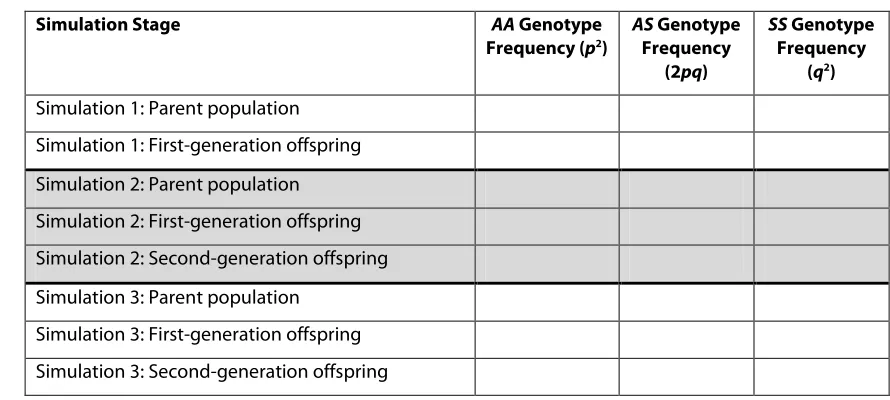
1. From the tables in all three simulations, record the calculated genotype frequencies in Table 4.1 below.
Table 4.1. Genotype Frequencies for All Simulations
Simulation Stage AA Genotype
Frequency (p2)
AS Genotype
Frequency (2pq)
SS Genotype
Frequency (q2)
Simulation 1: Parent population Simulation 1: First-generation offspring Simulation 2: Parent population Simulation 2: First-generation offspring Simulation 2: Second-generation offspring Simulation 3: Parent population
2. Using colored pencils and the graphing grids provided below, sketch a bar graph representing genotype frequencies in each generation for all three simulations. Clearly and neatly label the axes and the bars with their respective variables. You may want to sketch practice graphs on another piece of paper, or on graph paper if your teacher provides it, before drawing your final graphs here.
3. You collected data from simulation 2 over five generations. The frequency of the S allele over time is graphed below. The graph shows a rapid decrease in the sickle cell allele frequency in the first generation but a slower decrease in later generations. By the fifth generation, the allele is not completely eliminated from the population.
Provide two explanations for why the S allele persists after five generations.
____________________________________________________________________________________________ ____________________________________________________________________________________________ ____________________________________________________________________________________________ 4. If you continued both simulation 2 and simulation 3 for three more generations (up to five generations), do you
predict that the frequency of the S allele in simulation 2 would be greater, less than, or equal to the S allele frequency in simulation 3? Explain your answer.
____________________________________________________________________________________________ ____________________________________________________________________________________________ ____________________________________________________________________________________________ ____________________________________________________________________________________________ 5. Which simulation might represent a population of people who live in the moist lowlands of East Africa? Use data to
explain why you chose this simulation.
____________________________________________________________________________________________ ____________________________________________________________________________________________ ____________________________________________________________________________________________ ____________________________________________________________________________________________ 6. Which simulation might represent a population of people living in a remote village in the dry highlands of Africa? Use data to explain why you chose this simulation.
____________________________________________________________________________________________ ____________________________________________________________________________________________ ____________________________________________________________________________________________ ____________________________________________________________________________________________ 7. Design a simulation that models equal selection for the two homozygous genotypes and selection against the heterozygous genotype. Start with the original parent population as established in Table 1.1. Design your simulation to have 60 parents and 60 offspring in each successive generation. Feel free to vary the survival percentage of particular genotypes, as in simulation 3; however, be sure to incorporate selection for the two homozygous genotypes and selection against the heterozygous genotype. Explain your simulation in the space provided.
Design
Predicted Data
Based on 60 offspring in each generation, predict the number of offspring of each genotype in each generation of the simulation you designed. Use the table below to record your predictions.
Predicted of Number of Offspring Per Genotype Per Generation
Genotype Initial Number of
Individuals in the Parent Population
Predicted Number of First-Generation
Offspring
Predicted Number of Second-Generation
Offspring
Predicted Number of Third-Generation
Offspring
AA 15
AS 30
SS 15
Using the predicted genotype numbers above, count the number of each allele found in each generation. Example: parent population A allele calculation = (AA× 2) + AS = (15 × 2) + 30 = 60 A alleles
Number of Alleles in Each Generation
Allele Initial Number of
Alleles in the Parent Population
Predicted Number of Alleles in the First
Generation of Offspring
Predicted Number of Alleles in the Second
Generation of Offspring
Predicted Number of Alleles in the Third
Generation of Offspring
A 60
S 60
Calculated Frequencies
Using the predicted numbers above, calculate the genotype and allele frequencies to illustrate how the frequencies will change over the three generations of offspring.
Genotype and Allele Frequency Changes over Three Generations
Genotype Initial Parent
Population Frequencies Predicted First-Generation Frequencies Predicted Second-Generation Frequencies Predicted Third-Generation Frequencies
AA 0.25
AS 0.50
SS 0.25
Allele
A 0.50
Explanation
a. How do the genotype frequencies change over time? Be sure to address all three genotypes.
_________________________________________________________________________________________________ _________________________________________________________________________________________________ _________________________________________________________________________________________________ b. How do the allele frequencies change over time? Address both alleles.
_________________________________________________________________________________________________ _________________________________________________________________________________________________ _________________________________________________________________________________________________ c. Based on how you designed this simulation, explain why these changes in allele and genotype frequencies make
sense in terms of selection and evolution.
_________________________________________________________________________________________________ _________________________________________________________________________________________________ _________________________________________________________________________________________________ _________________________________________________________________________________________________ _________________________________________________________________________________________________ _________________________________________________________________________________________________
AUTHOR