1
LIFESPAN DEVELOPMENT
A Psychological Perspective Second Edition
2
Lifespan Development: A Psychological Perspective
Second Edition
By Martha Lally and Suzanne Valentine-French (Published 2019)
This Open Education Resource (OER) textbook was funded by a grant from the
College of Lake County Foundation and supported by the Business and Social
Sciences Division.
This textbook can be found at:
http://dept.clcillinois.edu/psy/LifespanDevelopment.pdf
Publication is under the following license:
3
Table of Contents
Chapter 1: Introduction to Lifespan Development
Chapter 2: Heredity, Prenatal Development, and Birth
Chapter 3: Infancy and Toddlerhood
Chapter 4: Early Childhood
Chapter 5: Middle and Late Childhood
Chapter 6: Adolescence
Chapter 7: Emerging and Early Adulthood
Chapter 8: Middle Adulthood
Chapter 9: Late Adulthood
4
Table of Contents
Chapter 1: Introduction to Lifespan Development ... 9
Lifespan Perspective ... 10
Conceptions of Age ... 13
Periods of Development... 14
Issues in Lifespan Development ... 16
Historical Theories on Development ... 17
Contemporary Theories on Development ... 18
Descriptive Research ... 24
Correlational Research ... 26
Experimental Research ... 28
Research Involving Time-Spans ... 29
Conducting Ethical Research ... 32
References ... 33
Chapter 2: Heredity, Prenatal Development, and Birth... 35
Heredity ... 35
Genotypes and Phenotypes ... 36
Genetic Disorders ... 37
Chromosomal Abnormalities ... 39
Behavioral Genetics ... 41
Prenatal Development ... 43
The Germinal Period ... 43
The Embryonic Period ... 44
The Fetal Period ... 45
Prenatal Brain Development ... 47
Teratogens ... 47
Maternal Factors ... 53
Prenatal Assessment ... 57
Complications of Pregnancy ... 59
Preparation for Childbirth ... 60
Stages of Birth for Vaginal Delivery ... 61
Assessing the Neonate ... 63
Problems of the Newborn ... 63
Postpartum Maternal Concerns ... 65
References ... 65
Chapter 3: Infancy and Toddlerhood ... 71
The Brain in the First Two Years ... 72
Infant Sleep ... 74
From Reflexes to Voluntary Movements ... 77
Motor Development ... 78
Sensory Capacities ... 79
Nutrition ... 82
Global Considerations and Malnutrition ... 84
Piaget and the Sensorimotor Stage ... 85
Language ... 89
Components of Language ... 90
Language Developmental Progression ... 91
5
Temperament ... 97
Infant Emotions ... 99
Forming Attachments ... 101
Erikson: Trust vs. Mistrust ... 102
Mary Ainsworth and the Strange Situation Technique ... 102
Erikson: Autonomy vs. Shame and Doubt ... 106
Measuring Infant Development ... 106
References ... 106
Chapter 4: Early Childhood ... 115
Brain Maturation ... 116
Motor Skill Development... 117
Toilet Training ... 119
Sleep ... 119
Sexual Development in Early Childhood ... 120
Nutritional Concerns ... 121
Piaget’s Preoperational Stage ... 123
Vygotsky’s Sociocultural Theory of Cognitive Development ... 126
Information Processing ... 127
Attention ... 127
Memory ... 128
Neo-Piagetians ... 130
Children’s Understanding of the World ... 131
Language Development ... 133
Bilingualism ... 134
Preschool ... 135
Autism Spectrum Disorder ... 136
Erikson: Initiative vs. Guilt ... 139
Self-Concept and Self-Esteem ... 139
Self-Control ... 140
Gender ... 140
Theories of Gender Development ... 141
Transgender Children ... 142
Parenting Styles ... 143
Spanking ... 145
Sibling Relationships ... 146
Play ... 147
Children and the Media ... 149
Child Care ... 150
Child Abuse... 151
Adverse Childhood Experiences (ACEs) ... 152
References ... 155
Chapter 5: Middle and Late Childhood ... 164
Physical Development ... 164
Sports ... 165
Childhood Obesity ... 168
Concrete Operational Thought ... 170
Information Processing ... 172
Language Development ... 174
6
Theories of Intelligence ... 175
Measuring Intelligence: Standardization and the Intelligence Quotient ... 179
Extremes of Intelligence: Intellectual Disability and Giftedness ... 181
Education ... 183
Cultural Differences in the Classroom ... 184
Children with Disabilities ... 187
Children with Disabilities: Legislation ... 191
Erikson: Industry vs. Inferiority ... 193
Self-Understanding ... 193
Kohlberg’s Stages of Moral Development ... 194
Friends and Peers ... 196
Bullying ... 199
Family Life... 200
References ... 205
Chapter 6: Adolescence ... 215
Growth in Adolescence... 215
Sexual Development ... 216
Adolescent Brain ... 219
Adolescent Sleep ... 221
Adolescent Sexual Activity ... 222
Eating Disorders ... 223
Piaget’s Formal Operational Stage ... 225
Information Processing ... 227
Education ... 228
School Based Preparatory Experiences ... 230
Teenagers and Working ... 230
Teenage Drivers ... 231
Self-concept and Self-esteem in Adolescence ... 233
Erikson: Identity vs. Role Confusion... 233
Parents and Teens: Autonomy and Attachment ... 237
Peers ... 238
Romantic Relationships ... 239
References ... 240
Chapter 7: Emerging and Early Adulthood ... 246
Emerging Adulthood Defined ... 246
Cultural Variations ... 248
When Does Adulthood Begin? ... 249
Young Adults Living Arrangements ... 250
The Physiological Peak... 251
Obesity ... 252
A Healthy, But Risky Time ... 254
Gender ... 257
Sexuality ... 258
Beyond Formal Operational Thought: Postformal Thought ... 265
Education ... 266
Career Development and Employment ... 268
Sexism ... 270
Temperament and Personality in Adulthood ... 274
7
Relationships with Parents and Siblings ... 279
Erikson: Intimacy vs. Isolation ... 280
Factors influencing Attraction ... 280
Friendships ... 281
Love ... 281
Adult Lifestyles ... 283
Intimate Partner Abuse ... 291
Parenthood ... 293
References ... 295
Chapter 8: Middle Adulthood ... 307
Physical Changes ... 308
Sensory Changes ... 309
Health Concerns ... 311
Digestive Issues ... 319
Sleep ... 319
Exercise, Nutrition, and Weight ... 321
Climacteric ... 324
The Climacteric and Sexuality ... 327
Brain Functioning ... 328
Crystalized versus Fluid Intelligence... 329
Middle Adults Returning to Education ... 331
Gaining Expertise: The Novice and the Expert... 332
Work at Midlife ... 333
Leisure ... 336
Midlife Crisis? ... 338
Stress ... 339
Erikson: Generativity vs Stagnation ... 344
Midlife Relationships ... 345
Middle Adult Lifestyles ... 348
Grandparents ... 352
Friendships ... 354
Women in Midlife ... 356
Religion and Spirituality ... 356
References ... 358
Chapter 9: Late Adulthood ... 371
Late Adulthood in America ... 371
The "Graying" of the World ... 372
Life Expectancy vs Lifespan ... 373
Gender Differences in Life Expectancy ... 375
Age Categories in Late Adulthood ... 377
Theories of Aging ... 380
Physical Changes of Aging ... 383
Sensory Changes in Late Adulthood ... 385
Nutrition ... 390
Chronic Conditions ... 390
Brain Functioning ... 394
Sleep ... 396
Sexuality ... 397
8
Memory ... 399
Attention and Problem Solving... 401
Intelligence and Wisdom ... 403
Neurocognitive Disorders ... 404
Work, Retirement, and Leisure ... 407
Ageism ... 411
Living Arrangements ... 412
Erikson: Integrity vs. Despair ... 414
Generativity in Late Adulthood ... 414
Social Networks in Late Adulthood ... 416
Late Adult Lifestyles ... 418
Gay and Lesbian Elders ... 421
Elder Abuse ... 422
Substance Abuse and the Elderly ... 423
Successful Aging ... 424
References ... 425
Chapter 10: Death and Dying ... 438
Death Defined... 439
Most Common Causes of Death ... 440
Suicide ... 443
Fatal Drug Overdoses ... 446
Where do People Die? ... 447
Developmental Perceptions of Death and Death Anxiety ... 448
Curative, Palliative, and Hospice Care ... 449
Family Caregivers ... 451
Advanced Directives ... 452
Cultural Differences in End-of-Life Decisions ... 452
Euthanasia ... 454
Religious Practices after Death ... 455
Green Burial ... 456
Grief, Bereavement, and Mourning ... 457
Models of Grief ... 458
Grief: Loss of Children and Parents ... 460
Mourning ... 462
References ... 463
9
Chapter 1: Introduction to Lifespan Development
Developmental Psychology, also known as Human Development or Lifespan Development, is the scientific study of ways in which people change, as well as stay the same, from conception to death. You will no doubt discover in the course of studying that the field examines change across a broad range of topics. These include physical and other psychophysiological processes,
cognition, language, and psychosocial development, including the impact of family and peers. Originally concerned with infants and
children, the field has expanded to include adolescence and more recently, aging and the entire life span. Previously, the message was once you are 25, your development is
essentially completed. Our academic knowledge of the lifespan has changed, and although there is still less research on adulthood than on childhood, adulthood is gaining increasing attention. This is particularly true now that the large cohort known as the “baby boomers” are beginning to enter late adulthood. The assumption that early childhood experiences dictate our future is also being called into question. Rather, we have come to appreciate that growth and
change continues throughout life and experience continues to have an impact on who we are and how we relate to others. We now recognize that adulthood is a dynamic period of life marked by continued cognitive, social, and psychological development.
You will also discover that developmental psychologists investigate key questions, such as whether children are qualitatively different from adults or simply lack the experience that adults draw upon. Other issues that they deal with is the question of whether development occurs through the gradual accumulation of knowledge or through shifts from one stage of thinking to another, or if children are born with innate knowledge or figure things out through experience, and whether development is driven by the social context or something inside each child. From the above explanation, you may be thinking already that developmental psychology is related to other applied fields. You are very right. The field informs several applied fields in psychology, including, educational psychology, psychopathology, and forensic developmental psychology. It also complements several other basic research fields in psychology including social psychology, cognitive psychology, and comparative psychology. Lastly, it draws from the theories and research of several scientific fields including biology, sociology, health care, nutrition, and anthropology.
Figure 1.1
10
Lifespan Perspective
Paul Baltes identified several underlying principles of the lifespan perspective (Baltes, 1987; Baltes, Lindenberger, & Staudinger, 2006).
Development is lifelong. Lifespan theorists believe that development is life-long, and change is apparent across the lifespan. No single age period is more crucial, characterizes, or dominates human development. Consequently, the term lifespan development will be used throughout the textbook.
Development is multidirectional. Humans change in many directions. We may show gains in some areas of development, while showing losses in other areas. Every change, whether it is finishing high school, getting married, or becoming a parent, entails both growth and loss.
Development is multidimensional. We change across three general domains/dimensions; physical, cognitive, and psychosocial. The physical domain includes changes in height and weight, sensory capabilities, the nervous system, as well as the propensity for disease and illness. The cognitive domain encompasses the changes in intelligence, wisdom, perception, problem-solving, memory, and language. The psychosocial domainfocuses on changes in emotion, self-perception and interpersonal relationships with families, peers, and friends. All three domains influence each other. It is also important to note that a change in one domain may cascade and prompt changes in the other domains. For instance, an infant who has started to crawl or walk will encounter more objects and people, thus fostering developmental change in the child’s understanding of the physical and social world.
Development is multidisciplinary. As mentioned at the start of the chapter, human
development is such a vast topic of study that it requires the theories, research methods, and knowledge base of many academic disciplines.
Development is characterized by plasticity. Plasticityis all about our ability to change and that many of our characteristics are malleable. For instance, plasticity is illustrated in the brain’s ability to learn from experience and how it can recover from injury.
Development is multicontextual. Development occurs in many contexts. Baltes (1987) identified three specific contextual influences.
Learning Objectives: Lifespan Perspective
• Explain the lifespan perspective and its assumptions about development.
• Differentiate periods of human development.
• Explain the issues underlying lifespan development
11
• Normative age-graded influences: An age-gradeis a specific age group, such as toddler, adolescent, or senior. Humans in a specific age-grade share particular experiences and developmental changes.
• Normative history-graded influences: The time period in which you are born (see Table 1.1) shapes your experiences. A cohort is a group of people who are born at roughly the same period in a particular society. These people travel through life often
experiencing similar circumstances.
• Non-normative life influences: Despite sharing an age and history with our peers, each of us also has unique experiences that may shape our development. A child who loses his/her parent at a young age has experienced a life event that is not typical of the age group.
Another context that influences our lives is our social standing, socioeconomic status, or social class. Socioeconomic status (SES)is a way to identify families and households based on their shared levels of education, income, and occupation. While there is certainly individual variation, members of a social class tend to share similar lifestyles, patterns of consumption, parenting styles, stressors, religious preferences, and other aspects of daily life. All of us born into a class system are socially located, and we may move up or down depending on a combination of both socially and individually created limits and opportunities.
Families with higher socioeconomic status usually are in occupations (e.g., attorneys, physicians, executives) that not only pay better, but also grant them a certain degree of freedom and control over their job. Having a sense of autonomy or control is a key factor in experiencing job satisfaction, personal happiness, and ultimately health and well-being (Weitz, 2007). Those families with lower socioeconomic status are typically in occupations that are more routine, more heavily supervised, and require less formal education. These occupations are also more subject to job disruptions, including lay-offs and lower wages.
Poverty levelis an income amount established by the federal government that is based on a set of income thresholds that vary by family size (United States Census Bureau, 2016). If a family’s income is less than the government threshold, that family is considered in poverty. Those living at or near poverty level may find it extremely difficult to sustain a household with this amount of income. Poverty is associated with poorer health and a lower life expectancy due to poorer diet, less healthcare, greater stress, working in more dangerous occupations, higher infant mortality rates, poorer prenatal care, greater iron deficiencies, greater difficulty in school, and many other problems. Members of higher income status may fear losing that status, but the poor may have greater concerns over losing housing.
Table 1.1 Which generation (cohort) are you?
Generation Born between …
Silent Generation 1928 and 1945 Baby Boomers 1946 and 1964 Generation X 1965 and 1980 Millennials 1981-1996 Generation Z 1997-Present
12
Today we are more aware of the
variations in development and the impact that culture and the environment have on shaping our lives. Cultureis the totality of our shared language, knowledge, material objects, and behavior. It includes ideas about what is right and wrong, what to strive for, what to eat, how to speak, what is valued, as well as what kinds of emotions are called for in certain situations. Culture teaches us how to live in a society and allows us to advance because each new generation can benefit from the solutions found and passed down from previous
generations. Culture is learned from parents, schools, houses of worship, media, friends and others throughout a lifetime. The kinds of traditions and
values that evolve in a particular culture serve to help members function and value their own society. We tend to believe that our own culture’s practices and expectations are the right ones. This belief that our own culture is superior is called ethnocentrism and is a normal by-product of growing up in a culture. It becomes a roadblock, however, when it inhibits
understanding of cultural practices from other societies. Cultural relativityis an appreciation for cultural differences and the understanding that cultural practices are best understood from the standpoint of that particular culture.
Culture is an extremely important context for human development and understanding development requires being able to identify which features of development are culturally based. This understanding is somewhat new and still being explored. Much of what
developmental theorists have described in the past has been culturally bound and difficult to apply to various cultural contexts. The reader should keep this in mind and realize that there is still much that is unknown when comparing development across cultures.
Lifespan vs. Life expectancy: At this point you must be wondering what the difference between lifespan and life expectancy is, according to developmentalists. Lifespan, or longevity, refers to the length of time a species can exist under the most optimal conditions. For instance, the grey wolf can live up to 20 years in captivity, the bald eagle up to 50 years, and the Galapagos tortoise over 150 years (Smithsonian National Zoo, 2016). The longest recorded lifespan for a human was Jean Calment who died in 1994 at the age of 122 years, 5 months, and 14 days (Guinness World Records, 2016). Life expectancyis the predicted number of years a person born in a particular time period can reasonably expect to live (Vogt & Johnson, 2016).
Figure 1.2
Source
13
Conceptions of Age
How old are you? Chances are you would answer that question based on the number of years since your birth, or what is called yourchronological age. Ever felt older than your
chronological age? Some days we might “feel” like we are older, especially if we are not feeling well, are tired, or are stressed out. We might notice that a peer seems more emotionally mature than we are, or that they are physically more capable. So years since birth is not the only way we can conceptualize age.
Biological age: Another way developmental researchers can think about the concept of age is to examine how quickly the body is aging, this is yourbiological age. Several factors determine the rate at which our body ages. Our nutrition, level of physical activity, sleeping habits, smoking, alcohol consumption, how we mentally handle stress, and the genetic history of our ancestors, to name but a few.
Psychological age: Our psychologically adaptive capacity compared to others of our chronological age is our psychological age. This includes our cognitive capacity along with our emotional beliefs about how old we are. An individual who has cognitive
impairments might be 20 years of age, yet has the mental capacity of an 8-year-old. A 70- year-old might be travelling to new countries, taking courses at college, or starting a new business. Compared to others of our age group, we may be more or less adaptive and excited to meet new challenges. Remember you are as young or old as you feel.
Social age: Our social ageis based on the social norms of our culture and the expectations our culture has for people of our age group. Our culture often reminds us whether we are “on target” or “off target” for reaching certain social milestones, such as completing our education, moving away from home, having children, or retiring from work. However, there have been arguments that social age is becoming less relevant in the 21st century (Neugarten, 1979; 1996). If you look around at your fellow students in your courses at college you might notice more people who are older than the more traditional aged college students, those 18 to 25. Similarly, the age at which people are moving away from the home of their parents, starting their careers, getting married or having children, or even whether they get married or have children at all, is changing.
Those who study lifespan development recognize that chronological age does not completely capture a person’s age. Our age profile is much more complex than this. A person may be
physically more competent than others in their age group, while being psychologically immature. So, how old are you?
Figure 1.3 You are as young as you feel!
14
Periods of Development
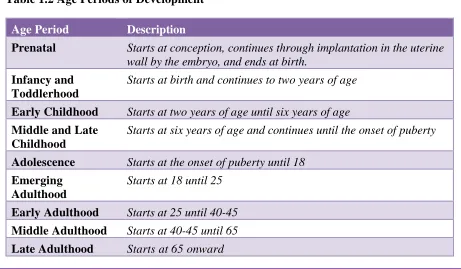
Table 1.2 reflects unique aspects of the various stages of childhood and adulthood that will be explored in this book. So, while both an 8-month old and an 8-year-old are considered children, they have very different motor abilities, social relationships, and cognitive skills. Their
nutritional needs are different and their primary psychological concerns are also distinctive. The same is true of an 18-year-old and an 80-year-old, as both are considered adults.
Prenatal Development: Conception occurs and development begins. All of the major structures of the body are forming, and the health of the mother is of primary concern. Understanding nutrition, teratogens, or environmental factors that can lead to birth defects, and labor and delivery are primary concerns.
Infancy and Toddlerhood: The first two years of life are ones of dramatic growth and change. A newborn, with a keen sense of hearing but very poor vision, is transformed into a walking, talking toddler within a relatively short period of time. Caregivers are also transformed from someone who manages feeding and sleep
schedules to a constantly moving guide and safety inspector for a mobile, energetic child.
Early Childhood: This period is also referred to as the preschool years and consists of the years which follow toddlerhood and precede formal schooling. As a two to six-year-old, the child is
Figure 1.4
Source
Table 1.2 Age Periods of Development
Age Period Description
Prenatal Starts at conception, continues through implantation in the uterine wall by the embryo, and ends at birth.
Infancy and Toddlerhood
Starts at birth and continues to two years of age
Early Childhood Starts at two years of age until six years of age
Middle and Late Childhood
Starts at six years of age and continues until the onset of puberty
Adolescence Starts at the onset of puberty until 18
Emerging Adulthood
Starts at 18 until 25
Early Adulthood Starts at 25 until 40-45
Middle Adulthood Starts at 40-45 until 65
15
busy learning language, is gaining a sense of self and greater independence, and is beginning to learn the workings of the physical world.
Middle and Late Childhood: The ages of six to the onset of puberty comprise middle and late childhood, and much of what children experience at this age is connected to their involvement in the early grades of school. Now the world becomes one of learning and testing new academic skills and by assessing one’s abilities and accomplishments by making comparisons between self and others.
Adolescence: Adolescence is a period of dramatic physical change marked by an overall growth spurt and sexual maturation, known aspuberty. It is also a time of cognitive change as the adolescent begins to think of new possibilities and to consider abstract concepts such as love, fear, and freedom. Ironically, adolescents have a sense of invincibility that puts them at greater risk of dying from accidents or contracting sexually transmitted infections that can have lifelong consequences.
Emerging Adulthood: The period of emerging adulthood is a transitional time between the end of adolescence and before individuals acquire all the benchmarks of adulthood. Continued identity exploration and preparation for full independence from parents are demonstrated.
Although at one’s physiological peak, emerging adults are most at risk for involvement in violent crimes and substance abuse.
Early Adulthood: The twenties and thirties are identified as early adulthood. Intimate relationships, establishing families, and work are primary concerns at this stage of life.
Middle Adulthood: The forties through the mid-sixties is referred to as middle adulthood. This is a period in which aging becomes more noticeable and when many people are at their peak of productivity in love and work.
Late Adulthood: Late adulthood is sometimes
subdivided into two categories: The young-old who are from 65-84 years and the oldest-old who are 85 years and older. One of the primary differences between these groups is that the young-old are still relatively healthy, productive, active, and the majority continue to live independently. With both age groups the risks of diseases such as, arteriosclerosis, cancer, and cerebral vascular disease increases substantially.
Figure 1.5
16
Issues in Lifespan Development
Nature and Nurture: Why are you the way you are? As you consider some of your features (height, weight, personality, being diabetic, etc.), ask yourself whether these features are a result of heredity or environmental factors, or both. Chances are, you can see the ways in which both heredity and environmental factors (such as lifestyle, diet, and so on) have contributed to these features. For decades, scholars have carried on the "nature/nurture" debate. For any particular feature, those on the side of naturewould argue that heredity plays the most important role in bringing about that feature. Those on the side of nurturewould argue that one's environment is most significant in shaping the way we are. This debate continues in all aspects of human
development, and most scholars agree that there is a constant interplay between the two forces. It is difficult to isolate the root of any single behavior as a result solely of nature or nurture.
Continuity versus Discontinuity: Is human development best characterized as a slow, gradual process, or is it best viewed as one of more abrupt change? The answer to that question often depends on which developmental theorist you ask and what topic is being studied. The theories of Freud, Erikson, Piaget, and Kohlberg are called stage theories. Stage theoriesor discontinuous development assume that developmental change often occurs in distinct stages that are qualitatively different from each other, and in a set, universal sequence. At each stage of development, children and adults have different qualities and characteristics. Thus, stage theorists assume development is more discontinuous. Others, such as the behaviorists,
Vygotsky, and information processing theorists, assume development is a more slow and gradual process known ascontinuous development. For instance, they would see the adult as not possessing new skills, but more advanced skills that were already present in some form in the child. Brain development and environmental experiences contribute to the acquisition of more developed skills.
Active versus Passive: How much do you play a role in your own developmental path? Are you at the whim of your genetic inheritance or the environment that surrounds you? Some theorists see humans as playing a much more active role in their own development. Piaget, for instance believed that children actively explore their world and construct new ways of thinking to explain the things they experience. In contrast, many behaviorists view humans as being more passive in the developmental process.
Figure 1.6
The tree represents continuous development, while the ladybug represents discontinuous/stage development.
17
Stability versus Change: How similar are you to how you were as a child? Were you always as out-going or reserved as you are now? Some theorists argue that the personality traits of adults are rooted in the behavioral and emotional tendencies of the infant and young child. Others disagree, and believe that these initial tendencies are modified by social and cultural forces over time.
Historical Theories on Development
Preformationist View: Well into the 18th century, children were merely thought of as little adults. Preformationism, or the belief that a tiny, fully formed human is implanted in the sperm or egg at conception and then grows in size until birth,
was the predominant early theory. Children were believed to possess all their sensory capabilities, emotions, and mental aptitude at birth, and as they developed these abilities unfolded on a predetermined schedule (Thomas, 1979). The environment was thought to play no role in determining development
.
John Locke (1632-1704): Locke, a British philosopher, refuted the idea of innate knowledge and instead proposed that children are largely shaped by their social environments, especially their education as adults teach them important knowledge. Hebelieved that through education a child learns socialization, or what is needed to be an
appropriate member of society. Locke advocated thinking of a child’s mind as a tabula rasaor blank slate, and whatever comes into the child’s mind comes from the environment. Locke
emphasized that the environment is especially powerful in the child’s early life because he considered the mind the most pliable then. Locke indicated that the environment exerts its effects through associations between thoughts and feelings, behavioral repetition, imitation, and rewards and punishments (Crain, 2005). Locke’s ideas laid the groundwork for the behavioral perspective and subsequent learning theories of Pavlov, Skinner and Bandura.
Jean-Jacques Rousseau (1712-1778): Like Locke, Rousseau also believed that children were not just little adults. However, he did not believe they were blank slates, but instead developed according to a natural plan which unfolded in different stages (Crain, 2005). He did not believe in teaching them the correct way to think, but believed children should be allowed to think by themselves according to their own ways and an inner, biological timetable. This focus on biological maturation resulted in Rousseau being considered the father of developmental psychology. Followers of Rousseau’s developmental perspective include Gesell, Montessori, and Piaget.
Arnold Gesell (1880-1961): Gesell spent 50 years at the Yale Clinic of Child Development, and with his colleagues he studied the neuromotor development of children. Gesell believed that the child’s development was activated by genes and he called this process maturation (Crain, 2005). Further, he believed that development unfolded in fixed sequences, and he opposed efforts to teach children ahead of schedule as he believed they will engage in behaviors when their nervous systems had sufficiently matured.
Figure 1.7
18
Sigmund Freud (1856-1939): Freud was a very influential figure in the area of development. Freud emphasized the importance of early childhood experiences in shaping our personality and behavior. In our natural state, we are biological beings and are driven primarily by instincts. During childhood, however, we begin to become social beings as we learn how to manage our instincts and transform them into socially
acceptable behaviors. His assumptions were that personality formed during the first few years of life. The ways in which parents or other caregivers interacted with children were assumed to have a long-lasting impact on children’s emotional states. His beliefs formed the psychodynamic perspective and his theories of psychosexual development and psychopathology dominated the field of psychiatry until the growth of
behaviorism in the 1950s.
However, Freud’s theory has been heavily criticized for several reasons. One is that it is very difficult to test scientifically (Crews, 1998). Freud suggested that much of what determines our actions were unknown to us, and as scientists we cannot measure these unconscious concepts. A second criticism is that Freud’s case studies were not validated and cannot be used as evidence for his theories. Many later theories, particularly behaviorism and humanism, came about as challenges to Freud’s views.
Contemporary Theories on Development
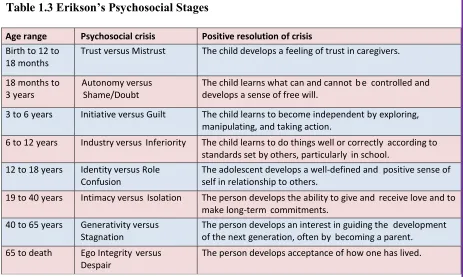
Erikson (1902-1994) and Psychosocial Theory: Now, let's turn to a less controversial psychodynamic theorist, Erik Erikson. Erikson presents eightdevelopmental stages that encompass the entire lifespan. For that reason, Erikson’s psychosocial theory forms the foundation for much of our discussion of psychosocial development. Erikson (1950) proposed a model of lifespan development that provides a useful guideline for thinking about the changes we
experience throughout life. Erikson broke with Freud’s emphasis on sexuality as the cornerstone of social-emotional development and instead suggested that social relationships fostered development. Erikson proposed that each period of life has a unique challenge or crisis that the person who reaches it must face, referred to as psychosocial crises. According to Erikson, successful development involves dealing with and resolving the goals and demands of each of these psychosocial crisesin a positive way. These crises are usually called stages, although that is not the term Erikson used. If a person does not resolve a stage successfully, it may hinder their ability to deal with later stages. For example, the person who does not develop a sense of trust (Erikson’s first stage) may find it challenging as an adult to form a positive intimate relationship (Erikson’s sixth stage). Or an individual who does not develop a clear sense of purpose and identity (Erikson’s fifth stage) may become self-absorbed and stagnate rather than work toward the betterment of others (Erikson’s seventh stage).
Figure 1.9
Erik Erikson Figure 1.8
19
However, most individuals are able to successfully complete the eight stages of his theory (See Table 1.3).
Erikson’s theory has been criticized for focusing so heavily on crises and assuming that the completion of one crisis is a prerequisite for the next crisis of development. His theory also focused on the social expectations that are found in certain cultures, but not in all. For instance, the idea that adolescence is a time of searching for identity might translate well in the middle-class culture of the United States, but not as well in cultures where the transition into adulthood coincides with puberty through rites of passage and where adult roles offer fewer choices.
Learning Theory: Also known as Behaviorism, is based on the premise that it is not possible to objectively study the mind, and therefore psychologists should limit their attention to the study of behavior itself. The most famous behaviorist was Burrhus Frederick (B. F.) Skinner (1904– 1990), who expanded the principles of behaviorism and also brought them to the attention of the public at large. Skinner used the ideas of stimulus and response, along with the application of rewards or reinforcements, to train pigeons and other animals. In addition, he used the general principles of behaviorism to develop theories about how best to teach children and how to create societies that were peaceful and productive (Skinner, 1957, 1968, 1972).
The behaviorists made substantial contributions to psychology by identifying the principles of learning. Although the behaviorists were incorrect in their beliefs that it was not possible to measure thoughts and feelings, their ideas provided new insights that helped further our
understanding regarding the nature-nurture debate as well as the question of free will. The ideas of behaviorism are fundamental to psychology and have been developed to help us better understand the role of prior experiences in a variety of areas of psychology.
Table 1.3 Erikson’s Psychosocial Stages
Age range Psychosocial crisis Positive resolution of crisis Birth to 12 to
18 months
Trust versus Mistrust The child develops a feeling of trust in caregivers.
18 months to
3 years
Autonomy versus Shame/Doubt
The child learns what can and cannot b e controlled and develops a sense of free will.
3 to 6 years Initiative versus Guilt The child learns to become independent by exploring, manipulating, and taking action.
6 to 12 years Industry versus Inferiority The child learns to do things well or correctly according to standards set by others, particularly in school.
12 to 18 years Identity versus Role Confusion
The adolescent develops a well-defined and positive sense of self in relationship to others.
19 to 40 years Intimacy versus Isolation The person develops the ability to give and receive love and to make long-term commitments.
40 to 65 years Generativity versus Stagnation
The person develops an interest in guiding the development of the next generation, often by becoming a parent.
65 to death Ego Integrity versus Despair
20
Social Learning Theory, or learning by watching others, was developed by Albert Bandura (1977). His theory calls our attention to the ways in which many of our actions are not learned through conditioning, as suggested by Skinner. Young children frequently learn behaviors
through imitation. Especially when children do not know what else to do, they learn by modeling or copying the behavior of others.
Bandura (1986) suggests that there is interplay between the environment and the individual. We are not just the product of our surroundings, rather we influence our surroundings. There is interplay between our personality and the way we interpret events and how they influence us. This concept is calledreciprocal determinism. An example of this might be the interplay between parents and children. Parents not only influence their child's environment, perhaps intentionally through the use of reinforcement, etc., but children influence parents as
well. Parents may respond differently with their first child than with their fourth. Perhaps they try to be the perfect parents with their firstborn, but by the time their last child comes along they have very different expectations, both of themselves and their child. Our environment creates us and we create our environment.
Other social influences: TV or not TV? Bandura, Ross and Ross (1963) began a series of studies to look at the impact of television on the behavior of children. Bandura began by conducting an experiment in which he showed children a film of a woman hitting an inflatable clown or “bobo” doll. Then the children were allowed in the room, where they found the doll and during their play they began to hit it. The children also demonstrated novel ways of being aggressive toward the doll that were not demonstrated by those children who did not see the aggressive model. Bandura’s
research raised concerns about the impact of violence on young children. Since then, considerable research has been conducted on the impact of violent media on children’s aggression including playing video games.
Cognitive Theory: The cognitive theoriesfocus on how our mental
processes or cognitions change over time. Three important theories are Jean Piaget’s, Lev Vygotsky’s, and Information-processing.
Jean Piaget (1896-1980) was one of the most influential cognitive theorists in development. He was inspired to explore children’s ability to think and reason by watching his own children’s development. He was one of the first to recognize and map out the ways in which children's intelligence differs from that of adults (Piaget, 1929). He became interested in this area when he was asked to test the IQ of children and began to notice that there was a pattern in their wrong answers. He believed that children's intellectual skills change over time and that maturation, rather than training, brings about that change. Children of differing ages interpret the world differently. Piaget theorized that children progressed through four stages of cognitive development (see Table 1.4).
Figure 1.10 The Bobo Doll
21
Piaget has been criticized for overemphasizing the role that physical maturation plays in cognitive development and in underestimating the role that culture and experience plays.
Looking across cultures reveals considerable variation in what children are able to do at various ages. Research has shown considerable overlap among the four stages and that development is more continuous.
Lev Vygotsky (1896-1934) was a Russian psychologist who wrote in the early 1900s, but whose work was not discovered by researchers in the United States until the 1960s and became more widely known in the 1980s (Crain, 2005). His sociocultural theoryemphasizes the importance of culture and interaction in the development of cognitive abilities. Vygotsky differed with Piaget in that he believed that a person not only has a set of abilities, but also a set of potential abilities that can be realized if given the proper guidance from others. Vygotsky developed theories on teaching that have been adopted by educators today.
Information Processingis not the work of a single theorist, but based on the ideas and research of several cognitive scientists studying how individuals perceive, analyze, manipulate, use, and remember information. This approach assumes that humans gradually improve in their
processing skills; that is, cognitive development is continuous rather than stage-like. The more complex mental skills of adults are built from the primitive abilities of children. We are born with the ability to notice stimuli, store, and retrieve information. Brain maturation enables advancements in our information processing system. At the same time, interactions with the environment also aid in our development of more effective strategies for processing information.
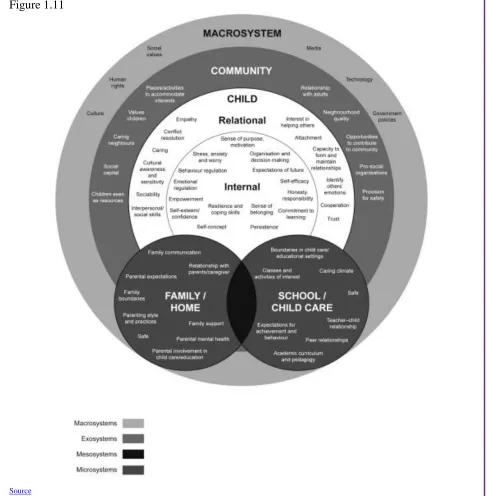
Urie Bronfenbrenner (1917-2005)developed the Ecological Systems Theory, which provides a framework for understanding and studying the many influences on human development
(Bronfenbrenner, 1979). Bronfenbrenner recognized that human interaction is influenced by
Table 1.4 Piaget’s Stages of Cognitive Development
Stage Approximate
age range
Characteristics Stage attainments
Sensorimotor Birth to about 2 years
Children experience the world through their fundamental senses of seeing, hearing, touching, and tasting.
Object permanence
Preoperational 2 to 7 years Children acquire the ability to internally represent the world through language and mental imagery. They also start to see the world from other people’s perspectives.
Theory of mind; rapid increase in language ability
Concrete operational
7 to 11 years Children become able to think logically. They can increasingly perform operations on objects that are real.
Conservation
Formal operational
11 years to adulthood
Adolescents can think systematically, can reason about abstract concepts, and can understand ethics and scientific reasoning.
22
larger social forces and that an understanding of these forces is essential for understanding an individual. The individual is impacted by several systems including:
o Microsystem includes the individual’s setting and those who have direct, significant contact with the person, such as parents or siblings. The input of those is modified by the cognitive and biological state of the individual as well. These influence the person’s actions, which in turn influence systems operating on him or her.
o Mesosystem includes the larger organizational structures, such as school, the family, or religion. These institutions impact the microsystems just described. The philosophy of the school system, daily routine, assessment methods, and other characteristics can affect the child’s self-image, growth, sense of accomplishment, and schedule thereby impacting the child, physically, cognitively, and emotionally.
o Exosystemincludes the larger contexts of community. A community’s values, history, and economy can impact the organizational structures it houses. Mesosystems both influence and are influenced by the exosystem.
o Macrosystemincludes the cultural elements, such as global economic conditions, war, technological trends, values, philosophies, and a society’s responses to the global community.
o Chronosystemis the historical context in which these experiences occur. This relates to the different generational time periods previously discussed, such as the baby boomers and millennials.
In sum, a child’s experiences are shaped by larger forces, such as the family, schools, religion, culture, and time period. Bronfenbrenner’s model helps us understand all of the different environments that impact each one of us simultaneously. Despite its comprehensiveness,
23
Figure 1.11
24
An important part of learning any science, including psychology, is having a basic knowledge of the techniques used in gathering information. The hallmark of scientific investigation is that of following a set of procedures designed to keep questioning or skepticism alive while describing, explaining, or testing any phenomenon. Science involves continuously renewing our
understanding of the subjects in question and an ongoing investigation of how and why events occur. The scientific methodis the set of assumptions, rules, and procedures scientists use to conduct research.
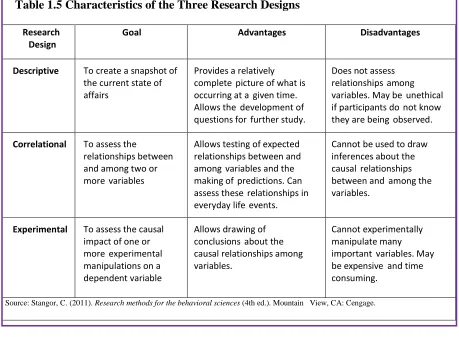
A research design is the specific method a researcher uses to collect, analyze, and interpret data. Psychologists use three major types of research designs in their research, and each provides an essential avenue for scientific investigation. Descriptive research is research that describes what is occurring at a particular point in time.Correlational research is research designed to discover relationships among variables and to allow the prediction of future events from present knowledge. Experimental research is research in which a researcher manipulates one or more variables to see their effects. Each of the three research designs varies according to its strengths and limitations.
Descriptive Research
Case Study: Sometimes the data in a descriptive research project are based on only a small set of individuals, often only one person or a single small group. These research designs are known as case studieswhich are descriptive records of one or a small group of individuals’
experiences and behavior. Sometimes case studies involve ordinary individuals. Developmental psychologist Jean Piaget observed his own children. More frequently, case studies are
conducted on individuals who have unusual or abnormal experiences. The assumption is that by carefully studying these individuals, we can learn something about human nature. Case studies have a distinct disadvantage in that, although it allows us to get an idea of what is currently happening, it is usually limited to static pictures. Although descriptions of particular
experiences may be interesting, they are not always transferable to other individuals in similar situations. They are also time consuming and expensive as many professionals are involved in gathering the information.
Observations: Another type of descriptive research is known as observation. When using
naturalistic observation, psychologists observe and record behavior that occurs in everyday settings. For instance, a developmental psychologist might watch children on a playground and
Learning Objectives: Research Methods
• Define the scientific method
• Compare research methods noting the advantages and disadvantages of each.
• Explain research involving time spans
25
describe what they say to each other. However, naturalistic observations do not allow the researcher to have any control over the environment.
Laboratory observation, unlike the naturalistic observation,is conducted in a setting created by the researcher. This permits the researcher to control more aspects of the situation. One example of laboratory observation involves a systematic procedure known as the strange situation test, which you will learn about in chapter three. Concerns regarding laboratory observations are that the participants are aware that they are being watched, and there is no guarantee that the behavior demonstrated in the laboratory will generalize to the real world.
Survey: In other cases, the data from descriptive research projects come in the form of asurvey, which isa measure administered through either a verbal or written questionnaire to get a picture of the beliefs or behaviors of a sample of people of interest. The people chosen to participate in the research, known as the sample, are selected to be representative of all the people that the researcher wishes to know about
called the population. A representative sample would include the same percentages of males, females, age groups, ethnic groups, and socio-economic groups as the larger population.
Surveys gather information from many individuals in a short period of time, which is the greatest benefit for surveys. Additionally, surveys are inexpensive to administer. However, surveys typically yield surface information on a wide variety of factors but may not allow for in-depth understanding of human behavior.Another problem is that respondents may lie because they want to present themselves in the most favorable light, known associal desirability. They also may be embarrassed to answer truthfully or are worried that their results will not be kept confidential. Additionally, questions can be perceived differently than intended.
Interviews: Rather than surveying participants, they can be interviewed which means they are directly questioned by a researcher. Interviewing participants on their behaviors or beliefs can solve the problem of misinterpreting the questions posed on surveys. The examiner can explain the questions and further probe responses for greater clarity and understanding. Although this can yield more accurate results, interviews take longer and are more expensive to administer than surveys. Participants can also demonstrate social desirability, which will affect the accuracy of the responses.
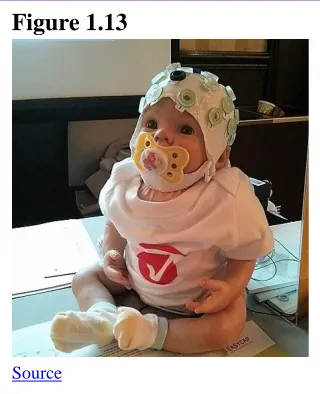
Psychophysiological Assessment: Researchers may also record psychophysiological data, such as measures of heart rate, hormone levels, or brain activity to help explain development. These measures may be recorded by themselves or in combination with behavioral data to better
understand the bidirectional relations between biology and behavior. Special equipment has been developed to allow researchers to record the brain activity of very young and very small research
Figure 1.12
How many surveys have you taken?
26
subjects. One manner of understanding associations between brain development and behavioral advances is through the recording of event-related potentials (ERPs). ERPs are recorded by fitting a research participant with a stretchy cap that contains many small sensors or electrodes. These electrodes record tiny electrical currents on the scalp of the participant in response to the presentation of stimuli, such as a picture or a sound.
The use of ERPs has provided important insight as to how infants and children understand the world around them. Webb, Dawson, Bernier, and Panagiotides (2006) examined face and object processing in children with autism spectrum disorders, those with developmental delays, and those who were typically developing. The children wore electrode caps and had their brain activity recorded as they watched still photographs of faces of their mother or of a stranger, and objects, including those that were familiar or unfamiliar to them. The researchers examined differences in face and object processing by group by observing a component of the brainwaves. Findings suggest that children with autism are in some way processing faces differently than typically developing children and those with more general developmental delays.
Secondary/Content Analysis involves analyzing information that has already been collected or examining documents or media to uncover attitudes, practices or preferences. There are a number of data sets available to those who wish to conduct this type of research. For example, the U. S. Census Data is available and widely used to look at trends and changes taking place in the United States. The researcher conducting secondary analysis does not have to recruit subjects, but does need to know the quality of the information collected in the original study.
Correlational Research
In contrast to descriptive research, which is designed primarily to provide static pictures, correlational research involves the measurement of two or more relevant variables and an assessment of the relationship between or among those variables. For instance, the variables of height and weight are systematically related (correlated) because taller people generally weigh more than shorter people.
ThePearson Correlation Coefficient, symbolized by the letter r, is the most common statistical measure of the strength of linear relationships among variables. The value of the correlation coefficient ranges fromr= –1.00 tor= +1.00. The strength of the linear relationship is indexed by the distance of the correlation coefficient from zero (its absolute value). For instance,r= –.54 is a stronger relationship thanr= .30, andr= .72 is a stronger relationship thanr= –.57. The direction of the linear relationship is indicated by the sign of the correlation coefficient. Positive values ofr(such asr= .54 orr= .67) indicate that the relationship is positive (i.e., the pattern of the dots on the scatter plot runs from the lower left to the upper right), whereas negative values
Figure 1.13
27
ofr(such asr= –.30 orr= –.72) indicate negative relationships (i.e., the dots run from the upper left to the lower right).
When the straight line indicates that individuals who have high values for one variable also tend to have high values for the other variable, as in part (a), the relationship is said to be a positive correlation. Examples of positive correlations include those between education and income, and between age and mathematical abilities in children. In each case people who score higher on one of the variables also tend to score higher on the other variable.Negative
correlations, in contrast, as shown in part (b), occur when high values for one variable tend to be associated with low values for the other variable. Examples of negative correlations include those
between the age of a child and the number of diapers the child uses, and between practice and errors made on a learning task. In these cases, people who score higher on one of the variables tend to score lower on the other variable.
An important limitation of correlational research designs is that they cannot be used to draw conclusions about the causal relationships among the measured variables. Consider, for instance, a researcher who has hypothesized that viewing violent behavior will cause increased aggressive play in children. He has collected, from a sample of fourth-grade children, a measure of how much violent television each child views during the week, as well as a measure of how
aggressively each child plays. The researcher discovers a positive correlation between the two measured variables. Although this positive correlation appears to support the hypothesis, it cannot be taken to indicate that viewing violent television causes aggressive behavior as there are other possible explanations. One alternative is that children who behaved aggressively at school want to watch violent television shows. Still another possible explanation for the observed correlation is that it has been produced by the presence of a third variable.
A third variableis a variable that is not part of the research hypothesis but produces the observed correlation between them. In our example a potential third variable is the discipline style of the children’s parents. Parents who use a harsh and punitive discipline style may produce children who both like to watch violent television and who behave aggressively in comparison to
children whose parents use less harsh discipline.
Figure 1.15 Figure 1.14
28
For this reason, we are left with the basic limitation of correlational research: Correlation does not demonstrate causation! It is important that when you read about correlational research projects, you keep in mind the possibility of third variables.
Strengths and limitations: Correlational research can be used when experimental research is not possible because the variables cannot be manipulated or it would be unethical to use an experiment. Correlational designs also have the advantage of allowing the researcher to study behavior as it occurs in everyday life. We can also use correlational designs to make predictions. For instance, we can predict from the scores on a battery of tests the success of job trainees during a training session. However, we cannot use such correlational information to determine whether one variable caused another variable. For that, researchers rely on an experiment.
Experimental Research
The goal of the experimental method is to provide more definitive conclusions about the causal relationships among the variables in a research hypothesis than what is available from
correlational research. Experimentsare designed to test hypotheses, or specific statements about the relationship between variables. Experiments are conductedin a controlled setting in an effort to explain how certain factors or events produce outcomes. A variable is anything that changes in value. In the experimental research design, the variables of interest are called the independent variable and the dependent variable. The independent variable in an experiment is the causing variable that is created or manipulated by the experimenter. The dependent variable in an experiment is a measured variable that is expected to be influenced by the experimental manipulation.
A good experiment randomly assigns participants to at least two groups that are compared.The
29
Research Involving Time-Spans
Cross-sectional researchcompares samples that represent a cross-section of the population who vary in age. Participants might be asked to complete a survey or take a test of some physical or cognitive skill. The attitudes or skill levels based on age are compared. In cross-sectional research, respondents are measured only once, and consequently this method is not expensive or time consuming. In addition, because participants are only tested at one point in time, practice effects are not an issue as children do not have the opportunity to become better at the task over time. There is also no need to keep in contact with, or follow-up with, participants over time.
However, cross-sectional research does not allow the researcher to look at the impact of having been born in a certain time-period, which is known as thecohort effect. For example, those born during the depression have very different views about and experiences with the internet than
Table 1.5 Characteristics of the Three Research Designs
Research Design
Goal Advantages Disadvantages
Descriptive To create a snapshot of the current state of affairs
Provides a relatively complete picture of what is occurring at a given time. Allows the development of questions for further study.
Does not assess relationships among variables. May be unethical if participants do not know they are being observed.
Correlational To assess the
relationships between and among two or more variables
Allows testing of expected relationships between and among variables and the making of predictions. Can assess these relationships in everyday life events.
Cannot be used to draw inferences about the causal relationships between and among the variables.
Experimental To assess the causal impact of one or more experimental manipulations on a dependent variable
Allows drawing of conclusions about the causal relationships among variables.
Cannot experimentally manipulate many important variables. May be expensive and time consuming.
Source: Stangor, C. (2011). Research methods for the behavioral sciences (4th ed.). Mountain View, CA: Cengage.
Figure 1.16 Cross-Sectional
30
those born in the last twenty years. Different attitudes about the Internet, for example, might not be due to a person’s biological age as much as their life experiences as members of a cohort.
Longitudinal researchinvolves studying a group of people who are the same age, and
measuring them repeatedly over a period-of-time. This type of design allows researchers to study individual differences in development. Longitudinal studies may be conducted over the short term, such as a span of months, or over much longer durations including years or decades. For these reasons, longitudinal research designs are optimal for studying stability and change over time.
Problems with longitudinal research include being very time consuming and expensive. Researchers must maintain continued contact with participants over time, and these studies necessitate that scientists have funding to conduct their work over extended durations. An additional risk is attrition. Attrition occurs when participants fail to complete all portions of a study. Participants may move, change their phone numbers, or simply become disinterested in participating over time. Researchers should account for the possibility of attrition by enrolling a larger sample into their study initially, as some participants will likely drop out over time. Even with a large sample size, the experimenter never knows if there was something different about the individuals who dropped out versus those that remained in the study.
The results from longitudinal studies may also be impacted by repeated assessments. Consider how well you would do on a math test if you were given the exact same exam every day for a week. Your performance would likely improve over time not necessarily because you developed better math abilities, but because you were continuously practicing the same math problems. This phenomenon is known as a practice effect. Practice effectsoccur when participants become better at a task over time because they have done it again and again; not due to natural psychological development.
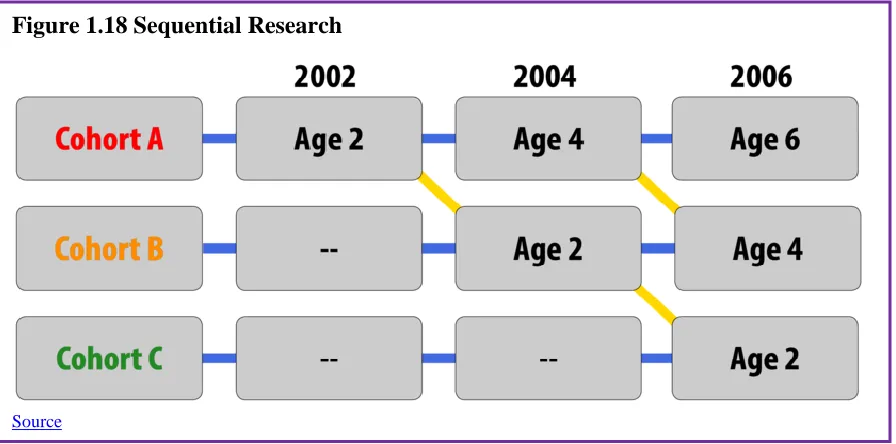
Sequential researchincludes elements of both longitudinal and cross-sectional research designs. Similar to longitudinal designs, sequential research features participants who are followed over time; similar to cross-sectional designs, sequential work includes participants of different ages. This research design is also distinct from those that have been discussed
previously in that individuals of different ages are enrolled into a study at various points in time
Figure 1.17 Longitudinal Research
31
to examine age-related changes, development within the same individuals as they age, and account for the possibility of cohort effects.
For example, in a study with a sequential design, a researcher might enroll three separate groups of children (Groups A, B, and C). Children in Group A would be enrolled when they are 2 years old and would be tested again when they are 4 and 6 years old. This is similar in design to the longitudinal study described previously. Children in Group B would also be enrolled when they are 2 years old, but this would occur two years later when Group A is now 4 years old. Finally, children in Group C would be enrolled when they are 2 years old and Group A is now 6 and Group B is now 4. At this time, the children would represent a cross-sectional design (2, 4, and 6 years of age). Further, along the diagonal children of the same age can be compared to
determine if cohort effects are evident. Sequential designs are appealing because they allow researchers to learn a lot about development in a relatively short amount of time.
Because they include elements of longitudinal and cross-sectional designs, sequential research has many of the same strengths and limitations as these other approaches. For example,
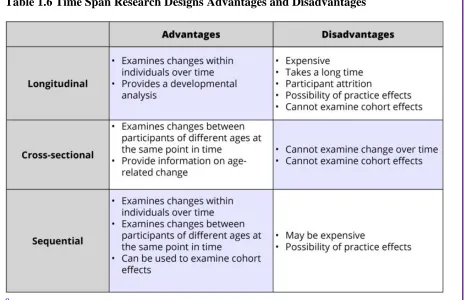
sequential work may require less time and effort than longitudinal research, but more time and effort than cross-sectional research. Although practice effects may be an issue if participants are asked to complete the same tasks or assessments over time, attrition may be less problematic than what is commonly experienced in longitudinal research since participants may not have to remain involved in the study for such a long period-of-time. Table 1.6 identifies advantages and disadvantages for each of the described time span research design.
Figure 1.18 Sequential Research
32
Conducting Ethical Research
One of the issues that all scientists must address concerns the ethics of their research. Research in psychology may cause some stress, harm, or inconvenience for the people who participate in that research. Psychologists may induce stress, anxiety, or negative moods in their participants, expose them to weak electrical shocks, or convince them to behave in ways that violate their moral standards. Additionally, researchers may sometimes use animals, potentially harming them in the process.
Decisions about whether research is ethical are made using established ethical codesdeveloped by scientific organizations, such as the American Psychological Association, and federal governments. In the United States, the Department of Health and Human Services provides the guidelines for ethical standards in research. The following are the American Psychological Association code of ethics when using humans in research (APA, 2016).
• No Harm: The most direct ethical concern of the scientist is to prevent harm to the research participants.
• Informed Consent: Researchers must obtain informed consent, which explains as much as possible about the true nature of the study, particularly everything that might be Table 1.6 Time Span Research Designs Advantages and Disadvantages