Immune system and
Cell Signaling
Fig. 43-7 Adenoid Tonsil Lymph nodes Spleen Peyer’s patches (small intestine) Appendix Lymphatic vessels Lymph
Defense against threats
•All ways of rapid dissemination of new phenotypes and rapid evolution.
•Variety of pathogens (viruses, bacteria, protists, worms, arthropods, etc)
•Many pathogens constantly generate
variety to change appearance / approach
Retroviruses? Viruses that
work in reverse; take over cells RNA instead of DNA
Bacteria? ways to accomplish rapid
multiplication: conjugation: bacterial cell to cell swap of genetic info; transformation: uptake of “naked” DNA; transduction: viral uptake of bacterial DNA; transposition:
Overview of immune system
a
b
1
2
a
Innate (nonspecific) defenses
•Defend against all pathogens without targeting specific ones
•Faster response
a) External: Creates Barriers
b) Internal: 1) warning other cells
2) attracts attention to site of infection a. inflammation b. complements
3) mounting the attack
a. outside: sending cells out through blood, lymph, interstitial fluid
External defenses
•Skin (physical and chemical barrier)
Sweat contains enzymes and increases salinity
Mucous membranes
•Where skin doesn’t separate internal from external environment
•Ex: eyes, respiratory, digestive, urinary/reproductive tracts
•Defenses: 1) mucus – traps pathogen
Fig. 43-3
Microbes
PHAGOCYTIC CELL
Vacuole
Internal
innate defenses
•A white blood cell engulfs a microbe, then fuses with a lysosome to destroy the microbe
•Different types of phagocytic cells:
▫Neutrophils engulf and destroy microbes
▫Macrophages engulf and destroy microbes; also function in acquired immune response
▫Eosinophils discharge enzymes killing parasites
▫Dendritic cells display foreign antigens and initiate acquired
Chemical
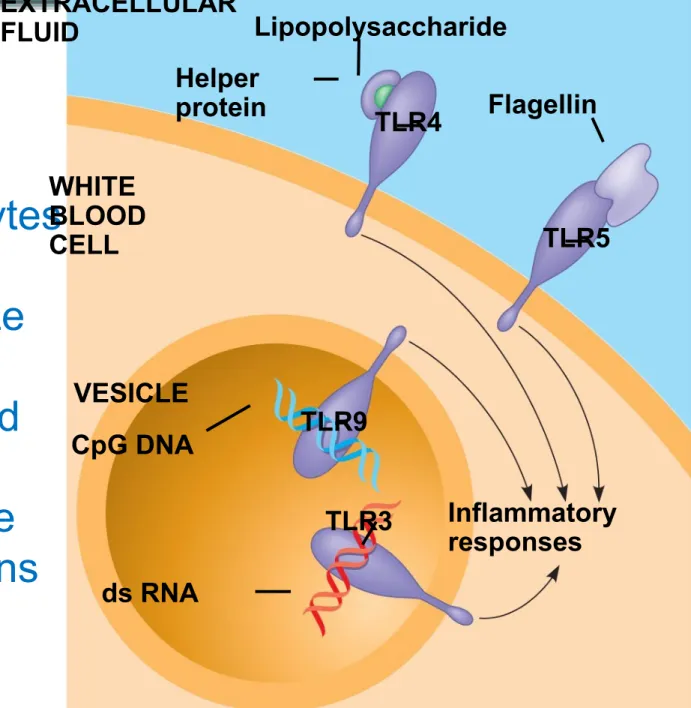
Warning signs by infected cells
•Interferons – produced by cells infected by viruses (only), limits cell to cell spread, and activates macrophages
some are being mass produced with
recombinate DNA tech for possible treatment of some cancers
•Defensins - can be secreted by
Warning signs by damaged cells
•Inflammatory response – physical damage causes release of histamine
•Histamine causes local vasodilation –
Destroying infected cells
• NKC induce apoptosis;always on patrol
So why don’t they destroy healthy “self” cells?
▫ Normal cells have a class 1 MHC protein on their surface; infected or cancerous cells do not
Apoptosis: Link to cell cycle
•When normal cells are beyond checkpoint repair they should be eliminated by
apoptosis
•Mainly by tumor suppressor gene p53
•Mutations or overexpression can result in
cancer: too little cell death
Summary of innate defense
•External – prevent pathogens from getting in
•Internal – identify general pathogen threat, create warning, attack pathogens, attack infected cells
•Problem: many pathogens have co-evolved to slip by innate defenses or to jump species to species barriers; Emerging Diseases
Overview of immune system
What cells (lymphocytes) make antigen
receptors?
•All lymphocyte cells made in bone marrow
•T cells – mature in thymus
Acquired Immunity
3
rdline of defense
• Activated by mainly by dendritic cells that
secrete cytokines (although some macrophages secrete these chemicals, too)
• Example of cell signaling and communication
• “role of MHC”
Class I MHC: nearly all somatic cells; identify cell as “self”
Class II MHC: Dendritic cells and
Specific responses: Acquired Immunity
• WBC produced in bone marrow some migrate to thymus to mature into T cells, some stay in bone marrow to mature to B cells
• Can identify a specific marker on pathogen’s surface (MHC)
• Viruses / bacteria / most parasites all have
antigens on cell surface
• Problem: antigens often mutate rapidly
Problem for acquired system (ch. 43.3)
•How can immune system stay current when pathogens are constantly mutating?
B and T cells already have specific 100,000 antigen receptors that recognize epitopes (antigens on pathogen surface)
•Solution:
1) randomly generate receptor shapes that bind with ever changing antigens
2) clonal selection – mass produce the cells with receptors that bind to specific pathogens
Random generation of receptor shape(skim over for now)
•Recall introns and exons
•Some introns removed, some introns
randomly left in
•Creates
Types of T and B cells(beginning of 43.3)
•Helper T cell – “gets the party started”
•Activated by binding to antigen
presented by macrophage or
dendritic cells and/or cytokines
B cells –
humoral response
•Produce antibodies – free-floating antigen receptors https://
innovation.org/2017/01/17/building-smart-bombs-attack-ca ncer
/
•Helper T cells secrete cytokines to
B cells – humoral response
T cells – cell-mediated response
•Cytotoxic T cells (activated by cytokines) – find infected cells presenting antigens
• https://www.hhmi.org/biointeractive/ctl-killing-target-cell
•Destroy infected cell
•Different from NKC
Cytotoxic T Cells: Response to Infected Cells
• Cytotoxic T cells are the effector cells in cell-mediated immune response
• Cytotoxic T cells make CD8, a surface protein that greatly enhances interaction between a target cell and a cytotoxic T cell
• Binding to a class I MHC complex on an
infected cell activates a cytotoxic T cell and makes it an active killer
• The activated cytotoxic T cell secretes proteins that destroy the infected target cell
Killing action of cytotoxic T’s
•Fig 43.16 Secrete Perforines that cause
apoptosis
When infected cell lyses; pathogens are released and are marked by antibodies
http://www.hhmi.org/biointeractive/cloning-army-t-cells-immune-defense
Cytoxic T cells can also cause apoptosis of cancer cells by recognizing tumor antigens;
Finally …
•Memory B and memory T cells
•Survive over long-term to “remember” a pathogen
•Therefore, can quickly clone itself if it binds to returning pathogen creating
Immune system problems
•Transplantation – moving organs to another body
Different surface proteins = invader to be attacked by immune system
Immunosuppressant drug
Immune system disorders. Most are genetic.
Attack on the Immune System: HIV
•
Human immunodeficiency virus (HIV)
infects helper T cells
•
The loss of helper T cells impairs both
the humoral and cell-mediated immune
responses and leads to AIDS
•
HIV eludes the immune system because
of antigenic variation and an ability to
remain latent while integrated into host
DNA
HIV
•Breaking into helper T cells specifically to reproduce
•HIV infection AIDS
(Acquired Immune Deficiency Syndrome)
RNA virus or retrovirus. Mutates rapidly, much faster than DNA viruses.
You should now be able to:
1. Distinguish between innate and acquired immunity
2. Name and describe four types of phagocytic cells
3. Describe the inflammation response
4. Distinguish between the following pairs of terms: antigens and antibodies; B lymphocytes and T
lymphocytes; antibodies and B cell receptors; primary and secondary immune responses;
humoral and cell-mediated response; active and passive immunity
5. Explain how B lymphocytes and T lymphocytes recognize specific antigens