This may be the author’s version of a work that was submitted/accepted for publication in the following source:
Blackler, Alethea, Desai, Shital,Swann, Levi,Chamorro-Koc, Marianella, Moyle, Gene, & Stephens, Mikaela
(2019)
Using technology to enhance and encourage dance-based exercise. Heliyon,5(3), Article number: e01241 1-28.
This file was downloaded from: https://eprints.qut.edu.au/125672/
c
Consult author(s) regarding copyright matters
This work is covered by copyright. Unless the document is being made available under a Creative Commons Licence, you must assume that re-use is limited to personal use and that permission from the copyright owner must be obtained for all other uses. If the docu-ment is available under a Creative Commons License (or other specified license) then refer to the Licence for details of permitted re-use. It is a condition of access that users recog-nise and abide by the legal requirements associated with these rights. If you believe that this work infringes copyright please provide details by email to [email protected] License: Creative Commons: Attribution-Noncommercial-No Derivative Works 4.0
Notice:Please note that this document may not be the Version of Record (i.e. published version) of the work. Author manuscript versions (as Sub-mitted for peer review or as Accepted for publication after peer review) can be identified by an absence of publisher branding and/or typeset appear-ance. If there is any doubt, please refer to the published source.
Manuscript Details
Manuscript number HELIYON_2018_1917_R2
Title Using Technology to Enhance and Encourage Dance-Based Exercise Article type Original Research Article
Abstract
This study investigated the role of Self-Service Technologies (SSTs) in dance-based exercise in order to begin exploring the motivations behind the use (or not) of SSTs by ordinary men and women in this context. The research approach employed interviews to gain insights into participants’ use of SSTs and their exercise practices, in order to start establishing ways in which dance can be re/incorporated into people’s lives through the design of appropriate SSTs. Findings from this study highlight the significant opportunity to further explore how the properties of music and dance can be integrated into the design of new SSTs. Literature suggests dance could be a beneficial exercise format for many people and self-service technology abounds for exercise but is often not used consistently. Our interview study asked participants about dance-based exercise and SSTs for exercise and showed that there is an opportunity to design SSTs to help people access dance-based exercise. SSTs should help people learn dance, build confidence, and dance alone or with others. SSTs could facilitate movement and increase engagement with physical activity whilst addressing issues around logistics, confidence and dance knowledge and experience.
Keywords Dance-based exercise; Self-service technologies; Fitness trackers; Quantified self; Technology acceptance and adoption; Ordinary men and women
Taxonomy Human-Centered Computing, Health Technology, Applied Computing, Exercise Promotion, Physical Exercise, Accelerometer
Manuscript category Computer Science Manuscript region of origin Asia Pacific Corresponding Author Alethea Blackler
Order of Authors Alethea Blackler, Shital Desai, Levi Swann, Marianella Chamorro-Koc, Gene Moyle, Mikaela Stephens
Suggested reviewers Paula Saukko, Gabija Didžiokaitė Opposed reviewers Janneke Blijlevens
Submission Files Included in this PDF
File Name [File Type]
final covering letter.docx [Cover Letter]
Dance-based exercise Heliyon_Reviewer_final revision.docx [Manuscript File] Figure 1.tif [Figure]
Appendix A.docx [Supplementary Material]
CRICOS No. 00213J ABN 83 791 724 622
Feb 7th, 2018
Dear Editors,
Please find attached the minor revisions for our paper Using Technology to Enhance and Encourage Dance-Based Exercise, as invited. Revisions are detail below:
Your manuscript currently contains comments from authors and reviewers. Please remove these, leaving a clean manuscript.
Done
Please remove your keywords from your manuscript, as this information is handled separately.
Done
We will only be able to display standardized
subheadings on our website, so please ensure that each of your sections is displayed underneath the following headers: Abstract, Introduction, Background,
Theory/Calculation, Theory, Hypothesis, Calculation, Design, Model, Experimental, Materials & Methods, Materials, Methods, Instrumentation, Methodology, Study Area, Analysis, Example, Geological Setting, Results, Results & Discussion, Discussion, Discussion & Conclusions, Discussion & Conclusion, Conclusions, Conclusion, Related Work, References,
Acknowledgements
Done. I checked some recent online Heliyon papers and often they have some small sub-headings which are not on this list. Therefore I have left in some small sub-headings in Background and Results sections to help with reader comprehension. I have removed bolding from these sub-headings and removed numbering system throughout. Please let me know if you would prefer me to remove these also.
Please indicate which author is the corresponding author, and accordingly provide contact information, on your manuscript file itself.
Done
Please document the full name of the approving ethical committee in your Method section.
The full name is already documented. It has the unimaginative name of QUT University Human Research Ethics Committee. I have added the acronym (UHREC), which we use internally.
We highly encourage the use of DOI's in the reference list, please add this information to each reference.
I have added DOIs where they are available. For references without a DOI, I have located a URL
instead. Please ensure all your supplementary file (Appendix A)
is self-contained and can stand alone with a title, legend, etc. Please also ensure that the file name is labelled as the file is referenced in-text, as that is how they will be named on our website.
File is now simply called
Please note that all authors should have made
substantial contributions to all of the following: (1) the conception and design of the study, the acquisition of data, or the analysis and interpretation of data; (2) drafting the article or critically revising its important intellectual content; (3) final approval of the version submitted. Currently, the only contribution attributed to Levi Swann is "Wrote the paper". Please correct your Author Contribution Statement to follow the guidelines above.
Done. However, due to space restrictions within the box provided on the website I have had to use only author initials. Please let me know if you require more details.
Please identify which of the below taxonomy terms are applicable to your manuscript (please select all relevant terms):
As below
Physiology
Public health x
Computer science x
Sociology Psychology
I hope you find that our revisions address the remaining issues and that our paper is ready to be published in your journal. Please contact me if you would like to clarify anything.
Sincerely,
Professor Thea Blackler, corresponding author
Discipline Leader for Industrial, Fashion, Interative and Visual Communication Design Queensland University of Technology
2 George Street Brisbane QLD 4001 Australia
Eail: [email protected] Phone: +61 7 3138 7030 Mobile: +61 410 736494
Using Technology to Enhance and Encourage Dance-Based
Exercise
Abstract
This study investigated the role of Self-Service Technologies (SSTs) in dance-based exercise in order to begin exploring the motivations behind the use (or not) of SSTs by ordinary men and women in this context. The research approach employed interviews to gain insights into
participants’ use of SSTs and their exercise practices, in order to start establishing ways in which dance can be re/incorporated into people’s lives through the design of appropriate SSTs. Findings from this study highlight the significant opportunity to further explore how the properties of music and dance can be integrated into the design of new SSTs. Literature suggests dance could be a beneficial exercise format for many people and self-service technology abounds for exercise but is often not used consistently. Our interview study asked participants about dance-based exercise and SSTs for exercise and showed that there is an opportunity to design SSTs to help people access dance-based exercise. SSTs should help people learn dance, build confidence, and dance alone or with others. SSTs could facilitate movement and increase engagement with physical activity whilst addressing issues around logistics, confidence and dance knowledge and experience.
Alethea Blackler, Queensland University of Technology, Australia*
Shital Desai, AGE WELL Center of Excellence, Ontario Shores, Canada
Levi Swann, Queensland University of Technology, Australia
Marianella Chamorro-Koc, Queensland University of Technology, Australia
Gene Moyle, Queensland University of Technology, Australia
Mikaela Stephens, Bolton Clarke, Australia
Using Technology to Enhance and Encourage Dance-Based
Exercise
Introduction
Music and dance are an important part of the human experience. Many people engage in these activities in a social and recreational capacity. Less known and less understood, however, is that dance can also be an effective form of exercise (Angioi et al., 2009; Domene, Moir, Pummell, & Easton, 2014; Flores, 1995). Regular exercise can improve physical and cognitive function and psychological well-being, and dance-related exercise can provide similarly positive effects on physical and mental health (Angioi, Metsios, Koutedakis, & Wyon, 2009).
Despite access to extensive knowledge and information to promote health and wellbeing, health problems are pervasive in society. A contributing factor to these health problems is the increasing prevalence of inactivity in the workplace and in recreational activities (Martin, Melnyk, & Zimmerman, 2015; Ng & Popkin, 2012; Vandewater, Shim, & Caplovitz, 2004). In efforts to address these problems and re-engage people with physical activity, an increasing number of self-service technologies (SSTs) have been developed. SSTs are services that the customer generates and interacts with in replacement of a traditional face-to-face service (Curran and Meuter, 2005). Popular SSTs for fitness include apps for mobile devices and wearable devices such as Fitbit, Garmin, Apple Watch, and Polar heart rate monitors. These apps and devices aim to encourage healthy behaviour by prompting physical activity and monitoring progress toward wellness goals.
Although the potential benefit of SSTs for fitness is large, they often fail to achieve their aims. The effectiveness of fitness trackers has been found to be dependent on the goals set by users and their motivation to engage with the device and associated website or application (Wang, 2014; Delgado, 2014). However, apps are a crowded market, many are not downloaded, and others are downloaded and abandoned after only a short period; according to a global study of more than 300 mobile apps and 300 million user profiles, only 25% of apps in all categories are used again after the first day and fewer than 10% of people continue use beyond seven days. Mobile gaming apps fare slightly better with nearly 40% used beyond the first day (Greenan, 2016). Given these circumstances, the purpose of this research was to investigate how dance as an engaging type of exercise can
Background
This section contains a thorough exploration of the issues that can be brought together to create a greater understanding of how emerging self-service technologies could assist in increasing levels of physical activity, specifically in terms of dance. This section firstly explores engagement as a concept and as applied to technology, then explains the benefits of dance and finally details the small amount of existing research on SSTs applied to dance-related exercise.
Engagement
The notion of engagement has been explored in several activities and domains. These range from education and learning environments (Douglas & Hargadon, 2000; Strean, 2011; Williams & Germain, 2008), interactions with technology and the Internet (Lehmann, Lalmas, Yom-Tov, & Dupret, 2012), fitness and sport (Gao, 2012; Stålnacke Larsson, 2013), social interaction and team building (Mueller, Agamanolis, & Picard, 2003) and videogames (Boyle, Connolly, Hainey, & Boyle, 2012; Márquez Segura, Waern, Moen, & Johansson, 2013). Because of the diversity of these different activities and domains, it can be difficult to establish a clear definition of engagement. O’Brien and Toms (2008) defined engagement as:
...a quality of user experiences with technology that is characterized by challenge, aesthetic and sensory appeal, feedback, novelty, interactivity, perceived control and time, awareness, motivation, interest, and affect. (p.949).
While it is certainly possible to identify a number of properties of engagement that are consistent in most domains, the effects of these properties have also been shown to vary among contexts (O’Brien & Toms, 2008). To facilitate a detailed understanding of engagement, this section will discuss some of the key properties of engagement, as well as explore how these properties may differ in relation to context.
The properties of engagement can be classified as either psychological factors or technological factors (Turner, 2014). Psychological factors are concerned with the internal forces that affect engagement. These forces are generally unique to an individual and include concepts such as presence, intrinsic motivation, feelings, knowledge, interests, attention, and willingness to follow rules and participate. In contrast, technological factors describe external forces that affect engagement. These factors are typically concerned with those from other people, the environment, and relevant activities. However, it should be noted that psychological factors that are internal to a person also have some moderating influence. For example, motivation and personal interest can impact on how external forces are perceived (O’Brien & Toms, 2008).
disengagement, re-engagement and non-engagement. These stages are important for contextualising the concepts associated with engagement and form an effective way to discuss the technological properties of engagement.
The point of engagement is associated with motivation and goals (O’Brien & Toms, 2008; Turner, 2014), where engagement is facilitated by experiences that are seen to be meaningful and relevant (Williams & Germain, 2008). For instance, a person may engage in an activity because it provides some type of progression towards a higher goal, such as participating in a training program required for a promotion at work, or to avoid an undesirable outcome, such as punishment (Ryan & Deci, 2000). Alternatively, a person may engage due to intrinsic motivation - defined as the willingness to engage for one’s own sake. Intrinsic motivation describes the outcome of several psychological properties. Some of these are enjoyment (Gao, 2012; Ryan & Deci, 2000), fun (Strean, 2011), personal improvement and mastery (O’Brien & Toms, 2008), autonomy and control (Domene et al., 2014).
Other common external forces of engagement at the point of engagement can be broadly defined as concepts intended to attract and capture attention (O’Brien & Toms, 2008; Turner, 2014). In learning environments, such attractors have been identified as fun, novelty and humour (Strean, 2011; Williams & Germain, 2008). Video gamers commented on specific stimuli such as trailers or advertising as types of attractors. These elements provide exposure to information such as gameplay, story and graphics, which all contributed to excitement and anticipation about the game (O’Brien & Toms, 2008). Similar concepts are described in web and other digital products, with aesthetics and graphics having a substantial impact on engagement (Boyle et al., 2012).
Following the point of engagement is ‘the period of engagement’ (O’Brien & Toms, 2008). This stage describes the period of continued or sustained engagement during an activity and is commonly associated with the concept of immersion. The exact properties that facilitate immersive and sustained experiences of engagement differ among contexts. In the task of reading, immersion is associated with familiarity and the possession of relevant schemas to facilitate effective interpretation of the text (Douglas & Hargadon, 2000). Similarly, for online web applications, engagement is facilitated by experiences that are easily understood and do not result in confusion or frustration (O’Brien & Toms, 2008). Unlike these two examples, immersion in video games is associated with experiences that are positively challenging and test the user’s skill. However, it is also important that users believe they have the requisite skill, or can obtain the requisite skill, to meet the challenges of a particular situation (Bianchi-Berthouze, 2013; O’Brien & Toms, 2008). These types of positive feelings - previous successes, adequacy and accomplishment are also important in exercise and fitness domains, and social situations (Yee, 2006; Gao, 2012; Ryan & Deci, 2000).
difficult enough (Bianchi-Berthouze, 2013; O’Brien & Toms, 2008). In relation to internal factors that may cause disengagement, an important property is feedback. Ryan & Deci (2000) found that receiving positive feedback enhanced intrinsic motivation, while negative feedback resulted in diminished intrinsic motivation. These effects have also been found to be mediated by perceived confidence, where negative feedback had less of an impact on people with higher perceived confidence (Vallerand & Reid, 1984 in Ryan & Deci, 2000).
Just as it is possible to become disengaged, it is also possible to become re-engaged. The factors contributing to re-engagement are similar to those at the point of engagement. However, an important additional facilitator of re-engagement is positive past experience. In the context of video games, O’Brien and Toms (2008) associate positive past experience with situations such as replaying a videogame because it had an enjoyable story, or simply because it was associated with a positive memory. Positive past experience can also be considered in terms of previous successes and failures or mastery experiences (Gao, 2012). Ryan & Deci (2000) state that people generally want to engage in activities that make them feel adequate, capable, effective, and in control. Gao (2012) found that when playing fitness-focused videogames, those with successful mastery experiences and positive past experience demonstrated significantly higher intrinsic and extrinsic motivation. In comparison, if a person has had a bad experience or has failed in the past, s/he may believe s/he lacks the relevant skills and will be reluctant to re-engage with an activity or situation.
The final stage of engagement identified by O’Brien & Toms (2008) is ‘non-engagement’. As hard as designers or providers may try and as encouraging as the context might be, some people may not be engaged at all. A key factor of non-engagement is amotivation, which refers to a lack of intention and absence of motivation (Gao, 2012; Ryan & Deci, 2000). Amotivation can be linked to some of the properties described above, such as repeated negative feedback or negative past experience. If an activity is perceived to have no benefit a person may choose not to participate in it (Williams & Germain, 2008), or amotivation might simply arise from having preferable options. O’Brien and Toms (2008) describe this situation in reference to online experiences, where a person may choose not to engage in online shopping because they have the alternative to shop at a physical store.
Benefits of Dance
Much of the literature investigating dance and its effects on cognitive function and physical health has focused on dance as a form of ‘therapy’ for the elderly or unwell, or on the existing professional dance community. A distinct lack of research has investigated dance in the ‘general community’ (Campion & Levita, 2014; Cota, Ishitani, & Vieira, 2015; Kloos, Fritz, Kostyk, Young, & Kegelmeyer, 2013).
Of the research that has investigated dance as a viable form of exercise, results generally show that it provides many of the same benefits as traditional exercise. In a study investigating salsa dance for exercise, it was found that more than half the time spent dancing could be classified as moderate-to-vigorous physical activity (Domene et al., 2016). Similarly, an earlier study by the same researchers showed that over a two-hour period of dancing, two thirds was classified as ‘active time’ and yielded just under 10,000 steps for both men and women. 10,000 steps per day is considered a reasonable total for adults to successfully reach the recommended amount of physical activity (Domene et al., 2014). Another study (Flores, 1995) investigating the potential of dance as a type of exercise for high school students showed similarly positive results. Results showed significant decreases in BMI and heart rate in girls who participated in a dance program when compared to girls in the control group, who participated in standard physical education classes (Flores, 1995).
Beyond physical health benefits, participation in dance activities is also beneficial to mental health and well-being. Domene et al. (2016) recorded physiological experiences during Zumba and Salsa dance activities using a wrist-worn accelerometer and captured psychological experiences using a Likert-style questionnaire. Zumba fitness rated higher than Salsa dance in terms of energy expenditure and step count. Participants also reported substantial improvements in positive-well-being and psychological distress when performing Zumba. However, participants reported the highest reduction in psychological stress and depression when performed partnered Salsa dancing (Domene et al., 2016). In another study, significant enhancements to mood and self-assessment of physical appearance and emotional experience was achieved after participating in a 60-minute aerobic dance activity (McInman & Berger, 1993). Engagement in dance has also resulted in improved attitudes toward physical activity, as demonstrated by the girls who participated in Flores's (1995) dance program described earlier. Similarly, in a study by Wagener, Fedele, Mignogna, Hester, & Gillaspy (2012), improved attitudes toward physical activity that developed after of participating in dance-based exergaming were shown to increase the likelihood to continue exercising.
showed that they had increased physical fitness and life satisfaction compared to the control group, and suggested that dance-based exercise can be accepted by an older demographic (Cruz-Ferreira et al., 2015). Dance-based exercise programs have also been successful in engaging young children with exercise. For example, when children were engaged in dance activity twice a week, although teachers reported that it was sometimes a struggle to get the children moving, children were found to be more focused, less agitated, and appeared to be more calm and ready to learn (Parnell, 2015). The next section explores how music might contribute to the benefits of dance described in this section.
The outcomes of positive experience, enhanced mood, and improved feelings of well-being discussed in the previous section demonstrate the potential of dance for facilitating engagement in physical activity. Much of this potential relates to the properties of dance connecting with the sensual, emotional and spatiotemporal experiences that are instrumental for engagement. For instance, sensual experience is associated with visual, auditory and interactive components of an activity; emotional experience is associated with affective experiences such as fun and enjoyment, and also relates to physiological responses such as heart rate and ‘goose bumps’; and,
spatiotemporal experience pertains to the time and space of an experience, such as perception of time, internal states and external environments (O’Brien & Toms, 2008). In the context of dance, these aspects of human experience are explored in the theory of music, mood and movement. This theory is based on the premise that music, mood and movement are closely intertwined, with each element having a profound effect on the other, thus affecting the different aspects of human experience (Murrock & Higgins, 2009).
Music is the central element of the music, mood and movement theory due to its ability to alter mood states and facilitate movement. Murrock and Higgens (2009) state that music produces psychological and physiological responses. This connection between music and movement is attributed to the spatiotemporal characteristics that are shared by music and physical motion. Similarities in terms of speed, rhythm, and smoothness engage the same brain circuits, particularly those involved in time-keeping, sequence learning and motion perception (Fan, 2013 ). This connection also extends to mood. When humans physically move to a beat (even simply bobbing the head), the auditory and motor areas of the brain synchronise to produce brain waves which parallel a powerful emotion of enjoyment (Fan, 2013).
Integrating Dance and Self Service Technologies
The benefits of dance, and its relationship to physiological and psychological wellbeing, have been clearly illustrated. Dance has been shown to elicit physiological response, emotional arousal, and positive affect. In the context of health and well-being, music and dance offer potential for enhancing engagement. These combined factors present a significant opportunity to explore how the properties of music and movement can be integrated into the design of SSTs with the purpose of increasing engagement with physical activity.
Integration of dance, music and technology is not an entirely new idea. Many apps and other digital media have been designed to enhance engagement and encourage physical activity. A common strategy used for digital media to enhance engagement with physical activity is the use of ‘gamification’. Gamification is defined as the addition of game-like elements, such as incentives or rewards for specific behaviours or achievements (Lister et al., 2014). An exercise activity with the addition of gamification elements is known as an ‘exergame’. In the case of mobile phone apps, the addition of game elements to enhance engagement in exercise is often based on including a reward and achievement system such as receiving points for reaching a fitness goal (Bogost, 2005). Other apps use novel methods such as adding story elements to enhance physical activity. An example of this is the app Zombie Run (Six to Start & Alderman, 2015), which provides a narrative in which the runner is a character escaping from zombies. The game works in any location and provides various cues that enhance physical activity, as runners have to speed up to avoid zombies.
Beyond achievements and rewards, exergames can also be highly interactive, with the exercise activity directly integrated into the game. This strategy is used in many games available on the Sony Playstation, Microsoft Xbox and Nintendo Wii. Exergames for these consoles (also referred to a “controller apps”) require a specialised input device that is able to measure body movement and apply it in the game. Games that use these technologies are becoming increasingly popular, with effective integrations of workout programs ranging from moderate to intensive (Bronner, Pinsker, Naik, & Noah, 2016). One of the most well-known exergames is Dance Dance Revolution (DDR). DDR requires participants to follow onscreen dance instructions, which are input into an interactive pad by performing real dance and foot movements. These interactions involve full body movement and are enhanced by the use of energetic music and visuals (Gao, 2012).
Exergames, predominantly DDR, have been the focus of several studies investigating their viability as platforms for exercise and promoting well-being. Kloos, at al. (2013) investigated the potential of dance exergames in therapy for people living with Huntington’s disease. Participants used the DDR game two days per week for six weeks, and showed significant reductions in need for physical support for walking. Participants also stated that they enjoyed playing the game and wanted to continue playing after the study completion. Another study using DDR has explored the effect dance-based exercise can have upon severely overweight children (Mealey, Jakicic, Marcus and Mealey, 2010). Their study measured the energy expenditure and enjoyment recorded by 20 children using various exercise aids. Results showed no significant difference in energy expenditure between the different methods of activity, however, the enjoyment ratings differed significantly. DDR was rated at the highest level of enjoyment, followed by an in-home walking video, with a treadmill placing last.
It has been shown through several studies of dance-based exergames that players rate enjoyment during exergames more highly compared to traditional forms of exercise such as cycling or walking. The technology must be engaging and challenging for the participant, so that they feel motivated to return and discouraged from cutting corners with the input devices (Bronner et al., 2016). Dance exergames promote a fun and competitive platform for participants, however, they battle the image that they are purely game based, and not consistently used as a regular form of exercise. The physical exertion during even 30 minutes of dance-based exergames is well above the average for ‘standard physical activity’ and can be a viable option to keep people moving and healthy.
Summary of Literature
Design
Thus, instead of implementing another intervention, this research study aimed to explore people’s attitudes to engagement or potential engagement with dance-based exercise facilitated through SSTs by focussing on the following two research questions:
RQ1 What is the role of dance in people’s wellbeing?
RQ2 What are the attributes of engagement, disengagement, sustained engagement, and reengagement with SSTs in the context of dance-based exercise?
Method
Eleven participants were recruited through a university email list, and through Facebook. The research was approved by the QUT University Human Research Ethics Committee (UHREC) and people who expressed their interest in participating were provided with the approved Participant Information and Consent Forms. No incentives were offered to the participants.
We made an effort to recruit “ordinary men and women” (Bakardjieva & Smith, 2001) rather than tracking enthusiasts in the Quantified Self community (so-called QSers), who seek self-knowledge through self-tracking variables such as heart rate, respiration, steps taken, or hours slept, in order to find personal meaning in personal data (QS Institute, 2016). Ordinary people are likely a much more realistic representation of what most people are really doing with their SSTs (Didžiokaitė,
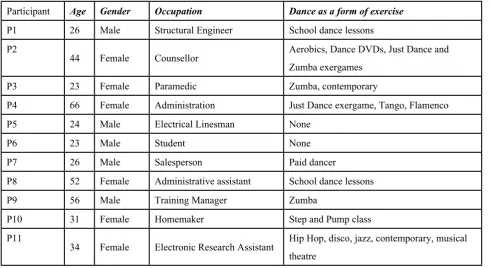
Saukko, & Greiffenhagen, 2017). A participant overview is provided in Table 1.
Table 1 Participant demographics
Participant Age Gender Occupation Dance as a form of exercise
P1 26 Male Structural Engineer School dance lessons P2
44 Female Counsellor Aerobics, Dance DVDs, Just Dance and Zumba exergames
P3 23 Female Paramedic Zumba, contemporary
P4 66 Female Administration Just Dance exergame, Tango, Flamenco
P5 24 Male Electrical Linesman None
P6 23 Male Student None
P7 26 Male Salesperson Paid dancer
P8 52 Female Administrative assistant School dance lessons
P9 56 Male Training Manager Zumba
P10 31 Female Homemaker Step and Pump class
P11
A semi-structured interview technique was selected, using broad, open-ended questions designed to draw out participants’ experiences and values in the context of dance (Appendix A). The same questions were used for each participant, however, the order that questions were asked was changed depending on the answers given by the participant. This was done at the discretion of the interviewer to maintain a constant flow of discussion, and to enable a comfortable interview environment for the participant. Interviews were conducted at a preferred location identified by each participant. Locations ranged from public libraries to university conference rooms. The interviews were conducted one-on-one, and were audio recorded.
Analysis
The audio recordings of interviews were transcribed and coded using Atlas.ti. This software is ideal for text-based coding as it allows flexible use of almost any coding scheme but also facilitates basic quantification of data – e.g. the co-occurrences and basic frequencies that we calculated in this study. In this case the ability to find co-occurrences in the data was the most important function of the software.
Four interview questions were coded for positive or negative responses which are given below. The responses were subsequently quantified for number of positive and negative responses. The numbers further help us explain participants’ responses to other questions, as discussed in the results.
1. Do you believe technology is effective in assisting your exercise?
2. Would you consider dancing as exercise?
3. Are you more inclined to exercise with music playing?
4. Would you prefer to dance alone or with a partner?
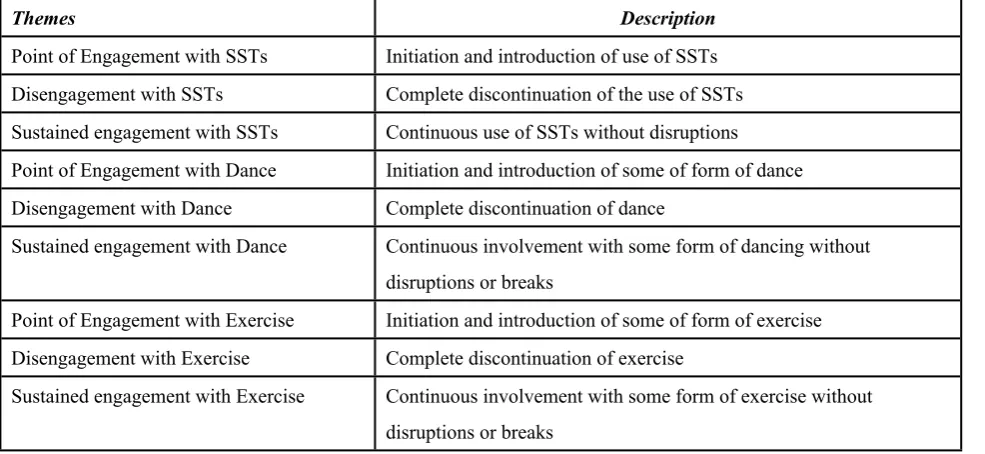
Then, O’Brien & Toms' (2008) model of users’ engagement with technology was used to develop the coding scheme (Table 2). Engagement, disengagement, and sustained engagement with SSTs, and dance formed the themes for this study. The attributes for each of these themes were derived from the interview transcripts. Initial analysis of the data did not reveal information on participants’ re-engagement with SSTs, exercise and/or dance. Thus, re-re-engagement was not included as a theme in the coding.
sub-theme Point of Engagement with SSTs for Dance-based Exercise. Similarly, sub-themes were created for Sustained Engagement with SSTs for Dance-based Exercise, and Disengagement with SSTs for Dance-based Exercise.
Table 2 Themes identified for coding interview transcripts (based on O’Brien and Toms’ engagement framework)
Themes Description
Point of Engagement with SSTs Initiation and introduction of use of SSTs Disengagement with SSTs Complete discontinuation of the use of SSTs
Sustained engagement with SSTs Continuous use of SSTs without disruptions
Point of Engagement with Dance Initiation and introduction of some of form of dance
Disengagement with Dance Complete discontinuation of dance
Sustained engagement with Dance Continuous involvement with some form of dancing without disruptions or breaks
Point of Engagement with Exercise Initiation and introduction of some of form of exercise Disengagement with Exercise Complete discontinuation of exercise
Sustained engagement with Exercise Continuous involvement with some form of exercise without disruptions or breaks
Results
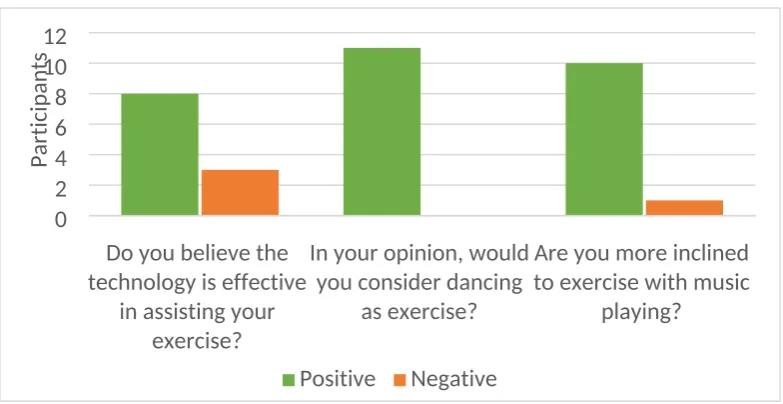
Figure 1. Positive and Negative responses to three key interview questions
was weird or dancing with a partner was more fun or sociable. However, one of the eight mentioned that to dance with a partner, the partner had to be a capable dancer.
Engaging with Dance-based Exercise
The attributes that were revealed from the analysis as contributing to engagement, sustained engagement, and dis-engagement from dance-based exercise are summarised in Table 3 and discussed in the sections below.
Table 3. Attributes contributing to engagement, sustained engagement and disengagement with dance as a form of exercise
Intrinsic Motivation
Extrinsic Motivation Attributes for point of engagement with dance-based
exercise
Enjoying the music or particular music style Fun
Skill, experience, and confidence in dancing Attributes for sustained engagement with dance-based
exercise
Social setting
Lack of skill, experience, and confidence in dancing
Problems with social setting Attributes for dis-engagement from dance-based
exercise
Logistics of attending dance classes
The co-occurrence tool when applied to the two themes Engagement with Dance and Engagement with Exercise resulted in three attributes for engagement with dance as a form of exercise: intrinsic motivation, extrinsic motivation and enjoying the music or music style.
Participants introduced some form of dance (shown in Table 2) in their exercise regime because of intrinsic motivation to remain physically and mentally fit, and for personal wellbeing. All eleven participants believed that dance is a form of exercise (Figure 1) and can contribute to an exercise
Do you believe the technology is effective
in assisting your exercise?
In your opinion, would you consider dancing
as exercise?
Are you more inclined to exercise with music
regime that is fun to engage in. They believed dance could provide energetic full body exercise and is good for fitness.
And um, you know I think you use your core strength a lot…. (P4)
… the exercise is pretty good when you dance… (P5)
They also claimed that dance offered a means towards improving mental wellness.
... it's an exercise [but] also good for your mind …. (P4)
… But not only, um, for physical, but also mental, emotional, I've…with my experience, I've seen, including myself, come out of the shell through movement, and dance and stuff like that… (P11)
Participant P4 said that dance offered a way to vent out frustrations and anger in everyday life and stated she felt very good after the dance session.
…. you're stamping on the floor…getting angry with the floor…. (P4)
Extrinsic motivation came in the form of other peoples’ opinions, suggestions, and reviews. Two participants got involved with dance-based exercise because someone (roommate, family members, school-based instructor) introduced them to it.
Well, I first came across it when I was, um, with my nieces and nephew, and it was basically something that we were doing together as a family that we were doing over the Christmas holidays and we had a lot of fun doing that. (P2)
I probably did aerobics a bit in high school. (P2)
All eleven participants said that music took their mind off the negative experiences of exercising such as feeling tired and feeling pain and thus they would at the least try out any form of exercise associated with music.
Well, it helps you relax and makes you feel ... It takes your mind off the pain of what you're doing… (P9)
Ten participants said that music played an important role in their exercise regime and they listened to music while exercising (Figure 1). Eight participants took to dancing as an exercise because of positive experiences with the music associated with the type of dance. For example, one participant enjoyed aerobics when it was set to music in comparison to an older form of aerobics.
jump, star jump, run around the room which I didn't enjoy but when music or dance orientated aerobics came in, I really enjoyed it. (P4)
Another participant suggested that the type of music played determined whether the experience of dancing and exercising was good or not.
… probably the fact that it was Latin, so the music was fantastic… (P2)
The co-occurrence tool applied to Sustained engagement with Dance and Sustained engagement with exercise resulted in three attributes for sustained engagement with dance as a form of exercise: fun; skill, experience and confidence in dancing; and social setting. Six Participants stayed with dance-based exercise because they just enjoyed it.Four participants remained engaged with dance-based exercise because they had the skill or/and experience with dancing. Participant P4 had learned Flamenco and various other forms of dance and at the time of the study was enrolled in a Tango class. The skill and experience made her appear confident about her skills. Participant P8 had picked up dance at school and, although not currently engaged, was keen to learn more dance styles/take up dance-based exercise because she thought she was good at it.
At school, many moons ago…I was very good at it. Received an award for a dance performance…P8
The confidence was combined with the fact that she also thought that dance would provide full body exercise.
…Um, because I think it's a good form of exercise because you're using your whole body. (P8)
Four participants suggested that the social aspect was critical for staying on track with their exercise regime. They claimed that the social setting facilitated motivation and fun in their exercise routine which made them stick to their routine on a regular basis.
Ahhh, it was uh ... it was like being motivated, yes and having the whole ... so many people in the building, all of us doing it together... (P4)
Four participants suggested that it did not matter what type of dance they were engaging in as long as they were doing it with their friends.
Silly dancing, I suppose, [laughs] yeah I like, just social dancing (P5)
The perception with dance as a form of exercise is that it requires skill and learning. If either or both are not facilitated, people could disengage from the dance-based exercise due to lack of confidence resulting in lack of motivation. One participant did say that she did not feel confident about her dancing skills.
I am shockingly bad at it...not graceful at all. (P2)
Lack of skill in dancing becomes more prominent in social settings, and could make people feel embarrassed to dance in front of others.
Like I said I am not very coordinated, *laughs*, so going to classes and stuff like that I don't like doing that, because I get self-conscious and feel stupid. (P2)
Dancing in a social setting could bring other challenges. Different people have different preferences regarding who to dance with, type of music played during the exercise, age groups of people in the social setting and so on. Participant P5 had found a group of women of her age to exercise with.
… it's mostly women my age, or fifties, couple of younger ones…. (P4)
However, she found the women very noisy and chatty. She could not hear the music that was being played. She remained engaged for a while because the exercise was giving her a good workout, but left the group after one month.
In a social setting involving dance as a form of exercise, people were specific about who they danced with. Negative experiences, such as the group being noisy as in the case of participant P5, could result in disengagement with the dance-based exercise. Participant 2 preferred to dance with her husband but her husband is not interested in dance. This resulted in her giving up dance-based exercise and talking up walking instead as a form of exercise so that she could do it with her husband. This indicates that in a social setting, people may want to look at a form of exercise that allows them to spend more time with their family/friends.
Two participants disengaged from their dance-based exercise due to logistical issues posed by location and timing of group dance settings and the cost associated with dance-based exercise. Both the participants believed that they needed to go to a class to participate in a dance-based exercise as they needed professional help to do the routines properly. Thus, the logistical issue is tied to the fact that some people believe that dance requires skill and learning and that it is something that cannot be done on their own.
Engaging with SSTs in the context of dance-based exercise
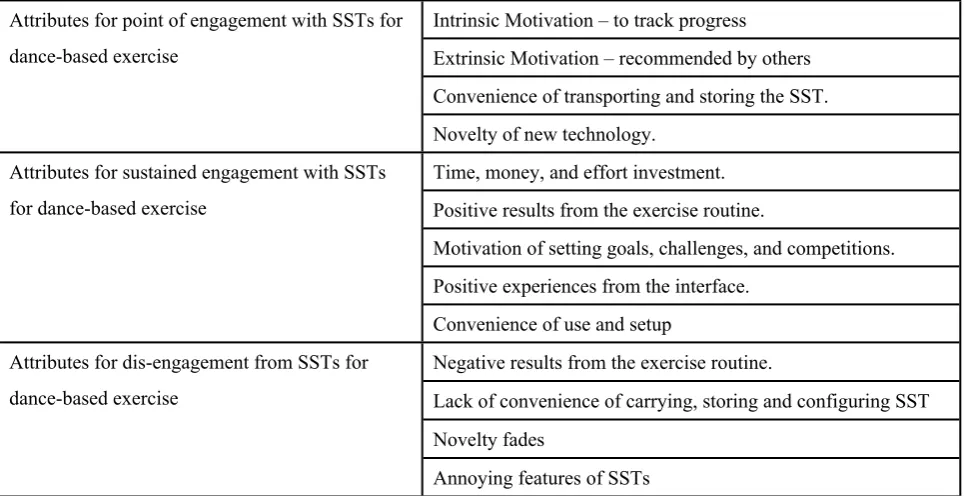
Participants used SSTs such as apps, controller apps with gaming consoles, DVDs, monitors and trackers, and pedometers with the prime objective of keeping fit and healthy. The interpretation of most participants when asked about SSTs was that we were asking about apps. Most apps available in the market are meant for tracking progress and thus the participants’ understanding of SSTs was that they are technology based gadgets that help monitor and track progress during an exercise regime. Thus, the participants were probed with questions to reflect on their potential use of SSTs in exercise. The attributes contributing to engagement, sustained engagement and dis-engagement with SSTs for dance as a form of exercise are summarised in Table 4 and discussed in the sections below.
Table 4. Attributes contributing to engagement, sustained engagement, and dis-engagement with SSTs for dance as a form of exercise
Intrinsic Motivation – to track progress
Extrinsic Motivation – recommended by others Convenience of transporting and storing the SST. Attributes for point of engagement with SSTs for
dance-based exercise
Novelty of new technology.
Time, money, and effort investment.
Positive results from the exercise routine.
Motivation of setting goals, challenges, and competitions.
Positive experiences from the interface. Attributes for sustained engagement with SSTs
for dance-based exercise
Convenience of use and setup
Negative results from the exercise routine.
Lack of convenience of carrying, storing and configuring SST
Novelty fades Attributes for dis-engagement from SSTs for
dance-based exercise
Annoying features of SSTs
The co-occurrence tool, when applied to the three themes Engagement with Dance, Engagement with exercise, and Engagement with SSTs revealed four attributes for engagement with SSTs for dance as a form of exercise: intrinsic motivation; extrinsic motivation; convenience of transport and storage; and novelty of new technologies.
One of the reasons for people to engage with SSTs for dance-based exercise was because someone (e.g. children in the family, roommates) introduced them to it. Another reason was to track and monitor the progress in a graphical and visual format. One participant suggested he started using apps to view his progress in the form of pretty graphs and statistics.
…then I wanted to have pretty graphs…(P1)
phone to track progress and view their status.
…I used to have a notepad to write everything down on…but I like to see how I was doing without having to like flip through all the pages…(P1)
Novelty of new technology and features is another attribute that engages people with SSTs.
Just bought a new phone, so it was an initial craze kind of… (P5)
The co-occurrence tool when applied to the three themes: Sustained engagement with Dance, Sustained engagement with exercise and Sustained engagement with SSTs resulted in five attributes for Sustained engagement with SSTs for dance as a form of exercise: investment of time, money and effort; positive results from the exercise; motivation of setting goals, challenges and competitions; positive experiences from the interface; convenience of use and set-up.
Effort and time required to configure and set up any new SST (such as installing a new app) results in people preferring to continue using a SST that they have already engaged with. Three participants suggested that they continued using the SSTs (sustained engagement) because it was technically painful to switch between technologies.
Um, I guess switching from like one app to another is pretty painful, you basically have to start again… (P1)
People tend to continue using a technology once they have invested time, space, and money in it. Using a new SST could also mean losing tracked and monitored data. However, this sustained engagement could persist only if people can derive positive results from the exercise. Participant P2 associated the successful positive outcome of the exercise regime to the use of SSTs for tracking and monitoring.
…I was getting fit doing it…. (P2)
The next attribute is the feasibility of SSTs in allowing users to set goals and motivating users through challenges and competitions to be incorporated in the exercise routine. Participants continued using apps because they allowed them to set goals, and they were rewarded when the set goals were achieved.
just so it sets some, like, goals for me. And so it sets some benchmarks…(P3)
if you get so many steps there's a reward at the end…(P9)
A well-designed interface generates positive experiences during the use of SSTs, which can help users to remain engaged with the SST. Positive experiences with SSTs as stated by participants were experiences associated with their interactions with the SST interfaces.
Like you are not kind of having to dig around in crappy interfaces and that kind of stuff… (P1)
Convenience in terms of where SSTs can be used and effort required to setup the device before use was an important attribute to three participants. One participant preferred easy setup mechanisms such that it is convenient to use at any time.
…I don't like going anywhere when I exercise. It has to be a spur of the moment, 'I could exercise now', alright let's exercise. It has to be right there. When I have the moment, when I can be bothered, it has to be really flexible and completely under my control…I don't want to rely on anyone else. (P10)
Participants also expressed their preference towards SSTs which require less manual intervention and are automatic.
I don't have to do anything, really. It's all done for you… (P7)
The co-occurrence tool when applied to the three themes: engagement with Dance, Dis-engagement with exercise and Dis-Dis-engagement with SSTs revealed four attributes for dis-Dis-engagement from SSTs for dance as a form of exercise. These were; negative results from the exercise regime, lack of convenience in storing, configuring and transporting SSTs, novelty fading, and annoying features of SSTs.
Lack of convenience in terms of space occupied by the SST, space required for the use of the SST and the setup configuration required before use (such as in gaming consoles) could result in disengagement. This was evident in the case of participant P2 who found setting up the Wii for using Just Dance cumbersome and had storage issues with the Wii fit.
…it was a bit of a pain…having [to] boot the Wii up and drag the steppy thing out and all that kind of stuff…(P2)
Four participants stopped using SSTs because of negative results reported by the SSTs. Participant P2, for example, stopped using an app because it consistently reported lack of progress in terms of reaching number of steps.
…It changed the little icon to make you look fat. That got too depressing…(P2)
above.
…in the short term yes because it was something that was a bit of a fad but it was not something that I…found was maintainable…(P2)
Another attribute that concerned two participants was an annoying feature, in both cases the narration and voice of the narrator in the SST.
I don't think I did not enjoy anything in SSTs. Maybe the voice (laughs) actually…It drives my husband insane, the voice. (P11)
Yeah and um, but it annoyed me because I didn't like, you know ... be doing the exercise and this voice go. Oh that's good ... You know that's good. And I just go shut up and it put me off. (P4)
Discussion
Generally, our findings confirmed the model of engagement proposed by O’Brien and Toms, with attributes found within the point of engagement, sustained engagement and dis-engagement. This framework was a useful and appropriate approach to interrogating our data. Our results suggest that dance is perceived as an important form of experience for physical, as well as mental and emotional, wellbeing. However, for people to take up dance as a form of exercise, learning and development of dance skills might be required. Developing these skills is important to instill confidence, which in turn is required for sustained engagement with the exercise regime. People generally want to engage in activities that make them feel adequate, capable, effective, and in control (Ryan & Deci, 2000), and previous successes or mastery experiences can also provide positive reinforcement (Gao et al., 2013). Therefore, designing SSTs to facilitate these experiences should increase engagement. For example, because learning of dance steps is important for people who have no prior experience of dance, SSTs should facilitate that learning.
partner. However, they should also allow the flexibility of dancing alone.
Music was highlighted as a facilitator of dance-based exercise within this study. All participants agreed that music gets them to take their mind off the effort of exercising, with ten of the eleven participants listening to music while exercising. Music has been shown to trigger movement (Murrock & Higgins, 2009) and should be essential for dance-based exercise. Consideration of suitable music styles and options for users to select preferred music are some directions to be explored in the design and development of SSTs for danced-based exercise.
Literature has shown that disengagement may occur if a website is too difficult to use (O’Brien & Toms, 2008), or a text is too complicated or unfamiliar (Douglas & Hargadon, 2000). Similarly, our study showed that poor usability could contribute to disengagement. Previous research has also shown that features unrelated to the core function of a device, including set-up and maintenance routines as well as over-featured interfaces and un-needed functions, can cause negative responses in users (Blackler, Gomez, Popovic, & Thompson, 2016; Rust, Thompson, & Hamilton, 2006), and that ordinary men and women do not use all the complex features that are offered by current self-tracking apps (Didžiokaitė et al., 2017). Our study showed that easy to use interfaces helped to keep people engaged, confirming these previous findings and highlighting the importance of careful feature inclusion and design in order to maximise engagement. Results from a study of five popular dance-based exergames showed that games that had a higher usability rating and increased energy expenditure reflected highest on engagement scores and were thus more likely to be used again (Bronner, Pinsker, & Noah, 2015).
Ironically, knowing that a different system may be difficult to set-up and learn did encourage some people to stick with what they had, which suggests an opportunity for well-designed products to stand out in this marketplace, leveraging their usability as a point of difference and to build loyalty. However, at the end of the day, participants wanted the exercise regime to show results, and that was a major factor in them staying engaged with it and with the associated SST. Ryan & Deci (2000) found that receiving positive feedback enhanced intrinsic motivation, while negative performance feedback resulted in diminished intrinsic motivation, and our findings have borne this out.
Our results suggest that SSTs for dance-based exercise should be simple to use, always available, and require minimal set-up routines. Users should be able to participate in an exercise regime anytime and anywhere as per their convenience. Logistical problems were a major reason for disengagement and SSTs have the potential to overcome these problems almost completely (e.g. users can set their own time and place, involve who they like and pay out less money over time).
engagement with dance-based exercise can assist to make this happen – for example, through structuring of weekly targets related to learning dance steps and/or prompts to practice what has been learnt to-date, subtle reminders about posture and movement during complex dance moves, or through pushing interesting new music and dances to the system periodically. These sorts of features may be far more attractive and useful to ordinary men and women than the kinds of extras offered by many fitness apps (heart-rate, sleep tracking, calorie counts, etc).
Overall, our findings show that SSTs have a role in facilitating movement and increased engagement with physical activities if they facilitates dance based exercise that also supports people’s confidence, dance knowledge and positive experiences.
Conclusion
This study has shown that dance can be a form of enjoyable exercise, and that there is appetite for SSTs for dance-based exercise. SSTs can play an important role in dance-based exercise, however their role needs to go above and beyond simple tracking. The study has revealed that people’s engagement with dance as a form of exercise as well as use of related SSTs is governed by positive results or feedback from both the exercise regime and the SSTs. The role of SSTs should thus primarily be facilitating dance and exercise rather than just reporting and tracking. Domene et. al. (2016) explain how adherence to a dance exercise regime is likely maintained only when participation is enjoyable, offers opportunities for mastering new skills, facilitates a self-regulated experience, and provides connectedness with others. SSTs need to provide learning and feedback, be able to eliminate logistical problems by adapting to the environment in which the dancing is performed, and facilitate the social side of dance as well as allowing for solo or collaborative remote dance experiences. They can facilitate all of this if we design them appropriately. Our future work in this area includes investigating how different types or groups of people may engage differently with SSTs for exercise, how innovative SSTs can be used to increase physical activity in young children, and the place of dance in facilitating this.
References
Angioi, M., Metsios, G., Koutedakis, Y., & Wyon, M. A. (2009). Fitness in Contemporary Dance: A Systematic Review. International Journal of Sports Medicine, 30(7), 475-484, https://doi.org/10.1055/s-0029-1202821 .
Bakardjieva, M., & Smith, R. (2001). The internet in everyday life: computer networking from the standpoint of the domestic user. New Media & Society, 3(1), 67-83,
Beauchamp, M. R., Carron, A. V, McCutcheon, S., & Harper, O. (2007). Older adults’ preferences for exercising alone versus in groups: considering contextual congruence. Annals of
Behavioral Medicine, 33(2), 200–206, https://doi.org/10.1007/bf02879901.
Bianchi-Berthouze, N. (2013). Understanding the role of body movement in player engagement. Human--Computer Interaction, 28(1), 40–75, doi/abs/10.1080/07370024.2012.688468.
Blackler, A. L., Gomez, R. E., Popovic, V., & Thompson, H. (2016). Life is too short to RTFM : how users relate to documentation and excess features in consumer products. Interacting with Computers, 28(1), 27-46. doi:10.1093/iwc/iwu023
Bogost, I. (2005). The rhetoric of exergaming. Proceedings of the Digital Arts and Cultures (DAC) Conference, Copenhagen, Denmark, available at:
http://bogost.com/writing/the_rhetoric_of_exergaming/
Boyle, E., Connolly, T., Hainey, T., & Boyle, J. (2012). Engagement in digital entertainment games: A systematic review. Computers in Human Behavior, 28(3), 771–780,
https://doi.org/10.1016/j.chb.2011.11.020
Bronner, S., Pinsker, R., Naik, R., & Noah, A. (2016). Physiological and psychophysiological responses to an exer-game training protocol. Journal of Science and Medicine in Sport, 19(3), 267–271, https://doi.org/10.1016/j.jsams.2015.03.003
Bronner, S., Pinsker, R., & Noah, A. (2015). Physiological and psychophysiological responses in experienced players while playing different dance exer-games. Computers in Human Behavior, 51(Part A), 34-41, https://doi.org/10.1016/j.chb.2015.04.047
Campion, M., & Levita, L. (2014). Enhancing positive affect and divergent thinking abilities: Play some music and dance. The Journal of Positive Psychology, 9(2), 137–145,
https://doi.org/10.1080/17439760.2013.848376
Cota, T., Ishitani, L., & Vieira, N. (2015). Mobile game design for the elderly: A study with focus on the motivation to play. Computers in Human Behavior, 51, 96–105,
https://doi.org/10.1016/j.chb.2015.04.026
Cruz-Ferreira, A., Marmeleira, J., Formigo, A., Gomes, D., & Fernandes, J. (2015). Creative dance improves physical fitness and life satisfaction in older women. Research on Aging, 37(8), 837– 855, https://doi.org/10.1177/0164027514568103
Curran, J.M. and Meuter, M.L. (2005) Self-Service Technology Adoption: Comparing Three Technologies. Journal of Services Marketing, 19, 103-113.
Delgado, M. (2014). How fit is that Fitbit? Retrieved September 27, 2015, from http://berkeleysciencereview.com/fit-fitbit/
Didžiokaitė, G., Saukko, P., & Greiffenhagen, C. (2017). The mundane experience of everyday calorie trackers: Beyond the metaphor of Quantified Self. New media and Society, 20(4), 1470-1487, https://doi.org/10.1177/1461444817698478
Domene, P., Moir, H., Pummell, E., & Easton, C. (2014). Physiological and perceptual responses to Latin partnered social dance. Human Movement Science, 37, 32–41,
https://doi.org/10.1016/j.humov.2014.06.009
Domene, P., Moir, H., Pummell, E., & Easton, C. (2016). Salsa dance and Zumba fitness: Acute responses during community-based classes. Journal of Sport and Health Science, 5(2), 190– 196. http://doi.org/10.1016/j.jshs.2015.04.004
Douglas, Y., & Hargadon, A. (2000). The pleasure principle: immersion, engagement, flow. In Proceedings of the eleventh ACM on Hypertext and hypermedia (pp. 153–160),
https://doi.org/10.1145/336296.336354.
Fan, S. (2013). The Ancient Marriage between Music, Movement and Mood. Scientific American. Retrieved from https://blogs.scientificamerican.com/mind-guest-blog/the-ancient-marriage-between-music-movement-and-mood/
Flores, R. (1995). Dance for health: improving fitness in African American and Hispanic adolescents. Public Health Reports, 110(2), 189, available at:
https://www.ncbi.nlm.nih.gov/pmc/articles/PMC1382101/
Gao, Z. (2012). Motivated but not active: the dilemmas of incorporating interactive dance into gym class. Journal of Physical Activity and Health, 9(6), 794–800,
https://doi.org/10.1123/jpah.9.6.794
Gao, Z., Zhang, T., & Stodden, D. (2013). Children’s physical activity levels and psychological correlates in interactive dance versus aerobic dance. Journal of Sport and Health Science, 2(3), 146–151, https://doi.org/10.1016/j.jshs.2013.01.005
Greenan, Todd (2016). App User Retention: Less Than 25% Of New App Users Return The Day After First Use (Here’s What To Do About It). Braze Magazine, available at https://www.braze.com/blog/app-customer-retention-spring-2016-report/.
Karageorghis, C., & Priest, D.-L. (2008). Music in Sport and Exercise: An Update on Research and Application. Sport Journal, 11(3), available at: http://thesportjournal.org/article/music-sport-and-exercise-update-research-and-application/
Karageorghis, C., Terry, P., Lane, A., Bishop, D., & Priest, D. (2012). The BASES Expert Statement on use of music in exercise. Journal of Sports Sciences, 30(9), 953–956, https://doi.org/10.1080/02640414.2012.676665
QS Institute (2016). Retrieved from https://qsinstitute.com/
Keyani, P., Hsieh, G., Mutlu, B., Easterday, M., & Forlizzi, J. (2005). DanceAlong: supporting positive social exchange and exercise for the elderly through dance. In CHI’05 extended abstracts on Human factors in computing systems (pp. 1541–1544),
https://doi.org/10.1145/1056808.1056961
Kloos, A., Fritz, N., Kostyk, S., Young, G., & Kegelmeyer, D. (2013). Video game play (Dance Dance Revolution) as a potential exercise therapy in Huntington’s disease: a controlled clinical trial. Clinical Rehabilitation, 27(11), 972–982, https://doi.org/10.1177/0269215513487235
Lehmann, J., Lalmas, M., Yom-Tov, E., & Dupret, G. (2012). Models of user engagement. In International Conference on User Modeling, Adaptation, and Personalization (pp. 164–175), https://doi.org/10.1007/978-3-642-31454-4_14
Lister, C., West, J., Cannon, B., Sax, T., & Brodegard, D. (2014). Just a fad? Gamification in health and fitness apps. JMIR Serious Games, 2(2), e9, https://doi.org/10.2196/games.3413
Márquez Segura, E., Waern, A., Moen, J., & Johansson, C. (2013). The design space of body games: technological, physical, and social design. In Proceedings of the SIGCHI conference on Human Factors in computing systems (pp. 3365–3374),
https://doi.org/10.1145/2470654.2466461
Martin, M., Melnyk, J., & Zimmerman, R. (2015). Fitness Apps: Motivating Students to Move: Editor: Brian Mosier. Journal of Physical Education, Recreation & Dance, 86(6), 50–54, https://doi.org/10.1080/07303084.2015.1054214
McInman, A., & Berger, B. (1993). Self-concept and mood changes associated with aerobic dance. Australian Journal of Psychology, 45(3), 134–140,
https://doi.org/10.1080/00049539308259130
Mealey, L., Jakicic, J. M., Marcus, Mealey, A. D (2010). The Effect of Dance Dance Revolution on energy expenditure and enjoyment in severely overweight children compared to alternative forms of activity. Journal of Strength and Conditioning Research 24(1), DOI:
Mueller, F., Agamanolis, S., & Picard, R. (2003). Exertion interfaces: sports over a distance for social bonding and fun. In Proceedings of the SIGCHI conference on Human factors in computing systems (pp. 561–568), https://doi.org/10.1145/642708.642709
Murrock, C., & Higgins, P. (2009). The theory of music, mood and movement to improve health outcomes. Journal of Advanced Nursing, 65(10), 2249–2257, https://doi.org/10.1111/j.1365-2648.2009.05108.x
Ng, S. W., & Popkin, B. (2012). Time use and physical activity: a shift away from movement across the globe. Obesity Reviews, 13(8), 659–680, https://doi.org/10.1111/j.1467-789x.2011.00982.x
O’Brien, H., & Toms, E. (2008). What is User Engagement? A Conceptual Framework for Defining User Engagement with Technology. Journal of the American Society for Information Science and Technology, 59(6), 938–955, https://doi.org/10.1002/asi.20801
Palo-Bengtsson, L., Winblad, B., & Ekman, S.-L. (1998). Social dancing: a way to support intellectual, emotional and motor functions in persons with dementia. Journal of Psychiatric and Mental Health Nursing, 5(6), 545–554,
https://doi.org/10.1046/j.1365-2850.1998.560545.x
Parnell, E. C. (2015). Spark more dancing: getting past the limitations of dance in school-wide fitness programs. Physical & Health Education Journal, 81(1), 28ff., available at: https://search.proquest.com/docview/1704438161
Ryan, R., & Deci, E. (2000). Self-determination theory and the facilitation of intrinsic motivation, social development, and well-being. American Psychologist, 55(1), 68,
https://doi.org/10.1037//0003-066x.55.1.68
Ryan, R., Williams, G., Patrick, H., & Deci, E. (2009). Self-determination theory and physical activity: The dynamics of motivation in development and wellness. Hellenic Journal of Psychology, 6(2), 107–124, available at:
http://selfdeterminationtheory.org/SDT/documents/2009_RyanWilliamsPatrickDeci_HJOP.pdf
Rust, R., Thompson, D., & Hamilton, R. (2006). Defeating feature fatigue. Harvard Business Review, 84(2), 98-107, available at: https://hbr.org/2006/02/defeating-feature-fatigue
SCEA. (2015). SingStar Dance. Retrieved from https://www.playstation.com/en-us/games/singstar-dance-ps3/
Stålnacke Larsson, R. (2013). Motivations in Sports and Fitness Gamification: A study to
understand what motivates the users of sports and fitness gamification services, Univeristy of Umea, available at: http://umu.diva-portal.org/smash/get/diva2:654720/FULLTEXT01.pdf
Strean, W. (2011). Creating student engagement? HMM: Teaching and learning with humor, music, and movement. Creative Education, 2(3), 189-192, https://doi.org/10.4236/ce.2011.23026
Terry, P., & Karageorghis, C. (2011). Music in sport and exercise. In: The new sport and exercise psychology companion. Fitness Information Technology, Morgantown, WV. United States, pp. 359-380. ISBN 978-1-935412-02-1, available at: http://fitpublishing.com/content/new-sport-and-exercise-psychology-companion.
Terry, P. C., Karageorghis, C. I., Saha, A. M., & D'Auria, S. (2012). Effects of synchronous music on treadmill running among elite triathletes. J Sci Med Sport, 15(1), 52-57. doi:10.1016/j.jsams.2011.06.003
Turner, P. (2014). The figure and ground of engagement. AI & Society, 29(1), 33–43. https://doi.org/10.1007/s00146-012-0439-6
Ubisoft. (2015). Just Dance. Retrieved from https://www.ubisoft.com/en-AU/game/just-dance-2015/
Vallerand, R., & Reid, G. (1984). On the causal effects of perceived competence on intrinsic motivation: A test of cognitive evaluation theory. Journal of Sport Psychology, 6(1), 94–102, https://doi.org/10.1123/jsp.6.1.94
Vandewater, E., Shim, M., & Caplovitz, A. (2004). Linking obesity and activity level with children’s television and video game use. Journal of Adolescence, 27(1), 71–85, https://doi.org/10.1016/j.adolescence.2003.10.003
Wagener, T., Fedele, D., Mignogna, M., Hester, C., & Gillaspy, S. (2012). Psychological effects of dance-based group exergaming in obese adolescents. Pediatric Obesity, 7(5), e68--e74, https://doi.org/10.1111/j.2047-6310.2012.00065.x
Wang, J. (2014). A wearable sensor (Fitbit One) and text-messaging to promote physical activity and participants’ level of engagement (a randomized controlled feasibility trial), available at: http://hdl.handle.net/10211.3/123567
Wilcox, S., King, A. C., Brassington, G. S., & Ahn, D. K. (1999). Physical activity preferences of middle-aged and older adults: A community analysis. Journal of Aging and Physical Activity, 7(4), 386–399, https://doi.org/10.1123/japa.7.4.386