IJIRT 144234
INTERNATIONAL JOURNAL OF INNOVATIVE RESEARCH IN TECHNOLOGY220
The effects of cross-diffusion and stratification in
unsteady currents on vertical plate
with power law
variation
Dr Madhava Reddy Ch
Department of Mathematics, Visvodaya Engineering College, Kavali, Andhra Pradesh, India
Abstract—In this paper, the influence of viscous
dissipation effects, Dufour and Soret effects, stratification effects along with power law variation of both temperature and concentration effects on unsteady natural convective flow of an electrically conducting fluid in a Brinkman porous medium has been analyzed along with vertical plate. By using the non-dimensional transformations in to the governing differential equations, the system expressed into a set of non-linear coupled differential equations along with the boundary conditions. The unconditionally stable implicit finite difference scheme of Crank-Nicolson type has been used to solve the reduced unsteady nonlinear boundary value problem. The Numerical results for velocity, temperature and concentration profiles are analyzed in detail and depicted graphically for various physical parameter values after comparison with available results in literature with good agreement.
Index Terms—Brinkman porous medium,
Crank-Nicolson method, Double stratification, Dufour and Soret effects, Unsteady, Variable temperature and concentration.
I. INTRODUCTION
In a porous medium, the natural convective transport has wide significance in heat and mass transfer problems due to their increasing applications in different areas such as scientific, biological, various engineering and industrial technology areas. In the monographs by Ingham and Pop [1], a detailed discussion of these applications are available. Much of the work related to porous media transport phenomena has been presented in the handbook of porous media by Vafai [2]. The solutal and thermal stratification of fluid arises due to concentration differences, temperature variations and in the form of the existence of different type fluids. Similarly, it is favorable in particular engineering areas such as thermal energy storage systems, heat rejection into
the environment and heat transfer from thermal sources.
With this inspiration, most of the researchers have begun their studies in the area of doubly stratified convective flows. By Introducing the thermal stratification in the energy equation provides more realistic scenario than the conventional models as it produces a coupling effect on both the temperature and velocity fields. Nakayama and Koyama [3] discussed the thermal stratification effect, whereas Srinivasacharya and Ramreddy [4] and Murthy et al.
[5] analysed the double stratification effects on natural convection flow. An influence of electrophoresis and chemical reaction on unsteady convection doubly stratified flow past a vertical plate in the presence of a heat source/sink is presented by Ganesan and Suganthi [6]. Recently Srinivasacharya and Upendar [7] analyzed and presented, mixed convection in MHD doubly stratified micropolar fluid.
IJIRT 144234
INTERNATIONAL JOURNAL OF INNOVATIVE RESEARCH IN TECHNOLOGY221
comparison with regular cross diffusion effects. The cross-diffusion impacts are peculiar to nanofluids, and at the same time investigating the interaction between these effects when the base fluid of the nanofluid is itself a binary fluid like salty water. Recently, Loganathan et al. [12] observed that the local heat transfer rate enhances with an enhancement in Dufour and Soret numbers for both air and water by analyzing the problem of the cross-diffusion effects on the unsteady natural convection and Srinivasacharya and Surender [13] studied and presented the effect of double stratification along with Dufour and Soret type diffusivities on mixed convection boundary layer flow of a nanofluid past a vertical plate in a porous medium.
Studying the effects of cross-diffusion along with double stratification in porous medium on unsteady natural convection fluid past vertical plate with variable surface temperature and concentration is one of the interesting domain. Recently, Javaherdeh et al.
[14] worked on Natural convection heat and mass transfer in MHD fluid flow past a moving vertical plate with variable surface temperature and variable surface concentration in a porous medium. Whereas Ekambavanan, and Ganesan [15] studied about Finite difference solution of an unsteady natural convection boundary layer flow over an inclined plate with only variable surface temperature. And Ibrahim and Palani [16] investigated the effects of magnetohydrodynamic flow past a vertical plate with only variable surface temperature. Shanker and Kishan [17] presented the effect of mass transfer on the MHD flow past in an impulsively started vertical plate along with variable temperature but constant heat flux.
The aim of the present study is to investigate the effects of cross-diffusion in the Brinkman porous medium on unsteady natural convection doubly stratified fluid past vertical plate with variable surface temperature and concentration using an implicit finite difference method of Crank-Nicolson type. The influence of velocity, temperature and concentration are analyzed and exhibited graphically for variations in governing parameters in detail.
II. MATHEMATICAL FORMULATION Consider a problem of two-dimensional, unsteady, laminar free convection flow past a vertical plate of a viscous incompressible doubly stratified
fluid saturated porous medium in an electrically conducting fluid with variable surface temperature and concentration under the influence of magnetic field is formulated mathematically in this section by taking into account the effect of viscous dissipation. The coordinate system is chosen to represent the x -axis along the vertical plate and the y-axis as upward normal to the plate. The fluid and the plate are assumed to be at the constant temperature and constant concentration initially at t'=0, The ambient medium is assumed to be vertically linearly stratified with respect to both temperature and concentration in the form T∞(x) = T∞,0+Ax and C∞(x) = C∞,0+Bx respectively. Then, under these assumptions, the governing boundary layer equations of mass, momentum, energy and species concentration for free convection flows with Boussinesq’s and Brinkman porous medium approximation are as follows
0
u
v
x
y
(1)2 2
0
2 2 2
1
'
B
u
u
u
v
u
u
u
u
t
x
y
y
k
[
T( '
( ))
C( '
( ))]
g
T
T x
C
C
x
(2)2
2
T
T
T
T
u
v
t
x
y
y
2 2 2 TDK
u
C
Cp
y
CsCp
y
(3)2 2 2 2
'
'
'
'
'
'
T mDK
C
C
C
C
T
u
v
D
t
x
y
y
T
y
(4)Where u and v are Darcy velocity components along the x and y directions respectively, ρ is the density, g is the acceleration due to gravity, Cp is the specific heat, μ is the coefficient of viscosity,
is the electrical conductivity,k
is the permeability, ε is the porosity, T is the temperature,C
is the concentration, βT and βC are the coefficients of thermal and solutal expansions, α is the thermal diffusivity, D is the mass diffusivity and Tm is the mean fluid temperature.The boundary conditions are
0 : ( , , ')
0,
( , , ')
0,
t
u x y t
v x y t
( , , ')
( ),
( , , ')
( )
IJIRT 144234
INTERNATIONAL JOURNAL OF INNOVATIVE RESEARCH IN TECHNOLOGY222
0 : ( , 0, ')
0,
( , 0, ')
0,
t
u x
t
v x
t
T x
( , 0, ')
t
T
,0
(
T
w
T
,0)(
ax
) ,
m
C x
( , 0, ')
t
C
,0
(
C
w
C
,0)(
ax
)
n.0 : (0, , ')
0,
(0, , ')
0,
t
u
y t
v
y t
T
(0, , ')
y t
T
,0,
C
(0, , ')
y t
C
,0.0 : ( , , ')
0,
( , , ')
( ),
t
u x
t
T x
t
T x
C x
( , , ')
t
C
( )
x
. (5) Using the following non-dimensional variables 1 4 1 1 2 4,
,
,
,
x
y
X
Y
Gr
L
L
uL
vL
U
Gr
V
Gr
1 2 2 ,0( )
,
,
wT
T x
t
t
Gr
T
L
T
T
,0( )
1
,
.
w
C
C
x
C
a
C
C
L
(6) in to the (1) to (4), we obtain the following system of non-dimensional partial differential equations0
U V
X Y
(7)
1
2 2
2
1
U
U
U
V
U
1
U
t
X
Y
DaGr
2 1 2 21
M
1
U
U
T
NC
Y
Gr
(8)1
T T T
U V U
t X Y
2 2 2 2 2
1
Pr
T
U
C
Ec
Df
Y
Y
Y
(9)2
C
C
C
U
V
U
t
X
Y
2 2
2 2
1
C
T
Sr
Sc
Y
Y
(10)along with the corresponding initial and boundary conditions in a non-dimensional form are
0 :
( , , )
0,
( , , )
0,
t
U X Y t
V X Y t
T X Y t
(
, , )
0,
C X Y t
(
, , )
0
.0 :
( , 0, )
0, ( , 0, )
0,
t
U X
t
V X
t
1 2
( ,0, )
mX, ( ,0, )
nX
T X
t
X
C X
t
X
0 : (0, , ) 0, (0, , ) 0,
(0, , ) 0, (0, , ) 0
t U Y t V Y t
T Y t C Y t
0 : ( , , ) 0, ( , , ) 0, ( , , ) 0
t U X t T X t C X t (11) where
Gr
g
TL T
3(
w
T
,0) /
2 is the Grashof number,N
C(
C
w
C
,0) / (
T(
T
w
T
,0))
is the buoyancy ratio,Da
k
/ (
L
2)
is the Darcy number,M
B L
02 2/ (
)
is the magnetic parameter,EC
n
02/ (
C T
p(
w
T
,0))
is the Eckertnumber, 12
0( / (
))n L Gr ,
k/ (
CP) is the thermal diffusitivity,Pr
/
andSc
/
D
are the Prandtl and Schmidt numbers,,0 ,0
(
) / (
(
))
T w m w
Sr
DK T
T
T
C
C
and,0 ,0
(
) / (
(
))
T w S p w
Df
DK C
C
C C
T
T
are the Soret and Dufour numbers,
1
AL
/ (
T
w
T
,0)
and
2
BL
/ (
C
w
C
,0)
are the thermal and solutal stratification parameters.The non-dimensional forms of physical parameters of interest local skin friction, Nusselt number and Sherwood number are obtained as
3/ 4 0
0 0
,
Y,
X X Y Y
T
X
U
Y
Gr
Nu
Y
T
0 0 Y X YC
X
Y
Sh
C
(12)The non-dimensional forms of average skin friction, Nusselt number and Sherwood number are obtained as
1 1
3/ 4 0
0 0
0 0
,
Y,
Y Y
T
U
Y
Gr
dX Nu
dX
Y
T
1 0 0 0 Y YC
Y
Sh
dX
C
IJIRT 144234
INTERNATIONAL JOURNAL OF INNOVATIVE RESEARCH IN TECHNOLOGY223
III. RESULTS AND DISCUSSION
The reduced unsteady, nonlinear and coupled (7) to (10) with conditions (11) are solved numerically by using the implicit finite difference method known as Crank-Nicolson type scheme (for more details on this method, one can refer the work of Loganathan et al. [18] along with citations therein). In order to verify the accuracy of the present results, the velocity profiles of the present problem are compared with the existing solution of Gebhart and Pera [19] in the absence of doubly stratified porous medium with
Pr=0.71 Sc=0.94, N=1.0, Ec=0.0, Sr=0.0, Df=0.0, ε=0.0, m=0.0, n=0.0 and M=0.0.
The effects of various parameters on the physical quantities are analyzed by taking fixed values of
Pr=0.71, Gr=5.0, Ec=1.0, Sc=0.22, N=0.5 and
Da=0.1. All These computations are carried out at steady state time t.
The effects of various parameters on non-dimensional velocity, temperature and concentration are analyzed and plotted with fixed values Pr=0.71, Gr=5.0, Ec=1.0, Sc=0.22, N=1.0 at steady state time
t.
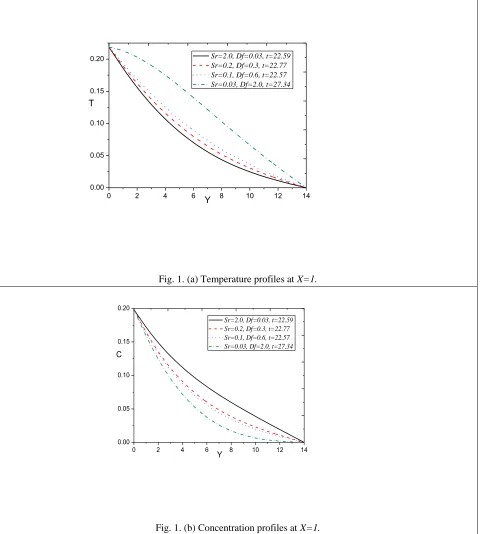
Figs. 1. (a) to 1. (b) represent profiles of non-dimensional temperature and concentration for various estimations of cross-diffusion parameters for
ε=0.6, M=0.5, ε1=0.1, ε2=0.5, m=0.5, n=0.5.
Figs. 1. (a) to 1. (b) show temperature and concentration profiles with an upgrade in Dufour number and simultaneous decrease in Soret number for steady state.
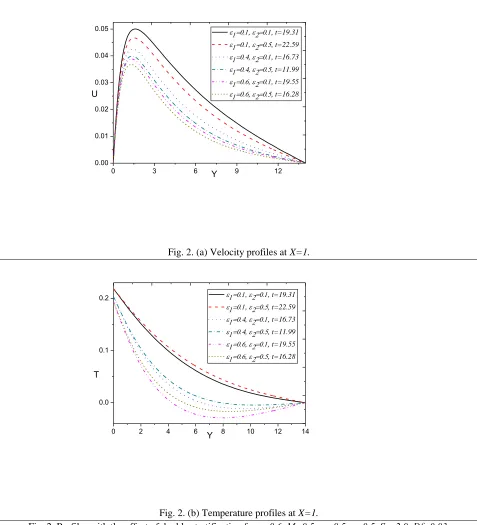
The variations in non-dimensional velocity, temperature for various values of thermal and solutal stratification parameters are investigated and plotted with ε=0.6, M=0.5, m=0.5, n=0.5, Sr=2.0, Df=0.03 in Figs. 2. (a) to 2. (b).
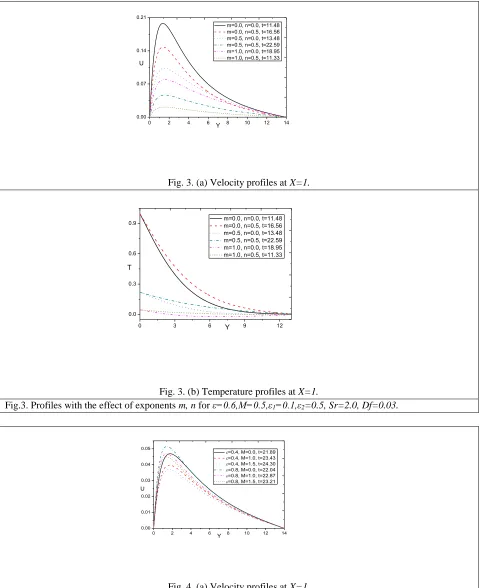
From Fig. 3. (a) to Fig. 3. (b) demonstrated the impacts of exponents in the power law variation of the both temperature and concentration m and n
values on non-dimensional velocity and temperature, profiles with ε=0.6,M=0.5,ε1=0.1,ε2=0.5, Sr=2.0,
Df=0.03.
The development of non-dimensional velocity for various values of the porosity and magnetic
parameter are illustrated and plotted with ε1=0.1,
ε2=0.5, m=0.5, n=0.5, Sr=2.0, Df=0.03 in Fig. 4. (a). IV. CONCLUSION
This paper analyses the problem of unsteady MHD free convective flow past a vertical plate with variable surface temperature and concentration with doubly stratified porous medium in the presence of porosity, Soret and Dufour effects. The resulting non-dimensional governing coupled partial differential equations are solved numerically by using the unconditionally stable implicit finite difference method of Crank-Nicolson type. The important findings of this study are listed as follows:
a) The decrease in the concentration profile and an increase in the temperature and velocity profiles with an increase in the value of the Dufour number (or simultaneous decrease in the Soret number).
b) For increasing value of the thermal stratification parameter, temperature depict the reverse trend while both velocity and concentration depicts the same trend. In case of a rise in value of the solutal stratification parameter, concentration, depict the reverse trend while velocity, temperature, depicts the same trend. More over it is also observed that, the value of time t at steady state decreases with an increase in the value of thermal stratification parameter and increases with an increase in the value of solutal stratification parameter.
c) The velocity and temperature decreases with an increase in the exponent m. But except temperature, velocity and concentration decrease with the rise in the exponent n. Further, to reach the steady state values, the required time is more when the exponents
m, n are more.
IJIRT 144234
INTERNATIONAL JOURNAL OF INNOVATIVE RESEARCH IN TECHNOLOGY224
0 2 4 6 8 10 12 14
0.00 0.05 0.10 0.15
0.20 Sr=2.0, Df=0.03, t=22.59 Sr=0.2, Df=0.3, t=22.77 Sr=0.1, Df=0.6, t=22.57 Sr=0.03, Df=2.0, t=27.34
T
Y
Fig. 1. (a) Temperature profiles at X=1.
0 2 4 6 8 10 12 14
0.00 0.05 0.10 0.15 0.20
Sr=2.0, Df=0.03, t=22.59 Sr=0.2, Df=0.3, t=22.77 Sr=0.1, Df=0.6, t=22.57 Sr=0.03, Df=2.0, t=27.34 C
Y
Fig. 1. (b) Concentration profiles at X=1.
IJIRT 144234
INTERNATIONAL JOURNAL OF INNOVATIVE RESEARCH IN TECHNOLOGY225
0 3 6 9 12
0.00 0.01 0.02 0.03 0.04 0.05
U
Y
t=19.31
t=22.59
t=16.73
t=11.99
t=19.55
t=16.28
Fig. 2. (a) Velocity profiles at X=1.
0 2 4 6 8 10 12 14
0.0 0.1
0.2 t=19.31 t=22.59
t=16.73
t=11.99
t=19.55
t=16.28 T
Y
Fig. 2. (b) Temperature profiles at X=1.
IJIRT 144234
INTERNATIONAL JOURNAL OF INNOVATIVE RESEARCH IN TECHNOLOGY226
0 2 4 6 8 10 12 140.00 0.07 0.14 0.21
U
Y
m=0.0, n=0.0, t=11.48 m=0.0, n=0.5, t=16.56 m=0.5, n=0.0, t=13.48 m=0.5, n=0.5, t=22.59 m=1.0, n=0.0, t=18.95 m=1.0, n=0.5, t=11.33
Fig. 3. (a) Velocity profiles at X=1.
0 3 6 9 12
0.0 0.3 0.6
0.9 m=0.0, n=0.0, t=11.48 m=0.0, n=0.5, t=16.56
m=0.5, n=0.0, t=13.48 m=0.5, n=0.5, t=22.59 m=1.0, n=0.0, t=18.95 m=1.0, n=0.5, t=11.33
T
Y
Fig. 3. (b) Temperature profiles at X=1.
Fig.3. Profiles with the effect of exponents m, n for ε=0.6,M=0.5,ε1=0.1,ε2=0.5, Sr=2.0, Df=0.03.
0 2 4 6 8 10 12 14
0.00 0.01 0.02 0.03 0.04 0.05
U
Y
=0.4, M=0.0, t=21.89 =0.4, M=1.0, t=23.43 =0.4, M=1.5, t=24.30 =0.8, M=0.0, t=22.04 =0.8, M=1.0, t=22.87 =0.8, M=1.5, t=23.21
Fig. 4. (a) Velocity profiles at X=1.
IJIRT 144234
INTERNATIONAL JOURNAL OF INNOVATIVE RESEARCH IN TECHNOLOGY227
REFERENCES
[1] Ingham, D. B., Pop, I., 2002, "Transport Phenomena in Porous Media II", Pergamon, Oxford.
[2] Vafai, K. (Ed.)., 2005, "Handbook of Porous Media", 2nd edition, CRC Press, Boca Raton.
[3] A. Nakayama and H. Koyama, 1987, "Effect of thermal stratification on free convection within a porous medium. J. Thermo physics and Heat Transfer", 1(3), pp.282-285.
[4] D. Srinivasacharya and Ch. RamReddy, 2011, "Free convective heat and mass transfer in a doubly stratified non-Darcy micropolar fluid". Korean J. Chem. Eng., 28(9), pp.1824-1832.
[5] P.V.S.N. Murthy, D. Srinivasacharya and P.V.S.S.S.R. Krishna, 2004, "Effect of double stratification on free convection in a Darcian porous medium". J. Heat Transfer 126(2), pp.297-300.
[6] P. Ganesan and R.K. Suganthi, 2013, "Free convective flow over a vertical plate in a doubly stratified medium with electrophoresis, heat source/sink and chemical reaction effects". Korean J. Chem. Eng., 30(4), pp.813-822.
[7] D. Srinivasacharya and Upendar Mendu, 2015, "Mixed convection in MHD doubly stratified micropolar fluid", J Braz. Soc. Mech. Sci. Eng., 37, pp.431-440.
[8] E.R.G. Eckeret and R.M. Drake, 1972, "Analysis of heat and mass transfer". McGraw Hill, Newyork.
[9] Z. Dursunkaya and W.M. Worek, 1992, "Diffusion-thermo and thermal-diffusion effects in transient and steady natural convection from a vertical surface". Int. J. Heat Mass Transfer. 35, pp.2060–2065.
[10] D. Srinivasacharya and Ch. RamReddy, 2011, "Mixed convection heat and mass transfer in a non-Darcy micropolar fluid with Soret and Dufour effects", Nonlinear Analysis: Modeling and Control, 16(1), pp.100–115.
[11] D. A. Nield, and A. V. Kuznetsov, 2011, "The Cheng–Minkowycz problem for the double- diffusive natural convective boundary layer flow in a porous medium saturated by a nanofluid", International Journal of Heat and Mass Transfer, 54, pp.374-378.
[12] P. Loganathan, D. Iranian and P. Ganesan, 2015, "Dufour and Soret effects on unsteady free convective flow past a semi-infinite vertical plate with variable viscosity and thermal conductivity". Int. J. Engineering and Technology, 7(1), pp.303-316.
[13] D. Srinivasacharya and Ontela Surender, 2015, "Effect of double stratification on mixed convection boundary layer flow of a nanofluid past a vertical plate in a porous medium", Applied Nanoscience, 5, pp.29-38.
[14] K. Javaherdeh , Mehrzad Mirzaei Nejad and M. Moslemi, 2015, "Natural convection heat and mass transfer in MHD fluid flow past a moving vertical plate with variable surface temperature and concentration in a porous medium", Engineering Science and Technology, an International Journal, 18, pp.423-431.
[15] K. Ekambavanan, P. Ganesan, 1994, "Finite difference solution of unsteady natural convection boundary layer flow over an inclined plate with variable surface temperature", Warme- und Stoffubertragung, 3, pp.63-69.
[16] Ibrahim A. ABBAS and G. Palani, 2010, "Effects of magnetohydrodynamic flow past a vertical plate with variable surface temperature", Appl. Math. Mech. -Engl. Ed., 31(3), pp.329-338.
[17] B. Shanker, N. Kishan, 1997, "The effects of mass transfer on the MHD flow past an impulsively started infinite vertical plate with variable temperature or constant heat flux", J. Energy, Heat Mass Transfer, 19, pp.273–278.
[18] P. Loganathan, D. Iranian and P. Ganesan, 2015, "Dufour and Soret effects on unsteady free convective flow past a semi-infinite vertical plate with variable viscosity and thermal conductivity. Int. J. Engineering and Technology", 7(1), pp.303-316.