E-ISSN 2308-9830 (Online) / ISSN 2410-0595 (Print)
Simulation-Based Proportional Study of Routing Protocols for
MANET
Faisal Ahmed1 and Fakir Mashuque Alamgir2
1 Graduate Teaching Assistant, Department of Electrical and Electronic Engineering, East West University,
Dhaka, Bangladesh
2
Senior Lecturer, Department of Electrical and Electronic Engineering, East West University, Dhaka,
Bangladesh
1[email protected], 2[email protected]
ABSTRACT
Wireless ad-hoc networks lately increased huge research consideration because of their huge capability of uses in numerous fields. Multihop routing is an imperative viewpoint which decides, to a substantial degree, the general execution of the system. A number of routing protocols have been proposed for routing in wireless ad-hoc networks with the focus on optimizing different aspects of the network routing. This paper focuses on studying two popular protocols for wireless networks: Ad-hoc On-Demand Distance Vector (AODV) and Optimized Link-State Routing (OLSR). The two protocols belong to different classes of routing categorization. The technical aspects of the two protocols is studied while highlighting the differences between the two and simulation-based performance comparison of the two protocols is carried out under varying traffic, mobility and network conditions using the Network Simulator.
Keywords:
Wireless Ad-hoc network, routing protocol, Network Simulator, AODV, OLSR.
1 INTRODUCTION
Mobile ad-hoc networks are a very popular type of networks which have a great variety of application in various fields. Due to the versatility of the network configuration topology and the need for faster and secure communication leave it a challenging job to provide reliant and secure routing protocol. So, mobile Ad-hoc networks are often more vulnerable than another type of networks. The overall performance of a mobile ad-hoc network depends on the routing protocol. The main purpose of this paper is to study two different type of routing protocols: Ad-hoc On-Demand Distance Vector (AODV) and Optimized Link-State Routing (OLSR), observing their role and performance in a network and compare their performances. For this purpose, we have performed some computer-aided simulation.
2 IMPLEMENTATION
2.1 Shell Script File
The ShellScript.sh is the main driving script of the simulation, which calls the network simulator to simulate a given network. This script automates the simulation process by handling multiple simulations in same time. Mainly the script provides the capability to vary the parameters such as network size, data rate, topology, and passes them dynamically to the network simulation executable.
2.2. Simulation Settings
Table 1: Simulation Parameters
Simulation Parameters
Value
Network Area 700×700
No. of Nodes 25,50,75,100
Traffic Area CBR/UDP
No. of Flows 5
Packet Size 1500 Bytes
MAC Protocol IEEE802.11b
Data Rate 11 Mbps
Frequency 2.5GHz
Propagation Model Two-Ray Ground
Simulation Time 2000s
2.3. Simulation Modeling
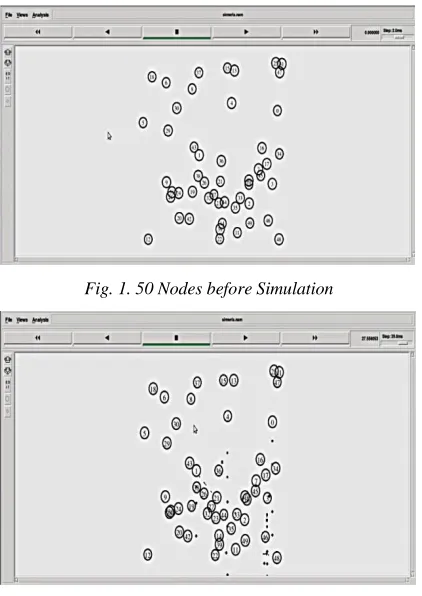
The following are the figures for nodes movement before and after simulation for 50 and 100 nodes.
Fig. 1. 50 Nodes before Simulation
Fig. 2. 50 Nodes after Simulation
Fig. 3. 100 Nodes before Simulation
Fig. 4. 100 Nodes after Simulation
3 PERFORMANCE EVALUATION
3.1 Performance Evaluation Varying Network size
Fig. 5. Packet Delivery Percentage for AODV and OLSR
Fig. 6. Packet loss Percentage for AODV and OLSR
The Fig.7 shows the comparison of end-to-end delay of the two protocols. The overall end-to-end delay for the two protocols is comparable but OLSR has a slightly higher delay compared to AODV. The primary reason is that, for larger topologies, OLSR creates more routing packets due to its proactive nature, which causes collisions and results in larger delays compared to AODV, creating so a similar routing overhead for all topologies.
Fig. 7. End-to-End Delay for AODV and OLSR
The figure is given below (Fig.8) shows comparison of routing overhead generated by the two protocols. OLSR being a proactive protocol creates a significantly larger routing overhead especially for larger topologies. OLSR generates a lot of HELLO and Topology Control messages, which results in larger overhead while AODV relies on infrequent Route Discoveries which generate less traffic.
Fig. 8. Routing Overhead for AODV and OLSR
The throughput is another representation of the Packet Delivery Ratio (Fig. 9). AODV provides a higher throughput for larger topologies because it has a smaller routing overhead compared to OLSR which creates a lot of overhead for larger topologies.
Fig. 9. Throughput for AODV and OLSR
3.2 Performance Evaluation Varying Traffic
performance of both protocols deteriorates as the load increases (Fig.10 and Fig.11).
Fig. 10. Packet Delivery Percentage for AODV and OLSR Varying Traffic
Fig. 11. Packet loss Percentage for AODV and OLSR Varying Traffic
Both protocols show comparable performance in terms of end-to-end delay, as the traffic load is increased on the network. Overall, both the protocols have increasing delays as the traffic load is increased because increased traffic on the wireless medium causes collisions which in turn necessitate retransmissions at MAC layer, resulting in larger end-to-end delays (Fig.12).
Fig. 12. End-to-End Delay for AODV and OLSR Varying Traffic
The biggest difference in terms of performance of the two protocols stems from the large difference in the routing overhead of the two protocols (Fig.13). OLSR, in general, generates a larger overhead being a proactive protocol while AODV generates a
smaller overhead as it creates routes only when required. It is also interesting to note that increasing the traffic has almost no impact on the routing overhead because the routing overhead is mainly dependent on the network size, which for this simulation remains constant.
Fig. 13. Routing Overhead for AODV and OLSR Varying Traffic
Similar to the results for Packet Delivery Rate, the throughput obtained with AODV is higher than that of OLSR mainly because of the problem of routing overhead and a higher collision rate in OLSR as the load increases (Fig.14). Overall, for both protocols, the throughput increases as the amount of traffic injected into the network increases.
Fig. 14. Throughput for AODV and OLSR Varying Traffic
3.3 Performance Evaluation Varying Mobility
Fig. 15. Packet Delivery Percentage for AODV and OLSR Varying Mobility
Fig. 16. Packet Loss Percentage for AODV and OLSR Varying Mobility
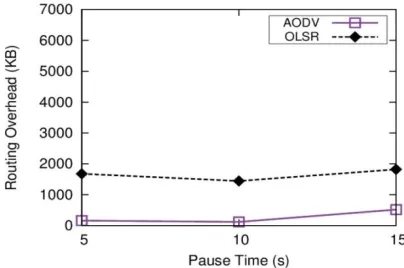
In terms of routing overhead, the important point to note is that the routing overhead remains more or less constant for both the protocols with AODV giving a smaller routing overhead due to its reactive nature. The overhead remains constant because it is mainly dependent on the network size and not on the mobility (Fig.17).
Fig. 17. Routing Overhead for AODV and OLSR Varying Mobility
In terms of end-to-end delay, the delay remains more or less constant as the mobility is varied (Fig.18). Both protocols are well equipped to handle mobility scenarios and therefore give acceptable performance.
Fig. 18. End-to-End Delay for AODV and OLSR Varying Mobility
In terms of throughput, the two protocols show similar performance as the mobility rate is varied (pause time 5s to 15s) (Fig.19). This is primarily because the two protocols differ significantly when the topology size changes, but for the case of mobility, the topology size is constant.
Fig. 19. Throughput for AODV and OLSR Varying Mobility
4 RESULT AND OBSERVATION
5 CONCLUSION
The aim of this work was to evaluate the performance of routing protocols AODV and OLSR. In this paper, based on the results of simulation a comparative analysis was done between selected routing protocols AODV and OLSR and the results were documented. The performance has been evaluated based on parameters that aim to figure out the effects of routing protocols. By comparing these protocol performances, this work justifies that the AODV routing protocol performs better compared to OLSR in terms of 1) End-to-end delay 2) Throughput 3) Packet loss 4) Packet delivery ratio 5) Routing overhead AODV is a reactive protocol and creates a very low routing overhead due to discovering routes only when needed, OLSR is proactive in nature. From the comparative analysis of routing protocols, the AODV outperforms the OLSR. The AODV has low load than OLSR respectively. From the above results, the behavior of all the routing protocols in the different number of mobile nodes, it can be seen that which routing protocol perform well. In terms of network size, mobility and traffic load AODV shows better results than OLSR. From the simulated results the behaviors of all routing protocols for different numbers of mobile nodes was observed and we came to the conclusion that AODV routing protocol performs well. The study of these routing protocols shows that the AODV is better in a wireless ad-hoc network according to the simulation results but it is not necessary that AODV perform always better in all the networks. Its performance may vary by varying the network. At the end, we came to the point that the performance of routing protocols varies with network size and selection of accurate routing protocols according to the network that ultimately influences the efficiency of that network in an efficient way.
6 REFERENCES
[1] S.Marti, T. Guiuli, K. Lai and M. Baker, “M R M v M H N k ,” P 6 AnnualACM/IEEE Mobile Computing and Networking, Boston, MA, Aug.2000, pp.255-265
[2] S. buchegger and J. –Y. Le Boudec, “P y CONFID NT Protocol: Cooperation Of Nodes-Fairness In Dynamic Ad- N k ,” P 3 IEEE/ACM Symposium on Mobile Ad
HocNetworking and Computing, Lausanne, CH, 9-11 June 2002, pp.226-236
[3] P. Michiardi and R. Molva, "CORE: A Collaborative Reputation Mechanism to Enforce Node Cooperation in Mobile Ad Hoc Networks," The 6th IFIP Conf. on Security Communications, and Multimedia, Porotoz, Slovenia, 2002.
[4] K G v P M , “T Computations and Trust Dynamics in Mobile N k : S v y”, IEEE Communications Surveys and Tutorials, 2012, pp.279-298
[5] D B J D M z, “Dy S R H W N k ”, Mobile Computing, Kluwer Academic Publishers, vol.353, pp. 153-181, 1996
[6] Y H P , “ S v y S W H R ”, IEEE S y Privacy, vol.2, no. 3, pp. 28-39, May 2004 [7] Jin-Hee Cho, Anathram Swami, Ing-Ray Chen,
“ S v y T M M H N k ”, IEEE Communications Survey & Tutorials, vol. 13, No. 4, FourthQuarter 2011
[8] P k G y D O’M y, “S R M N k ”, IEEE Communications Surveys, vol.7, No. 4 [9] Farooq Anjum, Dhanant Subhadrabandhu and
Saswati Sarkar "Signature based Intrusion Detection for Wireless Ad-Hoc Networks: A Comparative study of various routing protocols" in proceedings of IEEE 58th Conference on Vehicular Technology, 2003. [10]D U z , J I y , “E
Trust Metrics for MANET Using QoS P S R ”, The 2nd International Conference on Wireless
Broadband and Ultra Wideband
Communications (2007)
[11]Hongmei Deng, Wei Li, and Dharma P. , “R S y W H N k ” IEEE C ons M z • O 2002