COMPARATIVE STUDY ON RICE AND MAIZE BASED CROPPING SYSTEM AS INFLUENCED BY
ORGANIC NUTRIENT MANAGEMENT IN HILL AREAS OF NE INDIA
1
N.Khumdemo Ezung,
1ICAR Research Complex for NEH Region, Nagaland Centre, Medziphema,Nagaland 1Department of Agronomy, AAU, Jorhat, Assam
2Agriculture Technology Management Agency, Wokha, Government of Nagaland, Department of Agriculture, Wokha:797111, Nagaland
A R T I C L E I N F O
INTRODUCTION
Cropping system in the NER is also predominantly rice based with little exception in the state of Sikkim where maize is the main food crop. Rice cultivation in the region is under low input low risk and low yield condition. In the lowland mostly, mono-cropping of rice is practiced with the little exception in Tripura, Assam, parts of Garo hills etc, where rice
is practiced. The production of food grains in NE region is 5.97 million tonnes and the requirement are 7
and the requirement would be 15.24 million tonnes by 2021 (Sharma and Datta, 2006). In order to make the region self sufficient in food grain production, the productivity of rice and maize has to be increased from the present level
cultivated in Jhum under zero input supply and gives very low level of yield (1 to 1.5 t ha-1). The productivity of rice in the state of Tripura (23.57 q ha-1) and Manipur
higher than the national average, whereas all other states have lower productivity compared to national average
2011). In case of maize, the state of Manipur
ISSN: O: 2319-6475, ISSN: P: 2319-6505,
Available Online at www.journalijcar.org
Volume 8; Issue 05 (E); May 2019; Page No.
DOI: http://dx.doi.org/10.24327/ijcar.2019
Copyright©2019 N.Khumdemo Ezung, J.K.Choudhary and
Attribution License, which permits unrestricted use, distribution, and reproduction in any medium, provided the original work
Article History:
Received 06thFebruary, 2019
Received in revised form 14th March, 2019
Accepted 23rd April, 2019 Published online 28th May, 2019
Key words:
Cropping system, organic nutrient management, yield
*Corresponding author: N.Khumde1ICAR Research Complex for NEH Region, Nagaland Centre, Medziphema, Nagaland-797106, Indiamo Ezung,
COMPARATIVE STUDY ON RICE AND MAIZE BASED CROPPING SYSTEM AS INFLUENCED BY
ORGANIC NUTRIENT MANAGEMENT IN HILL AREAS OF NE INDIA
N.Khumdemo Ezung,
1J.K.Choudhary and
2Tiatula Jamir
ICAR Research Complex for NEH Region, Nagaland Centre, Medziphema,Nagaland Department of Agronomy, AAU, Jorhat, Assam-785013, India
Agriculture Technology Management Agency, Wokha, Government of Nagaland, Department of Agriculture, Wokha:797111, Nagaland
A B S T R A C T
The experiment was carried out at the experiment farm of ICAR, Nagaland Centre, Medziphema during 2015-16 and 2016-17 with the objectives to study the yield potential of rice and maize based cropping system under organic nutrient management. The experiment was laid out in SPD with three replications. The main plot treatment consisted of four combinations of two cropping systems (C), viz.,rice
greengram and two organic nitrogen management (N)., viz., 75 % RD through vermicompost and 100 % RD through vermicompost and the sub
of two organic phosphorus management practices
vermicompost and 100 % RD through vermicompost in greengram. Inglongkiri (upland rice), RCM-76 (maize) and Pratap (greengram).The study revealed that application of 100 % N through vermicompost showed significant effect on yiel
rice and maize. The effect of the main plot factor also showed significant carry over effect on the following greengram crop. It was observed that the sub plot factor showed significant effect with the application of 100 % P as compared with the application of 75 % P in greengram. The system economic analysis revealed that maize
the application of 100% N and 75% P resulted in the highest economic returns with a B:C ratio of 1.12 as compared with the rice-greengram system with the same treatment.
Cropping system in the NER is also predominantly rice based with little exception in the state of Sikkim where maize is the Rice cultivation in the region is under low In the lowland mostly, cropping of rice is practiced with the little exception in Tripura, Assam, parts of Garo hills etc, where rice-rice system The production of food grains in NE region is requirement are 7.6 million tonnes 24 million tonnes by 2021 In order to make the region self sufficient in food grain production, the productivity of rice and sent level. Rice is also cultivated in Jhum under zero input supply and gives very low The productivity of rice in the and Manipur (25.87 q ha-1) are s all other states have lower productivity compared to national average (Das et al.,
In case of maize, the state of Manipur (22.00 q ha-1),
Mizoram (18.75 q ha-1) and Nagaland
comparatively better productivity than national average al., 2011). Simply by adopting low cost agro
improved variety, proper time of
practices, effective recycling of resources etc, yield can be increased significantly.
The importance of highly intensive crop sequence is well recognized to meet the growing demands of ever
population. To fulfill the
intensification of cropping sequence is essential depending on the need of the area. Oilseeds and pulses are receiving more attention owing to higher prices due to increased demand Inclusion of these crops in sequence has been fou
beneficial. It is well established that the basic requirement for stabilizing the crop productivity lies in the betterment of soil fertility. But continuous intensive cropping sequence aggravates the problems of weed infestation, reduced soil fertility and infestation of other pests and diseases, which ultimately result in declining the efficiency and productivity of the system. After the resounding success of green revolution, a decline in rate of growth of food production was seen during the recent past in respect of crop productivity and fertilizer input response. Current generalized recommendations with
6505, Impact Factor: 6.614
www.journalijcar.org
; Page No.18823-18827
//dx.doi.org/10.24327/ijcar.2019.18827.3606
houdhary and Tiatula Jamir. This is an open access article distributed under the Creative Commons Attribution License, which permits unrestricted use, distribution, and reproduction in any medium, provided the original work
N.Khumde1ICAR Research Complex for NEH Region, Nagaland Centre, Medziphema,
COMPARATIVE STUDY ON RICE AND MAIZE BASED CROPPING SYSTEM AS INFLUENCED BY
ORGANIC NUTRIENT MANAGEMENT IN HILL AREAS OF NE INDIA
Tiatula Jamir
ICAR Research Complex for NEH Region, Nagaland Centre, Medziphema,Nagaland-797106, India
Agriculture Technology Management Agency, Wokha, Government of Nagaland,
The experiment was carried out at the experiment farm of ICAR, Nagaland Centre, 17 with the objectives to study the yield potential of rice and maize based cropping system under organic nutrient management. The experiment was laid out in SPD with three replications. The main plot treatment consisted ropping systems (C), viz.,rice-greengram and maize-greengram and two organic nitrogen management (N)., viz., 75 % RD through vermicompost and 100 % RD through vermicompost and the sub-plot treatment consisted of two organic phosphorus management practices (P)., viz., 75 % RD through vermicompost and 100 % RD through vermicompost in greengram. Inglongkiri (upland 76 (maize) and Pratap (greengram).The study revealed that application of 100 % N through vermicompost showed significant effect on yield and yield attributes both in rice and maize. The effect of the main plot factor also showed significant carry over effect on the following greengram crop. It was observed that the sub plot factor showed as compared with the application of 75 % P in greengram. The system economic analysis revealed that maize-greengram system with the application of 100% N and 75% P resulted in the highest economic returns with a B:C
greengram system with the same treatment.
and Nagaland (20.00 q ha-1), has comparatively better productivity than national average (Das et Simply by adopting low cost agro-techniques like improved variety, proper time of sowing, intercultural practices, effective recycling of resources etc, yield can be The importance of highly intensive crop sequence is well recognized to meet the growing demands of ever increasing To fulfill the demand of food, oil etc, intensification of cropping sequence is essential depending on Oilseeds and pulses are receiving more attention owing to higher prices due to increased demand. Inclusion of these crops in sequence has been found more It is well established that the basic requirement for stabilizing the crop productivity lies in the betterment of soil But continuous intensive cropping sequence aggravates the problems of weed infestation, reduced soil lity and infestation of other pests and diseases, which ultimately result in declining the efficiency and productivity of After the resounding success of green revolution, a decline in rate of growth of food production was seen during t past in respect of crop productivity and fertilizer Current generalized recommendations with
Research Article
Ne India
respect to NPK fertilizers alone are pointing to soil fatigue; proving their decreased efficiency and thus need upward refinement and proper balance among the required nutrients. Farming in the north-east hill region is regarded as organic by default as the application of fertilizers and pesticides is meagre in this part compared to the other parts of the country. However, with increase in population and lesser production and productivity from traditional system of crop production in this region, there is need to increase the cropping intensity and convert the subsistence agriculture into a sustainable form like organic agriculture.
MATERIALS AND METHOD
The present investigation was carried out during 2015-2016 and 2016-2017 at the experimental farm of ICAR, Nagaland Centre, Medziphema where the climatic condition of the experimental area is sub-tropical humid. The annual average rainfall varies from 1500 mm to 2000 mm which is mainly received during April to October and from November to March the weather is generally dry. The mean summer temperature ranges between 19o C to 35o C, while in winter it rarely goes below 5oC. The soil was sandy loam in texture with pH 4.84, organic carbon (0.47%), N (147.39 kg ha-1), P2O5
(19.04 kg ha-1) and K2O (170.02 kg ha-1).
The experiment was laid out in split plot design with three replications. The treatment included cropping system (C), viz., rice-greengram (C1) and maize-greengram (C2), organic N
management (N), viz., 75 % RD through vermicompost (N1)
and 100 % RD through vermicompost (N2) and organic
phosphorus management (P) in the sub plot viz., 75 % RD through vermicompost (P1) and 100 % RD through
vermicompost (P2) in greengram.
RESULT AND DISCUSSION
Yield Attributing Characters and yield of rice and Maize
It was observed that the yield and yield attributes of rice and maize was significantly higher with application of 100 % RD of N as compared with the application of 75 % RD of N through vermicompost (Table 1-4).
Yield Attributing Characters and yield of Greengram
The Table 5 represents the effect of the main plot factor i.e., cropping system (C) and organic N management (N) on the yield attributes which were found to be significant. The data showed that in C2 as compared to C1, greengram produced
significantly more number of pods/plant, seeds/pod, test weight, seed and stover yield and HI. And, N2 was observed to
significantly improve upon these yield attributes in greengram compared to N1.
Effect of Organic Phosphorus Management (P)
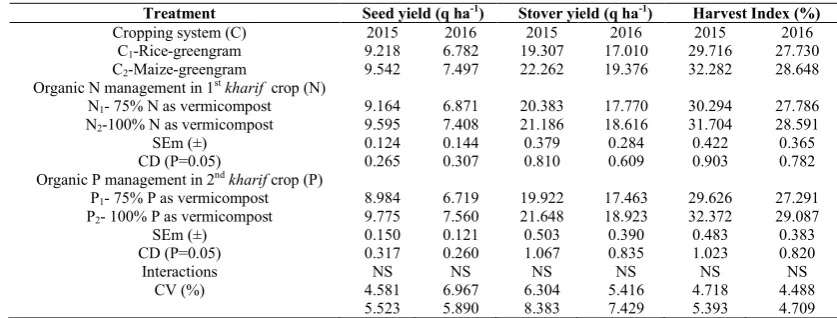
The data shown in Table 6 indicated that the significant effect of P, the sub-plot factor on the mentioned yield attributes in greengram. The data revealed that application of 100 % RD of P through vermicompost (P2) in greengram resulted in
significantly more number of pods/plant, number of seeds/pod, test weight, seed and stover yield and HI as compared with the application of 75 % RD of P through vermicompost in greengram.
Table 1 Effect of cropping system, organic n and weed management on yield parameters of rice
Treatment Tillers per hill Grains per panicle Panicle length(cm) Panicle weight(g)
2015 2016 2015 2016 2015 2016 2015 2016
C1N1L1 7.751 8.872 115.282 126.352 26.801 27.882 4.652 5.870
C1N1L2 9.382 10.241 132.003 144.571 28.292 31.273 5.650 7.543
C1N2L1 8.813 9.453 125.591 137.592 27.283 29.481 5.562 6.452
C1N2L2 10.640 11.444 148.334 162.544 30.344 35.284 6.244 8.881
Table 2 Effect of cropping system, organic n and weed management on yield parameters of rice
Treatment Test weight(g) Seed yield(q ha-1) Stover yield
(q ha-1) Harvest Index (%)
2015 2016 2015 2016 2015 2016 2015 2016
C1N1L1 17.430 19.430 15.170 16.270 29.591 30.272 33.9270 34.5922
C1N1L2 19.982 21.542 17.442 18.872 33.062 35.473 35.0503 35.0080
C1N2L1 19.283 21.142 16.743 17.883 31.033 33.471 34.5662 34.7393
C1N2L2 20.681 22.874 20.481 22.470 35.020 37.244 36.9041 37.6214
C1-Rice-greengram, C2-Maize-greengram, N1- 75% N as vermicompost, N2- 100% N as vermicompost, L1-Control (No mulching),
L2-Live mulching with cowpea
Table 3 Effect of cropping system, organic n and weed management on yield parameters of maize
Treatment Grains /cob Plants m-2 Cob length(cm)
2015 2016 2015 2016 2015 2016
C2N1L1 410.001 425.630 6.762 7.240 18.512 20.470
C2N1L2 475.962 489.573 7.853 8.142 20.283 22.511
C2N2L1 441.054 452.272 7.141 7.843 20.070 21.474
System Economics
The economic analysis of the system revealed that the application of 100 % RD of N and 75 % RD of P through vermicompost in maize-greengram system gave the highest economic return which obtained a B: C ratio of 1.61 as compared with the rest of the treatment combinations (Table7).
The finding on the influence of organic nitrogen application that the application of 100 % RD of N through vermicompost in rice and maize significantly increased the yield and yield attributes as compared with the application of 75% N through vermicompost. Similar findings was also reported by Murali and Setty, 2000; Sethil et al., 2010; Thirunavukkarasu et al., 2010 and Davari and Sharma, 2010.
Table 4 Effect of cropping system, organic n and weed management on yield parameters of maize
Treatment Test weight(g) Seed yield(q ha-1) Stover yield (q ha-1) Harvest Index (%)
2015 2016 2015 2016 2015 2016 2015 2016
C2N1L1 71.342 72.140 30.361 31.272 60.250 63.470 32.2712 32.9892
C2N1L2 89.071 90.872 39.452 41.123 73.583 75.583 35.0360 35.0913
C2N2L1 75.343 76.440 35.922 36.470 71.224 73.781 32.5801 33.0740
C2N2L2 90.490 92.243 44.920 45.581 79.260 81.240 35.9713 36.5774
C1-Rice-greengram, C2-Maize-greengram, N1- 75% N as vermicompost, N2-100% N as vermicompost L1-Control (No
mulching), L2-Live mulching with cowpea
Table 5 Effect of cropping system, organic N and weed management on yield parameters of greengram
Treatment Number of pods/plant Number of seeds/pod Test weight (g)
Cropping System 2015 2016 2015 2016 2015 2016
C1-Rice-greengram 28.701 23.032 9.848 7.552 34.392 31.372
C2-Maize-greengram 31.331 26.784 10.162 8.326 35.767 32.762
Organic N management in 1stkharif crop (N)
N1- 75% N as vermicompost 28.749 23.888 9.787 7.711 34.216 31.199
N2-100% N as vermicompost 31.283 25.928 10.224 8.137 35.943 32.935
SEm (±) 0.763 0.602 0.144 0.139 0.512 0.516
CD(P=0.05) 1.634 1.288 0.309 0.297 1.095 1.105
Organic P management in 2ndkharif crop (P)
P1- 75% P as vermicompost 27.723 22.890 9.677 7.611 33.851 30.838
P2- 100% P as vermicompost 32.309 26.926 10.334 8.237 36.309 33.295
SEm(±) 0.412 0.526 0.197 0.127 0.395 0.439
CD(P=0.05) 0.874 1.127 0.417 0.272 0.838 0.939
Interactions NS NS NS NS NS NS
CV (%) 8.811 8.370 5.001 6.074 5.051 5.576
4.757 7.322 6.814 5.565 3.903 4.739
NS- Not significant
Table 6 Effect of cropping system, organic N, weed and P management on yield parameters of greengram
Treatment Seed yield (q ha-1) Stover yield (q ha-1) Harvest Index (%)
Cropping system (C) 2015 2016 2015 2016 2015 2016
C1-Rice-greengram 9.218 6.782 19.307 17.010 29.716 27.730
C2-Maize-greengram 9.542 7.497 22.262 19.376 32.282 28.648
Organic N management in 1stkharif crop (N)
N1- 75% N as vermicompost 9.164 6.871 20.383 17.770 30.294 27.786
N2-100% N as vermicompost 9.595 7.408 21.186 18.616 31.704 28.591
SEm (±) 0.124 0.144 0.379 0.284 0.422 0.365
CD (P=0.05) 0.265 0.307 0.810 0.609 0.903 0.782
Organic P management in 2ndkharif crop (P)
P1- 75% P as vermicompost 8.984 6.719 19.922 17.463 29.626 27.291
P2- 100% P as vermicompost 9.775 7.560 21.648 18.923 32.372 29.087
SEm (±) 0.150 0.121 0.503 0.390 0.483 0.383
CD (P=0.05) 0.317 0.260 1.067 0.835 1.023 0.820
Interactions NS NS NS NS NS NS
CV (%) 4.581 6.967 6.304 5.416 4.718 4.488
5.523 5.890 8.383 7.429 5.393 4.709
NS- Not significant
Table 7 Economic analysis of the system
Treatments Cost of cultivation of
the system
Total gross return of the
system Total net return of the system
B:C ratio of the system
2015 2016 2015 2016 2015 2016 2015 2016
C1N1P1 111700 111700 10308015 152465.00 76315 40765.00 0.68 0.36
C1N1P2 129580 129580 10308015 165615.00 71085 36035.00 0.55 0.28
C1N2P1 119620 119620 11374830 168375.00 78610 48755.00 0.66 0.41
C1N2P2 137500 137500 11374830 183175.00 76380 45675.00 0.56 0.33
C2N1P1 121350 121350 22921800 249348.34 155000.00 127998.34 1.28 1.05
C2N1P2 139230 139230 22921800 261398.34 147620.00 122168.34 1.06 0.88
C2N2P1 133350 133350 27119600 283091.67 176991.67 149741.67 1.33 1.12
Ne India
The finding on maize was also supported by Jayaprakash et al., 2003; Atiyeh et al., 2000, Aracon et al., 2004, Kumar et al., 2007 and Meena et al., 2011, where they reported that application of vermicompost increased the yield and yield attributes. It was observed that with the increase in the levels of N, the effect on the yield and yield attributes increased. This observation was also supported by Mohadeseh et al., 2015, where they reported that the growth and yield attributes showed significant increase with the increase in the dose of vermicompost.
The efficacy of vermicompost application on increasing the yield of greengram was also reported by Rajkhowa et al., 2002; Bhatt et al., 2012 and Sushil et al., 2015, which confirms to the findings of the present investigation. The significant residual effect of vermicompost application on the succeeding greengram and other crops on yield and yield attributes were also reported by, Faujdar and Sharma, 2013; Dey and Paul, 2013; Pate et al., 2014; Tushar et al., 2014 and Alagappan and Venkitaswamy, 2016.
SUMMARY AND CONCLUSION
Upon application of 100% N through vermicompost, the yield and yield attributes of rice increased significantly as compared with the application of 75 % RD of N through vermicompost. Similar response was obtained from the maize crop where application of 100 % RD of N through vermicompost recorded the highest yield as compared with application of 75 % RD of N through vermicompost.
Cropping system and organic nitrogen management showed significant carry over influence on the succeeding greengram crop, where the application of 100 % N through vermicompost proved to be better in maize-greengram system as compared with rice-greengram system. The application of 100 % P and 75 % P through vermicompost in greengram also exhibited similar response on the yield of the greengram.
With regard to the treatments combined effect on the yield, the maize-greengram system with 100 % N and P outperformer the rest of the treatment interactions which is quickly followed by the application of 75 % N and P through vermicompost. For profitable and sustainable farming, maize-greengram cropping sequence may be practiced which was found to be more profitable as compared to rice-greengram under rainfed situation organic approach. Application of 100 % N in maize and 75 % P in greengram through vermi-compost not only increased the yield of maize but also the productivity of the sequence. However, in areas where there is limitation of vermicompost availability, application of vermicompost at 75 % N in maize and 75 % P in greengram may also be considered in maize-greengram sequence since the B:C ratio between the levels were almost at par with each other. Vermicompost, which formed an important component of this research, if it can be produced within the farm itself by the farmers’ where the crop biomass is readily available, the income of the farmers’ will be further increased.
Reference
Alagappan and Venkitaswamy, R 2016. Impact of different sources of organic manures in comparison with TRRI practice, RDF and INM on growth, yield and soil enzymatic activities of rice - greengram cropping
system under site - specific organic farming situation. American-Eurasian Journal of Sustainable Agriculture 10(2): 1-8.
Atiyeh RM, Dominguez J, Subler S, Edwards CA 2000. Changes in biochemical properties of cow manure processed by earthworms (Eisenia andreii) and their effects on plant growth. Pedobiologia 44: 709-724. Arancon N, Edwards CA, Bierman P, Welch C and
Metzger JD 2004. Influences of vermicompost on field strawberries: Effects on growth and yields. Bio-resource Technology 93:145-153.
Bhatt PK, Patel BT, Ravel CH and Vyas KG 2012. Effect of vermicompost and phosphorus levels with PSB on growth and yield of summer greengram (Vigna radiata L.) under north Gujarat conditions. Green Farming 3(6): 666-669.
Das A, Patel DP, Munda GC, Ghosh PK, Ngachan SV, Choudhury BU, Ramkrushna GI, Saha R, Rajkhowa DJ, Pamwar AS, Kumar R, Kumar M and Juri B 2011. Conservation agriculture in rice and maize based cropping systems :Principle and practices for NEH Region. Research Bulletin No. 75.
Davari MR and Sharma SN 2010. Effect of different combinations of organic materials and biofertilizers on productivity, grain quality and economics in organic farming of basmati rice (Oryza sativa L.). Indian Journal of Agronomy 55 (4): 290-294.
Dey JK and Paul SR 2013. Effect of in-situ greengram (Phaseolus radiatus) residue and nitrogen levels on toria (Brassica rapa) in rice (Oryza sativa) - greengram-toria sequence in Ultic Haplustalf. The Indian Journal of Agricultural Sciences 46(3) 67-74. Faujdar R S and Sharma M 2013. Effect of FYM,
biofertilizers and zinc on yield of maize and their residual effect on wheat. Journal of Soils and Crops 23(1): 41-52.
Jayaprakash DC, Sawant PS and Singh RS 2004. Effect of vermicompost on growth and yield of maize as well as nutrient uptake. Indian Journal of Agronomy 23(1):121-123.
Kumar P, Singh H, Hooda R S and Singh VP 2007. Effect of nitrogen levels and biofertilizers on productivity, soil properties and rhizosphere micro flora under pearl millet - wheat cropping system. Research on Crops 8(1): 72-76.
Meena KN, Kumar A, Rana DS and Meena MC 2011. Productivity and nutrient uptake of maize (Zea mays L.) - wheat (Triticum aestivum) cropping system under different bio- resource and nitrogen levels. Indian Journal of Agronomy 56(3): 182-188.
Mohadeseh VN, Mobasser HR and Ganjali H R 2015. Effect of different levels of vermicompost on yield and quality of maize varieties. Biological Forum - An International Journal 7(1): 856-860.
Murali MK and Setty RA 2000. Effects of levels of NPK, vermicompost and growth regulators (Triacontanol) on growth and yield of scented rice. Mysore Journal of Agricultural Sciences 34(4): 335-339.
succeeding crop. International Journal on Agriculture Sciences and Veterinary Medicines 2(4): 47-52.
Rajkhowa DJ, Saikia M and Rajkhowa KM 2002. Effect of vermicompost and levels of fertilizer on greengram. Legume Research 26(1): 63-65.
Sushil V, Lal EP and Rao KP 2015. Studies on integrated nutrient management on seed yield and quality of greengram (Vigna Radiate L.). International Journal of Recent Research in Life Sciences 2(2): 42-45.
Thirunavukkarasu M and Vinoth R 2013. Influence of vermicompost application along with nitrogen on growth, nutrients uptake, yield attributes and economics of rice (Oryza sativa L.). International Journal of Agriculture, Environment & Biotechnology 6(4): 599-604.
Tushar RM, Pravat KR and Kumar SM 2014. Energetics of greengram (Vigna radiata L.) production as affected by residual effect of rice establishment methods and nutrient management practices in rice - greengram cropping system. Journal of Agriculture and Veterinary Science 7(7): 51-54.
How to cite this article:
N.Khumdemo Ezung, J.K.Choudhary and Tiatula Jamir (2019) 'Comparative Study on Rice and Maize Based Cropping System as Influenced by Organic Nutrient Management in Hill Areas of Ne India', International Journal of Current Advanced Research, 08(05), pp.18823-18827. DOI: http://dx.doi.org/10.24327/ijcar.2019.18827.3606