Irreversibility Fields in NbTi Superconducting
Wires with Different Filament Diameters
Tsugio Hamada
National Institute of Technology, Miyakonojo College, Miyazaki 885-8567, Japan
Yusuke Hisamatsu
National Institute of Technology, Miyakonojo College, Miyazaki 885-8567, Japan
Hideki Noji
National Institute of Technology, Miyakonojo College, Miyazaki 885-8567, Japan
Abstract- The irreversibility fields in multifilamentary Nb-Ti wires were measured and were found to be seriously suppressed due to the flux creep at high temperatures while the critical current density was fairly large. This is explained by the small pinning potential as compared with a bulk specimen, since the pinning potential is limited by the size of filaments. The experimental results are compared to the prediction based on the flux creep theory. Quantitative difference exists in the vicinity of the critical temperature. This difference could be explained by the statistical method on the inhomogeneity in the specimens.
Keywords – Pinning Potential, Irreversibility Field, Superconductor, Nb-Ti Wire, Flux Bundle
I.
I
NTRODUCTIONThe irreversibility field of high temperature superconductor was suppressed seriously by the large thermal agitation of flux lines at high temperatures [1,2]. According to the flux creep theory [3], irreversibility field is governed by the magnitude of pinning potential. Recently, it was found that the irreversibility field of a thin film under a normal magnetic field was fairly smaller than that of a bulk specimen in spite of the larger critical current density. This result can be explained from the pinning potential. In this paper, we are going to explain the phenomenon by using a metallic superconductor that the pinning mechanism has been clarified. The pinning potential, Vb, is proportional to the flux bundle [4], given as
(1)
for a bulk superconductor, where is the number of fluxoids inside the flux bundle, is the fluxoids spacing, and is the longitudinal correlation length of the fluxoids. If the size of superconductor, D, is smaller than , is limited by D and given by
(2)
instead of Eq. (1). Similar limitation of the irreversibility field has been observed for multifilamentary wires with fine filaments even for a metallic superconductor. In this study, the irreversibility field in multifilamentary Nb-Ti wires is measured to investigate the validity of the description of the pinning potential in the collective flux creep theory for small superconductors.
II. EXPERIMENTS
Specimens investigated are Cu matrix Nb-47wt%Ti multifilamentary wires with fine filaments. The specifica-tions of the specimens are listed in Table 1. The specimens were cut in units of 150 mm and were wound into a coil with a diameter of 7 mm. The magnetic field was applied normal to the wire up to 7 T. The critical current density, , was estimated from the measurement of DC magnetization curve using the so called FC (Field Cooled) and ZFC
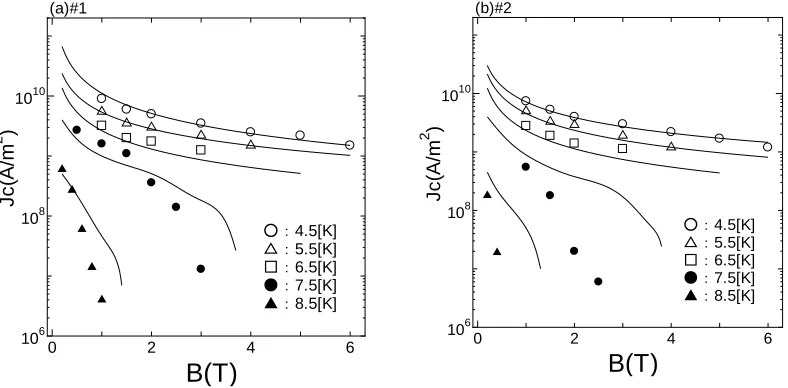
Figure1. Critical current density vs. DC magnetic field of multifilamentary Nb-Ti wire specimens (a) #1 and (b) #2 at different temperatures. Solid lines show the virtual value given by Eq. (3) with the pinning parameters listed in Table 2.
(Zero Field Cooled) processes using a SQUID magnetometer. FC is a method to measure the magnetization for decreasing the temperature while applying a magnetic field to the superconductor. ZFC method is lowering the temperature of the superconductor in the magnetic field of zero. By comparing these two results, the magnetization value can be measured the irreversibility temperature. Inhomogeneity of the filament on the crosssectional surface is investigated by a SEM (scanning electron microscope) equipment.
III.
E
XPERIMRNT AND RESULTThe critical current density, , is estimated from the hysteresis of the magnetization, , in the formula, where is the filament diameter. The results of the magnetic field, B, dependence of of specimens #1 and #2 at difference temperatures are shown in Figs. 1. (a) and (b), respectively. The value of #1 is larger than that of #2. The virtual critical current density, , in the flux creep-free case can be approximately obtained at low temperatures because the effect of thermal agitation is negligible. The is expressed by
(3)
where A, m, , and are pinning parameters.
Specifications of the multifilamentary Nb-Ti wires used in this study are shown in Table 1. The multifilamentary Nb-Ti wire is generally developed for an application of using in a field of Alternating Current. For the design, Filament diameter, Filament spacing, and Twist pitch are important parameters. That is, electrical loss does not occur in a field of Direct Current in superconducting state. But, in the Alternating Current, a certain loss occurs in spite of the superconducting state. The loss can be decreased with considering the above parameters.
Table 1. Specifications of Nb-Ti specimens
Specimen no. #1 #2
Wire diameter [ ] 0.144 0.300
Filament diameter [ 1.26 2.62
Filament spacing [ 0.31 0.64
Twist pitch [ 1.46 5.35
The number of filaments 4152 4152
Critical temperature [ 9.12 9.02
0 2 4 6
106 108 1010
B(T)
J c (A /m 2 ) ○:4.5[K] △:5.5[K] □:6.5[K] ●:7.5[K] ▲:8.5[K] (b)#20 2 4 6
Figure2 Irreversibility field of specimens (a) #1 and (b) #2. Solid lines show the theoretical results corresponding to the measurement of from .
The solid lines in Fig. 1 are determined so as to get a good agreement between Eq. (3) and experimental results at low temperatures (T < 7.0 K). The estimated pinning parameters are listed in Table 2. There seem to be as large as usually observed values.
The irreversibility field, , and upper critical field, , are estimated from the measured results of FC (Field Cool) and ZFC (Zero Field Cool) processes.
Here we briefly explain how to estimate the Biand Bc2. Fig.3 shows a schematic illustration of B-T plane in a
superconductor. The Biand Bc2 have a dependence of temperature, respectively. The Biis usually in the vicinity of the
Bc2 for the strongly pinned superconductors. The reversible region where the critical current density becomes zero
despite of superconducting state exists between the Bc2 and the Bifor the weakly pinned superconductors. Fig.4 shows a
schematic illustration of the measurement of magnetization with changing the temperature and the magnetic field by the FC and ZFC processes.The applied magnetic field to the specimen for the decision of Tc is generally smaller than
the lower critical magnetic field, Bc1,.This is schematically shown the both ends arrow (ab) in Fig. 3. That is, the
specimen not superconducting state is applied the magnetic field at room temperature, and is cooled to the liquid helium temperature in the case of FC process. The magnetic fields are through the specimen because the specimen is not superconducting state. When the specimen transits to the superconducting state at Tc, some fluxoids cannot move in
order to be pinned. Therefore, the change of magnetization is not larger than that of the ZFC process in Fig.4. On the other hand, the magnetic field is applied to the specimen of superconducting state in the case of the ZFC process. Therefore, the fluxoids are not inside the specimen at low temperature. When temperature meets the Tc by increasing
temperature, the fluxoids penetrate immediately into the specimen. Therefore, the large magnetization signal is observed in this case.
Let us consider the Biand Bc2 with comparing the Figs. 3, 4 and 5. In the case of cooling from room temperature
along the both ends arrow (ab) in Fig. 3. The Tc to the applying magnetic field appears, and this magnetic field means
the Bc2 at this temperature. The fluxoids in the reversible region are moved by the Lorentz force, because the pinning
forces do not acted to them. The fluxoids are pined when the cooling temperature attains the temperature of the irreversibility region. This temperature means the irreversibility temperature, Ti, and the strength of magnetic field is
called as the Biat this temperature. The magnitude of the magnetization below the temperature of the irreversible
region is almost constant because the pinned fluxoids cannot move. Therefore, the reversible region in Fig.4 is decided between Tc(B) and Ti(B) against the certain magnetic field. Other Bi(T) and Bc2 (T) can be decided in the same manner
Table 2 Pinning parameters defined in Eq. (3)
Specimen A m
Figure 3. The reversible region where the critical current density becomes zero despite of superconducting state exists between the Bc2 (T) and the Bi
(T).
Figure 4. Bi(T) and Bc2(T) are decided by measuring the Figure 5. A schematic illustration of DC magnetization
magnetization using FC and ZFC processes. for weakly pinned superconductors.
using several magnetic fields. The is also determined by the magnetic field at which the obtained from the DC magnetization curve is equaled to . However,the above mentioned is obtained from another DC magnetization measurement (see Fig.5). The schematic illustration of DC magnetization at certain temperature is shown in Fig.5. The processes of FC and ZFC changed the temperatures in a constant magnetic field. On the other hand, The DC magnetization measurement is changed the magnetic fields at a constant temperature. The Bi(T)
and Bc2(T) are also decided as Fig.5. This is equivalent with the both ends arrow (cd) in Fig. 3. The results of and
of the two specimens are shown in Figs. 2 (a) and (b), respectively.
The open triangle symbol shows the result of determined from . The difference between and is small at low temperatures (T < 7.0 K) and become large with increasing temperatures. The values of determined from FC and ZFC magnetizations are comparable to those from for specimens #2 and is slightly larger than that from for specimens #1 in the range of 7.0 < T < 8.5K. The difference between the values from the two methods comes partially from the difference in the electric field which is lower for the measurement of FC and ZFC magnetizations, and hence, from this method is more close to .
According to the flux creep theory in which the size of superconductor is taken into account [6], the pinning potentials are given by
(4)
where is the Boltzman constant, and behaves a role to connect energy with temperature. is a constant depending on the kind of pinning center and is known for a strong and large pinning centers as in the present case. In terms of , the condition of the irreversibility field is written as
(6)
where the sinusoidal washboard potential is assumed. is the oscillation frequency of flux bundle and is the electric field criterion for determination of . From Eq. (4)-(6), we get the following two equations for the irreversibility field.
(7)
(8)
The calculated results of Bi from ∆M are shown by solid lines in Fig. 2, where the theoretically obtained is used in present region and is assumed. Within the range of FC and ZFC are slightly closer to
compared to the results of from due to the more strict criterions of and . These are not plotted in Fig. 2. For comparison, the broken lines show the results for a bulk specimens, where . It is found that the bulk value of is closer to . It was reported that of a bulk Pb-Bi specimen was close to in spite of the low critical current density .Thus, the smaller irreversibility field in multifilamentary wires is due to the restriction of the volume of the flux bundle by the collective flux creep theory. However, the theoretical result of is fairly larger than the experimental result in the vicinity of . This may be explained from the spatial inhomogeneity of the superconductor such as the critical temperature, the filament diameter and the flux pinning strength.
The influence of inhomogeneity for the pinning strength was studied by Hamada et al [5]. If we assume a sinusoidal washboard potential, the dependence of the activation energy on the current density U(j) is express as
, (9
)
where j is the current density normalized by the virtual critical current density in the creep-free case, . An electric field is induced even in the pinned state below the flux flow region by the thermally activated motion of fluxoids. According to the one-dimensional flux creep model, it is given by
(10)
where U and U’ are the activation energies for fluxoids motion forwards and backwards, respectively, in relation to the direction of the Lorenz force. Then Eq. (10) is written as
(11)
,where is calculated, and is the flux flow resistivity, for which the Bardeen-Stephen model is assumed . On the other hand, the contribution from the flux flow, Eff, is given by
Figure 6. The theoretically calculated irreversibility fields of specimens (a) #1 and (b) #2. They fit in the vicinity of the filament diameter as opposed to the results showed in Fig. 2.
Here we assume that the total electric field is simply given by E = , where Ecr is the electric field by the
flux creep.
From here, we consider an influence of distribution of the filament diameter. The ununiformity of the filament diameters in the cross-sectional surface is investigated by a SEM equipment. From the obtained SEM images, the standard deviations are estimated using a statistical method. The values obtained are listed in Table 3. We assume
(13)
We assume that the distribution of filament diameters is shown in the Gaussian distribution. Since should be positive, is approximately the mean value. K is approximately use K = 1.
The virtual critical current density, , which is shown in Eq.(3) is reconsidered to introduce a distribution of the filament diameter. In this study, we assume the size of the filament diameter, to affect the performance of the superconductor, value as written
(14)
We assume that only A depends on . When is smaller than , the filament has decreased performance of the superconductor because it’s snapped. When is bigger than , filaments are adjoin each other and become the lump. With the lump of the filament, the performance as the superconductor decreases. Thus, we have
) (15)
where A is a constant. As a result, the electric field is calculated by
f (16)
Table 3 Statistical parameters for using in the calculation Specimen
#1 1.26
#2 2.62
For more study, if we use the statistical parameters considered with longitudinal distribution of the filaments using the statistical estimation method, the calculation results will fit better with the experimental results. It is important for fabrication of the high quality multifilamentary wires to develop production technics and equipment so as to reduce the ununiformity of the filament diameters.
IV.CONCLUSION
The irreversibility field in multifilamentary Nb-Ti wire were measured and compared with the result of the flux creep theory. Following results are obtained.
(1) The irreversibility fields are remarkably suppressed due to the limitation of the filament size. Namely, the pinning potential is determined by the filament size when the longitudinal correlation length is larger than the filament size.
(2) The temperature dependence of the irreversibility field is approximately explained by the flux creep theory. However, the quantitative dependence of the irreversibility fields for the experimental data and theoretical data are explained by considering the distribution of filament diameter size.
REFERENCES
[1] T. Matsushita and N. Ihara, “Scaling Current-Voltage Characteristics in High Temperature Superconductor”, Proc. 7th Int. Workshop on
Critical Currents in Super-conductors , pp. 169-173, 1994.
[2] T. Matsushita., T. Tohdoh and N. Ihara, “Effects of inhomogeneous flux pinning strength and flux flow on scaling of current-voltage characteristics in high-temperature superconductors”, Physica C, vol. 259 , pp. 321-326, 1996
[3] T. Matsushita and N. Ihara, “Flux Pinning Characteristics of Y-Ba-Cu-O in the Vicinity of Irreversibility Line”, Proceedings of the 6th
International Symposium on Superconductivity in Japan, pp. 507-510, 1993.
[4] E.S.Otabe, T. Matsushita, T. Nakatani., N. Ihara, K. Noda, T. Umemura, M. Waka, M. and F. Uchikawa “IRREVERSIBILITY LINES IN Bi-2212 SUPER-CONDUCTORS”, Proceedings of the 6th International Symposium on Superconductivity in Japan , pp.499-502. 1993 [5] T. Hamada, T. Matsushita, B. Ni, T. Akune. and N. Sakamoto, “Change of irreversibility fields in pinning-strength-controlled