On Choice of Wavelet for DWT-DFT-SVD based
Image Watermarking Scheme
1
Mehak Saini,
2Dr. Priyanka
1,2Dept. of ECE, D.C.R. University of Sci. & Tech., Murthal, Sonepat, Haryana, India
Abstract
Watermarking has been identified as a promising solution to provide protection to the digital media from illegal manipulations by the hackers. Watermarking techniques in frequency domain are more robust as compared to spatial domain techniques. In frequency domain, many watermarking techniques based on disrete fourier transform, discrete cosine transform, singular value decomposition, discrete wavelet transform etc. have been reported inliterature. In this work, the effect of type of wavelet on a DWT-DFT-SVD based scheme has been examined with respect to image quality and robustness of the water marking schemes against various attacks.
Keywords
Digital Watermarking, Wavelet, Discrete Wavelet Transform (DWT), Discrete Fourier Transform (DFT), Singular Value Decomposition (SVD), YCbCr Color Space
I. Introduction
Information hiding has become an important research area in the fields of computer aided manufacturing systems and electronics and communication engineering [1]. In recent times, manipulation, distribution and duplication of digital data has become very easy due to huge developments in the field of information technology.
Original Watermark
Extracted Watermark signal
Embedding
Watermarked image Original Image Extraction
Fig. 1: Block Diagram of Watermarking Scheme [3]
This necessitates a technique to ensure copy right protection of digital data and to prevent illegal tampering of digital data by unauthorized users.
Digital watermarking is a solution to these problems. It has emerged as a simple technique to retrieve the right owner information, thus, to ensure content authentication. Basic block diagram of watermarking scheme (as shown in the fig. 1), illustrates that it includes the insertion of information (watermark) into the digital image and later its extraction for authentication and owner identification [2]. Other applications of digital watermarking includes broadcast monitoring, finer printing, in field of telemedicine and indexing etc [4]. Main constraints for watermarking schemes are to maintainrobustness of the watermark information while keeping the quality of the original image intact.
Digital watermarking is mostly addressed in either spatial or frequency domain. Spatial domain methods involve the embedding of data directly by manipulation of pixel values, code values of the host image/signal or bit stream. Inspite of being straight forward and simple, these methods are not robust in the presence of attacks [2]. To improve the robustness, most of the present work in this area is inspired by the manipulation of the frequency domain of the multimedia objects. In frequency domain, researchers have selected different transformation methods for embedding and extracting watermark objects. These includes Discrete Cosine Transform (DCT) [5], Discrete Fourier Transform (DFT) [6-8] and discrete wavelet transform [9-10] etc. Use of DCT results in a robust scheme (with respect to JPEG compression), but, it is sensitive to geometrical distortions [8]. This disadvantage is overcome by the use of DFT, which is rotation invariant and translation resistant [8].
Many hybrid image watermarking schemes have been developed by the researchers to get the benefit of two or more techniques. In a hybrid scheme based on DWT and SVD, the watermark is embedded on the elements of singular values of the DWT sub-bands of cover image [11]. This technique is further enhanced by adding the concept of Discrete Cosine Transform (DCT) [2]. To further improve the robustness and efficiency of watermarking scheme, DWT-DFT-SVD based scheme is used [12] and is extended to YCbCr colour space [8].
In this work, the effect of type of wavelet, i.e., Haar, Biorthogonal 1,Coiflets 1 and Daubecies 3 on the performance of a DWT-DFT-SVD based scheme [8] has been examined with respect to image quality and robustness of the water marking schemes against various attacks. Rest of the paper is organized as follows:A brief introduction to the watermarking scheme is given in the next section. Performance measures are elaborated in section III, Simulation results are presented in section IV followed by conclusion & list of references.
II. DWT-DFT-SVD based Water Marking Scheme [8]
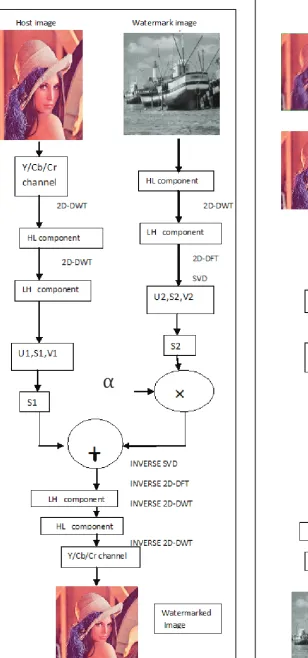
In this section, a brief summary of the steps involved in the embedding and extraction of watermark for the DWT-DFT-SVD based water marking scheme [8] (analyzed in this paper) is presented withhelp of flowchart as shown in fig. 2 and 3 respectively. Main features of thisscheme are as follows [8]:
Use ofYCbCr colourspace helps to achieve better correlation 1.
between theactualandextractedwatermark.
With help of Discrete Wavelet Transform (DWT), the image 2.
can be decomposed into four wavelets and any of thesub bands can be chosen as per individual requirements.
Use of Discrete Fourier Transform (DFT) helps to make 3.
the scheme resistant to geometric attacks as DFT is rotation invariant and translation resistant.
Singular Value Decomposition (SVD) helps to get a smaller 4.
61
The performance of the scheme isexamined[8] for seven 5.
different pairs of standard images. Also, the performance evaluation has been made in the presence of various attacks, like, motion, averaging,cropping etc.
α
Fig. 2: Insertion of Watermark
α
III. Performance Measures
The imperceptibility and robustness of the watermarking schemegiven in section II is tested in this paper for different types of wavelets, i.e., Haar, Biorthogonal 1, Coiflets 1 and Daubecies3. Peak signal to noise ratio (PSNR) (calculated by using eqn.1) between the cover image & watermarked image is used to test the imperceptibility of scheme.
(1)
Here, RMSE stands for root mean square error and is calculated by using eqn. (2).
(2)
Aij is a pixel of the host image of size X×Y and B_ij is a pixel of watermarked image of size X×Y.
Correlation coefficient (as calculated by eqn. (3)) between the original and extracted watermark is used as a measure of robustness of the scheme. It’s ideal value is one, yet, 0.7 is acceptable.
(3)
Worgij is a pixel of the host image of size X×Y and Wextij is a pixel of recovered watermarked image of size X×Y.
IV. Simulation Results
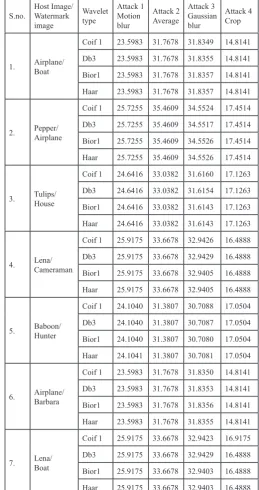
The performance of the proposed watermarking scheme for different types of wavelets is tested by simulation in MATLAB. Seven different Image pairs of size 512×512 are used as cover & watermark images respectively. The perceptual quality of the scheme is tested by calculation of peak signal to noise ratio (PSNR) between cover image and watermarked image. As shown in Tables 1& 2, peak signal to noise ratio values (between original and watermarked image) is sameor almost same for all the four types of wavelets in the absence of attacks and in the presence of motion blur, averaging and cropping and Gaussian blur attack for all the image pairs.
Table 1: PSNR Values (Between Original and Watermarked Image) for Different Types of Wavelets (Without Attack)
S.no. Host Image/Watermark image Wavelet type Without attack
1. Airplane/ Boat
Coif 1 57.0476 Db3 57.0476 Bior1 57.0476 Haar 57.0476
2. Pepper/Airplane
Coif 1 57.1144 Db3 57.1144 Bior1 57.1144 Haar 57.1144
3. Tulips/House
Coif 1 57.0957 Db3 57.0957 Bior1 57.0957
4. Lena/Cameraman
Coif 1 56.9806 Db3 56.9806 Bior1 56.9806 Haar 56.9806
5. Baboon/Hunter
Coif 1 57.0559 Db3 57.0559 Bior1 57.0559 Haar 57.0559
6. Airplane/Barbara
Coif 1 57.0476 Db3 57.0476 Bior1 57.0476 Haar 57.0476
7. Lena/Boat
Coif 1 56.9806 Db3 56.9806 Bior1 56.9806 Haar 56.9806
Table 2: PSNR Values (Between Original and Watermarked Image) for Different Types of Wavelets (in Presence of Attacks)
S.no. Host Image/Watermark image
Wavelet type
Attack 1 Motion blur
Attack 2 Average
Attack 3 Gaussian blur
Attack 4 Crop
1. Airplane/Boat
Coif 1 23.5983 31.7678 31.8349 14.8141 Db3 23.5983 31.7678 31.8355 14.8141 Bior1 23.5983 31.7678 31.8357 14.8141 Haar 23.5983 31.7678 31.8357 14.8141
2. Pepper/Airplane
Coif 1 25.7255 35.4609 34.5524 17.4514 Db3 25.7255 35.4609 34.5517 17.4514 Bior1 25.7255 35.4609 34.5526 17.4514 Haar 25.7255 35.4609 34.5526 17.4514
3. Tulips/House
Coif 1 24.6416 33.0382 31.6160 17.1263 Db3 24.6416 33.0382 31.6154 17.1263 Bior1 24.6416 33.0382 31.6143 17.1263 Haar 24.6416 33.0382 31.6143 17.1263
4. Lena/Cameraman
Coif 1 25.9175 33.6678 32.9426 16.4888 Db3 25.9175 33.6678 32.9429 16.4888 Bior1 25.9175 33.6678 32.9405 16.4888 Haar 25.9175 33.6678 32.9405 16.4888
5. Baboon/Hunter
Coif 1 24.1040 31.3807 30.7088 17.0504 Db3 24.1040 31.3807 30.7087 17.0504 Bior1 24.1040 31.3807 30.7080 17.0504 Haar 24.1041 31.3807 30.7081 17.0504
6. Airplane/Barbara
Coif 1 23.5983 31.7678 31.8350 14.8141 Db3 23.5983 31.7678 31.8353 14.8141 Bior1 23.5983 31.7678 31.8356 14.8141 Haar 23.5983 31.7678 31.8355 14.8141
7. Lena/Boat
63
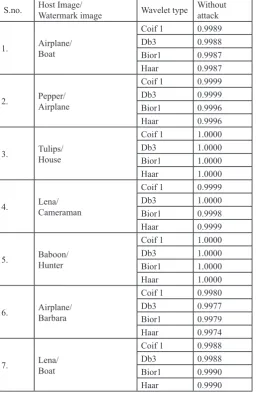
Table 3: Correlation Coefficient Values Between Original and Extracted Watermark Image for Different Types of Wavelets (Without Attack)
S.no. Host Image/Watermark image Wavelet type Without attack
1. Airplane/Boat
Coif 1 0.9989 Db3 0.9988 Bior1 0.9987 Haar 0.9987
2. Pepper/Airplane
Coif 1 0.9999 Db3 0.9999 Bior1 0.9996 Haar 0.9996
3. Tulips/House
Coif 1 1.0000 Db3 1.0000 Bior1 1.0000 Haar 1.0000
4. Lena/Cameraman
Coif 1 0.9999 Db3 1.0000 Bior1 0.9998 Haar 0.9999
5. Baboon/Hunter
Coif 1 1.0000 Db3 1.0000 Bior1 1.0000 Haar 1.0000
6. Airplane/Barbara
Coif 1 0.9980 Db3 0.9977 Bior1 0.9979 Haar 0.9974
7. Lena/Boat
Coif 1 0.9988 Db3 0.9988 Bior1 0.9990 Haar 0.9990
Table 4: Correlation Coefficient Values Between Original and Extracted Watermark Image for Different Types of Wavelets (In Presence of Attacks)
S.no. Host Image/ Watermark image Wavelet type Attack 1 Motion blur Attack 2 Average Attack 3 Gaussian blur Attack 4 Crop
1. Airplane/Boat
Coif 1 0.9988 0.9988 0.9988 0.9988 Db3 0.9988 0.9988 0.9988 0.9988 Bior1 0.9985 0.9985 0.9985 0.9985 Haar 0.9985 0.9985 0.9985 0.9985
2. Pepper/Airplane
Coif 1 0.9997 0.9988 0.9998 0.9998 Db3 0.9998 0.9998 0.9997 0.9998 Bior1 0.9993 0.9995 0.9995 0.9994 Haar 0.9993 0.9995 0.9995 0.9994
3. Tulips/House
Coif 1 0.9999 0.9999 0.9999 0.9999 Db3 0.9999 0.9999 0.9999 0.9999 Bior1 0.9998 0.9998 0.9998 0.9998 Haar 0.9998 0.9998 0.9999 0.9998
4. Lena/Cameraman
Coif 1 0.9999 0.9999 0.9999 0.9999 Db3 1.0000 1.0000 1.0000 1.0000 Bior1 0.9998 0.9998 0.9998 0.9998 Haar 0.9998 0.9998 0.9998 0.9998
5. Baboon/Hunter
Coif 1 1.0000 1.0000 1.0000 1.0000 Db3 1.0000 1.0000 1.0000 1.0000 Bior1 0.9999 0.9999 0.9999 0.9999 Haar 0.9999 0.9999 0.9999 0.9999
6. Airplane/Barbara
Coif 1 0.9978 0.9978 0.9978 0.9978 Db3 0.9977 0.9977 0.9977 0.9977 Bior1 0.9977 0.9977 0.9977 0.9978 Haar 0.9972 0.9972 0.9972 0.9973
7. Lena/Boat
Coif 1 0.9988 0.9989 0.9989 0.9988 Db3 0.9988 0.9988 0.9988 0.9989 Bior1 0.9985 0.9985 0.9987 0.9986 Haar 0.9985 0.9985 0.9987 0.9986
Thus, the perceptibility of the watermarking scheme [8], remains almost unaffected by usage of any of the four types of wavelets used in this work. To test the effect of type of wavelet used on the robustness of the scheme, correlation coefficients between original and extracted watermark is calculated for all the four types of wavelets for seven different image pairsagainst four types of attacks, i.e., motion blur, average, Gaussian blur and cropping. As shown in Table 3 & 4, maximum value of correlationcoefficients is obtained by the use of coiflet 1 wavelet (in the presence and absence of all types of four attacks). Results are almost equal forDaubecies3 type of wavelet. But, use of biorthogonal and Haar wavelet results in slightly reduced robustness as correlation coefficients for these wavelets are less as compared to coiflet1 and Daubecies3 types of wavelets.
V. Conclusion
Simulation results show that perceptibility of the scheme is unaffected by the type of wavelet used. But, maximum robustness of the scheme can be achieved by the use of Coiflet 1 wavelet.
References
[1] Mahendra Kumar, Poma Rewani, Aman,“Digital Image Watermarking using Fractional Fourier transform via image compression”, In Proceedings of IEEE International Conference on Computational Intelligence and Computing Research, pp. 1-4, 2013.
[2] Amit Kumar Sin, Mayank Dave, Anand Moan,“Hybrid Technique for Robust and Imperceptible Image Watermarking in DWT-DCT-SVD Domain”, National Academy Science Letters, Vol. 37, No. 4, pp. 351-358, 2014.
[3] Mehak Saini, Dr. Priyanka,“Digital Image Water Marking Techniques: State of the Art”, International journal of Research in Electronics and Computer Engineering, Vol. 4, Issue 4, pp. 55-59, 2016.
[4] Mohammad Ibrahim Khan, Md. Maklachur Rahman, Md. Iqbal Hasan Sarker,“Digital Watermarking for Image Authentication Based on Combined DCT, DWT and SVD Transformation”, IJCSI International Journal of Computer Science Issues, Vol. 10, No. 1, pp. 1-8, 2013.
[5] Huang-Chi Chen, Yu-Wen Chang, Rey-Chue Hwang,“A water-marking technique based on the frequency domain,” Journal of Multimedia, Vol. 7, No. 1, pp. 82-89, 2012. [6] Ante Poljicak, Lidija Mandic, Darko Agic,“Discrete Fourier
transform based watermarking method with an optimal implementation radius”, Journal of Electronic Imaging, Vol. 20, No. 3, pp. 033008-1 to 033008-8, 2011.
[8] Advith J, Varun K R, Manikantan K,“Novel digital image watermarking using DWT-DFT-SVD in YCbCr color space”, In Proceedings of IEEE Conference on Emerging Trends in Engineering, Technology and Science, pp. 1-6, 2016. [9] Anurada, Rudresh Pratap Singh,“DWT based watermarking
algorithm using Haar wavelet technique for digital images”, International Journal of Electronics and Computer Science Engineering, Vol. 1, No. 1, pp. 1-6, 2012.
[10] Pallavi Patil, D.S. Bormane,“DWT based invisible watermarking technique for digital images”, International journal of engineering and advanced technology, Vol. 2, No. 4, pp. 603-605, 2013.
[11] Chih-Chin Lai, Cheng-Chih Tsai,“Digital image watermar-king using discrete wavelet transform and singular value decomposition”, IEEE transactions on instrumentation and measurement, Vol. 59, No. 11, pp. 3060-3063, 2010. [12] Rahim Ansari, Mrutyunjaya, M. Devanalamat, S. Ramacand,
“Robust digital image watermarking algorithm in DWT-DFT-SVD domain for color images”, In Proceedins of IEEE conference on communication, information and computing technology, Mumbal, pp. 1-6, 2012.
Mehak Saini is B.Tech (ECE) and pursuing M.Tech from Deenbandhu Chhotu Ram University of Science and Technology Murthal, Sonepat (Haryana), India. She is a young Technocrat and Researcher. She has published 6 research papers in National/ International Journals. Her areas of Interest are Digital Water Marking Techniques, Optical Communication and Advanced Communication System.
![Fig. 1: Block Diagram of Watermarking Scheme [3]](https://thumb-us.123doks.com/thumbv2/123dok_us/1336267.1642143/1.595.37.292.437.587/fig-block-diagram-of-watermarking-scheme.webp)