Competitive Intelligence and Resource Based view of the Firm
Bhagat Singh (Research Scholar)
Dr. Sunita Tanwar (Assistant Professor)
Introduction
Any organization that fails to respond to the changes and challenges in its business environment cannot expect to remain in business for very long. The organization requires adaptability, flexibility, and an ability to create variety in order to survive in a changing, complex, and uncertain competitive environment.With the globalization of the world economy, rapid advance of technology and rising customer expectations, sustain a competitive advantage is become very difficult. Through the exploration of knowledge, organization develops valuable competencies. (Moingeon & Edmondson, 1996) (Sanchez & Heene, 1997). One of the ways to gain a comparative advantage in the market is application of competitive intelligence in business enterprises (Wright, Eid, & Fleisher, 2009) The ability to produce and use Competitive Intelligence will become a necessity in the near future for most organizations (Bose, 2008).
Despite the importance of systematic Competitive Intelligence the concept is still trying to find a footing in academic theory. The objective of this paper is to provide analysis of definition of Competitive Intelligence and how it is related to the theory of Resource based view of the firm.
Definition of Competitive Intelligence
Competitive Intelligence is not a new concept. Many competitive intelligence articles refer to the work of Sun Tzu, who some 2400 years ago wrote “The art of war” a seminal text which provides a detail description how to develop a military intelligence. (Rouach & Santi, 2001). In ancient time it was a practice of Spying and espionage. In 1815 Nathan Rothschild makes a fortune on London stock exchange due to his timely intelligence about battle of waterloo (Ferguson, 1998).In the modern era the Kelly’s Book “Marketing Intelligence: the Management of Marketing Information” considered to be the pioneering work in competitive
intelligence. It introduced the field of Intelligence. Nearly 30 years ago Porter reported that whilst companies were carrying this activity out informally, in his opinion this was nowhere near sufficient. He advocated the need for a structured intelligence process at all times inorder to continuously and systematically identify business opportunities and threats (Porter, 1980).Although competitive intelligence evolved out of marketing the activities of the discipline have come to serve all business functions. ``Research and development'' people seek to monitor rival organizations while safeguarding their own data. Possessing information such as the production capabilities of a competitor's factories, furthermore, can provide valuable insights. The financial health of a competitormay influence a decision to confront the rival ``head on'' or (as an alternative) to strategically avoid direct conflict. Although competitive intelligence began as a special area of marketing research, it has grown beyond its origins and today it provides information in all these areas (Walle, 1999) (Dishman & Calof, 2008).
In business and academics there are many synonym terms for competitive intelligence used by different researchers for example Environmental Scanning (Aguilar, 1967) , Business Intelligence (Pearce, 1976), Competitor analysis (Ghoshal & Westney, 1991), Marketing Intelligence (Kelley, 1965). Market Intelligence (Maltz & Kohli, 1996). Competitive Intelligence helps companies to sustains and develop distinct competitive advantages by using the entire organization and its networks to develop actionable insights about the environment (customers, competitor, regulars, and technology). It uses a systematic and ethical process involving, planning, collection, analysis, communication and management (Calof & Wright, 2008). According to Kahaner “Competitive Intelligence is a systematic programme for gathering and analyzing information about your competitor’s activity and general business trends to further your own companies’ goals” (Kahaner, 1998). The Society of Competitive Intelligence Professionals (SCIP) defines the competitive intelligence as follows: “Competitive intelligence (CI) is the process of monitoring the competitive environment. CIenables senior managers in companies of all sizes to make informed decisions about everything from marketing, R&D, and investing tactics to long-term business strategies.Effective CI is a continuous process involving the legal and ethical collection of information,analysis that doesn't avoid unwelcome conclusions, and controlled dissemination ofactionable intelligence to decision makers”
The term “CI” has been in popular use and practice for two or three decades. It has demonstrated staying power and is not viewed as “faddish.” A good number of associations, authors, business departments, consulting firms, practitioners and/or scholars have for years used the term with little ill effect and would see the costs, not benefits, associated with changing it. Also, extending this argument suggests that competitive intelligence is now viewed as an accepted, legitimate, and necessary activity in today’s global business world.
Competitive Intelligence and Business Intelligence
Sometimes CI is confused with business intelligence (BI). The difference between Business Intelligence and Competitive Intelligence is that BI is internal intelligence about and within the company, whereas CI is external intelligence about the firm’s competitive environment. CI Examples include analysis of the manufacturing or service capabilities of the competitors; analysis of alliances and/or joint ventures entered into by competitors; the competitor’s future plans and strategies for specific markets, or product lines; reasons behind changes in the corporate or business unit strategy (Britt, 2006).
Competitive Intelligence and Competitor Intelligence
The focus of Competitor Intelligence is on competitors and industry. It identifies and understands the competitors, their strengths, weaknesses, and anticipates their moves (Wright & Calof, 2006). It is the surveillance of the activities of rival firms whereas Competitive Intelligence is a broader concept. Competitive intelligence adds value to the organisation by connecting competitor intelligence with strategic planning. Competitor Intelligence is a subset of Competitive Intelligence. Competitor Intelligence focuses on short term effectiveness of the firms and problems associated with it, whereas Competitive Intelligence focuses on long term sustainability of the firm (Badr, 2003).
Competitive Intelligence and Marketing Research
marketing research (Dishman & Calof, 2008). Competitive Intelligence isn't confined to occasional research directed by organizations as for their rivals, markets and client inclinations. It is a continuous process which includes gathering and investigation of information as well as incorporating it into the key decision making procedure of the organizations (Bose, 2008) (Dishman & Calof, 2008). Owing to the accessibility of open source data and computing revolution, competitive intelligence has been developed. The other difference between competitive intelligence and marketing research is based upon responsibility; competitive intelligence team is not only responsible for data collection but also for defending the business's own proprietary information. Competitive Intelligence is considered a more comprehensive discipline that simultaneously serves other business functions (Walle, 1999).
The focus of marketing research tends to be on problems associated with the profitable marketing of a firm's product and services. The scope of CI is broader. CI is a valuable added concept that layers over the top of business development, market research and strategic planning. CI is done for the purpose of driving companies business decisions regarding marketing, products, prices, and marketing efforts in order to gain competitive advantage and it must be a total effort, practiced on a continuing basis. This discipline is strongly linked with marketing research and uses many marketing research techniques.
Theory of Strategy
The mechanics of how the firm can maximize its potential in the market place. Any organization’s environment is the sum of all the external factors that impact upon it in any manner and degree. There are different levels of environment of the organization like the industry in which organization operates, the city, the country, indeed the whole globe. There are also different kinds of environment: technological, economic, physical, social, and political. These are all factors of which the business strategist is at least subliminally aware. But the rates at which changes occur also vary - fastest in technology, less so in politics. Change requires a company to continuously monitor its environment. Strategy is future-oriented, and those who formulate it must be sensitive to the ways in which their company is vulnerable to change, and to how such changes will affect that future.
With the emerging era of rapid, systemic and radical change, Organization requires more flexible, systemic and dynamic approaches to strategy formulation. The old linear and static approaches require rethinking. Strategic competitiveness is achieved when a firm successfully formulates and implements a value creating strategy but it achieved competitive advantage only when competitors are unable to duplicate or find too costly to try to imitate its strategy. Firms without a competitive advantage at best earn average return. The probability of achieving strategic competitiveness in the 21st-century competitive landscape is enhanced for the firm that realize that its survival is depends on the ability to capture intelligence , transform it into usable knowledge and diffuse it rapidly throughout the company. (Ethiraj, Kale, Krishnan, & Singh, 2005). Therefore firm must develop and acquire knowledge, integrate it in to the organization to create capabilities and then apply it to gain a competitive advantage. To be strategically flexible, a firm has to develop the capacity to learn. A company has to learn and apply the knowledge throughout its business faster than its competitors. There are two modern schools of thought which describes how firms generate the information for strategic flexibility and Competitive Advantage.
• The Industrial/Organization(I/O) or Environmental Model of competitive advantage
The Industrial Organization (I/O) model of Competitive Advantage
It explains the external environment’s dominant influence on firm’s strategic actions. This model is grounded in economics and has four underlying assumptions. First the external environment is assumed to impose pressure and constraints that determine the strategies that would result in above average returns. Second, most firms competing within an industry or within a segment of that industry are assumed to control similar strategically relevant resources and to pursue similar strategies in light of those resources. Third, resources used to implement strategies are assumed to be highly mobile across firms, so any resource difference that might develop between firms will be short-lived. Fourth, organizational decision makers are assumed to be rational and committed to acting in firm’s best interest.
The Resource Based Model of Above Average Return
The Resource based model assumes that each organization is a collection of unique resources and capabilities. The uniqueness of its resources and capabilities is the basis of firm’s strategy and its ability to earn above average returns. Individual resources alone may not yield a competitive advantage. Resources are source of competitive advantage when they are formed into a capability. Resources and Capabilities that serves as a source of competitive advantage for a firm over its rivals are called core competencies.
Resource Based View and Competitive Intelligence
Wernerfelt argued that looking at firms in terms of their resources leads to different immediate insights than the traditional product perspective. Firms can identify the resources leads to high profit. Acquisition can be seen as a purchase of a bundle of resources in a highly imperfect market. Strategy for a bigger firm involves striking a balance between the exploitation of existing resources and the development of new ones. (Wernerfelt, 1984). Firm’s resources are heterogeneous and immobile. In order to attain sustained competitive advantage the firm’s resources should be valuable, rare, imperfectly imitable, and not substitutable. These resources and capabilities can be viewed as bundles of tangible and intangible assets, including a firm’s management skills, its organizational processes and routines, and the information and knowledge it controls (Barney, 1991). A major contribution of the resource-based model is that it explains long-lived differences in firm profitability that cannot be attributed to differences in industry conditions. According to resource based theory the firm performance is determine by the resources it owns.
Conclusion
References
Aguilar, F. J. (1967). Scanning the business environment. New York: Macmillan,.
Badr, A. (2003). The Role of Competitive Intelligence in Formulating Marketing Strategy.
Leicester UK: De Montfort University.
Barney, J. (1991). Firm Resources and Sustained Competitive Advantage. Journal of Management, 17 (1), 99-120.
Bose, R. (2008). Competitive intelligence process and Tools for intelligence analysis.
Industrial Management & Data system, 108 (4), 510-528.
Britt, P. (2006). The new competitive intelligence: raising the confidence quotient. KMWorld , 15 (10), 10-12.
Calof, J. L., & Wright, S. (2008). Competitive intelligence A practitioner, academic and inter-disciplinary perspective. European Journal of Marketing, 42 (7/8), 717-730.
Dishman, P. L., & Calof, J. L. (2008). Competitive intelligence: a multiphasic precedent to marketing strategy. European Journal of Marketing, 42 (7/8), 766-785.
Dishman, P. L., & Calof, J. L. (2008). Competitive Intelligence: A Multiphasic Precedent to Marketing Strategy. European Journal of Marketing , 42(7/8),766-785.
Ethiraj, S. K., Kale, P., Krishnan, M. S., & Singh, J. V. (2005). Where do capabilities come from and how do they matter? A study in the software service Industry. Strategic Management Journal .
Ferguson, N. (1998). The World's Banker: The history of the house of Rothschild.
Weidenfeld & Nicolson London.
Ghoshal, S., & Westney, D. E. (1991). Organizing competitor analysis systems. Strategic Management Journal, 12 (1), 17-31.
Kahaner, L. (1998). Competitive Intelligence: How to Gather,Analyze and Use Information to Move your Business to the Top. New York: Touchstone.
Kelley, W. T. (1965). Marketing Intelligence for Top Management. Journal of Marketing, 29 (4), 19-24.
Maltz, E., & Kohli, A. K. (1996). Market Intelligence Dissemination across Functional Boundaries. Journal of Marketing Research, 33 (1).
Moingeon, B., & Edmondson, A. (1996). Organizational learning and competitive advantage. Sage.
Pearce, F. T. (1976). Business Intelligence Systems: The Need , Development and Integration. hdustriai’ Marketing Management, 5 (2-3), 115-138.
Porter, M. E. (1980). Competitive strategy: Techniques for analyzing industries and competition. New york.
Prescott, J. E. (1999). The Evolution of Competitve Intelligence Designing a process for Action. Proposal Management , 37-52.
Rouach, D., & Santi, P. (2001). Competitive Intelligence Adds Value: Five Intelligence Attitudes. European Management Journal, 19 (5).
Sanchez, R., & Heene, A. (1997). Strategic learning and knowledge management. John Wiley and Sons Inc.
Walle, A. H. (1999). From Marketing Research to Competitive Intelligence : Useful Generalization or loss of focus? Management Decision, 37 (6), 519-525.
Wright, S., & Calof, J. L. (2006). The Quest for Competitive, Business and Marketing Intelligence: A Country Comparison of Current Practices. European Journal of Marketing, 40 (5/6), 453-465.
Wright, S., Bisson, C., & Duffy, A. P. (2012). Applying a behavioural and operational diagnostic typology of competitive intelligence practice: empirical evidence from the SME sector in Turkey. Journal of Strategic Marketing, 20 (1), 19-33.
Investigation On Harden Property Of Concrete By Using
Copper Slag In Place Of Fine Aggregate With Percentage
Inclusion Of Steel Fiber
POOJA PATIL N
AKSHATA MUSALE
Abstract
A huge mass of concrete is used in construction field in entire world.Gradually the sand is getting depleted and the natural resources are becoming scant hence Government is restricting sand quarrying, thus resulting in a significant increase in its cost. In this present study we are making copper slag as substitue for fine aggregate. Along with the copper slag we are adding steel fiber at different percentage so as to increase the strength. Steel fiber having aspect ratio of 50, and it is hooked end steel fiber.Test are done on compressive strength and acid resistance test and their results are tabulated for 3,7 and 28 days.
Keywords:, fine aggregate, Steel fibre
1. Introduction
Concrete is one of the important Building Material used in our construction field for different types of structure due to its Strength and Mould ability[2] .And it gives all requirements like Durability, fire resistance and impermeability for development of infrastructure[3].As this Aggregate acquires major part in concrete the scarcity of this material is increasing. Because of this problem we are moving with substitution of fine aggregate by other industrial waste materials, by this it contributes in reduction of use fine aggregate. Copper slag is one of the material waste generated in refinery part during extraction of copper metal and its appearance is like black glassy granular material[5] .It has huge quantity of iron oxide and its density is comparable high that any other material It is said that in India around 25 million ton of copper is generated per year. Only 15 to 20 % is used in construction industry and remaining is dumped off[3]. . In manufacture of pig iron, the bi product which we get is nothing but granulated blast furnace slag. It is used with ordinary Portland cement because of its good durability, and it extends building life span. It avoids formation of cold joint and gain strength at later period. By using granulated furnace slag the risk of damage is less and also attack of corrosion to reinforcement is less.
Dr.T.Ch Madhavi et al (2015) [8]Studied on copper slag effect on concrete with different
percentage of polypropylene fiber reinforced concrete.study states that copper slag can be used up to 30 to 50% exceeding that limit decrease strength, and fiber can be used up to 0.2%.Binaya Patnaik et al (2015)[3] studied the strength properties of concrete by using both
fiber and copper slag. Mix design is done for 20 and 30 grade,They say beyond 1% of steel fiber there is decrease in strength. But for split tensile test and flexural test the strength was increasing without any limit. As they used 2 grade of concrete for M20 they got strength of 11.5% increment and for M30 15.8%. Similarly for tensile test 12.45%, 18.94% for M20 and M30 grade respectively. And 22.97% and 22.38 %for M20 and M30 grade concrete for
flexural test. The aim of this research is Study on percentage increase in strength of member by replacement of fine aggregate. We used M40 Grade of concrete
2.Experimental Programme 2.1 Materials Used
The materials used were cement,sand,Coarse aggregate, copper slag and steel fibre. ordinary portland cement of grade43 with specific gravity of 3.14.The fine aggregate confirming to grading zone II as per IS 383-1970[7] .The specific gravity of the fine aggregate and coarse aggregate were 2.64 and 2.66 respectively. Adopted steel fiber of aspect ratio 50.
Mix Proportion
Design was done as per IS 10262-1982 to achieve characteristic compressive strength of 49.53 N/mm2 .
TABLE 1: MIX PROPORTION
Cement ( kg/m3 )
Fine aggregate
(kg/m3 )
Coarse aggregate
(kg/m3 )
Water (lit/m3)
350 707 1265 140
1 1.62 2.87 0.5
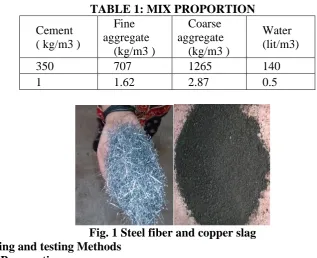
Fig. 1 Steel fiber and copper slag 2.2 Sampling and testing Methods
Specimen Preparation
The quantities of cement, fine aggregate and coarse aggregate were determined by weight. By using slump cone test method workability was checked. For the determination of compressive strength test, concrete specimens were cast in 0.150m x 0.150m x 0.150m cube steel.The specimens were covered with sacks for 24 hours to maintain the humidity. After 24 hours the specimen were demoulded and allowed for curing till the date of testing we have done testing on 3,7 and 28 days
2.3 Tests Conducted
Compression testAfter 28-days of curing the concrete cubes were removed from the curing.tank and the surface was wiped off.The compressive strength,test was conducted on a compression testing machine with a capacity of 200 Tonnes.For 1% steel fiber with 40% copper salg we got maximum compressive strength of 58.76N/mm2
Acid resistance test
care is taken the solution in maintained uniformity. After 30 days the cubes are removed and strength is checked. and we have got maximum strength 40.23 N/mm2 for 1% Steel fiber.
3. Results and Analysis
In this we shall study on compressive strength and Acid resistance test which was conducted by replacing fine aggregate. Achieved target strength results are studied based on our trial mix. The replacement is in the from 0%, 20%, 40% and 60% for mix of M40 grade
TABLE 2: COMPRESSIVE TEST RESULTS
COMPRESSIVE STRENGTH N/mm2
Replacemnt Fine aggregate +Copper slag Days %
steel added
100+0 80+20 60+40 20+60
3 0 15.89N/mm2 17.11N/mm2 17.98N/mm2 16.32N/mm2
0.5 15.89N/mm2 19.76N/mm2 22.14N/mm2 18.59N/mm2 1 15.89N/mm2 20.84N/mm2 25.5N/mm2 9N/mm2 1.5 15.89N/mm2 19N/mm2 22.7N/mm2 17N/mm2 7 0 30.56N/mm2 32N/mm2 35.29N/mm2 31.99N/mm2 0.5 30.56N/mm2 32.95N/mm2 37.95N/mm2 32N/mm2 1 30.56N/mm2 34.79N/mm2 42.11N/mm2 31.92N/mm2
1.5 30.56N/mm2 33.56N/mm2 40.59N/mm2 30.69N/mm2
28 0 41.9N/mm2 46.04N/mm2 49.56N/mm2 43.18N/mm2 0.5 41.9N/mm2 46.99N/mm2 52.87N/mm2 43.98N/mm2 1 41.9N/mm2 49.61N/mm2 58.76N/mm2 44N/mm2 1.5 41.9N/mm2 47.89N/mm2 56.76N/mm2 43.67N/mm2
Fig. 3 Variation in Compressive strength for 1% and 1.5% of steel fiber TABLE 3: ACID RESISTANCE TEST RESULTS
Acid Resistance test
Replacemnt Fine aggregate +Cooper slag
Days % steel added
100+0 80+20 60+40 20+60
28 0 0N/mm2 9.88N/mm2 18.28N/mm2 3.05N/mm2 0.5 0N/mm2 12.14N/mm2 26.18N/mm2 4.96N/mm2 1 0N/mm2 18.4N/mm2 40.23N/mm2 5.01N/mm2
1.5 N/mm2 14.29N/mm2 35.46N/mm2 4.22N/mm2
Fig. 4 Acid resistance test for 0 and 0.5% steel fiber
4.Conclusion
• The density of concrete goes on increased by adding copper slag.The slump value lies between 72 mm to 100 mm.
• For 0.5 %steel fiber addition to concrete gives percentage increase in strength from 24.95 to 39% for all 3 .7, and 28 days. Highest strength achieved is 52.87 N/mm2 at 28 days; hence 26 % increment is seen compared with nominal concrete. Similarly for 1% steel we get increase strength of 58.76N/mm2 that is, 40.23% increment in strength is achieved.
• At 1.5 % steel fiber we get decreased value in strength compared to 1%, the value decreased by 6% for 1% steel fiber.
• It has been seen that there is decrease in strength by 5 % with addition of copper slag by 60%.
• The Compressive strength increased by 18.28% for 40% slag with 0%steel fibre. As we go on adding steel fibre we were getting good strength but at 1.5%steel fibre and 40%slag we found that strength goes on decreasing.
• For acid resistance test, as the percentage of steel fiber goes on increasing there is no much variation in compressive strength Hence we can conclude that steel fiber concrete shows good durability against acid attack
References
[1] Al-Jabri Khalifa S, Hisada Makoto, Al-Oraimi Salem K, Al-Saidy Abdullah H, “Copper slag as sand replacement for high performance concrete”, Cement & Concrete Composites, Vol. 31, 2009, pp. 483–488.
[2] Wu Wei, Zhang Weide, Glowed Ma “Optimum content of copper slag as a fine aggregate in high strength concrete” Materials and Design, Elsevier science Ltd, Vol. 31, 2010, pp. 2878–2883.
[3] Binaya patnaik,seshadri sekhar An experimental investigation on strength properties of copper slag fiber reinforced concrete, volume 10, nov 2015
[4] Shi Caijun, Meyer, Behnood Ali, “Utilization of copper slag in cement and concrete” Resources, Conservation and Recycling, Vol. 52, 2008, pp. 1115 – 1120.
[5] R.R.Chavan and D.B.Kulkarni,Performance of copper slag on strength properties as partial replace of fine aggregate in concrete mix design.
[6 ]Arivalagan.S Experimental study on the flexural behavior of reinforced concrete beams as replacement of copper slag as fine aggregate, volume 3,issue 4:176-182(2013).
[7] J.Karthick,S.Suriya Experimental study on strength characteristics on M20 concrete with partial replacement of cement with fly ash and replacement with fine aggregate with copper slag,vol 1,issue1(july-sept 2014).
[8] Dr.T.Ch.Madhavi copper slag in concrete as replacement material,volumee5,issue 3 march 2014,pp 327-332.
Asset Management System: Criticality of Assets
Muhammed Shiyas.K.M
Abstract
Criticality assessment is a fundamental component of effective Asset Management. Criticality rating uses in asset management to identify the criticality of assets in various organizations throughout the world. Criticality is dealing with Asset Management and Maintenancehowever it plays an important role infacilitating many of the Asset Management functions. Through proper development of the criticality analysis,an organization will be able to know how to manage their assets and how it is critical to its regular operations. Awell-developed Criticality rating is beneficial to the organisation it impacts positively on decisionmaking and provides an objective guide when establishing appropriate responses for various end-user scenarios. Assigning criticality enables every organization to begin implementing the practice of Asset Management by providing a formal means to prioritize work activities and investments and to implement an effective maintenance management system.
Key Words: Criticality, Asset Management, Maintenance.
Introduction
Literature Review
It is very important to know the criticality of every assets owing by the organizations. It will help mainly to improve the performance and life of the assets also to avoid the asset failures. Criticality analysis is a process for determining the relative ranking of assets in a plant or system. The purpose is to objectively rank assets and form a collective agreement and analysis. The study based on Doha, Qatarand this paper outlines the development and implementation of a Risk based assessment of Criticality and discusses the application of Criticality in day-to-day Asset Management and Maintenance activities. A deeper understanding and follow-through with asset criticality strengthen maintenance planning and scheduling operations as industrial businesses learn how best to leverage predictive analytics through their CMMS.
What is Asset Criticality?
ISO 31000:2009 - Risk Management - Principles and Guidelines defines risk as “the effect of uncertainty on objectives”. The risk assessment process starts by first identifying risk events. In turn, these risk events have two dimensions:
• The consequence of an event
• The likelihood of an event
The overall level of risk is determined by the combination of these dimensions, visualised in a risk matrix.
or eliminate the potential likelihood or consequences of each failure mode (cause). This process is not intended to result in an overall criticality assessment at asset level.
However, assessing risk implies having to assess the likelihood of an eventwhich in turn means that we need to be clear about exactly which events are being assessed, and how the probability and consequences associated with multiple events on an asset item are to be rolled up to an overall failure risk associated with that asset. It is always advisable to consider the highest probability and consequences for the risk calculation. In other words, are we supposed to assess the risks assuming that we do not have any controls in place to minimise the likelihood or consequences of those failure events.
Why do you Need Criticality for Assets?
To determine the overall priority for performing a maintenance task
The priority for a maintenance task should be determined by the level of risk associated. The level of risk associated with asset is higher, it indicates that the asset is very critical for the particular organization. The higher risk is giving higher priority for the assets. The failure on any critical asset may can affect the regular operation of the organization which will affect reputation and other parameters affecting the performance of the organization.
To determine at a high level, the type of risk mitigation strategy to be applied to the asset The key issue with this type of approach for determining whether Predictive Maintenance, Preventive Maintenance or Run to Failure strategies are employed is that it fails to comply with the Concepts of Preventive Maintenance Development. The selection of maintenance strategy occurs at a task, not an asset level, and must be in response to the specific failure modes (causes) occurring on the equipment. In any way it is strictly advisable to make sure that a contingency plan are in place for very high criticality equipment items.
To determine the optimum spare parts holdings required for the asset
It requires to assess the risks (criticality) that we would be exposed to without holding the spare part in stock, and compare this with the risks that we would be exposed to if we did hold the item in stock. The level of risk reduction that results needs to be balanced against the costs of holding the spare part in stock. The risk is higher it is advisable to maintain the required quantity of the spares in the stock.
To provide input into the capital program to get high priority for upgrade or replacement One of the major factors in determining whether to replace or retire an item of an asset in its current condition. In addition, life cycle analysis will determine what the appropriate replacement schedule for an asset. The criticality will give a priority list to upgrade and replacement actives of the assets.
To support maintenance team for the improvement efforts on the most “critical” assets. Asset criticality can be valuable in terms of providing direction to the maintenance team for improving asset performance as to which asset items are more important, in an overall sense to the businessand therefore where they should be directing their efforts. In general, the asset is more critical to the business, then the team to be more careful regarding the decisions we make regarding that asset and therefore apply more rigorous analytical approaches when making decisions on critical assets.
How to Identify the Critical Assets
can target and refine investigative activities, maintenance plans, and financial plans at the most crucial and critical areas. Critical asset considerations may also include access to assets managed by third parties and sub-contractors.
Criticality can be assessed by applying broad assumptions about the implications of failure, for example, whether the non-availability of a major asset would have a significant impact on the operation of an organization. Depending on the criticality of the asset, the risk management approach may be at a network level, by ensuring that diversions are available and have minimal impact; at an individual asset level; or at a detailed component level, with extensive consideration of failure modes.
Criticality Assessment
Criticality assessment is a structured methodology that provides a proactive approach for the assessment of risks in the organisation. A comprehensive Criticality assessment wouldprovide a ranked list of systems and/or asset (a Criticality Ranking) identifying possible failure mechanisms, underlyingfailure rates, likelihood of impact from the failure and the consequences of the failure. The outcome of the assessment wouldtypically lead to risk management strategies for equipment which would benefit most from the application of a particularmanagement, operating or maintenance strategy. Criticality ranking also assists in making decisions about which equipment ismost important for planning and scheduling maintenance work as well as other management functions.
Criticality assessments can be carried out using various techniques. The more common systematic approaches to identifying and representing Criticality include ‘Qualitative Assessments’, ‘Semi-Quantitative assessments’ and ‘Quantitative Assessments’. Within each of these broad groupings a wide range of approaches are often used. Each approach has its merits and disadvantages and should be clearly understood by those undertaking the study before committing to a specific approach. For an initial assessment of criticality, or where information is limited upon which to base the assessment, a Qualitative or Semi-Quantitative approach is likely to be the most practical and can give effective results if well implemented. It is likely that the initial assessment would highlight the lack of suitable data as being a risk factor and the management of that risk may involve improved data collection and analysis in the future.
There are a wide range of risks, and their identification and evaluation is a crucial part of the asset management process. some common Criticality Ranking criteria include,
• Safety
• Reputation
• Operations
• Environmental
Operations
Operations having an effect on the operational process of the organization whether by interfering with their customers, Clint’s, Stakeholders, infrastructure or punctuality.
Environment
Environment having an effect or with the potential to affect land and/or air and /or wear equality or causing nuisance.
Finance
If the failure is realized, what is Organizations financial exposure, what is their total financial liability, how much would it cost to restore normality? The financial impact is defined as the loss of the company.
Reputation
Actions or incidents having an effect on the reputation of the company. Safety
Actions or omissions having a safety consequence. Risk Identification
in this step, it has to identifies the risks that could affect its objectives. These can be various i.e. internal and external. Th external risks such as price changes, legislative actions, Political, Social, Economical, extreme weather and climatic events, seismic events, or malevolent acts. Risks also can be internal, such as operational failures, data failures, conflicting internal program objectives, or a lack of trained personnel for key tasks. All risks are generally recorded in a formal risk register.
Risk Analysis
This step evaluates the probability of risk with its consequence. The calculation can be qualitative and based upon expert judgment, it can be quantified simply in a 1 to 10 scale, or it can be subject to complex mathematical modelling. Most such analyses are relatively simple. Regardless of the method used, the intent of this step is to understand the risks and their magnitude.
Risk assessment involves a determination of the likelihood and consequence of an event. Risk assessment allows the identified risks to be analysed in a systematic manner to highlight which risks are the most severe and which are unacceptably high. A senior leadership team in an organization can then determine its level of exposure to the risk and the actions necessary to minimize that risk.
Likelihood is the chance of an event happening, for example, a failure (asset as well as organizational). It can be measured objectively, subjectively, qualitatively, or quantitatively. It can be described using general or mathematical terms, such as frequency or probability. Issues to be considered include the following:
• Changes in policy and funding
• Current and historic performance of the asset
• Severity of the environment, rate of deterioration, and/or current age of the asset
• Asset type, material type, mode of failure, extent of failure, etc.
• Exposure to incidents of all types
• Human behaviour and workmanship
• Vulnerability to climate change
• Quality of the asset management approach and system
The likelihood of physical failure of an asset is related to the current condition of the asset, hence the importance of a realistic and accurate condition assessment. The likelihood of natural and external events is determined less easily, but scientific studies are usually available. The likelihood of other events, such as poor work practices or planning issues, can be difficult to ascertain.
Risk management is the framework to define the necessary treatments for the reduction of the different types of risk.
The steps of risk management occur within the context of continuous communication and consultation and continuous monitoring and review. The communication flows up and down the organization and into and out of it with stakeholders. Similarly, the monitoring occurs within the agency as well as outside it from oversight bodies, legislators, the media, and the public.
Understanding and management of risk is fundamental to effective asset management and should figure strongly in training and development programs for asset managers.
A Criticality Analysis can be carried out by applying Risk Analysis techniques to identify the Risk associated with particular equipment failure mechanisms in a specific operating context. The risk can be calculated by applying a score to the likelihood of an event occurring and another score to the expected consequences associated with each occurrence. These scores are multiplied together to give a risk score which can be used as a measure of criticality. The risk (or criticality) ranking is used to identify the most important assets in the organisation. Depending upon the range of scores available (1...5 each for Likelihood and Consequences in this example) and whether the scale is ascending or descending with increasing importance, the Risk ranking can range from a score of 1 through to 25.
Applicability of Criticality
The criticality assessment will be beneficial to the organisation if it impacts positively on decision making. In deciding how best to respond to various situations the criticality ranking is a useful guide in establishing typical responses for various end user scenarios. The development of project plans needs to take account of the criticality of different assets in the proposed operatingsystem, if maximum advantage is to be gained from the plant at the lowest cost. A clear and detailed understanding of an asset and system criticality is vital for decisions on reliability and the need for redundant equipment to achieve the design system reliability
studies. For example, when the system reliability requirements are greater than can be achieved by one unit alone it may be necessary to install a stand-by unit to ensure the system reliability targets can be met. The manner in which the equipment is used during normal operations has a significant impact on the reliability that can be achieved from individual machines and therefore ‘best practice’ operating practices must be enforced to maximise the utilisation of an asset and achieve the ‘Maximum Sustainable Capacity’ (MSC) of the equipment. Correctlyspecified equipment that is well operated and maintained has an ‘Inherent Reliability’ which sets the maximum reliability that can be reasonably expected from the equipment over time.
Backlog management quickly gets highlighted whenever maintenance and operating practices are being reviewed and is acommon point of conflict between the operations and maintenance groups. Much of the conflict arises because of a poorunderstanding of what jobs should be in the backlog and which shouldn’t. It is common practice in many organizations to consider any job known about but not yet completed, to be included in the backlog. The reason for keeping an inventory of spare parts is to control or avoid the consequences of failure of the equipment. Spare parts have to be managed to maintain the optimum trade-off between the cost of purchasing/holding spare parts and the consequences of not having these spares available when required. When the cost of sourcing a spare part off-site only when required (considering all costs especially downtime and lost product) is significantly greater than the cost of holding the spare in-house, the spare is usually held on site. This superficially simple cost-benefit analysis can be very difficult to carry out in practice especially for those parts infrequently or irregularly used or if their impact cannot be easily quantified in cost terms.
Documents such as operating manuals, maintenance manuals, drawings etc. are a vital resource for the organisation and must be the subject of rational management strategies just as hardware or other assets might be. Documents can be difficult and expensive to obtain and in the case of drawings expensive to produce. Across the board reductions in budgets have become almost routine in many organisations in pursuit of cost reductions and ever better efficiencies. Most common is the percentage-based reduction over a previous budget (e.g. 10% reduction in the maintenance budget compared to the previous year) which is often repeated in subsequent years and by subsequent management team members.
Conclusions
References
1) ISO 55001:2014-Asset Management System.
2) ISO 31000:2009 - Risk Management - Principles and Guidelines
3) Equipment Criticality Analysis – is it a Waste of Time?
(https://www.assetivity.com.au/article/reliability-improvement/equipment-criticality-analysis-is-it-a-waste-of-time.html)
4) Identifying critical assets (https://road-asset.piarc.org/en/data-and-modeling-risk/identifying-critical-assets)
5) Criticality: A Key Idea in Asset Management (https://icma.org/articles/article/criticality-key-idea-asset-management)
6) Criticality in Asset Management-Dr. J.A. Healy-JAHCon Physical Asset Management Pty. Ltd.
7) The Asset Criticality Ranking; Key to Any Reliability Improvement Programme (https://www.maintworld.com/Asset-Management/The-Asset-Criticality-Ranking-Key-to-Any-Reliability-Improvement-Programme)
8) Defining Holistic Asset Criticality to Manage Risk (https://www.lce.com/Defining-Holistic-Asset-Criticality-to-Manage-Risk-1414.html)
9) Why is Criticality Analysis important (https://www.lce.com/Why-is-Criticality-Analysis-important-1204.html)
10)Equipmentcriticalityanalysis(https://www.slideshare.net/rickysmithcmrp/chapter-54-equipment-criticality-analysis)
11) Equipment critical analysis: The need for an effective maintenance program
Rough Generalized Minimal And Maximal Closed Sets
K.UTHRA
K.BHUVANESWARI
J.SHEEBA PRIYADHARSHINI
Abstract: This paper introduced a new class of sets called Rough minimal and maximal
closed sets and Rough generalized minimal and maximal closed sets in Rough topological spaces which are subclasses of Rough generalized closed sets. Basic properties of Rough minimal and maximal closed sets and Rough generalized minimal and maximal closed sets are also analyzed.
Keywords: R-Min closed sets, R-Max closed sets, Rg-Min closed sets, Rg-Max closed sets
1. Introduction
In 1970 Levine[5] introduced the concept of generalized closed sets as a generalization of closed sets in topological spaces. Rough set theory proposed by Pawlak [6] is a new mathematical tool for data reasoning. The basic structure of rough set is an approximation space such as lower, upper and boundary approximations. The lower approximation of a set is the set of all elements that surely belongs to X, whereas the upper approximation of X is the set of all elements possibly belong to X. The difference between upper and lower approximation of X is its boundary region. Bhuvaneswari et al., [1] have introduced and investigate Nano generalized closed sets in Nano topological spaces. F. Nakaoka et al.,[3] [4] introduced minimal open set and, Some Properties of Maximal open sets. S.S.Benchalli et al., [2] have introduced generalized maximal closed sets topological spaces. In this paper we introduced a new class of sets called Rough minimal and maximal closed sets and Rough generalized minimal and maximal closed sets in Rough topological spaces and the relation of these new sets with the existing well sets.
2. Preliminaries
Definition 2.1[5]: A subset A of (X, ) is called a generalized closed set (briefly g closed) if cl A( )U whenever AU and U is open in X.
Definition 2.2[3]: A nonempty subset A of a topological space (X, τ) is called a minimal open (resp. minimal closed) set if and only if any open (resp. closed) subset of X which is contained in A, is either A or φ.
Definition 2.3[4]: A non-empty open set A of a topological space X is said to be a maximal open (resp. maximal closed) set if and only if any open (resp. closed) set which contains A, is either A or X.
Definition 2.4[6]: Let U be a non-empty finite set of objects called the universe and R be an equivalence relation on U named as indiscernibility relation Elements belonging to the same equivalence class are said to be indiscernible with one another. The pair K=(U,R) is said to be the approximation space. LetX U.
(i) The lower approximation of X with respect to R is the set of all objects, which can be for certain classified as X with respect to R and its is denoted by
U R
/
. That is,{ / : }
RX =UYU R Y X .
(ii) The upper approximation of X with respect to R is the set of all objects, which can be possibly classified as X with respect to R and it is denoted by
U R
/
. That is{ / : }
RX =UY U R Y X
(iii) The boundary region of X with respect to R is the set of all objects, which can be classified neither as X nor as not-X with respect to R and it is denoted by
( )
B
R X =RX−RX
Definition 2.5: Let U be the universe, R be an equivalence relation on U and { , , , B( ), }
R U RX R X RX
= where X⊆R.Then
R
satisfying the following axioms: (i)U and
R
(ii)The union of the element of any sub collection of
R
is in
R
.(iii) The intersection of the element of any finite sub collection of
R
is in
R
.R
forms a topology on U called as the rough topology on U with respect to X. We call (U,R
(X)) as the rough topological spaces.Definition 2.6[1]: A closed A of( ,U R X( )) is called a Nano generalized closed set
(briefly Rg closed) if Rcl A( )Vwhenever AV and V is Nano open in ( ,U R X( )) Definition 2.1[2]: A subset A of a topological space (X, τ) is said to be generalized minimal closed (briefly g-mi closed ) set if cl (A) ⊆ U whenever A ⊆ U and U is a minimal open in X.
3. Rough Minimal And Rough Generalized Minimal Closed Sets
In this section, the concepts of Rough minimal closed sets and Rough generalized minimal closed sets are defined and studied some of its properties.
Definition 3.1: Let ( ,U R X( )) be a rough topological space. A non-empty rough closed (resp. rough open) set A of U is said to be a rough minimal closed (resp. rough minimal open) set if only if any rough closed (resp. rough open) set which is contained in A is Ф or A.
Example 3.2: Let U={H,I,J,K,L} with U/R={{H,I},{J,K},{L}} and X={I,K,L} Rτ(X) = {U, ɸ, {L}, {H,I,J,K}} which are the rough open sets.
Rough closed sets = {U, ɸ,{H,I,J,K},{L}} Rough Minimal open sets = {Ф, {L},{H,I,J,K}} Rough Minimal closed sets = {ɸ ,{L},{H,I,J,K}
Theorem 3.3: (i) Let R be a rough minimal open set and K be a rough open set. Then R∩K= ɸ
or R⊂ K.
(ii) Let R and S be rough minimal open sets. Then R∩S = ɸ or R=S.
Proof: (i) Let K be a rough open set such that R∩K≠ ɸ. Since R is a rough minimal open set and R∩K ⊂ R. We have R∩K = R.
(ii) If R∩S≠ ɸ, then we see that R⊂ S and S ⊂ R by (i). Therefore R=S.
Proof: Let K be a rough open neighborhood of p. Such that R⊄K. Then R∩K is a rough open set such that R ∪ 𝐾 ⊊ R and R∩K ≠ ɸ. This contradicts the assumption that R is a rough minimal open set.
Theorem 3.5: Let R be a rough minimal open set, then R=∩{K/K is a rough open neighborhood of p} for any element p of R.
Proof: By Theorem 3.2 and the fact R is a Rough open neighborhood of p, we have R⊂ ∩{K/K is a rough open neighborhood of p}⊂ R. Therefore R is a finite intersection of all rough open neighborhood of p.
Definition 3.6: If ( ,U R X( ))is a Rough topological space with respect to X where X U
and if AU, then
• The rough minimal closure of A is defined as the intersection of all rough minimal closed sets containing A and it is denoted by R−mincl A( ). R−mincl A( ) is the smallest rough minimal closed set containing A.
• The rough minimal interior of A is defined as the union of all rough minimal open subsets of A contained in A and it is denoted by R−minInt A( ). R−minInt A( ) Is the largest rough minimal open subset of A.
Definition 3.7: A subset A of a Rough topological space ( ,U R X( )) is said to be Rough generalized minimal closed set if RclV whenever AV and V is Rough minimal open set in ( ,U R X( )).
Example 3.8: Let U={H,I,J,K,L} with U/R={{H,I},{J,K},{L}} and X={L,H} τR(X) = {U, ɸ,{L},{H,I,},{H,I,L,}} which are the rough open sets.
Rough closed sets = {U, ɸ,{H,I,J,K},{J,K,L},{J,K}} Rough Minimal open sets = {Ф, {L},{H,I,}}
Rough Minimal closed sets = {ɸ ,{J,K}}
Rough generalized open set = {U,ɸ, {J},{K}, {H,J},{H,K},{I,J},{I,K},{J,K},{J,L},{K,L}, {H,I,J},{H,I,K},{H,I,L},{H,J,K},{H,J,L},{H,K,L},{I,J,K},{I,J,L},{J,K,I},{J,K,L},{H,I,J, K},
{H,I,J,L},{H,J,K,L},{I,J,K,L}}
Rough generalized closed set={U, ɸ,{H,I,K,L},{H,I,J,L},{I,K,L},{I,J,L}, {H,K,L},{H,J,L},
{H,I,L},{H,I,K},{H,I,J},{K,L},{J,L},{J,K},{I,L},{I,K},{I,J},{H,L{,{H,K},{H,L},{H,I},{ L},
{K},{I},{H}}
Rough generalized minimal open sets = {U,Ф,{I}}
Rough generalized minimal closed sets = {U ,ɸ ,{H,J,K,L}}.
Remark 3.9: Let ( ,U R X( )) be a Rough topological space and A be a subset of ( ,U R X( ))
. If A is a Rough minimal closed set, then it is a Rough closed set. But not conversely. From Example 3.3, U is a Rough closed set, but not a Rough minimal closed set.
Theorem 3.10: Let ( ,U R X( )) be a Rough topological space and A be a subset of
( ,U R X( )). If A is a Rough minimal closed set, then it is a Rough generalized closed set.
Remark 3.11: The converse of the above Theorem3.10 need not be true. From Example 3.8, the set {H,I,K,L} is a Rough generalized closed set , but not a Rough minimal closed set.
Theorem 3.12: Let ( ,U R X( )) be a Rough topological space. If the Rough minimal open set containing A in that Rough topological spaces are also Rough closed set, then the subset A of {J,K,L} is a Rough generalized minimal closed set.
Proof: Lets consider the Rough minimal open set V containing A are Rough closed set, A⊆V thenRcl A( )Rcl V( )=V (Since V is Rough minimal closed set).Which implies
( )
Rcl A Vthat whenever AV and V is Rough minimal open. Hence from the definition of Rough generalized minimal closed set, A is a Rough generalized minimal closed set.
Theorem 3.13: Let ( ,U R X( )) be a Rough topological space and A be a subset of
( ,U R X( )). If A is a Rough generalized minimal closed set, then it is a Rough generalized closed set.
Proof: Let A be a Rough generalized minimal closed set. By the definition of Rough generalized minimal closed set, we have Rcl A( )V whenever AV and V is Rough minimal open. Since every Rough minimal open set is a Rough open set and hence V is a Rough open set. Thus Rcl A( )V whenever AV and V is Rough open set. Hence A is Rough generalized closed set.
Remark 3.14: The converse of the above theorem is not true. From Example 3.8, {I,J,K,L} is a Rough generalized closed set, but not a Rough generalized minimal closed set.
Theorem 3.15: Let ( ,U R X( )) be a Rough topological space. Then is a Rough generalized minimal closed set, but U is not a Rough generalized minimal closed set.
Proof: Every Rcl( ) = subset of any Rough minimal open set containing . So is a Rough generalized minimal closed set. But U is not contained in any Rough minimal open set, so U is not a Rough generalized minimal closed set.
Theorem 3.16: Let ( ,U R X( )) be a Rough topological space and A and B are subsets of , ( ))
(U
R X . If A and B are two Rough generalized minimal closed sets in ( ,U R X( )),then the intersection of A and B is also a Rough generalized minimal closed set in ( ,U R X( )).Proof: Let A and B be two Rough generalized minimal closed sets in ( ,U R X( )).Then V is Rough minimal open in ( ,U R X( )) such that BV , which implies thatA B VAs A and B are Rough generalized minimal closed sets in ( ,U R X( )),𝑅𝑐𝑙(𝐴) ⊆ 𝑉 and𝑅𝑐𝑙(𝐵) ⊆ 𝑉.Now,𝑅𝑐𝑙(𝐴 ∩ 𝐵) = 𝑅𝑐𝑙(𝐴) ∩ 𝑅𝑐𝑙 (𝐵) ⊆ 𝑉.Thus we have,𝑅𝑐𝑙(𝐴 ∩ 𝐵) ⊆ 𝑉 whenever
A B Vand V is Rough minimal open set in ( ,U R X( )), Which implies that
A
B
is a Rough generalized minimal closed set.Remark 3.17: The union of two Rough generalized minimal closed set need not be a Rough generalized minimal closed set. From Example 3.2, Let A={ }H and B={ }I . Now,
{ } { } { , }
A =B H I = H I which is not a Rough generalized minimal closed set. Hence the union of two Rough generalized minimal closed set need not be a Rough generalized minimal closed set.
Proof: Let V be a Rough minimal open set of a Rough generalized minimal closed subset of
( ,U R X( )) such that BV .As AB, we have AV .As A is Rough generalized minimal closed set,𝑅𝑐𝑙 ⊆ 𝑉.Given that𝐵 ⊆ 𝑅𝑐𝑙(𝐴), which implies that𝑅𝑐𝑙(𝐵) ⊆ 𝑅𝑐𝑙(𝐴).But 𝑅𝑐𝑙(𝐴) ⊆ 𝑉,which implies that 𝑅𝑐𝑙(𝐵) ⊆ 𝑉 whenever BV and Vis Rough minimal open. Hence, B is a Rough generalized minimal closed subset of ( ,U R X( )).
Theorem 3.19: If A is any Rough generalized minimal closed set in a Rough topological space ( ,U R X( )), then for each 𝑥 ∈ 𝑅𝑐𝑙(𝐴), 𝑅𝑐𝑙{𝑥} ∩ 𝐴 ≠ 𝜙.
Proof: Let A be any Rough generalized minimal closed set in ( ,U R X( )) such that for each 𝑥 ∈ 𝑅𝑐𝑙(𝐴).Let 𝑅𝑐𝑙{𝑥} ∩ 𝐴 = 𝜙.Then 𝐴 ⊆ [𝑅𝑐𝑙{𝑥} ]𝑐 ,where [𝑅𝑐𝑙{𝑥}]𝑐 is an open set in ( ,U R X( ))But, A is Rough generalized closed set, and 𝐴 ⊆ [𝑅𝑐𝑙{𝑥} ]𝑐.Therefore by the definition of Rough generalized closed set, 𝑅𝑐𝑙(𝐴) ⊆ [𝑅𝑐𝑙{𝑥} ]𝑐, which is a contradiction to the fact that 𝑥 ∈ 𝑅𝑐𝑙(𝐴).Therefore 𝑅𝑐𝑙{𝑥} ∩ 𝐴 ≠ 𝜙.
Theorem 3.20: If A is a Rough generalized minimal closed set in a Rough topological space
( ,U R X( )) then Rcl (A) − A contains no nonempty Rough minimal closed subset.
Proof: Let F be any Rough minimal closed subset of Rcl (A) − A. Then 𝐹𝑐 is a Rough minimal open set in X. Now F ⊆ Rcl (A) − A = Rcl (A) ∩ 𝐴𝑐.Since Rcl (A) ∩ 𝐴𝑐⊆ Rcl (A) and Rcl (A) ∩ 𝐴𝑐⊆𝐴𝑐, we have F ⊆ Rcl (A) and F ⊆𝐴𝑐, which implies A ⊆𝐹𝑐, where 𝐹𝑐 is Rough minimal open set. Since A is a Rough generalized minimal closed set, by the definition of Rough generalized minimal closed set, Rcl (A) ⊆𝐴𝑐.So F ⊆ [Rcl (A)]𝐶.Also F
⊆ Rcl (A). Then F ⊆𝑅𝐶𝑙(𝐴)𝑐 ∩Rcl (A) = φ. Therefore F = φ.
4. Rough Maximal And Rough Generalized Maximal Closed Sets
In this section, the concepts of Rough maximal closed sets and Rough generalized maximal closed sets are defined and studied some of its properties.
Definition 4.1: Let ( ,U R X( )) be a Rough topological space. A non-empty Rough closed (resp. R open) set A of U is said to be a Rough maximal closed (resp. R- max open) set if only if any R closed (resp. R open) set which is contain in A is Ф or U.
Example 4.2:Let U={H,I,J,K,L} with U/R={{H,I},{J,K},{L}} and X={I,K,L}
( ) R X
= {U, ɸ, {L},{H,I,J,K}} which are the R open sets. R closed sets = {U, ɸ, {H,I,J,K},{L}}
R-max open sets = {U, {H,I,J,K,L}} R-max closed sets = {U, {L}, {H,I,J,K}
Theorem 4.3: Let ( ,U R X( )) be a R topological space and A be a subset of ( ,U R X( )).If A be a R- max closed set, then it is a Rg- closed set.
Proof: Let A be a R- max closed set. But, every R- max closed set is a R closed set. But, every R closed set be a Rg-closed set and hence A is a Rg-closed set.
Definition 4.4: If ( ,U R X( ))is a Rough topological space with respect to X where X U
and if AU, then
• The rough maximal closure of A is defined as the intersection of all rough maximal closed sets containing A and it is denoted byR−maxcl A( ). R−maxcl A( ) is the smallest rough minimal closed set containing A.
Definition 4.5: A subset A of a Rough topological space ( ,U R X( )) is said to be Rough generalized maximal closed (briefly Rg-max closed) setif RclV whenever AV and V is R maximal open set in ( ,U R X( )).
Example 4.6:Let U={H,I,J,K,L} with U/R={{H,I},{J,K},{L}} and X={L,H} τR(X) = {U, ɸ,{L},{H,I,},{H,I,L,}} which are the rough open sets.
Rough closed sets = {U, ɸ,{H,I,J,K},{J,K,L},{J,K}} Rough Maximal open sets = {U, {H,I,L}}
Rough Maximal closed sets = {U,{H,I,J,K}} Rough generalized open set = {U, ɸ, {J},{K}, {H,J},{H,K},{I,J},{I,K},{J,K},{J,L},{K,L},
{H,I,J},{H,I,K},{H,I,L},{H,J,K},{H,J,L},{H,K,L},{I,J,K},{I,J,L},{J,K,I},{J,K,L},{H,I,J, K},{H,I,J,L},{H,J,K,L},{I,J,K,L}}
Rough generalized closed set={U, ɸ,{H,I,K,L},{H,I,J,L},{I,K,L},{I,J,L}, {H,K,L},{H,J,L},
{H,I,L},{H,I,K},{H,I,J},{K,L},{J,L},{J,K},{I,L},{I,K},{I,J},{H,L},{H,K},{H,L},{H,I},{ L},
{K},{I},{H}}
Rough generalized maximal open sets =
{U,Ф,{J},{K},{H,J},{H,K},{I,J},{I,K},{J,K}.{J,L},
{K,L},{H,I,J},{H,I,K},{H,I,L},{H,J,K},{H,J,L},{H,K,L},{I,J,K},{I,J,L},{J,K,I},{J,K,L}, {H,I,J,K},{H,I,J,L},{H,I,K,L},{H,J,K,L},{I,J,K,L}}
Rough generalized maximal closed sets = {U ,ɸ,{H,I,K,L},{H,I,J,L},{I,K,L},{I,J,L}, {H,K,L},{H,J,L},{H,I,L},{H,I,K},{H,I,J},{K,L},{J,L},{J,K},{I,L},{I,K},{I,J},{H,L},{H, I},
{L}, {K,},{J},{I},{H}}.
Theorem 4.7: Let ( ,U R X( )) be a R topological space and A be a subset of( ,U R X( )). If A is a Rg- max closed set, then it is a Rg- closed set.
Proof: Let A be a Rg- max closed set. By the definition of Rg- max closed set, we have
( )
Rcl A V whenever AV and V is R- max open. Since every R- max open set is a R
open set and hence V is a R open set. Thus Rcl A( )V whenever AV and V is R open set. Hence A is Rg- closed set.
Remark 4.8: The converse of the above Theorem 4.7 is not true. From Example 4.6, {H,I,J,K,} is a Rg- closed set, but not a Rg-max closed set.
Theorem 4.9: Let ( ,U R X( )) be a R topological space. Then is a Rg-max closed set, but U is not a Rg- max closed set.
Proof: Every Rcl( ) = subset of any R-max open set containing . So is a Rg- min closed set. But U is not contained in any R-max open set, so U is not a Rg- min closed set.
Theorem 4.10: Let ( ,U R X( )) be a R topological space and A and B are subsets of , ( ))
(U
R X If A and B are two Rg-max closed sets in ( ,U R X( )),then the intersection of A and B is also a Rg-max closed set in ( ,U R X( )).Proof: Let A and B be two Rg-max closed sets in ( ,U R X( )).Then V is R-max open in
𝑉.Thus we have,𝑅𝑐𝑙(𝐴 ∩ 𝐵) ⊆ 𝑉 whenever A B Vand V is R-max open set in
( ,U R X( )), Which implies that
A
B
is a Rg-max closed set.Remark 4.11: The union of two Rg-max closed set need not be a Rg-max closed set. From Example 4.2, Let A={ }H and B={ }I Now, A =B { }H { } { , }I = H I which is not a Rg- max closed set. Hence the union of two Rg-max closed set need not be a Rg-max closed set.
Theorem 4.12: Let A be a Rg-max closed set in a R topological space ( ,U R X( )).If𝐴 ⊆ 𝐵 ⊆ 𝑅𝑐𝑙(𝐴), then B is a Rg-max closed subset of ( ,U R X( )).
Proof: Let V be a R-max open set of a Rg-max closed subset of ( ,U R X( )) such that
BV .As AB, we have AV .As A is Rg-max closed set,𝑅𝑐𝑙 ⊆ 𝑉.Given that𝐵 ⊆ 𝑅𝑐𝑙(𝐴), which implies that𝑅𝑐𝑙(𝐵) ⊆ 𝑅𝑐𝑙(𝐴).But 𝑅𝑐𝑙(𝐴) ⊆ 𝑉,which implies that 𝑅𝑐𝑙(𝐵) ⊆ 𝑉 whenever BV and Vis R-max open. Hence, B is a Rg-max closed subset of( ,U R X( ))
.
Theorem 4.13: If A is any Rg-max closed set in a R topological space( ,U R X( )), then for each 𝑥 ∈ 𝑅𝑐𝑙(𝐴), 𝑅𝑐𝑙{𝑥} ∩ 𝐴 ≠ 𝜙.
Proof: Let A be any Rg-max closed set in ( ,U R X( )) such that for each 𝑥 ∈ 𝑅𝑐𝑙(𝐴).Let 𝑅𝑐𝑙{𝑥} ∩ 𝐴 = 𝜙.Then 𝐴 ⊆ [𝑅𝑐𝑙{𝑥} ]𝑐 ,where [𝑅𝑐𝑙{𝑥}]𝑐 is an open set in
( ,U R X( ))But, A is Rg-closed set, and 𝐴 ⊆ [𝑅𝑐𝑙{𝑥} ]𝑐.Therefore by the definition of
Rg-closed set, 𝑅𝑐𝑙(𝐴) ⊆ [𝑅𝑐𝑙{𝑥} ]𝑐, which is a contradiction to the fact that 𝑥 ∈ 𝑅𝑐𝑙(𝐴)..Therefore 𝑅𝑐𝑙{𝑥} ∩ 𝐴 ≠ 𝜙.
Theorem 4.14: If A is a Rg-max closed set in a R topological space( ,U R X( )) then Rcl (A) − A contains no nonempty R-max closed subset.
Proof: Let F be any R-max closed subset of Rcl (A) − A. Then 𝐹𝑐 is a R-max open set in X.
Now F ⊆ Rcl (A) − A = Rcl (A) ∩ 𝐴𝑐.Since Rcl (A) ∩ 𝐴𝑐⊆ Rcl (A) and Rcl (A) ∩ 𝐴𝑐⊆𝐴𝑐,
we have F ⊆ Rcl (A) and F ⊆𝐴𝑐, which implies A ⊆𝐹𝑐, where 𝐹𝑐 is R-max open set. Since
A is a Rg-max closed set, by the definition of Rg-max closed set, Rcl (A) ⊆𝐴𝑐. So F
⊆ [Rcl (A)]𝐶.Also F ⊆ Rcl (A). Then F ⊆𝑅𝐶𝑙(𝐴)𝑐 ∩Rcl (A) = φ. Therefore F = φ.
References
[1].Bhuvaneswari.K and Mythili Gnanapriya.K, “ Nano Generalized Closed sets in Nano
Topological spaces”, International Journal of Scientific and Research Publications, Volume 4, Issue 5, May 2014.
[2].Benchalli.S.S,Banasode.N,Siddapur.G.P, ”Generalized maximal closed sets topological
spaces” Journal of computer and mathematical science vol.(6),710-715 Oct 2010.
[3].Fumie Nakaoka and Nobuyuki oda, ”Some Application of Minimal open sets”.IJMMS
27.8 471-476 /http.hindawi.com ,Jan 2001.
[4].Fumie Nakaoka and Nobuyuki oda ,”Some Properties of Maximal open sets”,IJMMS
2003:21 1331-1340/ http.hindawi.com July 2002.
[5].Levine.N,”Generalized closed sets in topological spaces”, Rend.Cric.Mat.Palermo,
19,(1970) ,89-96.
[6].Pawlak “Rough set” International journal of computer and information science vol.11
A New Generalization Of Regular Semi Set In Nano Topological
Space
J.Sheeba Priyadharshini
Dr.K.Bhuvaneswari
Abstract
The purpose of this paper is to define and study a new class of sets called nano semi regular and nano regular semi generalized closed sets in nano topological spaces. Basic properties of nano semi regular and nano regular semi-generalized closed sets are analyzed and their relation with existing sets are investigated.
Keywords: nano semi regular set, nano semi regular open, nano regular semi generalized
closed sets
1. Introduction
In 1970, Levine [5] introduced the concept of generalized closed sets as a generalization of closed sets in topological spaces. In 1987, Battacharyya and Lahiri [1] used semi-open sets [4] to define the notion of semi-generalized closed sets. Mean while In 1987 Di Maio et al. [3] have introduced the concept of semi-regular set. In 2010 Noiri et al. [6] have defined the concept of regular semi generalized closed sets. Rough set theory introduced by Pawlak [8] in 1982 is a mathematical tool that supports the uncertainty reasoning but qualitatively. In Pawlak’s study, any rough set is replaced by the crisp sets called lower and upper approximations of it. If the rough set satisfies the topological properties is called rough topology/nano topology. In 2014, Bhuvaneswari et al. [2] have introduced the notion of nano semi generalized and nano generalized semi closed sets in nano topological space. The purpose of this paper is to define and study a new class of sets called nano semi regular and nano regular semi-generalized closed sets in nano topological spaces. Also study the relation of these new sets with the existing well known sets.
2. Preliminaries
Definition 2.1 [7]: A subset A of a topological space ( , )X is called a regular open set if
[ ( )]
A=Int cl A . The complement of a regular open set of a space X is called regular closed set in X.
Definition 2.2 [4]: A subset A of a topological space ( , )X is called a semi open set if
[ ( )]
Acl Int A . The complement of a semi open set of a space X is called semi closed set in X.
Definition 2.3 [1]: If ( , )X is a topological space with respect to X where X Uand if
AU, then
(i). The semi-closure of A is defined as the intersection of all semi closed sets containing A and it is denoted byscl A( ). scl A( ) is the smallest semi closed set containing A.
(ii). The semi interior of A is defined as the union of all semi open sets contained in A and
Research Scholar, Department of Mathematics, Mother Teresa Women’s University Kodaikanal