EXPERIMENTAL EVALUATION OF IMMUNO MODULATORY EFFECT OF
YASHADA BHASMA
(INCINERATED ZINC)
Bhojashettar Santhosh1 Jadar P. G.2 Rao Nageswara1 1
Dept. of Rasashastra and Bhaishajya Kalpana, NIA, Jaipur, Rajasthan, India 2
Dept. of Rasashastra, K. L. E. University Shri B. M. Kankanwadi Ayurved Mahavidyalaya, Belgaum, Karnataka, India
INTRODUCTION
The present day lifestyle and food habits have increased the production of free radicals. These cytotoxic free radicals not only raise the oxidative stress but also play an important role in the immune-system dysfunction due to which the mankind is prone to various major ailments and it is now proved that diseases like Prameha
(diabetes), Pandu (anemia), Vata vyadhi
(neuro muscular diseases) etc are free radical mediated ones1. To tackle these free radicals our body needs antioxidants and potent immuno modulators. Many herbals drugs and compound herbal preparations have been screened for their immuno modulatory properties but still there is a need for effective immuno modulators.
Yashada bhasma prepared by following standard operative procedures laid by the classics is said to have properties like Kapha
pitta hara, Balya, Medhya, Veerya vardhaka, Parama chakshushya, Pandu, Prameha, Shwasa, Kasa, Vrana srava, Kampavatahara etc2. Hence Yashada bhasma was prepared classically and was screened to validate its immuno modulatory effect.
AIMS AND OBJECTIVES
1. To prepare Yashada Bhasma according to Rasachandamshu
2. To screen its immuno modulatory effect MATERIALS AND METHODS
Pharmaceutical Study:
Major Materials: Yashada (Zinc), Parada
(Mercury) and Gandhaka (Sulphur) were the major raw materials which were collected from the department of Rasashastra and Bhaishajya kalpana according to the Grahya Lakshnas3 (desired qualities) mentioned in the classics and also depending upon the % of purity.
Research Article International Ayurvedic Medical Journal ISSN:2320 5091
ABSTRACT
The main aim of the study was to scientifically validate the immuno modulatory effect of Yashada bhasma. Yashada bhasma, prepared as per Rasachandamshu, was subjected to screening of immuno modulatory effect using three healthy adult human blood samples and with three different drug concentrations i.e. 1%, 2% and 5%. The parameters used were Nitro blue tetrazolium assay, Phagocytosis, Candidacidal assay and Chemotaxis. 5% drug suspension showed significant results in all the four parameters.
2
www.iamj.in IAMJ: Volume 1; Issue 4; July – Aug 2013Table 1: Analysis of Raw drugs
Drug Test Result (%)
Yashada* % of Zn 94.42
Parada (Merck Co.)# % of Hg 99.99
Gandhaka# Total Sulphur 99.62
*Bhide Foundation, Pune, India #Bangalore Test House, Vijaynagar, Bangalore, India
Yashada Shodhana and Marana:
Yashada (Zinc metal) and the associated materials used for the preparation of Yashada bhasma were procured from the Dept of Rasashastra of the institution.
Samanya shodhana4 (general purification) was done by the Dhalana (liquefying and pouring) method in Kanji (sour gruel),
Takra (butter milk), Kulattha (Dolichus biflorus) kwatha (decoction), Gomutra
(Cow’s urine) and Tila (Sesamum indicum)
Taila (oil). Dhalana was carried out three times in each liquid media. After samanya shodhana, Vishesha shodhana5 (specific purification) was carried out in Churnodaka
(lime water) for seven times. After
shodhana, the metal became more brittle and was then subjected to Jarana6 (roasting) using Apamarga panchanga churna (Achyranthes aspera). After Jarana, the metal was converted into a very fine grey shining powder which was deemed fit for
Marana (incineration). The powder was then subjected to Marana7 by triturating it with
Shuddha Parada (purified Mercury) and
Shuddha Gandhaka (purified Sulphur) both 1/4th quantity of Yashada, to form a black powder, to which one bhavana (triturating in liquid media) each with Kumari swarasa
(fresh juice of Aloe vera) and Nimbu swarasa (fresh juice of Citrus limon) was given and Chakrikas (pellets) prepared. After drying, they were kept in sharava
(casseroles), sandhi bandhana (sealing) was done and subjected to Gajaputa (heating system). After two Gajaputas, Yashada bhasma of yellowish color was obtained.
Experimental Study
Screening of Immuno-modulatory effect of Yashada Bhasma8
Materials Required: Drug: Yashada
bhasma. Human blood samples – 3 (A, B and C) Equipments and Glassware: Micropipette, Incubator, Centrifuge, Light Microscope (having oil-immersion objective), Top pan balance, Water bath, Weighing Machine, Measuring cylinders, Test Tubes and Slides.
Nitro blue tetrazolium test Principle:
Neutrophils when exposed to the yellow dye of NBT, take up the dye into phagosomes and intracellular reduction of dye converts them to an insoluble, blue crystalline form (formazan crystals). Un-stimulated neutrophils do not ingest this dye. These blue crystals are visible in the light microscope and can be counted. The NBT test gives information about phagocytic function, since the dye is not taken into cells except by phagocytosis.
Procedure:
Preparation of Chemicals and Reagents: E. coli Endotoxin Standard: 20 ml of broth from each of 5 strains of E. coli was taken and boiled on water bath for 2 hrs. Then centrifuged at 2000 rpm for 30 min and pooled the supernatant to store it as 1 ml aliquots at –200C.
3
www.iamj.in IAMJ: Volume 1; Issue 4; July – Aug 2013 Minimum Essential Medium (MEM):1.17g of MEM powder was dissolved in 100 ml of distilled water.
Preparation of Yashada bhasma
suspension: Compound powder of
Tragakanth was used as suspending agent. Preparation of compound powder of Tragakanth: 7.5 g of Tragakanth, 10 g each of gum acasia and soluble starch and 22.5 g of finely powdered sucrose were taken and mixed well.
1%, 2% and 5% suspensions of
Yashada bhasma were prepared with Compound Powder of Tragacanth (CPT). 1% Yashada bhasma suspension was
prepared by adding 1g of Yashada bhasma
with 2g compound powder of tragacanth into 100 ml of distilled water (D.W.). 2%
Yashada bhasma suspension was prepared by adding 2g of Yashada bhasma with 4g of compound powder of tragacanth into 100 ml of distilled water. 5% Yashada bhasma
suspension was prepared by adding 5g of
Yashada bhasma with 10g of compound powder of tragacanth into 100 ml of distilled water. Tablet of Vitamin C weighing 550 mg dissolved in 100 ml of distilled water and 1 ml was used. The same suspension was used in testing all the four parameters.
Table 2: Yashada bhasma suspensions
Ingredients 1% YB Suspension 2% YB Suspension 5% YB Suspension
Y.B. 1 g 2 g 5 g
CPT 2 g 4 g 10 g
D.W. 100 ml 100 ml 100 ml
Estimation of NBT positive cells: Three healthy blood samples were taken viz. A, B and C. Suspension of leucocytes was made (5x10⁶ / ml) in 0.5 ml Phosphate buffer solution (PBS). 0.1 ml endotoxin-activated plasma was added. 0.2 ml freshly made-up 0.15% NBT solution was added and incubated at 37oC for 20 min. and then gently spun at 400 rpm for 3-4 min. The
supernatant was discarded. One drop of PBS was added and gently re-suspended the cells in the small volume of fluid at the bottom of the tube. A film was prepared by allowing a drop of this fluid to dry on a microscope slide. Using an oil immersion objective, 300 neutrophils were counted and the % of NBT positive cells containing blue deposits determined.
Table 3: Filling of each test tube in NBT
All the test tubes were incubated for 20mins at 370C. Then kept at room temperature for 20 min. Smear was prepared. Slides were dried for 10-15 min. Methanol fixation was carried out and again slides were kept for
drying. Then stained in Giemsa stain for 15 min and washed under tap water. After complete drying the slides were observed under light microscope with oil-immersion objective.
Ingredients for NBT Test
1% Suspension
2% Suspension
5% Suspension
PC (Positive
control)
NC(Normal
control)
MEM 150 l 150 l 150 l 200 l 250 l
NBT 50 l 50 l 50 l 50 l 50 l
DRUG 100 l 100 l 100 l - -
BLOOD 100 l 100 l 100 l 100 l 100 l
4
www.iamj.in IAMJ: Volume 1; Issue 4; July – Aug 2013 Observations and ResultsTable 4: Results of NBT (Stimulated cells in %)
Blood sample Blood sample - A Blood sample - B Blood sample – C
Concentration of drug 1%
Y.B.
2% Y.B.
5% Y.B.
1% Y.B.
2% Y.B.
5% Y.B.
1% Y.B.
2% Y.B.
5% Y.B.
Stimulated cells 65% 73% 82% 68% 70% 85% 66% 69% 80%
NC 19% 20% 23%
PC 78% 79% 77%
Statististical Analysis
Table 5: Kruskal Walli’s test for NBT results
Mean of 1 % 66.3 ± 1.52
Mean of 2 % 70.6 ± 2.08
Mean of 5% 82.3 ± 2.57
Chi square 7.2
DF 2
P 0.027
Result Significant
Maximum stimulation was seen with 5% Yashada bhasma suspension and we can infer that stimulation increased with the increase in concentration of the drug in our study.
Phagocytosis and Candidacidal Assay Principle:
It is the twin method which can be performed at the same time for phagocytosis and for candidacidal assay. The cells are exposed to the candida albicans suspension. If the leucocytes are stimulated to phagocytic activity, the majority of candida cells will be engulfed by them. The leucocytes containing candida cells are clearly visible under light microscope which can be counted and MPN (Mean Particle Number) can be calculated.
In candidacidal assay, sodium deoxicholate and Methylene Blue are added to the same cells containing candida albicans. Sodium deoxycholate lyses the leucocytes but do not damage candida cells. Methylene blue is used for staining of dead candida cells. Using an improved Neabauer
counting chamber the proportion of dead cells i.e. those which have taken up the methylene blue can be determined.
Procedure:
Preparation of chemicals and reagents: Minimum Essential Medium (MEM): was prepared same as in the NBT test. Sodium deoxicholate 2.5% in distilled water, pH = 8.7. Methylene Blue solution: 0.01% in 0.15 M NaCl.
Isolating Neutrophils by Dextran
sedimentation method: Materials:
i) Dextran solution – 6% in 0.15 M NaCl ii) MEM – As tissue culture medium iii) Preservative free heparin – 15U/ml blood
5
www.iamj.in IAMJ: Volume 1; Issue 4; July – Aug 2013 removed into 3 to 4 centrifuge tubes and anequal volume of MEM was added.
The tubes were then centrifuged at 500 rpm for 10 min. The supernatant was discarded and the cells were carefully flicked up. A small volume of MEM was used to wash the contents of 2 tubes into one and then was filled to 10μl with MEM. The liquid was centrifuged at 500 rpm for 10 min. Above step i.e. pooling the neutrophils
into one tube was repeated, centrifuged further at 500 rpm for 10 min, supernatant liquid was then discarded after which cells were flicked up and finally 850μl of MEM was added to make the volume up to 1 ml. Candida albicans suspension: Candida albicans were grown on glucose peptone agar. A culture suspension of 24 hour old was prepared and used for test.
Table 6: Filling of test tubes for Phagocytosis and Candidacidal Assay
Ingredients 1% of Y.B. 2% of Y.B. 5% of Y.B. PC NC
MEM 100 l 100 l 100 l 100 l 200 l
Neutrophil
Suspension 100 l 100 l 100 l 100 l 100 l
Candida
suspension 100 l 100 l 100 l 100 l 100 l
Test drug 100 l 100 l 100 l - -
Serum - - - 100 l -
All the test tubes were kept in an incubator for 30 min at 370C. Then 0.1 ml from each test tube was taken and smear prepared on glass slides for phagocytosis assay. Further all test tubes were incubated in an incubator for 30 minutes at 370C for candidacidal assay. Meanwhile, for phagocytosis assay, methanol fixation and Giemsa staining were carried out and slides were kept for drying. After 30 min, 250 l of 2.5% sodium deoxycholate and 1 ml of methylene blue
indicator were added to each tube. Centrifugation was done for 10 min at 1000 rpm. Supernatant liquid was discarded and only the sediment part was collected. One drop from each test tube was taken on separate slides. Cover slips were placed over that drops and each slide was then observed under light microscope for dead candida cells and counted at least 300 cells per slide using Neubauer’s chamber.
Observations and Results
Table 7: Results of Phagocytosis (mean particle number)
Neutrophil Suspension Suspension A Suspension - B Suspension - C
Conc. of drug 1%
Y.B. 2% Y.B.
5% Y.B.
1% Y.B.
2% Y.B.
5% Y.B.
1% Y.B.
2% Y.B.
5% Y.B.
Candida engulfed 4 5 5+ 5 5+ 5+ 4 5 5+
NC 3 4 3
PC 6 5 6
Table 8: Results of Candidacidal assay (Dead candida cells in %)
Neutrophil Suspension Neutrophil Suspension A Neutrophil Suspension - B Neutrophil Suspension - C
Concentration of drug 1%
Y.B.
2% Y.B.
5% Y.B.
1% Y.B.
2% Y.B.
5% Y.B.
1% Y.B.
2% Y.B.
5% Y.B.
Dead candida cells 38% 42% 48% 36% 40% 44% 40% 45% 46%
NC 19% 17% 18%
6
www.iamj.in IAMJ: Volume 1; Issue 4; July – Aug 2013 Statistical AnalysisTable 9: Kruskal Walli’s test for phagocytosis and candidacidal assay
Test Phagocytosis Candidacidal assay
Mean of 1 % 4.3 ± 0.28 38 ± 2
Mean of 2 % 5 ± 0 42.3 ± 2.57
Mean of 5% 5 ± 0 46 ± 2
Chi square 7.714 6.118
DF 2 2
P 0.021 0.047
Result Significant Significant
Maximum activity was seen with 5% Yashada bhasma suspension and we can infer that activity increased with the increase in concentration of the drug in our study. The candidacidal activity was seen to be better in all the concentrations when compared to the positive control used. Neutrophil locomotion and Chemotaxis test
Principle:
When the cells are placed in a gradient of chemo attractant, the cells change their shape as they orient and migrate in unison towards the source of stimulus, a process called as “chemotaxis”. Most of neutrophil locomotion assesses the behaviour of a population of cells moving through cellulose nitrate filters or under agarose. The cells are allowed to move a set time period then fixed, stained and assessed. Procedure:
Preparation of chemicals and reagents: a) 0.024 gm/ml agarose: 0.24 gm of agarose was dissolved in 10 ml of distilled water by heating on water bath for 10-15 min and then cooled.
b) Supplemented MEM:
2 ml MEM
2 ml heat inactivated pooled human serum
0.2 ml of 7.5% sodium bicarbonate
5.8 ml of sterile distilled water
c) 10-8 M. Fm-leu-phe (As known chemo attractant)
d) Staining reagents per plate
3-5 ml of methanol
3-5 ml of formaline
Giemsa stain
Preparation of agarose culture plates: 10 ml of pre-warmed supplemented MEM was added to 10 ml of 0.024 gm/ml of agarose and around 5 ml of this mixture was added to each culture plate. The medium was then allowed to solidify. After solidifying, appropriate wells in agarose were made. Arrangement of wells in agarose plates: Using Pasteur pipette, wells were prepared carefully measuring 3 mm in the diameter and spaced apart.
Neutrophil locomotion and chemotaxis
test: Three samples of neutrophil
7
www.iamj.in IAMJ: Volume 1; Issue 4; July – Aug 2013 other end of the slides. After putting all thesuspension, slides were kept for charging i.e. kept in an incubator at 370C for 2 hrs. Then the slides were flooded in methanol for 30 min. The slides were kept flooding in formaline for 30 min. Agarose gel was
removed carefully from slides. Giemsa staining was carried out and slides were kept for drying purpose. After complete drying, slides were observed under light microscope. A distance traveled by the cells (distance of cell’s migration) was noted. Observations and Results
Table 10: Results of Neutrophil Locomotion and Chemotaxis test (In mm)
Statistical Analysis
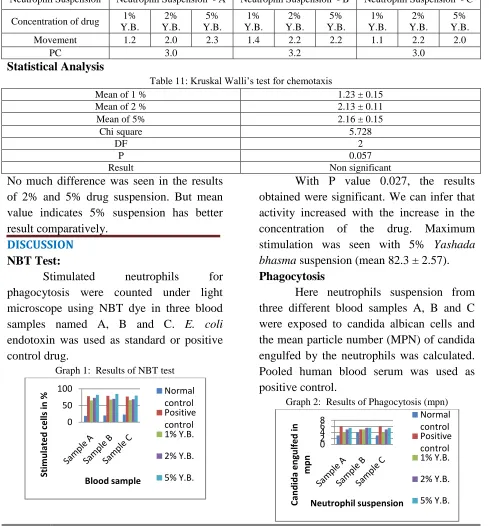
Table 11: Kruskal Walli’s test for chemotaxis
Mean of 1 % 1.23 ± 0.15
Mean of 2 % 2.13 ± 0.11
Mean of 5% 2.16 ± 0.15
Chi square 5.728
DF 2
P 0.057
Result Non significant
No much difference was seen in the results of 2% and 5% drug suspension. But mean value indicates 5% suspension has better result comparatively.
DISCUSSION NBT Test:
Stimulated neutrophils for phagocytosis were counted under light microscope using NBT dye in three blood samples named A, B and C. E. coli
endotoxin was used as standard or positive control drug.
Graph 1: Results of NBT test
With P value 0.027, the results obtained were significant. We can infer that activity increased with the increase in the concentration of the drug. Maximum stimulation was seen with 5% Yashada bhasma suspension (mean 82.3 ± 2.57). Phagocytosis
Here neutrophils suspension from three different blood samples A, B and C were exposed to candida albican cells and the mean particle number (MPN) of candida engulfed by the neutrophils was calculated. Pooled human blood serum was used as positive control.
Graph 2: Results of Phagocytosis (mpn)
0 50 100
Stim
u
late
d
c
e
lls
in
%
Blood sample
Normal control Positive control 1% Y.B.
2% Y.B.
5% Y.B.
0 2 4 6 8
Can
d
id
a
e
n
gu
lfed
in
m
p
n
Neutrophil suspension
Normal control Positive control 1% Y.B.
2% Y.B.
5% Y.B.
Neutrophil Suspension Neutrophil Suspension - A Neutrophil Suspension - B Neutrophil Suspension - C
Concentration of drug 1%
Y.B.
2% Y.B.
5% Y.B.
1% Y.B.
2% Y.B.
5% Y.B.
1% Y.B.
2% Y.B.
5% Y.B.
Movement 1.2 2.0 2.3 1.4 2.2 2.2 1.1 2.2 2.0
8
www.iamj.in IAMJ: Volume 1; Issue 4; July – Aug 2013 With P value 0.021 the result wassignificant and it was seen that the activity increased with the increase in the concentration of the drug. Maximum activity was seen with 5% Yashada bhasma
suspension and it was almost equal to the positive control values.
Candidacidal assay
Dead candida cells (in %) were calculated in this assay. Pooled human blood serum was used as positive control. Yashada bhasma suspensions of three different concentrations 1%, 2% and 5% were used as test drug.
Graph 3: Results of Candidacidal assay (dead cells in %)
With P value 0.047 the result was significant and it was seen that the activity increased with the increase in the concentration of the drug. Maximum activity was seen with 5% Yashada bhasma
suspension. The activity was seen better in all the three concentrations when compared with the positive control used.
Chemotaxis
The distance traveled (in mm) by the neutrophils under the influence of a known chemo attractant and the three concentrations 1%, 2% and 5% of Yashada bhasma was noted. Fm-leu-phe was used as chemo attractant which acted as positive control.
Graph 4: Results of Chemotaxis
With P value 0.057 the result was non – significant. There is no much difference in the result of 2% and 5% drug suspension. May be the known chemo attractant which was used was more powerful which attracted most of the cells towards it. But the results were good in 2% and 5% when compared to 1% drug suspension.
CONCLUSION
Samanya Shodhana by Dhalana in
Kanji, Takra, Kulattha kwatha, Gomutra
and Tila taila for 3 times in each media in the specified order, Vishesha Shodhana by
Dhalana in Churnodaka for 7 times, Jarana
by using Apamarga panchanga churna and
Marana by two puta were sufficient to obtain yellow colored Yashada bhasma
which passed all the classical bhasma parikshas. Immuno-modulatory study revealed results in which 5% drug suspension showed significant results in all the four parameters i.e. NBT, Phagocytosis, Candidacidal assay and Chemotaxis.
REFERENCES
1. Patwardhan B. et. al; Indian Drugs: 1990;28(2): P 56-63
2. Acharya Shri Madhava, Ayurveda Prakasha, edited by Gulraj Sharma Mishra, Chaukamba Brihat Academy, 1999, Varanasi, 2nd edition, 3/183, Pp 381
0 10 20 30 40 50 60
D
e
ad
c
an
d
id
a c
e
lls
in
%
Neutrophil suspension
Normal control
Positive control
1% Y.B.
2% Y.B.
5% Y.B.
0 0.51 1.52 2.53 3.5
N
e
u
tr
o
p
h
il
lo
co
m
o
tion
in
mm
Neutrophil suspension
Positive control
1% Y.B.
2% Y.B.
9
www.iamj.in IAMJ: Volume 1; Issue 4; July – Aug 2013 3. Sharma Sadanand, Rasatarangini, editedby Kasinatha Shastri, 11th edition, Motilal Banarsidas Publication Delhi, Reprint 2009, Tarang 19/95-6, Pp 474
4. Sharma Sadananda, Rasatarangini, edited by Kasinatha Shastri, 11th edition, Motilal Banarasidas Publications Delhi, Reprint 2009, Taranga 15/4-6, Pp 362
5. Sharma Sadananda, Rasatarangini, edited by Kasinatha Shastri, 11th edition, Motilal Banarasidas Publications Delhi, 2009, Taranga 19/98-103, Pp 475-6
6. Sharma Sadananda, Rasatarangini, edited by Kasinatha Shastri, 11th edition, Motilal Banarasidas Publications Delhi, 2009, Taranga19/104-17, Pp 476-8
7. Shri Halasikara, Rasachandamshu, Atreya Sadana, Hubli, 1850, Purvakhanda Sloka 587, Pp 144
8. Thompson R. A, Techniques in Clinical Immunology, Chapter 10 written by Wilkinson P.C, Neutrophil leucocyte function tests, Blackwell Scientific Publications, 1977, Pp 201 – 18
CORRESPONDING AUTHOR Dr. SAnthosh Bhojashettar PhD Scholar of Rasashastra National Institute of Ayurveda Amer Road, Jaipur – 302002 Email: [email protected]