Technology Use for Adolescent Health
and Wellness
Ana Radovic, MD, MS,aSherif M. Badawy, MD, MSb,c
abstract
As avid users of technology, adolescents are a key demographic to engage when designing and developing technology applications for health. There are multiple opportunities for improving adolescent health, from promoting preventive behaviors to providing guidance for adolescents with chronic illness in supporting treatment adherence and transition to adult health care systems. This article will provide a brief overview of current technologies and then highlight new technologies being used specifically for adolescent health, such as artificial intelligence, virtual and augmented reality, and machine learning. Because there is paucity of evidence in this field, we will make recommendations for future research.aDepartment of Pediatrics, School of Medicine, University of Pittsburgh and University of Pittsburgh Medical Center Children’s Hospital of Pittsburgh, Pittsburgh, Pennsylvania;bDepartment of Pediatrics, Feinberg School of Medicine, Northwestern University, Chicago, Illinois; andcDivision of Hematology, Oncology, Neurooncology, and Stem Cell Transplantation, Ann & Robert H. Lurie Children’s Hospital of Chicago, Chicago, Illinois
All authors approved thefinal manuscript as submitted and agree to be accountable for all aspects of the work.
DOI:https://doi.org/10.1542/peds.2019-2056G
Accepted for publication Jan 29, 2020
Address correspondence to Ana Radovic, MD, MS, UPMC University Center, 120 Lytton Avenue, Pittsburgh, PA 15213. E-mail: [email protected]
PEDIATRICS (ISSN Numbers: Print, 0031-4005; Online, 1098-4275).
Copyright © 2020 by the American Academy of Pediatrics
FINANCIAL DISCLOSURE:The authors have indicated they have nofinancial relationships relevant to this article to disclose.
FUNDING:Supported by the National Institutes of Health National Institute of Mental Health (grant 1K23MH111922-01A1; principal investigator: Dr Radovic) and the Agency for Healthcare Research and Quality (grant K12HS023011; principal investigator: Dr Badawy). The content is solely the responsibility of the authors and does not necessarily represent the official views of the National Institutes of Health National Institute of Mental Health or the Agency for Healthcare Research and Quality. Funded by the National Institutes of Health (NIH).
TECHNOLOGY OPPORTUNITIES FOR ADOLESCENT HEALTH
The speed at which new technologies have developed has changed the context of adolescent health and development. As opposed to computers, almost all adolescents (95%) have access to a smartphone, and this does not differ by sex, race, ethnicity, or income.1Almost half of teenagers say they are online almost constantly.1Adolescents today can be defined as“digital natives,”meaning they cannot remember a time when technology was not all around them, and therefore, they are more adept at using it. Although risks associated with technology use are being investigated, unlike what is reported in popular media,2these associations (for example, between social media use and mental health outcomes) are more nuanced and related to different factors. For example, these
associations are dependent on contextual factors,3the type of measurements used,4and the manner in which the technology is used5,6and have mostly been cross-sectional4 and shown differing results.7–9 Therefore, there is an inherent complexity to the nature between technology use and adolescent health, especially due to its ubiquity, and learning how to leverage and moderate technology use as opposed to restricting it is likely the best solution moving forward.10
Adolescents are actively engaged in using technology, especially social media, and feel that it is mostly a positive experience for them.11 Capitalizing on this adolescent engagement, technology is widely thought to be a promising vehicle with which to build interventions that can also improve their health outcomes. Although adolescents value technology, they prefer using these tools as a way to enhance, not replace, the interaction and support they receive from their pediatricians.12 Therefore, it is important to understand specifically how to
integrate technology in the delivery of adolescent health care. The major health concerns during adolescence involve navigating a successful transition to adulthood, not only taking on the management of their health care needs (especially if they have chronic medical and mental health conditions)13but also establishing healthy behaviors while mitigating risks. These behaviors include driving, substance use, and sexual risk behaviors within the context of an individual’s peer, family, school, neighborhood, and
sociocultural-political environment, which may or may not be supportive. These challenges to adolescent health occur at an opportune time of rapid brain development, during which adolescents develop their cognitive control but are less likely to use it to inhibit decisions that lead to positive reward, especially in the context of peers.14As adolescents desire to become independent and
differentiate from their parents, their parents may have less oversight of their decision-making process. Adolescents begin to manage whether they will adhere to a medication regimen or engage in a behavior that places risk on their health. As adults, personal support is minimized, and the question becomes whether technology is able to play a role in influencing healthy decision-making as well as increasing resilience and motivating use of healthy
interventions at the right time and in the right place.
Several existing technologies offer opportunities for improving adolescent health and providing guidance for the development of future technologies. Observational studies show that sharing health care experiences online through sites like YouTube (the most popular social media site for adolescents1) may lead to decreased isolation, support, an exchange of coping strategies, and health care learning from shared experiences.15,16Employing these
types of online peer components can enhance health interventions, as evidenced by an educational lupus Web site (www.facinglupustogether. com) that showed improved
medication adherence in a group that discussed educational modules in a social media group, as opposed to independent journaling.17Online peer support for mental health conditions in adolescents has shown varied results depending on the type of disorder.18Of note, moderation by clinical experts19–21has been identified as a key component to foster comfort and safety in these groups.
Adolescents who develop skills to monitor their symptoms and self-manage their health may experience improved outcomes in disease knowledge and adherence.22 Specifically, text messaging and mobile phone applications show modest evidence supporting their efficacy at improving adherence among healthy adolescents,23as well as those with chronic health
conditions,24with more positive results around contraception continuation and adolescents with conditions such as attention-deficit/ hyperactivity disorder.25,26A systematic review of adolescent technology-based interventions for diabetes mellitus showed improved rates of blood glucose monitoring and increases in self-efficacy but little clinical significance, with generally no difference seen in hemoglobin A1c.27 A meta-analysis found serious games or mental contests with the goal of meeting an objective can be effective at increasing disease knowledge and improving self-management for adolescents who have chronic health conditions.28A self-management Web site for adolescents with
laboratory.29These data are then interpreted and scored for symptom severity; results are sent to the patient with guidance and recommendations on whether to contact the hospital for further testing, evaluation, and/or treatment. Using this system resulted in less frequent outpatient visits and fewer disease-related school absences without any differences in disease severity.29Mobile directly observed therapy consists of using a mobile device to send videos of medication administration to a physician and has been shown to improve inhaler technique in asthma30and
hydroxyurea adherence in sickle cell disease.31A mobile health
intervention also improved inhaler adherence for
adolescents using a pharmacist chat function.32
Behavior change interventions that require multiple strategies in an ongoing manner are amenable to the incorporation of technology
components, which may ease acceptability and feasibility as opposed to in-person sessions and paperwork. These types of behavior change interventions show varying results. Several interventions addressing diet and physical activity as they relate to obesity and sedentary behavior show behavior change occurring in the context of education, goal setting, self-monitoring, and parental
involvement33as well as increases in physical activity (including when wearable devices are used)34but have not shown differences in BMI.35 An intervention employing
exergaming (ie, exercise with a video game component) did show
a decrease in BMI as well as other cardiovascular health indicators.36On the other hand, technologies have been developed to improve driver safety, including in-vehicle
technologies that are more effective when they include parental
involvement, because safe-driving
applications may be less likely to be used without an incentive.37 Promising technologies have also evolved in sexual health behavior change. Shafii et al38describe the implementation of an electronic-KIOSK Intervention for Safer Sex, an interactive computer-based
intervention that uses a physician avatar and instructive video modules to provide personalized sexual health feedback; this intervention has shown
nonsignificant reductions in all areas of adolescent sexual health risk, including unprotected sexual intercourse, sexually
transmitted infections, and unwanted pregnancy.
With regard to substance use interventions, different methods have greater uptake; a health game was used more frequently than an informational Web site to result in improvements in tobacco-related health literacy.39A sex-specific, Web-basedintervention for drug use prevention showed long-termprevention of cigarette and electronic cigarette use.40In a marijuana use intervention, text messages directed at counseling regarding an adolescent’s peer network (or unhealthy marijuana-using friends) helped youth meet goals of better managing their marijuana use.41
Combined, the existing research highlights the importance of including online social components while considering how to involve parents, incorporating serious gaming, and using technology to support self-management for chronic conditions to facilitate adolescents’healthy transition into adulthood. In the rest of this article, we will provide an overview of how new technologies are being used to support adolescent health, offering examples from various disease processes and populations as well as a summary with recommendations for future directions.
New Adolescent Health Technologies and Current Research
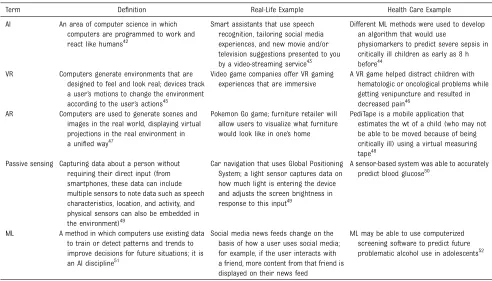
In this section, we will provide an overview of several new technologies that are now starting to be applied in medical settings. We will explore the ways in which these technologies are beginning to be used in efforts to optimize health outcomes for adolescent populations as well as their potential for future use (Table 1).
Artificial Intelligence
Artificial intelligence (AI) is being used in decision support and hospital monitoring, medical imaging and biomedical diagnostics (such as radiology and dermatology),53 precision medicine and drug discovery, improving patient education materials,54digital medicine and wearable technology, and robot technology and virtual assistants.55AI has applicability and utility across the health care spectrum, from diagnosis, treatment, care coordination, and appointment scheduling to informing health policy and management decisions. Although AI is not new, the current era of big data, extensive patient registries in and out of electronic health records, ubiquitous use of smartphones, wearable devices, the Internet of things, enhanced computational power, and cloud computing allow for capabilities never seen before.55
The evidence for AI, specifically in diagnosis and treatment in pediatrics and adolescent medicine, is in the beginning stages. In radiology, computer-aided systems can assist with image interpretation, such as predicting bone age.56A pediatric registry of cervical spine injury was used to train a computer algorithm that predicted injury with
operating characteristic curve between 0.89 and 0.97.58In cysticfibrosis, AI was capable of predicting the most effective types of physiotherapy to improve overall health state.59 Approaches to using AI to
automatically detect seizure activity from computer analysis of EEGs are resulting in high sensitivity (93%) and specificity (94%).60On the basis of a sampling from 3 different ethnic groups, AI has been shown to be able to correctly classify patients with acne on the basis of severity with high accuracy (0.854).53AI has the potential to pull in data sources to predict suicidality in adolescents; although Instagram activity and social media language markers did not predict suicidality in adolescent Instagram users,61natural language processing using text in electronic health records shows more promise.62A supervised algorithm that pulled in diffusion MRI-based structural connectome data were able to predict, with 83% accuracy, depressive symptom reduction in adolescents receiving 3 months of cognitive behavioral therapy.63
The existing and potential benefits of AI in pediatrics and adolescent health are vast in nature, including improved efficiency and patient reach through expanding what a limited human workforce can accomplish.
Regardless, potential harms include false-positive results (as with any test) and a lack of human empathy in decision-making. Also, in all
technology, with big data from multiple sources being shared across multiple platforms, there are concerns about data privacy and security. Future research will need to measure for frequency of data breach as a potential adverse outcome.
Virtual Reality and Augmented Reality
Virtual reality (VR) and augmented reality (AR) have also been studied in multiple venues in health care, including whether VR and/or AR can enhance social, emotional, and daily living skills in children with autism.64 Some benefits to using VR and/or AR as an intervention or treatment approach include simulating a real-life scenario in a more controlled
fashion with therapist support and personalizing scenarios according to the patient’s needs.64VR and/or AR may also be used to simulate environments that may elicit
behaviors that are needed to confirm a diagnosis of attention-deficit/ hyperactivity disorder65or anorexia nervosa66and assist in motor rehabilitation in children with cerebral palsy.67,68Furthermore, VR and/or AR have been used to distract adolescents from pain during wound care (especially patients with burns),69–72overcome phobias,73 encourage physical activity,74screen for sports-related concussion,75and improve knowledge gain among healthy adolescents76as well as those with diabetes77or Down syndrome.78 To date, evidence for the efficacy of VR and/or AR as technology-based interventions for adolescents remains unclear, although overall feasibility, acceptability, and preliminary efficacy data are encouraging.67,68,79The use of VR and/or AR does not come without risks or potential harm, such as eyestrain, nausea, sickness, TABLE 1Definition of New Technologies Being Used for Health
Term Definition Real-Life Example Health Care Example
AI An area of computer science in which computers are programmed to work and react like humans42
Smart assistants that use speech recognition, tailoring social media experiences, and new movie and/or television suggestions presented to you by a video-streaming service43
Different ML methods were used to develop an algorithm that would use
physiomarkers to predict severe sepsis in critically ill children as early as 8 h before44
VR Computers generate environments that are designed to feel and look real; devices track a user’s motions to change the environment according to the user’s actions45
Video game companies offer VR gaming experiences that are immersive
A VR game helped distract children with hematologic or oncological problems while getting venipuncture and resulted in decreased pain46
AR Computers are used to generate scenes and images in the real world, displaying virtual projections in the real environment in a unified way47
Pokemon Go game; furniture retailer will allow users to visualize what furniture would look like in one’s home
PediTape is a mobile application that estimates the wt of a child (who may not be able to be moved because of being critically ill) using a virtual measuring tape48
Passive sensing Capturing data about a person without requiring their direct input (from smartphones, these data can include multiple sensors to note data such as speech characteristics, location, and activity, and physical sensors can also be embedded in the environment)49
Car navigation that uses Global Positioning System; a light sensor captures data on how much light is entering the device and adjusts the screen brightness in response to this input49
A sensor-based system was able to accurately predict blood glucose50
ML A method in which computers use existing data to train or detect patterns and trends to improve decisions for future situations; it is an AI discipline51
Social media news feeds change on the basis of how a user uses social media; for example, if the user interacts with a friend, more content from that friend is displayed on their news feed
dizziness, real-world injuries, loss of confidentiality, game transfer phenomena, digital fatigue with too much screen time, and possible psychological consequences, including VR and/or AR
addiction.80,81Use of VR and/or AR may be cost-prohibitive for many patients, and current payment structures for such technologies are not yet delineated. Future research on effectiveness should also include cost-effectiveness analyses.82
Machine Learning and Passive Sensing
Machine learning (ML) is a discipline of AI that has been used in the area of passive sensing. Passive sensing is a method that is being increasingly used and often involves using data that are being automatically captured on smartphones and wearable devices to predict health status. Researchers have used multiple ML techniques83to develop algorithms that translate passive data (eg, accelerometer or how fast someone is moving; light sensor or detecting ambient light both indoors and outdoors; communication or tracking frequency of calls and messages) by means of real-time monitoring and computational analysis into data that may provide insight into a person’s inner state. For example, heart rate variability captured by wristbands has been found to accurately predict pleasure, happiness, fear, and anger through use of artificial neural network–based classification with a range of 82% to 93.4%.84 Furthermore, these interventions have been tailored for delivery at more pertinent moments (also called just-in-time adaptive interventions). For example, an intervention for homeless adolescent mothers involves a wearable wristband to measure electrodermal activity as a marker of stress and to time the notification of stress signals to prompt the adolescent to use emotion regulation support.85A socialization intervention for children with autism spectrum disorder, which used the
wearable Google Glass with an AI-driven component that uses ML in real time to indicate an individual’s emotion, showed improved
socialization.86
Investigation is currently underway to determine if passive sensing can predict depressive symptoms and suicidal thoughts and behaviors in adolescents.87ML is being used to understand whether emotional dysregulation can be described by automated facial expression coding,88 whether pain can be predicted by objective measures in sickle cell disease,89and whether adolescent suicidal behavior can be predicted from natural language processing of data from the electronic health record.90Electronic momentary assessment involves capturing self-reported data in the moment in an effort to decrease biases, which may be related to memory, and has been more feasible to employ with the ubiquity of smartphones. Electronic momentary assessment has been used widely in observational research, but more recent studies explore whether ecological momentary interventions can be delivered at the time when a person is symptomatic. Studies show that these types of interventions may reduce anxiety91and be effective in reducing desire among adolescents and young adults to use marijuana.92
The potential benefits of using ML and passive sensing in adolescents includes opportunities to use real-time monitoring to enhance self-management through the use of just-in-time interventions. Although smartphone use is ubiquitous, not all adolescents will have adequate data plans; therefore, interventions relying on smartphones and expensive wearables may be limited. Parental monitoring may, at times, obscure an adolescent’s access to such devices. Future research should explore whether such interventions improve long-term clinical effects.
Summary and Recommendations
There has been growing evidence to support the potential benefits of using personal technologies to optimize health outcomes in adolescents, although their cost-effectiveness remains unclear.93,94 This is a dynamicfield that will continue to develop over time at a fast pace. There have been some interventions used daily (eg, AI in electronic health records) that pediatricians need to be aware of and anticipate where thefield may be moving to stay up to date with these evolving technologies and provide feedback and input as the end users. As technology advances, payment structures and policy changes need to be responsive and adaptable to allow for the wide dissemination and implementation of different technology-based interventions that have been shown to be efficacious in improving care delivery and health outcomes with high acceptability by adolescents. Taking a user-centered iterative approach and involving adolescents and their parents in all stages of developing these
interventions is key to optimizing their uptake as well as their potential efficacy and cost-effectiveness.95 Accessibility of technology should be offered at low or no cost for all adolescents with potentially
subsidized options, especially for data and Internet access. These
provide insight into diagnosis, monitoring, and intervention as well as to expand the reach of innovative technologies to underserved
adolescents, which include racial and ethnic minorities and rural
populations. Future research priorities should include cost-effectiveness analyses, validating whether technologies that are found to be effective in adult populations show the same applicability and acceptability in adolescents, and monitoring the degree to which access to new technologies further exacerbates existing health disparities for underserved
adolescents or expands reach to those with limited access. Pediatricians should neither shun new technologies nor accept them wholeheartedly without review but always advocate for and consider the best interests of adolescents by carefully balancing the risks and benefits of using and recommending these technologies to optimize health outcomes, including physical, emotional, and social well-being, in this vulnerable population.
ABBREVIATIONS
AI: artificial intelligence AR: augmented reality ML: machine learning VR: virtual reality
REFERENCES
1. Pew Research Center. Teens, Social media & technology 2018. 2018. Available at: https://www.pewresearch. org/internet/wp-content/uploads/sites/ 9/2018/05/PI_2018.05.31_TeensTech_ FINAL.pdf. Accessed March 13, 2020
2. National Public Radio. The risk of teen depression and suicide is linked to smartphone use, study says. Available at: https://www.npr.org/2017/12/17/ 571443683/the-call-in-teens-and-depression. Accessed April 20, 2019
3. Frison E, Subrahmanyam K, Eggermont S. The short-term longitudinal and reciprocal relations between peer
victimization on Facebook and adolescents’well-being.J Youth Adolesc. 2016;45(9):1755–1771 4. Seabrook EM, Kern ML, Rickard NS.
Social networking sites, depression, and anxiety: a systematic review.JMIR Ment Health. 2016;3(4):e50
5. Gonzales AL, Hancock JT. Mirror, mirror on my Facebook wall: effects of exposure to Facebook on self-esteem.
Cyberpsychol Behav Soc Netw. 2011; 14(1–2):79–83
6. Campisi J, Folan D, Diehl G, Kable T, Rademeyer C. Social media users have different experiences, motivations, and quality of life.Psychiatry Res. 2015; 228(3):774–780
7. Allen KA, Ryan T, Gray DL, McInerney DM, Waters L. Social media use and social connectedness in adolescents: the positives and the potential pitfalls.Aust J Educ Dev Psychol. 2014;31(1):18–31 8. Orben A, Przybylski AK. The association
between adolescent well-being and digital technology use.Nat Hum Behav. 2019;3(2):173–182
9. Twenge JM, Campbell WK. Associations between screen time and lower psychological well-being among children and adolescents: evidence from a population-based study.Prev Med Rep. 2018;12:271–283
10. Wiederhold BK. Should smartphone use be banned for children?Cyberpsychol Behav Soc Netw. 2019;22(4):235–236 11. Common Sense Media. Common sense
research reveals everything you need to know about teens’use of social media in 2018. Available at: https:// www.commonsensemedia.org/about- us/news/press-releases/common- sense-research-reveals-everything-you-need-to-know-about-teens. Accessed April 20, 2019
12. Zieve GG, Richardson LP, Katzman K, Spielvogle H, Whitehouse S, McCarty CA. Adolescents’perspectives on
personalized e-feedback in the context of health risk behavior screening for primary care: qualitative study.J Med Internet Res. 2017;19(7):e261
13. White PH, McManus MA, McAllister JW, Cooley WC. A primary care quality improvement approach to health care transition.Pediatr Ann. 2012;41(5): e1–e7
14. Luna B, Paulsen DJ, Padmanabhan A, Geier C. Cognitive control and motivation.Curr Dir Psychol Sci. 2013; 22(2):94–100
15. Naslund JA, Grande SW, Aschbrenner KA, Elwyn G. Naturally occurring peer support through social media: the experiences of individuals with severe mental illness using YouTube.PLoS One. 2014;9(10):e110171
16. Forgeron PA, McKenzie E, O’Reilly J, Rudnicki E, Caes L. Support for my video is support for me: a YouTube scoping review of videos including adolescents with chronic pain.Clin J Pain. 2019;35(5):443–450
17. Scalzi LV, Hollenbeak CS, Mascuilli E, Olsen N. Improvement of medication adherence in adolescents and young adults with SLE using web-based education with and without a social media intervention, a pilot study.
Pediatr Rheumatol Online J. 2018;16(1): 18
18. Ridout B, Campbell A. The use of social networking sites in mental health interventions for young people: systematic review.J Med Internet Res. 2018;20(12):e12244
19. Alvarez-Jimenez M, Bendall S, Koval P, et al. HORYZONS trial: protocol for a randomised controlled trial of a moderated online social therapy to maintain treatment effects fromfi rst-episode psychosis services.BMJ Open. 2019;9(2):e024104
20. Windler C, Clair M, Long C, Boyle L, Radovic A. Role of moderators on engagement of adolescents with depression or anxiety in a social media intervention: content analysis of web-based interactions.JMIR Ment Health. 6(9):e13467
21. Rice S, Gleeson J, Davey C, et al. Moderated online social therapy for depression relapse prevention in young people: pilot study of a‘next generation’ online intervention.Early Interv Psychiatry. 2018;12(4):613–625 22. Bal MI, Sattoe JN, Roelofs PD, Bal R, van
23. Badawy SM, Kuhns LM. Texting and mobile phone app interventions for improving adherence to preventive behavior in adolescents: a systematic review.JMIR Mhealth Uhealth. 2017; 5(4):e50
24. Badawy SM, Barrera L, Sinno MG, Kaviany S, O’Dwyer LC, Kuhns LM. Text messaging and mobile phone apps as interventions to improve adherence in adolescents with chronic health conditions: a systematic review.JMIR Mhealth Uhealth. 2017;5(5):e66 25. Weisman O, Schonherz Y, Harel T, Efron
M, Elazar M, Gothelf D. Testing the efficacy of a smartphone application in improving medication adherence, among children with ADHD.Isr J Psychiatry Relat Sci. 2018;55(2):59–63 26. Buchanan CRM, Tomaszewski K, Chung
S-E, Upadhya KK, Ramsey A, Trent ME. Why didn’t you text me? poststudy trends from the depotext trial.Clin Pediatr (Phila). 2018;57(1):82–88 27. Knox ECL, Quirk H, Glazebrook C, Randell
T, Blake H. Impact of technology-based interventions for children and young people with type 1 diabetes on key diabetes self-management behaviours and prerequisites: a systematic review.
BMC Endocr Disord. 2019;19(1):7 28. Charlier N, Zupancic N, Fieuws S,
Denhaerynck K, Zaman B, Moons P. Serious games for improving knowledge and self-management in young people with chronic conditions: a systematic review and meta-analysis.
J Am Med Inform Assoc. 2016;23(1): 230–239
29. Carlsen K, Jakobsen C, Houen G, et al. Self-managed eHealth disease monitoring in children and adolescents with inflammatory bowel disease: a randomized controlled trial.Inflamm Bowel Dis. 2017;23(3):357–365 30. Shields MD, Al Qahtani F, Rivey MP,
McElnay JC. Mobile direct observation of therapy (MDOT) - a rapid systematic review and pilot study in children with asthma.PLoS One. 2018;13(2):e0190031 31. Creary SE, Gladwin MT, Byrne M,
Hildesheim M, Krishnamurti L. A pilot study of electronic directly observed therapy to improve hydroxyurea adherence in pediatric patients with sickle-cell disease.Pediatr Blood Cancer. 2014;61(6):1068–1073
32. Kosse RC, Bouvy ML, Belitser SV, de Vries TW, van der Wal PS, Koster ES. Effective engagement of adolescent asthma patients with mobile health-supporting medication adherence.JMIR Mhealth Uhealth. 2019;7(3):e12411 33. Rose T, Barker M, Maria Jacob C, et al. A
systematic review of digital interventions for improving the diet and physical activity behaviors of adolescents.J Adolesc Health. 2017; 61(6):669–677
34. Lee AM, Chavez S, Bian J, et al. Efficacy and effectiveness of mobile health technologies for facilitating physical activity in adolescents: scoping review.
JMIR Mhealth Uhealth. 2019;7(2):e11847 35. Kaakinen P, Kyngäs H, Kääriäinen M.
Technology-based counseling in the management of weight and lifestyles of obese or overweight children and adolescents: a descriptive systematic literature review.Inform Health Soc Care. 2018;43(2):126–141
36. Staiano AE, Beyl RA, Guan W, Hendrick CA, Hsia DS, Newton RL Jr.. Home-based exergaming among children with overweight and obesity: a randomized clinical trial.Pediatr Obes. 2018;13(11): 724–733
37. Sezgin E, Lin S. Technology-based interventions, assessments, and solutions for safe driving training for adolescents: rapid review.JMIR Mhealth Uhealth. 2019;7(1):e11942 38. Shafii T, Benson SK, Morrison DM, Hughes JP, Golden MR, Holmes KK. Results from e-KISS: electronic-KIOSK Intervention for Safer Sex: a pilot randomized controlled trial of an interactive computer-based intervention for sexual health in adolescents and young adults.PLoS One. 2019;14(1):e0209064
39. Parisod H, Pakarinen A, Axelin A, Löyttyniemi E, Smed J, Salanterä S. Feasibility of mobile health game “Fume”in supporting tobacco-related health literacy among early
adolescents: a three-armed cluster randomized design.Int J Med Inform. 2018;113:26–37
40. Schwinn TM, Schinke SP, Keller B, Hopkins J. Two- and three-year follow-up from a gender-specific, web-based drug abuse prevention program for
adolescent girls.Addict Behav. 2019;93: 86–92
41. Mason MJ, Moore M, Brown A. Young adults’perceptions of acceptability and effectiveness of a text message-delivered treatment for cannabis use disorder.J Subst Abuse Treat. 2018;93: 15–18
42. Techopedia. What is artificial intelligence (AI)? Available at: https:// www.techopedia.com/definition/190/ artificial-intelligence-ai. Accessed April 24, 2019
43. Beebom. 10 examples of artificial intelligence you are using in daily life. Available at: https://beebom.com/ examples-of-artificial-intelligence/. Accessed April 24, 2019
44. Kamaleswaran R, Akbilgic O, Hallman MA, West AN, Davis RL, Shah SH. Applying artificial intelligence to identify physiomarkers predicting severe sepsis in the PICU.Pediatr Crit Care Med. 2018;19(10):e495–e503 45. Techopedia. Virtual reality (VR).
Available at: https://www.techopedia. com/definition/4784/virtual-reality-vr. Accessed April 24, 2019
46. Atzori B, Hoffman HG, Vagnoli L, et al. Virtual reality analgesia during venipuncture in pediatric patients with onco-hematological diseases.Front Psychol. 2018;9:2508
47. Techopedia. Augmented reality (AR). Available at: https://www.techopedia. com/defi nition/4776/augmented-reality-ar. Accessed April 24, 2019
48. Scquizzato T, Landoni G, Carenzo L, Forti A, Zangrillo A. A smartphone application with augmented reality for estimating weight in critically ill paediatric patients.Resuscitation. 2020;146:3–4 49. Cornet VP, Holden RJ. Systematic review
of smartphone-based passive sensing for health and wellbeing.J Biomed Inform. 2018;77:120–132
50. Rodin D, Kirby M, Sedogin N, Shapiro Y, Pinhasov A, Kreinin A. Comparative accuracy of optical sensor-based wearable system for non-invasive measurement of blood glucose concentration.Clin Biochem. 2019;65: 15–20
definition/8181/machine-learning. Accessed April 24, 2019
52. Afzali MH, Sunderland M, Stewart S, et al. Machine-learning prediction of adolescent alcohol use: a cross-study, cross-cultural validation.Addiction. 2019;114(4):662–671
53. Melina A, Dinh NN, Tafuri B, et al. Artificial intelligence for the objective evaluation of acne investigator global assessment.J Drugs Dermatol. 2018; 17(9):1006–1009
54. Rose-Davis B, Van Woensel W, Stringer E, Abidi S, Abidi SSR. Using an artificial intelligence-based argument theory to generate automated patient education dialogues for families of children with juvenile idiopathic arthritis.Stud Health Technol Inform. 2019;264:1337–1341 55. Shu LQ, Sun YK, Tan LH, Shu Q, Chang
AC. Application of artificial intelligence in pediatrics: past, present and future.
World J Pediatr. 2019;15(2):105–108 56. Dallora AL, Anderberg P, Kvist O, Mendes
E, Diaz Ruiz S, Sanmartin Berglund J. Bone age assessment with various machine learning techniques: a systematic literature review and meta-analysis.PLoS One. 2019;14(7): e0220242
57. Bertsimas D, Masiakos PT, Mylonas KS, Wiberg H. Prediction of cervical spine injury in young pediatric patients: an optimal trees artificial intelligence approach.J Pediatr Surg. 2019;54(11): 2353–2357
58. Kim SY, Kim S, Cho J, et al. A deep learning model for real-time mortality prediction in critically ill children.Crit Care. 2019;23(1):279
59. Slavici T, Almajan B. Artificial
intelligence techniques: an efficient new approach to challenge the assessment of complex clinicalfields such as airway clearance techniques in patients with cysticfibrosis?J Rehabil Med. 2013;45(4):397–402
60. Fergus P, Hignett D, Hussain A, Al-Jumeily D, Abdel-Aziz K. Automatic epileptic seizure detection using scalp EEG and advanced artificial intelligence techniques.BioMed Res Int. 2015;2015: 986736
61. Brown RC, Bendig E, Fischer T, Goldwich AD, Baumeister H, Plener PL. Can acute suicidality be predicted by Instagram
data? Results from qualitative and quantitative language analyses.PLoS One. 2019;14(9):e0220623
62. Velupillai S, Epstein S, Bittar A, Stephenson T, Dutta R, Downs J. Identifying suicidal adolescents from mental health records using natural language processing.Stud Health Technol Inform. 2019;264:413–417 63. Tymofiyeva O, Yuan JP, Huang CY, et al.
Application of machine learning to structural connectome to predict symptom reduction in depressed adolescents with cognitive behavioral therapy (CBT).Neuroimage Clin. 2019; 23:101914
64. Mesa-Gresa P, Gil-Gómez H, Lozano-Quilis JA, Gil-Gómez JA. Effectiveness of virtual reality for children and adolescents with autism spectrum disorder: an evidence-based systematic review.Sensors (Basel). 2018;18(8): E2486
65. Eom H, Kim KK, Lee S, et al. Development of virtual reality continuous
performance test utilizing social cues for children and adolescents with attention-deficit/hyperactivity disorder.
Cyberpsychol Behav Soc Netw. 2019; 22(3):198–204
66. Fisher S, Abdullah A, Charvin I, Da Fonseca D, Bat-Pitault F. Comparison of body image evaluation by virtual reality and paper-basedfigure rating scales in adolescents with anorexia nervosa: retrospective study [published online ahead of print April 11, 2019].Eat Weight Disord. doi:10.1007/s40519-019-00680-1
67. Chen Y, Fanchiang HD, Howard A. Effectiveness of virtual reality in children with cerebral palsy:
a systematic review and meta-analysis of randomized controlled trials.Phys Ther. 2018;98(1):63–77
68. Ravi DK, Kumar N, Singhi P. Effectiveness of virtual reality rehabilitation for children and adolescents with cerebral palsy: an updated evidence-based systematic review.Physiotherapy. 2017; 103(3):245–258
69. Hua Y, Qiu R, Yao WY, Zhang Q, Chen XL. The effect of virtual reality distraction on pain relief during dressing changes in children with chronic wounds on lower limbs.Pain Manag Nurs. 2015; 16(5):685–691
70. Mott J, Bucolo S, Cuttle L, et al. The efficacy of an augmented virtual reality system to alleviate pain in children undergoing burns dressing changes: a randomised controlled trial.Burns. 2008;34(6):803–808
71. Kipping B, Rodger S, Miller K, Kimble RM. Virtual reality for acute pain reduction in adolescents undergoing burn wound care: a prospective randomized controlled trial.Burns. 2012;38(5):650–657
72. Schmitt YS, Hoffman HG, Blough DK, et al. A randomized, controlled trial of immersive virtual reality analgesia, during physical therapy for pediatric burns.Burns. 2011;37(1):61–68 73. Bouchard S. Could virtual reality be
effective in treating children with phobias?Expert Rev Neurother. 2011; 11(2):207–213
74. Barkley JE, Lepp A, Glickman EL. “Pokémon Go!”may promote walking, discourage sedentary behavior in college students.Games Health J. 2017; 6(3):165–170
75. Nolin P, Stipanicic A, Henry M, Joyal CC, Allain P. Virtual reality as a screening tool for sports concussion in adolescents.Brain Inj. 2012;26(13–14): 1564–1573
76. Huang K-T, Ball C, Francis J, Ratan R, Boumis J, Fordham J. Augmented versus virtual reality in education: an exploratory study examining science knowledge retention when using augmented reality/virtual reality mobile applications.Cyberpsychol Behav Soc Netw. 2019;22(2):105–110
77. Calle-Bustos AM, Juan M-C, García-García I, Abad F. An augmented reality game to support therapeutic education for children with diabetes.PLoS One. 2017;12(9):e0184645
78. de Mello Monteiro CB, da Silva TD, de Abreu LC, et al. Short-term motor learning through non-immersive virtual reality task in individuals with Down syndrome.BMC Neurol. 2017;17(1):71 79. Farronato M, Maspero C, Lanteri V, et al.
Current state of the art in the use of augmented reality in dentistry: a systematic review of the literature.
BMC Oral Health. 2019;19(1):135 80. Cipresso P, Giglioli IAC, Raya MA, Riva G.
and augmented reality research: a network and cluster analysis of the literature.Front Psychol. 2018;9:2086 81. Marr B; Forbes. The important risks and dangers of virtual and augmented reality. 2019. Available at: https://www. forbes.com/sites/bernardmarr/2019/ 07/17/the-important-risks-and-dangers- of-virtual-and-augmented-reality/-18148a3f3d50. Accessed September 9, 2019
82. Delshad SD, Almario CV, Fuller G, Luong D, Spiegel BMR. Economic analysis of implementing virtual reality therapy for pain among hospitalized patients.
NPJ Digit Med. 2018;1:22
83. Cho G, Yim J, Choi Y, Ko J, Lee SH. Review of machine learning algorithms for diagnosing mental illness.
Psychiatry Investig. 2019;16(4):262–269 84. Chen YC, Hsiao CC, Zheng WD, Lee RG,
Lin R. Artificial neural networks-based classification of emotions using wristband heart rate monitor data.
Medicine (Baltimore). 2019;98(33): e16863
85. Leonard NR, Casarjian B, Fletcher RR, et al. Theoretically-based emotion regulation strategies using a mobile app and wearable sensor among homeless adolescent mothers: acceptability and feasibility study.JMIR Pediatr Parent. 2018;1(1):e1
86. Voss C, Schwartz J, Daniels J, et al. Effect of wearable digital intervention for improving socialization in children with autism spectrum disorder: a randomized clinical trial.JAMA Pediatr. 2019;173(5):446–454
87. Allen NB, Nelson BW, Brent D, Auerbach RP. Short-term prediction of suicidal thoughts and behaviors in adolescents: can recent developments in technology and computational science provide a breakthrough?J Affect Disord. 2019; 250:163–169
88. Haines N, Bell Z, Crowell S, et al. Using automated computer vision and machine learning to code facial expressions of affect and arousal: implications for emotion dysregulation research.Dev Psychopathol. 2019;31(3): 871–886
89. Yang F, Banerjee T, Narine K, Shah N. Improving pain management in patients with sickle cell disease from
physiological measures using machine learning techniques.Smart Health (Amst). 2018;7–8:48–59
90. Carson NJ, Mullin B, Sanchez MJ, et al. Identification of suicidal behavior among psychiatrically hospitalized adolescents using natural language processing and machine learning of electronic health records.PLoS One. 2019;14(2):e0211116
91. Loo Gee B, Griffiths KM, Gulliver A. Effectiveness of mobile technologies delivering Ecological Momentary Interventions for stress and anxiety: a systematic review.J Am Med Inform Assoc. 2016;23(1):221–229
92. Shrier LA, Burke PJ, Kells M, et al. Pilot randomized trial of MOMENT,
a motivational counseling-plus-ecological momentary intervention to reduce marijuana use in youth.
mHealth. 2018;4:29
93. Badawy SM, Kuhns LM. Economic evaluation of text-messaging and smartphone-based interventions to improve medication adherence in adolescents with chronic health conditions: a systematic review.JMIR Mhealth Uhealth. 2016;4(4):e121 94. Iribarren SJ, Cato K, Falzon L, Stone PW.
What is the economic evidence for mHealth? A systematic review of economic evaluations of mHealth solutions.PLoS One. 2017;12(2): e0170581
DOI: 10.1542/peds.2019-2056G
2020;145;S186
Pediatrics
Ana Radovic and Sherif M. Badawy
Technology Use for Adolescent Health and Wellness
Services
Updated Information &
http://pediatrics.aappublications.org/content/145/Supplement_2/S186 including high resolution figures, can be found at:
References
#BIBL
http://pediatrics.aappublications.org/content/145/Supplement_2/S186 This article cites 84 articles, 1 of which you can access for free at:
Permissions & Licensing
http://www.aappublications.org/site/misc/Permissions.xhtml in its entirety can be found online at:
Information about reproducing this article in parts (figures, tables) or
Reprints
DOI: 10.1542/peds.2019-2056G
2020;145;S186
Pediatrics
Ana Radovic and Sherif M. Badawy
Technology Use for Adolescent Health and Wellness
http://pediatrics.aappublications.org/content/145/Supplement_2/S186
located on the World Wide Web at:
The online version of this article, along with updated information and services, is
by the American Academy of Pediatrics. All rights reserved. Print ISSN: 1073-0397.