P R O C E E D I N G S
Open Access
Towards improving phenotype representation in
OWL
Frank Loebe
1*, Frank Stumpf
1, Robert Hoehndorf
2, Heinrich Herre
3From
Ontologies in Biomedicine and Life Sciences (OBML 2011)
Berlin, Germany. 6-7 October 2011
* Correspondence: frank. [email protected] 1Department of Computer Science, University of Leipzig, 04103 Leipzig, Germany
Abstract
Background:Phenotype ontologies are used in species-specific databases for the annotation of mutagenesis experiments and to characterize human diseases. The Entity-Quality (EQ) formalism is a means to describe complex phenotypes based on one or more affected entities and a quality. EQ-based definitions have been developed for many phenotype ontologies, including the Human and Mammalian Phenotype ontologies.
Methods:We analyze formalizations of complex phenotype descriptions in the Web Ontology Language (OWL) that are based on the EQ model, identify several
representational challenges and analyze potential solutions to address these challenges. Results:In particular, we suggest a novel, role-based approach to representrelational qualitiessuch asconcentration of iron in spleen, discuss its ontological foundation in the General Formal Ontology (GFO) and evaluate its representation in OWL and the benefits it can bring to the representation of phenotype annotations.
Conclusion:Our analysis of OWL-based representations of phenotypes can contribute to improving consistency and expressiveness of formal phenotype descriptions.
Introduction
In recent years, molecular biology has made significant progress in understanding the mechanisms underlying human disease. Several studies investigate disease mechanisms in animals that serve as models for humans [1]. In particular, the targeted modification of the genetic markup of these organisms provides a powerful means to investigate the molecular mechanisms associated with heritable diseases in humans [2]. Large-scale mutagenesis projects are now underway with the aim to characterize the outcomes of null-mutations for every gene in an organism. The observable characteristics of these modified organisms (their phenotypes) are represented in model organism databases and can be utilized to suggest candidate genes for diseases for which no molecular origin is currently known [3].
To standardize the terminology used in describing phenotypes, multiple species-specific phenotype ontologies were developed. For example, the Mammalian Phenotype Ontology (MP) [4,5] is used to characterize phenotypes in mice and other mammals,
and the Worm Phenotype Ontology (WPO) [6] is used to characterize C. elegans phenotypes. The Human Phenotype Ontology (HPO) [7] describes phenotypes in humans and is applied for describing human diseases and individual patients.
To translate phenotypes across species and enable their comparison with human phenotypes and diseases, a syntax for phenotype decompositions has been developed [8-10]. In this syntax, phenotypes are represented by a combination of a quality and one or more entities. The entities represent the entities that are affected by a pheno-type and are either physiological processes and functions (from the Gene Ontology [11]) or anatomical structures as represented by species-specific anatomy ontologies. The Phenotypic Attribute and Trait Ontology (PATO) [12] is an ontology of qualities which is used to describe howan entity is affected within a phenotype. Entity-Quality (EQ) based specifications of phenotypes have been developed for several species-speci-fic phenotype ontologies [10], including the HPO [7], MP [4,5,13], WPO [6], and others, thereby integrating pre- and postcoordinated biomedical ontologies [10,14]. Recently, mechanisms became available to enable the automated translation of pheno-types across different species [3,10]. In these methods, ontologies are integrated through species-independent ontologies, and automated reasoning over the integrated ontologies enables the automated comparison of species-specific phenotype informa-tion across multiple species. This approach crucially relies on the formalizainforma-tion of phe-notype information in ontologies and model organism databases. With the increasing application of ontologies for data analysis, improving the representation of phenotype ontologies has the potential to directly affect and advance scientific analyses and discoveries.
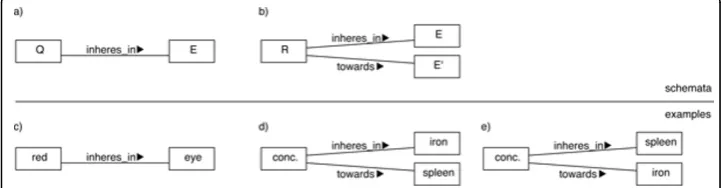
The EQ model is an important and widely used means for formalizing phenotype information in ontologies [15]. In greater detail, its main idea is to combine an‘entity class’(the E in EQ) from an anatomy or process ontology with a‘quality class’(the Q) from PATO. For example, the class eye(MA:000261 in the Mouse adult gross anatomy ontology (MA) [16]) as the E and the color red (PATO:0000322) for Q can be com-bined to form the class Red eye. The typical formal interpretation of EQ statements is that the combination refers to a specialization of the quality class Q such that it inheres in instances of the entity class E [[10], p. 3], [17]. In the example, this yields the class red that inheres in an eye(cf. Figure 1, especially part c)).
Relational qualities involve at least one additional entity besides E. In the semantics of EQ, a second entity can be attached to a quality via the relation towards[[10],
Figure 1EQ model. In the schematic part, E stands for entity, Q for quality, and R for relational quality. Schema a) accounts for a simple (unary or non-relational) quality, while b) refers to relational qualities. The examples c) and d) correspond to those from the text. Example e) in parallel with d) is forestalling the problem of inter-modeler consistency from the Methods section.‘conc.’in d) and e) abbreviates
p. 3-5]. An example of this kind is the concentration of iron in the spleen, which can be formalized as a quality concentration of (PATO:0000033) inhering in spleen (MA:0000141) and connected via towardstoiron(CHEBI:18248 in the ontology of Chemical Entities of Biological Interest [18]), in order to define abnormal spleen iron level (MP:0008739). Note that, despite continued use of this example, we will not go into detailed ontological analyses of the relationship between iron and spleen, e.g., as particulars/individuals. In particular, iron as an amount of matter/quantity or collection would deserve special treatment, cf. e.g. [19,20].
The term ‘relational quality’ as nowadays found in the bio-ontology community is typically used without further analysis, e.g. in [10], and via [17] can be traced back to [21] where it seems to be meant synonymously with the more widely used term‘ rela-tion’. Notably, in the context of formal ontology, by ‘relational qualities’sometimes constituents of particular relation instances are referred to (in contrast to the overall relation instances themselves), termed ‘relational roles’in section‘Enhancements for Relational Qualities’below.
While EQ descriptions characterize a phenotype, a related question pertains to the for-malization of theannotationof organisms, genotypes and genes with EQ-based phenotype descriptions. In model organism databases such as the MGI database [13], genotypes like Add2tm1Llp(MGI:2149065) are annotated with a class likeabnormal spleen iron level (MP:0008739). The intended meaning of this annotation is that organisms of a particular mouse strain that exhibit the described genotype (a targeted mutation of theAdd2gene) within a specific environment will develop theabnormal spleen iron levelphenotype. This complex relation can be simplified to improve performance of specific information retrie-val tasks into a view in which the genotype is equiretrie-valent to the intersection of phenotypes, and individual mice are instances of their phenotypic annotations.
Only few efforts formally explore the compositional nature of phenotypes, i.e., how atomic phenotypes can be combined into more complex phenotypes such as in disease descriptions or in genotypes annotated with multiple phenotypes. In particular, the naive combination of phenotypes such asred eyewithshort tailis based on class inter-sections, and these lead to contradictory class definitions due to the disjointness ofcolor (the super-class of red) andsize(the super-class ofshort) [22]. More challenging are combinations of qualities which are hidden in the taxonomy of biomedical ontologies. For example, asserting thatred eyeis a sub-class of anabnormal eye morphologywill imply thatred eyeis both a subclass ofmorphologyandcolor. This will lead to another contradictory class definition due to the disjointness ofcolorandmorphology[23].
Methods
Identification of basic problems
We see threebasic problemsthat need to be addressed regarding the representation of phenotypes and the interpretation of EQ descriptions in terms of the Web Ontology Language (OWL) [24], in order to utilize automated and semantically correct reasoning to its full extent.
The ontological foundation of complex phenotypes pertains to the problem of how combinations of concepts are correctly handled. It is argued that the current methods of combining concepts that are available in logical formalisms, including OWL,“have serious problems handling concept combinations in the way humans do.”[[25], p. 19]. There the examplestall squirrel, honey bee, stone lion, andwhite Zinfandelare mentioned, for which no precise and correct representation within OWL is immediately available. Due to the connection with concept formation, the ontology of complex phenotypes exhibits an extensive and new research field that integrates methods and results of cognitive science and methods of formal ontology. Notably, in cognitive science itself research on concep-tual combinations is still at a relatively early stage of development [26].
To address the first problem, we attempt to gain a clear understanding of the ontologi-cal nature of complex phenotypes and rely on an ontologiontologi-cal framework for the explana-tion and foundaexplana-tion of complex phenotypes. This does not depend on the expressive power of OWL. Once we obtained an understanding of the ontological nature, this is the basis for investigating how to represent complex phenotypes in OWL, as a case of the second problem. The results of the first basic problem will influence the solutions to the second problem accordingly. Furthermore, limitations in expressiveness may cause the formal coverage of the ontological understanding to be partial, compared to the overall ontological picture.
The third step is to apply the theory to existing descriptions of complex phenotypes, such as those found in the phenotypic annotation of diseases and genotypes in model organism annotations.
Focusing on issues of formal representation
As is clear from above, the first basic problem requires further attention, although it is already widely discussed, even in biomedicine and formal ontology, e.g. see [22,27,28]. In the present paper, our focus is on the second problem and its application to forma-lizing phenotype annotations. The latter, to a limited extent, also touches on the third basic problem. Regarding this focus, we identify five interrelatedparticular issuesthat affect our analyses.
1. ontological adequacy/coherence of ontological interpretation 2. invalid permutations/ambiguities
3. relational expressiveness 4. consistency of domain modeling 5. formal reflection of annotations
Referring to ontological adequacy, we intend to find OWL representations that are close to the ontological understanding of phenotypes asqualities, similar to established ontological theories of phenotypes [10,17]. While several approaches allow for repre-sentations of individual EQ statements in OWL, combining multiple EQ statements by means of their intersections may create incorrect [[22], sect. 4.2, p. 3117] and some-times contradictory statements [23]. For instance, consider the following OWL concept:
Concept (1) is necessarily empty, because no instance of redis equally an instance of short. Furthermore, this formalization faces the problem ofpermutations (issue two), arising from the commutativity and associativity of intersections in OWL. In par-ticular, the parentheses in example (1) are merely auxiliary for reading. The concept is formally equivalent to (red that inheresIn some tail) and (short that inheresIn some eye). As a consequence, queries will deliver incorrect results if this mode of combining EQ statements is used.
The next two issues concern primarily phenotypes based on relational properties, like iron concentration in the spleen. Relational expressiveness is used for referring to lim-itations of the arity of relations that can be specified with an EQ description. The cur-rent model does not allow for relational qualities of an arity greater than two. This may lead to undesirable consequences, since several applications of biomedical knowl-edge representation require relations of higher arity [29,30]. This issue has been identi-fied as a particularly important challenge for representing EQ-based phenotypes [17]. Closely connected to the number of arguments is the question ofinter-modeler consis-tency/harmonization, cf. also [30]. This fourth issue refers to the question of how to link (a class representing) a relation to (classes of) its arguments such that it is as unambiguous as possible which argument connects to the relation in which way. In the current EQ model confusion can arise, e.g., on whetheriron concentration in the spleen should be formalized asconcentration that inheresIn some spleen and towards some ironor instead as concentration that inheresIn some iron and towards some spleen, see parts d) and e) of Figure 1. The different positions may correlate with the community/background of modelers, e.g. whether a biologist or a chemist makes the assertion. Corresponding decisions are not only rele-vant for formalization, but likewise influence querying. For the particular case of con-centrations, [20] proposes inherence in those entities that are concentrated in another in the context of an ontological analysis, i.e., inherence in iron in the example. We comment on this in the discussion section below, with hindsight regarding our analysis.
The fifth and final issue is the orientation and clarification of howannotationsare inter-preted, for any account of phenotype representations. This immediately links back to the ontological reading of phenotype representations and the third basic problem above.
Spectrum of solutions
In this paper we focus first on solutions that limit the number of changes to the established interpretation of EQ descriptions. The latter are meanwhile widely in use, cf. e.g. [15], as are phenotype ontologies with their basic presupposition of providing (sub)concepts of quality. Therefore, the migration to new proposals should be facili-tated by an approach with less changes compared to more radical revisions.
Results
EQ interpretations with regard to annotations
First of all, what appears unavoidable is a more complex provision for annotations, at least if complex phenotypes formalized in OWL/description logics (DL) [31] shall be composable in terms of the usual intersection. Implicitly, this has already been observed in [22], to some extent also in connection with the EQ formalism. The fol-lowing adheres to the understanding of annotations as outlined in the Introduction and is inspired by the notion of phenesin [22]. Nevertheless, the subsequent variant differs in order to minimize changes to PATO and phenotype ontologies.
In order to solve especially the permutation problem of combined EQ descriptions, formally it suffices to have an “encapsulating”relation available. For instance, while (1) suffers from unwanted permutations, this is avoided in (2), where the encapsulating relation is termed hasPheno.
hasPheno some (red that inheresIn some eye) and
hasPheno some (short that inheresIn some tail) (2)
Naturally, the question arises which ontological reading applies to hasPheno. We interpret (2) as a concept for classifying organisms (by two phenotype descriptions). The hasPhenorelation belongs to an interpretive view/pattern that overlays common interconnections of entities, centering on the organism. In terms of the example, one may consider an organism Othat has an eyeE as its part, while there is a redRthat inheres in E. Thus Ois indirectly related with Rin terms of common relations like inherence and part-of. In the phenotype view, this allows us to viewO, as phenotype bearer, to exhibitR as a pheno of O. The latter connection is reflected by the has-Phenolink betweenOandR. We require that eachhasPhenolink is“justified”by a chain of basic relations like inheres-in,part-of, has-function, participates-in, etc., that connects the entity in the pheno role with the one in the phenotype bearer role (PB in Figure 2, 3, 4 below). This approach leaves existing ontologies intact, resolves the first two particular issues identified, and accounts for the fifth, as well.
Enhancements for relational qualities Purely formal extension
the notion of external dependence, see [[33], esp. sect. 6.2.7]. The more common approach to name those auxiliary relations would have been the use of names counting arguments, like argument1andargument2. With the latter, an extension to n-ary
relations is straightforward, which would solve the expressiveness issue. However, with fixed auxiliary relations there is no support for consistent domain modeling because the assignment of“values” to arguments is arbitrary. This may be the reason why all published variants of this pattern that we are aware of eventually suggest the variable, relation-specific naming of auxiliary relations [[29], sect. 5.1], [32,34].
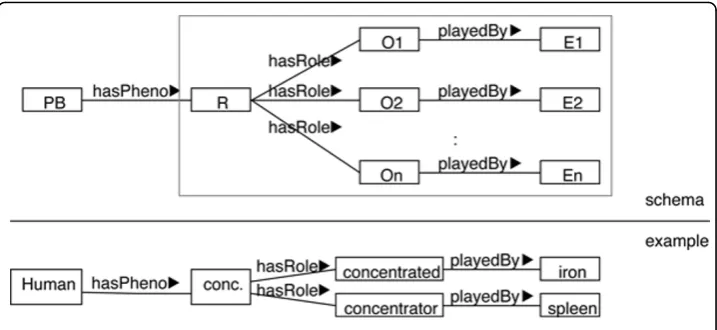
Therefore, we do not see that changing the interpretation of relational EQ statements could be sidestepped, if inter-modeler consistent domain modeling is to be supported any further. Striving at the same time for ontological adequacy somewhat systemati-cally, we adopt the model of relations and (relational) roles from the General Formal Ontology (GFO) [35,36], cf. also [37,38]. As a side remark, we indicate that there are more types of roles in GFO, but for brevity we use roles and relational roles as syno-nyms herein. Note further that from here on ‘role’ is reserved for the ontological Figure 2Roles-as-properties: Ontological roles encoded as OWL properties. PB stands for phenotype bearer in the schematic part.
interpretation, whereas the meaning as set of pairs/as binary relation in the context of description logics and OWL is referred to as‘OWL property’or‘DL role’.
Ontological alternatives using relations
In brief, relations in GFO are considered as categories of relators. Relatorsare ontolo-gical individuals akin to qualities, but with the power to mediate/connect entities. A relator consists ofrole individuals (viahasRole/roleOf) and each role individual, besides depending on the relator, depends on a player(via playedBy/plays). The term‘player’is relative to this approach; in general, arbitrary entities can play a role within a relation. At the categorial/class level, each relation Ris associated with a set of role categories that forms the role base for this relation. Basically, that means for each relator of type Rthat its roles must instantiate one of the role categories in that set, cf. [[38], sect. 3.3.3].
The GFO model of relations and roles can be encoded into an OWL representation in two obvious ways, termedroles-as-properties(Figure 2) androles-as-classes(Figure 3). Common to both cases is to represent phenotype descriptions involving a relationRand (kinds of) entitiesE1, . . . ,Enas argument restrictions. Either, corresponding to Figure 2, roles are left implicit in the OWL propertieso1, . . . ,on, or, regarding Figure 3, role cate-gories are explicated as OWL classesO1, . . . ,On(in betweenRand theEi). Consider the example ofiron concentration in the spleen, with the relationconcentrationand assum-ing that its two role categories are labeledconcentratedandconcentrator. The role of theconcentratedis to be played by those entities that are concentrated in other entities, while the role of the concentratoris played by those (other) entities within which the first are concentrated. (Notably, in this technical readingconcentratormust be under-stood merely like“container”, which may be biologically misleading. In particular, any-thing in theconcentratorrole isnot(necessarily) expected to cause or generate the concentration under consideration. A biological example of a concentrator in this non-intended sense could be akidneythat causesureato be concentrated within thebladder. Despite this potential for confusion,concentratoris employed below in the“container” -sense in order to use a succinct role term that derives from the relation name.) The approach of roles-as-properties yields in OWL
hasPheno some ( concentration and
(concentrated some iron) and (concentrator some spleen) ),
(3)
whereas roles-as-classes leads to
hasPheno some ( concentration and
(hasRole some (concentrated that playedBy some iron) ) and
(hasRole some (concentrator that playedBy some spleen) ) ).
The first of these cases equals the above approach of using variable, relation-specific names for the auxiliary relations [[29], sect. 5.1], [32,34]. The second uses only two OWL propertieshasRoleandplayedBy(and their inverses, possibly), but here this is unproblematic because the roles of the reified relation explicitly account for what is missing with fixed auxiliary relations without roles. Of course, both of these proposals will require a syntactic extension of the EQ model in order to capture the correspond-ing roles within EQ statements. Moreover, the roles-as-properties way may be simpler to reinterpret in other top-level ontological theories, because the roles presupposed by GFO are less explicit compared to roles-as-classes.
Ontological alternative using relations and qualities
The previous subsection suggests two ontologically inspired ways of formalizing rela-tional qualities like concentration of(PATO:0000033, hereafter CO) in EQ statements that cure the immediate deficiencies previously described. We note that biological pro-cesses like concentratinganything in anything else are not taken into account here. Instead, both approaches are based on a purely relational reading of CO (and relational qualities, in general). CO is merely considered as a noun form of the phrase is concen-trated in (CI). For example,‘(a particular amount of) iron Iis concentrated in a (parti-cular)spleen S’is a“relational proposition”, stating thatI is concentrated inS. This proposition can be true or false, depending on whether the relation CI applies toIand Sor not, but there is nothing to be measured, neither quantitatively nor qualitatively. (Pursuing this line of thought further in the example, one may wonder what remains as the actual difference between CI and relations such as‘is contained in’and‘is part of’.) In noun form, yet somewhat artificially, one may equivalently refer to ‘there is concentration ofI inS’for CI (note that IandS are particulars). However, we hold that CO comes in a second flavor, which is more amenable to specialization with notions likeincreased concentration of or to expressing specific values, e.g., 0.5g/l. In
phrases like ‘the concentration of X inYis 0.5g/l’, it appears more adequate to us to
view CO as a proper quality which can be numerically quantified. Of course, immedi-ately the question arises what that quality inheres in, which must be something that
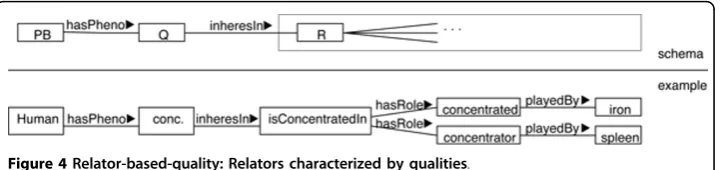
Eventually we arrive at a third approach, depicted in Figure 4, where the relation is characterized by a quality. In the example, that means that CI is distinguished from CO, the latter being understood as a quality that inheres in CI relators/instances. Accordingly, we refer to this approach as relator-based-quality. Note that the intuitive term‘relational quality’experiences a formal-ontological reinterpretation from relations in the previous cases of roles-as-properties and roles-as-classes to qualities proper (which are not relations) in the relator-based-quality approach. Looking again at iron concentration in the spleen, assuming the roles-as-properties approach for modeling a relationisConcentratedIn (with roles like above) and a relational quality con-centrationyields in OWL
hasPheno some ( concentration that
( inheresIn some ( isConcentratedIn and
(concentrated some iron) and
(concentrator some spleen) ) ) ). (5)
This approach appears ontologically plausible to us currently, following the explana-tions above. Moreover, from the point of view of representation, it exhibits the benefi-cial property that CO is a “unary quality” like color, in the sense that it inheres in a single entity (a CI relator, which in turn accounts for the relational character of the quality). Any general account of representing measurements should thus be applicable to CO as it is to qualities like color. In these cases there is a single entity available -the quality - to which a measured value can be attached, where exploiting OWL data-type properties is one among several options that remain to be studied in future work. Furthermore, linking qualities to relators does not prescribe an overly specific relation model, but allows for adopting either of the approaches as-properties and roles-as-classes in formalizing relations and roles, or even other theories (for which the qual-ity bearer may require reinspection).
Discussion
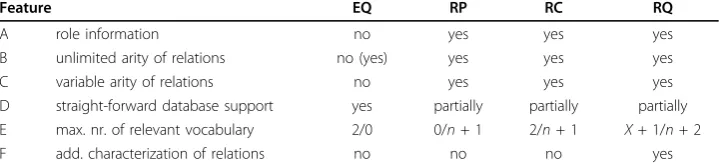
We limit the discussion mainly to aspects of the enhancements for relational qualities. Table 1 compactly summarizes the approaches that are considered herein. At the end, some remarks on measurements and comparative qualities are provided, and we briefly compare the relation hasPhenoin this paper with has-phenefrom [22].
Aspects of enhancements for relational qualities
and (3) modeling diversity due to arbitrary splittings of reified relations, e.g. of reifying a 6-ary relation in terms of two ternary ones.
We disagree with all of these, yet to different degrees. Concerning (1), we agree that more vocabulary is involved which requires additional attention inontology maintenance. But this can be countered by the mutual disjointness of relation, role, and non-relational classes and the use of distinct subsumption hierarchies/graphs for each category, within which relations, roles, and other classes can be organized manageably. Extra effort that remains is to determine role names for each relation when introducing the latter, which is a source of inter-modeler differences. One may adopt linguistic principles in some cases, supporting uniformity. For example, for binary relations that can be appropriately named by verbs, participles can be used as role names in many cases. Admittedly, that approach likely requires manual care and checking, e.g. remembering the remarks on misinterpret-ing the roles ofconcentration of(PATO:0000033) in the section Ontological alternatives using relations.
The use of the ontologymay be less affected, if there are effective intermediate repre-sentations and user interfaces, cf. [[17], p. 1]. (2) is wrong in the light of the GFO approach to relations and roles, where these are ontological entities and thus not of purely technical nature. Admittedly, the roles-as-classes approach is closer to the onto-logical view of GFO, whereas roles-as-properties is a mainly technical simplification of the former. But this is not the technical nature criticized in [30]. Criticism (3) appears not applicable in our case, because the reification directly uses roles instead of arbitrary k-ary“parts”of ann-ary relation (wherek<n).
Moreover, we see significant advantages in modeling and expressiveness that arise from the use of roles. For instance, relations are not only unconstrained in the number of arguments per relation, but one may even use anadic relations (i.e., with a variable number of arguments) and such with optional arguments. Similarly, symmetry proper-ties of relations derive naturally from allowing for multiply instantiable role categories in the context of a role base. That means, a relation may be instantiated by relators that have several individual roles instantiating the same role category.
Notably, it is also symmetry of this kind that produces doubts on the treatment of concentration in [[20], sect. 3.2]. Hastings et al. present a fairly detailed analysis of sub-stance mixtures (among other topics) which we can follow to a large extent. This ana-lysis is aimed at formalizing the notion of concentration in description logics. In this
Table 1 Summary of the main features of the discussed approaches.
Feature EQ RP RC RQ
A role information no yes yes yes
B unlimited arity of relations no (yes) yes yes yes
C variable arity of relations no yes yes yes
D straight-forward database support yes partially partially partially E max. nr. of relevant vocabulary 2/0 0/n+ 1 2/n+ 1 X+ 1/n+ 2
F add. characterization of relations no no no yes
connection and transferred to the original EQ model (cf. the Introduction and the Methods section), the consistency of domain modeling is achieved - for concentration only - by simply declaring that concentrations inhere in the entity, say iron, that is concentrated in another, sayspleen. This likely means for EQ that the concentration is linked to that other entity by means oftowards, and thusconcentration that inheresIn some iron and towards some spleen is the preferred formalization, cf. the same example in the Methods section. At least, this is what we read from sect. 3.2 in [20]. It is not actually stated whether and how the concentration relates directly with a mixture, e.g. blood (in their example). One can also find more informal state-ments which suggest different interpretations, e.g. in sect. 2.2 of [20]. In any case, how-ever, in their analysis this choice of assigning inherence and towards is not explained. Considering other relational properties than concentration, an analogous decision would have to be made for each relational property (and established among modelers), which appears less attractive than finding more general rules. Closing the circle to symmetric relations, for these it is not possible to distinguish one of the arguments (at least, not based on their roles only). For instance, for a phenotype like increased distance of the eyes, it appears completely implausible to select one eye in which a distance inheresIn, whereas it istowards the other eye. Especially the relator-based-quality approach, despite its own unresolved choices (see the respective part of the Results section), avoids such arbitrary fixing.
A practical factor of all three approaches that might be of potential importance is a slightly increased complexity, which prevents a straight-forward integration of corre-sponding annotations into the relational schemas of annotation databases. Relational database tables are set up with a fixed number of columns. While for the established EQ approach one may simply add one column for each of ‘quality’, ‘entity-1’, and
‘entity-2’ (and possibly for‘qualifier’), a role-based approach requires a more exible solution that allows for a variable number of entities as arguments of relations, for example. Thus we proposenot to encode roles in the database schema, but rather as instance data (i.e., role-based information is captured row-wise rather than column-wise). Table 2 shows one corresponding proposal by way of example (jointly with Tables 3 and 4), yet more work in this direction remains to be done. To some extent, there seems to be an in-principle incompatibility of various aims, including the provi-sion forn-ary relations vs. a simple database implementation.
Another interesting observation arises from considering the proposed database tables in Tables 2, 3, 4 in connection with the OWL representation schemes in Figure 2, 3, 4. Annotations in a corresponding database would be compatible with all approaches dis-cussed above, because these rely on the same core of conceptual primitives. Database contents can thus be translated into OWL according to any of the three schemes. Con-sequently, the support of annotation databases provides no criterion to distinguish among the three approaches.
suggests a uniform manner of interfacing with representations of measurements for non-relational and relational qualities.
Contextual aspects: measurements, qualifiers, and phenes
Having just mentioned the representation of measurements, this connects in a further way to the more general topic of relations (and phenotypes). The question arises whether the notion of an ontological relation (based on relators, as included in GFO) covers all relevant interpretations of the term ‘relation’that are needed to construct and analyze all kinds of complex phenotypes. There is a reading of ‘relation’expressed by comparative conditions like X is redder than Y,X is faster than Y, andX is heavier than Y. The specification of these relations assumes an ordering or scale on the instances of the propertiesred, velocity, andweight. Such a scale is in many cases the result of measuring, where a measure connects properties of the real world with num-bers. The latter are included in the mathematical realm, and the orderings of numbers are usually considered as set-theoretic relations, i.e., as sets of ordered tuples. Based on the measuring process, these relations are transferred to relations between properties (e.g., instances of red,velocity, andweight). Accordingly, we expect that set-theoretic relations are likewise necessary to get a full picture of understanding the term‘relation’ in the context of phenotype analysis and representation (and yet in other connections).
Table 2 Sample phenotype table for annotation databases.
Phenotype Table
r_id p_id quality role entity qualifier
0 0 red
PATO:0000322
eye MA:000261
1 1 concentration of
PATO:0000033 concentrator N/A spleen MA:0000141 abnormal PATO:0000460
2 1 concentration of
PATO:0000033 concentrated N/A iron CHEBI:18248 abnormal PATO:0000460 3 2 increased concentration
PATO:0001162
concentrator
N/A
spleen MA:0000141 4 2 increased concentration
PATO:0001162
concentrated
N/A
iron CHEBI:18248
Tables 2-4 form an integrated set of database tables, as an example of one implementation option for annotation databases. The present table stores pure phenotype descriptions. It supports non-relational and relational qualities, in the latter case of arbitrary arity and role type. For this purpose, role types do not correspond to columns (attributes) of the table, but they are stored in rows. Rows of a single phenotype description have the same phenotype identifier assigned to them. The sample entries repeat examples of the main text (with natural language terms for readability), but are arbitrary otherwise.
Abbreviations:r_id:row identifier,p_id: phenotype identifier,N/A: not available. Empty positions are to be read as null values.
Table 3 Sample entity table for annotation databases.
Entity Table
e_id . . . .
0 . . . .
1 . . . .
2 . . . .
3 . . . .
The database table for the description of entities to be annotated with phenotypic information can adhere to an arbitrary schema in the context of Tables 2-4. Only entity identifiers must be presumed for Table 4. This entity table is merely shown for completeness.
We emphasize that GFO is an appropriate means for this analysis, since it includes both, relator-based relations and set-theoretic relations.
Next, let us briefly return to the hypothetical annotation database in Tables 2, 3, 4, where the phenotype table comprises a column named‘qualifier’(Table 2). This stays clo-sely in line with the use of aqualifier(also called modifier) in EQ statements, indicated in [[10], p. 3 and Tables 2 and 4]. Actually, however, we regard a more comprehensive treat-ment of qualifiers as future work. It remains debatable, for instance, why abnormality (abnormal, PATO:0000460) is captured by means of the qualifier construct, whereas pre-fixes such asincreasedanddecreased(e.g. inincreased concentration, PATO:0001162) are parts of names of qualities. The treatment of‘qualifier’in Table 2 is therefore preliminary and the overall approach of encoding qualifiers may experience revision. Notably, impli-citly comparative qualities such asincreased concentrationare usable with all approaches above in exact analogy to the their use with the EQ model. A final note concerns the hasPhenorelation introduced in the Results section above. It is inspired by, but deviates from the notion ofphenesand thehas-phenerelation in [22]. Therein, phenes may be understood as quality-like entities that reflect/abstract complex aspects that an organism is involved in. For instance, a structural phene accounting forpresence of a spleencan be given the following class definition in OWL:present-spleen equivalentTo: phene-of some (has-part some spleen). This phenotype description can then be applied to an entity (class) in terms of thehas-phenerelation, e.g.human that has-phene some present-spleen. As a result of the logical constraints of the approach to phenes in [22], an instanceIof the latter class must have a spleen as part, and addition-allythere must be a pheneP(an attributive entity, different from the spleen) such thatI has-pheneP. The same applies in the case of qualitative phenes, e.g. cf.being-red equivalentTo: phene-of some (has-quality some red). Again, if a particular entity has a quality of typered, it also has a phene of typebeing red. Here lies the differ-ence to thehasPhenoapproach above, which does yield new relational links between instances in addition to more basic relations, likeinherence, part-of, etc. But it does not lead to additional instances, quality-like or otherwise, cf. the passage on EQ interpretations of the Results section. This suffices for our purposes, such that avoiding additional entities may be judged to be preferable. On the other hand, further comparison of the strengths and weaknesses of both views is a future task.
Conclusions
In this paper we report on the (work-in-progress) state of our analyses and improve-ment proposals concerning the Entity-Quality (EQ) model. A simple general
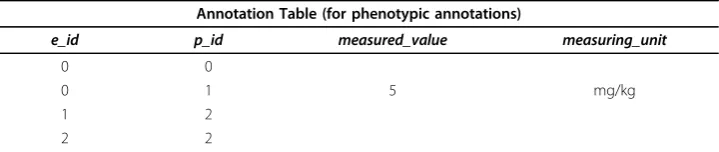
Table 4 Sample annotation table for annotation databases.
Annotation Table (for phenotypic annotations)
e_id p_id measured_value measuring_unit
0 0
0 1 5 mg/kg
1 2
2 2
Assuming phenotypes and entities according to Tables 2 and 3, the actual annotations of entities with phenotypes are kept separately in this table, since this is a many-to-many-relationship. The two additional columns shall indicate a simple option to capture quantitative data. Notably, the qualifier column of Table 2 is placed therein for coherence with current EQ descriptions. That column may alternatively be part of the present table.
modification in the understanding of qualities in PATO is argued to be necessary. Moreover, three variants of formalizations of extended support for relations/relational qualities in the Web Ontology Language (OWL) are presented.
Much work remains to be done or completed. The approaches detailed herein rely on theoretical analyses thus far. For further assessment, an experimental evaluation should be conducted, e.g. exploring the efficiency of reasoning over ontologies which rely on one or another approach. Despite our (preliminary) decision to minimize changes to the EQ interpretation to the greatest possible extent, we still see many interesting open theoretical issues in the EQ model, respective ontologies, and pheno-type understanding and representation in general. For instance, we are convinced that not all concepts of PATO should be regarded ontologically properly as qualities. The connections betweenhasPheno above andhas-phenein [22] are only initially ela-borated yet and deserve continued treatment, as well. Accordingly, further alternatives, which possibly involve larger reinterpretation of existing resources, should be studied and compared. On that basis EQ syntax extensions and possibly changes to phenotype ontologies can be devised.
List of abbreviations
CHEBI: Chemical Entities of Biological Interest; CI: is concentrated in (relation name); CO: concentration of (relation/ quality name); DL: description logic; EQ: Entity-Quality; GFO: General Formal Ontology; HPO: Human Phenotype Ontology; MA: Mouse Adult Gross Anatomy Ontology; MGI: Mouse Genome Informatics (database); MP: Mammalian Phenotype Ontology; OWL: Web Ontology Language; PATO: Phenotypic Attribute and Trait Ontology; WPO: Worm Phenotype Ontology.
Acknowledgements
Funding for RH was provided by the European Commission’s 7th Framework Programme, RICORDO project, grant number 248502.
This article has been published as part ofJournal of Biomedical SemanticsVolume 3 Supplement 2, 2012: Proceedings of Ontologies in Biomedicine and Life Sciences (OBML 2011). The full contents of the supplement are available online at http://www.jbiomedsem.com/supplements/3/S2.
Author details
1Department of Computer Science, University of Leipzig, 04103 Leipzig, Germany.2Department of Genetics, University of Cambridge, Cambridge CB2 3EH, UK.3Institute of Medical Informatics, Statistics and Epidemiology (IMISE), University of Leipzig, 04107 Leipzig, Germany.
Authors’contributions
RH identified problems of the EQ model and initiated the work. FS and FL devised the modeling alternatives for relational qualities and determined their properties, with further support from RH. HH supervised the project. All authors wrote the paper, discussed and revised it. All authors read and approved the final manuscript.
Competing interests
The authors declare that they have no competing interests.
Published: 21 September 2012
References
1. Rosenthal N, Brown S:The mouse ascending: perspectives for human-disease models.Nat Cell Biol2007,
9(9):993-999.
2. Collins FS, Finnell RH, Rossant J, Wurst W:A new partner for the international knockout mouse consortium.Cell2007,
129(2):235.
3. Hoehndorf R, Schofield PN, Gkoutos GV:PhenomeNET: a whole-phenome approach to disease gene discovery. Nucleic Acids Res2011,39(18):e119.
4. Smith CL, Goldsmith CAW, Eppig JT:The Mammalian Phenotype Ontology as a tool for annotating, analyzing and comparing phenotypic information.Genome Biol2005,6:R7.
5. Bult CJ, Eppig JT, Kadin JA, Richardson JE, Blake JA, The Mouse Genome Database Group:The Mouse Genome Database (MGD): mouse biology and model systems.Nucleic Acids Res2008,36(Suppl 1):D724-D728.
6. Schindelman G, Fernandes J, Bastiani C, Yook K, Sternberg P:Worm Phenotype Ontology: Integrating phenotype data within and beyond the C. elegans community.BMC Bioinformatics2011,12:32.
8. Beck T, Morgan H, Blake A, Wells S, Hancock J, Mallon AM:Practical application of ontologies to annotate and analyse large scale raw mouse phenotype data.BMC Bioinformatics2009,10(Suppl 5):S2.
9. Washington NL, Haendel MA, Mungall CJ, Ashburner M, Westerfield M, Lewis SE:Linking human diseases to animal models using ontology-based phenotype annotation.PLoS Biol2009,7(11):e1000247.
10. Mungall C, Gkoutos G, Smith C, Haendel M, Lewis S, Ashburner M:Integrating phenotype ontologies across multiple species.Genome Biol2010,11:R2.
11. Ashburner M, Ball CA, Blake JA, Botstein D, Butler H, Cherry JM, Davis AP, Dolinski K, Dwight SS, Eppig JT, Harris MA, Hill DP, Issel-Tarver L, Kasarskis A, Lewis S, Matese JC, Richardson JE, Ringwald M, Rubin GM, Sherlock G:Gene ontology: tool for the unification of biology.Nat Genet2000,25:25-29.
12. Gkoutos GV, Green EC, Mallon AM, Hancock JM, Davidson D:Using ontologies to describe mouse phenotypes. Genome Biol2004,6:R8.
13. Blake JA, Bult CJ, Kadin JA, Richardson JE, Eppig JT, the Mouse Genome Database Group:The Mouse Genome Database (MGD): premier model organism resource for mammalian genomics and genetics.Nucleic Acids Res2011,
39(Suppl 1):D842-D848.
14. Schulz S, Schober D, Rau e D, Boeker M:Pre- and postcoordination in biomedical ontologies.2010, L.1-4, Herre et al. 39.
15. Balhoff JP, Dahdul WM, Kothari CR, Lapp H, Lundberg JG, Mabee P, Midford PE, Westerfield M, Vision TJ:Phenex: ontological annotation of phenotypic diversity.PLoS ONE2010,5(5):e10500.
16. Hayamizu TF, Mangan M, Corradi JP, Kadin JA, Ringwald M:The Adult Mouse Anatomical Dictionary: a tool for annotating and integrating data.Genome Biol2005,6(3):R29.
17. Mungall C, Gkoutos G, Washington N, Lewis S:Representing phenotypes in OWL.InProceedings of the OWLED 2007 Workshop on OWL: Experiences and Directions, Innsbruck, Austria, Jun 6-7, Volume 258 of CEUR Workshop Proceedings.
Aachen, Germany: CEUR-WS.org;Golbreich C, Kalyanpur A, Parsia B 2007:.
18. Degtyarenko K, de Matos P, Ennis M, Hastings J, Zbinden M, McNaught A, Alcantara R, Darsow M, Guedj M, Ashburner M:ChEBI: a database and ontology for chemical entities of biological interest.Nucleic Acids Res2008,
36(Suppl 1):D344-D350.
19. Guizzardi G:On the representation of quantities and their parts in conceptual modeling.InFormal Ontology in Information Systems: Proceedings of the Sixth International Conference, FOIS 2010, Toronto, Canada, May 11-14, Volume 209 of Frontiers in Artificial Intelligence and Applications.Amsterdam: IOS Press;Galton A, Mizoguchi R 2010:103-116. 20. Hastings J, Steinbeck C, Jansen L, Schulz S:Substance concentrations as conditions for the realization of
dispositions.InSemantic Applications in Life Sciences: Proceedings of the 4th International Workshop on Formal Biomedical Knowledge Representation, KR-MED 2010, hosted by Bio-Ontologies 2010, Boston, Massachussetts, USA, Jul 9-10, Volume 754 of CEUR Workshop Proceedings.Aachen, Germany: CEUR-WS.org;Cornet R, Schulz S 2010:.
21. Neuhaus F, Grenon P, Smith B:A formal theory of substances, qualities and universals.InFormal Ontology in Information Systems: Proceedings of the Third International Conference, FOIS-2004, Turin, Italy, Nov 4-6, Volume 114 of Frontiers in Artificial Intelligence and Applications.Amsterdam: IOS Press;Varzi AC, Vieu L 2004:49-59.
22. Hoehndorf R, Oellrich A, Rebholz-Schuhmann D:Interoperability between phenotype and anatomy ontologies. Bioinformatics2010,26(24):3112-3118.
23. Hoehndorf R, Dumontier M, Oellrich A, Rebholz-Schuhmann D, Schofield PN, Gkoutos GV:Interoperability between biomedical ontologies through relation expansion, upper-level ontologies and automatic reasoning.PLoS ONE
2011,6(7):e22006.
24. W3C:OWL 2 Web Ontology Language document overview.W3C Recommendation, World Wide Web Consortium (W3C), Cambridge, Massachusetts2009 [http://www.w3.org/TR/2009/REC-owl2-overview-20091027/].
25. Gärdenfors P:How to make the Semantic Web more semantic.InFormal Ontology in Information Systems: Proceedings of the Third International Conference, FOIS-2004, Turin, Italy, Nov 4-6, Volume 114 of Frontiers in Artificial Intelligence and Applications.Amsterdam: IOS Press;Varzi AC, Vieu L 2004:17-34.
26. Hampton J:Conceptual combination.InKnowledge, concepts, and categories, Studies in Cognition.Cambridge, Massachusetts: MIT Press;Lamberts K, Shanks D 1997:133-160.
27. Mahner M, Kary M:What exactly are genomes, genotypes and phenotypes? And what about phenomes?J Theor Biol1997,186:55-63.
28. Uciteli A, GrobS, Kireyev S, Herre H:An ontologically founded architecture for information systems in clinical and epidemiological research.J Biomed Semantics2011,2(Suppl 4):S1.
29. Stevens R, Aranguren ME, Wolstencroft K, Sattler U, Drummond N, Horridge M, Rector A:Using OWL to model biological knowledge.Int J Hum Comput Stud2007,65(7):583-594.
30. Grewe N:A generic reification strategy forn-ary relations in DL.2010, N.1-5, Herre et al. 39.
31. Baader F, Calvanese D, McGuinness D, Nardi D, Patel-Schneider P, (Eds):The Description Logic Handbook: Theory, Implementation and Applications.2 edition. Cambridge, UK: Cambridge University Press; 2010.
32. Nary Relationship.[http://www.gong.manchester.ac.uk/odp/html/Nary_Relationship.html].
33. Guizzardi G:Ontological Foundations for Structural Conceptual Models, Volume 015 of Telematica Instituut Fundamental Research Series.Enschede (Netherlands): Telematica Instituut; 2005.
34. Noy N, Rector A:Defining N-ary relations on the Semantic Web.W3C working group note, World Wide Web Consortium (W3C), Cambridge, Massachusetts2006 [http://www.w3.org/TR/2006/NOTE-swbp-n-aryRelations-20060412/]. 35. Herre H:General Formal Ontology (GFO): a foundational ontology for conceptual modelling.InTheory and
Applications of Ontology: Computer Applications.Heidelberg: Springer;Poli R, Healy M, Kameas A 2010:297-345. 36. Herre H, Heller B, Burek P, Hoehndorf R, Loebe F, Michalek H:General Formal Ontology (GFO) - A Foundational
Ontology Integrating Objects and Processes [Version 1.0.1].Draft, Research Group Ontologies in Medicine, Institute of Medical Informatics, Statistics and Epidemiology, University of Leipzig2007 [http://www.onto-med.de/Archiv/
ontomed2002/en/theories/gfo/part1-drafts/gfo-part1-v1-0-1.pdf].
37. Loebe F:Abstract vs. social roles - towards a general theoretical account of roles.Appl Ontol2007,2(2):127-158. 38. Loebe F:An Analysis of Roles: Towards Ontology-Based Modelling. No. 6 in Onto-Med Report, Research Group Ontologies in
39. Herre H, Hoehndorf R, Kelso J, Schulz S:Proceedings of the 2nd Workshop of the GI-Fachgruppe“Ontologien in Biomedizin und Lebenswissenschaften”(OBML), Mannheim, Germany, Sep 9-10. No. 2/2010 in IMISE-Report, Institute of Medical Informatics, Statistics and Epidemiology, University of Leipzig2010.
doi:10.1186/2041-1480-3-S2-S5
Cite this article as:Loebeet al.:Towards improving phenotype representation in OWL.Journal of Biomedical
Semantics20123(Suppl 2):S5.
Submit your next manuscript to BioMed Central and take full advantage of:
• Convenient online submission
• Thorough peer review
• No space constraints or color figure charges
• Immediate publication on acceptance
• Inclusion in PubMed, CAS, Scopus and Google Scholar
• Research which is freely available for redistribution