Performance Evaluation of Concurrency Control and Locking
in Distributed Database Systems
By
Lu Jiazhen
A thesis submitted for the degree of Doctor of Philosophy
in Computer Science
in the Faculty of Science,
University of London
Department of Computer Science
University College London
ProQuest Number: 10797678
All rights reserved
INFORMATION TO ALL USERS
The qu ality of this repro d u ctio n is d e p e n d e n t upon the q u ality of the copy subm itted.
In the unlikely e v e n t that the a u th o r did not send a c o m p le te m anuscript
and there are missing pages, these will be note d . Also, if m aterial had to be rem oved,
a n o te will in d ica te the deletion.
uest
ProQuest 10797678
Published by ProQuest LLC(2018). C op yrig ht of the Dissertation is held by the Author.
All rights reserved.
This work is protected against unauthorized copying under Title 17, United States C o d e
M icroform Edition © ProQuest LLC.
ProQuest LLC.
789 East Eisenhower Parkway
P.O. Box 1346
To My Parents
and
Acknowledgements
First of all, I would like to thank my supervisors, Professor C.H.C. Leung and Professor P.T. Kirstein
for their guidance through the course of this work. In particular, I am in great debt to Professor C.H.C.
Leung for many valuable discussions and important advices. I would like to thank Professor P.K. Kirstein
for his valuable suggestion that the mathematic theory should be put into practice, which leads to the work
of implementation in the thesis and for him to give me the opportunity to work in the department as a
research assistant, which provides financial support for me to continue my Ph.D study.
I would also like to thank Professor S.R. Wilbur and Ms. K. Paliwoda for their many discussions on the
implementation work. I am also indebted to British Council for providing me with the initial financial
support.
Most of all, I would like to thank my parents and my husband, Guoxiong, for their continuous support
CONTENTS
Chapter 1. I n t r o d u c t i o n ... 2
1.1 The Area of Performance Evaluation of Centralized and Distributed Database Systems ... 2
1.2 Current Research in the A r e a ... 6
1.2.1 Analytic Modeling of Centralized D a ta b a se s ... 6
1.2.2 Analytic Modeling o f Distributed Databases ... 9
1.3 The Goal of the T h e s i s ... 11
1.4 Thesis O rg a n iz a tio n ... 13
Chapter 2. Preliminaries o f DDB M o d e l i n g ... 15
2.1 I n t r o d u c t i o n ... 15
2.2 Computer Time Sharing System E v a lu a tio n ... 18
2.2.1 I n t r o d u c t i o n ... 18
2.2.2 Round Robin Scheduling A l g o r i t h m ... 18
2.2.3 Last-Come-First-Serve Scheduling Algorithm . 20 2.2.4 Batch Processing Algorithm ... 22
2.3 Computer Networks E v a l u a t i o n ... 22
2.3.1 I n t r o d u c t i o n ... 22
2.3.2 Model Definition and E v a l u a t i o n ... 26
2.4 Database and File Systems E v a l u a t i o n ... 29
2.4.1 Secondary Storage S t r u c t u r e ... 30
2.4.2 File Organizations in Databases ... 33
2.4.2.1 Sequential F i l e ... 34
2.4.2.2 Indexed F i l e ... 34
2.4.2.3 Direct F i l e ... 36
2.5 Queueing Network Models o f Database Oriented Computer System ... 38
2.5.1 Model Definition of Computer S y s t e m s ... 39
2.5.2 Decomposition Approach with Exponential Service T i m e s ... 40
2.5.3 Diffusion Approximation Approach with Non-exponential Service T i m e ... 45
2.6 S u m m a r y ... 50
Chapter 3. Concurrency Control Model of Centralized D B ... 52
3.1 I n t r o d u c t i o n ... ^ ... 52
3.2 Model S p e c ific a tio n ... 52
3.2.1 Basic Two Phase L o c k i n g ... 52
3.3 The Scheduled Waiting Model in an Open System . . . .
3.4 The Scheduled Waiting Model in a Closed System . . . .
3.5 The Scheduled Waiting Model With Multiple Classes . . .
3.6 Variation by S im u la tio n ...
3.7 S u m m a r y ...
Chapter 4. Concurrency Control Model of D D B ...
4.1 System S p ecificatio n ...
4.2 Two Phase Commit Model D efin itio n ...
4.2.1 Access Pattern M a t r i x ...
4.2.2 Communication Flow M e t h o d ...
4.2.3 Arrival Rate M a t r i x ... 4.2.4 Markov Chain Matrix ...
4.2.5 Queueing Network M o d e l ...
4.3 Fixed Waiting Model ... 4.3.1 Locking Model with Fixed Waiting . . . . .
4.3.2 Queueing Network Solution ...
4.4 Extended Diffusion Approximation A p p r o a c h ...
4.4.1 Diffusion Approximation Solution ...
4.4.2 Diffusion Approximation Solution of Distributed Locking
4.5 Validation by S i m u l a t i o n ...
4.5.1 Simulation M o d e l ...
4.5.2 Comparison o f R e s u l t s ...
4.6 Case S t u d i e s ... 4.7 S u m m a r y ...
Chapter 5. Major Locking Protocols in D D B ...
5.1 Primary Copy 2 P L ...
5.1.1 System S p e c ific a tio n ...
5.1.2 Model D e f in itio n ...
5.1.3 Performance R e s u l t s ...
5.2 Majority Consensus 2PL ...
5.2.1 System S p e c ific a tio n ...
5.2.2 Model D e f in itio n ...
5.2.3 Performance R e s u l t s ...
5.3 Centralized 2 P L ... * ...
5.3.1 System S p e c ific a tio n ...
5.3.2 Model D e f in itio n ...
5.4 Comparison o f Major 2PL P r o t o c o l s ... 175
5.5 S u m m a r y ... 179
Chapter 6. Empirical Evaluation of an Actual D D B ... 180
6.1 I n t r o d u c t i o n ...180
6.2 A r c h i t e c t u r e ...180
6.2.1 General A rc h ite c tu re ...180
6.2.2 Physical Architecture ... 182
6.2.3 Access S t r u c t u r e ...182
6.2.4 Program Structure ...182
6.3 Dynamic Configuration of the TM G r o u p ...184
6.3.1 Group Management P r o t o c o l s ... 186
6.3.2 Protocol Implementation ... 188
6.4 Transaction M a n a g e m e n t ...188
6.4.1 Transaction Management P ro to c o l... 188
6.4.2 Protocol Implementation ...189
6.4.3 Protocol to Update Global Data S c h e m a ... 191
6.5 Failure R e c o v e r y ... 191
6.5.1 Participant Failure R e c o v e r y ... 192
6.5.2 Coordinator Failure R e c o v e r y ... 192
6.5.3 Recovery Protocol ...193
6.6 Analytic Model of the D R F S ... 194
6.6.1 Analytic Model of the E th e rn e t... 194
6.6.2 Analytic Model of the Overall System ...203
6.7 Performance Measurements and Comparison of R e s u l t s ...206
6.8 S u m m a r y ... 208
Chapter 7. C o n c l u s i o n s ... 209
7.1 C o n c l u s i o n s ... 209
7.2 Future D ire c tio n s ...212
Appendix A. List o f N o tio n s ... 214
Appendix B. Theorem P r o o f ... 222
Appendix C. Evaluation of Service Time D istrib u tio n s... 227
References...*...235
-LIST OF FIGURES
Figure 2.1. Architecture of a Distributed Database Management S y s t e m ... 16
Figure 2.2. Computer System S t r u c t u r e ... . 19
Figure 2.3. Structure of the Round Robin Scheduling A l g o r i t h m ... 20
Figure 2.4. Last-Come-First-Serve Scheduling A l g o r i t h m ... 21
Figure 2.5. Structure of Communication N e tw o r k ... 23
Figure 2.6. Network Topology ... 24
Figure 2.7. Inter-related Network P r o t o c o l ... 25
Figure 2.8. Store-and-Forward Queueing System of a Message Switch ... 27
Figure 2.9. Computer Communication N e t w o r k ... 28
Figure 2.10. Indexed File O r g a n i z a t i o n ... 35
Figure 2.11. Direct File O rg a n iz a tio n ... 37
Figure 2.12. Outer Model of Multiprogramming C o n t r o l ... 40
Figure 2.13. Inner Model of a Multiprogramming Computer S y s t e m ... 41
Figure 2.14. Queueing Network Model of a Decomposed Computer S y s t e m ... 42
Figure 2.15. Closed Queueing N e t w o r k ... 48
Figure 3.1. Locking Model of an Open Database S y s te m ... 54
Figure 3.2. Queueing Network Model of an Open S y s t e m ... 55
Figure 3.3. Epochs of the Second Priority C u s to m e rs ... 58
Figure 3.4. A Phase Method o f Waiting Time in the Blocked Q u e u e ... 63
Figure 3.5. Locking Model in a Closed S y s te m ... 68
Figure 3.6. Queueing Network Model of a Closed s y s t e m ... 69
Figure 3.7. Locking Model with Multiple C l a s s e s ... 76
-Figure 3.8. Ries and Stonebraker’s Simulation M o d e l... 80
Figure 3.9. Mean Response Time of the Multiclass S y s t e m ... 82
Figure 3.10. Useful 10 Time of the Multiclass S y s t e m ... 82
Figure 3.11. Useful CPU Time o f the Multiclass S y s t e m ... 83
Figure 3.12. Useful CPU and 10 Time of the Multiclass S y s t e m ... 83
Figure 4.1. Communication Structure of 2 P L ... 89
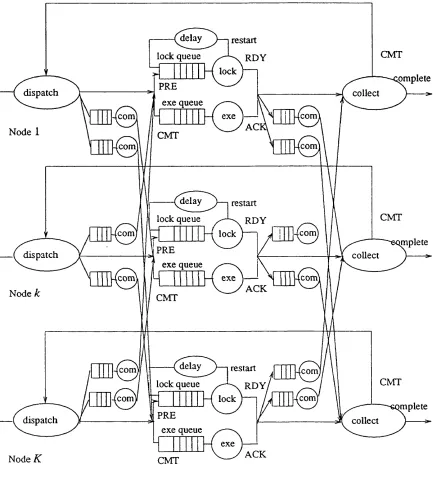
Figure 4.2. 2PL Distributed Database Model at Node k ... 98
Figure 4.3. The Database Locking Model at D M jt ... 99
Figure 4.4. Distributed Database Locking M o d e l ...103
Figure 4.5. Simulation Model of a Distributed D a t a b a s e ... 114
Figure 4.6. Communication Channel with Deterministic D i s tr ib u tio n ... 117
Figure 4.7. Transaction Execution Center with Exponential D is tr ib u tio n ...117
Figure 4.8. Lock Request Center with Exponential D i s t r i b u t i o n ...119
Figure 4.9. Conflict Rate p c of Lock Request C e n t e r ...119
Figure 4.10. Useful Computer T i m e ... 120
Figure 4.11. Mean Turnaround T i m e ... 120
Figure 4.13. Response Times with Different Read-Write Ratio y ^ ... 122
Figure 4.14. Response Time with Different Replicated Copies N f ...122
Figure 4.15. Response Times with Different Granularity
r!L
... 123Figure 4.16. Response Times vs N f with Different Read-Write Ratio ...123
Figure 4.17. Mean Conflict Rates with Different Replicated Copies N f... 124
Figure 5.1. Concurrency Control Structure of
Re ad (X)
of Primary Copy 2 P L ... 128Figure 5.2. Concurrency Control Structure of
Write
(
X
) of Primary Copy 2 P L ... 129Figure 5.3. Response Times with Different Read-Write Ratio y ^ ,...139
Figure 5.4. Response Time with Different Replicated Copies N f ... 139
-Figure 5.5. Response Times with Different Granularity r ! L ... 140
Figure 5.6. Response Times vs N f with Different Read-Write Ratio y ^ ...140
Figure 5.7. Mean Conflict Rates with Different Replicated Copies N f... 141
Figure 5.8. Structure of
Re a d
(X ) of Majority Consensus 2 P L ...143Figure 5.9. Structure of
Write ( X)
o f Majority Consensus 2 P L ... 144Figure 5.10. Locking Model of Basic 2 P L ...147
Figure 5.11. Locking Model of Majority Consensus 2 P L ... 148
Figure 5.12. Blocking M o d e l ...149
Figure 5.13. Response Times with Different Read-Write Ratio y ^ ...157
Figure 5.14. Response Time with Different Replicated Copies N f ...157
Figure 5.15. Response Times with Different Granularity r ! L ... 158
Figure 5.16. Response Times vs N f with Different Read-Write Ratio Y r w ... 158
Figure 5.17. Mean Conflict Rates with Different Replicated Copies N f... 159
Figure 5.18. Mean Blocking Rates with Different Replicated Copies N f ... 159
Figure 5.19. Concurrency Control Structure of
Re ad
(X ) of Centralized 2 P L ... 160Figure 5.20. Concurrency Control Structure of W rite
(X)
o f Centralized 2PL ... 161Figure 5.21. Integrated Concurrency Control Structure of Centralized 2 P L ...162
Figure 5.22. Lock Request Service Center at
D M
j ...167Figure 5.23. Response Times with Different Read-Write Ratio y ^ , ... 172
Figure 5.24. Response Time with Different Replicated Copies N f ... 172
Figure 5.25. Response Times with Different Granularity r ! L ... 173
Figure 5.26. Response Times vs N f with Different Read-Write Ratio y ^ , ...173
Figure 5.27. Mean Conflict Rates with Different Replicated Copies N f...174
4 Figure 5.28. Response Times with Different Read-Write Ratio ylM, ... 175
Figure 5.30. Response Times with Different Granularity r / L =
5/500
,35/3500
176Figure 5.31. Response Times vs N f with Different Read-Write Ratio 7 ^ = 0 , 1 ...177
Figure 5.32. Mean Conflict Rate with Different N f =1
, 3
177 Figure 6 .1. Architecture of the D R F S ...181Figure 6.2. The Physical Structure of the D R F S ... 183
Figure 6.3. Access Pattern of the D R F S ...184
Figure 6.4. Program Structure of the D R F S ...185
Figure 6.5. Vulnerable Period for Pure A L O H A ... 194
Figure 6.6. Queueing Network Model of Broadcast Communication Channel ...195
Figure 6.7. Reconstructed Queueing Model for Broadcast N e t w o r k ... 196
Figure 6.8. Bus N e t w o r k ... 199
Figure 6.9. The Communication Structure of the D R F S ... 204
Figure 6.10. Throughput of the DRFS S y s t e m ... 206
Figure 6.11. Cpu Utilization at a
D M
in the DRFS S y s t e m ... 207Figure C .l. Interprocess Communication M o d e l ... 228
Figure C.2. The Model of Service Time D i s t r i b u t i o n ... 234
-A b str a c t
This thesis studies the methods of evaluating the performance of centralized and distributed database
systems by using analytic modeling, simulation and system measurement. Numerous concurrency control
and locking mechanisms for distributed database systems have been proposed and implemented in
recent years, but relatively little work has been done to evaluate and compare these mechanisms. It is the
purpose of this thesis to address these problems.
The analytic modeling intends to provide a consistent and novel modeling method to evaluate the
performance o f locking algorithms and concurrency control protocols in both centralized and
distributed databases. In particular, it aims to solve the problems of waiting in database locking, and
blocking in concurrency control protocol which have not been solved analytically before. These models,
which are based on queueing network and stochastic analysis, are able to achieve a high degree o f
accuracy in comparison with published simulation results.
In addition, detailed simulation models are built to validate the analytic models and to study
various concurrency control protocols and distributed locking algorithms; these simulation models are able
to incorporate system details at very low levels such as the communication protocols, elementary file server operations, and the lock management mechanisms.
In order to further validate the findings through measurements, an actual' distributed database
management system is specifically implemented which adopts the two phase commit protocol, majority consensus update algorithm, multicast communication primitives, dynamic server configuration, and failure
recovery. Various performance measurements are obtained from the system such as the service time
characteristics o f communication and file servers, system utilization and throughput, response time, queue
length and lock conflict rates.
The performance results reveal some interesting phenomena such as systems with coarse granularity
outperform those with fine granularity when lock overhead is not negligible, and that the effect o f the
database granularity is small in comparison with the effect of the number of replicated copies. Results also
suggest that centralized two phase commit protocol outperforms other types of two phase commit protocol,
such as basic, majority consensus and primary copy two phase commit protocol under some circumstances.
C h a p te r l. In tr o d u c tio n
1.1 The Area of Performance Evaluation of Centralized
and Distributed Database Systems
In recent years, distributed database (DDB) research has become increasingly important in the area of
information processing because of the widespread use o f local databases and the increasing availability of
computer networks. The main goal of the distributed database management systems (DDBMS) is to
manage logically correlated data across computer networks. The complexity of DDBMS is beyond that of
traditional database and network in isolation. The problems of concurrendy accessing and updating the
logically correlated data as a whole, preventing inconsistent data manipulation, and providing crash
recovery facilities are raised. A vast amount of research work has been done to solve the above problems,
which leads to the extensive studies and implementations of the concurrency control and distributed
locking algorithms. -*5,46,47,48,44 However relatively little work has been done to provide an effective
evaluation method to estimate and compare these algorithms.
Because of the size and complexity of the DDBMSs, it is not feasible to build many experimental
systems to estimate and compare the designs and proposed algorithms. Thus the theoretical performance
evaluation of DDBMSs becomes increasingly important in both the system design stage and algorithms
comparison stage. As pointed out by Ferrari22, "The importance of perfoimance and its evaluation in all
technical fields is obvious. Performance is one of the fundamental categories of attributes that are
indispensable for the viability of any technical system. Computer systems are no exception to these rules.
Studying their performance aspects is an essential and fundamental component of computer engineering."
Despite the great demand in the performance evaluation area, relatively little work has been done to
provide quantitative evaluations o f DDBMSs. The performance evaluation of distributed database system
involves a detailed estimation o f the characteristic and functionality of the system architecture, namely, the
concurrency control algorithms, the locking mechanisms, the network architectures, the database i/o
structures and the statistical descriptions of all the components in the distributed database system. The goal
o f the evaluation is to provide a quantitative description of a distributed database system; thus it gives a
useful guidance and active involvement into the system design and implementation, installation
management, capacity plan formulation, and performance tuning and upgrading. The techniques involved
in distributed database performance evaluation can be classified into three categories: analytic modeling,
simulation and measurement. In analytic modeling, queueing network methods can be used to represent a
DDB system as a network of queues. In simulation, the characteristic and functionality of various DDB
systems can be simulated at a detailed level; thus providing a more accurate evaluation of the system. The
simulation results can be used to verify the analytic results. In measurement, samples from on-line
hardware and software monitors can be obtained to provide the statistical description o f the service time
CHAPTER 1: INTRODUCTION
distributions of the system components and various mean measurements of the system. Measurements from
an actual DDBMS can also validate analytic models. All the techniques have their place in the
performance evaluation area.
Concurrency control is one of the most important aspects o f DDBMSs. Its main function is to
coordinate concurrent accesses to the databases distributed over different sites, while still g u a r a n ty data
integrity. If the concurrent execution of a distributed transaction is equivalent to a serial execution of the
transaction, the concurrency execution is said to be serializable. And if the concurrent execution can
guarantee that a distributed transaction is either done completely or not done at all, the concurrent
execution is then considered to be atomic. The concurrency control mechanisms should guarantee both serializability and atomicity of transaction executions. Numerous concurrency control algorithms have
been proposed and some have been implemented for DDBMSs. These algorithms can be mainly classified
into two categories: two-phase-locking and timestamps8. In two-phase-locking (2PL), they can be further
derived into basic 2PL8, primary copy 2PL76, majority consensus 2PL79, and centralized 2PL3,24. In
timestamps, there are basic timestamps7, Thomas timestamp generation rule80, multiversion timestamps63,
and conservative timestamps7.
The performance evaluation o f concurrency control method aims to provide a theoretical treatment to
various concurrency control algorithms proposed above and compare their superiorities. Because of the
increasing complexity of the existing DDBMSs, the experimental comparison of concurrency control algorithms becomes infeasible. Therefore the development of effective analytic models and the
construction of representative simulation models have a key role in evaluating the DDB performance. In
analytic modeling, different concurrency control algorithms should be specified in the form of different
mathematical models. How efficiently and accurately the model can represent the real situation depends on
the effectiveness of the analytic methods and the accuracy of the theoretical definitions of the algorithms.
An effective analytic model should provide a detailed specification of the algorithm in terms of its
characteristics and functionalities. The detailed statistical descriptions of the system components obtained
from real system measurements are also vitally important to the evaluation. Simulation approach is another
method to evaluate the performance evaluation of DDBMSs. The major advantage of simulation over
analytic modeling is that simulation can be used to model the real system at a more detailed level, thus
giving a more accurate representation of the real system performance and providing a validation of the
analytic models. However it requires a much higher cost in terms of cpu time and storage and sensitivity
analysis is also difficult.
Locking is another important characteristic of DDBMSs. Distributed locking integrates the locking
methods used in the centralized database and< furthermore deals with the problems of maintaining the
serializability and atomicity of the DDB systems. The problem of evaluating the locking performance is
complicated, because the nature of locking consists of both hardware contention and software contention;
this means that transactions have to compete not only for hardware resources, like cpu, i/o. etc, but also for
CHAPTER 1: INTRODUCTION
data resources. The particular difficulty caused by data contention is that there are various different ways to
compete for the data resources due to the complexity of the software itself. In data contention, two major
collision resolution algorithms are used: the fixed waiting algorithm and the scheduled waiting algorithm.
The fixed waiting collision resolution algorithm is to restart a blocked transaction after a fixed period
regardless o f the availability o f the locks. The scheduled waiting algorithm is to free blocked transactions
as soon as the required locks become available. Performance evaluation of locking aims to model these
two algorithms.
In centralized databases, concurrency control is achieved by using two major locking mechanisms: the
dynamic locking and static locking together with the introduction of two types o f locks, namely exclusive
and nonexclusive locks. Dynamic locking, as implied by its name, has the pow er to dynamically grant
locks, and then to execute a transaction bit by bit whenever a lock becomes available. Upon conflicts, the
transaction then has to wait until the conflicting locks are released while still holding the granted locks.
Deadlock detection algorithms have to be used to detect and solve possible deadlocks caused by dynamic
locking. In static locking, a transaction cannot start execution unless all the required locks are granted.
Therefore there is no deadlock problem in this case. Various different scheduling mechanisms have been
used in implementing the dynamic and static locking algorithms. The conflicting transactions can be scheduled to retry in several ways, such as waiting for a fixed interval, waiting for a random interval, or
restarting as soon as conflict locks are released. All these different mechanisms will affect the system
performance considerably; thus they have to be taken into account in the performance evaluation. Dealing
with exclusive and nonexclusive locking is another major task in evaluating locking performance. The
introduction o f these two different types of locks enables databases to gain maximum concurrency, while
still guaranteeing the serializability of the transaction execution.
In distributed databases, locking is achieved mainly by two major approaches, the distributed two-
phase-locking and timestamps. Distributed two-phase-locking is performed by granting the locks at each
site in the first phase, and releasing them in the second phase after transaction execution. While the
timestamp mechanism is achieved by first identifying a specific serial order of the transactions, and then
ensuring that serializable execution at each site is equivalent to the chosen serial order. The performance
evaluation of distributed locking aims to define the problem and to develop a feasible method to solve it.
The attention should be paid particularly to the distributed blocking phenomenon which is a new problem
in the area. Distributed blocking is caused by lock conflict. Transactions are forced to wait in the blocked
queue upon lock conflict. How to. release the blocked transactions depends on the collision resolution
algorithm used. Evaluating distributed blocking is a rather complicated task; thus has not been tackled so
far.
4
The performance of DDB system depends on not only the characteristics of DDBMSs but also the
architectures of the underlying computer network. Computer networks can have various different physical topologies, such as star, hierarchical, ring, completely interconnected, and irregular topology. They can
CHAPTER 1: INTRODUCTION
also be classified into local area and wide area networks. The communication delay and cost associated
with them vary significantly from one another, and so does their performance. The performance also
depends on the actual implementation of the communication protocols. As proposed by the International
Standard Organization (ISO), protocols are decomposed into seven communication layers each of which
performs its unique function. How and on which layer a protocol is implemented makes a significant
difference to the performance and functionality of the system. The basic network performance parameters
which affect the bearing DDBMSs are the network topology, the communication delay, the throughput, the
resource capacity and utilization.
A distributed database system is composed of many local databases whose performances affect that o f
the whole DDB system. The performance o f a local database management system depends on the
architecture of the database schema and the data manipulation tools implemented for the particular
database. A database schema is referred to as a logical database description. It defines the logical structure
of the data and their relations; it thus provides clearly structured cross-references. There are three main
database schemas: the relational model, network model and hierarchical model. The architecture of a
schema determines the way of cross-referencing at the conceptual level. At the physical level, data are
actually stored on the secondary storage device, such as drum, disk and tape. The main objective of
physical organization is to provide fast access to the database with the minimum storage cost. The basic file system organization has the following file structures; pile, sequential file, indexed-sequential file, indexed
file, direct file, and multi-ring file. The performance evaluation of these file organizations should reflect the
characteristics of file manipulations and provide quantitative measures and comparison of the
performance characteristics for different types of files.
The performance of database systems also depends on the computer systems. The time sharing
operating system which schedules the execution of a transaction may decompose the computation into a
number of distinct processes. Processes are the basic computational units managed by an operating system.
The various processes of a single computation may require different units of the com puter’s hardware and
may be executed in parallel. The scheduling o f processes and their computations determine the
performance of database system built upon the operating system. The evaluation of the commonly
available operating systems and their power in data processing is necessary.
In conclusion, the main aims of this thesis are
1. to study the effect of locking algorithms in both centralized and distributed databases;
2. to study and develop systematic analytic methods to evaluate the concurrency control algorithms in
distributed databases and compare the performance of different concurrency control algorithms;
3. to validate the analytic model by simulation; and
CHAPTER 1: INTRODUCTION
4. to validate the analytic model by implementing and measuring an actual distributed database
system.
1.2 Current Research in the Area
1.2.1 A n a ly tic M o d e lin g o f C en tra liz ed D a ta b a se s
In general, the evaluation of centralized databases has been better studied than that of distributed
systems. In particular, the concurrency control and locking mechanisms of centralized databases have been
treated extensively. The locking mechanism can be mainly classified into static two phase locking,
dynamic locking and conflict oriented locking; while the collision resolution algorithms can be classified as
fixed and scheduled waiting. Most of the performance models only deal with the problem of exclusive
locking. The non-exclusive locking phenomenon is not well studied. Some studies cover the evaluation of
access pattern and non-uniform file attribute. Some better known results achieved so far are given below.
M ark o v C h ain A pproach
Markov chain model has been used by Menasce, 61 Mitra 63 and Thomasian81 to analyze the
concurrency control algorithms in centralized databases.
Menasce and Nakanishi 61 proposed an analytic model to evaluate two different concurrency control
mechanisms; the locking oriented (LOCC) and conflict oriented (COCC) mechanisms. They decomposed
the analytic model into two levels. Level 1 is a computer system consisting of a cpu service centre and a number of parallel i/o service centres. At this level, the probability o f a transaction succeeding in its
conflict test is considered to be fixed and an approximation technique is used to obtain the average time a
transaction spent in a computer system. The level 2 model substitutes the whole computer system by a
number of parallel exponential servers with a known service rate. The resulting model was analyzed using
a truncated Markov chain model to analyze the detailed concurrency control mechanisms. This establishes
a system of non-linear equations which could be solved interactively. In their model, the lock tables are
assumed to be kept in main memory, therefore the time needed to check or release locks is considered to be
negligible and all locks are exclusive. They also assumed that transactions arrive according to a Poisson
distribution, the service time of a transaction at a cpu or i/o device is exponentially distributed, and for
database manipulation, read set is equal to write set, and access to a database has a uniform distribution.
Their analytic results were compared with simulation results. The range o f error is around 10%. Their
analytic model is used to estimate the average response time affected by different database size, different
read/write sized, different number of parallel i/os, etc. They also compared the performance of COCC with
LOCC under two different conditions and concluded that LOCC has a better performance than COCC in
i
both cases.
Mitra and Weiberger 63 introduced a Markov chain probabilistic model of database locking. Their
model intends to give the exact formulae for equilibrium database locking performance. It models the
CHAPTER 1: INTRODUCTION
interference phenomenon of locking with the assumption of blocked transactions being cleared. The
locking graph of transactions is aggregated into a coarser definition of state in order to form the
corresponding Markov process. The Maikov process has a product form in the equilibrium distribution
which is constituted from O ( N p ) terms, where N is the number of items in the database, and p is the level
of multiple programming o f transactions. Mitra and Weiberger used an algorithm to reduce the
computation of the resultant Markov process from 0 ( N P) to 0 ( N p) multiplications. Mitra and Weinberger made the following assumptions that locking is static; blocked transactions are cleared without
retry; interarrival process is Poisson and for exact result, the service time distribution is assumed to be
exponentially distributed. M itra and Weinberger’s model is used to estimate the mean concurrency and
throughput of the system, and the probability of nonblocking is a function o f total offered traffic. M itra and
W eiberger’s model is the first one to find the exact analytic results of locking performance. W ith the
introduction of the numerical algorithm to reduce the 0 ( N P) calculation into 0 ( N p), the model is considered to be feasible to deal with the locking problem, although it is still rather expensive. The
assumption of blocked transactions being cleared restricts the application o f the model. Although an
approximate solution to the retry case is given, it seems that the approach is much simplified. The model
also excludes the lock request and release service time. The only service time included is the transaction
processing time which is assumed to be exponentially distributed.
Thomasian 81 has studied the performance of static two phase locking using both Markov chain analytic
model and simulation model. The main difference of Thomasian’s work from othe'rs in modeling static
locking is that the execution states o f the system are derived from the lock request table, i.e. the lock
conflict model is deterministic rather than probabilistic. Therefore the states of the correspondent Markov process are derived from the predefined lock request table. In order to simplify the complexity of the
model, he used a hierarchical decomposition method to analyze the system and replace it with a composite
queue with exponential service times. Thomasian used an approximation method to obtain the throughput
of the system up to the point of the maximum level of concurrency for transactions in order to reduce the
infeasible calculation o f the Markov chain. The resultant throughputs are then used in conjunction with a
one dimensional birth-death process to analyze the mean performance characteristics of the system.
Thomasian assumed that lock request table and transaction classes are predefined, i.e. they have
deterministic service time distributions; computer system is only characterized by its throughput in
processing various combinations o f transactions; interarrival process is Poisson; service time of the cpu and
i/o compound system is exponentially distributed; and all jobs share a service with a FCFS discipline; The
performance results estimated by Thomasians model are the throughputs o f different classes of
transactions, the mean number o f transactions in the system and mean response time of the overall
transaction classes. These assumptions, especially the first two, can simplify the locking model to some
extent and avoid some difficult problems involved in seeking a product form solution of queueing network
or solving the computationally unfeasible Maikov process. The assumption of deterministic lock request
seems to restrict the applicability of the model, since lock requests are usually probabilistic rather than
CHAPTER 1: INTRODUCTION
deterministic. Furthermore, a computer system can not be accurately characterized only by its throughput.
Its performance depends on the states and other parameters of the system such as the queueing discipline,
the arrival and service rate and their distributions. Another drawback of the model is that the lock request
time and its blocking time are not presented in the model; thus the locking phenomenon is not modeled
accurately.
P robability A p p ro ach
A analytic method based on basic probability is used by Shum and Spirakis. 74 They developed an
analytic model for both dynamic 2PL and general 2PL. For dynamic 2PL in a centralized database, they
gave some worst case bounds o f the probability of lock conflicts. The worst case bounds are compared with
the computation solution of a Markov process describing the actual system. All the worst case bounds are
below the actual value and some of them are far from actuate. The upper bound on the average number of restarts per transaction and average time of a transaction are also given for the dynamic 2PL case. Shum
and Spirakis also built a model for the general 2PL. The model is formed on the basis of the wait-for graph under some assumptions, which is used to estimate the steady state rate of conflicts and deadlocks in the
system. They concluded that the rate of deadlock is proportional to the average number of transactions in
the system. In the model, Shum and Spirakis assumed that all locks are exclusive locks, each transaction
locks the same number of data items and all data items are accessed uniformly. They also assumed that the
input process is Poisson and service time distribution is exponential. The behavour of cpu and i/o is also
simplified and substituted by a general service centre with service time exponentially distributed. Another
major drawback of the model is that the results of the model depend on some operational parameters such
as the mean number of free transactions in the system. Therefore the application of the evaluation is
restricted to only the existing systems.
Q ueueing N etw ork A pproach
A queueing network method is used by Irani and Lin 31 to analyze the performance of different
concurrency control algorithms in a database system. Two models were developed to investigate the effect
of locking granularity on the performance of a database system. They used the BCMP queueing network
model introduced by Baskett et al6 to solve their problem. The problem of analytically modeling the
waiting time for a blocked request is avoided in their model. They suggested users to use simulation or
empirical measurement to estimate the waiting time. To simplify the problem, they also made several
assumptions that the waiting time for a blocked transaction is constant, independent of the number of
concurrent transactions and the locking granularity; the probability of lock conflict is inversely proportional
only to the number of granules; and database storage access time is exponentially distributed. They gave
some results of the resource utilization and throughput for both i/o unit and cpu. They also gave the
percentage useful i/o(/cpu) and locking overhead i/o(/cpu). They concluded that coarse granularity
performs better. The main disadvantage of Irani and L in’s model is that the evaluation has to involve
CHAPTER 1: INTRODUCTION
the assumption made in the estimation can reduce the accuracy of the whole evaluation considerablely.
Flow D iagram A pproach
A flow diagram method is introduced by Tay, Sun and Goodman78,77. The model uses only the steady
state average values of the variables. It is designated to evaluate the performance of both static and
dynamic locking, transaction blocking, multiple transaction classes, nonuniform access and transactions of
the indeterministic length. The method is based on the steady state mean value analysis and has a
straightforward and simple nature. The main drawback o f the method is that the hardware contention of
computer system is factored out. Thus the effect of competing hardware resources is not accurately
evaluated.
We can summarize that All the analytic models of centralized databases61,74,63,81,78,77,31 are based on
the assumptions o f Poisson interarrival process and exponential or constant service time distributions. The
problem of evaluating multiple transaction classes is dealt with by Thomasian 81 and Tay78,77. However,
in Thom asian’s model the lock requests by multiclass transactions are deterministic rather than
probabilistic. And T ay ’s multiclass model is based on the assumption of no hardware contention. The
problem of blocking has been tackled by Irani31 and Tay78,77. Irani uses simulation and empirical
measurement to estimate the waiting time of blocking, which is either time consuming or practically
difficult. T ay’s method o f evaluating the waiting time in the blocked queue is based on the assumption of
no hardware contention, which reduces the accuracy of the evaluation. The blocking with scheduled
waiting is not studied.
In the above models for centralized databases, the following problems need to be further studied.
Firstly, in transaction blocking, the scheduled waiting collision resolution algorithm is widely used in
database systems but relatively little work has been done to evaluate such algorithm. Secondly all the
above models assume Poisson interarrival time and exponential server time distribution, but in real system
it is usually not justified. Thirdly most of the above models evaluate only single class transaction and
only two models have tried to evaluate multiclass transactions under stringent assumptions. Forthly none
of the above models have estimated the effect of locking operation having priority over transaction
execution operation, which is usually the mechanism implemented in most database systems. In this thesis,
these problems will be tackled.
1.2.2 A n alytic [Modeling o f D istrib u ted D a ta b a ses
The analytic methods for evaluating distributed database systems have not been well developed in
general, due to the complexity o f distributed concurrency control algorithms. The research in this area is
still at its very early stage. Among the few developed models, most of them are based on basic probability
evaluation or even deductive reasoning, such as Menasce, Garcia-Molina, Sevcik and Badal’s models.
CHAPTER 1: INTRODUCTION
P robability A p proach
Menasce and N akanishi62 have studied the performance of time stamps concurrency control algorithm
based on the two phase commit protocol for distributed databases. They used a group o f nonlinear
equations to represent the relations between various parameters, such as probability o f conflict, arrival rate,
system utilization and response time. The equations were solved by using iteration methods. The analytic
model was verified by simulation. They provided the performance results of the arrival rate, the probability
of conflict and the size of the query change. The major assumptions made in Menasce and Nakanishi’s
model are: Poisson arrival rate; exponential service time distribution for cpu and i/o; fixed size read and
write set; full data replication and constant transmission time. The assumptions o f Poisson arrival rate and
exponential service times do simplify the analytic model significantly, but nevertheless reduces the
accuracy of the results. M oreover the model only deals with immediate restart upon conflicts, waiting is not
studied. The assumption of full duplication also reduces the applicability of the model.
Garcia-Molina 25 used analytic model based on basic probability to estimate the performance of distributed database systems. The concurrency control algorithm he analyzed was a majority consensus
method introduced by Thomas80. The underlying communication was built on a ring network. The analytic
model used by Garcia-Molina is straightforward and iterative in nature. The results obtained by Garcia- Molina indicate that centralized concurrency control mechanism is better than the decentralized ones; both
centralized and decentralized mechanisms perform well under light traffic but poorly under heavy traffic.
The assumptions made in Garcia-Molina’s model are no parallel communication, full data replication,
predeclared data objects and update only transactions. The first assumption has significantly restricted the
applicability of the model since most distributed database systems employ parallel communication as the
means to obtain high concurrency.
Sevcik 72 used some simplified probabilistic formulae and a cumulative distribution function to
evaluate the probabilities of conflicts and the maximum of parallel delay in isolation. The evaluation
method is iterative in nature. It starts with assuming the probabilities of the exceptional events to be zero
and goes on to evaluate each delay in isolation. The process is repeated until the successive estimates cease
changing. Sevcik estimated five concurrency control algorithms, i.e. centralized 2PL, conservative T/O,
aggressive T/O, distributed 2PL and basic T/O. Sevcik made the following assumptions: the distribution
function of parallel delay is formed by negative exponential distribution; each transaction has only a single
processing site and that is its original site and transactions access data items in a uniform fashion.
Deductive A pproach
Badal 4 introduced a deductive reasoning approach to analyze the impact o f concurrency control (CC)
on distributed database systems. The evaluations show the possible dependency and relationship between
two parameters, such as degree of interference vs. classes o f CC mechanisms, degree of locality vs. degree
of CC centralization, acquisition of data objects by transactions vs. degree of CC centralization and degree
CHAPTER 1: INTRODUCTION
o f locality vs. classes of CC mechanisms. The deductive reasoning is obtained by observations. No formal
analytic calculation is used.
Q ueueing N etw ork A pproach
A queueing network model is used by Sheth, Singhal and Liu 73 to analyze the effect of network
param eters on the performance of distributed database systems. The delays in transmission channels o f the
long haul networks with star and completely connected topologies were estimated by using Jackson’s
queueing network method. The results show that the completely connected network topology outperforms
the star network. The assumptions made in their analysis are Poisson interarrival rate; exponential service
time; full data replication and neglected queueing delay in cpu. These assumptions very much simplify the
analytic model, which enables the analytic model to use straightforward queueing network method
introduced by Jackson. However the assumptions may not be justifiable for the environments with heavy
load and multilevel architectures. In particular the last assumption which neglects queueing delay in cpu is
usually not true in a real system.
In the above models for distributed databases, ^23,62,72,73 evaluation methods need to be further extended to provide a systematic way to define a distributed database by a wide range of parameters rather
than a few; to release those restrictive assumptions such as full data replication, exponential service time;
Poisson interarrival time, etc. and to build a unified model to evaluate a wide variety of distributed
concurrency control algorithms.
1.3 The Goal of the Thesis
The prime goal of the thesis is to introduce a consistent performance modeling method to evaluate
various concurrency control mechanisms for both centralized and distributed database systems. Since most
of the concurrency control mechanisms fall into the two phase locking (2PL) category (the other being time
stamps), and the evaluation method o f 2PL mechanisms in distributed databases is not well studied, we
concentrate on providing a consistent method to evaluate the 2PL based concurrency control algorithms,
such as basic 2PL, primary copy 2PL, majority consensus 2PL and centralized 2PL.
From the literature survey in the previous section we can conclude that in both centralized and
distributed database systems the problem of solving waiting time of a blocked transaction is not studied by
most of the researchers except Tay. But Tay’s model of waiting in centralized databases is considerablely
restricted by the assumption of no hardware contention in the system. We intend to solve this problem by
introducing a waiting model which not only factors in the hardware contention but also considers the effect
of priority of locking over transaction execution.
In almost all the proposed analytic models in the literature the interarrival process is assumed to be
Poisson and service time distribution is exponential. This assumption very much simplifies the modeling
technique. However it is not usually justifiable in a real computer system54. It is very desirable to lift this
CHAPTER 1: INTRODUCTION
restriction. An extended diffusion approximation method is used to model distributed databases with non-
Poisson interarrival rate and non-exponential service time distribution.
In actual systems, locking operations usually have priority over transaction execution operations.
H owever there is no available analytic modeling method so far in dealing with the problem efficiently due
to the complexity of priority queueing. It is one o f the purposes o f the thesis to address and solve this
problem.
The complexity of 2PL algorithm in distributed databases results uiihdack of a systematic method to
define the concurrency control algorithm. In all the researches given so far there is no formal way of
defining the concurrency control algorithms. In the thesis we introduce a systematic method to formally
define a concurrency control algorithm by using a communication flow matrix and an access pattern matrix.
Important system parameters such as degree of data replication, degree of data locality, read-write ratio,
etc. are represented as the components of the matrices. All the 2PL concurrency control algorithms can be
m odeled by this method in a consistent fashion.
The major weakness o f most analytic models is the lack of key descriptive parameters, which is caused
by imposing stringent assumptions such as full data replication, read-only or write-only, full
communication connection, single class transaction etc to simplify modeling technique. In the thesis we
aim to overcome this weakness by introducing as many descriptive parameters in the model as possible.
Firstly the network topology is included as one of the descriptive parameters o f the distributed database
system. All types of topologies such as star, ring, mesh, bus and fully connected network can be modeled. Secondly the degree of data replication is included as an important parameter o f the system. It varies from
single copy to fully replicated distributed databases. Thirdly the read-write ratio is introduced in the model
to monitor the effect of read and write. Fourthly locking granularity is studied by introducing two
parameters: total number of lock granules and the mean number of locks required by each transaction in
the system. Fifthly the restriction of transactions being single class is released by allowing multiclass
transactions to be modeled. Finally we introduce the technique to define the service time distributions for
various types of database operation, such as insert, delete, append, reorganize, etc.
Validation is a very important part of performance evaluation. In this work a simulation model for
distributed database system has been built to verify the analytic model. The simulation model intends to
prove the vital part of methods introduced in the analytic model. The results are very conclusive in nature.
Moreover our analytic model for centralized databases is also well validated by the simulation results given
by Ries and Stonebraker69.
Validation by system measurement has not been well studied, which is a reason why performance
evaluation methods have not been enthusiastically accepted. In this thesis we not only intend to prove that
our analytic model is correct and applicable but also intend to show the reader how to use it and explain the
results. An actual distributed replicated database system is implemented on several Sun workstations over
CHAPTER 1: INTRODUCTION
Ethernet (a but network ) with basic 2PL and majority consensus 2PL concurrency control algorithms. An
analytic model is built on the basis of the actual system and various system performances are estimated by
the model. These analytic results are further verified by the results obtained by system measurements.
1.4 Thesis Organization
Chapter 2 gives the preliminaries of distributed database modeling. It is not simply a review o f the
previous researches but rather a coherent reorganization of a wide variety o f system modeling techniques
which can be applied to distributed database modeling. In addition the. author has made some new
contributions in extending the existing methods which are not available ' . before.
M ajor components of distributed database system, i.e. computer time sharing systems, computer networks
and databases, are studied and their evaluation methods are presented. Furthermore a method to evaluate
database-bound computer system with multiprogramming is introduced.
Chapter 3 studies the concurrency control model of centralized databases. The prime goal is to
introduce a method to model the waiting time o f the blocked transactions in both open and closed systems.
Furthermore novel methods are introduced to deal with priority execution of lock operations,
nonexponential service time distributions and multiclass transactions. The analytic results are validated
using the simulation results given by Ries and Stonebraker69.
Chapter 4 introduces the methods to model the concurrency control protocol for distributed databases
and extends the modeling techniques introduced for centralized databases to distributed databases. A
particular locking protocol, basic 2PL, is studied throughout the chapter. A systematic method is -presented to define a concurrency control algorithm. Restrictions on interarrival process and service time
distributions are released by applying and extending diffusion approximation to the queueing network
theory. The analytic results are validated by a simulation model.
Chapter 5 shows the consistency and integrity of the modeling method introduced in chapter 4 by
applying it to three popular two phase locking algorithms, i.e. primary 2PL, majority consensus 2PL and
centralized 2PL. These results are compared and some useful conclusions are drawn at the end.
C hapter 6 gives an actual application o f the analytic modeling techniques to a real system together with
validating by system measurements. It introduces the implementation of a real-time distributed replicated
database and measurements of the system. A performance model is built for this actual system, with
particular emphasis on the novel analytic model to evaluate bus network. Various analytic results are
verified by direct measurements.
Chapter 7 gives the conclusions o f the thesis and future directions of this research. In appendixes, the
list of notions, theorem derivation and evaluation of service time distributions are included. In the thesis,
some formula derivations include detailed steps in order to provide easy reading.
C h a p te r 2. P r e lim in a r ie s o f D D B M o d e lin g
2.1 Introduction
A distributed database system is composed of hardware components, software components and data
components. The structure o f the hardware, the mechanisms of the software and the pattern of data
structure determine the overall system performance.
D ata C om ponents
are defined by the granularity and the structure of data. Users of a DDB system compete not only for
hardware and software resources but also, more importantly, for data resources. For example, a write
oriented transaction will have to exclusively lock the records; while a read operation requires non
exclusive locks to prevent others from writing the records at the same time. There are a wide variety of
data locking algorithms used for both centralized and distributed databases. Typical examples are basic two
phase locking (2PL), primary copy 2PL, majority consensus 2PL, and centralized 2PL.
Softw are C om ponents
A distributed database management system is designed to support data transparency, transaction atomicity, serializability, concurrency and reliability for distributed transactions. Data transparency
supports a global picture of the logical data stored at various local databases. Thus a user do not have to
know the actual physical locations of the data; Transaction atomicity guarantees that a distributed
transaction is either done completely or not done at all. The system will never be in an incomplete state;
Serializability is defined as the correct sequence of executions when transactions are executed parallelly;
Concurrency control is used to achieve transaction serializability with maximum parallelism and reliability
is referred to as the ability to deal with failures, such as site failure, network failure etc. A typical
implementation o f distributed database management system consists of various software developments
such as concurrence control, locking and recovery. The software components of the distributed database
system are the programs which forms the distributed database management system. They are
• Transaction Manager (TM ) which supports data transparency, concurrency control and recover for
distributed transactions;
• Communication Manager (CM) which supports communications between distributed database
managers;
• local Database Manager (DM) which manipulates the local database.
CHAPTER 2: PRELIMINARIES
Local Database
Local Database
User
TM
DM CM
DM CM
TM
User
Local Database
DM
T M CM
COMPUTER
NETWORK
CM CM
TM TM
User User
Figure 2.1. Architecture of a Distributed Database Management System
CHAPTER 2: PRELIMINARIES
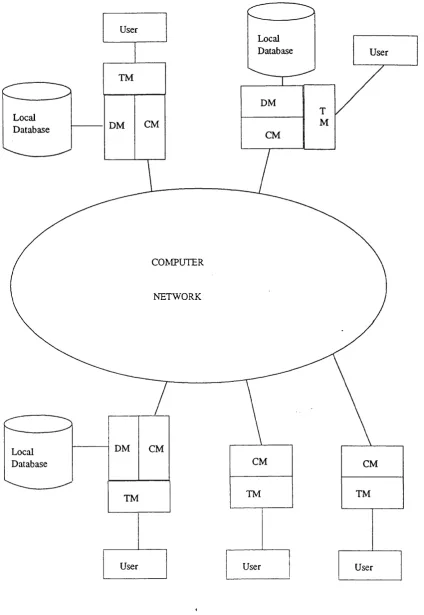
The architecture o f a distributed database management system is shown in figure 2.1. In a typical
implementation, a local database and its manager (DM) situate at the same site with the transaction
manager (TM), although a DM and TM can be built separately where the communication between TM s
and DMs is via the communication manager (CM).
Inside a TM there is always a data dictionary which keeps the global data schem a and data allocation
mapping information. In distributed database terms, the mapping is classified into the three layered
schemas namely global schema, fragmentation schema and allocation schema. A global schema provides
users with a logical overview o f the data stored in the whole distributed database system. The users can
read and update data without knowing their actual locations. A fragmentation schema is used to define the
logical partitions of the global schema. An allocation schema is the actual mapping between the logical
data partitions and their physical locations. With these three schemas stored in the data dictionary, a TM
can therefore achieve data transparency. A TM can be seen as a transaction server which provides users
with the global naming of data for reference and the tool to achieve concurrent and correct propagation o f a
distributed transaction.
At the lower level of the system a local database manager (DM) performs the corresponding data
manipulations according to the instructions of the TM. There is a clear interface between a DM and a TM.
The agreement about a distributed transaction is reached at the TM level and then data manipulations are
performed at the DM level.
The communication manager (CM) is a piece of software for passing messages between TMs to control
the concurrency of the distributed transactions. The efficiency of concurrency control protocol depends
very much on the underlying communication networks.
H a rd w a re Com ponents
All the software functions described above will not work at all without the underlying hardware
support. The hardware components of a distributed database system consist of the cpu, the file system and
the communication network. The cpu and file system are essential for local database manipulations. The
communication network is the foundation of the concurrency control protocols in distributed databases.
Thus the structure and capacity of these hardware systems will have a strong impact on the performance of
distributed database systems.
This chapter introduces the essential methods for hardware components evaluation. In section 2, the
evaluation method for computer time sharing system is discussed. The three most widely used scheduling
algorithms, i.e. the round robin, last-come-first-serve and batch processing are evaluated. Section 3
introduces the evaluation method for point-to-point network. Section 4 describes the database and file
evaluation methods. In section 5, the queueing network models of database oriented computer system with
multiprogramming are developed.
CHAPTER 2: PRELIMINARIES
2.2 Computer Tim e Sharing System Evaluation
2 .2.1 In tro d u c tio n
W ith the rapid growth of information technology, computer systems become increasingly essential for
information processing. This has led to that computer power becomes less expensive and more efficient
nowadays. The access to computers has become easier and faster with the introduction o f time sharing
computer systems.
For a time sharing computer system, many users can access the same computer simultaneously through
their own remote terminals. Each user goes through a thinking phase and a computing phase. Since users’
thinking time is usually much longer than the computing time in each phase, a computer can serve many
user’s computing phases simultaneously without affecting the response times.
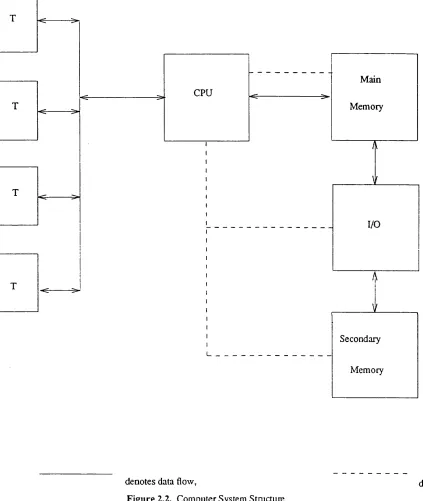
As shown in figure 2.2 a time sharing computer system consists of the following resources: remote
terminals, communication links, main memory, central processing unit (cpu) and input/output devices
which transfer data from secondary memory to main memory. The data generated by users at the remote
terminals flow to the cpu via communication links. When receiving each user’s request, the cpu will start
computing. If data are required from secondary storage, the cpu will control the i/o device to transfer data
from secondary memory to main memory. There is a control function to assign the cpu processing
resource, the memory resource and the i/o resource to each user’s request. Since the number of users can
be very large, there will be inevitablely resource conflicts. Therefore the control function is actually the
scheduling control over the resources. The resources are assigned to jobs according to some scheduling
algorithms. The objectives of the scheduling control are to increase the efficiency o f resource usage and be
reasonable to users. For example, a scheduling algorithm may give smaller jobs priorities over larger jobs. The most well known scheduling algorithm is the so called round robin algorithm. In addition, the batch
algorithm and the last-come-first-serve algorithms are also widely used. In the following sections the
performance models of these scheduling algorithms are discussed.
2 .2.2 R o u n d R ob in S c h e d u lin g A lg o r ith m
The round robin scheduling algorithm is a very simple and robust algorithm. It always takes the first job
in the queue; serves it for a fixed quantum of time; then returns it to the end of the queue; and starts to
serve the next job at the beginning of the queue. Each job in the queue is served an equal quantum in one
turn of the service. The cpu processing time for each jo b is divided by the number of jobs currently in the
queue. So each job uses one /zth of the cpu capacity, where n is the number o f jobs in the queue. The
structure of the round robin scheduling algorithm is show in figure 2.3.
i
Suppose that q m is a quantum of cpu service time which a job receives at its m th return to service. The job arrives according to Poisson process with mean HX. The service time of a job is independent and
identically distributed with distribution function given by