University of Pennsylvania
ScholarlyCommons
Publicly Accessible Penn Dissertations
2016
Teacher Sense-Making: A Case Study Of The
Implementation Of The Giffin Model
Horatio W. Blackman
University of Pennsylvania, [email protected]
Follow this and additional works at:https://repository.upenn.edu/edissertations
Part of theEducational Assessment, Evaluation, and Research Commons, and theEducation Policy Commons
This paper is posted at ScholarlyCommons.https://repository.upenn.edu/edissertations/2194 For more information, please [email protected].
Recommended Citation
Blackman, Horatio W., "Teacher Sense-Making: A Case Study Of The Implementation Of The Giffin Model" (2016).Publicly Accessible Penn Dissertations. 2194.
Teacher Sense-Making: A Case Study Of The Implementation Of The
Giffin Model
Abstract
This study sought to shed light on teachers’ thinking as they implemented an educational intervention. Specifically, this study looked at teachers’ attitudes and beliefs about teaching and learning, their
interpretations of a policy’s attributes, and how those views impacted implementation quality. The findings from this study describe how factors related to the implementation of a program interact with teachers’ knowledge and philosophies of teaching. This interaction was shown to be related to the success of
implementation in these schools. Based on its findings, this study recommends that further investigation into the role of teacher sense-making and its impact on implementation using the framework proposed in this paper. Further efforts should be made to improve the survey for this purpose. The effectiveness of a program is mediated by the quality of implementation, which this research shows is related to perceptions of a program. As schools grapple with implementing programs, principals and other leaders of implementation should pay close attention the factors related to implementation that are described in this paper.
Degree Type
Dissertation
Degree Name
Doctor of Philosophy (PhD)
Graduate Group
Education
First Advisor
Laura M. Desimonelaur
Keywords
cognition, implementation, policy attributes, sensemaking, teacher
Subject Categories
TEACHER SENSE-MAKING: A CASE-STUDY OF THE
IMPLEMENTATION OF THE GIFFIN MODEL
Horatio Blackman
A DISSERTATION
in
Education
Presented to the Faculties of the University of Pennsylvania
in
Partial Fulfillment of the Requirements for the
Degree of Doctor of Philosophy
2016
Supervisor of Dissertation:
Laura M. Desimone, Professor of Education
Graduate Group Chairperson:
J. Matthew Hartley, Professor of Education
Dissertation Committee:
Laura M. Desimone, Professor of Education
France O’Connell Rust, Adjunct Professor of Education
ACKNOWLEDGEMENTS
I would never have been able to finish my dissertation without the guidance of my committee members, support from my friends, and my family.
I would like to express my deepest thank you to my advisor, Dr. Laura Desimone, for her fantastic guidance and patience, providing me with feedback that greatly improved my work. I would also like to thank Dr. Rust for joining my committee without a second’s hesitation and for sharing with me so much research on teacher learning and education. Thank you, Dr. Boruch for your comments, suggestions, and most of all your kind words as I have worked on this dissertation.
Many thanks must also go to Dr’s. Ted Hershberg and Claire Kraft-Robertson. Without them, my study would not have been possible.
I would also like to thank my parents and my sister. You all have been my rock throughout my journey; encouraging me, supporting me, and giving me the
confidence I needed to finish this dissertation.
Finally, I would like to thank my brother, Balewa. I think about you
A
BSTRACTTEACHER SENSE-MAKING: A CASE STUDY OF THE IMPLEMENTATION OF
THE GIFFIN MODEL
Horatio Blackman
Laura Desimone
This study sought to shed light on teachers’ thinking as they implemented an
educational intervention. Specifically, this study looked at teachers’ attitudes and beliefs
about teaching and learning, their interpretations of a policy’s attributes, and how those
views impacted implementation quality. The findings from this study describe how
factors related to the implementation of a program interact with teachers’ knowledge
and philosophies of teaching. This interaction was shown to be related to the success of
implementation in these schools. Based on its findings, this study recommends that
further investigation into the role of teacher sense-making and its impact on
implementation using the framework proposed in this paper. Further efforts should be
made to improve the survey for this purpose. The effectiveness of a program is
mediated by the quality of implementation, which this research shows is related to
perceptions of a program. As schools grapple with implementing programs, principals
and other leaders of implementation should pay close attention the factors related to
Table of Contents
Acknowledgements ... ii
Abstract ... iii
List of Tables ... v
List of Figures ... vi
Chapter 1: Introduction ... 1
Statement of the Problem ... 2
Purpose of the Study ... 5
Theoretical Framework ... 6
Research Design ... 13
Study Significance ... 13
Chapter 2: Literature Review ... 16
Policy Attributes Theory ... 31
Cognition: Spillane’s Sense-Making Framework ... 39
Policy Attributes Sense-Making Framework ... 42
Chapter 3: Methodology ... 71
Research Questions ... 71
Research Design ... 71
Data Collection ... 74
Analytic Methods ... 78
Chapter 4: Research Findings and Discussion ... 83
Implementation ... 83
Policy Attributes ... 85
Policy Attributes and Implementation ... 86
Case-by-Case Analysis ... 86
Holland Intermediate Academy ... 87
Ashland Intermediate ... 97
Trident Academy ... 106
Cross-Case Analysis ... 113
Chapter 5: Discussion, Recommendations and Conclusion ... 129
Review of the study ... 129
Policy attributes and implementation ... 130
Principal Leadership ... 132
Recommendations for Practice ... 139
Recommendations for Future Research ... 141
Conclusion ... 142
Appendix A: Interview Guide ... 145
Appendix B: Giffin Model Survey ... 148
Appendix C: Consent Form ... 159
Appendix D_ IRB Documentation ... 160
Appendix E: Model Fit Data Tables ... 161
L
IST OFT
ABLESTable 1. Teacher Demographic Characteristics……….17
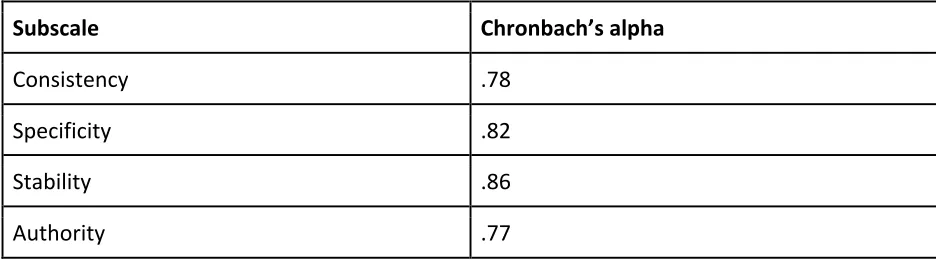
Table 2. Overall Subscale Reliability ………83
Table 3. Factor Scores……….86
Table 4. Implementation Results by School………87
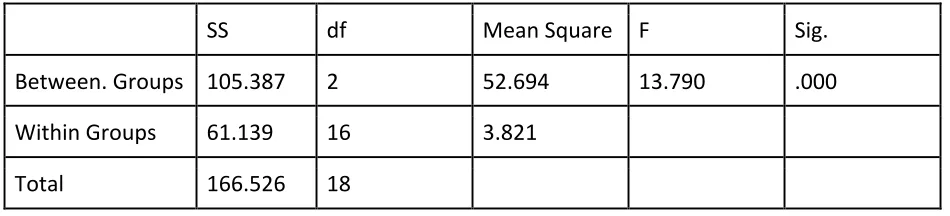
Table 5. ANOVA Results: Overall Implementation Measures……….87
Table 6. Implementation Scores: Math versus ELA………...88
Table 7. ANOVA Results: Math versus ELA………..88
Table 8. Policy Attribute Survey Scores……….89
Table 9. Correlations: Policy Attributes and Implementation……….89
Table 10. Holland Teacher Characteristics………...91
Table 11. Ashland Teacher Characteristics………..………….101
L
IST OFF
IGURESFigure 1. Policy Attributes Sense-Making Framework………...7
Figure 2. Giffin Model Components………..13
Figure 3. Conceptual Framework for the Policy Attributes Theory……….39
C
HAPTER1:
I
NTRODUCTIONOne of the most pressing issues with using reforms to improve student
outcomes in education is the “implementation gap”; which is the gap between what a
program intends and what actually occurs in schools and classrooms. (Barber, Rodriguez
and Artis, 2010). As policy-makers, program designers, administrators, and teachers
work to improve student outcomes, a significant barrier that stands in the way of
achieving their goal lies in the translation of a program into practice at the classroom
level. Through efficacy studies, which establish whether an intervention produces an
expected result under ideal conditions, educational researchers have been able to
identify programs that have a positive impact on student learning. Effectiveness studies,
which measure the impact of a program in real-world conditions, have shown that it is
common for educational interventions to have less impact in real world settings. In part,
this is due to the gap in implementation (Cordray & Pion, 2006).
A great deal of research has been conducted that looks at issues concerning
implementation and has found that several different factors are related to the quality of
implementation of educational policies and programs. Some of these factors fall outside
of the scope of the intervention, such as the composition of students in the classroom,
the resources available to the school and its teachers, and the grade(s) that an
intervention targets (Anyon, 1997; Berliner, 2005; Bodily, 1998; Palacios et al., 2014).
to, the attributes of a policy (Dusenbury, et al., 2010; Porter, Floden, Freeman, Schmidt,
& Schwille, 1988).
One aspect of implementation that has been given little attention in the
literature on implementation is the role of teacher cognition in implementation; the role
that the interaction between teachers’ knowledge, skills, and philosophies about
learning with factors related to implementation have on implementation success. This
dissertation shed light on teachers’ thinking, exploring the different considerations
teachers have as they attempt to understand and implement a new program. The
dissertation also evaluated the relationship between a policy’s attributes and the quality
with which the Giffin Model was implemented.
Statement of the Problem
In earlier waves of education reform, researchers and program designers
believed that teachers were “passive acceptors of an innovation, rather than active
modifiers of a new idea” (Rogers, 2003, p. 174). This belief largely stemmed from the
application of economic theories to the study of education (Cibulka & Nakayama, 2000;
Coleman et al., 1966). Through this economic lens, teachers were largely viewed as just
another cog in the machine, receiving instructions and carrying out the directive,
irrespective of the fact that humans are much more complex entities; interpreting
information through a complex cognitive web of knowledge and experiences and
situation (Piaget, 1958; Vygotsky, 1978). Because of this belief, studies in the 1960s and
that implementation might vary and that variation in implementation might influence
program outcomes (Berman & McLaughlin, 1974; Coleman et al., 1966; Sykes,
Schneider, & Plank, 2009).
Stemming from the landmark report, A Nation at Risk (National Commission on
Excellence in Education, 1983), policies and programs from the 1980s and 90s, took that
perspective and attempted to create “teacher-proof” programs. Schubert, Schubert,
Thomas, and Carroll (2002) defined “teacher-proof” materials as, “materials that would
achieve goals without distortion by teacher implementation” (p. 149). Rather than
looking at and attending to the root causes of variation in implementation, these highly
scripted programs gained prominence in k-12 education (McCarthy, 1993).
Designers developed curricula and programs that were based on the premise
that most teachers were not equipped with the skills to teach the content in a manner
that would lead to improved student outcomes. As a result of this belief, pedagogy and
content became highly scripted (Schubert, 1986). Due this shift, research continued to
focus on the outcomes of a program. That reform did not however, result in the large
improvement in student achievement that was anticipated (Schubert et al., 2002;
Soloway, 1996). Additionally, this outcomes-based research lacked a focus on the
individual implementer, their situational context, and how these might affect
implementation and ultimately, program outcomes. A gradual shift however, would
Over time, research on the effectiveness of educational programs has begun to
include data on implementation and in some cases, included those measures as
mediators in the analysis of program outcomes. What research has begun to uncover is
that several factors impact implementation. These include, but are not limited to
principal support for implementation, teacher perceptions of teaching and learning, and
the attributes of the reform (Coburn, 2005; Porter, et al., 1988; Spillane, 2000). One goal
of my study was to look at these factors to understand and describe their relationship to
implementation quality.
Despite the increased focus on implementation, there is a large gap in the body
of knowledge on implementation concerning teachers’ attitudes, beliefs, and
perceptions about an intervention and their relationship to implementation quality
(Spillane, 1999; Spillane, Reiser, & Reimer, 2002). The research that does exist suggests
that there is a relationship between the level of implementation quality and the
alignment of teachers’ attitudes and belief with the basic tenets of an intervention
(Coburn, 2001; 2005; Mirel, 1994); specifically, the attributes of a policy as defined by
Porter and colleagues (1988).
Adapted by Desimone (2002) in a study of comprehensive school reform models,
the theory argues that teacher perceptions of five attributes of a policy are related to
implementation success. The attributes are specificity, consistency, stability, authority,
aligned with practices, procedures, and goals of the school.Stability is defined as the
extent to which policies, practices, structures, and people remain in place over time.
Authority refers to the extent to which a policy is supported by actors or institutions
(e.g., state/district leaders, school administrators, teachers). Power is the rewards and
sanctions tied to a policy.
Without specifically naming the policy attributes, Spillane and colleagues (2002)
argue similarly to Desimone (2002), that implementation success is related to teacher
perceptions of the reform. They argue that “a key dimension of the implementation
process is whether, and in what ways, implementing agents come to understand their
practice” (Spillane et al., 2002, p. 387). The theory states that those “outcomes”, the
degree to which they implement the new practices, and the ways in which they proceed
to implement them, are affected by their perceptions of the model. These perceptions
they argue, are formed by (1) individual cognition which is comprised of a teacher’s
prior philosophy about teaching and learning, and (2) situated cognition, or the effect of
one’s local context on the development of their perceptions about a program. Messages
are derived from actions by their peers, their supervisors, and interpreted through their
own views of teaching and learning. Implementation then, is affected by those
perceptions, best understood and categorized by the Policy Attributes theory.
Purpose of the Study
The primary purpose of this study is to add to the body of knowledge about the
conducted on teachers’ thinking as they implement a program compared to other
factors related to implementation. Much of the research on implementation still focuses
on tangible aspects of a program that relate to implementation as opposed to how
those aspects are interpreted by teachers and the role that interpretation plays
concerning implementation quality (Coburn, 2004; Spillane, Reiser, & Reimer, 2002).
While research in this area indicates that it takes teachers time to successfully
implement a program as teachers become familiarized with it, there is not a great deal
of data that identifies how their perceptions of a program’s attributes relate to
implementation quality and what attributes of a program teachers consider during
implementation (Coburn, 2001; Spillane et al., 2002).
Theoretical Framework
This study sought to shed light on teachers’ thinking as they implemented an
educational intervention. Specifically, this study looked at teachers’ attitudes and beliefs
about teaching and learning, their interpretations of a policy’s attributes, and how those
views impacted implementation quality.
To investigate the role that teachers’ thinking had on implementation, I
introduced a framework for understanding and evaluating implementation. My
framework is a synthesis of two existing theories, the Policy Attributes Theory (PAT;
Porter et al., 1998) and Spillane and colleagues’ (2002) sense-making theory. My
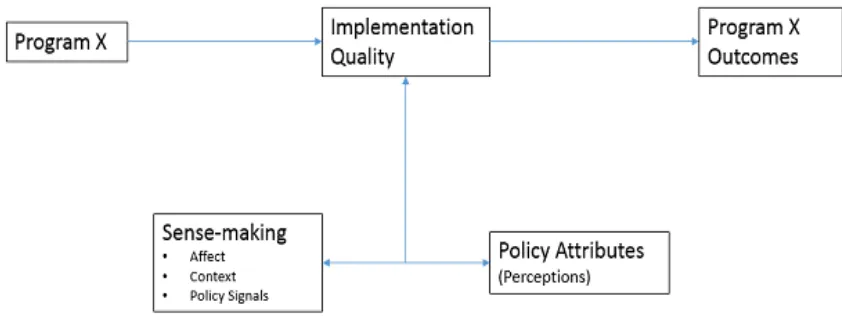
framework, called the Policy Attributes Sense-Making Framework (PASMF), asserts that
teaching and learning. Those attitudes and beliefs are shaped by teachers’ prior
experiences (Spillane, 1999). PASMF framework argues that teacher perceptions of a
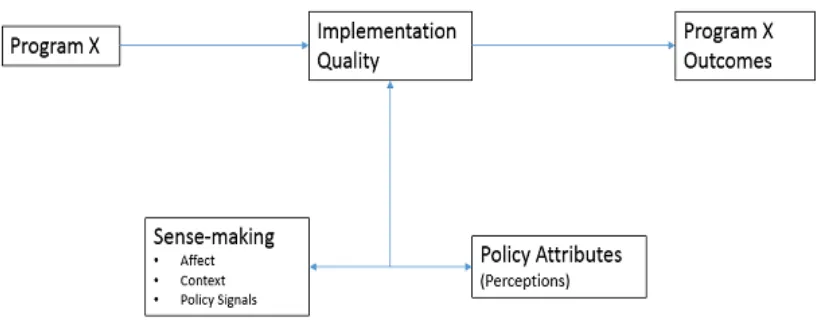
policy’s attributes impact implementation quality. Figure 1 below is a visual
representation of PASMF.
Figure 1. Policy Attributes Sense-Making Framework
Research Questions and Hypotheses
This dissertation addressed two primary research questions:
1. To what extent are the policy attributes related to the quality of teacher’s
implementation of the Giffin model?
2. In what ways and to what extent do contextual factors and teachers’
knowledge, skills, and philosophies of teaching relate influence their sense-making of
a. How do teachers’ philosophies affect how they perceive the attributes of
the Giffin Model? How does that relate to implementation success?
b. How do teachers interpret the actions of the principal or of their peers
and what influence does that have on implementation?
c. What policy stimuli impacted teacher sense-making and how?
Context
Giffin Model. To shed light on the role of teacher cognition in implementation,
this dissertation examined the implementation of the Giffin Model; a segment of a
comprehensive school reform model implemented in four elementary/middle schools in
a large, urban district in Texas. The Giffin Model is an educational initiative that was
designed by former principal Joel Giffin, whose school led all other students in learning
growth for ten years in the state of Tennessee as determined by the Tennessee
Value-Added Assessment System (TVAAS). There are three main components that drive the
Giffin Model, one of which is implemented by the principal and two of which are
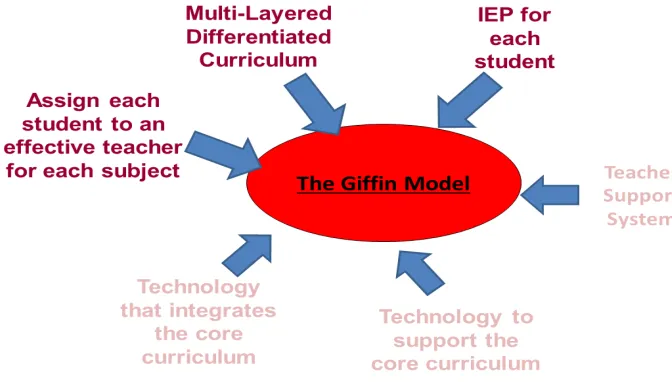
teacher-directed. Figure 2 depicts the components of the Giffin Model. Shaded
components were not central to the model and were not implemented in the pilot year,
Figure 2. Giffin Model Components
The first, requires principals to assign teachers to homogeneously grouped
classrooms based on student achievement and teachers’ growth scores from prior
years. Teachers are assigned to classrooms based on how effective they are at creating
test score growth with(roughly) thirds of the school’s population; defined as low,
middle, and high achieving students. The best combination of highly effective teachers
for each subgroup, based off prior years’ test score data, is put in place.
The Giffin Model requires teachers to tailor instruction to the level of student
they are teaching; using, material that is at student’s current level of understanding, as
opposed to teaching grade level material and setting a curricular pace that allows
students to be successful in the classroom. The Giffin Model calls this a “multi-layered
as beginning of year, and interim assessments aligned to the Texas Essential Knowledge
and Skills (TEKS), the state standards for the state of Texas.
All students are also expected to receive an individualized education/learning
plan (IEP) to guide their growth, created and maintained by their teacher. At minimum,
each student’s learning plan contains data on student progress on quarterly
assessments. It also contains information on progress towards goals, which are to be
updated as the year goes on. Additional qualitative information that the teacher may
choose to add, such as notes about student engagement and attendance are also part of
the individualized learning plan. Under the Giffin Model teachers are expected to meet
within their grade and subject to discuss student progress and to plan for moving
students across the curricular layers. This student movement piece of the Giffin Model is
directed by the teachers, with support from the principal.
District context. The school district where this study was situated served 69,716
students in 2014-2015, the year that implementation of the Giffin Model took place.
82.3 percent of the students were classified as economically disadvantaged, being
eligible for free-and-reduced-price lunch. 71.4 percent of the students in the district
were Hispanic, 24.6 percent African-American, 1.9 percent White and 1.3 percent Asian.
The four schools that implemented the Giffin Model ranged from Grades k-6.
Three schools served grades 4-6, and one school served grades 6-8. Demographic data
presented in detail in the following section. The four schools began implementing the
Giffin Model in the 2014-2015 school year. This case-study took place during that first
year of implementation.
Study Population
The population in this study were the teachers tasked with implementing the
Giffin Model during the 2014-2015 school year. Teachers were selected to implement
the Giffin Model by their principals prior to the 2014-2015 school year. Informal
conversations with principals indicated that grades were selected where the principal
felt that they had the strongest core of teachers. Principals voluntarily elected to
implement the model after being presented with the option at the district’s annual
end-of-year conference that occurred in the Summer of 2013. A total of twenty-four
teachers across four schools were selected to implement the Giffin Model. All
twenty-four teachers were asked to complete the Giffin Model survey. Twenty-three of the
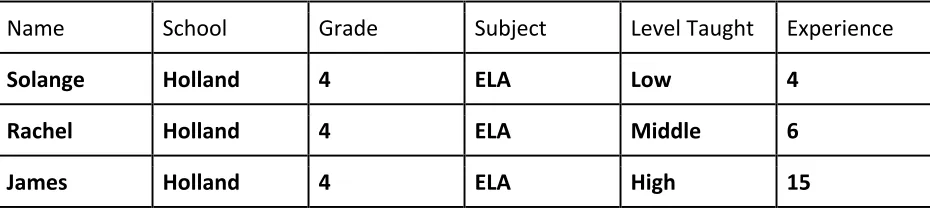
twenty-four teachers completed the survey. Table 1 provides demographic detail for
Giffin Model teachers.1
Table 1. Teacher Demographic Characteristics
Name School Grade Subject Level Taught Experience
Solange Holland 4 ELA Low 4
Rachel Holland 4 ELA Middle 6
James Holland 4 ELA High 15
1 Teachers’ names are pseudonyms. Only teachers who were interviewed were given names to help
Teacher H1 Holland 4 Math Low 11
Teacher H2 Holland 4 Math Middle 3
Teacher H3 Holland 4 Math High 4
Brian Ashland 4 Math Low 4
Jamie Ashland 4 Math Middle 3
Jamal Ashland 4 Math High 7
Teacher A1 Ashland 4 ELA Low 5
Teacher A2 Ashland 4 ELA Middle 5
Teacher A3 Ashland 4 ELA High 13
Amelia Trident 6 Math Low 6
Mr. Franklin Trident 6 Math Middle 8
Ms. Paulson Trident 6 Math High 4
Teacher T1 Trident 6 ELA Low 20
Teacher T2 Trident 6 ELA Middle 14
Teacher T3 Trident 6 ELA High 4
Teacher T4 Trident 6 ELA Low 8
Teacher T5 Trident 6 ELA Middle 7
Teacher T6 Trident 6 ELA High 9
Teacher J1 John Jacobs 4 ELA Low 4
Teacher J2 John Jacobs 4 ELA Middle 3
Research Design
This study employed a mixed-methods, multiple case-study design. The study
was carried out over the 2014-2015 school year. The methods used in this study were a
cross-sectional survey of Giffin Model teachers, observations of classroom practice, and
semi-structured interviews with the teachers. Implementation was measured through
classroom observations as well as through teacher self-reports on the survey. Survey
and interview data were used to describe teacher perceptions of the attributes of the
Giffin Model. Detailed information on these instruments are presented in Chapter 3.
Study Significance
With more knowledge in the hands of researchers, program designers, and
practitioners about teachers’ thinking during implementation, the quality of
implementation and student outcomes can be improved. For example, with more
knowledge at hand about the attributes of a reform that teachers consider as they
implement a program, and the influence of teachers’ attitudes/beliefs on
implementation quality, better programs can be designed. Program designers would
have information that would give them insight into how different aspects of a program
may be interpreted by teachers, and can craft programs that address those issues,
leading to higher average levels of implementation quality.
The study sought to inform program implementers - administrators, external
implementers and coaches – greater insight into teachers’ thinking as they are faced
presented with preliminary findings and recommendations to assist the implementation
of the Giffin Model. Second, conclusions from the study, covered in Chapter 5, provide
recommendations for implementers of any program that may prove useful for
improving implementation. This expanded base of knowledge may assist them during
the process of implementation. For example, information could be delivered in such a
way that would positively influence teachers’ perceptions of a reform, which research
indicates is related to implementation quality (Berends et al., 2002; Coburn, 2005).
Lastly, because of this increased knowledge, program effectiveness can also be
improved as the implementation gap is reduced because of increased understanding of
teachers’ thinking as they implement education programs.
Structure of the Dissertation
Chapter Two presents a review of the literature on implementation in education.
The evolution of the field towards an understanding of the substantial role that
implementation plays in program outcomes is also discussed in Chapter 2. Research and
theories concerning factors that influence implementation quality, focusing on the
policy attributes and the sense-making theories of implementation will also be
reviewed. Lastly, the framework for this study is described. Chapter Four covers the
methodology employed for this study. Embedded in the chapter are the assumptions,
limitations and delimitations of the study. Chapter Four consists of the research
Summary
The study of the cognitive approach to policy implementation is still in an
infantile stage. Research from this body of literature has argued that the way teachers
come to understand and carry out policies is influenced by their preexisting knowledge,
attitudes and beliefs about teaching and learning (Coburn, 2001; Spillane et al., 2002,
Weick, 1995). Additionally, research also indicates that the social context within which
teachers work – the actions and beliefs of their peers and their administrators, the
policy environment, etc. – influences their understandings and enactment of a policy.
This dissertation aims to add to the body of knowledge on implementation by (1)
focusing on teacher cognition, (2) determining the relationship between the policy
attributes described by Porter et al., (1988) and implementation success, and (3)
shedding light on what and how those factors are considered as teachers implement a
C
HAPTER2:
L
ITERATURER
EVIEWIntroduction
For some time, education has was seen as a way to cure a number of disparate,
yet interconnected social ills. In 1964, President Lyndon B. Johnson launched his Great
Society initiative that sparked major federal investment into the nation’s educational
infrastructure. Closing achievement gaps between different racial and socioeconomic
groups were seen as the means to eradicate poverty and new programs – such as the
Head Start early education program – opened the door to research and evaluation on
the effectiveness of educational interventions.
Over time, researchers in the field of education have added to the body of
knowledge concerning the effectiveness of different educational programs, policies,
school models, teaching practices, etc. Research has also shifted and broadened over
time, from focusing on policies enacted by the federal government, for example, to a
more recent focus on activities and processes that occur within schools and classrooms.
While research on the effectiveness of wide-reaching policies such as No Child Left
Behind and Race to the Top is certainly still carried out, many researchers today have
expanded their attention to attend to the role that implementation plays concerning a
program’s effectiveness.
Implementation is an important, if not crucial aspect of the effectiveness of
2002; Weatherley & Lipsky, 1977). Implementation is a process whereby users enact a
program; which generally has a set of actions to be carried out (Elmore & McLaughlin,
1983). Markers, or indicators of that uptake of practices are measured by evaluators
and researchers.
In 1977, Weatherley & Lipsky published a study that described the role that
“street-level bureaucrats”, those at the ground level, played in implementing a policy.
The study, which looked at public service workers across a number of different sectors,
including teachers in the education arena, found that program implementation relied
upon those tasked with carrying out a program’s directives. As research began to
highlight in the late 1970s (and continuing today), implementation has a significant
impact on program effectiveness and “is a decidedly complex endeavor, more complex
than the policies, programs, procedures, techniques, or technologies that are the
subject of the implementation efforts” (Fixsen et al., 2005, p. 2). Due to the complexity
inherent in implementation, the study of implementation is also decidedly complex.
Research on implementation has shown that due to a number factors,
implementation vary dramatically (Berman & McLaughlin, 1978; Coburn, 2001). Several
different theories have been put forth that offer potential explanations for the variation
in implementation that researchers have found to be the norm. The primary purpose of
this study was to put forth a framework for the study of implementation that is itself a
sense-making theory of implementation. In doing so, this study attempted to determine
which, if any, of the policy attributes were related to implementation success.
The policy attributes sense-making framework (PASMF) recognizes the
relationship between the policy attributes theory and the sense-making framework and
the role of cognition in implementation. Briefly, drawn from Spillane et al. (2002),
PASMF argues that teacher sense-making consists of three aspects; policy signals,
contextual factors, and affect or prior beliefs and attitudes about teaching (see Figure 1
below). These sense-making components, PASMF argues, drive teachers’ perceptions of
the policy attributes outlined by Porter et al., (1988). Consequently, teachers’
the program which in turn has a mediating effect on program outcomes.
With a multiplicity of factors known to affect implementation, and the existence
of theories that attempt to explain why these factors have the effect that they do,
“explorations of the state of the art of implementation as sub-discipline” to the study of
educational effectiveness has great importance for the field (Young & Lewis, 2015, p. 4).
In Chapter Five, I make an argument for the use of the Policy-Attributes Sense-Making
Framework to understand, describe, and ultimately improve implementation quality.
Research supporting the framework’s use are also presented in this chapter and in
First, this paper will discuss different dimensions and definitions used to denote
implementation quality. Following this, is an exploration of the evolution of the field of
research on the effectiveness of educational programs and policies; from the lack of
inclusion of measures of implementation in studies, to the understanding of its
importance in measuring program effects and subsequent inclusion in research. Chapter
Two presents a summary of the literature that has identified factors that affect
implementation as it pertains to teacher cognition and interpretation. The literature
review is situated alongside the argument that will be made for the use of the
policy-attributes sense-making framework.
Defining Implementation Quality
As time, has progressed, conceptions of implementation quality have evolved.
Hulleman & Cordray (2009) state that “the notion of intervention fidelity has been
captured under a broad array of labels, such as treatment integrity, adherence,
compliance, dose, exposure, quality of delivery, and treatment differentiation” (p. 89).
Although the labels have been collapsed and used interchangeably in much of the
literature, it is important to differentiate the distinct aspects of implementation
represented by each term and the impact each has on program outcomes (Dane &
Schneider, 1998; Hulleman & Cordray, 2009; O’Donnell, 2008). The term “quality” is
often viewed synonymously with the term “fidelity”. Implementation fidelity is largely
1998). Sometimes, an educational intervention carries with it a set of specific set of
practices that are expected to be carried out, and may come with materials intended to
be used by the implementers (e.g., a new curriculum with instructional materials for
teachers to use). Viewing a program as a set of practices to be undertaken,
implementation quality then is the extent to which those practices are employed by the
implementers, measured by a set of markers, or indicators of the uptake of that
practice. However, not all programs have clearly delineated practices. Some programs
leave processes loosely defined to allow for local adaption of the program (Munter,
Wilhelm, & Cordray, 2014). Others may simply lack a coherent theory of action.
Due to the vast number of types of programs, each of which have different areas
of focus, goals, and targets, implementation quality has been conceptualized by at least
five different terms. (Dane & Schneider, 2008). In their review of 162 primary and early
secondary school “behavioral, social, and/or academic maladjustment” programs, Dane
& Schneider (2008) found that researchers considered implementation quality in terms
adherence, exposure, quality of delivery, responsiveness and program differentiation.
The definitions of each are provided below. Program adherence is the extent to which
specific program components were delivered or adopted as intended. Exposure is an
index that may include any of the following: (a) the number of program sessions
delivered to the student; (b) the length of each session; or (c) the frequency with which
program techniques/processes/materials were utilized. Quality of delivery is a measure
implementation of prescribed content, such as implementer enthusiasm, leader
preparedness, global estimates of session effectiveness, and leader attitudes toward a
program. Participant responsiveness is the degree to which participants are engaged
with the program. Program differentiation is a manipulation check that is performed to
safeguard against the diffusion of treatments, that is, to ensure that the subjects in each
experimental condition received only planned interventions.
With the Giffin Model implementation quality is understood as the degree to
which teachers carry out practices specified by the Giffin Model. Teachers are expected
to create individualized learning plans for each student in their class. First, the learning
plans were to describe the goals for each student, denoting scores students are
expected to achieve on their quarterly assessments. Second, a complete IEP was
supposed describe the specific skills the student should master, which is drawn from the
Texas Education Knowledge and Skills (TEKS) standards. Lastly, teachers were supposed
to meet as content teams on a frequent basis to discuss student progress and
movement. Survey data and artifact review (the latter being conducted during
classroom observations) were used to evaluate IEP development and use.
Concerning teaching on-level, self-reports via the survey and classroom
observations were used to evaluate program quality. Teachers were asked survey
questions probing if and how often they felt they were teaching students at their level,
TEKS and data on student’s prior and current performance were compared to evaluate
the degree to which teachers were meeting students at their level of understanding.
Student movement, the third component of the Giffin Model was also evaluated.
Self-reports about the frequency of student movement was analyzed alongside student
assessment data to determine if teachers were moving students if they consistently
performed above 95% on their assessments.
The Importance of Implementation
Prior to the late 1970s, research concerning school effects focused primarily on
inputs and outputs. Research from that era focused on identifying the optimal ways to
spend federal funds to improve education and eliminate existing gaps in attainment
across different racial and socioeconomic groups. The Equality of Educational
Opportunity report (Coleman et al., 1966), better known as the Coleman Report, stood
as the seminal piece of research from this era that centered on input-output analyses
(Gamoran, 2006; Sykes, Schneider, & Plank, 2009). The report, and research that would
follow it, looked at a variety of schooling factors (e.g., class size, teacher salary, etc.) to
ascertain where best to direct funds. This body of research also assessed the
relationship between student achievement – on standardized test scores – and other
factors outside of the influence of schools, such as peer characteristics of the student
body including socioeconomic status and racial composition. This body of work
concluded that factors outside of the control of schools were the primary drivers of
Meta-analyses of research from that era concluded that the level of funding bore little to no
relationship to student achievement (Hanushek, 1986, 1996).
The body of research spawned by the Coleman report, and rooted in human
capital theory, viewed implementers (i.e., teachers) as “passive acceptors of an
innovation, rather than active modifiers of a new idea” (Rogers, 2003, p. 174). The
myriad activities and processes of implementation that occurred in schools were not
well understood and therefore not considered instrumental to outcomes. Following that
line of thought, it was assumed that (un)successful programs could be identified
through a relatively simplistic cause-and-effect lens, whereby the program itself, the
input, was looked at as the sole factor in student outcomes. Cibulka & Nakayama (2000)
adroitly summarized the research that was tied to the Coleman report, stating that this
body of research did not concern itself "withthe internal workings of schools, the
process through which schools produce desired outcomes, or how their organizational
structures might influence the distribution of these outcomes" (p. 40).
More recent analyses of the relationship between school-related factors and
student achievement contradict the body of research that did not consider the impact
of implementation, finding that factors within the sphere of control of schools did
indeed have significant and large impacts on student achievement (Berman &
McLaughlin, 1978; Bodily, 1998; Fixsen et al., 2005). These factors are introduced later
While a significant amount of research in education failed to account for
variation in implementation around the time of the Coleman report, research in the late
1970s and 1980s began to look at the role implementation had on program effects. The
publishing of the RAND Change Agent Study in 1978 would stand as the body of work
that redirected the focus of research on program effectiveness (Borman & Hewes, 2002;
Sykes, Schneider, & Plank, 2012). The Rand study was a four-year, two phase study that
looked at the implementation of 293 new federally funded educational programs
(Berman & McLaughlin, 1978). The study sought to illustrate differences between the
way in which program implementers delivered the program and the way in which
developers designed the program; all with an eye on implementation and its potential
effect on program outcomes. Concerning implementation, the RAND study came to two
main conclusions:
1. Implementation dominates outcomes: In other words, “local choices
about how (or whether) to put a policy into practice have more significance for policy
outcomes” than policy inputs such as funding or mandates (Elmore & McLaughlin, 1983,
p. 12).
2. Local variability is the rule, not the exception: Within each of the
educational interventions included in the Rand study, implementation varied in different
ways and across different settings; each yielding differences in outcomes (Berman &
Other studies that were published around the time of the Rand study came to
similar conclusions. For example, in a study examining the relationship between
implementation and student achievement scores for bilingual education programs, Hess
& Buckholdt (1974), found that implementation quality was correlated with student
achievement. Leinhardt (1974) came to a parallel finding in a study of an adaptive
second grade instructional program; that implementation quality accounted for a
portion of the variance in student achievement scores.
Around the time of the Rand study, as some research began to shed light on the
importance of implementation in program outcomes, research in education was still
slow to begin including measures of implementation. For example, in 1977 Fullan &
Pomfret published their review of educational interventions, focusing on
implementation fidelity – the extent to which teachers exhibit specific practices laid out
by the program – and the failure of educational studies to include measures of
implementation. The authors concluded that studies of educational programs and
policies needed to include measures of fidelity to better understand the nature of
program outcomes. Similarly, in their review of studies in education between 1980 and
1990, across a number of peer-reviewed journals including the Journal of Applied
Behavioral Analysis (JABA), Gresham et al. (1993) found that only 16% school-based and
child-based behavioral intervention studies provided data on implementation.
outcomes of policies, programs and practices” (Smiley & Evans, 2006, p. 187). In recent
years, the emphasis on evaluating implementation and the role it plays regarding
program outcomes has grown significantly. For example, in their review of 72 studies
published in JABA that focused on academic and behavioral practices, Sanetti et al.,
(2011) found that over half of the studies included data on implementation.
Additionally, many articles in well-regarded journals such as Education Evaluation and
Policy Analysis (EEPA) and American Educational Research Journal (AERJ) include data on
implementation or include implementation measures in their results. Studies
commissioned, reviewed and rated by the Department of Education’s What Works
Clearinghouse require the inclusion of data on implementation (What Works
Clearinghouse Procedures and Standards Handbook, 2008).
Understanding the impact that implementation has on program outcomes is of
crucial importance when estimating the effectiveness of education interventions
(Cordray & Pion, 2006; Song & Herman, 2010). To adequately assess the impact of an
intervention, one must account for all factors that might influence program outcomes.
While in reality this is difficult, if not impossible, researchers should attempt to account
for foreseeable influences. The level of implementation is one such influence.
Failing to account for variation in implementation threatens the validity of claims
about outcomes and their causes. Internal validity, the validity of the inference about
whether the observed variation between the program and the outcomes of interest
for (Song & Herman, 2010). This in turn also threatens the external validity, or the
generalizability of outcomes of the study (Cordray, 2007). The inclusion of data on
implementation in studies of educational effectiveness has become much more
commonplace since the publishing of the Coleman Report (1966) and its importance
cannot be understated.
The RAND study (Berman & McLaughlin, 1978) showed that variability in
implementation quality was the rule and not the exception, impressing upon the field
the need to include measures of implementation quality in effectiveness research.
Following this study, researchers increased their focus on implementation, recognizing
the instrumental role that implementation played between objectives and outcomes.
The study of the effectiveness of policies and programs in education has evolved
greatly over the past half-century. Early studies from this time span lacked a focus on
implementation, failing to account for the role that implementation might have on
program outcomes. These early studies opted for a stricter input-output view of
program effectiveness. Studies from the late 1970s and 1980s added to the body of
knowledge in education by showing that implementation was an important factor to be
considered in program outcomes. This work showed that implementation not only
mattered, but that it also varied considerably. The work from that era eventually
opened the door for exploration into why implementation varies and, subsequently
Why Implementation Varies
From a research perspective, identifying the factors that cause variation in
implementation allows for greater depth of understanding of program outcomes. When
researchers measure implementation and/or account for variation in program effects,
greater context is given to the findings of the study. From a practical standpoint, an
understanding of the factors that affect implementation can lead to improvements in
program outcomes by attending to those factors during implementation; by
implementing practices that increase implementation quality, and by removing barriers
that hinder implementation.
Two findings were reaped from the body of research spawned around the time
of the Rand study; that (1) implementation dominated outcomes, and (2) that local
variability was the rule, not the exception (Berman & McLaughlin, 1978). More
contemporary studies have attempted to uncover what factors are related to variations
in implementation. These studies have focused on how people, places, and policies
affect implementation, and how variation in implementation impacts program
outcomes (Spillane, 1999; Coburn, 2001, 2005; Hall & Hord, 2005).
A significant amount of research on implementation focuses on factors that
affect teachers as they implement a program. As the inner-workings of schools have
evolved over time, becoming more complex, the importance of teachers in
implementation is now seen as tantamount to successful implementation of educational
2002; Weatherley & Lipsky, 1977). Schools are complex organizations, with many
different actors operating within the system, and teachers operate as the primary
implementers of educational programs and policies. Teachers are also the largest single
group of personnel within a school and operate as the final link between the program to
be implemented and the students who will be affected by those changes. Following this,
the research on implementation largely focuses on teachers, as teachers are considered
the primary implementing agents in schools (Weatherley & Lipsky, 1977; Porter,
Fusarelli, & Fusarelli, 2015).
A large amount of the body of research that concerns implementation focuses
on structural and procedural aspects – e.g., the attributes of a policy and the type of
professional development offered, etc. – arguing that these factors influence the extent
to which a program is implemented by teachers with quality (Cuban, 1988; Fullan, 1991;
Matsumura, Garnier, Correnti, Junker, & Bickel, 2010; Porter et al., 1988). Others focus
more on cognitive processes of teachers during implementation (Coburn, 2005; Hall &
Hord, 2005; Spillane, et al., 2002). Research from this segment of the implementation
literature argues that implementation quality is dependent upon teachers’
interpretations of messages sent from the policy, their leaders and peers, and from their
own prior experiences (Coburn, 2001; Porter et al., 2015; Spillane, 1999). Factors that
influence implementation will be discussed in the context of the PASMF as the
framework adequately highlights the key factors found to cause variation in
First, a review of the two frameworks, PAT and Spillane’s sense-making
framework will ensue, followed by a discussion of PASMF, the blended framework. The
blended framework is used to guide a review of the literature on factors that influence
implementation quality. The purpose for embedding the literature review in the context
of the PASMF is to illustrate the appropriateness of the use of the framework for
understanding and improving implementation. The attributes defined by PAT, and
understood through Spillane’s sense-making framework, serve as a frame through which
prior research on implementation can be understood, future studies can be guided by,
and implementation efforts can be improved.
Policy Attributes Theory
The policy attributes theory postulated that successful implementation of an
educational program was rooted in five policy attributes (Porter et al., 1988): Specificity
is the extent to which a policy’s designers deliver detailed information and guidance to
teachers. Consistency is the degree to which the reform is aligned with practices,
procedures, and goals of the school.Stability is defined as the extent to which policies,
practices, structures, and people remain in place over time.Authority refers to the
extent to which a policy is supported by actors or institutions (e.g., state/district leaders,
school administrators, teachers). Rewards and sanctions tied to the program are
considered Power. The policy attributes theory argued that program quality would be
higher the more teachers perceived a program to be specific, consistent, stable,
The policy attributes theory was an application of rational choice theory used to
understand policy implementation in the educational domain. Rational choice theory
assumed that actors were rational in their decision-making process (Towler, 2010). The
theory, applied to the field of education, argued that teachers, having complete
information about a program, would make a rational choice as to what to implement in
their schools and classrooms; evaluating its attributes and making decisions as a result
of that evaluation (Porter et al., 1988).
Porter’s Policy Attributes Theory flows from rational choice theory and ascribes
to this line of thought:
1. Actors, having complete information about a program will make a
rational choice as to what to implement in their schools and classrooms; evaluating its
features and making decisions because of that evaluation.
2. Therefore, what matters to policy implementation are the characteristics,
the attributes, of the policy.
The five policy attributes represented have been examined by a few researchers
in their attempts to understand how these attributes influence implementation
(Patterson, Campbell, Johnson, Marx, & Whitener, 2013; Porter, 1994). Applying this
top-down, rational choice view of implementation, empirical analyses of different
policies highlighted the appropriateness of the policy attributes theory for
employed the policy attributes theory is through an examination of documents that
provided guidelines for implementing a program, and that also provided an outline of
the rewards and/or sanctions (i.e., power) associated with program (Phelps et al., 2011;
Polikoff, 2012). Document analysis, whereby trained researchers summarize content
and assign them to a set of categories was employed and was followed up by interviews
and observations of practice to determine the degree to which policy components were
adhered to (Phelps, Durham, & Wills, 2011; Polikoff, 2012).
Using the policy attributes theory, Phelps et al. (2011) conducted a study that
assessed the degree to which states had successfully implemented their individual
learning plan (ILP) policies. The researchers analyzed policy documents as part of a
seven-state study focusing on four of the policy attributes; specificity, consistency,
power and stability. Each researcher involved in the project independently analyzed the
collected set of policy documents, rank-ordering each state along the four attributes.
The team then compared their ranks and created a master ranking. This ranking of the
seven states fell in line with the subsequent case-study of the four highest ranking
states; finding that the states with the highest levels of specificity, consistency, power
and stability, exhibited the highest levels of implementation.
Polikoff (2012) investigated the quality of implementation as it related to state
policy attributes. Employing both content analyses and the use of survey data from the
Surveys of Enacted Curriculum (SEC), Polikoff described how the attributes of different
instructional alignment. SEC is a survey used to gather data on teachers’ instructional
focus, asking them to provide information about time spent covering specific topics
(Polikoff, 2012). Polikoff (2012) used content analysis to assess the alignment between
teacher-reported instruction – measured by SEC – and state standards and assessment.
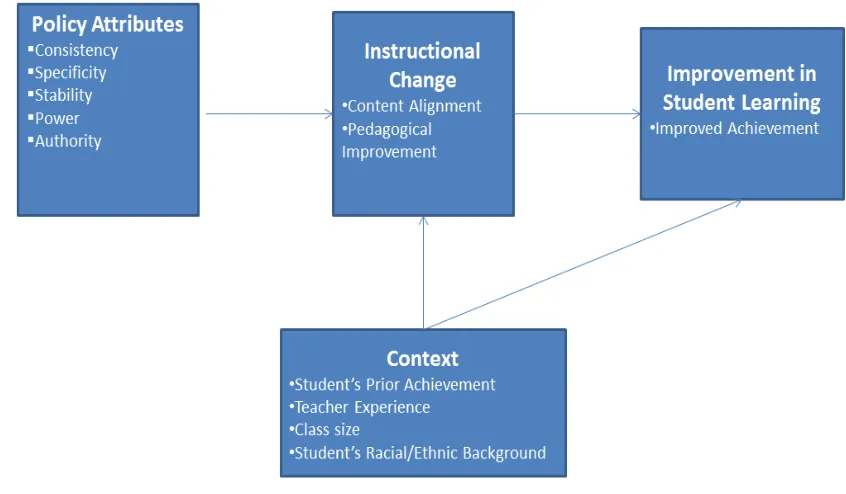
Below, Figure 3. depicts the framework for the policy attributes theory, adapted
to Polikoff’s (2012) study. Polikoff (2012) argued that variation in four policy attributes –
specificity, consistency, stability and power – led to variation in alignment of the content
delivered with the guidelines set forth in the policy. It was hypothesized that higher
levels of the policy attributes would lead to higher implementation quality.
Implementation quality was understood as the extent to which content became aligned
Figure 3. Conceptual Framework for the Policy Attributes Theory
Through his content analysis, Polikoff (2012) noted a large degree of variation on
policy attributes across states, including, among other findings, low consistency across
the board between standards and assessments. Using the survey data collected from
SEC, he estimated two indices of alignment, looking separately at alignment of
instruction with standards and with assessments. The indices were calculated by
comparing teacher self-reports of instruction with the analyses of state standards and
assessment content. Using this method, Polikoff (2012) found that the four policy
attributes studied – specificity, consistency, stability and power – predicted the
The top-down perspective of implementation that has been applied by Porter
(1994), Polikoff (2012) & Phelps et al., (2012) has been shown to be effective at
understanding and predicting implementation of educational policies. Using interviews,
surveys, and content analyses, researchers have been able to apply the policy attributes
theory to their understanding of implementation, finding that these attributes do
indeed influence implementation.
Bounded Rationality: The Limitations of Individual Knowledge
In its original convention, the policy attributes theory has been shown to have
the capacity to predict implementation (Phelps et al., 2012; Polikoff, 2012; Porter,
1994). However, the theory as it was originally conceived does not account for the role
of the individual as an active decision-maker. Rational choice theory, which underlies
the policy attributes theory, assumed that individuals have complete knowledge; about
a policy, about the choices available to them regarding actions to take concerning that
policy, and about the consequences related to a set of actions. Bounded rationality,
while still focused on the link between policies and individual decision-making makes a
different argument. The theory of bounded rationality arose as
“… [A] critique of comprehensive rationality, and grew from an effort to
reconcile the reductionist economic assumptions of rational choice with observed
psychological constraints on human decision-making”. (Jones, Boushey, & Workman,
The theory argues that individuals do not have complete information. Therefore,
an individual’s decision-making process is constrained by their own knowledge of
aspects (e.g., goals, processes, etc.) related to the policy (Jones, 2003; Simon, 2009).
Studies have shown that individuals lack the requisite information to make a fully
rational decision that would optimize their individual decisions concerning
implementation (Jones, 2003; Zaller, 1992). Simon (2009) clarified the distinction
between rational choice theory and the theory of bounded rationality, arguing that
decisions will always be based on an incomplete and, to some degree, inadequate
comprehension of the true nature of the problem being faced. Therefore, Simon stated,
decision-makers will never succeed in generating all possible alternative solutions for
consideration. Additionally, alternatives are always evaluated incompletely because it is
impossible to predict accurately all consequences associated with each alternative.
Therefore, the ultimate decision regarding which alternative to choose must be based
on some criterion other than maximization or optimization because it is impossible to
ever determine which alternative is optimal (Simon, 2009).
Desimone (2002) attempted to describe the implementation of CSR models
through a different conception of the policy attributes theory than originally put forth
by Porter et al. (1988); one thatfalls in close tandem with the assertions put forth by
bounded rationality, and also with Spillane et al.’s (2002) sense-making framework.
Where Porter et al. (1988) argued for a strictly rational-choice choice view of
individual’s perceptions of the policy’s attributes. Desimone (2002) asserted that instead
of a policy’s attributes affecting implementation quality, it was the implementers’
perceptions of the policy’s attributes that moderated implementation. Supporting
Desimone’s (2002) contention, Weatherley & Lipksy (1977) in their influential study of
implementation and the role of public service workers – which included teachers –
found that implementation was driven by those individuals’ (called “street-level
bureaucrats”) interpretations of the reform initiative.
Departing from the full-knowledge perspective of rational choice theory,
Desimone’s (2002) application of the policy attributes theory focuses on the individual’s
understanding and interpretation of messages signaled by a policy’s attributes. Her
application of the theory necessitates an acknowledgement that it is unlikely for a
person to operate with complete information, therefore leading to the choosing of
actions that may not result in the optimal outcome, i.e. a high level of implementation.
In this context, rationality is decided by the perceptions that the implementer holds
about the policy; what is being asked of them, how it impacts their practice, how it
might impact their student’s learning, etc. Those perceptions are guided by their own
past experiences, attitudes and beliefs (Piaget, 1972). The research on implementation
shows that the attributes identified by Porter et al. (1988), as perceived by
implementers, do indeed influence implementation quality (Coburn, 2005; Desimone,
Cognition: Spillane’s Sense-Making Framework
While applicable to the study of implementation, the theories of rational choice
and bounded rationality (much more so the former than the latter), leave untouched
teachers’ thinking as they acquire information about and subsequently, implement a
program. Recapping, traditional economic models view the role of the individual in
implementation as rather limited. It is largely assumed, based on that body of literature,
that the individual implementer is passive in the implementation of a program. Factors
within the policy are the primary drivers of implementation, and not how the
implementer understands and forms ideas about the policy (Coleman, 1990).
To the contrary, cognitive frameworks for understanding implementation attend
directly to the individual, arguing that the individual is not only active, but instrumental
in the process of implementation (Browning, Halcli, & Webster, 2000; Kisun & Nam,
2008; Spillane et al., 2002). For several decades – dating back to the RAND study –
researchers asserted that local variation in implementation was the norm, yet the role
of teachers’ cognition in this process has not garnered significant attention until much
more recently. The cognitive processes that teachers undergo during implementation
are a focal point of an emerging segment of the implementation literature.
Understanding implementation through a cognitive lens allows researchers to
explore the ways that teachers come to understand a policy as it is implemented,
identifying the factors that drive the decisions they make about the policy, and how
Research concerning the role of cognition in implementation has been carried out
across a few fields of study, including public policy, political science, and psychology
(Weiss, 1989; Yanow, 1996; Weick, 1995). First and foremost, these studies argued that
the ideas that implementers form about a program are instrumental to the
implementation process. Spillane and colleagues (2002) went on to argue that the
formation of these ideas was a complex process, guided by individual’s prior
experiences.
“Sense-making is not a simple decoding of the policy message; in general, the
process of comprehension is an active process of interpretation that draws on
the individual’s rich knowledge base of understandings, beliefs, and attitudes.”
(Spillane et al., 2002, p. 391)
Specifically, Spillane et al. (2002), argue that sense-making is rooted in three
domains, individual cognition, situation or context, and policy signals. The theory of
sense-making argues first, that individuals are sense-makers; they develop
interpretations about programs based on their prior knowledge, beliefs, and
experiences. Sense-making is an “active attempt to bring one’s past organization of
knowledge and beliefs to bear in the construction of meaning” (Spillane et al., 2002, p.
395). For example, a teacher may have difficulty reconciling her belief that students
should not be tracked by prior achievement. When faced with reforming to meet those
(i.e., low program quality). Or, a teacher may see the program as being consistent with
their philosophy about teaching and learning. This, the literature suggests, has a positive
effect on implementation (Smith et al., 1997).
Second, the theory asserts that situation, the context in which the reform is
taking place, has an influence on implementing agents’ sense-making. Spillane and his
colleagues (2002) argue the implementing agent is also a social sense-maker and that all
sense-making is “embedded in social contexts” (p.404). The attitudes and beliefs of
peers and administrators, and the quantity and quality of support they receive during
implementation influences program quality. Peer attitudes consistent with the program
can positively impact individual teacher’s perceptions of the model and in action, impact
their efforts to implement the model as intended (Datnow, 2000)
The third domain asserts that sense-making also consists of policy signals or the
role the development of “representations of ideas about changing practice” (Spillane et
al., 389) have on perceptions of the program and how those influence implementation.
Programs, through their design send signal to teachers about teaching and learning. In
engaging with a new reform, teachers are confronted with expectations that often
require them to change their practice. These expectations may or may not fit with
teacher’s worldviews, be clear enough to encourage adoption or adaptation of the
practice, or be perceived to have a chance at success given the stability of the current
environment. Implementation and therefore program quality, may be influenced by
Policy Attributes Sense-Making Framework
The contention made by the Policy Attributes Sense-Making Framework – that
policy interpretation is guided by the individual implementer, the local context and
policy signals – complements Desimone’s (2002) application of the policy attributes
theory. The theory (Desimone, 2002), which focused on teacher perceptions and the
relationship of those perceptions to implementation, meshes with Spillane’s
sense-making framework in that both argue for viewing implementation through the ways in
which teachers interpret messages sent from a policy. The Policy Attributes Theory
serves as a frame through which we can categorize important factors shown to affect
implementation, and the sense-making framework gives insight into how those factors
can and do affect implementation. Therefore, it serves the field of research on
implementation to have a framework that attends to the role of cognition in
implementation, while also having a way to organize factors that influence the
implementation of any given program. My framework, the policy attributes
sense-making framework (PASMF), fills that need. In this paper, I argued that teachers’
perceptions about a program are the outcomes of an individual making-sense of the
information they receive. Sense-making, as Spillane et al. (2002) argue, consists of three
aspects – affect, context, and policy signals – that drive teacher perceptions. In turn,
these perceptions moderate implementation quality which in turn mediates program
effects. The logic model depicted in Figure 4 describes the framework and its role in