University of Pennsylvania
ScholarlyCommons
Publicly Accessible Penn Dissertations
2018
Self-Consistency In Sequential Decision-Making
Long Luu
University of Pennsylvania, [email protected]
Follow this and additional works at:
https://repository.upenn.edu/edissertations
Part of the
Neuroscience and Neurobiology Commons, and the
Psychology Commons
This paper is posted at ScholarlyCommons.https://repository.upenn.edu/edissertations/3152
Recommended Citation
Luu, Long, "Self-Consistency In Sequential Decision-Making" (2018).Publicly Accessible Penn Dissertations. 3152.
Self-Consistency In Sequential Decision-Making
Abstract
Human decisions are rarely made in isolation. We typically have to make a sequence of decisions to reach a goal. Studies in economics and cognitive psychology have shown that making a decision may result in several biases in subsequent judgments. Similar biases have also recently been found in human percepts of low-level stimuli such as motion direction. What lacking is a principled framework that can account for several sequential dependencies between judgments. Towards that goal, in my thesis, I propose and experimentally test a self-consistent Bayesian observer model that assumes humans maintain self-consistency along the inference process. In Chapter 2, I first demonstrate that after having made a categorical decision on stimulus orientation, subjects’ estimate of the stimulus is systematically biased away from the decision boundary. Two additional experiments suggest that the bias occurs because subjects treat their first decision as a fact and use that to constrain the subsequent estimation. Model fit to the data in my experiments and data in previous studies show that the self-consistent Bayesian model can quantitatively account for human behaviors in a wide range of experimental settings. In Chapter 3, using the same decision-estimation tasks, I probed the post-decision sensory representation by providing feedback on the categorical post-decision. I found that subjects’ sensory representation is kept intact and the self-consistency is implemented by conditioning the prior distribution on the categorical decision. The results also suggest another interesting form of self-consistency when subjects’ decision was incorrect: they reconstructed the sensory measurement to make it consistent with the given feedback. In Chapter 4, I found that the choice-induced bias also occurs in human judgment of number. The bias is similar for both non-symbolic (cloud of dots) and symbolic (sequence of Arabic
numerals) forms of number. Finally, I propose in the general discussion how the self-consistent Bayesian framework may account for other biases in sequential decision-making such as the halo effect and sunk-cost fallacy.
Degree Type
Dissertation
Degree Name
Doctor of Philosophy (PhD)
Graduate Group
Psychology
First Advisor
Alan A. Stocker
Keywords
Bayesian decision theory, Decision-making, Perception, Psychophysics, Self-consistency, Sequential judgment
Subject Categories
SELF-CONSISTENCY IN SEQUENTIAL DECISION-MAKING
Long Luu
A DISSERTATION
in
Psychology
Presented to the Faculties of the University of Pennsylvania
in
Partial Fulfillment of the Requirements for the
Degree of Doctor of Philosophy
2018
Supervisor of Dissertation
Alan A. Stocker, Associate Professor of Psychology
Graduate Group Chairperson
Sara Jaffee, Professor of Psychology
Dissertation Committee
David H. Brainard, Professor of Psychology Joshua I. Gold, Professor of Neuroscience
Dedicated to my parents and my wife
Acknowledgment
I would like to express my gratitude to many people who have helped to bring this thesis
to fruition.
First I want to thank my advisor, Alan Stocker, for his dedicated mentoring. I have
learned from him how to become a proper scientist which ranges from doing solid science and
efficiently communicating my works to the scientific community to developing a scientific
career. In every aspect of the scientific enterprise, Alan has shown me the high standards I
should always aspire to.
I am also deeply grateful to my thesis committee, David Brainard, Josh Gold and Joe
Kable for their relentless support and helpful guidance during my PhD years. I want to
especially thank David for introducing me to the beauty and fascination of vision science
and psychophysics. I want to thank Josh for always giving constructive feedback and helping
me see the problem from a different perspective. I am grateful to Joe for his willingness to
help when I need it.
I am grateful to many people in Psychology Department. First I would like to thank the
administrative staffs, especially Yuni Thornton, Laurel Sweeney and Jessica Marcus who
have helped me a lot with the administrative works. I also want to thank many faculty
members in psychology who have introduced me to the exciting field of psychology through
proseminar courses.
During the years at Penn, I have received generous mentoring and enjoyed friendship
with many fellow students and postdocs, especially those in perception group. Manuel
Spitschan provided me with detailed and valuable guidance in performing psychophysical
experiment. Xuexin Wei always gave me interesting insights in our frequent conversation
both inside and outside the lab. I want to thank Ana Radonjic, Nicolas Cottaris, Toni
Sareela, Matjaz Jogan, Pedro Ortega, Alan He, Mohammad Rostami, Daniel Pak,
Ben-jamin Chin, Cheng Qiu, Jiang Mao, Lingqi Zhang, Noam Roth, David White, Michael
Barnett, Yunshu Fan and Takahiro Doi for many interesting discussions and conversations
Last but not least, I want to thank my parents, my uncle Vuong and my wife for their
relentless and unconditional support for my professional career no matter what path I have
ABSTRACT
SELF-CONSISTENCY IN SEQUENTIAL DECISION-MAKING
Long Luu
Alan A. Stocker
Human decisions are rarely made in isolation. We typically have to make a sequence of
decisions to reach a goal. Studies in economics and cognitive psychology have shown that
making a decision may result in several biases in subsequent judgments. Similar biases have
also recently been found in human percepts of low-level stimuli such as motion direction.
What lacking is a principled framework that can account for several sequential
dependen-cies between judgments. Towards that goal, in my thesis, I propose and experimentally test
a self-consistent Bayesian observer model that assumes humans maintain self-consistency
along the inference process. In Chapter 2, I first demonstrate that after having made a
categorical decision on stimulus orientation, subjects’ estimate of the stimulus is
systemat-ically biased away from the decision boundary. Two additional experiments suggest that
the bias occurs because subjects treat their first decision as a fact and use that to constrain
the subsequent estimation. Model fit to the data in my experiments and data in previous
studies show that the self-consistent Bayesian model can quantitatively account for human
behaviors in a wide range of experimental settings. In Chapter 3, using the same
decision-estimation tasks, I probed the post-decision sensory representation by providing feedback
on the categorical decision. I found that subjects’ sensory representation is kept intact and
the self-consistency is implemented by conditioning the prior distribution on the categorical
decision. The results also suggest another interesting form of self-consistency when subjects’
decision was incorrect: they reconstructed the sensory measurement to make it consistent
with the given feedback. In Chapter 4, I found that the choice-induced bias also occurs
in human judgment of number. The bias is similar for both non-symbolic (cloud of dots)
and symbolic (sequence of Arabic numerals) forms of number. Finally, I propose in the
general discussion how the self-consistent Bayesian framework may account for other biases
TABLE OF CONTENTS
Abstract . . . v
List of figures . . . x
1 Introduction . . . 1
1.1 Sequential dependency in cognitive judgments . . . 3
1.2 Sequential dependency in perceptual judgments . . . 5
1.2.1 Single-judgment task . . . 5
1.2.2 Multiple-judgment task . . . 7
1.3 Bayesian decision theory . . . 8
1.4 Supplemental-psychophysics methods . . . 12
2 Self-consistent inference . . . 15
2.1 Introduction . . . 15
2.2 Replicating choice-induced bias . . . 16
2.3 Self-consistent Bayesian observer model . . . 18
2.4 Validating self-consistent Bayesian observer model . . . 23
2.4.1 Key features of the model . . . 23
2.4.2 Inconsistent trials . . . 28
2.4.3 Explaining existing experimental data . . . 30
2.5 Self-consistency despite memory degradation . . . 32
2.6 Alternative interpretations . . . 33
2.7 Discussion . . . 36
2.8 Method and supplementary material . . . 37
3 Post-decision sensory representation . . . 57
3.2 Probing post-decision sensory representation . . . 58
3.2.1 Experimental test and alternative models . . . 58
3.2.2 Some sensory information is still preserved . . . 61
3.3 Further test of alternative models . . . 64
3.3.1 Imposing asymmetric prior . . . 64
3.3.2 Subjects maintain full sensory representation . . . 65
3.4 Discussion . . . 68
3.5 Methods . . . 70
4 Self-consistency in number judgment . . . 79
4.1 Introduction . . . 79
4.2 Dot array stimulus . . . 80
4.2.1 Choice-induced bias in perceived number of dots . . . 80
4.2.2 Explaining the bias with self-consistent model . . . 81
4.3 Symbolic number stimulus . . . 84
4.3.1 Probabilistic inference over a sequence of numbers . . . 84
4.3.2 Trial-by-trial prediction of observer models . . . 84
4.3.3 Replicating the result with different task instruction . . . 87
4.4 Discussion . . . 89
4.5 Method and supplementary material . . . 92
5 General discussion . . . 100
5.1 Summary of thesis contribution . . . 100
5.2 Testable predictions of self-consistency principle . . . 101
5.2.1 Sequential judgments on multiple attributes . . . 101
5.2.2 Incorporating additional evidence after a preliminary decision . . . . 107
5.3 Self-consistent inference . . . 109
5.3.1 Benefits of self-consistency . . . 109
5.4 General implications for decision-making study . . . 114
List of figures
Figure 1.1: Example to illustrate Bayesian decision theory . . . 14
Figure 2.1: Post-decision biases in a perceptual task sequence . . . 17
Figure 2.2: Bayesian observer models for the perceptual task sequence . . . 19
Figure 2.3: The self-consistent Bayesian observer model . . . 21
Figure 2.4: Experiment 1: Data and model fits for individual subjects . . . 22
Figure 2.5: Effect of the stimulus prior . . . 24
Figure 2.6: Self-made vs. given category assignment . . . 25
Figure 2.7: Experiments 2 and 3: Joint fit to data for individual subjects . . . . 27
Figure 2.8: Inconsistent trials are due to lapses and motor noise . . . 29
Figure 2.9: Model fits for experimental data by Zamboni et al. (2016) . . . 31
Figure 2.10: Maintaining self-consistency in the face of working memory noise . . 34
Figure 2.11: Full distributions of individual subjects’ estimates in Experiment 1 . 47 Figure 2.12: Measured motor noise of individual subjects . . . 48
Figure 2.13: Histogram plots of the orientation estimates together with the model fit for Experiment 1 (combined subject) . . . 49
Figure 2.14: Goodness-of-fits for Experiment 1 . . . 50
Figure 2.15: Full distributions of individual subjects’ estimates in Experiment 2 . 51 Figure 2.16: Full distributions of individual subjects’ estimates in Experiment 3 . 52 Figure 2.17: Goodness-of-fits for Experiments 2 and 3 . . . 53
Figure 2.18: Zamboni et al. (2016) data (Experiment 1, combined subject) and fit with the self-consistent observer model . . . 54
Figure 2.19: Zamboni et al. (2016) data (Experiment 2, combined subject) and fit with the self-consistent observer model . . . 55
Figure 3.1: Alternative hypotheses of post-decision sensory representation. . . . 59
Figure 3.2: Prediction of alternative hypotheses for incorrect trials. . . 60
Figure 3.3: Self-consistent model fit to correct trials. . . 62
Figure 3.4: Data and model prediction for incorrect trials. . . 63
Figure 3.5: Performance of alternative models in Experiment 1. . . 65
Figure 3.6: Dissociating the models by imposing an asymmetric prior. . . 66
Figure 3.7: Model prediction and data in Experiment 2. . . 67
Figure 3.8: Performance of alternative models in Experiment 2. . . 69
Figure 4.1: Experiment 1 procedure . . . 80
Figure 4.2: Data and model fit in Experiment 1 . . . 82
Figure 4.3: Experiment 2 procedure and result . . . 85
Figure 4.4: Comparing alternative models . . . 86
Figure 4.5: Instruction for Experiment 3 . . . 88
Figure 4.6: Experiment 3 result . . . 90
Figure 4.7: Histogram of subjects’ estimates and model fits in Experiment 1 . . 98
Figure 4.8: Correlation of sample position and decision . . . 99
Figure 5.1: Rational Bayesian observer of multi-attribute judgment . . . 104
Figure 5.2: Self-consistent observer of multi-attribute judgment . . . 105
Figure 5.3: Experimental test of halo effect at low-level perception . . . 106
Figure 5.4: Modeling sunk cost fallacy . . . 110
Figure 5.5: Advantage of self-consistent Bayesian observer . . . 111
Chapter 1
Introduction
As the field of machine intelligence advances at a blistering pace, we are now used to
hearing breaking news about machine beating human experts on many areas once thought
to be exclusively for the human. That ranges from AlphaGo beating Go champions (Silver
et al., 2016, 2017), machine learning algorithms making medical decisions (Obermeyer and
Emanuel, 2016; Kononenko, 2001) to autonomous robots fighting in wars (Singer, 2010;
Ayoub and Payne, 2016). It leaves many of us to wonder what will be left for human
intelligence. A common response is that we are still far from building a machine that makes
a medical diagnosis in the morning, then drives to a friend’s home to play a chess game in
the afternoon and is ready to get in war at any time if necessary. In other words, the best
machines excel humans at a specific area yet fall far behind an average person in all other
areas (Lake et al., 2017; Kasparov, 2017).
Among areas that machines are still behind human in many regards is perception which
involves judgments about basic properties of the world. Deep Blue computer that defeated
Gary Kasparov cannot tell whether the sky is blue or how deep the ocean is. The ease
with which we make such perceptual decisions conceals the complexity of the underlying
processes. For instance, driving appears to be a fairly basic skill for most people, yet it
requires a tremendous amount of complicated decisions many of which involve inference
about perceptual features of the world (e.g. what are the surrounding objects and how far
away or how fast are they?). The challenges are more obvious with the development of
state-of-the-art technologies such as self-driving cars or humanoid robots. In fact, research on
perception dates back to as early as the 19thcentury when the pioneers like Gustav Fechner
and Hermann von Helmholtz conceived the lawful relations between the mental process and
works has followed those early attempts and greatly advanced our understanding of how
humans perceive the world (Cornsweet, 2012; Blakemore, 1993; Wandell, 1995; Green and
Swets, 1966; Wolfe et al., 2006). In these studies, human subjects typically make a single
judgment on a simple stimulus in each trial (see Supplemental-psychophysics methods for a
brief overview of experimental methods). Crucially, the dominant theoretical frameworks in
perception such as linear system theory (Wandell, 1995), signal detection theory (Macmillan
and Creelman, 2004) and Bayesian decision theory (Kersten and Schrater, 2002; Maloney,
2002) mostly assume that perceptual judgments are made independent of each other. As a
result, a perceptual decision should not affect subsequent judgments.
However, several lines of research in cognition and perception suggest that there exist
many forms of sequential dependency between decisions. In cognitive psychology and
eco-nomics, a rich body of works found evidence that a decision may cause systematic biases
in subsequent judgments (Abelson, 1968; Kahneman, 2011). For instance, when humans
made a sequence of judgments on the same stimulus features, the later judgment tend to
be distorted to be consistent with the preceding decision (Brehm, 1956). Several other
decisional biases induced by preceding judgments have also been well documented such as
confirmation bias (Nickerson, 1998), halo effect (Nisbett and Wilson, 1977) and sunk-cost
fallacy (Arkes and Blumer, 1985).
Several perception studies have found that perceptual decisions across trials exhibit
specific patterns such as repetition or alternation despite the fact that the experimental
stimuli were randomized (Fernberger, 1920; Gold et al., 2008; Fr¨und et al., 2014). An
important difference between these studies and the cognitive literature mentioned above is
that subjects only made one decision in each trial, which makes it difficult to have a direct
comparison. More recently, a small body of works in perception had multiple judgments in
each trial and show biases that are similar to the cognitive biases (Jazayeri and Movshon,
2007; Zamboni et al., 2016; Bronfman et al., 2015). As an example, a study by Jazayeri
and Movshon (2007) shows that after having made a decision on motion direction of a dot
from the decision boundary.
Although there exist many ad hoc theories that can explain each of these bias effects,
what we lack is a unifying model framework that may account for many of the findings
and provide fruitful predictions for future research. Towards that goal, my thesis extends a
self-conditioned Bayesian observer model (Stocker and Simoncelli, 2007) and demonstrates
through several experiments how the model can quantitatively account for sequential
de-pendency in human perceptual decisions across various experimental settings.
In the rest of the chapter, I provide the necessary background for the readers that are
not familiar with the relevant literature. Specifically, I will review key studies that show
several forms of sequential dependency between decisions in cognition and perception. Then
I will review the standard framework of Bayesian decision theory as applied in perception.
1.1. Sequential dependency in cognitive judgments
In 1956, the psychologist Leon Festinger published a book to describe the behavior of
mem-bers in a religious cult that believes the world would be destroyed by a flood on December
21, 1954 and the believers would be saved by a flying saucer (Festinger et al., 1956).
In-terestingly, after they found out that the end of the world did not happen, they readily
accepted the leader’ argument that the world is saved by their extreme piety and even
doubled down on their belief and fervently proselytized for it. To explain the phenomenon,
Festinger developed a theory of cognitive dissonance which posits that people dislike
holding contradictory beliefs in mind and tend to modify them to maintain a sense of
con-sistency (Festinger, 1957). In the religious cult example, the members’ belief that the world
would be destroyed is highly dissonant with the belief that the event did not happen.
Im-portantly, they cannot change either of them because they had given up everything (jobs,
spouses, possessions) to follow the cult. Therefore, they easily fell prey to demagoguery
claims and actively advanced those arguments that may help in reconciling these dissonant
beliefs.
Following on Festinger’s pioneering works, a large body of experimental studies has
and Carlsmith, 1959; Bem, 1972; Knox and Inkster, 1968; Younger et al., 1977; Frenkel and
Doob, 1976; Cohen and Goldberg, 1970). In a study by Brehm (1956) subjects were asked
to rate the desirability of eight items (e.g. coffee-maker, toaster, stopwatch). Then they had
to choose between two equally desirable options (e.g. coffee-maker vs. toaster) and rate the
items again. In accordance with cognitive dissonance theory, subjects’ ratings of the items
after a difficult decision change according to their choice, that is, the value of chosen item
increases whereas the value of rejected item decreases. This line of works has been revived
recently (Lee and Schwarz, 2010) and researchers recast it as choice-induced preference
(Egan et al., 2010; Sharot et al., 2010, 2012) or preservation of coherence/consistency (Simon
et al., 2004; Riefer et al., 2017). By using choice-blindness paradigm (Johansson et al., 2005),
the studies on choice-induced preference confirm that cognitive dissonance effect is not due
to statistical artifacts as pointed out by Chen and Risen (2010).
As reviewed above, cognitive dissonance studies demonstrate sequential dependency
between judgments that subjects make on the same feature using the same evidence.
How-ever, the practical situation that a decision maker encounters often involves judgments on
different attributes (e.g. intelligence, experience, and integrity of a job candidate). If the
judgments are made sequentially, the order in which the attributes are considered may
sig-nificantly affect the judgment results as demonstrated in studies on halo effect (Nisbett
and Wilson, 1977; Thorndike, 1920; Sigall and Ostrove, 1975; Leuthesser et al., 1995).
An-other typical real-life scenario is when we cannot acquire all relevant information at once.
Hence, we first make a preliminary decision and subsequently incorporate any additional
in-formation presented to us. For example, a company decides to invest in a promising project
with an initial estimated budget of $100 million dollars. Halfway through the project, all
money is spent and it is estimated that another $100 million dollars are needed to finish
it. Moreover, the project is not as promising as it was and the same amount of money can
be spent on another more profitable project. What should the company do? Anecdotal
observation and empirical evidence have shown that the company is more likely to continue
likely invest in the new project. This phenomenon is namedsunk-cost fallacy (Arkes and
Blumer, 1985; Staw, 1976). A related ”irrational” behavior, confirmation bias, was also well
documented in several studies which suggest that subjects tend to search for information
supporting their previous decision (Nickerson, 1998; Mynatt et al., 1977; Jonas et al., 2001).
Those scenarios will be discussed more extensively in section 5.2.
1.2. Sequential dependency in perceptual judgments
1.2.1. Single-judgment task
Even in the standard psychophysics experiments that include a single decision in a trial,
researchers have long noticed some dependency in subjects’ decisions across trials. As early
as 1920, Fernberger (1920) found that when subjects made a simple discrimination on a pair
of weights (”lighter”, ”heavier” or ”equal”), their decision in the current trial was repulsed
away from the decision in the previous trial (e.g. they tended to respond ”lighter” when
the response had been ”heavier” in the preceding trial). Several subsequent studies using
a wide range of stimuli and task designs found mixed results. In some studies, subjects
tended to avoid the previous response (Arons and Irwin, 1932; Preston, 1936; Collier, 1951)
whereas other studies show that subjects tended to repeat the previous response (Senders
and Sowards, 1952; Senders, 1953; Verplanck et al., 1952; Day, 1956; McGill, 1957). Several
studies have tried to determine the factors that influence this dependency such as training
(Verplanck et al., 1953), intertrial interval, experimental duration (Collier, 1954; Day, 1957)
and previous stimulus identity (Verplanck and Blough, 1958; Collier and Verplanck, 1958).
More recent studies replicated the sequential dependency and demonstrated that the effect
cannot be explained by motor bias, sensory adaptation or attentional effect (Akaishi et al.,
2014; Fr¨und et al., 2014; Braun et al., 2018). When feedback was given in every trial,
subjects’ decision is dependent on the feedback in the previous trial: repetition if correct
and alternation if incorrect (win-stay, lose-switch) (Busse et al., 2011; Abrahamyan et al.,
2016; Urai et al., 2017).
How can we explain this type of sequential dependency? Some proposed that the
a pattern even when the stimulus is totally ambiguous (Tune, 1964; Goodfellow, 1938).
Other researchers approached the problem from the perspective of signal detection theory
and suggested that the dependency occurs because the observer’s decision criterion
sys-tematically fluctuates throughout the experiment (Treisman and Williams, 1984; Dorfman
and Biderman, 1971; Kac, 1962). More specifically, after a response, the observer shifts
the criterion by a certain amount and the shift direction will determine the avoidance or
repetition dependency. In the framework of drift-diffusion model, sequential dependency is
suggested to happen because the starting point of evidence accumulation process is biased
by the statistics of previous responses and/or feedback (Gold et al., 2008; Kim et al., 2017;
de Lange et al., 2013). Along the same line, Akaishi et al. (2014) proposes that the history
of previous decisions affects subsequent ones through a reinforcement learning process that
updates based on subject’s decision instead of feedback (note that there was no feedback in
their experiments). In the context of Bayesian observer model, Angela and Cohen (2009)
suggest that the observer assumes the environment is inherently volatile so that the
prob-ability of stimulus being repeated or alternated changes over time (see Glaze et al. (2015)
for a similar account using drift diffusion model).
Essentially, the above explanations for sequential dependency posit that decisions across
trials are dependent because they share a common source (response bias, decision criterion,
history of previous trials/feedback or prior belief about environmental stability). That
is different from what is typically thought about sequential dependency in the cognitive
literature discussed above: a preceding decision directly biases subsequent decisions. The
closest explanation in perceptual studies comes from Gold et al. (2008) and Akaishi et al.
(2014) which suggest previous decisions directly affect subsequent ones. However, they also
found that the effect of immediately preceding decision is either negligible or insufficient to
account for the data. This discrepancy may be partly because in the perceptual studies,
subjects only made a single judgment in each trial and the trials were often designed to be
random and independent of each other. That differs from the cognitive literature in which
but growing body of works in perception that bears a close resemblance to such situation.
1.2.2. Multiple-judgment task
In a perceptual task that is analogous to cognitive dissonance experiments, subjects had to
make two sequential judgments on a cloud of moving dots: they first indicated whether the
dots’ motion direction was clockwise or counterclockwise of a decision boundary; then they
had to report the perceived motion direction of the dots (Jazayeri and Movshon, 2007). The
authors found that subjects’ estimates in the second task were systematically biased away
from the decision boundary. Importantly, the estimate bias is in the same direction as the
decision. For instance, if their decision was clockwise in the first judgment, the estimate
was biased away from the decision boundary in the clockwise direction. Furthermore, the
bias magnitude was larger when the task was more difficult, that is, when the dots’ motion
direction was closer to the decision boundary or when the noise in the dots’ motion direction
was high. The findings were replicated in another study by Zamboni et al. (2016).
Along the same line, several studies on decision confidence found that decision may
bias subsequent judgment of confidence. In a study by Zylberberg et al. (2012), subjects
first made a categorical decision about the motion of a dots cloud (e.g. left or right),
then they had to report their confidence on a continuous scale. The authors found that
subjects’ confidence judgments depend more on stimulus evidence supporting the decision
than evidence opposing the decision. Similar results using face/house stimuli were found in
Peters et al. (2017) at both behavioral and neural levels. The results imply that subjects
are overconfident after the decision (see Yu et al. (2015a) for the under-confidence scenario).
Bronfman et al. (2015) show sequential dependency in a perceptual task similar to
the sunk-cost fallacy scenario. Subjects were first presented with a sequence of 8 symbolic
numbers and indicated whether the sequence average was less or greater than 50. Then
another sequence of 8 numbers were displayed and subjects had to estimate the average
of all 16 numbers. By regressing subjects’ final estimates on the presented numbers, the
authors found that subjects significantly down-weighed the evidence in the second sequence
a preliminary decision on the first sequence, subjects reduced sensitivity to the second
sequence.
1.3. Bayesian decision theory
The key assumption of this theoretical approach is that humans maintain an internal model
of how the world works (generative/forward model) and this internal model is
charac-terized by probabilistic relations between variables. In this framework, perception can be
formulated as an inverse process that infers hidden variables from the observed variables.
For example, a baseball player wants to know the velocity of a ball flying in the air. In
most cases, he doesn’t have direct access to the true velocity of the ball (hidden variable)
but instead he has some indirect information (observed variable) that is related to that
variable. The most simple generative model assumes there is a true velocity v of the ball
which the player doesn’t know and would like to estimate (Fig. 1.1a). The player’s visual
system collects sensory evidencemv about the true velocity which is a noisy copy ofv. The
player’s task is to infer the ball’s true velocity, v from the sensory evidence,mv. Note that
the internal models may vary in structure and level of details and that depends on several
factors such as the task specification or subjects’ past experience. In the baseball example,
the player may have a more complicated internal model. For instance, his visual system
may gather sensory evidence of the distancedtraveled by the ball between two time points
and the traveling time t(Fig. 1.1b). In this case, the player has to infer the ball’s velocity
from the sensory evidence of distancemd and timemt.
Among many ways to solve the problem, Bayesian decision theory provides a principled
approach that can be interpreted intuitively. There are 3 main components of Bayesian
decision theory: the prior distribution, the likelihood function and the loss function, each
of which will be explained in detail below.
Theprior distribution represents the observer’s prior belief about the variable to be
estimated before the sensory evidence is gathered. Technically, it is a probability
distribu-tion over the feasible space of the estimated variable. In the baseball example, the prior
player observes the current flying ball. An example of prior distribution shown in Fig. 1.1c
illustrates the observer’s prior belief that the ball’s velocity tends to be slow rather than
fast. Several studies provide supportive evidence for this tendency of people’s prior belief
about speed in general (Weiss et al., 2002; Stocker and Simoncelli, 2006; H¨urlimann et al.,
2002).
Another important factor in Bayesian decision theory is the observer’s belief about the
process that generates the sensory information. In the baseball example, this process may
include how light is reflected off the ball and arrives at the player’s retina and how the
retina and early visual system convert that incoming light pattern into neural signals. The
whole process is often simplified by a noise model p(mv|v) that indicates the probability
of obtaining a sensory evidence mv given the true velocity v. In the estimation task,
the sensory evidence is observed and fixed. When we write p(mv|v) as a function of v,
it becomes the likelihood function. Therefore, the likelihood function represents the
observer’s uncertainty about the sensory evidence and is totally determined by the whole
process that takes place from the stimulus to the sensory evidence. For example, if the
observer assumes the sensory evidencevm is the result of adding Gaussian noise to the true
velocityv, the conditional distributionp(mv|v) is a Gaussian distribution centered onvand
the standard deviation is constant for all v. That gives rise to a likelihood function that
has the Gaussian shape as illustrated in Fig. 1.1c.
Perception not only serves as a subjective experience but also has real consequences
when it guides the observer’s action in most practical situations (e.g. whether a player
successfully catches a ball or not). The observer’s belief about the consequence of its decision
is quantified by the loss function which indicates how the decision error is penalized.
Specifically, the loss functionL(ˆv, v) represents the cost of making decision ˆvwhen the true
stimulus value is v. For computational convenience, the loss function is often defined as
a parametric function of the difference between the decision and the true stimulus ˆv−v
(i.e. the decision error). Fig. 1.1c illustrates the squared loss function L(ˆv, v) = (ˆv−v)2
is an absolute function of the error,L(ˆv, v) =|vˆ−v|which also penalizes large error more
but to a lesser extent than the squared loss. The loss function typically depends on the
task and the reward structure. For instance, the squared or absolute loss functions may be
appropriate for the baseball example because a small error is likely to be less costly than a
large error (the player can still catch the ball if his hand is just a little bit away from the
true position of the ball). In contrast, when the observer has to make a categorical decision
(e.g. answering a multiple-choice question in an exam), the 0/1 loss function is often more
suitable because getting credit requires an exactly correct answer:
L(ˆv−v) =
0 if ˆv=v
1 if ˆv6=v
(1.1)
Given that all three main components (prior distribution, likelihood function and loss
function) are well-defined in a task, Bayesian decision theory provides a Bayes optimal
rule to make a decision. By using Bayes rule, the prior distribution is combined with the
likelihood function to form the posterior distribution:
p(v|mv) =
p(mv|v)·p(v) p(mv)
(1.2)
In the baseball example, the posterior distribution p(v|mv) represents the player’s belief
about the ball’s velocityv after integrating the sensory evidence with his prior belief.
Be-cause p(mv) is independent of v in Eqs. (1.2), it is just a normalizing constant for the
purpose of estimating v. Then depending on the loss function, the observer makes a point
estimate ˆv based on the posterior distribution p(v|mv). For instance, if we use the squared
loss function, the estimate is the mean of the posterior distribution:
ˆ
v(mv) = Z
v·p(v|mv)dv (1.3)
mode of the posterior distribution, respectively. Note that the estimate ˆv is a function of
the sensory evidencemv. So Bayes optimal decision rule is a deterministic mapping between
the sensory evidence and the estimate.
So far Bayesian decision theory has been described in terms of the observer’s beliefs
about the world (i.e. the generative model, prior, likelihood and loss function) and how the
observer makes Bayes optimal decision with these beliefs. An obvious question is whether
those beliefs reflect the facts about the physical world. It is an interesting question because
if the observer’s beliefs match the physical world, Bayesian decision theory is not just a
descriptive framework which only aims to describe what is going on but it is also a
prescriptive framework which defines the optimal strategy to make a decision. In fact,
this issue has been investigated long before the Bayesian approach to perception becomes
popular. Brunswik and Kamiya (1953) studied whether Gestalt rules of how humans group
items accord with the statistical regularities of the environment. They found that some
rules indeed reflect the statistical regularities of the world (e.g. the proximity principle in
which items closer to each other tend to belong to the same object). Several studies have
followed up on that using Bayesian approach and also found a fairly good match between
human beliefs and the statistical structure of the environment (Geisler et al., 2001; Geisler
and Perry, 2009; Burge et al., 2010; Girshick et al., 2011; Kim and Burge, 2018). Those
studies mostly touch on the prior distribution. Other components of Bayesian decision
theory (generative model, likelihood and loss function) seem to be harder to investigate.
For example, it is not always straightforward to determine the loss function. Gambles in the
casino (roulette, blackjack, etc.) may have a clear reward structure. In contrast, choosing
between orange and apple primarily depends on individual preferences. As a result, there is
still a lot of open questions regarding Bayesian decision theory as a prescriptive framework.
Application of Bayesian decision theory to the study of perception has been both
suc-cessful and fruitful because it can account for a wide range of experimental data and has the
potential to generate interesting testable predictions. Several studies have shown that
across a wide variety of stimuli and tasks such as the perception of depth (Ernst and Banks,
2002; Knill, 2007; Jacobs, 1999), velocity (Ascher and Grzywacz, 2000; H¨urlimann et al.,
2002), color (Brainard and Freeman, 1997; Brainard et al., 2006), sound (Gifford et al.,
2014), time (Jazayeri and Shadlen, 2010; Acerbi et al., 2012; Shi et al., 2013), multi-sensory
stimulus (K¨ording et al., 2007) as well as sensorimotor tasks (K¨ording and Wolpert, 2004;
K¨ording and Wolpert, 2006).
1.4. Supplemental-psychophysics methods
Scaling procedure: In a common form of scaling, subjects are typically asked to assign a
numerical value to their perceived intensity of the stimulus (Stevens, 1946, 1957; Marks,
1974). For example, the experimenter presents a standard sound as an anchor and assign
a number 10 to the loudness of that sound. Then another comparison sound is played and
subjects have to indicate how loud the comparison is relative to the standard sound (e.g.
20 if the comparison is twice as loud as the standard) (Stevens, 1956). Not all scaling
methods involve numerical assignment. In the Farnsworth-Munsell 100-Hue test, subjects
are shown a row of colored papers that are randomly ordered and vary in hue. The first
and last papers are fixed and subjects have to order the other papers to make a ”smooth
color series” (Farnsworth, 1943).
Forced choice task: Because many scaling methods involve subjects’ comprehension or
pro-duction of numbers, any abnormality in number perception may contaminate the result. The
forced choice method may overcome this by asking subjects to make a simple categorical
re-sponse to the stimulus (Fechner, 1860; Green and Swets, 1966). In a typical two-alternative
forced choice experiment, two stimuli (e.g. two circular gratings with different orientations)
are presented and subjects have to make a binary decision (e.g. which grating is more
clockwise). By analyzing the data of forced choice method using signal detection theory
(Macmillan and Creelman, 2004), we can make useful inference about subjects’ sensitivity
to the stimulus (e.g. subjects’ discrimination threshold) and subjects’ decision biases (e.g.
subjects’ tendency to respond clockwise regardless of the stimulus).
than a hundred years ago by James Clerk Maxwell (Maxwell, 1857). To study human color
perception, he constructed a countertop which consists of two disks put on top of each other.
The smaller disk on top is painted with a reference color. The bigger disk on the bottom is
divided into three wedges whose colors are vermilion, emerald green and ultramarine blue
(the three primary colors). During the experiment, the disks are spun very fast so that the
three colors of the big disk on the bottom are seen as being blended together, resulting in
the percept of a single color. Subjects were tasked to adjust the proportion of three primary
colors until the color of the top and the bottom disks are the same. An illustration of the
design can be found here (http://www.handprint.com/HP/WCL/colortop.html).
There are many variations of the above methods and interested readers can find more
details in Kingdom and Prins (2010), Macmillan and Creelman (2004) and Lu and Dosher
b
a
Sensory evidence
Ball velocity Travel
distance Traveltime
c
Velocity Velocity Estimate - True velocity
Velocity
Probability Probability
Loss
Probability
Prior distribution
mv
Likelihood function Loss function
Posterior distribution
Vv
v
v
m
vd
m
dt
m
tVelocity
estimate
Figure 1.1: Example to illustrate Bayesian decision theory. (a) A simple generative model
can be used to represent the problem of estimating the velocity of a ball: v indicates the
true velocity andmv indicates the sensory evidence about the ball’s velocity. The task is to
infer vfrom mv. (b) A more complicated generative model can be used. Here the observer
infers the ball velocity from sensory information about the distance traveled by the ball and
the travel time. (c) Three main components of Bayesian decision theory are shown: prior
Chapter 2
Self-consistent inference
2.1. Introduction
In this chapter, I set the theoretical foundation for the thesis by refining and experimentally
validating a hypothesis that may explain for several sequential dependencies between
deci-sions discussed in Chapter 1 (see section 1.2 and 1.3.2). Specifically, I tested the hypothesis
that an observer’s inclination to maintain a self-consistent, hierarchical interpretation of the
world leads to the observed post-decision biases in perceptual judgments. We expressed this
hypothesis with aself-consistent Bayesian observer model, which assumes that a subject’s
estimate is not only conditioned on the sensory evidence but also on the subject’s preceding
categorical judgment. The model extends a previous formulation (Stocker and Simoncelli,
2007) as it takes into account that sensory information in working memory degrades over
time, which has important implications with regard to the behavioral benefits of the
pro-posed hypothesis. I validated the model with three different psychophysical experiments
that were based on a perceptual task sequence in which subjects were asked to perform
a categorical orientation judgment followed by an orientation estimate of a visual
stimu-lus. Results from the first experiment, using a similar design as the original experiment
by Jazayeri and Movshon (2007), suggest that post-decision biases are general to different
low-level visual stimuli. The other two experiments were targeted to specifically test key
assumptions of the model such as the probabilistic dependence of the biases on sensory
priors. I show that the self-consistent observer model accurately accounts not only for the
data from our experiments but also from a previous study (Zamboni et al., 2016). The
similarity to well-documented bias effects in social psychology and economics suggests that
decision-making1.
2.2. Replicating choice-induced bias
The first goal was to obtain a quantitative characterization of how the perceptual inference
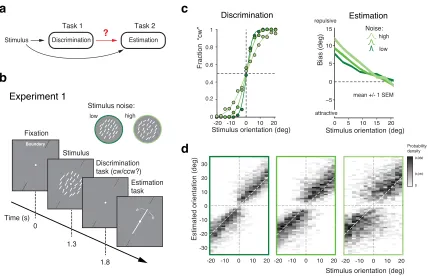
process is affected by a preceding, categorical decision task (Fig. 2.1a). In Experiment 1
subjects first indicated whether the overall orientation of an array of lines was clockwise
(cw) or counter-clockwise (ccw) relative to a discrimination boundary (discrimination task),
and then had to reproduce their perceived overall stimulus orientation by adjusting a
ref-erence line (estimation task). The experimental design was similar to that of a previous
experiment (Jazayeri and Movshon, 2007) (see also Zamboni et al. (2016)) with the notable
exceptions that we used an orientation rather than a motion stimulus, and that subjects
had to perform the estimation task in every trial rather than only in one third of the trials
(Fig. 2.1b). We found that subjects’ perceptual behavior was very similar to the findings of
these previous studies (Jazayeri and Movshon, 2007; Zamboni et al., 2016). Discrimination
performance monotonically depended on stimulus noise. Furthermore, reported stimulus
orientations showed clear repulsive biases away from the discrimination boundary with
larger biases for larger stimulus noise and orientations closer to the boundary (Fig. 2.1c).
This behavior is fully revealed in the overall distributions of subjects’ estimates for every
noise level (Fig. 2.1d; see Figure supplement 2.11 for individual subjects): The distributions
exhibit a characteristic bimodal shape for stimulus orientations close to the decision
bound-ary, with subjects’ estimates biased away from the decision boundary toward the side that
corresponds to their preceding discrimination judgment. Together with previous findings
(Jazayeri and Movshon, 2007; Zamboni et al., 2016), the results of Experiment 1 suggest
that the observed post-decision biases are independent of the specific type of stimulus used.
Also, they indicate that subjects’ anticipation of the frequency of the estimation task (every
trial vs. only in 1/3 of the trials) does not play a role in causing the biases.
1This is in line with the general idea by Lecky (1945) that an individual must remain a self-consistent
a
c
0
Experiment 1
b
Bias (deg)−5 0 5 10 15 0 0 5 10 -10 15 20 Noise: high low
d
Time (s)Fraction “cw”
Estimated orientation (deg)
0.2 0.4 0.6 0.8 1
0 10 20
20 10 -10 -20
-20 -20 -10 0 10 20 -20 -10 0 10 20
mean +/- 1 SEM
Stimulus orientation (deg) Stimulus orientation (deg)
repulsive
attractive
Stimulus orientation (deg) Fixation Boundary 0 50 Stimulus Stimulus noise: high low 1.3 Estimation task Discrimination task (cw/ccw?) 1.8 Discrimination Estimation Probability density 0.030 0.010 0 Stimulus Estimation
Task 1 Task 2
Discrimination ? -30 -20 -10 0 10 20 30
Figure 2.1: Post-decision biases in a perceptual task sequence. (a) Perceptual
decision-making in an estimation-discrimination task sequence: Does a discrimination judgment
causally affect a subject’s subsequent perceptual estimate? (b) Experiment 1: After being
presented with an orientation stimulus (array of lines), subjects first decided whether the overall array orientation was clockwise (cw) or counter-clockwise (ccw) of a discrimination boundary, and then had to estimate the actual orientation by adjusting a reference line with a joystick. Different stimulus noise levels were established by changing the orientation
variance in the array stimulus. (c) Psychometric functions and estimation biases (combined
subject). Estimation biases are only shown for correct trials and are combined across cw and ccw directions. Subjects show larger repulsive biases the noisier the stimulus and the
closer the stimulus orientation was to the boundary. (d) Distributions of estimates for the
2.3. Self-consistent Bayesian observer model
How are these post-decision biases explained? A Bayesian observer that regards the task
sequence as a two independent inference processes does not predict the biases. The observer
uses Bayesian statistics to determine the correct categorical judgment (e.g. ’cw’) based on
the stimulus response of a population of sensory neurons, and does the same to infer the
best possible estimate of the stimulus orientation (Fig. 2.2a). Consequently, this observer’s
discrimination judgment does not affect the estimation process; orientation estimates are
unimodally distributed around the true stimulus orientation and do not exhibit the
charac-teristic bimodal pattern that we have observed in Experiment 1 (Fig. 2.1d). In the context
of this paper, we refer to this model as the “independent” observer.
In contrast, we propose an observer model that regards the two tasks as causally
de-pendent (Fig. 2.2b); that is, by making the discrimination judgment the observer constrains
its subsequent estimation process to consider only those stimulus orientations that are
con-sistent with the judgment. It is as if the observer regards its own, subjective discrimination
judgment as an objective fact. Such behavior seems irrational (obviously, the judgment
could be incorrect) and furthermore leads to characteristic estimation biases away from the
discrimination boundary. It has the advantage, however, that the observer’s perceptual
in-ference process remains self-consistent throughout the entire task sequence at any moment
in time. We refer to this model as the “self-consistent” observer. It can be formulated
as a conditioned Bayesian model (Stocker and Simoncelli, 2007) that jointly accounts for
subjects’ behavior in both the discrimination and the estimation task. However, a closer
comparison between the predicted (Fig. 2.2b) and the measured distribution of the estimates
(Fig. 2.1d) reveals that this basic formulation does not capture all details accurately.
We formulated the self-consistent observer model as a two-step inference process over
the extended hierarchical generative model shown in Fig. 2.3a: Based on a noisy sensory
signalm, the observer first infers the category C (’cw’ or ’ccw’) by performing the
discrim-ination task and then infers the stimulus orientationθ in the estimation task. Because the
Model predictions Model predictions
Independent Bayesian observer a
Noise level
0 10 20 -10 -20 1 0 Fraction “cw” Discrimination judgement “cw”
Self-consistent Bayesian observer b
Noise level
0 10 20 -10
-20
Likelihoods low noise high noise ccw cw ccw cw Stimulus Sensory neurons 0 Orientation Bayesian Inference Conditional prior
Stimulus orientation (deg) Stimulus orientation (deg)
1 Fraction “cw” Bayesian Inference 0 20 -20 0 20
-20 -20 0 20
Estimated orientation (deg)
0 20
-20
Estimated orientation (deg)
Stimulus orientation (deg)
0 20
-20 -20 0 20
Stimulus orientation (deg) Orientation estimate
“cw” Bayesian
Inference BayesianInference Stimulus
Sensory neurons
0 Orientation
Discrimination
judgment Orientationestimate
Likelihoods low noise high noise Probability density 0.030 0.010 0
Discrimination Estimation Discrimination Estimation
cw Posteriors 0 Estimates Orientation Posteriors 0 Estimates Post-decision biases Orientation
Figure 2.2: Bayesian observer models for the perceptual task sequence. (a) The
discrim-ination judgment does not affect the estimated stimulus orientation for an observer who
considers both tasks independently. (b) In contrast, the self-consistent observer imposes a
causal dependency such that the judgment in the discrimination task (e.g. ’cw’) conditions
assume that estimation ofθmust rely on a noisy memory recallmm of the sensory signalm.
Inference onθis then conditioned on the preceding discrimination judgment (e.g. C = ’cw’),
which ultimately results in the characteristic repulsive estimation biases. Finally, we also
took into account that subjects’ report of their perceived stimulus orientation is corrupted
by motor noise. We measured motor noise for every subject in a control experiment (see
Figure supplement 2.12) and subsequently used these measured values for all model fits
and comparisons. The self-consistent observer model provides a full account of both the
observer’s discrimination judgment and orientation estimate in each trial and is thus jointly
predicting a subject’s psychometric function as well as the distribution of their orientation
estimates.
Figure 2.3b shows the model fit to the data from Experiment 1 for the combined
sub-ject. The stimulus noise level determines both the slope of the psychometric curves in the
discrimination task and the magnitude of the bias in the estimation task, which is well
predicted by the model. A comparison between the distributions of subjects’ estimates and
model estimates fully reveals the extent to which the model accurately accounts for the
observed human behavior (Fig. 2.3c; See Figure supplement 2.13 for a histogram
represen-tation). Note that all model predictions in this paper are the result of a joint fit to both the
measured psychometric functions of the discrimination task and the estimation distribution.
The self-consistent observer model can also account for the substantial individual
dif-ferences in behavior across subjects. While individual bias patterns are all repulsive, they
vary across subjects both in shape and magnitude (Fig. 2.4a). These variations are well
captured by the model and reflected in individual differences in the fit parameter values
such as the prior width and the level of sensory noise (Fig. 2.4b; see Figure supplement 2.14
for a goodness-of-fit analysis). Interestingly, all subjects seemed to substantially
overes-timate the width of the stimulus prior compared to the true stimulus distribution. This
did not come entirely as a surprise because subjects were never explicitly informed about
the stimulus range and thus had to learn it over the course of the experiment. Consistent
Fraction “cw” Noise: Model fit Data Bias (deg) −10 −5 0 5 10 15
0 5 10 15 20
Stimulus orientation (deg)
b
c
a
0 0.2 0.4 0.6 0.8 10 10 20 -10
-20 -10 0
Estimated orientation (deg)
Estimated orientation (deg)
20 10
-20 -20 -10 0 10 20-20 -10 0 10 20
Stimulus orientation (deg)
0 -10 10 20
-20 -20 -10 0 10 20-20 -10 0 10 20
Stimulus orientation (deg)
0.030 0.010 0 -30 -20 -10 0 10 20 30 -30 -20 -10 0 10 20 30 Sensory measurement Stimulus orientation Category Working memory recall conditioned on judgment Model Data Experiment 1 Probability density
+ Motor noise
Discrimination Estimation
Figure 2.3: The self-consistent Bayesian observer model. (a) Directed graph representing
the generative hierarchical model: Sensory measurement m is a noisy sample of stimulus
orientationθ. Everyθbelongs to one of two categoriesC ={’cw’,’ccw’}. Given an observed
m, the self-consistent model first performs inference overC (discrimination task), and then
infers the value of θ conditioned on the preceding discrimination judgment (e.g. Cˆ =’cw’)
(estimation task). Inference for the estimation task is assumed to be based on a noisy
memory recall mm of the sensory measurementm. Conditioning on the categorical choice
sets the posterior p(θ|mm,Cˆ) to zero for all values ofθ that do not agree with the choice.
This shifts the posterior probability mass away from the discrimination boundary and results in the repulsive post-decision biases for any loss function that more strongly penalizes large errors than small ones. Because subjects were instructed to provide estimates as accurate
as possible we assumed a loss function that minimizes mean squared error (L2 loss). (b) We
jointly fit the observer model to all discrimination-estimation data pairs of the combined
data across all subjects in Experiment 1 (combined subject). (c) The model not only
predicts the mean estimation bias (as shown in (b)) but also the entire distributions of
estimates, including those trials where discrimination judgments were incorrect. Data and
model show the characteristic bimodal pattern for orientation estimates. Each column
-5 0 5 10 15 10
0 5 15 20 0 5 10 15 20 0 5 10 15 20 0 5 10 15 20 0 5 10 15 20
Stimulus orientation (deg)
Bias (deg) -5 0 5 10 15 Bias (deg) 10
0 5 15 20 0 5 10 15 20 0 5 10 15 20 0 5 10 15 20 0 5 10 15 20
Noise
mean +/- 1 SEM
Noise (fit)
a b
S1 S2 S3 S4 S5
Experiment 1 Data
Model
Noise level SD (deg)
Prior width (deg)
0 10 20 30 40
S1 S2 S3 S4 S5 Sc
S1 S2 S3 S4 S5 Sc
Subjects Memory Sensory 0 4 8 12 16
Figure 2.4: Experiment 1: Data and model fits for individual subjects.(a) Individual subjects
(S1 non-na¨ıve) showed substantial variations in their bias patterns (green curves). These variations are well explained by individual differences in the fit parameter values of the self-consistent model (blue curves). For example, the width of the prior directly determines the
location where the bias curves intersect with the x-axis. (b) Fit prior widths wp and noise
levels for the five individual subjects plus the combined subject (Sc). Subjects’ prior widths
suggest that they consistently overestimated the actual stimulus range in the experiment (±
21 degrees; arrow). For all subjects, fit sensory noiseσs was comparable and monotonically
dependent on the actual stimulus noise. Memory noiseσmwas mostly small as expected, yet
prior distribution was the only non-na¨ıve subject S1 who had plenty of extra exposure to
the stimulus range through the participation in various pilot experiments. Extracted noise
levels differ across subjects with the worst subject being approximately twice as noisy as the
best (non-na¨ıve subject S1), yet consistently increase for increasing stimulus noise levels.
2.4. Validating self-consistent Bayesian observer model
2.4.1. Key features of the model
We ran two additional experiments that were designed to specifically probe two key features
of the self-consistent model: Experiment 2 was aimed at testing how subject’s orientation
estimates were dependent on their precise knowledge of the stimulus prior and thus were
consistent with the results of Bayesian inference; Experiment 3 examined whether subjects
indeed treated their discrimination judgments as if they were correct. We recruited a new
set of subjects (S6-S9, plus S1) that performed both experiments. By jointly fitting the
data from both experiment, we also tested how well the model can generalize across tasks2.
Experiment 2 was identical to Experiment 1 except that at the beginning of each trial,
subjects were explicitly reminded of the total range within which the stimulus orientation
would occur in the trial (Fig. 2.5a). Our assumption was that an explicit display of the
stimulus range provided subjects with a better and presumably narrower representation
of the stimulus distribution (given that subjects seemed to substantially overestimate the
prior in Experiment 1). If so, then the self-consistent observer model would predict a
shift of the bias curves’ crossover point towards the discrimination boundary. As shown
in Figs. 2.5b, the measured bias curves indeed show the predicted shift compared to the
bias curves measured in Experiment 1 (Fig. 2.3b). This shift is also clearly visible in the
distributions of the orientation estimates (see Figure supplement 2.15 for distributions of
individual subjects), which is again accurately accounted for by the model (Fig. 2.5c).
In Experiment 3, we separated the discrimination judgment from the discrimination
task. Subjects were no longer asked to perform the orientation discrimination task but
2
b
c
a
Experiment 20 5 10 15 20
Stimulus orientation (deg) Stimulus orientation (deg) Estimation task Discrimination task (cw/ccw?) Prior cue Model Model Time (s) 0 0.8 1.3 1.8 420 Data Data
0 5 10 15 20 mean +/- 1 SEM
−10 −5 0 5 10
15 Noise Noise (fit)
−10 −5 0 5 10 15 Bias (deg) 0 -10
Estimated orientation (deg)
20 10
-20 -20 -10 0 10 20 -20 -10 0 10 20
Stimulus orientation (deg)
0 -10 10 20
-20 -20 -10 0 10 20 -20 -10 0 10 20 0.030 0.010 0 -30 -20 -10 0 10 20 30
Estimated orientation (deg)
-30 -20 -10 0 10 20 30 Probability density
Figure 2.5: Effect of the stimulus prior. (a) Experiment 2 was identical to Experiment 1
except that at the beginning of each trial, subjects were shown the total range within which
the stimulus orientation would occur in the trial (gray arc, subtending ± 21 degrees). (b)
We hypothesize that reminding subjects of the exact stimulus range at the beginning of each trial helps them to form a more accurate (and more narrow) representation of their stimulus prior. If subjects’ orientation estimates were indeed the result of the conditioned Bayesian inference as assumed by the self-consistent observer model, then the bias curves should shift towards the discrimination boundary. The data support this prediction: Subjects’ bias curves (combined subject, see Fig. 2.7 for individual subjects) are shifted towards the
discrimination boundary compared to Exp. 1. (c) As with Exp.1, the fit self-consistent
Given correct answer (”cw”)
a
b
c
−10 −5 0 5 10 150 5 10 15 20 0 5 10 15 20
Experiment 3
Stimulus orientation (deg)
Color discrimination task (red/green?) Time (s) 0 0.5 0.8 1.3 1.8 Noise Estimation task Model Data Noise (fit) −10 −5 0 5 10 15 Bias (deg) 0
-10 10 20
-20 -20 -10 0 10 20-20 -10 0 10 20
0
-10 10 20
-20 -20 -10 0 10 20-20 -10 0 10 20
Stimulus orientation (deg)
Model
Data
Estimated orientation (deg)
Stimulus orientation (deg)
0.030 0.010 0 -30 -20 -10 0 10 20 30
Estimated orientation (deg)
-30 -20 -10 0 10 20 30 Probability density
Figure 2.6: Self-made vs. given category assignment.(a) Experiment 3: Instead of
perform-ing the discrimination judgment themselves, subjects were provided with a cue indicatperform-ing the correct category assignment right before the stimulus was presented. Then, after stimu-lus presentation, subjects first performed an unrelated color discrimination task in place of the orientation discrimination task (they needed to remember the randomly assigned color (red/green) of the cue indicating the correct category) before indicating their perceived
stimulus orientation. (b) According to our model we should see similar estimation biases
in Exp. 2 and 3, which is indeed what we found: because the data are from the same
subjects we can directly compare the bias curves with the results from Exp. 2. (c) Again,
the fit model well accounts for the overall distribution of orientation estimates (combined subject; see Figure supplement 2.16 for distributions for individual subjects)). Because the discrimination judgment was given and always correct independent of the noise in the
sensory measurementm, estimates only occurred in the “correct” quadrants. For the same
instead were signaled right at the beginning of each trial whether the stimulus orientation
would be cw or ccw (Fig. 2.6a). Subjects were instructed that this categorical information
was always correct, which it was. They then performed an unrelated color discrimination
task before finally performing the estimation task. The self-consistent model predicts
es-timation biases that are basically identical to those of Experiment 2 because it assumes
that subjects treat their own judgment as correct when performing the estimation task.
Indeed, as shown in Fig. 2.6b, subjects’ estimation biases are very similar to the biases in
Experiment 2 (Fig. 2.5b). Because both Experiment 2 and 3 were conducted on the same
set of subjects, the results are directly comparable. We can rule out that subjects may
have ignored the given category assignment in Experiment 3 and implicitly performed the
orientation discrimination task instead. If this were the case, then subjects would have
ex-hibited a large fraction of inconsistent trials (i.e. trials in which the estimated orientation
was not in agreement with the given correct answer) in particular for orientations close to
the discrimination boundary. This was not the case as we observed only small fractions
of inconsistent trials (4% on average) that were of similar magnitude as the error rates for
the (irrelevant) color discrimination task (2%). We discuss these inconsistent trials in more
detail in the next section below.
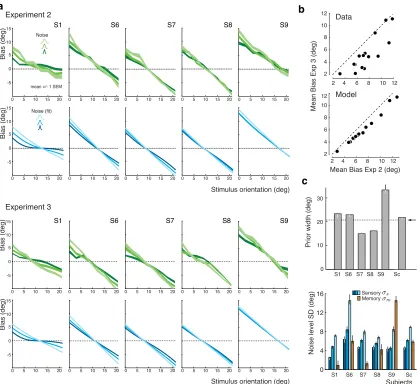
We again extended our analysis to individual subjects’ behavior. Figure 2.7a shows
subjects’ estimation biases in both experiments as well as the corresponding model
predic-tions based on a joint fit to data from both Experiment 2 and 3. Bias patterns, while quite
variable across subjects, are consistent across the two experiments for each subject. This
confirms that the impact of the categorical discrimination judgment on the perceived
orien-tation does not depend on whether the judgment was performed by the subjects themselves
or not. The model captures both the inter-subject as well as the within-subject variability
across the two experiments. Biases are slightly smaller in Experiment 3 compared to
Exper-iment 2 for stimulus orientations close to the boundary. As shown in Fig. 2.7b, the model
correctly predicts this difference because the self-made discrimination judgments in
S1 S6 S7 S8 S9
S1 S6 S7 S8 S9
a b
c mean +/- 1 SEM
Experiment 2 Experiment 3 -5 0 5 10 15 10
0 5 15 20 0 5 10 15 20 0 5 10 15 20 0 5 10 15 20 0 5 10 15 20
10
0 5 15 20 0 5 10 15 20 0 5 10 15 20 0 5 10 15 20 0 5 10 15 20
10
0 5 15 20 0 5 10 15 20 0 5 10 15 20 0 5 10 15 20 0 5 10 15 20
10
0 5 15 20 0 5 10 15 20 0 5 10 15 20 0 5 10 15 20 0 5 10 15 20
Bias (deg) -5 0 5 10 15 Bias (deg) -5 0 5 10 15 Bias (deg) -5 0 5 10 15 Bias (deg)
Stimulus orientation (deg)
Stimulus orientation (deg)
Prior width (deg)
0 10 20 30
S1 S6 S7 S8 S9 Sc
Subjects
Data
Model
Noise level SD (deg)
Mean Bias Exp 3 (deg)
Mean Bias Exp 2 (deg)
Memory Sensory
S1 S6 S7 S8 S9 Sc
Noise Noise (fit) 2 4 6 8 10 12 2 4 6 8 10 12
2 4 6 8 10 12
2 4 6 8 10 12
0 4 8 12 16
Figure 2.7: Experiments 2 and 3: Joint fit to data for individual subjects.(a) Five subjects
(S1, S6-9) participated both in Exp. 2 and 3. We performed a joint model fit to the data from both experiments for every subject. Each column shows data (green curves) and model fit (blue curves) for a particular subject. As in Exp. 1, the bias pattern across subjects
shows substantial variability yet is strikingly similar between the two experiments. (b)
Comparing the mean biases observed in Exps. 2 and 3 reveals that biases in Exp. 3 are slightly smaller for stimulus orientations close to the boundary. This effect is predicted by
the model. (c) Prior widthswp and noise levels from the joint fit for individual subjects and