438 | P a g e
EXTRU-INJECTION PLASTIC MOULDING
MACHINE
Mr. D. S. Wagh
1, Mr. P.V. Dongre
2, Mr. S.S. Jadhav
3,
Ms. A.K. Patil
4, Mr.M.A.Deore
51,2,3
Diploma in ME, Guru Gobind Singh Polytechnic, Nashik, Maharashtra, (India)
2
Lecturer in Mechanical Engineering Department,
Guru Gobind Singh Polytechnic, Nashik, Maharashtra, (India)
ABSTRACT
Extru-Injection plastic molding machine is the combination of two different plastic molding processes i.e.
Extrusion molding (Horizontal Single Screw) & Injection molding (Vertical Hand Operated). This machine
includes the advantages of both Extrusion & Injection Process. This machine is designed to overcome the
restrictions occurs in Injection & Extrusion of plastic. It is the simple plastic molding machine which is use at
primary level of production i.e. Home purpose. According to present conditions machines are not suitable for
primary use, for the reason that are containing high investment cost as well as adaptation cost (Cost
requirement for new Mould designing & machining or manufacturing).This Machine is able to work at two
different situation or processes (parallel / serial) that is ,it can make extrusion products & injection products at
the same time as well as combine products of extrusion & injection, which will economical affordable for
primary production.
Keywords: Extrusion (Horizontal Single Screw), Injection (Vertical Hand Operated),Plastic
Moulding, Primary production
I INTRODUCTION
For producing parts by injecting material into a mold, Injection molding process is used. Injection molding can
be performed with a host of materials, including metals, (also called as die-casting), elastomers, glasses,
confections, and most commonlythermosetting andthermoplastic polymers. Substantial for the part is fed into a
heated barrel, mixed, and forced into a mould cavity, where it cools and hardens to the shape of the cavity.
1.1 Injection Molding
Injection moldingmaybe the most common and important of all plastic processing processes. The process is
439 | P a g e
with metal inserts can be produced. While injection molding dies are expensive to produce, each die can be usedto make thousands of components at very rapid rate, so that per-part cost is very low. The simplest form of
injection molding is shown in the schematic below.
Figure 1. A simple reciprocating screw injection molding machine
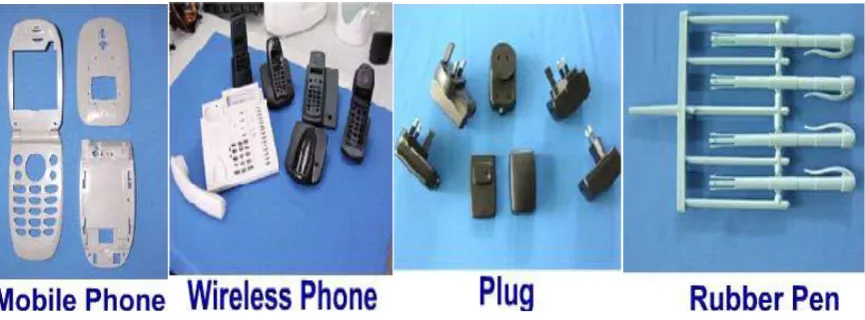
Figure 2. Examples of Injection Molding Parts
1.2 Extrusion
Extrusion can be used for thermoplastics. The raw material can be used in the form of mattress (~10mm sized
pieces), granules (~5 mm), or powder. Extrusion machines are used to make long pieces of constant
cross-section. The cross-section geometry is available in complex shapes, may be solid or hollow. Usually, extruded
parts are used as raw stock for use in manufacture of other products (e.g. channels on the sides of windows, etc.
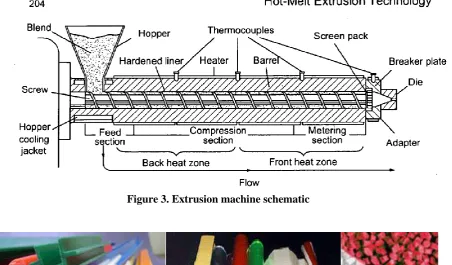
Plastic extruded parts are used in many fittings). Figure 3 shows a typical extrusion machine. Figure 4 shows
440 | P a g e
Figure 3. Extrusion machine schematic
Figure 4. Parts made by extrusion
II LITERATURE REVIEW
2.1 Markus Gottfried Battisti
[1]– Walter Friesenbichler
[1]explained that,
The preparation of PP polymer nanocomposites hasbeen carried out with an intermeshing, co-rotatingtwin-screw
extruder of the PNC-IMC in order to improve Young’s modulus and thermal conductivity;11 or 13 barrel
segments were used for thecompounding process, and the PNC-IMC was used for processing of injected parts in
a single heat, singleplasticizing process.
2.2 Shi W. Lee1, SeokyoungAhn
[2]More recently, there hasbeen a consistent increase in customer demands whichrequires materials with better
engineering propertiesincluding electrical, mechanical, magnetic and thermalcapabilities while enjoyingmany
benefits of injectionmolding technology. These trends have enabled the developmentof better injection molding
machines with higherforces, pressures, high operating temperatures and precisioncontrols. Finally, the
441 | P a g e
technology known as powderinjection molding (PIM) to emerge to be applicable tometal and ceramic powders.Taguchi method has been effectivelyapplied to a study of understanding the differences andsimilarities among
plastic injection molding, MIM andCIM. The PIM with metals and powders is more sensitiveto the filling time,
the shear-rate, the temperature controls,thermal diffusivity and switch-over than plastic injectionmolding.
2.3 Nik MizamzulMehat
[3]and ShahrulKamaruddin
[3]To predict and overcome problemsin selecting the appropriate processing parameters, theTaguchi optimization
method integrated for conducting simulationexperiments in the preliminary stage that can support
plasticmanufacturers. In PIM,incoherent processing parameters during the manufacturingprocess can either lead
tothe degradation of accuracy, shape, and surface finish of the final parts, as well as other part characteristics
related to mechanical properties or significant improvement of the injection-molded plastic parts. In the
preliminary stage, utilization of simulation packagescan facilitate the selection of the appropriate materials
andimprove part and mold design. Hence, before the real process manufacturing takes place the performanceof
the plastic part can be predicted. Integrated simulationpackages using the Taguchi method reduces acrimonious
conditions during optimization and reduces the numberof replications in conducting the experiment.
2.4 Jennifer Bakerstated
[4]that
Current moldingmethods require time for tempering and cooling of the chocolate product, whereas it has
beenproved that the shear pressures within the barrel of the single-screw machine are enough toeliminate the
need for tempering and allow for lower melt temperatures. With this, the data alsoproves that the cool time is
decreased, as the injection-molded samples required less than 120seconds to solidify. In addition to an improved
production process, the consistency of a screwand barrel machine would allow for regulation of the crystal
formation of the chocolate in theearly stages of molding, thus ensuring that physical properties such as fat
bloom developmentwould be avoided in the final product. In conclusion, the proven benefits of injection
moldingchocolate should be considered for the future of the confectionary industry.
2.5 J. Vlachopoulos
[5]and D. Strutt
[5]explained in the paper
After a brief introduction to the various types of polymers in size and use and its impact of the polymer
processingindustry, an overview focuses on the specific processes forthermoplastic materials, namely extrusion
andinjection moulding. Single and twin screwextruders are used for melting and pumping of polymers and for
dieextrusion for the production of lm, sheet, pipe, tubing, pro. les and . bres. Injection molding process is used
forthe production of numerous parts either small or large, by injecting a molten polymer into mould cavities.
Variousproblems associated with these processes are discussed. Other processes described include:
compressionmoulding, rotational moulding, powder injection moulding and thixomoulding. The overview
442 | P a g e
III CONCLUSION AND FUTURE SCOPE
Plastics extrusion is one of the high-volume manufacturing process in which raw material like plastic is melted
and formed into acontinuous profile. Extrusion produces items such as pipe/tubing, weather stripping, fencing,
deck railings, window frames, plastic films and sheeting, thermoplastic coatings, and wire insulation. In Plastics
extrusion raw plastic is melted so as to form a continuous profile. Extrusion produces items such as pipe/tubing,
weather stripping, fencing, deck railings, window frames, plastic films and sheeting, thermoplastic coatings, and
wire insulation. While Injection molding is a manufacturing process for producing parts by injecting material
into a mold. Injection molding is used to create many things such asbottle caps, wire spools,
packaging,automotive parts and components, Gameboys, pocket combs, some musical instruments (and parts of
them), one-piece chairs and small tables, storage containers, mechanical parts (including gears), and most other
plastic products available today. Injection molding is the most common modern method of manufacturing
plastic parts; it is ideal for producing high volumes of the same object. Injection molding is widely used for
manufacturing a variety of parts, from the smallest components to entire body panels of cars.
So we are working with a model of extru-injection molding machine. In extru-injection molding machine we are
working on combine process of extrusion and injection with minimum cost of investment. Untrained worker,
less initial and running cost, easily available scrap, simultaneous operation of injection molding and extrusion,
less process time, etc. are some advantages of the project.
REFERENCES
[1] Markus Gottfried Battisti* – Walter Friesenbichler, “Injection-Moulding Compounding of PP Polymer Nanocomposites”, Journal of Mechanical Engineering 59(2013)11, 662-668
[2] Shi W. Lee1, SeokyoungAhn, “Effects of process parameters in plastic, metal, and ceramic injection
molding processes”, Korea-Australia Rheology Journal Vol. 23, No. 3, September 2011 pp. 127-138
DOI: 10.1007/s13367-011-0016-4
[3] Nik MizamzulMehat&ShahrulKamaruddin (2011) Investigating the Effects of Injection Molding Parameters on the Mechanical Properties of Recycled Plastic Parts Using the Taguchi Method,
Materials and Manufacturing Processes, 26:2, 202-209, DOI: 10.1080/10426914.2010.529587
[4] Jennifer Baker “THE APPLICATION OF SINGLE-SCREW PLASTIC MOLDING TECHNIQUE IN
CHOCOLATE PRODUCTION
[5] Dr Vlachopoulos ([email protected]) is at the Centre for Advanced Polymer Processing and Design (CAPPA-D), Department of Chemical Engineering, McMaster University, Hamilton ON L8S
4L7, Canada and DrStrutt is with Polydynamics, Inc., 1685 Main St. W., Suite 305, Hamilton, ON L8S
1G5, Canada. Manuscript received 8 November 2002; accepted 10 January 2003.
[6] Tim Spieringa,n, StephanKohlitz, “Energy efficiency benchmarking for injection moulding processes”, 2015 Elsevier
[7] López, J. Aisa, A. Martinez, D. Mercado, “Injection moulding parameters influence on weight quality