INTERNATIONAL RESEARCH JOURNAL OF PHARMACY
www.irjponline.com
ISSN 2230
–
8407
Research Article
EVALUATION OF PHYTOCHEMICAL AND ANTI-MITOTIC POTENTIAL OF POLY-HERBAL
EXTRACT BY USING ONION ROOT MODEL
Anntoniya Rintelen *, Kelvin Bucktowar, Ranajit DT
Department of Pharmacognosy, T. John College of Pharmacy, Gottigere, Bannerghatta Road, Bangalore, Karnataka,
India
*Corresponding Author Email: [email protected]
Article Received on: 27/02/17 Approved for publication: 15/04/17
DOI: 10.7897/2230-8407.080447
ABSTRACT
Cancer is one of the main causes of mortality around the globe. Majority of the plants are believed to have anticancer properties. The present review was done to assess the antitumor action of various plants in combination, which was an attempt to prove the poly-herbal combination for in-vitro anticancer property. In present study, different plant extracts such as Withania somnifera, Asparagus gonoclados, Azadirachta indica and Streblus asper were used to prepare the combined extract which helps to determine cytotoxicity.
Anti-mitotic assay by onion root tip method was selected due to comprehensive results. Phytochemical investigation was carried out by standard procedures for investigation of phytoconstituents. Significant reduction in mitotic index was observed in Poly-herbal extract in high concentration in comparison to standard Vincristine as well as in comparison to individual plant extract with P value < 0.01.
Keywords: Cancer, Anti-Mitotic, Poly-Herbal, Vincristine, Anticancer
INTRODUCTION
Cancer is one of the most lethal diseases in human populace. Both synthetic and natural sources are used either alone or in combination for the prevention of cancer. Natural sources of plants are being flavored nowadays to fight against cancer compared to the use of allopathic drugs. The plants showing different chemical moiety such as flavonoids, terpenoids and steroids have pharmacological properties like antiulcer, antihyperlipidemic, antioxidant and antimitotic activity.
In Ayurveda, the drug formulation is based on two principles: Firstly, the usage as a single drug and usage of more than one drugs. The latter is known as PHF (Poly-herbal formulation). This key traditional therapeutic herbal strategy exploits the combination of several medicinal herbs to achieve an additional therapeutic effectiveness usually known as polypharmacy or polyherbalism1.
Withania somnifera is a plant belonging to the family Solanaceae. The latter is referred as the Nightshade family. It is commonly known as winter cherry, poison gooseberry, ashwagandha, Indian ginseng. It mainly contains withaferin A which is mainly used in the therapy for glioblastomas2. The
plant's long, brown, tuberous roots are used in traditional medicine3. In traditional medicine, the berries and leaves are
applied externally to tumours, tubercular glands, carbuncles and ulcers. The roots are used to prepare the herbal remedy ashwagandha4.
Azadirachta indica is commonly known as Neem, Indian Lilac and Nim tree. It consists of the dried whole plant of Azadirachta indica belonging to the family Meliaceae. It is a fast-growing tropical evergreen tree with a highly branched and stout and
solid stem. Due to its tremendous therapeutic, agricultural, ethnomedicinal significance and its proximity with human culture and civilization, neem is called as ‘the wonder tree’ and ‘nature's drug store’5. All parts of this tree, that is the leaves,
bark, seed-oil and their purified products are widely used for treatment of cancer6. There are over 60 different types of
biochemical including terpenoids and steroids have been purified from this plant7. Pre-clinical research work performed
during the last 10 years has fine-tuned our understanding of the anticancer properties of the crude and purified products from this plant. The anticancer properties of the neem plant have been studied widely in terms of its preventive, protective, tumour-suppressive, immunomodulatory and apoptosis effects against various types of cancer and their molecular mechanisms8.
Streblus asper is a tree known as the toothbrush tree, Siamese rough bush, khoi and serut. belonging to the family Streblus asper Lour. It is a small tree found in tropical countries such as India, Sri Lanka, Malaysia, Philippines and Thailand. Several parts of this plant have been used in Ayurveda and other folk medicines for the treatment of different ailments such as filariasis, leprosy, toothache, diarrhea, dysentery and cancer9,10,11,12.
Asparagus gonoclados is a medicinal plant commonly known as Shatavari belonging to the family Liliaceae13. Root tubers of
shatavari possesses adaptogenic, antioxidant, cooling, emollient, diuretic, galactagogue, nervine tonic, rejuvenating and stomachic properties. They are useful in the treatment of epilepsy, fatigue, inflammation, tuberculosis, tumours. They possess anti-cancer properties as well14.
the present study is an attempt to screen Poly-herbal combination for in vitro anti cancer activity by using the different drugs such as Withania somniferum, Asparagus gonoclodos, Azardirachta indica and Strebulus asper extracts were used in the ratio 1:1
MATERIALS AND METHODS15, 16, 17
The powders were obtained in Dept. of Pharmacognosy, T. John College of Pharmacy.
Reagents and chemicals
Ethanol, 45% Acetic acid, HCl (1N), aceto-carmine, of Hexane, Chloroform, Dichloromethane, Ethyl acetate, n-Butanol, Methanol, Chloroform and water
Evaluation of the powders
Withania somnifera
The following tests were performed to confirm the identity of the powder of Withania somnifera:
Table 1: Test analysis of Withania somnifera
S. N Phytochemical Test Result
1 Test for starch Iodine test Present
2 Test for Steroids Salkowski test Present
Liebermann-Burchard test Present
3 Test for Flavonoids Shinoda test Present
Lead acetate test Present
Alkaline reagent test/NaOH test Present
4 Test for Alkaloids Hager’s test Present
Wagner’s test Present
Mayer’s test Present
Dragendorff’s reagent Present
5 Test for Tannins Gelatin test Present
Ferric chloride test Present
6 Test for Saponins Foam test Absent
Froth test Absent
7 Test for carbohydrates Molisch’s test Present
Benedicts test Present
Fehlings test Present
8 Test for Phenolics Lead acetate test Present
9 Test for Glycosides Foam test Absent
The results revealed presence of starch, steroids, flavonoids, alkaloids, tannins, carbohydrates, phenols and the absence of saponins and glycosides.
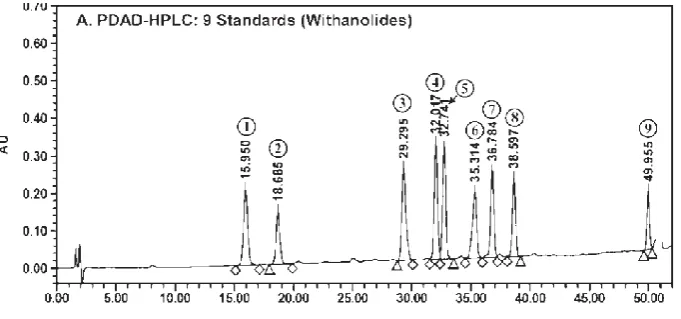
HPLC analysis was performed by reversed phase column subjected to binary gradient elution. The two solvents used for the analysis consisted of water containing 0.1% acetic acid (solvent A) and methanol containing 0.1% acetic acid (solvent B). Gradient programming of the solvent system was carried out at 27°C and was: initially at 60% A, changed to 40% A at 30.0 min, maintained for the next 2.0 min, changed to 25% A at 45 min, and then to 5% A at 54.0 min at a flow-rate of 0.6 ml/min and then at a flow rate of 1.0 ml/min the mobile phase was changed to 0% A at 55 min and this solvent composition was
maintained until the run time reached 60 min. The chromatograms were recorded at 227 nm.
The test set of withanolides consisted of
• 27-hydroxy withanone (1),
• 17-hydroxy withaferin A (2),
• 17-hydroxy-27-deoxy withaferin A (3),
• withaferin A (4),
• withanolide D (5),
• 27-hydroxy withanolide B (6),
• withanolide A (7), • withanone (8),
• 27-deoxywithaferin A (9)
Asparagus gonoclados
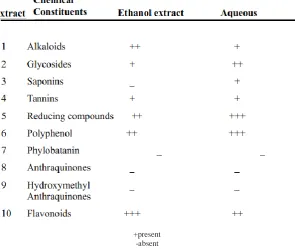
The hydro-alcoholic and aqueous extracts of Asparagus racemosus were subjected to qualitative phytochemical screening for the detection of phytoconstituents like
carbohydrates, glycosides, alkaloids, proteins, amino acids, tannins, phenolics, saponins, flavonoids, triterpenoids, steroids, fixed oils, gums and mucilages. The results (Table 2) revealed the presence of saponins, carbohydrates, glycosides and mucilages which confirms the identity of Asparagusgonoclados
Table 2: Qualitative Phytochemical analysis of Asparagus racemosus root extracts
Azardiracta indica
The analysis of Azardiractaindica was performed with different tests as follows:
Table 3: Phytochemical Screening of leaves of Azadirachta indica
+present -absent
The result obtained in Table 3 confirmed the identity of Azadirachta indica.
Streblus asper
Histochemical tests of root bark of Streblusasper (Table 4) and Ultraviolet tests analysis of root bark powder of Streblus asper
Table 4: Histochemical tests of root bark of Streblus asper
Table 5: Ultraviolet tests analysis of root bark powder of Streblus asper
The results confirm the identity of Streblusasper powder.
Preparation of extracts18
Dry powder (1:1) was used for carrying out successive Soxhlet extraction with 2 liters each of n-Hexane, Chloroform, Dichloromethane, Ethyl acetate, n-Butanol, Methanol, Chloroform and water for 72h at room temperature by maceration. Each time after completion of cycle the extract was removed and powder was dried at 450C for 24h. All the extracts
were filtered and filtrates were evaporated using Hot air oven.
Phytochemical screening
The extracts obtained were subjected for phytochemical screening using standard procedure. The dried extracts (few mg) were dissolved in sufficient amount of respective solvents and tested for various constituents. The Anti-mitotic activity was screened by Onion Root Inhibition assay.
Antimitotic assay19
Onions were left in water for 2 days. Germinated root tips were excised and incubated at 3 hours in the presence of test and control solutions.
Root tips were macerated and placed in ethanol and 45% Acetic acid (3:1) for 12 Hours. Root tips were hydrolysed with HCl (1N) for 15 min at 600C. Root tips were taken in a slide and a
drop of aceto-carmine stain was added and gently heated. Red discoloured roots were observed under 100x for different stages of cell division. Approximately 100 cells were counted per slide. Average mitotic index of 3 root tips for each extract were determined and repeated thrice.
Percentage inhibition in mitotic index was calculated by using the formula:
% Mitotic Index =
(Total No. of dividing cells / Total Number of cells examined) × 100 20
RESULTS AND DISCUSSION
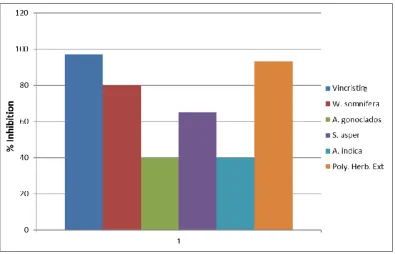
Onion Root tip method is an effective method for evaluation of the different plant extracts for in vitro anticancer activity. In present study attempt was made to compare the cytotoxicity of the Poly-herbal extract with standard vincristine and individual extracts by using Onion Root tip cells. In this study the Poly-herbal extract of Withaniasomnifera, root tubers of Asparagus gonocladus, leaves of Azardirachta indica and root barks of
Strebulusasper were prepared.
Table 6: Percentage inhibition of Mitotic index by different drugs and poly herbal extract
Drug name Concentration (µg/ ml) Mitotic Index % Inhibition
Control - 100 -
Vincristine 50 3 97
100 0 100
Withania somnifera 50 20 80
100 10 90
Asparagus gonocladus 50 60 40
100 50 50
Strebulus asper 50 35 65
100 25 75
Azardirachta indica 50 60 40
100 40 60
Poly-herbal extract (1:1) 50 7 93
100 4 96
Figure 2: Percentage inhibition in Mitotic index by Poly herbal extract in comparison to other plants and standard in High concentration
CONCLUSION
Poly-herbal Formulations has set up an example since ages by using the Ayurvedic concept, The various diseases that has been treated by Poly-herbal Formulations provide a holistic approach. The study of different phytoconstituents and discovery of useful medicinal herbs combinations has proved that Poly-herbal Formulations can work in a synergistic way to produce desirable effect. Today, the "renaissance" of Ayurvedic Poly-herbal Formulations has conquered the world over, owing to its comparable efficacy, fewer side effects and better acceptability than allopathic drugs.
Present study proved the synergistic effect of Poly-herbal extract against cell division of Onion Root tips which may be an alternative option to evaluate the Poly-herbal formulation for cancer therapy by using wide flora of the nature.
Ayurvedic Poly-herbal Formulations can exert the best effect in human health.
REFERENCES
1. Subramani Parasuraman, Gan Siaw Thing and SAD.
Polyherbal formulation Concept of ayurveda.
Pharmacognosy Review. 2014;8(16):73–80.
2. Kulkarni SK, Dhir A. Withania somnifera: An Indian ginseng. Vol. 32, Progress in Neuro-Psychopharmacology and Biological Psychiatry. 2008: 1093–105.
3. Archana R, Namasivayam A. Antistressor effect of Withania somnifera. J Ethnopharmacol. 1998;64(1):91–3.
4. Misra L, Mishra P, Pandey A, Sangwan RS, Sangwan NS, Tuli R. Withanolides from Withania somnifera roots. Phytochemistry. 2008;69(4):1000–4.
5. Kumar VS, Navaratnam V. Neem (Azadirachta indica): Prehistory to contemporary medicinal uses to humankind. Asian Pacific Journal Tropical Biomedical. 2013;3(7):505– 14.
6. Ragasa CY, Nacpil ZD, Natividad GM, Tada M, Coll JC, Rideout JA. Tetranortriterpenoids from Azadirachta indica. Phytochemistry. 1997;46(3):555–8.
7. Pankaj S, Lokeshwar T, Mukesh B, Vishnu B. Review on Neem ( Azadirachta Indica ): Thousand Problems One Solution. Int Res J Pharm. 2011;2(12):97–102.
8. Raji Y, Ogunwande IA, Osadebe CA, John G. Effects of Azadirachta indica extract on gastric ulceration and acid secretion in rats. J Ethnopharmacol. 2004;90(1):167–70. 9. Rastogi S, Kulshreshtha DK, Rawat AKS. Streblus asper
Lour. (Shakhotaka): A review of its chemical,
pharmacological and ethnomedicinal properties. Vol. 3, Evidence-based Complementary and Alternative Medicine. 2006: 217–22.
10.Ibrahim NM, Mat I, Lim V, Ahmad R. Antioxidant Activity and Phenolic Content of Streblus asper Leaves from Various Drying Methods. Antioxidants. 2013;2:156–66.
11.Prakash K, Deepak D, Khare A, Khare MP. A pregnane
glycoside from Streblus asper. Phytochemistry.
1992;31(3):1056–7.
12.Vanhaelen M, Fontaine J, De Graef C, Heenen M. Antimicrobial activity of Streblus asper leaf extract. Phyther Res. 2001;15(2):119–21.
13.Sun T, Tang J, Powers JR. Antioxidant activity and quality of asparagus affected by microwave-circulated water combination and conventional sterilization. Food Chem. 2007;100(2):813–9.
14.Laney C, Morris EK, Bernstein DM, Wakefield BM, Loftus EF. Asparagus, a Love Story. Exp Psychol. 2008;55(5):291– 300.
15.Mitosis RT. Mitosis in Onion Root Tip Cells. :1–6. 16.Maity P, Bepari M, Choudhury SM. Evaluation of
Antimitogenic and Cytotoxic Potential of
Anacardiumoccidentale Leaf Extracts in Allumcepa Root Tip Cells and Against Sarcoma-. 2015;4(4):2013–6. 17.Bengal W. Evaluation of Antimitotic and Genotoxic Effects
of the Triterpenoid Enriched Extract from Trichosanthes dioica Root Department of Pharmaceutical Technology , Jadavpur University ,. 2012;4(December 2009):20–3. 18.S. S. Mahamuni, S. G. Killedar, H. N. More, A.B. Nale AAP
and SVC. Evaluation of Phytochemical and Antimitotic Potential of Lagenaria Siceraria Fruit Using Onion Root Model. Ijpsr. 2012;3(8):2857–61.
19.Murthy GS, Francis TP, Singh CR, Nagendra HG, Naik C. An assay for screening anti-mitotic activity of herbal extracts. Curr Sci. 2011;100(9):1399–404.
20.Raj GG, Varghese HS, Kotagiri S, Vrushabendra Swamy BM, Swamy A, Pathan RK. Anticancer Studies of Aqueous Extract of Roots and Leaves of Pandanus Odoratissimus f. ferreus (Y. Kimura) Hatus: An In Vitro Approach. J Tradit Complement Med. 2014;4(4):279–84.
Cite this article as:
Anntoniya Rintelen. Evaluation of phytochemical and anti-mitotic potential of poly-herbal extract by using onion root model. Int. Res. J. Pharm. 2017;8(4):44-49 http://dx.doi.org/ 10.7897/2230-8407.080447
Source of support: Nil, Conflict of interest: None Declared