Review Article
PRIMARY TOOTH ERUPTION -
S. Asha
Research Officer (Ay), Dr. A. Lakshmipathi Research Centre for Ayurveda, Chennai, Tamil Nadu, India
Email: [email protected]
ABSTRACT
Teething is the process by which an infant's first teeth, the
gums, typically arriving in pairs1. It is an important landmark in assessing the growth and development of a child. Though there have been many references regarding dental care and dental disorders in
which is poorly dealt with. Kashyapasamhitha rate chapter – Danthajanmikam adhyayam
tooth eruption, factors influencing tooth eruption, variations and disorders of eruption, period of tooth eruption and its e fects etc. Vagbhata has dealt mainly the complications arising during dentition and how to mitigate them safely and effe tively. An attempt has been made to combi
text books and to re-interpret them in the light of modern scientific studies and knowledge.
Keywords: Ayurveda,Paediatric,Dantajanma
INTRODUCTION
Ayurveda has included dentistry in Salakya tantra among the Ashtangas. Oral care has been given much importance in Ayurveda. Rules of brushing teeth tadhavan), tongue scrapping (Jihwa nirlek
other oral cleansing measures are included in the daily regimen practices. Diseases of tooth and gums are e plained with their pathology and clinical manifestations. Treatment has been indicated specifically for each di ease. All classics of Ayurveda have accepted number of teeth along with their sockets as thirty-two. As per shyapa Samhita, the authentic Ayurvedic pa
book, out of these,eight erupt once (Sakrijjatha)
rest erupt twice (dwija). The central incisors are called Rajadanta, lateral incisors as Bastadanta,
called as Damshtra and the rest which grow in original roots are called Hanavya2. In what so ever month teeth
erupt after birth, shedding occurs in the corresponding year of life. Primary dentition is comprised of 20 teeth, which exfoliates as the primary teeth erupt. For Primary dentition, in each arch of mouth, there are two central
INTERNATIONAL
AYURVEDIC
MEDICAL JOURNAL
ISSN: 2320 5091
AN AYURVEDIC OVERVIEW
Research Officer (Ay), Dr. A. Lakshmipathi Research Centre for Ayurveda, Chennai, Tamil Nadu, India
's first teeth, the deciduous teeth sequentially appear by emerging through th It is an important landmark in assessing the growth and development of a child. Though there have been many references regarding dental care and dental disorders in Ayurveda, paediatric dentistry is an area
. Kashyapasamhitha, the authentic Ayurvedic classical book in paediatrics incorporates a sep Danthajanmikam adhyayam which deals with primary tooth eruption and its various aspects like types of
cing tooth eruption, variations and disorders of eruption, period of tooth eruption and its e has dealt mainly the complications arising during dentition and how to mitigate them safely and effe tively. An attempt has been made to combine various references about primary tooth eruption from classical
interpret them in the light of modern scientific studies and knowledge.
Dantajanma, tooth eruption, Danta
Salakya tantra, one been given much . Rules of brushing teeth
(Dan-Jihwa nirlekhanam) and other oral cleansing measures are included in the daily regimen practices. Diseases of tooth and gums are
ex-ogy and clinical manifestations. reatment has been indicated specifically for each
dis-have accepted number of two. As per
Ka-aediatric text-(Sakrijjatha) and the The central incisors are called Bastadanta, canines are and the rest which grow in original . In what so ever month teeth erupt after birth, shedding occurs in the corresponding sed of 20 teeth, which exfoliates as the primary teeth erupt. For Primary dentition, in each arch of mouth, there are two central
incisors, two lateral incisors, two canines and four m lars (no premolars and third molars).
Pediatric dentistry in Ayurveda
appraised. Teething is considered as an index of growth and development of children. Time of eruption and health of teeth indicates the level of maturity of
hathu in children. Variations or disorders in these can a sign of any underlying pathology.
the authentic paediatric text in
acteristics of ideal teeth and also has explained time and mode of eruption of ideal teeth
kamadhyayam. Disorders of to
healthy characteristics of teeth are also narrated. These are on par with that of modern dentistry
tive methods can be adopted from
teething disorders and to speed up the teething process. Ayurvedic medicines can be succe
tistry as antiseptic, antioxidants, and analgesic.
Impact Factor: 4.018
Research Officer (Ay), Dr. A. Lakshmipathi Research Centre for Ayurveda, Chennai, Tamil Nadu, India
sequentially appear by emerging through the It is an important landmark in assessing the growth and development of a child. Though , paediatric dentistry is an area , the authentic Ayurvedic classical book in paediatrics incorporates a sepa-which deals with primary tooth eruption and its various aspects like types of cing tooth eruption, variations and disorders of eruption, period of tooth eruption and its ef-has dealt mainly the complications arising during dentition and how to mitigate them safely and effec-ne various references about primary tooth eruption from classical Ayurvedic
incisors, two lateral incisors, two canines and four mo-no premolars and third molars).
Ayurveda is an area which is least is considered as an index of growth and development of children. Time of eruption and health of teeth indicates the level of maturity of
asthid-in children. Variations or disorders asthid-in these can be a sign of any underlying pathology. Kashyapa Samhitha, ediatric text in Ayurveda has given char-acteristics of ideal teeth and also has explained time and mode of eruption of ideal teeth in chapter
Danthajanmi-rs of tooth eruption and un-characteristics of teeth are also narrated. These
IAMJ: Volume 7, Issue 1, January - 2019 (www.iamj.in) Page 127 Physiology of tooth formation and eruption:
Danta is considered as the upadhatu of Asthi dhatu .It has predominance of Prithvi and vayumahabhuta3 and contributes for the stoutness and rigidness of tooth. Caraka has included teeth among the body parts which grow after birth4. Classics have accepted number of teeth along with their sockets as thirty two5,6,7.The Dasanas or Dantas are considered as Ruchakasthi, one among the type of Asthi’s8.
The teeth develop from ectoderm and mesoderm. The development is in four continuous stages - initiation stage, bud stage, cap stage, bell stage and then matura-tion. In the initiation stage the dental lamina connects the developing tooth bud to the epithelial layer of mouth. During the Bell stage, localized proliferation of cells in the dental laminae forms round or oval swellings, the tooth buds, which grow into the mesenchyme. In the cap stage, the deep surface of each ectodermal tooth bud be-comes invaginated by mesenchyme called the dental pa-pilla, which gives rise to the dentin and dental pulp. The ectodermal, cap-shaped covering over the papilla is called an enamel organ as it produces the future enamel of the tooth. Hard tissues, including enamel and dentin, develop during the next stage of tooth development i.e. the crown, or maturation stage9.
Tooth eruption is described as the movement of a tooth, primarily in the axial direction, from its site of develop-ment in the jaw bone to its functional position in the oral cavity As per Ayurveda, ideally tooth eruption should
begin in the eighth month of life10. The dhathus which are involved in the eruption of teeth are Asthi and Majja11. The dhathus get localised in the root of gums and along with doshas results in tooth eruption. The Dhatubija or tooth buds consists of localised prolifera-tion of cells in the dental lamina. These buds grows into mesenchyme and develops into primary teeth. As per various studies, on an average, the eruption of primary teeth begins at about the age of 8 months with the man-dibular central incisors, and ends at the age of about 30 months with the maxillary second molars. Thus, in most children the total period of eruption of primary teeth ex-tends for about 2 years. The eruption phase has been classified into the following stages: pre-eruptive; in-traosseous; mucosal penetration; pre-occlusal; and post-occlusal. In the pre-eruptive stage, the tooth crown is formed and the position of the tooth within the jaw bone is relatively stable. In the intraosseous stage the root be-gins to form and the tooth starts by much slower move-ment, moving inside the jaw bone towards the oral cav-ity. The mucosal penetration stage occurs, in general, when half to three-fourths of the root of the erupting tooth has been formed. The pre-occlusal stage is rela-tively short, whereas the post-occlusal stage is much longer and it is characterized by much slower tooth movement. Although the movement of teeth during eruption primarily occurs in the axial direction, the teeth actually move in all the three planes of space12.
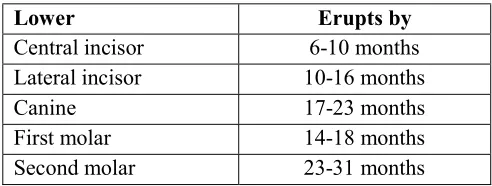
Table 1: Primary tooth eruption and period of eruption13
Upper Erupts by
Central incisor 8-12 months
Lateral incisor 9-13 months
Canine 16-22 months
First molar 13-19 months
Second molar 25-33 months
Complications of early teeth eruption:
As per Ayurveda, ideally tooth erupts by 8th month. When eruption occurs prior to this, there can be various complications.
4th month- Teeth will be of less strength and can lead to early decay and various other diseases.
5th month- Teeth will be shaky, increased sensitivity and can lead to various other diseases.
6th month- Teeth will be inverted, covered with plaques, discoloured and can be easily afflicted with dental caries. 7th month- Teeth will be having two pockets, split, bro-ken, stripped, dry, irregular and protruberant14.
These complications can be due to immaturity of dhathus involved in tooth formation and eruption. Stud-ies have failed to point out any specific cause for prema-ture eruption of teeth. However few endocrine or genetic
Lower Erupts by
Central incisor 6-10 months
Lateral incisor 10-16 months
Canine 17-23 months
First molar 14-18 months
IAMJ: Volume 7, Issue 1, January - 2019 (www.iamj.in) Page 128 factors may be involved in it as in congenital adrenal
hyperplasia.
Factors influencing tooth eruption:
Physiological variation in the normal eruption of teeth is a common finding, but in case of significant deviation, evaluation of health and development of child should be done. Kashyapa has mentioned few factors like Lingab-heda (Gender difference), Jaathivisesha (Racial differ-ence), Mathapithroranukaranam (Genetic and hereditary factors), swabhavam (Natural or other unknown causes), Swakarmavisesham (Nutrition of the child) etc which normally influence primary tooth development and erup-tion in children.
Gender – As per Ayurvedic classics, appearance of teeth in female babies are early and cause less trouble while in males it takes much time and causes difficulties due to compactness of teeth and stable nature of gums15. Stud-ies conducted on tooth eruption also prove this16. The difference in eruption times between both genders on average is from 4 to 6 months, largest difference being for permanent canines. This is attributed to early onset of maturation in females.
Racial – Difference in time of tooth eruption exists among different races (Jathi visesha). Teeth emerge con-siderably earlier in African and American-African chil-dren than in Asians and Caucasians 17.
Genetic – Genetic factors are proved to have effect in emergence of teeth by analysing the concordance rate among monozygotic and dizygotic twins18.
Natural causes-There can be some natural or unknown factors which determines the time of teeth eruption in children.
Nutritional factor- There is evidence that chronic malnu-trition extending beyond the early childhood is associ-ated with delayed teeth eruption19. It has been found that children from higher socioeconomic backgrounds have earlier tooth emergence than children from lower socio-economic classes as children from higher sociosocio-economic class get better health care, nutrition and these factors influence earlier development of dentition.
Others- Other factors like craniofacial morphology, hormonal factors and various systemic and genetic fac-tors influence the time and mode of teeth eruption. Ideal teeth characteristics
According to Ayurveda, teeth which erupt in eighth month possess ideal qualities20 and are an indication of longevity21. Completeness, evenness, compactness, whiteness, unctuousness, smoothness, cleanliness, dis-ease-free state and slight protuberance of upper row of
teeth are characteristics of good teeth. Ideal teeth should be supported with gums which are even, red, compact, unctuous and with big, compact, stable roots. Studies have shown that appearance of lips, appearance of dental arches, shape of teeth, teeth colour and appearance of gums contribute to the aesthetics of teeth and surround-ing structures22.
The following four major tissues make up a healthy tooth – enamel, dentin, cementum, and dental pulp. Enamel- It is the hardest and the most highly mineralised substance of human body. 96% of enamel comprises of mineral, with water and organic material composing the rest. Its normal colour varies from light yellow to grey-ish white. Dentin- It is the porous and yellow hued mate-rial, which works as a protective layer and supports the crown of tooth. Dentin is a mineralized connective tissue with an organic matrix of collagenous proteins. Cemen-tum- It is a specialised bone like substance wrapping the root of tooth. It is yellowish and softer than dentin and enamel. Dental pulp – It is the central part of the tooth filled with soft connective tissue. Dental pulp encloses blood vessels and nerves that enter the tooth from a hole at the apex of the root23. Ideal characteristics of these tissues indicate the maturity and health of Asthi and Majja dhathus.
IAMJ: Volume 7, Issue 1, January - 2019 (www.iamj.in) Page 129 then moves all over body along with pitha. This results
in various secondary diseases to the child by vitiating other dhatus and malas25. Vagbhata has mentioned teeth eruption as the cause for systemic and local diseases like fever (jwara), diarrhoea (vitbheda), cough (kasa),vomiting (chhardi), headache(siroruja), various ocular (Abhishyanda and pothaki) and skin manifesta-tions (visarpa). Vagbhata has explained Kukunaka, an inflammatory disease of eye to be the secondary compli-cation of dantotpathi26. He has stated that the diseases are self limiting and subsides when the eruption is com-pleted27, but mild measures can be opted to ease out the situation. Gums can be rubbed with powdered drugs like Pippali, flower of Dhataki and Dhathri by mixing with honey. Powder of dried meat of certain birds like lava, tittiri mixed with honey can also be used for this pur-pose. Studies have proved that light massage or rubbing over gums with clean fingers or very soft finger toothbrush for 1-2 minutes are good teething remedies as it reduces the swelling and thickness of gums28. Ghee formulations like Vachadi and Samangadi Ghritha can be used in general to lessen difficulties arising during teething29For managing the secondary manifestations associated with teething, symptomatic treatment should be adopted considering the vitiated dosha, origin and stage of disease, time, place etc. Only Ashtanga Sam-graha has mentioned specific treatment for each compli-cation arising during teething.
Treatment of fever of vata origin- Child should be made to drink syrup prepared from bhadradaru (Cedrus deodara), Ghana (Cyperus rotundus), yashti (Glycer-rhiza glabra) and samanga (Rubia cordifolia) with sugar candy.
Decoction or ghee prepared with drugs like Surahwa (Cedrus deodara), Ghana (Cyperus rotundus), yashti (Glycerrhiza glabra) etc can be used for oral intake or for anointing.
Oil prepared with Haridra(Curcuma longa), ku-shta(Saussurea lappa), vacha(Acorus calamus) etc can be used for massaging.
Treatment of fever, diarrhoea, vomiting and thirst- powder of parched paddy, neelotpala (Nymphaea stel-lata), kana (Piper chaba), madhuka (Glycerrhiza glabra), anjana (extract of Berberis aristata) with sugar and honey can be given fever of pitta origin and diar-rhoea.
Decoction of parched paddy, pippali (piper longum), gajapippali (piper chaba) with sugar and honey cures fever, diarrhoea, thirst and vomiting.
In diarrhoea associated with ama and diarrhoea with blood, powder of gajapippali(piper chaba)or devadaru (Cedrus deodara can be given with sugar.
Treatment of headache- Paste prepared with leaves of Kapittha (Feronia limonia), Changer (Oxalis cornicu-lata), Badari (Prunus domestica) and Kakamachi (So-lanum nigrum) mixed with ghee should be applied cold on head. This will relieve headache, vomiting and diar-rhoea.
Treatment of eye diseases- For ocular manifestations like kukunaka and pothaki, specific treatment should be adopted. However, vagbhata has indicated to use pills made of manassila (Realger), Sankhanabhi (conch), pip-pali (piper longum),, madhuyashi (Glycerrhiza glabra) mixed with honey generally in eye diseases of children. Treatment of excessive thirst, diarrhoea, vomiting – powder of priyangu (Callicarpa macrophylla), anjana (extract of Berberis aristata) and mustha (Cyperus ro-tundus) should be consumed along with rice washed wa-ter.
Treatment of fever of kapha origin- Medicated ghee should be prepared with Madhuka (Madhuka longifolia), vacha (Acorus calamus),vyosha (Piper longum, Zingiber officianalis and Piper nigrum) etc, consumed with honey cures fever of kapha origin and acts as a best carmina-tive.30
Disorders and variations of tooth eruption:
Apart from ideal teething, Kashyapa has mentioned various disorders of eruption like:
Samudga- decrease in number of teeth due to continuous falling.
Samvrta- inauspicious and dirty
Vivrta – worn-out, with excessive salivation, gets easily discoloured due to being uncovered and easily afflicted with diseases.
Kashyapa opines that birth with teeth or Natal teeth (Sa-dantajanma), eruption of upper teeth first (Poorvamutta-radantajanma), scattered teeth (Viraladanta), less teeth (Heenadanta), more number of teeth (Adhikadanta), ter-rible looking teeth (Karaladanta), discoloured teeth (Vivarnadanta) and cracked teeth (Sphutithadanta) are considered as variations from normal teething and are inauspicious31. These can be considered as signs of un-healthy maturation of body tissues and early indicators of developmental disorders in children.
Natal /neonatal teeth:
IAMJ: Volume 7, Issue 1, January - 2019 (www.iamj.in) Page 130 are known as natal teeth and those that erupt within the
first month of life is known as neonatal teeth. Approxi-mately one in 2000-3000 live births is so affected. The mandibular central incisor is the most common natal or neonatal tooth32. Vagbhata also suggests that birth with teeth and eruption of upper teeth first are not ideal and has suggested doing specific pacifications33. Child born with teeth is considered to be due to excessive sleshmala diet by pregnant woman34. Natal teeth or neonatal teeth tend to have abnormal roots. If the teeth are mobile there is probability of aspiration and should be extracted. Breastfeeding can be painful in natal or neonatal teeth35. The mobility of the tooth frequently causes inflammation of the surrounding gingivae. Trauma to the ventral sur-face of the tongue may cause ulceration. Natal or neona-tal teeth may be seen in association with syndromes like Pachyonychia congenita, Ellis-van Creveld syndrome, Hallermann-Streiff syndrome etc.
Delayed eruption
Delayed eruption of primary teeth may arise from either systemic or local factors. It may also be associated with prematurity or low birth weight. Delayed eruption of teeth is seen in association with Down syndrome and Turner's syndrome. Delayed eruption is seen in nutri-tional abnormalities and in endocrine disorders such as hypothyroidism or hypopituitarism
Variations in number of teeth:
Hypodontia is the term most often applied to a situation where a patient has missing teeth as a result of their fail-ure of development or other systemic illness. Anodontia describes the total lack of teeth of one or both dentitions. Oligodontia is a term used to describe a situation where more than six teeth are missing. This may be Supernu-merary teeth or excess numbers of teeth are most often located in the anterior maxilla in the midline, or immedi-ately adjacent to the midline, and they are then referred to as a mesiodens. Supernumerary teeth in the molar re-gions adjacent or distal to the normal sequence of teeth are referred to as paramolars or distomolars respectively. Supernumerary teeth have significant association with invaginated teeth and cleft palate. Multiple supernumer-ary teeth are seen in cleidocranial dysplasia and in syn-dromes such as oral-facial-digital syndrome type 1, Gardner syndrome etc36. These variations correlate with Kashyapa’s concept of less number of teeth (Heenadanta), scattered teeth (Viraladanta) and more number of teeth (Adhikadanta) which are considered as signs of unhealthy dentition.
Variations in tooth morphology:
Kashyapa has described unideal morphological charac-ters of teeth like terrible looking teeth (Karaladanta), discoloured teeth(Vivarnadanta) and cracked teeth(Sphutithadanta). Generally men have larger teeth than women. Racial differences have also been seen in size of tooth. Tooth size is defined as abnormal when dimensions have two standard deviations from average37. Crown size: Teeth which are obviously larger than nor-mal are referred to as megadont or macrodont and teeth which are smaller than normal are termed microdont. Generalized megadontia has been reported in connection with conditions like pituitary gigantism, unilateral facial hyperplasia and hereditary gingival fibromatosis. Micro-dontia can occur in association with hypoMicro-dontia as in the example of X-linked hypohidrotic ectodermal dysplasia, where a heterozygous female might have one missing lateral incisor and a peg-shaped crown of the contralat-eral maxillary latcontralat-eral Incisor.
Root size: Larger than normal roots are most often seen affecting the maxillary central incisors. Short roots may also be seen in a number of conditions affecting the den-tine and/or pulp and may be seen affecting the maxillary central incisors.
Invaginated teeth:
Des invaginus or invaginated teeth is a malformation of teeth most likely resulting from an infolding of the den-tal papilla during tooth development or invagination of all layers of the enamel organ in dental papillae.
Evaginated teeth:
It is the abnormal evagination of the internal enamel epi-thelium and dental papilla into the stellate reticulum. Evaginated teeth, or dens evaginatus, most commonly affect the premolar teeth.38
Taurodontism:
It is a condition found in the molar teeth of humans whereby the body of the tooth and pulp chamber is enlarged vertically at the expense of the roots. As a re-sult, the floor of the pulp and the furcation of the tooth is moved apically down the root.39
Conclusion
IAMJ: Volume 7, Issue 1, January - 2019 (www.iamj.in) Page 131 relevant in present era also and have been proved by
sci-entific studies. Symptoms associated with teething can be managed well with Ayurvedic measures and also helps in speeding up the teething process. Scientific validation of Ayurvedic dentistry is essential for its rec-ognition in modern era.
References
1. https://en.wikipedia.org/wiki/Teething.
2. Vriddha jeevaka, Kashyapa Samhitha, Chakhambha
vis-vabharati, Varanasi, Reprint 2002, suthra sthana, Chapter 20, Verse 4.
3. Vagbhata, AstangaSamgraha ,Chaukhambha Sanskrit
series, Varanasi, ShariraSthana, Chapter 5,Verse 65.
4. Agnivesa, Charaka Samhita,edited and translated by Prof.
P.V Sharma, Chaukambha publications, Sarira Sthana, Chapter 4,Verse14.
5. Agnivesa, Charaka Samhita ,edited & translated by Prof.
P.V Sharma, Chaukambha publications, Sarira
Sthana,Chapter 7,Verse 6.
6. Susruta, Susruta Samhita with commentaries
Niband-hasamgraha by Dalhana and Nyayacandrika by Gayadasa, Chaukambha Orientalia, Varanasi , 5th Edition, reprint 1992 , Sarira Sthana, chapter 5, verse19.
7. Vagbhata, AstangaSamgraha ,Chaukambha Sanskrit
se-ries, Varanasi, SariraSthana,Chapter5,verse 71.
8. Susruta, Susruta Samhita with commentaries
Niband-hasamgraha by Dalhana and Nyayacandrika by Gayadasa , Chaukambha Orientalia, Varanasi , 5th Edition, reprint 1992, Sarira Sthana, chapter 5,verse 20.
9. https://discovery.lifemapsc.com/library/review-of-medical-embryology/chapter-77-development-of-the-teeth
10. Vriddha jeevaka, Kashyapa Samhitha, Chakambha
vis-vabharati, Varanasi, Reprint 2002, suthra sthana, chapter 20,verse 8.
11. Vagbhata, Astanga Samgraha ,Chaukhambha Sanskrit
series, Varanasi,Uttara Sthana,chapter 2,verse15.
12. Goran Koch and Sven Poulsen,Paediatric dentistry- A clinical approach,A John Wiley and Sons Ltd, Publica-tions , 2nd Edition,2009, Chapter15, Page No 197. 13. https://www.ida.org.in/Public/Details/Teeth.
14. Vriddha jeevaka, Kashyapa Samhitha, Chakhambha
vis-vabharati, Varanasi, Reprint 2002, suthra sthana, chapter 20, verse 8.
15. Vriddha jeevaka, Kashyapa Samhitha, Chakhambha
vis-vabharati, Varanasi, Reprint 2002, suthra sthana, chapter 20, verse 5.
16. Ruta Almonaitiene, Irena Balciuniene, Janina Tutkuvi-ene,Stomatologija, Factors influencing permanent teeth eruption,Part one – general factors , Baltic Dental and Maxillofacial Journal, 12: 67-72, 2010.
17. Ruta Almonaitiene, Irena Balciuniene, Janina Tutkuvi-ene,Stomatologija, Factors influencing permanent teeth eruption,Part one – general factors , Baltic Dental and Maxillofacial Journal, 12: 67-72, 2010.
18. Ruta Almonaitiene, Irena Balciuniene, Janina Tutkuvi-ene,Stomatologija, Factors influencing permanent teeth eruption,Part one – general factors , Baltic Dental and Maxillofacial Journal, 12: 67-72, 2010.
19. Ruta Almonaitiene, Irena Balciuniene, Janina Tutkuvi-ene,Stomatologija, Factors influencing permanent teeth eruption,Part one – general factors , Baltic Dental and Maxillofacial Journal, 12: 67-72, 2010.
20. Vriddha jeevaka, Kashyapa Samhitha, Chakhambha
vis-vabharati, Varanasi, Reprint 2002, suthra sthana, chapter 20, verse 8.
21. Vagbhata, AstangaSamgraha ,Chaukhambha Sanskrit
series, Varanasi, Uthara Sthana , chapter 2,verse 20.
22. https://www.ncbi.nlm.nih.gov/pmc/articles/PMC5506250/
Assessment of esthetic characteristics of the teeth and sur-rounding anatomical structures/ NatalijaPricaOreški, Asja Čelebić, and Nikola Petričević , Acta Stomatol Croat, 2017 March; 51(1), 22–32.
23. https://en.wikipedia.org/wiki/Human_tooth.
24. Signs and symptoms associated with primary tooth
erup-tion: a clinical trial of nonpharmacological remedies, Mahtab Memarpour, ElhamSoltanimehr, and Taher-hEskandarian, BMC Oral Health-2015; 15:88
25. Vagbhata, AstangaSamgraha ,Chaukhambha Sanskrit
series, Varanasi, Uthara Sthana, chapter 2,verse 23.
26. Vagbhata, Ashtanga Hridaya, Kaviraja Atridev
Gupta(Commentator), Vaidya Yadunandan
Upadhyaya(Ed.), Chaukhambha Sanskrit Sansthan, Vara-nasi,Fourteenth Edition, 2003, Uttara Sthana chapter 8,verse 19.
27. Vagbhata, Ashtanga Hridaya, Kaviraja Atridev
Gupta(Commentator), Vaidya Yadunandan
Upadhyaya(Ed.); Chaukhambha Sanskrit Sansthan, Vara-nasi,Fourteenth Edition, 2003, Uttara Sthana chapter 2,verse 43.
28. Mahtab Memarpour, ElhamSoltanimehr, and Taherh
Eskandarian, Signs and symptoms associated with pri-mary tooth eruption- a clinical trial of non pharmacologi-cal remedies, BMC Oral Health, 2015, 15:88.
29. Vagbhata, Ashtanga Hridaya, Kaviraja Atridev
Gupta(Commentator),Vaidya Yadunandan
Upadhyaya(Ed.), Chaukhambha Sanskrit Sansthan, Vara-nasi,Fourteenth Edition, 2003, Uttara Sthana, chapter 2,verse 35-42.
30. Vagbhata, AstangaSamgraha ,Chaukhambha Sanskrit
series, Varanasi, Uthara Sthana, chapter 2,verse 36-55.
31. Vriddha jeevaka, Kashyapa Samhitha, Chakhambha
IAMJ: Volume 7, Issue 1, January - 2019 (www.iamj.in) Page 132
32. Richard Welbury and Monty Duggal, Pediatric dentistry,
3rd edition,2005, United States by Oxford University Press Inc., New York, Chapter13,Page No 313.
33. Vagbhata, Ashtanga Hridaya, Kaviraja Atridev
Gupta(Commentator), Vaidya Yadunandan
Upadhyaya(Ed.), Chaukhambha Sanskrit Sansthan, Vara-nasi;Fourteenth Edition, 2003. Uttara Sthana, chapter 2,verse 62.
34. Vagbhata, AstangaSamgraha ,Chaukhambha Sanskrit
series, Varanasi, Uthara Sthana, chapter 2,verse 56.
35.
https://www.dentalcare.com/en-us/professional-education/ce-courses/ce352/eruption-problems.
36. Goran Koch and Sven Poulsen, Pediatric dentistry- A clinical approach, 2 nd Edition, 2009, Blackwell publish-ing Ltd., Chapter 14, Page No189.
37. Goran Koch and Sven Poulsen, Pediatric dentistry- A clinical approach, 2 nd Edition, 2009, Blackwell publish-ing Ltd., Chapter 14, Page No191.
38. Goran Koch and Sven Poulsen, Pediatric dentistry- A clinical approach, 2 nd Edition, 2009, Blackwell publish-ing Ltd., Chapter 14, Page No195.
39. https://en.wikipedia.org/wiki/Taurodontism.
Source of Support: Nil
Conflict Of Interest: None Declared
How to cite this URL: S. Asha: Primary Tooth Eruption - An Ayurvedic Overview . International Ayurvedic Medical Journal {online} 2018 {cited January, 2019} Available from: