DIGITAL IMAGE WATERMARKING TECHNIQUES FOR
IMAGES USING TWO-DIMENSIONAL WALSH CODING
Ajeet Pratap Singh
1, Sachin Kumar
21,2
Department of ECE, ASET,
Amity University, Lucknow, U.P., (India)
ABSTRACT
The Digital image watermarking technology is being improved day by day, there are a lot of possibilities of
reproduction and manipulation of digital multimedia such as digital image, digital audio and digital video. Hence the
digital image watermarking methods have been designed and implemented for the purpose of content protection and
copyright management. In this paper, we present a robust and efficient digital image watermarking technique using 2-D
Walsh coding. The 1-D Walsh coding was used to improve the robustness of digital image watermarking. In digital
watermarking techniques, we discuss the various factors used in watermarking, properties and application area where
watermarking technique required to be used. The digital watermarking is a passive protection tool that used to secure
the data of researchers and the information is hidden inside a signal which cannot be easily detected by unauthorized
users. In this algorithm some digits are embedded in image. The algorithm is blind and does not require the original
image for extracting process. The digits were encoded by using 2-D Walsh functions and it was embedded in the low
frequency coefficients of the discrete cosine transform of the host image. The performance of this technique is evaluated
using Stir mark tool and results have been shown with the use of 2-D Walsh coding which is survived various attacks
such as JPEG compression, noise, and different image manipulation algorithms.
Keywords: Digital Image Watermarking, Walsh Coding, DCT, Lena Image.
I INTRODUCTION
copyright or to cast the same watermark after altering the data to forge the proof of authenticity. The design of techniques for preserving the ownership of digital information will be the basis of the development of future multimedia services.
The digital watermarking has certain requirements, such as watermark must be invisible causing minimum distortion to the images, tolerant to normal image processing techniques such as JPEG compression, filtering and image manipulation techniques and robust against most of the signal processing operations.
The algorithms were used for watermarking can be classified according to the insertion domain. The watermark can be inserted in either the transform or spatial domain. The transform domain watermarking schemes are typically much more robust to image manipulation compared to the spatial domain schemes [1, 17, 18, 19]. One type of transform algorithms is the embedding of the watermark in the low frequency DCT coefficients and other is the use of 1-D Walsh coding before embedding.
In this paper, a new blind watermarking technique using 2-D Walsh coding is presented. The algorithm is used decimal digits as the watermarking information.
II DIGITAL WATERMARK ALGORITHM
A. Walsh Function
The Walsh functions is produced proportional to the value of the length elements while this length is in terms of 2n, where n is an integer. The Walsh functions consist of trains of square pulses with allowed states being –1 and 1. In this proposed method, the 2-D Walsh functions are used to encode the digits before being embedded in the host image. The summation of the 14 decimal digits is checked that the extracted number is correct or not. Each of the 14 decimal digits is converted into 4 bit binary number. Each bit of binary number is Walsh coded and then they are multiplexed. The size of the watermarking information is much smaller than the size of the image. The watermarking information is repeated several times using the shuffling technique.
B. Watermark Embedding:
Figure1. Walsh coding of decimal digits
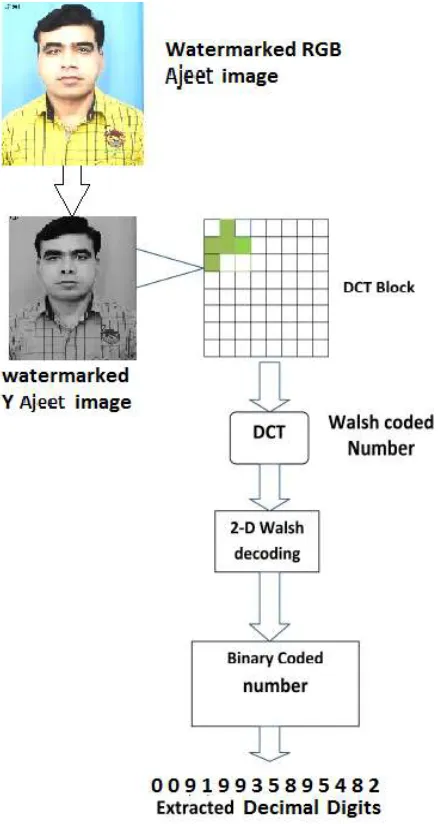
C. Watermark Extracting
Fig. 2 Watermark Extraction of Decimal Digits
III EXPERIMENTAL ANALYSIS
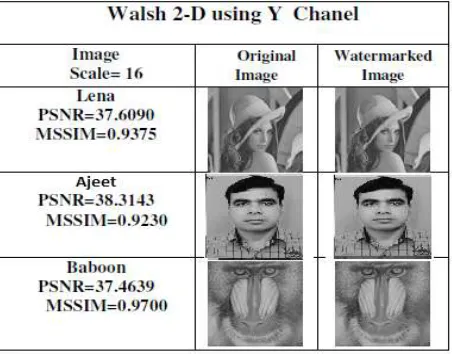
Table-II shows the robustness of the new watermark algorithm to JPEG compression. These values are the minimum JPEG quality factors below these values the watermark cannot be recovered. Table-III shows the PSNR and SSIM without using Walsh coding. Table-IV shows the lowest JPEG quality factors without using the Walsh coding. It is clear that the use of the 2-D Walsh coding obtained better results compared to the case without coding. Table-V shows the different types of attacks using the Stir mark software. The proposed new algorithm survived JPEG and filtering attacks.
Fig. 3 Original images and their watermarked versions
Table-II: The lowest JPEG factors with Walsh Coding, the watermark can be recovered.
Table-IV: The lowest JPEG factors where the watermark can be recovered.
IV CONCLUSIONS
In this paper, we present digital watermarking scheme for color images using 2-D Walsh coding. The new scheme is used due to minimal distortion to the watermarking images. The PSNR values > 37dB and the SSIM values > 0.92 have been achieved with different types of images. It is found that the use of 2-D Walsh coding with DCT blocks provides high robustness against JPEG attacks compared to the embedding without coding. This new scheme is blind and the watermark can be extracted without the original image. The DCT domain watermarking can survive against the attacks such as compression, filtering, sharpening, and noising.
REFERENCES
[1] M. Barni, F. Bartolini, V. Cappellini, and A. Piva, “A DCT-Domain System for Robust Image Watermarking,” Signal Processing, vol. 66, 1998, pp. 357–372.
[2] Patrick Bas, Jean-Marc Chassery, and Benoit Macq, “Geometrically Invariant Watermar king Using Feature Points”, IEEE Transactions on Image Processing, Vol.11,No.9,Sepetember 2002.
[3] R.C. Gonzalez, R.E. Woods, “Digital Image Processing”, Upper Saddle River, New Jersey, Prentice Hall, Inc., 2002.
[4] Vaishali S. Jabade, Dr. Sachin R. Gengaje,”Litrature Review of Wavelet Based Digital Watermarking techniques”, International Journal of Computer Applications, Volume 31, No.1,pp-28-35.
[5] Munesh Chandra, Shika Pandey, and Rama Chaudary, “Digital Watermarking Technique for Protecting Digital Images”, IEEE 2010.
[6] M. D. Swanson, B. Zhu and A. H. Tewfik, “Robust Data Hiding for Images”, IEEE Digital Signal Processing Workshop, pp. 37-40.
[7] J. Cox, J. Kilian, F. T. Leighton, and T. Shamoon, "Secure sprea spectrum watermarking for multimedia".
[8] M. B. Martin and A. E. Bell, “New Image Compression Techniques Multiwavelets and Multiwavelet Packets”, IEEE Trans. Image Process.,vol. 10, no. 4, pp. 500–510, Apr. 2001.
[9] L. Ghouti, A. Bouridane, M. K. Ibrahim and S. Boussakta, “Digital Image Watermarking Using Balanced Multiwavelets”, IEEE Trans.Signal Process., vol. 54, no. 4, pp. 1519-1536
[10] Callinan and D. Kemick, “Detecting Steganographic Content in Images Found on the Internet”, Department of Business Management, University of Pittsburgh at Bradford.
[11] E.Koch , J.Rindfrey and J.Zhao, “Copyright Protection of Multimedia Data”, in proceedings International Conference Digital Media and Electronic Publishing,1994.
[13] Jen-Sheng Tsai, Win-bin Huang, Chao-Leigh Chen, Yau-Hwang Kuo “A Feature-Based Digital Image Watermarking for Copyright Protection and Content Authentication” IEEE, 2007.
[14] Prabhishek Singh, R S Chadha ,“A Survey of Digital Watermarking Techniques, Applications and Attacks”, International Journal of Engineering and Innovative Technology (IJEIT), Volume 2, Issue 9, March 2013
[15] Mei Jiansheng, Li Sukang, “A Digital Watermarking Algorithm Based On DCT and DWT”, Proceedings of the 2009 International Symposium on Web Information Systems and Applications (WISA’09) Nanchang, P. R. China, May 22-24, 2009, pp. 104-107
[16] Http://cameo.mfa.org/wiki/Watermark.
[17] I. Cox, M. Miller, and J. Bloom, Digital Watermarking, Morgan Kaufmann Publishers, San Francisco, 2001. [18] S. Katzenbeisser, and F. Petitcolas, Information Hiding Techniques for Steganography and Digital Watermarking,
Artech House, London, 2000.