Effect on Behavior Problems of Teen Online
Problem-Solving for Adolescent Traumatic Brain Injury
WHAT’S KNOWN ON THIS SUBJECT: Traumatic brain injury in teenagers may lead to increased behavior problems and corresponding deterioration in family relationships. Family-centered training in problem-solving skills may facilitate improvements in behavior and self-management after traumatic brain injury, but this strategy has not been tested with teens.
WHAT THIS STUDY ADDS: A comparison of teen online problem-solving (TOPS) with access to Internet resources for treatment of teenagers after traumatic brain injury revealed lower family conflict after TOPS and improvements in behavior among teens with severe injury or lower socioeconomic status.
abstract
PURPOSE:To report the results of a randomized clinical trial of teen online problem-solving (TOPS) meant to improve behavioral outcomes of adolescents with traumatic brain injury (TBI).
METHODS:A randomized clinical trial was conducted to compare the efficacy of TOPS with access to Internet resources in teenagers with TBI in improving parent and self-reported behavior problems and parent-teen conflicts. Participants included 41 adolescents aged 11 to 18 years (range: 11.47–17.90 years) who had sustained a moderate-to-severe TBI between 3 and 19 months earlier. Teens in the TOPS group received 10 to 14 online sessions that provided training in problem-solving, communication skills, and self-regulation. Outcomes were assessed before treatment and at a follow-up assessment an average of 8 months later. Groups were compared on follow-up scores after we controlled for pretreatment levels. Injury severity and socioeconomic status were examined as potential moderators of treatment efficacy.
RESULTS:Forty-one participants provided consent and completed baseline assessments, and follow-up assessments were completed for 35 participants (16 TOPS, 19 Internet resource comparison). The TOPS group reported significantly less parent-teen conflict at follow-up than did the Internet-resource-comparison group. Improvements in teen behavior after TOPS were moderated by injury severity; there were greater improvements in the teens’ internalizing symptoms after TOPS among adolescents with severe TBI. Family socioeconomic status also moderated the efficacy of TOPS in improving behavior problems re-ported by both parents and teens, although the nature of the modera-tion effects varied.
CONCLUSION:Our findings suggest that TOPS contributes to improve-ments in parent-teen conflict generally and parent and self-reported teen behavior problems for certain subsets of participants.Pediatrics
2011;128:e947–e953 AUTHORS:Shari L. Wade, PhD,aNicolay C. Walz, PhD,a
JoAnne Carey, PsyD,aKendra M. McMullen, MA,aJennifer
Cass, PhD,bErin Mark, MS,band Keith Owen Yeates, PhDb aDepartment of Pediatrics, Cincinnati Children’s Hospital
Medical Center, and College of Medicine, University of Cincinnati, Cincinnati, Ohio; andbDepartment of Pediatrics, Ohio State
University and Center for Biobehavioral Health, Research Institute at Nationwide Children’s Hospital, Columbus, Ohio
KEY WORDS
adolescents, traumatic brain injury, telehealth, behavioral interventions
ABBREVIATIONS
TBI—traumatic brain injury SES—socioeconomic status TOPS—teen online problem-solving IRC—Internet resource comparison GCS—Glasgow Coma Scale CBCL—Child Behavior Checklist YSR—Youth Self-report
IBQ—Interaction Behavior Questionnaire
All of the authors made substantive intellectual contributions to the study, provided suggestions on previous drafts of the manuscript, and reviewed the final manuscript. Dr Wade was the principal investigator on the project, and she designed the study with input from others, oversaw all aspects of implementation, conducted the statistical analyses, and drafted the manuscript; Dr Walz was coinvestigator on the project, and she assisted in study conceptualization and design, development of the treatment modules, and preparation of the manuscript; Dr Carey assisted in development of the intervention content and treatment manual, served as a study therapist, and assisted in preparation of the manuscript; Ms McMullen assisted in the development of the intervention content and pretreatment and posttreatment assessments, oversaw data collection, entry, and management at participating sites, and assisted in preparation of the manuscript; Dr Cass oversaw intervention implementation and assisted in the conceptualization, analysis, and write-up of the findings in the manuscript; Ms Mark assisted in
development of the treatment manual, served as a study therapist, and assisted in preparation and conceptualization of the manuscript; and Dr Yeates was the principal investigator in Columbus, oversaw all aspects of implementation at that site, and also assisted in the conceptualization, analysis, and write-up of the findings in the manuscript.
These results were presented in part at the annual meeting of the Ohio Brain Injury Association, October 1, 2009, Columbus, OH; and the annual conference of the American Psychological Association, August 15, 2010, San Diego, CA.
This trial has been registered at www.clinicaltrials.gov (identi-fier NCT00409058).
(Continued on last page)
childhood, and incidence peaks during adolescence.1 Consequences include persistent changes in cognitive abili-ties, executive functions, behavior, and social competence.2–4 Families are also adversely affected, particularly af-ter severe TBI.5,6Injuries during ado-lescence may contribute to difficulties negotiating normative developmental transitions such as dating, driving a car, and getting a job. Parental con-cerns coupled with deterioration in the teen’s problem-solving skills and self-regulation can result in increased conflict and additional deterioration in teen behavior.
Few evidence-based treatments exist to facilitate adolescent and family ad-aptation after TBI.7A trial of online fam-ily problem-solving for children aged 5 to 17 years with moderate-to-severe TBI provided preliminary evidence that a family problem-solving treatment may result in greater improvements in self-management and compliance among older children and adoles-cents.8 In this study, socioeconomic status (SES) and the child’s age mod-erated treatment efficacy with greater effects in children 11 and older and those of lower SES.
Building on this previous study, we modified online family problem-solving to address the needs of adoles-cents by placing increased emphasis on metacognitive strategies, self-regulation, and emotion control.9In the current investigation we examined the efficacy of teen online problem-solving (TOPS) relative to access to Internet sources regarding TBI (Internet re-source comparison [IRC]). We hypoth-esized that teens and families who participated in TOPS would show greater reductions in adolescent be-havior problems and parent-teen con-flict than teens who participated in IRC. On the basis of previous research
re-severity would moderate the efficacy of the TOPS treatment, and that adoles-cents with severe TBI and those of lower SES would show greater im-provement than those with moderate TBI or those of higher SES.
PATIENTS AND METHODS
Participants
Participants were recruited from 2 ur-ban children’s hospitals. Eligible chil-dren were between 11 and 18 years old and had to have been hospitalized af-ter a moderate-to-severe TBI in the pre-vious 18 months. A severe TBI was de-fined as a lowest Glasgow Coma Scale (GCS)10score of ⱕ8; a moderate TBI was defined as a GCS score between 9 to 12, or a GCS score of⬎12 accompa-nied by abnormal imaging or other ev-idence of neurologic impairment. Chil-dren were excluded if English was not the primary language spoken in the home; if there was a history of child abuse documented in the medical re-cords; if the teen could not communi-cate sufficiently to participate in the sessions; if the teen had ever been hos-pitalized for psychiatric reasons; or if the primary caregiver had been hospi-talized for psychiatric reasons in the previous 5 years.
Procedure
Random Assignment
After we obtained informed consent from the participating parents and as-sent from teens, families were ran-domly assigned to either the TOPS or IRC group by use of a randomization scheme that stratified participants on the basis of the adolescent’s gender and race/ethnicity to ensure compara-ble diversity in each group. Given the nature of the study, we were unable to conceal group assignment from the participants and research staff; how-ever, the primary outcome measures
ments of research staff.
Therapist and Interviewer Training
Training of therapists and coordina-tors is detailed elsewhere.11Treatment fidelity was maintained through weekly supervision sessions among the 2 therapists and the supervising psychologists at each site. End-of-session checklists completed by the therapist and family indicated excel-lent correspondence between actual session content and intervention objectives.
Pretreatment and Posttreatment Assessments
During the initial visit, the research as-sistant administered baseline mea-sures and instructed participants how to log onto the Web site. Families in both groups were given high-speed In-ternet access, when available, and families who did not have an existing home computer were given one to use during the course of the study. Follow-up assessments were com-pleted 7.83 months (SD: 1.05 months) after baseline in the TOPS group and 7.92 months (SD: 2.88 months) after baseline in the IRC group (t34⫽0.12).
Description of the TOPS intervention
The TOPS intervention protocol and Web site are described more fully else-where.9During the initial in-home ses-sion, the therapist identified goals that the teen and family wanted to address and trained the family on navigating the TOPS Web site and using the video-conferencing software. All subsequent sessions were conducted remotely by using online videoconferencing or, in rare instances when videoconferenc-ing was not possible, over the telephone.
plan-ning/organization, self-regulation, anger management, verbal/nonverbal communication, and social problem-solving to all TOPS participants. For participants with issues not ad-dressed by the core content, supple-mental sessions provided information and skills training pertaining to pain management, sleep and memory is-sues, sibling concerns, transitioning after high school, parental guilt and grief, marital strains, and parent-teen communication. Families were encour-aged to complete all 10 core sessions and could complete up to 4 supplemen-tal sessions according to their individ-ual needs.
The teen and his or her primary care-giver were required to complete the initial face-to-face session and subse-quent videoconferences together with the therapist. They were also in-structed to complete the self-guided Web modules together before each session with the therapist. Both par-ents, in 2-parent families, and siblings were also encouraged to participate, al-though this participation was not re-quired. As part of the Web-site log in, participants indicated which family members were completing the module, and some of the interactive exercises re-quired separate responses from each participating family member.
After completion of each Web module, the family met with the therapist via videoconference. The therapist re-viewed the Web-site content and worked with the family to apply the problem-solving process with the goal of generating a plan to address a prob-lem or goal identified by the family, giv-ing the family experience in implement-ing the self-regulation skills taught through the self-guided Web pages.
Description of the IRC Intervention
Families in both the TOPS and IRC groups received access to a home Web page of brain injury resources and
links to online resources, but those in the IRC group did not have access to the specific session content offered in TOPS nor did they receive the synchronous vid-eoconferences with the therapist. Re-sources included links to local, state, and national brain-injury associations and to sites specific to pediatric brain injury, such as the Center on Brain Injury Re-search and Training. Families were en-couraged to spend at least 1 hour per week accessing the resources during the 6-month intervention; however, there was no requirement that parents and teens visit the Web sites together. Par-ents provided information about the Web sites visited and the time spent on each at the follow-up assessment. Contamina-tion between the treatments as a func-tion of contact among participants was unlikely given that neither of the partici-pating medical centers had regularly scheduled TBI follow-up clinics or sup-port groups.
Measures
Adolescent Adjustment
The Child Behavior Checklist (CBCL), a 113-item parent-report measure of child behavior problems, served as a measure of adolescent adjustment.12 The Youth Self-report (YSR) is a self-report scale of behavior problems that parallels the CBCL.12The internalizing and externalizing behavior problem to-tal scores from both the CBCL and YSR were treated as the primary outcomes in the current study. Both the CBCL and YSR generate standard (T) scores nor-malized for age and gender, with a mean of 50 and an SD of 10; higher scores reflect more problems. Results of previous studies of TBI indicate that the CBCL is sensitive to behavioral changes after pediatric TBI.
Family Conflict
Parent-adolescent communication and conflict behavior were assessed by using a 20-item short form of the
Interaction Behavior Questionnaire
(IBQ).13The IBQ was completed by both the parents and the adolescent. Re-spondents are asked to rate each statement as true or false. Items com-mon to both the parent and adolescent
versions include statements such as the following: “We almost never seem to agree” and “At least 3 times a week, we get angry at each other.” Total
scores can range from 0 to 20 on both the parent and adolescent versions. Normative data for the IBQ indicate that total scores for nonclinical
sam-ples ranged from 1.6 to 3.2, depending on the rater (parent versus child), and total scores for families in treatment ranged from 7.6 to 12.4.13
Analyses
We conductedttests and2analyses or Fisher’s exact tests to compare the TOPS and IRC groups on continuous and dichotomous background and
in-jury characteristics, respectively. Sim-ilar analyses were conducted to exam-ine baseline differences between those who completed the study and
those who dropped out. Overall group differences were examined by using analysis of covariance, in which the baseline score on the measure of
in-terest served as a covariate allowing us to assess change over time. Multi-ple regression analyses were used to examine the potential roles of family income and injury severity in
moderat-ing treatment response. In the model tested we controlled for the baseline score on the dependent variable of in-terest before analysis of the main
ef-fect for the moderator (ie, income), the effect for group, and the interaction of the group and the moderator. Given the small sample size and the difficulty
of interaction detection, the 2 hypothe-sized moderators were considered in separate models. Partial2provided a measure of effect size.
RESULTS
Participants
A total of 137 children were identified as potentially eligible for study participa-tion on the basis of data from the trauma registry and subsequent review of med-ical records. The families of 87 of these children (63%) were successfully con-tacted regarding participation. Forty-two families (48%) consented to participate, and 41 completed the baseline assess-ment. Participants were representative of the broader sample with respect to age and race. Participants tended to have more severe injuries, although this difference was not statistically signifi-cant (mean GCS in participants: 9.58 [4.56] versus mean GCS in nonpartici-pants: 11.07 [4.09];t86⫽1.81;P⫽.07). One TOPS family was subsequently dropped from the study because the pri-mary caregiver lacked the cognitive ca-pacity to complete the Web-based ses-sions. Of the 40 families who completed the baseline assessment and were re-tained in the study, 35 (88%) provided follow-up data. In the TOPS group, 4 of 20 families (20%) dropped out, compared with 1 of 20 (5%) in the IRC group. Al-though the difference was not statisti-cally significant, TOPS participants may have been more likely to drop out than IRC participants because of the greater time commitment required. Comparison of completers and dropouts revealed no statistically significant differences in
de-mographic or injury characteristics or baseline behavior or family conflict.
As reported in Table 1, adolescents who completed both the baseline and follow-up assessment ranged in age from 11.47 to 17.90 years at baseline (mean: 14.27 years; SD: 2.26 years) and were between 3 and 19 months after in-jury (mean: 9.6 months; SD: 4.94 months). Fourteen (40%) had severe TBI and 21 (60%) had moderate TBI. Partici-pants in the TOPS and IRC groups did not differ significantly with respect to demo-graphic characteristics such as age or SES, nor did they differ in any of the par-ent or self-report measures of conflict and behavior before treatment (allP⬎
.28). Three adolescents in TOPS and 2 in the IRC group were receiving other ther-apies concurrently with the study treatment.
Utilization and Satisfaction
Families in the TOPS intervention group completed an average of 10 ses-sions (range: 3–14), and all but 2 com-pleted all 10 core sessions. Families in the IRC intervention reported spending an average of 0.5 to 1 hour per week at brain injury Web sites. Ratings of ease of logging on and navigating the Web did not differ across the 2 treatment conditions. Ninety-three percent of parents in the TOPS group and 68% of parents in the IRC group reported in-creased understanding of their child’s
group (87% vs 50% in the IRC group;
P⬍ .05) reported that they reached the goals they had for the program, learned ways to improve their child’s behavior, and understood their child better. Parents in the IRC group were more likely to report that the interven-tion content did not pertain to them (50% vs 13% in the TOPS group;P⬍
.05).
Main Effects
Parents of adolescents in the TOPS group reported significantly lower lev-els of parent-teen conflict at follow-up than did those in the IRC group after we controlled for pretreatment levels of conflict (mean TOPS: 2.94 [3.99] ver-sus mean IRC: 5.47 [4.98]; F1,34⫽11.64;
P ⫽ .002). The corresponding effect size was large. However, adolescent ratings of parent-teen conflict did not differ between the groups (mean TOPS: 2.67 [3.75] versus mean IRC: 2.94 [4.22];F1,33⫽0.07;P⫽.9. The groups also did not differ on either parent or teen reports of the adolescent’s inter-nalizing and exterinter-nalizing symptoms at follow-up as assessed by use of the CBCL and YSR, respectively.
Moderating Effects of SES
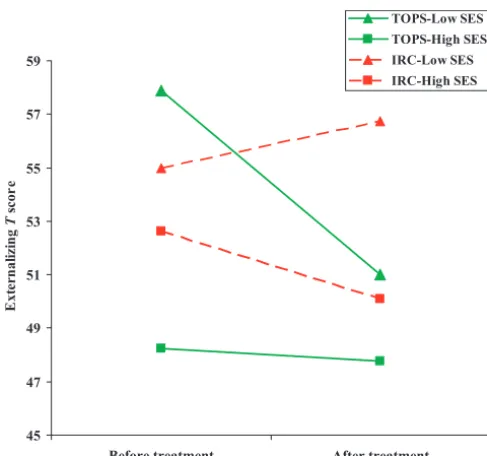
As reported in Table 2 and depicted in Fig 1, SES as assessed by an ordinal ranking of family income moderated the efficacy of TOPS in improving be-havior problems according to reports by both parents and teens. SES moder-ated improvements in parent-reported adolescent externalizing symptoms on the CBCL (F1,30⫽4.45;P⫽.04). Table 2 shows the posttreatment scores for the TOPS and IRC groups at high and low levels of family income statistically adjusted for the baseline score on the respective measure. As depicted in Fig 1, TOPS was associated with greater improvements in parent-reported teen externalizing symptoms among chil-Age at baseline, mean (SD), y 14.49 (2.13) 14.02 (2.45) 0.62
Age at injury, mean (SD), y 13.66 (2.22) 13.46 (2.82) 0.25
Time from injury to baseline, mean (SD), mo 10.32 (4.42) 8.75 (5.51) 0.93
Male,n(%) 11 (58) 6 (38) 1.45
White,n(%) 17 (89) 15 (94) 0.20
GCS score, mean (SD) 10.50 (4.63) 9.47 (4.61) 0.64
Income, mean (SD) 5.58 (3.39) 5.63 (3.24) ⫺0.04
WASI IQ, mean (SD) 98.68 (12.11) 105.19 (16.02) ⫺1.37
Premorbid LD/ADHD,n(%) 5 (26) 1 (6) 2.46
Family income was assessed by using a Likert scale. Income was coded in $5000 to $10 000 increments; 1 corresponds to incomes of less than $20 000, and 9 corresponds to incomes of $70 000 or higher. A rating of 5 corresponds to an income between $35 000 and $39 999, whereas a rating of 6 corresponds to an income between $40 000 and $49 999. WASI indicates the Weschler Abbreviated Scale of Intelligence; LD, learning disability; ADHD, attention-deficit/hyperactivity disorder.
dren with lower SES. The TOPS inter-vention had a large effect on parent-reported externalizing problems among adolescents of lower SES (par-tial2⫽0.21).
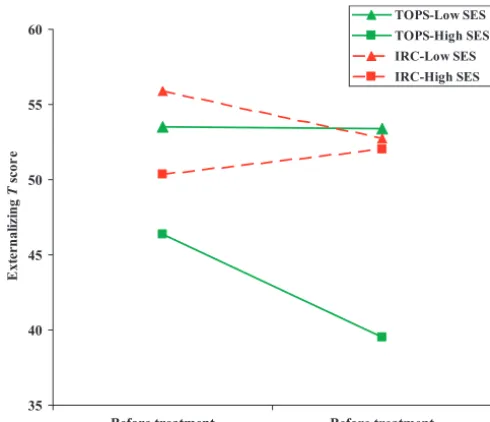
SES also moderated teen self-reported improvements in internalizing and ex-ternalizing totals of the YSR (internal-izing: F1,30⫽4.70;P⫽.04; externaliz-ing: F1,30⫽7.38;P⫽.01). As reported in Table 2, adolescents of higher in-come in the TOPS group reported sig-nificantly greater improvements in ex-ternalizing symptoms (P⫽ .01) than those in the IRC group; whereas there were no differences between the groups among adolescents of lower
in-come (see Fig 2). The effects of TOPS on teen-reported externalizing symptoms were large (corresponding partial2: 0.34). Adolescents of higher SES in the TOPS group also reported greater im-provements in internalizing symp-toms, although the group differences between the TOPS and IRC groups did not achieve significance among the teens from families with high incomes, and the effect sizes were moderate.
Moderating Effects of Injury Severity
Injury severity moderated the effects of TOPS on parent-reported teen inter-nalizing symptoms on the CBCL (F1,30⫽
6.97;P⫽.01). As reported in Table 3, separate analysis of covariance con-trolled for baseline levels of symptoms for participants with severe and mod-erate TBI revealed significant group differences at follow-up among those with severe TBI, but not those with moderate TBI. The corresponding ef-fect sizes were large (partial 2 ⫽ 0.34). Injury severity did not moderate improvements in self-reported inter-nalizing or exterinter-nalizing symptoms on the YSR, although there was a trend for teens with severe injuries to report lower levels of externalizing symptoms at follow-up.
CONCLUSIONS
Our results suggest that TOPS, a Web-based problem-solving treatment for teens with TBI and their families, may be effective in reducing parent-teen conflict and improving externalizing and inter-nalizing behavior problems within cer-tain subgroups. Parents in the TOPS group reported greater reductions in conflict with their adolescents than did parents in the IRC group. Improved parent-teen relationships may contrib-ute to additional improvements in the teen’s behavior over time.14
According to parent reports, teens of lower SES and those with severe TBI were more likely to demonstrate be-havioral improvements after TOPS. Previous investigations have linked low SES and severe TBI to worse behav-ioral outcomes; the combined effects of low SES and severe TBI have re-sulted in significantly poorer long-term recovery.2,3,4In a previous study of online family problem-solving for TBI, children from families of lower SES demonstrated greater improve-ments after the intervention relative to children of lower SES in the control group.8In the current study, both fam-ily income and lowest GCS score had significant negative correlations with externalizing symptoms at baseline.
TABLE 2 CBCL and YSR Internalizing and Externalizing Subscales at Follow-up According to High
and Low Family Income and Treatment Group
Outcome Low Income, Mean (SE) High Income, Mean (SE) F1,30
IRC (n⫽8) TOPS (n⫽8) IRC (n⫽11) TOPS (n⫽8)
CBCL Ext 57.92 (3.07) 49.83 (3.07) 48.87 (1.65) 49.43 (1.95) 4.45a CBCL Int 54.15 (2.82) 47.72 (2.82) 54.84 (2.30) 53.72 (2.71) 1.62 YSR Ext 51.87 (1.86) 54.26 (1.86) 51.21 (2.39) 40.58 (2.99) 7.38a YSR Int 53.50 (2.17) 56.13 (2.17) 50.09 (2.54) 44.63 (2.99) 4.70a
Data are adjusted means and SEs controlled for baseline scores. F values reflect the significance of theR2for the interaction
term of the group with injury severity. Ext indicates externalizing total; Int, internalizing total.
aP⬍.05.
45 47 49 51 53 55 57 59
Before treatment
E
xt
er
nal
iz
in
g
T
s
cor
e
TOPS-Low SES TOPS-High SES IRC-Low SES IRC-High SES
After treatment
FIGURE 1
Means for the CBCL externalizing scale at baseline and follow-up according to group and SES. The influence of SES, as defined by family income, on improvement from baseline to follow-up according to group (TOPS and IRC) is shown. Group differences between the TOPS and IRC groups in externalizing symptoms at follow-up approached significance among families of lower SES (F1,15⫽3.45;P⫽.09).
Thus, the adolescents who benefited most from the TOPS intervention were those who were likely to have the most significant behavioral consequences initially. In a related study, adolescents with severe TBI who received TOPS were found to report significantly greater improvements in executive function skills than adolescents with severe TBI in the IRC.11
It was surprising that improvements on the YSR internalizing and external-izing scales were greater among teens of higher SES. Self-report means for externalizing behavior problems were in the average range for all 4 groups, and the TOPS high-SES group had the
lowest self-reported symptoms ini-tially. Although all teens perceived themselves as doing well, the high-SES TOPS group perceived themselves as doing better, whereas the low-SES IRC group had significantly more behavior problems according to parents’ re-ports. One possible explanation is that adolescents of higher SES had greater cognitive resources, which enabled them to make use of the training in self-regulation and problem-solving to a greater extent than teens in the TOPS group of lower SES. However, given the relatively small sample size and unex-pected nature of these findings, repli-cation is warranted.
Study design also precluded distin-guishing improvements attributable to specific elements of the treatment (ie, training in problem-solving) from sup-portive involvement with a skilled ther-apist. Because TOPS integrated thera-pist support with Web-based skill building, generalization and dissemi-nation to remote locales without skilled therapists may prove more challenging. Assessment of both family conflict and behavior problems relied solely on parent report or self-report, and thus reported improvements may have been inflated by social desirabil-ity biases. Parents in both groups re-ported increased knowledge of TBI, which suggests that both groups per-ceived benefits from the treatment re-ceived. Future studies would benefit from extended follow-up and objective measures of adolescent functioning.
These findings add to the literature that supports the utility of Web-based, family problem-solving interventions to improve outcomes after TBI.8,9 Web-based interventions may be especially appropriate for adolescents who have high levels of computer sophistication coupled with an aversion to tradi-tional, office-based psychotherapy. Large, randomized clinical trials with longer-term follow-up will be neces-sary to establish the efficacy of these interventions.
ACKNOWLEDGMENTS
This work was supported by National Institute of Disability and Rehabilita-tion Research grant H133G050239 (to Dr Wade) and US Department of Educa-tion and Emergency Medical Services grant 10503 from the Ohio Department of Safety.
We acknowledge the contributions of Karen Oberjohn, Paulina Osinska, and Tara Lane in recruitment, data collec-tion, and data entry.
35 40 45 50 55
Before treatment
E
xte
rn
aliz
in
g
T
sc
or
e
IRC-Low SES IRC-High SES
Before treatment
FIGURE 2
Means for the YSR externalizing scale at baseline and follow-up according to group and SES. The influence of SES, as defined by family income, on improvement from baseline to follow-up according to group (TOPS and IRC) on externalizing symptoms on the YSR is shown. Teens of higher SES in the TOPS group reported significant improvements in externalizing symptoms from baseline to follow-up (t7⫽ 10.05;P⫽.001), whereas those of lower SES in the TOPS group and those in the IRC group reported minimal change.
TABLE 3 CBCL and YSR Internalizing and Externalizing Subscales at Follow-up According to TBI
Severity and Treatment Group
Outcome Severe TBI, Mean (SE) Moderate TBI, Mean (SE) F1,29
IRC (n⫽7) TOPS (n⫽7) IRC (n⫽12) TOPS (n⫽9)
CBCL Int 55.44 (2.99) 44.56 (2.99) 50.60 (1.89) 52.42 (2.17) 6.32a YSR Ext 59.01 (2.58) 50.85 (2.58) 46.49 (1.69) 45.56 (1.97) 3.91 YSR Int 54.57 (3.82) 53.86 (3.82) 49.14 (1.98) 48.48 (2.30) 0.12
Data are adjusted means and SEs controlled for baseline scores. F values reflect the significance of theR2for the interaction
term of the group with injury severity. Int indicates internalizing total; Ext, externalizing total.
REFERENCES
1. Langlois JA, Rutland-Brown W, Thomas KE. Traumatic Brain Injury in the United States: Emergency Department Visits, Hospitaliza-tions, and Deaths.Atlanta, GA: Centers for Disease Control and Prevention, National Center for Injury Prevention and Control; 2006
2. Anderson VA, Catroppa C, Morse S, Haritou F, Rosenfeld J. Recovery of intellectual abil-ity following traumatic brain injury in childhood: impact of severity and age of in-jury. Pediatr Neurosurg. 2000;32(6): 282–290
3. Ganesalingam K, Sanson A, Anderson V, Yeates KO. Self-regulation and social and behavioral functioning following childhood traumatic brain injury.J Int Neuropsychol Soc. 2006;12(5):609 – 621
4. Max JE, Levin HS, Landis J, et al. Predictors of personality change due to traumatic brain injury in children and adolescents in the first six months after injury.J Am Acad Child Adolesc Psychiatry. 2005;44(5): 434 – 442
5. Kinsella GJ, Ong B, Murtagh D, Prior M, Saw-yer M. The role of the family for behavioral
outcome in children and adolescents fol-lowing traumatic brain injury.J Consult Clin Psychol. 1999;67(1):116 –123
6. Rivara JB, Jaffe KM, Polissar NL, Fay GC, Liao S, Martin KM. Predictors of family function-ing and change 3 years after traumatic brain injury in children.Arch Phys Med Re-habil. 1996;77(8):754 –764
7. Wade SL, Taylor HG, Yeates KO, et al. Long-term parental and family adaptation follow-ing pediatric brain injury.J Pediatr Psychol. 2006;31(10):1072–1083
8. Wade S. Psychosocial interventions. In An-derson V, Yeates KOPediatric Traumatic Brain Injury: New Frontiers in Clinical and Translation Research.Cambridge, United Kingdom: Cambridge University Press; 2010:179 –191
9. Wade SL, Carey J, Wolfe CR. The efficacy of an online cognitive-behavioral, family inter-vention in improving child behavior and so-cial competence following pediatric brain injury.Rehabil Psychol. 2006;51(3):179 –189
10. Wade SL, Walz NC, Carey JC, Williams KM. Preliminary efficacy of a Web-based family problem solving treatment program for
ad-olescents with traumatic brain injury.J Head Trauma Rehabil. 2008;23(6):369 –377
11. Teasdale G, Jennett B. Assessment of coma and impaired consciousness: a practical scale.Lancet. 1974;2(7872):81– 84
12. Wade SL, Walz NC, Carey J, Williams KM, Cass J, Herren L, Mark E, Yeates KO. A randomized trial of teen online problem solving for im-proving executive function deficits follow-ing pediatric traumatic brain injury.J Head Trauma Rehabil. 2010;25(6):409 – 415
13. Achenbach TM, Rescorla LA.Manual for ASEBA School-age Forms and Profiles. Burl-ington, VT: University of Vermont, Research Center for Children, Youth, and Families; 2001
14. Robin AL, Foster SL.Negotiating Parent Ad-olescent Conflict: A Behavioral Family Sys-tems Approach. New York, NY: Guilford; 1989
15. Wade SL, Taylor HG, Drotar D, Stancin T, Yeates KO, Minich NM. Parent-adolescent in-teractions after traumatic brain injury: their relationship to family adaptation and adolescent adjustment.J Head Trauma Re-habil. 2003;18(2):164 –176
(Continued from first page)
www.pediatrics.org/cgi/doi/10.1542/peds.2010-3721
doi:10.1542/peds.2010-3721
Accepted for publication May 31, 2011
Address correspondence to Shari L. Wade, PhD, Division of Physical Medicine and Rehabilitation, Cincinnati Children’s Hospital Medical Center, 3333 Burnet Ave, Cincinnati, OH 45229. E-mail: [email protected]
PEDIATRICS (ISSN Numbers: Print, 0031-4005; Online, 1098-4275).
Copyright © 2011 by the American Academy of Pediatrics
FINANCIAL DISCLOSURE:The authors have indicated they have no financial relationships relevant to this article to disclose.
DOI: 10.1542/peds.2010-3721 originally published online September 2, 2011;
2011;128;e947
Pediatrics
Erin Mark and Keith Owen Yeates
Shari L. Wade, Nicolay C. Walz, JoAnne Carey, Kendra M. McMullen, Jennifer Cass,
Services
Updated Information &
http://pediatrics.aappublications.org/content/128/4/e947 including high resolution figures, can be found at:
References
http://pediatrics.aappublications.org/content/128/4/e947#BIBL This article cites 11 articles, 0 of which you can access for free at:
Subspecialty Collections
icine_sub
http://www.aappublications.org/cgi/collection/adolescent_health:med
Adolescent Health/Medicine following collection(s):
This article, along with others on similar topics, appears in the
Permissions & Licensing
http://www.aappublications.org/site/misc/Permissions.xhtml in its entirety can be found online at:
Information about reproducing this article in parts (figures, tables) or
Reprints
DOI: 10.1542/peds.2010-3721 originally published online September 2, 2011;
2011;128;e947
Pediatrics
Erin Mark and Keith Owen Yeates
Shari L. Wade, Nicolay C. Walz, JoAnne Carey, Kendra M. McMullen, Jennifer Cass,
Traumatic Brain Injury
Effect on Behavior Problems of Teen Online Problem-Solving for Adolescent
http://pediatrics.aappublications.org/content/128/4/e947
located on the World Wide Web at:
The online version of this article, along with updated information and services, is
by the American Academy of Pediatrics. All rights reserved. Print ISSN: 1073-0397.