IJEDR1404038
International Journal of Engineering Development and Research (www.ijedr.org)3619
Reducing Machining Time by Using Modern
Manufacturing Software
1
Jagadeesh Biradar,
2P. Divakara Rao,
3Dr. C. Udaya Kiran
1PG Student, 2Professor, 3Professor and Head of the Department1Mechanical Engineering, J B Institute of Engineering and Technology, Hyderabad, India
________________________________________________________________________________________________________
Abstract - By implementing feature-based CAM software from Delcam and investing in CNC mills, the industries can be able to reduce machining time and part programming time. Determined to be competitive not only in quality but also in manufacturing methods, the manufacturing companies are upgrading their capability with the help of Delcam software to take models of their components from 3D modeling software’s to production quickly. Typical machining tolerances in the specified range can be consistently achieved. In this thesis, the time taken to manufacture the main housing used in weighing machine is estimated. Main Housing is drawn in 3D Modeling and feature based software Pro/Engineer. The time taken for modeling, part programming and machining time using software’s Pro/Engineer and Delcam is compared and analyzed in this thesis. Models of the casing will be drawn in 3D Modeling and feature based software Pro/Engineer. The models are e imported in to the feature based CAM software Delcam. The time reduction using the software’s for modeling, part programming and machining time is analyzed in this thesis.
_______________________________________________________________________________________________________
I.INTRODUCTION
Machining is any of various processes in which a piece of raw material is cut into a desired final shape and size by a controlled material-removal process. The many processes that have this common theme, controlled material removal, are today collectively known as subtractive manufacturing, in distinction from processes of controlled material addition, which are known as additive manufacturing. Exactly what the "controlled" part of the definition implies can vary, but it almost always implies the use of machine tools (in addition to just power tools and hand tools).
The precise meaning of the term machining has evolved over the past one and a half centuries as technology has advanced. In the 18th century, the word machinist simply meant a person who built or repaired machines. This person's work was done mostly by hand, using processes such as the carving of wood and the hand-forging and hand-filing of metal. At the time, millwrights and builders of new kinds of engines (meaning, more or less, machines of any kind), such as James Watt or John Wilkinson, would fit the definition. The noun machine tool and the verb to machine (machined, machining) did not yet exist. Around the middle of the 19th century, the latter words were coined as the concepts that they described evolved into widespread existence. Therefore, during the Machine Age, machining referred to (what we today might call) the "traditional" machining processes, such as turning, boring, drilling, milling, broaching, sawing, shaping, planning, reaming, and tapping. In these "traditional" or "conventional" machining processes, machine tools, such as lathes, milling machines, drill presses, or others, are used with a sharp cutting tool to remove material to achieve a desired geometry. Since the advent of new technologies such as electrical discharge machining, electrochemical machining, electron beam machining, photochemical machining, and ultrasonic machining, the retronym "conventional machining" can be used to differentiate those classic technologies from the newer ones. In current usage, the term "machining" without qualification usually implies the traditional machining processes.
Machining is a part of the manufacture of many metal products, but it can also be used on materials such as wood, plastic, ceramic, and composites. A person who specializes in machining is called a machinist. A room, building, or company where machining is done is called a machine shop. Machining can be a business, a hobby, or both. Much of modern day machining is carried out by compute. Computer numerical control (CNC), in which computers are used to control the movement and operation of the mills, lathes, and other cutting machines.
IJEDR1404038
International Journal of Engineering Development and Research (www.ijedr.org)3620
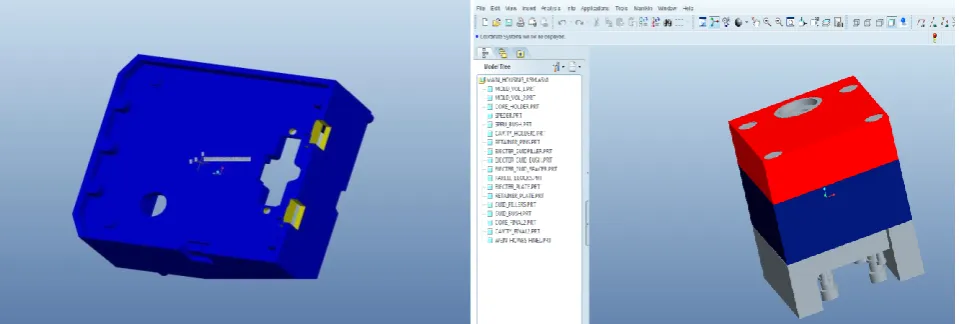
Fig: 2.1 3D Model of Main Housing Fig: 2.2 Die Assembly Of Main HousingFig 2.3: Exploded View Fig: 2.4 Core Holder Plate
IJEDR1404038
International Journal of Engineering Development and Research (www.ijedr.org)3621
Fig: 2.7 Cavity Insert PlateIII.MANUFACTURING PROCESS IN PRO-E 3.1 Roughing
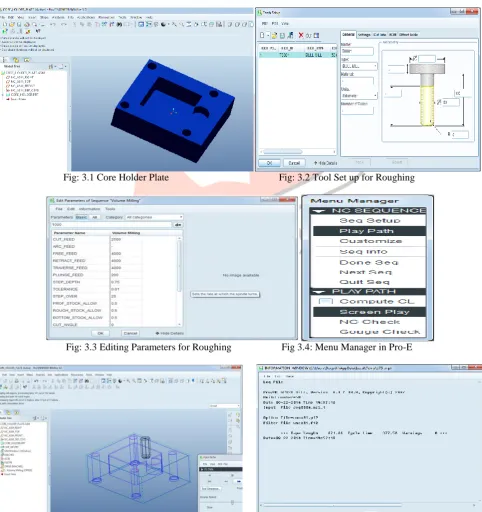
Fig: 3.1 Core Holder Plate Fig: 3.2 Tool Set up for Roughing
Fig: 3.3 Editing Parameters for Roughing Fig 3.4: Menu Manager in Pro-E
IJEDR1404038
International Journal of Engineering Development and Research (www.ijedr.org)3622
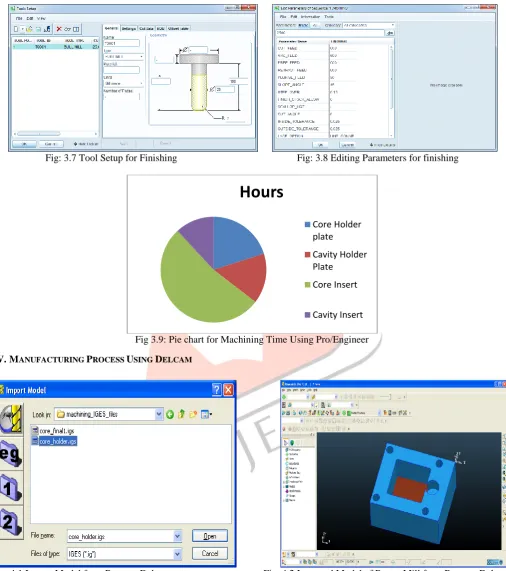
Fig: 3.7 Tool Setup for Finishing Fig: 3.8 Editing Parameters for finishing
Fig 3.9: Pie chart for Machining Time Using Pro/Engineer
IV.MANUFACTURING PROCESS USING DELCAM
Fig: 4.1 Import Model from Pro-e to Delcam Fig: 4.2 Imported Model of Power Mill from Pro-e to Delcam
Hours
Core Holder plate
Cavity Holder Plate
Core Insert
IJEDR1404038
International Journal of Engineering Development and Research (www.ijedr.org)3623
Fig: 4.3 Offset Area Clearance (Model Machining)IJEDR1404038
International Journal of Engineering Development and Research (www.ijedr.org)3624
Fig: 4.6 Feeds and Speeds from DelcamIJEDR1404038
International Journal of Engineering Development and Research (www.ijedr.org)3625
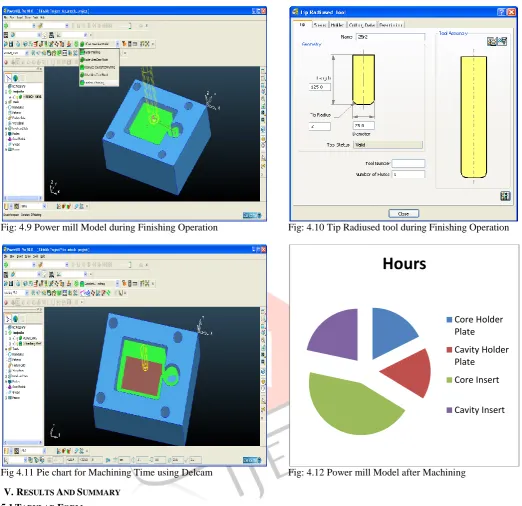
Fig: 4.9 Power mill Model during Finishing Operation Fig: 4.10 Tip Radiused tool during Finishing OperationFig 4.11 Pie chart for Machining Time using Delcam Fig: 4.12 Power mill Model after Machining
V.RESULTS AND SUMMARY
5.1 TABULAR FORM
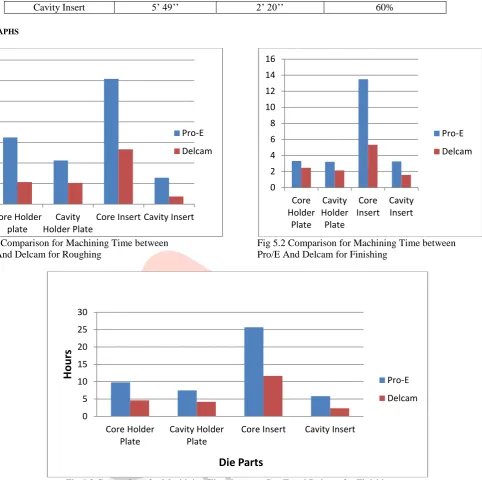
TABLE 5.1:COMPARISON FOR MACHINING TIME BETWEEN PRO/E AND DELCAM FOR ROUGHING
Die Parts Pro/E Delcam Time save (%)age
Core Holder Plate 6’ 29’’ 2’ 09’’ 67%
Cavity Holder Plate 4’ 15’’ 2’ 04’’ 52%
Core Insert 12’ 10’’ 6’ 20’’ 48%
Cavity Insert 2’ 34’’ 45’’ 71%
Table 5.2: Comparison for Machining Time between Pro/E and delcam for Finishing
Die Parts Pro/E Delcam Time save (%)age
Core Holder Plate 3’ 19’’ 2’ 28’’ 26%
Cavity Holder Plate 3’ 13’’ 2’ 08’’ 34%
Core Insert 13’ 30’’ 5’ 20’’ 60%
Cavity Insert 3’ 15’’ 1’ 35’’ 51%
Table 5.3 Comparison for Machining Time between Pro/E and Delcam for Complete part
Die Parts Pro/E Delcam Time save (%)age
Core Holder Plate 9’ 48’’ 4’ 37’’ 53%
Cavity Holder Plate 7’ 28’’ 4’ 12’’ 44%
Core Insert 25’ 40’’ 11’ 40’’ 35%
Hours
Core Holder Plate
Cavity Holder Plate
Core Insert
IJEDR1404038
International Journal of Engineering Development and Research (www.ijedr.org)3626
Fig 5.1 Comparison for Machining Time between Fig 5.2 Comparison for Machining Time betweenPro/E And Delcam for Roughing Pro/E And Delcam for Finishing
Fig 5.3 Comparison for Machining Time between Pro/E and Delcam for Finishing
VI.CONCLUSION
In this thesis, a die for a casting component used in weighing machine is designed in Pro/Engineer. The die parts core holder plate, cavity holder plate; core insert and cavity insert are to be machined.
The manufacturing process is done in both Pro/Engineer and Delcam. The machining time is analyzed and compared for both the software’s. By observing, by performing manufacturing process in Delcam, the machining time is reduced when compared with that of Pro/Engineer. This is because, in Delcam, the non cutting paths are not considered. The machining time for roughing and finishing are still reduced by changing the original parameters.
The finishing process in Pro/Engineer takes more time since it considers the time of roughing also which is a disadvantage. So using manufacturing software Delcam reduces 54% of the machining time and is a better tool than Pro/Engineer.
REFERENCES
[1] Pro-E 5.0 Manual [2] Delcam Manual
[3] K. Krishnapillai, R. Jones, D. Peng, Theoretical and Applied Fracture Mechanics, volume 50, pages30–48, 2008.
[4] Marina Novak, BojanDolsak, Intelligent FEA-based design improvement, journal of Engineering Applications of Artificial Intelligence, volume 21, pages 1239– 1254,2008.
[5] Technical drawings from JDP Tool Tech Workshop. 0 2 4 6 Core Holder plate Cavity Holder Plate
Core Insert Cavity Insert Delcam 0 2 4 6 Core Holder Plate Cavity Holder Plate Core Insert Cavity Insert Delcam 0 5 10 15 20 25 30 Core Holder Plate Cavity Holder Plate
Core Insert Cavity Insert
Hou
rs
Die Parts
Pro-E