University of Pennsylvania
ScholarlyCommons
Publicly Accessible Penn Dissertations
1-1-2015
Experiments, Simulations, and Lessons from
Experimental Evolution
Emily Parke
University of Pennsylvania, [email protected]
Follow this and additional works at:http://repository.upenn.edu/edissertations Part of theBiology Commons, and thePhilosophy Commons
This paper is posted at ScholarlyCommons.http://repository.upenn.edu/edissertations/1114 For more information, please [email protected].
Recommended Citation
Parke, Emily, "Experiments, Simulations, and Lessons from Experimental Evolution" (2015).Publicly Accessible Penn Dissertations. 1114.
Experiments, Simulations, and Lessons from Experimental Evolution
Abstract
Philosophers and scientists have sought to draw methodological distinctions among different kinds of experiments, and between experimentation and other scientific methodologies. This dissertation focuses on two such cases: hypothesis-testing versus exploratory experiments, and experiment versus simulation. I draw on examples from experimental evolution--evolving organisms in a controlled laboratory setting to study evolution via natural selection in real time--to challenge the way we think about these distinctions. In the case of hypothesis-testing versus exploratory experiments, philosophers have distinguished these categories in terms of the role of theory in experiment. I discuss examples from experimental evolution which occupy the poorly characterized middle ground between the two categories. I argue that we should take more seriously the point that multiple theoretical backgrounds can come into play at multiple points in an experiment, and propose some new contributions toward clarifying the conceptual space of experimental inquiry. In the case of experiment versus simulation, people have attempted to clearly delineate cases of science into these two categories, and base judgments about their epistemic value on these categorizations. I discuss and reject two arguments for the epistemic superiority of experiments over simulations: (1) Experiments put scientists in a better position to make valid inferences about the natural world; (2) Experiments are a superior source of surprises or novel insights. Both of these claims are false as generalizations across science. Focusing on the experiment/simulation distinction as a basis for in-principle judgments about epistemic value focuses us on the wrong issues. This leaves us with a question: What should we focus on instead? I offer preliminary considerations for a framework for evaluating inferences from objects of study to targets of inquiry in the world, which departs from the problematic custom of basing such evaluations on questions like "Was it an experiment or a simulation?" This framework is based on the ideas of capturing relevant similarities while appropriately accounting for what researchers already know and what they are trying to learn by asking the scientific question at hand.
Degree Type
Dissertation
Degree Name
Doctor of Philosophy (PhD)
Graduate Group
Philosophy
First Advisor
Michael Weisberg
Keywords
experimental evolution, experiments, exploratory experiments, hypothesis testing, simulations, surprise
Subject Categories
EXPERIMENTS, SIMULATIONS, AND LESSONS FROM EXPERIMENTAL EVOLUTION
Emily C. Parke A DISSERTATION
in Philosophy
Presented to the Faculties of the University of Pennsylvania in
Partial Fulfillment of the Requirements for the Degree of Doctor of Philosophy
2015
Supervisor of Dissertation
________________________
Michael Weisberg, Associate Professor of Philosophy
Graduate Group Chairperson
________________________
Michael Weisberg, Associate Professor of Philosophy
Dissertation Committee
Karen Detlefsen, Associate Professor of Philosophy and Education Daniel Singer, Assistant Professor of Philosophy
EXPERIMENTS, SIMULATIONS, AND LESSONS FROM EXPERIMENTAL EVOLUTION
COPYRIGHT 2015
ACKNOWLEDGMENT
I am immensely grateful to my committee members, all of whom have inspired,
challenged, and encouraged me not only in writing this dissertation but throughout my years as a graduate student. Michael Weisberg has been a great source of insight and support, always encouraging me to develop my own projects while guiding me to take them in fruitful directions and offering knowledgeable feedback every step of the way. I have benefited from all of his advice over the years, on everything from how to give talks to which font to use, and feel very lucky to have him as a supervisor. I am thankful to Karen Detlefsen for her support and generosity with her time, wealth of knowledge on the history and philosophy of the life sciences, and meticulous feedback on my writing. I am grateful to Paul Sniegowski for his thoughtful mentorship, inspiring conversations about science and philosophy and teaching, and for welcoming me into his lab and patiently teaching me so much about biology over the years. I was fortunate to have Dan Singer join my committee in my last two years at Penn, and have appreciated his careful comments on my work which have helped improve my attention to detail, his knowledge and
perspective on formal matters, and general encouragement as I finished the PhD.
While not on my official committee, I am also particularly indebted to three other mentors: Mark Bedau, for his ongoing advising, encouragement, and comments on everything I’ve written in the last 11+ years; Zoltan Domotor, who has been a valuable resource on all matters in philosophy of science; and Mary Morgan, whose work has been an important source of inspiration, for many great discussions and feedback on my work. I am grateful to all of my past and present colleagues in philosophy at Penn, in particular the members of Science Club, and to my fellow members of the Sniegowski Lab for being so welcoming and teaching me everything I know about experimental science: Matthew Gazzara, Angela Halstead, Meredith Hyun, Dave Katzianer, Kate Kerpen, Brooks Martino, Eugene Raynes, Kathleen Sprouffske, Ben Sprung, and especially Chris Gentile, Mitra Eghbal, and Tanya Singh.
I have also benefitted from feedback (both written and in conversations) on portions of the material in this dissertation from a number of others: Wes Anderson, David Barack, Matt Bateman, Brett Calcott, Mark Colyvan, Lindley Darden, Alkistis Elliott-Graves, Karen Kovaca, Peter Godfrey-Smith, Ben Kerr, J. J. LaTourelle, Alan Love, Margaret Morrison, Valerie Racine, Eric Saidel, Carlos Santana, Kyle Stanford, Kim Sterelny, and Michael Travisano.
ABSTRACT
EXPERIMENTS, SIMULATIONS, AND LESSONS FROM EXPERIMENTAL EVOLUTION
Emily C. Parke Michael Weisberg
Philosophers and scientists have sought to draw methodological distinctions among different kinds of experiments, and between experimentation and other scientific methodologies. This dissertation focuses on two such cases: hypothesis-testing versus exploratory experiments, and experiment versus simulation. I draw on examples from experimental evolution—evolving organisms in a controlled laboratory setting to study evolution via natural selection in real time—to challenge the way we think about these distinctions. In the case of hypothesis-testing versus exploratory experiments,
philosophers have distinguished these categories in terms of the role of theory in experiment. I discuss examples from experimental evolution which occupy the poorly characterized middle ground between the two categories. I argue that we should take more seriously the point that multiple theoretical backgrounds can come into play at multiple points in an experiment, and propose some new contributions toward clarifying the conceptual space of experimental inquiry. In the case of experiment versus simulation, people have attempted to clearly delineate cases of science into these two categories, and base judgments about their epistemic value on these categorizations. I discuss and reject two arguments for the epistemic superiority of experiments over simulations: (1)
TABLE OF CONTENTS
1. Experiments 1
1.1.What is an Experiment? 1
1.2.Different Kinds of Experiments 8
1.3.Overview of the Dissertation 10
2. Experimental Evolution 13
2.1.Lenski’s Long-Term Evolution Experiment 16
2.1.1. High Mutation Rates 21
2.1.2. Punctuated Evolution 22
2.1.3. Citrate Utilization 24
2.1.4. Laboratory Natural Selection? 25
2.1.5.The Lenski Experiment? 27
2.2.LNS Experiments Beyond Lenski: History and Current Directions 28
2.3.Tapes of Life, Darwin’s Mistake, and Other Challenges 33
3. Hypothesis-Testing and Exploratory Experiments 37
3.1.Hypothesis Testing: The Classic View of Experiments 39
3.2.Exploratory Experiments: A Response to the Classic View 42
3.3.Spaces of Experimental Inquiry 52
3.4.Theories Can Play Many Roles in Experiments 60
4. Experiments and Simulations 68
4.1.Some Preliminary Points About Experiments and Simulations 69
4.1.1. Simulations or Models? 72
4.2.The Argument about Inferential Power 75
4.3.Responses to the Materiality Thesis 77
4.3.1. Experiments Are Not Necessarily Designed To Be Like Particular Targets 78 4.3.2. Material Correspondence: Hard to Evaluate, Not Always the Goal 81
4.4.Surprise 89
4.4.1. Response to the Surprise Claim 92
4.5.Experimenters Almost Never Study Their Targets Directly 103 4.6.What’s the Difference between Experiment and Simulation? 107
5. Conclusion: Evaluating Inferences about the Natural World 111
LIST OF ILLUSTRATIONS
Figure 1: An illustration of the serial transfer protocol used in Lenski’s experiment...17 Figure 2: A TA plate showing red and white Ara–/Ara+ colonies (photo credit: Paul
Sniegowski)...19
Figure 3: Cell size as a function of time (over 3,000 generations) in one of the 12
populations on the Lenski experiment. From (Elena, Cooper, & Lenski 1996, Figure 1)...23
Figure 4: Dallinger’s drawing of the apparatus used in his evolution experiment (from Dallinger 1887)...30
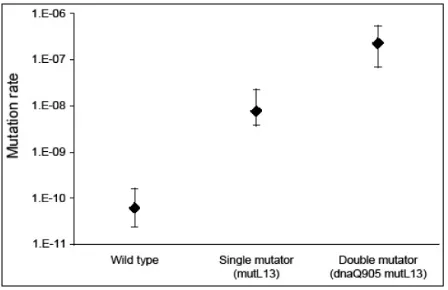
Figure 5: Mutation rates of wild type, single and double mutator E. coli (from (Gentile 2012); see also (Gentile et al. 2011)). Estimates are of the per base pair, per generation genomic mutation rates with 95% confidence intervals for wild type E. coli, single mutators with the mutL13 allele (which confers deficiency in mismatch repair), and double mutators with mutL13 and dnaQ905 alleles (the latter confers deficiency in DNA proofreading). Single mutators have a genomic mutation rate 100–fold higher than the wild type; double mutators have a genomic mutation rate 45–fold higher than single mutators...94
1. Experiments
Experiments play a central role in scientific practice. Throughout the history of
philosophy of science they have been largely neglected in favor of focusing attention on theories and models. Until several decades ago philosophers did not say much about experiments, and when they did, they talked about them mainly just as means to the end of linking theories and models to the world. Philosophy of scientific experimentation is still a surprisingly small but growing area in philosophy of science. Two recent trends in this area have sought to categorize different kinds of experiments, and to distinguish experiment from other scientific methodologies like simulation and observation. A key motivation for carving these sorts of methodological lines is to argue that they correspond to differences in epistemic value. For example, scientists as well as philosophers
commonly claim that experiments have a privileged status over simulations because they put researchers in a better position to generate trustworthy inferences about the natural world. In this dissertation I question the sharpness of some methodological distinctions that have been drawn regarding experiments, and the validity of using methodological categories—experiment versus simulation, in particular—as markers of epistemic differences. I propose a framework for evaluating inferences about the natural world which departs from the problematic custom of basing such evaluations on questions like “Was it an experiment or a simulation?”
1.1. What is an Experiment?
The key characteristic feature of scientific experimentation is intervention. Here are two examples:
A classic case, often featured in textbook introductions in discussions of the scientific method, is Francesco Redi’s series of experiments on insect generation. Redi is the seventeenth-century natural philosopher credited with initiating the end of belief in spontaneous generation. Since antiquity people had believed that inanimate matter could generate new life: riverbeds could give birth to eels (Aristotle, History of Animals
569a10-25; 570a4-12) and grain or sweaty piles of clothing left in a barn could give birth to mice (Fry 2000). In Redi’s experiments on insect generation he set out to challenge the claim that nonliving matter can generate new life (Redi 1668). He placed samples of organic matter in jars, left some uncovered and sealed others with paper and twine, and reported that by preventing insects from gaining access to the latter jars’ contents, no larvae would appear therein. This demonstrated that the life forms which were commonly observed “spontaneously” appearing on meat and other organic matter got there because flies had laid their eggs there, not because of some intrinsic life-generating property in the meat itself. He used hundreds of different kinds of plant and animal matter to
demonstrate this point, including flowers, grasses, and an impressive array of meats ranging from dog and eel to lion and water buffalo. In Redi’s detailed descriptions of thousands of repetitions of this experiment he continually emphasizes the necessity of many iterated rounds of gathering evidence to confirm his beliefs, and the careful use of what we now call controls: experimental setups which isolate single independent variables (for further discussion of Redi’s work see Parke 2014a).
Another example, which has been called the “most beautiful experiment in biology” (Holmes 2001), is Meselsohn and Stahl’s 1957 demonstration of the mechanism of DNA replication (see discussion in Weber 2014). In particular, their experiment
confirmed Watson and Crick’s prediction that DNA replication is semiconservative: When
molecules are copied, one strand of each resulting double helix is newly synthesized, while the other strand remains from the unwound “parent” molecule. Meselsohn and Stahl grew bacteria for a number of generations in a growth medium in which the only available nitrogen was a heavy isotope, 15N, which resulted in the bacteria’s DNA molecules containing only heavy nitrogen. They then transferred the bacteria to growth medium containing only standard lighter nitrogen, 14N, and extracted their DNA after one generation and after two generations in the new growth medium. They put the extracted DNA in a highly sensitive measuring device, capable of separating DNA containing heavy nitrogen, light nitrogen, or a hybrid intermediate. They found that after one round of DNA replication the cells’ DNA contained the hybrid intermediate, and after two rounds the lighter nitrogen version reappeared. This confirmed the hypothesis that DNA
replication is semiconservative.
These are both classic examples where experimenters designed interventions to test hypotheses. Until the last several decades, philosophers of science talked about
experiments almost exclusively as means to the end of testing hypotheses. In Philosophy of Natural Science, Hempel talks about experiments in terms of “bringing about the
conditions C and checking whether E occurs as implied by the hypothesis,” where the C
and E referred to are terms in a hypothesis of the form: If conditions of kind C occur, then an event of kind E will occur (Hempel 1966, p. 20). The examples discussed above fit this sort of model nicely. In the Redi case, the hypothesis in question could be stated as “If jars are sealed to prevent flies from entering them, then no maggots will appear on their contents.” In the Meselsohn-Stahl case, it could be stated as “If the semiconservative model of DNA replication is correct, then we should expect to see a certain pattern of
DNA nitrogen content when moving bacteria from growth medium with 15N to medium with 14N.”
The last few decades have seen philosophers and historians of science increasingly giving experiments more attention, and paying attention to the fact that they do not all fit the standard hypothesis-testing model. Pioneering works in this area include Ian
Hacking’s book Representing and Intervening (1983), Allan Franklin’s The Neglect of
Experiment (1989), and Peter Galison’s How Experiments End (1987). These works laid the early groundwork for a growing literature on experiments and their role in science. There is plenty to say about the contributions of this early work, but the key headlines are: taking experiments more seriously as central to understanding scientific practice; acknowledging that they often play a more complex, exploratory role than mere means to the end of testing hypotheses; beginning to account for the many ways scientists can engage methodologically and epistemically with their experimental objects of study; and exploring the ways that experiments overlap and differ from other scientific methodologies like simulation, observation, and measurement.
I will understand experiments throughout the dissertation as interventions in physical systems, consisting of physical entities and their environments in the laboratory or out in nature. The physical systems experimenters study vary widely, from meat in jars to bacteria in test tubes to electrons in particle accelerators to trees in forests. Okasha nicely characterizes the intuitive idea of the kind of intervention which takes place in experiments (contrasting experiment with observation):
Experiments involve actively intervening in the course of nature, as opposed to observing events that would have happened anyway. When a molecular biologist inserts viral DNA into a bacterium in his laboratory, this is an experiment; but when an astronomer points his telescope at the heavens, this is an observation. Without the biologist’s handiwork the bacterium would never have contained foreign DNA; but the planets would have
continued orbiting the sun whether or not the astronomer had directed his telescope skyward. (Okasha 2011, p. 222)
Following Woodward (2003, 2013) and others, I take the notion of an ideal experimental intervention to have to do with “surgical” change in a variable. As he puts it, regarding two variables A and B, such changes are “of such a character that if any change occurs in B, it occurs only as a result of its causal connection, if any, to A and not in any other way. In other words, the change in B, if any, that is produced by the manipulation of A should be produced only via a causal route that goes through A” (Woodward 2013).
People have also characterized the core methodology of experiments as involving putting a system in a state. Peschard (2012, p. 2) exemplifies this when she defines an experiment as follows:
… experimentation on a physical system S can be thought of as a procedure that consists in, at least:
1. Preparing the system S in a certain state, by fixing initial and boundary conditions, and selectively putting under control the parameters that have an effect on the outcomes of measurement, the active parameters.
2. Letting the system evolve. The evolution of S is characterized by the evolution of a set of physical quantities characterizing the state of S, the state variables.
3. Recording the evolution of S through a sequence of states when the values of some of these parameters are varied; analyzing the results.
Along similar lines, Winsberg (2009, p. 582) says that when one experiments, one “intervenes in [a system] by putting it in a particular initial state and observes its
subsequent states to learn about its properties in light of that intervention.” It might seem like there are two views of experiment at work here, intervention as outlined above versus putting systems in states. I think the latter is just one way to talk about intervention. Talking about it that way implies a certain kind of successful directed intervention. When we put a system in a state we are always intervening, but we can intervene without putting
a system in a state (understood as intending to, and successfully, putting it in a particular state). Parker (2009, p. 487) nicely ties together these two ways to talk about experiments in her characterization:
An experiment can be characterized as an investigative activity that involves intervening on a system in order to see how properties of interest of the system change, if at all, in light of that intervention. An intervention is, roughly, an action intended to put a system into a particular state, and that does put the system into a particular state, though perhaps not the one intended.
So I am inclined to say that the intervention and putting-systems-in-states views are not two different views of what an experiment is, but rather two ways to talk about what experimenters can be up to when they intervene.
Understanding experiments as interventions in physical systems distinguishes them from computer simulations, which are studies of computational models rather than physical systems. This position is somewhat controversial, because some people want to say that computer simulations are experiments. I discuss these views in Chapter 4, but do not want to take a strong position in that debate here or there. A key point I make in that discussion is that we should not hang so much on whether we label cases of scientific inquiry as experiments or simulations. A lot of ink has been spilled arguing for various ways to neatly carve up cases of research into these methodological categories, for the purposes of having categories to base judgments on (for instance, judgments about the epistemic privilege of experiments over simulations). I will argue that such categorization projects focus us on the wrong issues. The relevant points for evaluating cases of scientific inquiry are context-sensitive issues regarding the connection between the object of study and target of inquiry in question, how much a researcher knows about each, and what sort of scientific question she is asking—not whether we have labeled the case as an
experiment or a simulation or something else, per se. My reason for understanding
experiments as interventions in material systems is not to definitively deny simulations status as experiments, but to maintain what I think is an important methodological distinction between studying physical systems and studying computational or
mathematical models on computers. I say more about this methodological distinction in Chapters 4 and 5.
I should underline at the outset that it is not a goal of this dissertation to argue that methodological categorizations are useless or meaningless, or that we should stop using terms like ‘experiment’ and ‘simulation’ to refer to research activities. ‘Experiment’ does and should refer to a way of doing science. My objections will be to views that make generalized claims about science like “Experiment is epistemically better than observation because it involves active manipulation,” or “Experiments allow us to make better
inferences about the natural world than simulations.” Objecting to such claims is
compatible with endorsing the view that there are meaningful methodological differences between experiment, simulation, and observation. I am not objecting to the entire project of distinguishing them.
This is probably as good a place as any to clarify some key terminology regarding experiments which I will use throughout the dissertation:
• Object, or object of study: The system a scientist engages with in order to learn about her target of inquiry. In an experiment, the object is an experimental system. In a simulation, the object is a model.
• Experimental system: The complex of entities and processes (in most biology experiments these are organisms, their environment, and an experimental protocol) which together comprise an experimentalist’s object.
• Target,1 or target of inquiry: The system a scientist ultimately aims to generate knowledge about through studying or intervening in her object. Most often, but not always, the target is some system in the natural world. Very rarely, the object and target are identical. Almost always, they are not (I discuss this point further in Chapter 4).
1.2. Di
ff
erent Kinds of Experiments
Chapter 3 will focus on two kinds of experiments, hypothesis-testing versus exploratory experiments, distinguished according to their relationships with theory. There is another way kinds of experiments are commonly distinguished which is worth mentioning: laboratory versus field versus natural experiments. Laboratory experiments are
distinguished from field and natural experiments according to where they take place and the degree of control researchers have. The former take place, of course, in the lab, and the latter two take place in the world outside the lab. Laboratory experiments generally afford a greater degree of control than field and natural experiments because researchers have control, at least in principle, over far more details of the entities and environments constituting their experimental systems.
Field experiments are distinguished from laboratory experiments primarily according to their location: they take place out in nature rather than in the confines of a laboratory. Unlike laboratory experiments where researchers have control (at least in principle) over many variables, field experiments tend to involve manipulating a single
8
1 I am using the terms ‘object’ and ‘target’ in this way following Winsberg (2009) and others. It is important
variable, like removing or blocking a species from a particular geographic location, or introducing a new species to a localized environment like an island (Diamond 1983; Irschick & Reznick 2009).
The name ‘natural experiments’ is somewhat misleading as a way to distinguish a separate category from field experiments, because both occur out in nature rather than in the confines of the laboratory. In the case of natural experiments, ‘natural’ refers not (just) to the setting but to the way that the experimental intervention comes about. In
laboratory and field experiments, the experimenter himself is responsible for the
intervention; in a natural experiment, he is not. This can be either because somebody else is or nobody is. Woodward defines natural experiments as those which “typically [involve] the occurrence of processes in nature that have the characteristics of an intervention but do not involve human action or at least are not brought about by deliberate human design” (2003, p. 94). A classic example of a natural experiment is the case of the cholera outbreak in London in the 1950s. A physician named John Snow identified a particular public water pump as the source of the outbreak, and found strong associations between using water from that supply and becoming ill or dying of cholera. He also found that districts of the city whose water came from a different supplier had lower rates of cholera. His study of the outbreak in London involved a setup very much like the interventions experimenters intentionally cause in the lab or the field: One group used one water supply, another group used another, and this setup presented an opportunity to test the claim that using water from the former source causes cholera outbreaks. Only in cases like this natural experiment, nobody intentionally caused the intervention. Other examples of natural experiments include cases where species are introduced to novel habitats (either intentionally by humans or not), which afford researchers an unplanned “natural”
experimental setup for studying the evolutionary changes which result from these introductions (see discussion in Irschick & Reznick 2009).
1.3. Overview of the Dissertation
The rest of this dissertation addresses some methodological distinctions that have been made regarding experiments, both within the context of experimentation and between experimentation and and simulation. Throughout the dissertation I rely on examples from a research area which provides particularly provocative cases for challenging the
methodological distinctions in question: experimental evolution. Chapter 2 gives an overview of experimental evolution, which involves researchers propagating populations of organisms in the laboratory as a means to study evolution via natural selection in real time. This research area has received little attention from philosophers of science; it deserves more attention, as it offers a wealth of interesting cases to think about for philosophers interested in topics in scientific methodology, evolution, and ecology. I explain the history and scope of experimental evolution and describe in detail a noteworthy example, Richard Lenski’s long-term evolution experiment. I return to the long-term evolution experiment throughout the rest of the dissertation in my discussion of methodological categorizations and how scientists make inferences from objects to targets.
I then turn to the distinctions which have been drawn among different kinds of experiments. Section 1.2 briefly discussed kinds of experiments distinguished by the methodological issues of where they take place and the extent to which the researcher herself is responsible for the intervention. Chapter 3 focuses on another way that kinds of
experiments are distinguished: according to the role (or better, I argue, roles) played by theory. The classic view of experiments discussed earlier in this chapter says that theory comes first, and the point of experiments is to test the hypotheses that theory generates. Recent literature has rightly pointed out that this is not the whole picture; experiments can also be exploratory. Chapter 3 addresses classic hypothesis-testing versus exploratory experiments, which are methodologically more open-ended and have as their aim filling gaps in theory or generating entirely new theory, rather than testing specific hypotheses. People have had a lot to say about hypothesis-testing and about exploratory experiments, and not much to say about the middle ground. I outline a preliminary account of how to fill in some aspects of this conceptual middle ground, drawing on examples of cases from experimental evolution which occupy it.
In Chapter 4 I turn to the distinction between experiment and simulation. Philosophers have argued that we can divide up cases of science into these two methodological categories, and that doing so gives us a basis for making epistemic judgments. These judgments invariably come out privileging experiments over simulations. I discuss two arguments that have been made for the superiority of
experiments: (1) experiments put researchers in a better position than simulations do for making trustworthy inferences about the natural world, and (2) compared to simulations, experiments are a superior form of surprises or novel insights. I argue that both of these claims are false as generalizations across science. They are not false because experiments and simulations are epistemically on a par, or because simulations are in fact superior— rather, I argue, these methodological categorization-based assessments of science focus us on the wrong issues. We should stop looking to the experiment/simulation distinction to tell us anything in principle about epistemic value. Any judgments about the superiority of
experiments, or simulations, must be made in a context-sensitive way: in the context of a particular field or area of inquiry and the relevant shared background knowledge and research traditions.
This leaves us with a question: If categorical distinctions between experiment and simulation are a poor basis for judgments about inferential power, what is the right basis? Chapter 5 lays out initial considerations for a framework for evaluating inferences from scientific objects of study to targets of inquiry in the world, which departs from the problematic basis of beginning such evaluations by asking questions like “Was it an experiment or a simulation?” My account is based on the ideas of (1) capturing relevant similarities between object and target, and (2) appropriately accounting for what we already know and what we are trying to learn by asking the scientific question at hand. A more developed account is a topic for future work.
2. Experimental Evolution
It used to be the case that biologists’ only reliable sources of empirical information about long-term evolution were the fossil record and living natural populations. There are limitations to using the fossil record to study evolution in action, particularly microevolution, because the evidence contained therein is patchy; it gives us only glimpses of the forms of living things at sporadic points in the past. Data from living natural populations, while in principle much richer in quantity and level of detail,
similarly give us only snapshots. With rare exceptions, like the Grants’ multi-decade study of Galapagos finch populations (Grant & Grant 2002), studies of natural populations do not give us dynamic data about evolutionary lineages through time. They give us static data about a population’s current state and its gene pool, and we must then make inferences about how selection or other evolutionary forces have acted on that population.2
In the past few decades, a relatively new research area has added a richer source of long-term evolutionary data to the picture: experimentalevolution, which involves
propagating populations of organisms in a controlled laboratory setting to study evolution in real time. While experimental evolution actually dates back to the mid-nineteenth century (more on this below), it has become an increasingly active research area in biology just in recent years. The first major anthology on experimental evolution was published in 2009 (Garland & Rose 2009), a 2013 special issue of Biology Letters was devoted to current directions in the field (Bataillon, Joyce, & Sniegowski 2013 and papers
therein), and the American Society for Microbiology just held its first conference on experimental evolution in summer 2014.
In the introduction to their recent anthology, Garland and Rose define experimental evolution as “research in which populations are studied across multiple generations under defined and reproducible conditions, whether in the laboratory or in nature,” involving most, if not all, of the following features: “maintenance of control populations, simultaneous replication, observation over multiple generations, and the prospect of detailed genetic analysis” (Rose & Garland 2009, pp. 6–7). This broad
definition includes natural experiments like studies of invasive species in the wild. It also includes artificial selection experiments and studies of domestication processes.
The discussion in this dissertation will focus on a particular way to do
experimental evolution, a subset of what is covered by Garland and Rose’s broad definition of the field: laboratory natural selection (henceforth LNS) experiments. LNS experiments are more interesting for the present purposes than some of the other kinds of research included under Garland and Rose’s broad understanding of experimental evolution, like artificial selection and studies of natural populations. First, artificial selection has been happening, and has been talked about, for a long time; LNS experiments are newer and hence less discussed. LNS is importantly different from artificial selection: The
32). LNS is also importantly different from studies of natural populations: The controlled laboratory setting allows for much more direct, comprehensive analysis of the
populations’ genetic makeup and evolutionary history. As examples I discuss below illustrate, researchers much greater access to information about the organisms, their environments, their histories, and their genomes than they do in studies of natural populations..
The second, more important reason why I will focus on LNS experiments is that they present particularly compelling challenges for the boundaries philosophers of science have drawn regarding experiments. This is thanks to the combination of three particular features mentioned above: the degree of control afforded by the laboratory setting, the open-ended ability to watch evolution as it happens and collect extensive data throughout the process, and the “closeness” of the evolutionary processes in the lab to those occurring in nature. LNS experiments have features we typically think of as paradigm of
non-experimental methodologies like simulation and observational studies. I return to this point at the end of the chapter.
Section 2.1 gives an overview of an iconic LNS experiment, which I return to as a core example throughout the dissertation: Richard Lenski’s long-term evolution
experiment. Section 2.2 goes into more detail about the history and scope of LNS
experiments in general; Section 2.3 discusses some challenges this research area presents for ideas about the pace of evolutionary change and our ability to empirically test
2.1. Lenski’s Long-Term Evolution Experiment
The organisms of choice for experimental evolution are commonly microbes like bacteria. Bacteria are ideal subjects for a number of reasons: They have short generation times (from several to tens of generations per day), large populations of them can be stored in compact spaces, and they can be frozen and revived, allowing for easy comparisons and competitions between evolved populations and their ancestors (Forde & Jessup 2009; Gentile et al. 2011; Lenski et al. 1991; Travisano et al. 1995).
In February 1988, Richard Lenski’s lab used a single ancestral genome of
Escherichia coli to found twelve genetically identical3 populations in twelve identical environments: flasks filled with 10 ml of bacterial growth medium, a nutrient broth containing glucose as a limiting resource. These E. coli were engineered to be incapable of recombination, that is, they reproduce completely asexually. Lenski’s group was interested in observing the evolutionary dynamics of diversification and adaptation as they
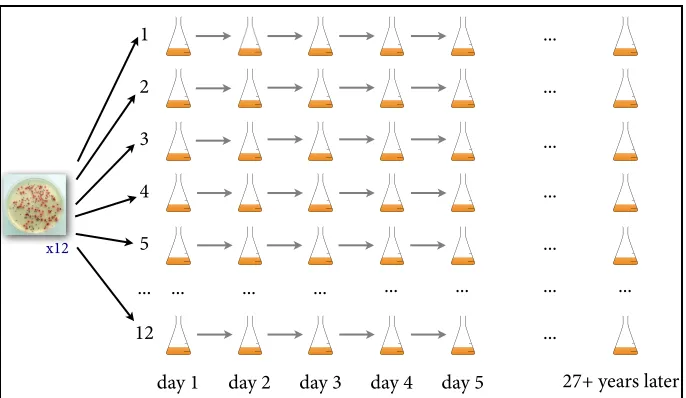
happened in the laboratory. The basic protocol of their experiment involves a simple serial transfer protocol: As the populations grow over the course of every 24 hours, they deplete the resources in their flasks, so every day a 0.1 ml sample of each population is transferred to a flask of 9.9 ml of fresh growth medium and thus allowed to keep on evolving (see Figure 1). Every 75 days (every ~500 generations) population samples from each strain are archived in a -80°C freezer, giving researchers a “frozen fossil record” of the populations’ evolutionary history (Lenski 2011). At any time, samples from these frozen flasks can be thawed and revived for further analysis of the population at the relevant time point, or even to literally back up and “rerun” a given lineage from an earlier time point.
3 Except for one neutral genetic marker, discussed below, which distinguishes six lineages from the other six
unexpected behaviors: high mutation rates (
μ
)
day 2 ... day 3 ... day 4 ... day 5 ... 1 2 3 4 5 12 ... day 1 ... x1227+ years later ... ... ... ... ... ... ... ...
Figure 1: An illustration of the serial transfer protocol used in Lenski’s experiment.
The original motivation for Lenski’s experiment was to learn about the dynamics of adaptation and diversification by watching evolution in real time. Because the
populations started out genetically identical and are evolving in identical environments, any differences in fitness, physiology, or morphology which arise over time are due entirely to new mutations. Since the experiment began in 1988, researchers in Lenski’s lab have been keeping the serial transfer protocol going every 24 hours. These populations go through approximately 6.6 generations per day, which means they have a long
evolutionary history. In 2010 they passed the 50,000 generation mark, and they are still going today (Lenski 2015). To give some perspective to that number: There is debate about exactly how long our species, Homo sapiens, has been around, but estimates point to something on the order of 5,000 to 10,000 generations.4
4 Estimates (depending on method) indicate that the common ancestor of today’s humans lived 100,000 to
200,000 years ago (see, e.g., Jorde, Bamshad, & Rogers 1998). This generation calculation is using a
In addition to the actively evolving populations themselves, researchers have a “frozen fossil record” of the populations’ evolutionary history (Lenski 2011). Every 75 days (every ~500 generations), a sample from each well-mixed flask is archived in a –80°C freezer. At any time, these fossil layers can be thawed and revived, by scraping a tiny sample from the frozen tube into a flask of fresh growth medium and growing it overnight at 37°C. This allows researchers to further analyze the revived population at the relevant time point—or even to back up and restart a lineage from an earlier point in its
evolutionary history.
of the ratio of its final plated density (on day 1) to its initial plated density (on day 0). The relative fitness of an evolved strain, then, is a measure of its growth rate relative to that of the ancestral strain during these direct competitions.
Figure 2: A TA plate showing red and white Ara–/Ara+ colonies (photo credit: Paul
Sniegowski).
migration occurred, the exact nature of the environment, and myriad other details inaccessible in fossil records outside the lab. Not only do they have access to this fossil record, but the populations preserved in it can be revived and their evolutionary history can be literally rerun.
Over 60 papers have been published on the Lenski experiment since its beginning. Early papers focused on questions about adaptation and divergence over the first several thousand generations (Lenski et al. 1991; Lenski & Travisano 1994). Later papers have focused on an impressive range of topics in evolution and ecology including the evolved populations’ response to novel environments (Travisano et al. 1995), ecological
mechanisms promoting coexistence of two populations (Turner, Souza, & Lenski 1996), the relative roles of history, contingency, and selection (Travisano et al. 1995), and three cases which I discuss in more detail in the following subsections: the evolution of high mutation rates (Sniegowski, Gerrish, & Lenski 1997), punctuated morphological evolution (Elena, Cooper, & Lenski 1996), and the evolution of novel traits like citrate utilization (Blount et al. 2012; Blount, Borland, & Lenski 2008). The breadth of what has been learned from this single experimental system is astounding.
form. These bacterial populations are not undergoing artificial selection or simulating natural selection, they are evolving via natural selection. These features raise a number of questions about the relationship between experiment and theory, the role of experiment in scientific inquiry, and how experimental systems relate to systems in the natural world. I get into these questions in detail in Chapters 4 and 5.
2.1.1. High Mutation Rates
The Lenski populations have been used to study the evolution of high mutation rates over long evolutionary time scales. Natural selection needs variation to act on, and new
mutations in organisms’ genetic material are the source of that variation. Most new mutations are deleterious, which intuitively makes sense: There are more ways to mess something up at random than there are ways to improve it. One might expect that in well-adapted populations in unchanging environments (that is, in the absence of new selection pressure), genomic mutation rates would stay the same over time or perhaps even
decrease. In just three of the twelve Lenski populations, the opposite happened: Their genomic mutation rates increased by two orders of magnitude after 10,000 generations. The explanation for how this happened involves mutator alleles, which raise the genomic mutation rate by inhibiting mechanisms like DNA mismatch repair or proofreading. Sniegowski and colleagues (1997) found that mutator alleles arise spontaneously, by mutation, and then hitchhike to high frequencies5 in the experimental populations, which is possible because those populations are completely asexual.
5 Mutator hitchhiking is a phenomenon whereby new mutations arise in a genome which are favored by
From this point about high mutation rates evolving in three of the laboratory populations, the authors make an inference about populations outside of the laboratory. They conclude that high mutation rates might evolve via the same hitchhiking
mechanisms in similar clonal populations of cells with high mutation rates in the natural world—in particular, pathogenic E. coli and Salmonella (Sniegowski, Gerrish, & Lenski 1997, p. 704).
2.1.2. Punctuated Evolution
In this second example, a different sort of inference is made from the same object of study. In a paper called “Punctuated Evolution Caused by Selection of Rare Beneficial
Mutations,” Lenski and colleagues used results from their evolving E. coli populations to make claims about punctuated equilibrium: the notion that evolution occurs in long periods of relative stasis punctuated by short periods of rapid change (Elena, Cooper, & Lenski 1996). Punctuated equilibrium was a hot topic in contemporary discussions of macroevolutionary trends in the fossil record, notably championed by Gould and Eldredge in their discussion of events like the Cambrian explosion, in the context of rejecting views about the ubiquity of phyletic gradualism (Eldredge & Gould 1972; Gould & Eldredge 1977).
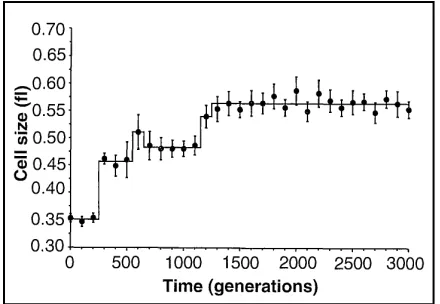
stable for another 300 generations before dramatically increasing again (see Elena, Cooper, & Lenski 1996 Figure 1, reproduced as Figure 3 below). This led the researchers to claim that punctuated evolutionary trends could be observed on (relatively) very short time scales, associated with the rise of beneficial new mutations in the population which rapidly sweep to fixation.6They conclude the paper with an inference from what
happened with the experimental populations of bacteria to a claim about what might be going on in the fossil record, or at least a subset of populations represented in the fossil record, delineated by certain features of their evolutionary history and environmental conditions:
The experimental population was strictly asexual, which may have increased our ability to resolve punctuated changes. However, any difference between sexual and asexual populations with respect to the dynamic of adaptive evolution breaks down when two conditions are met: (i) standing genetic variation for fitness is exhausted, as will eventually happen in any constant environment, and (ii) beneficial mutations are so rare that they occur as isolated events. To the extent that these conditions are fulfilled in nature, then the selective sweep of beneficial alleles through a population might explain cases of punctuated evolution in the fossil record. (Elena, Cooper, & Lenski 1996, p. 1804)
Figure 3: Cell size as a function of time (over 3,000 generations) in one of the 12 populations on the Lenski experiment. From (Elena, Cooper, & Lenski 1996, Figure 1).
6The authors are careful to use the term ‘punctuated evolution’ rather than ‘punctuated equilibrium’. Still,
2.1.3. Citrate Utilization
The glucose-limited growth medium the Lenski populations live in also contains citrate. Citrate is an additional energy source in principle, but E. coli cannot use citrate as an energy source in oxic conditions (when oxygen is present). During the first 30,000 generations of the experiment, none of the twelve populations evolved the ability to exploit environmental citrate. As Lenski describes this in a later paper,
One of the defining features of E. coli as a species is that it can’t grow on citrate because it’s unable to transport citrate into the cell. For 15 years, billions of mutations were tested in every population, but none produced a cell that could exploit this opening. It was as though the bacteria ate dinner and went straight to bed, without realizing a dessert was there waiting for them. (Lenski 2011)
By 31,500 generations, a Cit+ (citrate utilizing) phenotype had evolved in just one of the 12 strains, strain Ara–3. As the authors of the first paper on this surprising result point out, by 30,000 generations “each population experienced billions of mutations, far more than the number of possible point mutations in the ~4.6-million-bp genome. This ratio implies, to a first approximation, that each population tried every typical one-step mutation many times. It must be difficult, therefore, to evolve the Cit+ phenotype, despite the ecological opportunity” (Blount, Borland, & Lenski 2008, p. 7900).
Blount and colleagues tested whether the Cit+ phenotype arose in strain Ara–3 because of an unusual rare mutation, or because of historical contingency and the
evolutionary time point approaches 31,500 generations). They replayed and tested hundreds of replicates of strain Ara–3 from earlier time points, and the results supported the historical contingency hypothesis: some genetic background had arisen earlier in that strain’s history which paved the way for the Cit+ phenotype.
Concurrently with the Cit+ phenotype arising, there was also significant
population expansion in Ara–3, measured by optical density readings of the strain before and after the 31,500-generation time point. Interestingly though, the Cit+ phenotype did not fix in that population; Cit– (non-citrate utilizing) phenotypes persisted at a frequency
of around 1%.7 The authors suggest that the Cit– cells persist as glucose specialists, given their higher growth rate and shorter lag phase compared to Cit+ cells when utilizing glucose (Blount, Borland, & Lenski 2008). Frequency-dependent selection here appears to maintain ecological diversity in the population. The paper suggests future directions for research on the evolution of this novel phenotype including studying whether
differentiation into Cit+/Cit– phenotypes might be a first stage in sympatric speciation.
2.1.4. Laboratory Natural Selection?
Before moving on, it is worth addressing and setting aside a question—are these laboratory populations really undergoing natural selection? Two related ideas might motivate this question. The first holds that struggle for existence is a necessary condition for natural selection (as Darden has argued, in a personal communication, but see also Darden & Cain 1989) and questions whether there is genuine struggle for existence in the Lenski system. Second, one might wonder whether natural selection is really acting when
7This stable coexistence was confirmed in subsequent replays of mixed Cit+/Cit– populations; different
researchers are imposing the conditions, as part of the serial transfer protocol, for which organisms carry on to each subsequent generation.
In response to the first point: Questioning whether or not natural selection is acting here, for this reason, implies subscribing to the view that there can be struggle for existence only when that struggle is between organisms and a changing, challenging abiotic environment. On this line of thought, the abiotic environment (the bacterial growth medium) in Lenski’s experiment, kept constant throughout the experiment, presents the bacteria with no opportunity for struggle for existence and thus removes a necessary condition for evolution via natural selection. This is wrong for two reasons. First, while the recipe for the nutrient broth is always the same, the abiotic environment in the flask changes over the course of every 24 hours as the populations deplete
environmental glucose. Second, and more importantly, the environment relevant to thinking about the struggle for existence includes not only abiotic factors but other
organisms as well. The citrate utilization case (Section 2.1.3) is a perfect illustration of this: Citrate was part of the abiotic environment all along, but the sudden arrival of
conspecifics capable of using it to their advantage changes the selective environment for the population as a whole. Darwin himself understood struggle for existence the way I am here, to include other organisms as well as the abiotic environment:
In response to the second point, about it being up to researchers which individuals will carry on to the next generation: Population samples are taken from well-mixed flasks and transferred to a new flask each day. Researchers are not choosing which individuals from the population will make it into the next flask based on any features those
individuals possess, such as their phenotype or their location in the flask. The flask is constantly shaken over the course of the experiment, so the sample that carries on to the new flask each day is random and representative of the population. A bottleneck occurs each time a sample is transferred to a flask of fresh growth medium, but nobody has any say in which organisms make it through the bottleneck.
The selection process in the Lenski experiment is really natural selection. That is a crucial feature of what makes this and other LNS experiments such powerful tools for studying evolution in action. There might be all sorts of other reasons, in a given case, why inferences from what happens in the laboratory to what happens in nature might call for validation. As I will discuss in Chapter 5, some such inferences are more questionable than others due to differences in our reasons to trust that the laboratory populations are relevantly similar to the target populations in question. But “It’s not really natural selection” is not one of these reasons.
2.1.5. The Lenski Experiment?
Another question that might come up about the Lenski experiment is: What is “the experiment?” The 27+ years (tens of thousands of generations) of propagation of replicate
the above-mentioned 60+ publications from Lenski’s group based on this work.8 It might also make sense to think of the particular treatments and protocols contained in each of those papers as an experiment or set of experiments in itself (the researchers themselves sometimes refer to new treatments concurrent with the ongoing evolution experiment, like varying the growth medium or temperature, as separate evolution experiments (Lenski 2011)). So, there might be an argument for thinking of those studies as the experiments, and the 26+ years of propagation as a research tool rather than an experiment in itself. I suggest not getting hung up on worrying about the ontology of particular experiments at this level of detail. Nothing rests on this for the purposes of this dissertation. It makes more sense to talk about cases of experimental inquiry—Lenski’s work certainly counts—rather than looking for clean lines to draw around one experiment and another within the context of a given scientist’s or laboratory’s research.
2.2. LNS Experiments Beyond Lenski: History and Current Directions
The Lenski experiment is especially impressive and deservedly famous. But LNS
experiments actually date back to the 1880s, when William Henry Dallinger reported on a long-term evolution experiment in his Presidential Address to the Royal Microscopical Society (Dallinger 1887; see also discussion in Huey & Rosenzweig 2009). Dallinger’s goal was to discover “whether it was possible by change of environment, in minute life-forms, whose life-cycle was relatively soon completed, to superinduce changes of an adaptive character, if the observations extended over a sufficiently long period” (1887, p. 191). His
subjects were “the lowest forms of the infusoria,”9 and his chosen environmental manipulation was slowly increasing the temperature. He constructed an apparatus designed to maintain a constant temperature: a large water-filled copper vessel insulated with felt, with space for three glass inserts containing “putrefactive fluids” and the
microorganisms themselves (Figure 4). This was attached to a mercury thermometer and gas flame rigged to automatically regulate and stabilize the temperature in the glass vessels to within 1/4 of a degree Fahrenheit. Dallinger began slowly turning the temperature up— from 60° to 70°F (15.6°–21.1°C) over the first four months of the experiment—and observed the organisms in the vessels through a microscope attached to the apparatus, noting changes in their morphology and behavior. He gives a detailed account of their slow adaptation and stabilization at various temperatures as he continued to turn up the temperature after those first four months, describing them at 93°F (33.9°C) as about “to surrender to torpor and death,” after which point some organisms seemed to stabilize. With painstaking diligence he describes slowly turning the temperature up, with long pauses in between, finally reaching 158°F (70°C). He concludes with a note on the
remarkable adaptation of his populations at later time points: “If the adapted organisms at 158° F. were taken from that temperature and placed in an eminently nutritious and suitable nutritive fluid at 60° they died. While, of course, if forms of the same kind exactly, living and flourishing at 60°, were placed in a nutritive sterilized fluid at even 150° they were finally destroyed” (p. 199).
9 ‘Infusoria’ is an obsolete term for a class of aquatic microorganisms, including primarily the organisms we
Figure 4: Dallinger’s drawing of the apparatus used in his evolution experiment (from Dallinger 1887).
Dallinger’s experiment took seven years. It was brought to an abrupt halt only when “an accident, which no foresight could have guarded against, happened to the apparatus employed” (p. 190).10This stands out as a remarkably early exemplification of the key features of LNS experiments discussed above: long-term study of populations in the laboratory evolving via natural selection in a controlled environment.
LNS experiments began using bacteria in the 1950s, when Novick and Szilard (1950) used a chemostat to limit resources in populations of E. coli, controlling their
10 A side note of interest: Dallinger corresponded with Darwin in 1878 about his preliminary results; he
growth rate, and observed their rates of spontaneous mutation to resistance to
bacteriophages T4 and T5. Another notable early LNS experiment, published a year later, is described in a paper by Atwood and colleagues propagating E. coli in Erlenmeyer flasks at 37° C and transferring samples from each flask to a new one every 12 hours (1951). E. coli
are popular organisms of choice for the reasons cited above: their short generation times, ease of manipulability, ability to freeze and revive, and the wealth of existing knowledge about their genomes and other traits. But LNS experiments use all sorts of other
organisms as well, including viruses (Bono et al. 2013; Forde & Jessup 2009), fungi (Gifford, de Visser, & Wahl 2013), yeast (Gerstein 2013; Ratcliff et al. 2012; Zeyl 2000), green algae (Bell 2013; Colegrave et al. 2002), nematodes (Matsuba et al. 2013), insects (Simoes, Santos, & Matos 2009; Zera & Harshman 2009), and mice (Barnett & Dickson 1984).
Since the early examples discussed above and the beginning of Lenski’s
experiment, LNS experiments have made progress in a variety of issues in evolutionary biology and ecology. I do not have space for a thorough overview (but see Bataillon, Joyce, & Sniegowski 2013; Garland & Rose 2009 and papers therein), but will mention just a few more brief examples here to illustrate the breadth of topics covered in the field beyond Lenski’s work.
sinking to the bottom of test tubes, and watch it begin to form “snowflake”-like clusters which appear to show some division of labor, characteristic of entities at the transition from unicellular to multicellular life (Ratcliff et al. 2012). Rainey and colleagues have examined the transition in experimental populations of the bacterium Pseudomonas
fluorescens, in a spatially structured heterogenous environment, from living as individuals to living in cooperating groups, a first step in the evolutionary transition to
multicellularity (Rainey & Rainey 2003). This work on experimental evolution of
multicellularity ties to questions in the philosophy of biology about levels of selection and individuality, for example, at which point do these multicellular clusters become
individuals or objects of selection in themselves, and what are the implications? Recent experimental microbial evolution studies have also investigated the evolution of sex. Sexual reproduction is more costly than asexual reproduction. As Maynard Smith famously put it, there is a “twofold cost of sex:” Organisms that have sex contribute only half of their genetic material to their offspring (versus asexual organisms which contribute all of it), and all else being equal an asexual population grows twice as quickly as a sexual one (Maynard Smith 1978). Recent work in experimental evolution has investigated the tradeoffs between asexual and sexual reproduction. Raynes and
LNS experiments have also been used to study the mechanisms maintaining biodiversity. Kerr and colleagues have used laboratory microbial populations to look at the stable coexistence of different strains of E. coli in different spatial configurations. They set up a rock-paper-scissors dynamic involving three strains of E. coli: a colicin-producing strain (C) produces a toxin which kills a colicin-sensitive (S) strain; the sensitive strain however outgrows a third resistant strain (R), which in turn outgrows the colicin-producing strain. Thus there is a rock paper scissors dynamic: C beats S; S beats R; R beats C. They found that the three stains stably coexist when their interactions are spatially localized, but not when they disperse and interact over relatively large spatial scales (Kerr et al. 2002).
LNS experiments are making progress in a host of other research areas including studies of the interaction between evolution and ecology (Jessup et al. 2004), our
understanding of cancer as an evolutionary phenomenon (Sprouffske et al. 2012), genetic interactions and their influence on evolution, the evolution of sociality, and how
environmental variation affects evolution (see Bataillon, Joyce, & Sniegowski 2013; Garland & Rose 2009 and papers therein).
2.3. Tapes of Life, Darwin’s Mistake, and Other Challenges
provocatively titled paper “Darwin’s Other Mistake,”11 experimental evolution shows that this is wrong (see also Bataillon, Joyce, & Sniegowski 2013). It allows us to watch evolution as it happens, and observe remarkable changes in populations with generation times shorter than our own.
Another idea which LNS experiments have challenged regards our ability to “replay the tape of life.” As part of his argument for evolutionary biologists to take
historical contingency more seriously, Gould proposed a thought experiment in which we could rewind the history of life on Earth to some point in the deep past, erase what had happened from that point on, and replay it to see how things evolved. Gould said that if we were to do this, we could expect that “any replay of the tape would lead evolution down a pathway radically different from the road actually taken” (1989, p. 51). This is a powerful thought experiment, and Gould presented it as only a thought experiment, saying that we could never actually replay the tape of life. Lenski’s long-term evolution experiment proves him wrong: not his claim that evolution would differ were we to replay the tape, but his claim that we could never perform this experiment on real living systems by backing them up and “replaying” them from some earlier point in their evolutionary history, from the same starting conditions. Beatty (2006) and Desjardins (2011, note 3) have noted in previous discussions of the Lenski experiment that “playing” the twelve different lineages from the exact same genetic starting point in identical environments gives us an approximation of what Gould had in mind with replaying the tape. In other words, we can think of the twelve lineages as twelve “runs” of the same course, since they all began with the same ancestor. But there is also a further sense in which long-term microbial evolution experiments like Lenski’s allow us to replay the tape of life: As
11The first mistake alluded to is Darwin’s set of beliefs about the mechanism of heredity and blended
discussed above, the experimental populations can be frozen, defrosted, and “rerun” from any point in time. In other words, not only does the set of twelve lineages represent twelve replays of the same tape, the individual lineages themselves can be replayed, just by defrosting them and regrowing them. This latter aspect of the experiment represents an even more straightforward way in which experimental evolution allows us to replay the tape of life. Gould had in mind replays of the tape of life on a much vaster evolutionary time scale, spanning speciation events and hundreds of thousands of generations or more. The evolutionary time scale of the Lenski experiment is (so far) orders of magnitude smaller. In any case, the long-term evolution experiment offers an extremely powerful tool for investigating questions about the relative roles of history, chance, and adaptation in evolutionary processes (Futuyma & Bennett 2009; Travisano et al. 1995).
The Lenski experiment is by far the most well-known LNS experiment. It is the only one philosophers have talked about in detail. Beyond Beatty and Desjardins’
discussions, philosophers had not had much to say about this research area.12 In the rest of this dissertation I return frequently to examples of LNS experiments, as a case study for challenging ways philosophers and scientists have talked about methodological
boundaries in science.
What is special about LNS experiments, that they seem to straddle these different classic divisions in scientific methodology? We generally think of the ways to do biology as doing theory, studying laboratory-bred populations, or studying populations in nature. (This is not meant to be an exhaustive list, but the main research methodologies that come
12There are a few exceptions; for example Love and Travisano (2013) discuss examples of experimental
3. Hypothesis-Testing and Exploratory Experiments
As discussed in Chapter 1, in the last few decades philosophers and historians of science have pushed to focus more attention on experiments and their role in scientific inquiry (A. Franklin 1990; Galison 1987; Hacking 1983; Radder 2003; Weber 2004). Recent literature on exploratory experiments has addressed ways in which the classic picture of hypothesis-testing does not capture everything that experimenters are up to (Burian 2007; Elliott 2007; L. Franklin 2005; O'Malley 2007; Steinle 1997; Waters 2007). In this chapter, I argue that we need a better account of the whole space of experimental inquiry;
hypothesis-testing and open-ended exploration are not the entire picture. Waters (2007) and Elliott (2007) have previously made the point that there is such a space, but much work remains to be done to clarify it. As a starting point for that larger project, I propose a more nuanced way to think about the relationship between experiment and theory.13 I will frame this discussion within the context of examples of LNS experiments. This is a good starting point because these examples put pressure on the idea that cases of experimental research can be neatly classified as one or the other (hypothesis-testing or exploratory).
In Chapter 1 I talked about some classic examples of experiments, Redi’s experiments on insect generation and the Meselsohn-Stahl experiment. From the
discussion in Chapter 2, it should already be clear that LNS experiments are different from these canonical cases in interesting ways. The Lenski experiment did not begin with the aim of confirming or rejecting a particular hypothesis, but a number of questions have
13 Let me be clear from the outset what I mean by ‘theory’. I intend this broadly to encompass both syntactic
been answered, and hypotheses tested, along the way. Furthermore, the experimental setup incorporates elements of what we usually consider two very different kinds of inquiry: active intervention and manipulation, versus passively watching to see what happens while nature runs its course, typically considered the hallmarks of experiment and observation, respectively. The Lenski experiment takes place in an “artificial” laboratory system, but it was motivated by the desire to capture the process of natural selection in its “natural” form; these bacterial populations are not undergoing artificial selection or simulating natural selection, they are really evolving via natural selection. These sorts of features raise questions about the nature of experimental inquiry and the relationship between experiment and theory. In the rest of this chapter, I lay out the two main views in the literature on the nature of experimental inquiry and the relationship between experiment and theory, and discuss why neither of them alone adequately characterizes what is going on in Lenski’s experiment. This points to the need for a more nuanced understanding of possible experiment–theory relationships, as more than just a binary set of options. The latter point is not novel (see discussion below of Brandon’s, Waters’, and Elliott’s contributions on this front). My contribution in this chapter is to make progress on clarifying the conceptual space of experimental inquiry by developing an account of how we should think about a key set of dimensions of that space: the relationship between experiments and theories.