University of Pennsylvania
ScholarlyCommons
Publicly Accessible Penn Dissertations
1-1-2014
Temporal Processing in Auditory Perceptual
Grouping and Decision-Making
Andrew S. Liu
University of Pennsylvania, [email protected]
Follow this and additional works at:http://repository.upenn.edu/edissertations
Part of theNeuroscience and Neurobiology Commons
This paper is posted at ScholarlyCommons.http://repository.upenn.edu/edissertations/1348
Recommended Citation
Liu, Andrew S., "Temporal Processing in Auditory Perceptual Grouping and Decision-Making" (2014).Publicly Accessible Penn Dissertations. 1348.
Temporal Processing in Auditory Perceptual Grouping and
Decision-Making
Abstract
How do perceptual decision-making and auditory perceptual grouping interact on a perceptual,
computational, and neural level? The work in this dissertation lays the groundwork to investigate the neural basis for auditory perceptual decisions by examining the perceptual and computational effects of the temporal structure of an auditory stimulus. I examined the role of auditory perceptual grouping on auditory perceptual judgments by asking whether the presentation rate of a stimulus sequence, which can affect the perceptual grouping of the stimulus, affects how sensory evidence converted into a decision. I devised a task that allows us to test, under different grouping conditions, whether the observed performance was consistent with changes in the representation of sensory evidence used to make the perceptual judgment or in the process by which the sensory evidence is converted into the decision. Subjects made a judgment on the frequency changes over time of a tone sequences while the interburst interval (IBI), or the time between tones of the stimulus, was varied across trials. I examined how subjects processed the sensory evidence to form their decisions as well as modeled the effect of IBI on their decision-making process. The results show that subjects accumulated sensory evidence over time to form their judgment and while IBI and perceived grouping did not affect the accumulation rate, subjects accumulated less total sensory evidence for long IBIs consistent with a collapsing decision boundary. By understanding how the brain converts sensory stimuli into a perceptual decision with our task, we can better understand the computational principles and the neural implementation of how auditory percepts are formed.
Degree Type
Dissertation
Degree Name
Doctor of Philosophy (PhD)
Graduate Group
Bioengineering
First Advisor
Yale E. Cohen
Subject Categories
TEMPORAL PROCESSING IN AUDITORY PERCEPTUAL GROUPING AND DECISION-‐ MAKING
Andrew S. K. Liu
A DISSERTATION
In
Bioengineering
Presented to the Faculties of the University of Pennsylvania in
Partial Fulfillment of the Requirements for the Degree of Doctor of Philosophy
2014
Supervisor of Dissertation
__________________________________ Yale Cohen
Associate Professor of Otorhinolaryngology
Graduate Group Chairperson
__________________________________
Jason Burdick, Professor of Bioengineering
Dissertation Committee
TEMPORAL PROCESSING IN AUDITORY PERCEPTUAL GROUPING AND DECISION-‐ MAKING
COPYRIGHT
2014
Acknowledgements
I want to thank my mentors, Yale Cohen and Josh Gold, and the rest of my thesis committee, Diego Contreras and Alan Stocker for their guidance. I want to thank the past and present members of the Cohen Lab, especially Adam Gifford, Kate
Christison-‐Lagay, Joji Tsunada, Sharath Bennur, and Harry Shirley for their advice and support.
I wish to express my heartfelt gratitude to my wife, Wei, who has been
tremendously supportive and understanding during the writing process, to my parents, Jung-‐Dee and Jaung-‐Shen, and my sister, Betsy, for their guidance and support through all of the years.
ABSTRACT
TEMPORAL PROCESSING IN AUDITORY PERCEPTUAL GROUPING AND DECISION-‐ MAKING
Andrew S. K. Liu
Yale E. Cohen
How do perceptual decision-‐making and auditory perceptual grouping
interact on a perceptual, computational, and neural level? The work in this
dissertation lays the groundwork to investigate the neural basis for auditory
perceptual decisions by examining the perceptual and computational effects of the
temporal structure of an auditory stimulus. I examined the role of auditory
perceptual grouping on auditory perceptual judgments by asking whether the
presentation rate of a stimulus sequence, which can affect the perceptual grouping
of the stimulus, affects how sensory evidence converted into a decision. I devised a
task that allows us to test, under different grouping conditions, whether the
observed performance was consistent with changes in the representation of sensory
evidence used to make the perceptual judgment or in the process by which the
sensory evidence is converted into the decision. Subjects made a judgment on the
frequency changes over time of a tone sequences while the interburst interval (IBI),
or the time between tones of the stimulus, was varied across trials. I examined how
subjects processed the sensory evidence to form their decisions as well as modeled
the effect of IBI on their decision-‐making process. The results show that subjects
accumulated sensory evidence over time to form their judgment and while IBI and
total sensory evidence for long IBIs consistent with a collapsing decision boundary.
By understanding how the brain converts sensory stimuli into a perceptual decision
with our task, we can better understand the computational principles and the neural
implementation of how auditory percepts are formed.
Table of Contents
Acknowledgements ... iii
Abstract ... iv
List of Illustrations ... vii
1
Introduction ... 1
2
Integration of Auditory Contour Information is Invariant to Time
Gaps and Perceptual Grouping of Stimulus ... 14
3
Discussion ... 51
Bibliography ... 60
List of Illustrations
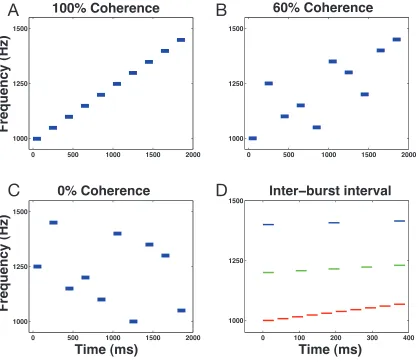
Figure 1 – Stimulus
42
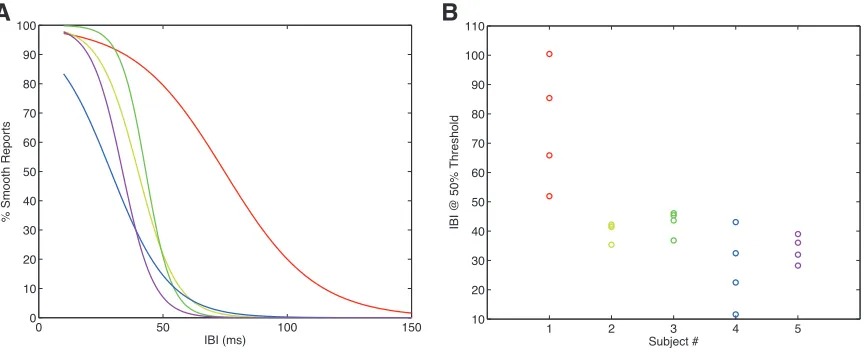
Figure 2 – IBI vs. Perceptual Grouping
43
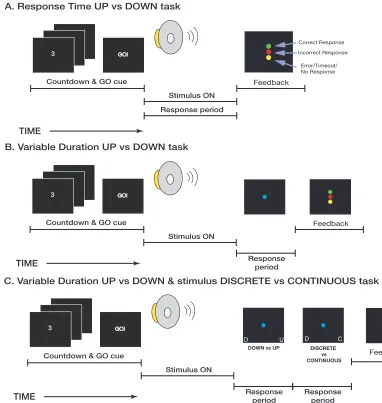
Figure 3 – Task
44
Figure 4 – Response Time Psychometric & Chronometric Data
45
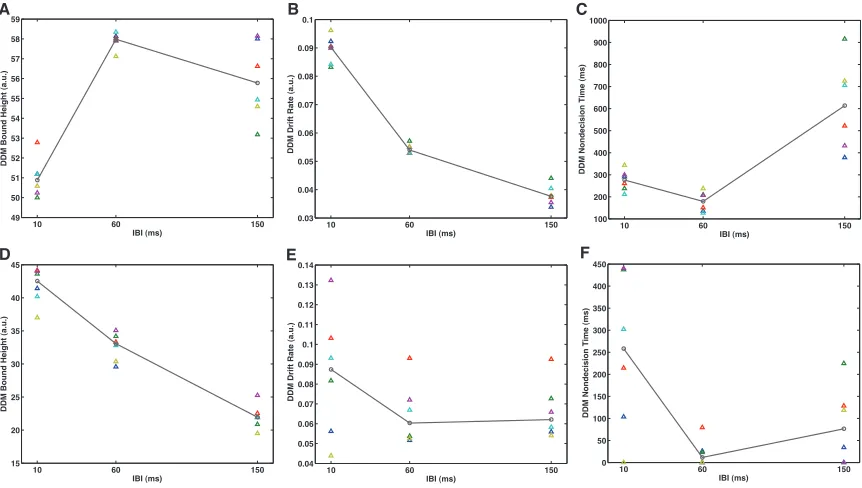
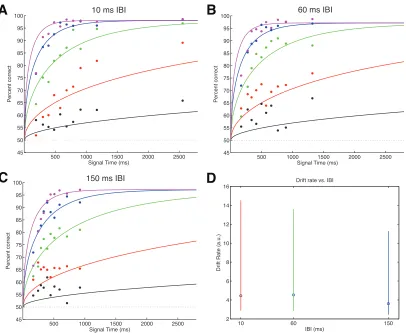
Figure 5 – Response Time Model Fits
46
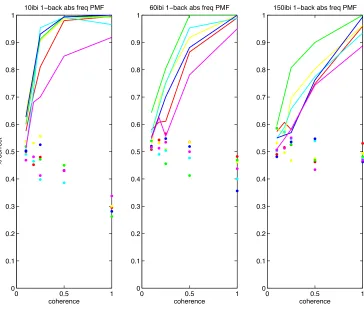
Figure 6 – Absolute Frequency Decision Model Comparison
47
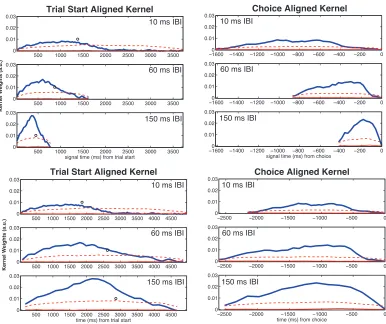
Figure 7 – Psychophysical Kernel
48
Figure 8 – Interrogation Task Data & Fits
49
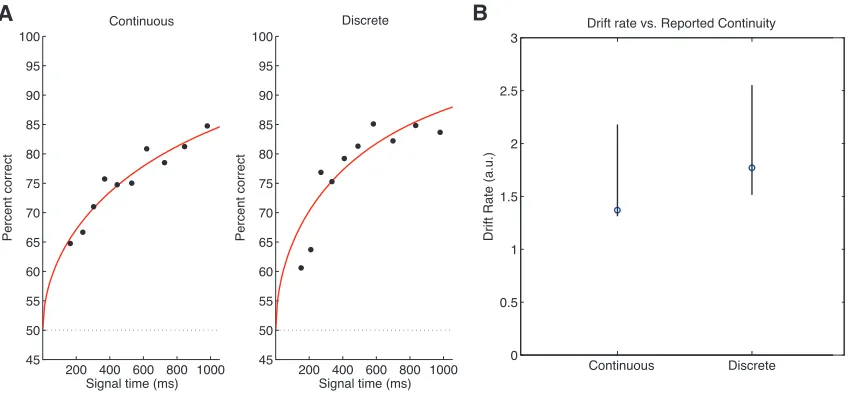
Figure 9 – Hybrid Task Data & Fits
50
Chapter 1
Introduction
We inform our decisions by inferring the state of the world, which is a
process called perceptual decision-‐making. This process uses information from a
stimulus to make a categorical judgment about the stimulus, which can then guide a
behavior, such as a motor action. The stimulus is initially transformed by the
peripheral sensory organs, such as the retina in the eye or the cochlea in the inner
ear, into a neural representation of the physical variables of the stimulus. The
cochlea, for example, transforms the acoustic stimulus, a time-‐varying pressure
waveform, into a neural-‐code representing the physical attributes of the stimulus,
such as the frequency content of the acoustic waveform. As sensory information is
processed further downstream, through the midbrain and then to the cerebral
cortex, the information represented by neurons is transformed from a
representation primarily encoding the physical attributes of the stimulus to a
representation that is more closely related to the perceptual report. This
transformation is typically thought to have two parts: first, the stimulus features
that correspond to the relevant perceptual dimensions for the judgment are
this higher-‐level representation of the relevant sensory evidence for the decision is
converted by neurons further downstream into a perceptual decision, which
typically correlates well with the behavioral report (Shadlen & Newsome 2001). In
this dissertation, I explore the behavioral and computational basis for the
transformation of an auditory stimulus into a perceptual decision. By understanding
how the brain represents sensory stimuli and how sensory information is
transformed into a perceptual decision, we can gain insight into the neural
mechanisms that allow us to adaptively interact with the environment.
Towards the goal of understanding the neural representation of auditory
stimuli and the conversion from sensory stimuli into auditory percepts, in this
dissertation I am investigating how certain perceptual decisions are affected by the
processing of the temporal structure of an auditory stimulus. Auditory perception
depends on the brain extracting and analyzing the temporal structure of a stimulus.
For example, the temporal structure of a Bach concerto for two violins is one factor
that allows a listener to separate out the different parts corresponding to each
violin. To separate out the different parts of the concerto for two violins, the
auditory system uses the temporal structure of the auditory stimulus to separate the
incoming stimulus into two perceptual representations, corresponding to each of
the two violin parts (Bregman 1994). This process is called auditory perceptual
grouping.
Auditory perceptual grouping converts the sensory representation of an
process, which itself depends on the temporal structure of the stimulus, may affect
the processing of the stimulus to extract perceptually relevant information from the
stimulus as well as how this information is converted into a categorical perceptual
decision. For many perceptual tasks, this transformation of the sensory information
into a perceptual decision depends on combining multiple samples of sensory
information over time in order to deal with unreliable sensory information
(Mauzrek et al 2003, Gold & Shadlen 2007, Shadlen & Kiani 2013). While some
recent studies have explored the effect of the stimulus temporal structure on the
perceptual decision-‐making process (Kiani et al 2013, Brunton & Brody 2013),
whether auditory perceptual grouping affects the process of combining multiple
samples of sensory information over time to make a decision remains to be
explored.
In this dissertation, I used human auditory psychophysics to examine the role
of temporal processing in auditory perceptual decision-‐making. Specifically, my goal
was to establish a novel auditory task in humans to test how the presentation rate of
a tone sequence affected how subjects converted the stimulus into a perceptual
judgment on how the frequencies of the tone sequence change over time. To
understand how auditory grouping based on the temporal structure of a stimulus
affects the transformation of the stimulus into a perceptual decision, subjects’
accuracy as well as the time needed to make a perceptual judgment was measured
while performing a perceptual task and across trials, the stimulus temporal
decision-‐making process, to relate the stimulus information on a given trial to both
the accuracy and the time needed to make a judgment. This model simultaneously
accounts for both measures of subject performance on the perceptual task. By
examining how the model differed across the different stimulus temporal structure
conditions, my aim was to test whether the temporal structure of the stimulus, and
specifically auditory grouping, had an effect on the decision-‐making process. Here, I
will first review the background for how the temporal structure of an auditory
stimulus affects how sounds are perceived. Then, I will review the approach I used
to study the effect of the stimulus temporal structure on auditory perceptual
decisions. Finally, I will conclude with a summary of the aims of this dissertation.
Stimulus Temporal Structure and Auditory Perception
To hear sounds and to use sound information to guide behavior, our auditory
system transforms acoustic stimuli into a perceptual representation (Griffiths &
Warren 2004; Bizley & Cohen 2013). These perceptual representations, also
referred to as auditory objects, form the basis of our experience of the auditory
environment. Auditory objects are the perceptual entity representing an
experienced sound, corresponding to a particular sound source or sound event.
Forming these perceptual representations depend on analyzing and extracting
behaviorally relevant information from the acoustic stimulus that may evolve
through time and may even be separated in time. For example, the brain is able to
perceptual representation of the part of a melody being played by an instrument as
part of a trio. This process begins in the cochlea, where the time-‐varying pressure
waveform of the acoustic stimulus is converted into neural activity. Downstream
areas in the brain convert this sensory representation based on the physical
attributes of the stimulus into a perceptual representation that we experience as
sound.
Several experimental paradigms have been used to explore how perceptual
representations are formed from the sensory information extracted from the
stimulus (Van Noorden 1975, Kidd et al 1994, Kidd et al 2003, Bregman 1994,
Bregman et al 2000, Nelken et al 1999), but one common process that has been
implicated in the formation of the perceptual representations is auditory perceptual
grouping (Bregman 1990, Bizley & Cohen 2013, Shamma et al 2011). Auditory
perceptual grouping tries to explain how the low-‐level, physical attributes of a
stimulus are converted into a perceptual representation. The auditory perceptual
grouping process extracts perceptual representations for the different auditory
objects present in the stimulus and is based on the principles of Gestalt psychology.
An acoustic scene is a mixture of acoustic waves from different sound sources that
can either be perceived as a whole, or as the elements that comprise the scene. For
example, a jazz trio can be perceived as a unified whole, or as the individual
components, as the pianist, bass, or vocalist parts of the trio. According to Gestalt
not just the combination of the percepts of the elements of the scene, such as the
different parts of the trio, but an entirely distinct perceptual entity.
While substantial progress has been made to understand the stimulus
parameters that promote auditory perceptual grouping, how cortical auditory
neurons implement the auditory perceptual grouping process to transform the
sensory input into a high-‐level perceptual representation remains to be elucidated.
While top-‐down factors such as attention certainly can play a role in the auditory
perceptual grouping process (Lakatos et al 2013, Bey & McAdams 2002), the
grouping process is typically driven by bottom-‐up factors derived from the physical
attributes of a stimulus (Bregman 1994, Hartman & Johnson 1991, Beauvois 1998,
Bregman et al 2000, Bizley & Cohen 2013). Bottom-‐up, or stimulus-‐driven,
perceptual grouping relies on regularities of the spectral and temporal structure of a
stimulus to allow different stimulus components to be grouped together. Acoustic
features such as spectral and temporal proximity of the different stimulus
components as well as similar spectral and amplitude modulation over time
contribute to the bottom-‐up processing. For example, the frequency separation and
the presentation rate of an ‘ABA’ tone triplet (where A and B represent tones with
different frequencies), can determine whether subjects perceive a sequence of the
tone triplets as a “gallop” or trill versus as two “streams” or two separate, but
continuously playing tones.
In this dissertation, I am interested in how auditory perceptual grouping,
representation or separated into distinct perceptual representations and is based on
the temporal structure of a stimulus, affects the process that converts the sensory
information into a judgment. The perceptual representation of a stimulus may affect
how sensory information is extracted and converted into a perceptual decision. The
hypothesized effect is that when the stimulus is represented by a unified, grouped,
perceptual representation, sensory information is more efficiently extracted from
the stimulus than if the stimulus were not grouped and was separated into distinct
perceptual representations. Thus, by having subjects make a judgment on how the
frequency of a tone sequence changes over time while varying the presentation rate
of the tone sequence across trials, the effects of auditory grouping on the overall
perceptual decision-‐making process should affect subjects' accuracy as well as the
amount of time needed to make their judgment. In the next section, I will explain the
basis for the methods that quantify the effect of auditory grouping based on the
temporal structure of the stimulus on how sensory information is processed and
how this information is used to make a perceptual decision.
Modeling perceptual decisions to understand auditory perceptual
processing
In this dissertation, subjects discriminated whether the frequency of a tone
sequence was increasing or decreasing over time while the presentation rate of the
tone sequence varied across trials. I used computational modeling to test whether
grouping. The approach I took infers the nature of the neural representation of
sensory information and the decision-‐making process from subjects’ performance
on a perceptual task. By modeling subjects’ performance for the different stimulus
temporal structure conditions, I could test whether auditory grouping, based on the
temporal structure of the stimulus, affected the extraction of sensory information
from the stimulus or the conversion of the sensory information into a perceptual
decision. This approach uses the drift diffusion model (DDM) of decision-‐making
that relates the physical parameters of a stimulus to subjects’ accuracy as well as the
time they took to make a decision for a perceptual task (Gold & Shadlen 2007,
Bogacz et al 2006). The DDM is based on signal detection theory (SDT), which was
initially developed to account for the variability in perceptual detection
performance due to the noisy representation of sensory information as well as to
quantify the effect of varying stimulus parameters on perception (Green & Swets
1966). The DDM extends signal detection theory to relate discrimination
performance, both accuracy and the time it takes to make a decision, to the
perceptually-‐relevant stimulus parameters (Ratcliff & Tuerlinckx 2002, Ratcliff &
Smith 2004, Ratcliff & McKoon 2008). By quantifying how subjects make their
decisions under a variety of listening duration conditions, the DDM allows us to
infer how the sensory information and the decision-‐making process varies under
different stimulus timing and auditory perceptual grouping conditions.
While SDT allows us to distinguish stimulus or task-‐related factors that affect
long subjects take to make a decision. The general class of sequential sampling
models extends the SDT to relate the stimulus parameters to both the accuracy as
well as the response times of each decision (Ratcliff & Tuerlinckx 2002, Ratcliff &
Smith 2004, Ratcliff & McKoon 2008). The sequential sampling models, which
include the DDM, make the key assumption that decisions are based on the
accumulation of multiple samples of sensory evidence. The accumulation of sensory
evidence over time is a mechanism to handle the inherent variability in the sensory
representation. This variability could be the result of a noisy, stochastic stimulus or
from a noisy neural representation (Gold & Shadlen 2007, Shadlen & Kiani 2013,
Roitman & Shadlen 2002, Mazurek et al 2003).
In the DDM, beginning at the start of the trial, momentary sensory evidence is
accumulated through time to form a decision variable. Variants of the DDM make
different assumptions of the nature of the sensory evidence. In the standard DDM,
the sensory evidence accumulated through time is set at a fixed, constant mean level
for the duration of the trial (Luce 1986, Smith 1995, Ratcliff & Tuerlinckx 2002,
Ratcliff & Smith 2004). In other DDM variants, such as the leaky integration model,
the accumulated sensory evidence is “leaked” away at a constant rate for the
duration of the trial, allowing for recency effects, where sensory information that
was processed closer in time to when the decision was made would have a greater
contribution to the decision variable than sensory information that came much
earlier in the trial (Usher & McClelland 2001). These models where the key
complex expressions that relate accuracy to the time it takes to make a decision,
thus are easier to fit than more general DDM models (Ratcliff & Tuerlinckx 2002,
Shadlen et al 2006). The more general DDM models relax the stationarity constraint
and have time-‐varying parameters that can vary during a trial, which increase the
complexity of the model and therefore make them more difficult to fit to the
behavioral data. In these models, the sensory evidence can vary as a function of time
according to a power-‐law (Eckhoff et al 2008) or has a mean level of sensory
evidence that varies as the trial progresses, consistent with an urgency or
confidence signal that pushes subjects to commit to a decision rather than
perseverating on the process of making a decision (Cisek et al 2009, Churchland et
al 2008, Ditterich 2006, Hanks et al 2011). The goal of using the different variants of
the DDM is to better quantify how auditory grouping based on the temporal
structure of the stimulus affects the nature of the sensory representation. By fitting
the subjects’ performance data collected under different stimulus temporal
structure conditions to the different DDM variants, the model that consistently fits
best would suggest that the neural representation might have features that are
consistent with the assumptions of the best fitting model.
In the DDM, sensory evidence is accumulated as the decision variable
through time. A decision is made when the accumulation process ends. The
termination of the accumulation process can either be due to the experimental
control of the stimulus duration, as in “fixed duration” or “variable duration”
commit to a decision even while the stimulus is still present. In the case of the
experimentally controlled stimulus duration, at the end of the stimulus
presentation, the level of the accumulated evidence is compared to a decision
threshold to determine which one of two possible choices is made. In the subject-‐
controlled viewing or listening duration case, the sensory evidence accumulation is
terminated when the accumulated evidence reaches one of two decision boundaries,
corresponding to each of the two choices in a two-‐choice discrimination task. These
boundaries are the criteria by which the accumulated evidence is converted to a
decision. Once the accumulated evidence reaches one of these boundaries, a
decision is rendered according to the boundary that was reached and typically
converted to a motor command, and eventually a behavioral report. The
accumulated evidence boundaries reflect strategic considerations based on
maximizing benefit and minimizing cost for the decision outcomes as well as other
considerations such as the urgency of making a decision or confidence of the level of
accumulated evidence (Ditterich 2006, Churchland et al 2008, Hanks et al 2011,
Drugowitsch 2012). While the decision outcome reflects which decision boundary
was reached, the time from the start of the accumulation process, typically the start
of the trial, to when the decision variable reached a decision boundary, represents
the decision time. The overall reaction time is the sum of the decision time and the
non-‐decision time, which represents the time for the decision to be converted into a
Because the temporal structure of an auditory stimulus can affect how the
auditory system perceptually represents the stimulus, the goal of this dissertation is
to test whether the temporal structure affects the accuracy and the time it takes to
make a perceptual decision as well as to explore how the temporal structure might
affect decision performance. By using the DDM model, I can quantify the effect of
auditory perceptual grouping as well as the processing of the stimulus temporal
structure on both the process of extracting sensory information from the stimulus to
guide a perceptual judgment and the decision-‐process that converts the extracted
sensory information into the judgment. In this dissertation, I examine whether
differences in presentation rate of the tone sequence stimulus can account for the
effects on decision performance, consistent with the stimulus temporal structure
affecting the process that extracts decision-‐related sensory information from the
stimulus. I also test whether the temporal structure of the stimulus affects the
process that converts the sensory information into a decision. Finally, I test whether
auditory perceptual grouping specifically has an effect on the process of extracting
sensory information from the stimulus that is eventually used to make the
perceptual judgment.
Summary
How do perceptual decision-‐making and auditory perceptual grouping
interact on a perceptual, computational, and neural level? The work in this
dissertation lays the groundwork to investigate the neural basis for auditory
temporal structure of an auditory stimulus. I examined the role of auditory
perceptual grouping on auditory perceptual judgments by asking whether the
presentation rate of a stimulus sequence, which can affect the perceptual grouping
of the stimulus, affects how sensory evidence converted into a decision. I devised a
task that allows us to test, under different grouping conditions, whether the
observed performance was consistent with changes in the representation of sensory
evidence used to make the perceptual judgment or in the process by which the
sensory evidence is converted into the decision. Subjects made a judgment on the
frequency changes over time of a tone sequences while the interburst interval (IBI),
or the time between tones of the stimulus, was varied across trials. I examined how
subjects processed the sensory evidence to form their decisions as well as modeled
the effect of IBI on their decision-‐making process. By understanding how the brain
converts sensory stimuli into a perceptual decision with our task, we can better
understand the computational principles and the neural implementation of how
Chapter 2
Integration
of
Auditory
Contour
Information is Invariant to Time Gaps and
Perceptual Grouping of Stimulus
Introduction
Time plays a key role in auditory perception. The timing of acoustic events in
a stimulus, such as notes in a melody, can affect the perceptual organization of the
stimulus (Moore & Gockel 2013, Shamma et al 2011). A rapid sequence of tones, for
example, are more likely to be perceptually grouped into a single auditory “stream”
than a slow sequence of tones (Van Noorden 1975, Bregman 1994). The auditory
system transforms low-‐level sensory input into a high level perceptual
representation by grouping acoustic events in a complex auditory scene into
auditory objects (Griffiths & Warren 2004). The processing of low-‐level temporal
cues to organize perceptually the incoming acoustic signal is fundamental (Bizley &
Cohen 2013) to allow for us to perceive sounds in the auditory environment.
Many studies have characterized the factors that affect auditory perceptual
organization (Moore & Gockel 2013) and grouping can affect perceptual judgment
Roberts et al 2002, Bey & McAdams 2002). However, because of the task-‐ and
stimulus-‐dependence of these grouping-‐related effects, the mechanisms that
contribute to these effects are unclear. For example, perceptual judgments of timing
differences are more accurate if the comparison is made within a stream than
comparisons between streams (Roberts et al 2002). In contrast, the grouping of
stimuli into different streams can facilitate the identification of a tone sequence if
the sequence is contained within one stream, effectively, segregating the target from
the distractor (Bey & McAdams 2002). These studies raise the question: by what
mechanism does perceptual grouping affect the processing of sensory evidence for
auditory perceptual judgments?
To address this, we examined the role of grouping on auditory perceptual
judgments by asking whether time gaps in a stimulus sequence, which can affect the
perceptual grouping of the stimulus, affect how sensory evidence converted into a
decision. We devised a task that allows us to examine, under different grouping
conditions, the representation of sensory evidence used to make the perceptual
judgment and the process by which the sensory evidence is converted into the
decision. Subjects made a frequency-‐change judgment based on tone sequences
increasing or decreasing in frequency while we manipulated the interburst interval,
or the time between tones of the stimulus. We examined how subjects processed the
sensory evidence to form their decisions as well as modeled the effect of IBI on their
decision-‐making process. We found that subjects accumulated sensory evidence
affect the accumulation rate, subjects accumulated less total sensory evidence for
long IBIs consistent with a collapsing decision boundary.
Methods
Experimental Setup
Subjects rested their chin on a chin rest approximately 2’ from the speaker
while seated in a soundproof booth (IAC) during the experiment. The task was
developed using the MATLAB-‐based Snow-‐Dots (http://code.google.com/p/snow-‐
dots) psychophysics software. On each trial, task parameters from the Snow-‐Dots
environment were used to generate the stimulus on a digital signal processor
(Tucker Davis Technologies RX6). The stimulus was presented free-‐field using a
calibrated speaker (Yamaha MSP-‐7). Subjects responded by a button press on a
gamepad (Microsoft Sidewinder) and task instructions and feedback was displayed
on a LCD flat panel monitor (DELL E171FP).
Stimulus
The stimulus was a tone-‐burst sequence (Figure 1A-‐D). Each tone burst was
presented at 65 dB SPL and had a duration of 30 ms (onset/offsets were smoothed
with a 5-‐ms cos2 gate). The time between the offset of one tone to the onset of the
next tone (i.e., the “inter-‐burst interval”; IBI) ranged between 10 and 150 ms (Figure
1D). The range of IBIs chosen were based on pilot studies in which subjects tended
to report that the stimulus sounded continuous when the IBI was relatively small
burst sequence was a function of (1) sequence direction (increasing or decreasing
frequency), (2) sequence duration, (3) IBI, and (4) coherence (Figure 1A-‐C); the
stimulus direction, duration, IBI, and coherence varied on a trial-‐by-‐trial basis
depending on the specific task constraints (see task descriptions below).
At the beginning of each trial, the frequency for the first tone burst in the
sequence was randomly sampled from a uniform distribution corresponding to the
direction of the stimulus. A monotonically increasing or decreasing frequency
sequence was first generated by adding or subtracting a fixed frequency increment
(Delta_f = 7.5 hz) to the previous tone-‐burst frequency.
Stimulus coherence was the proportion of tones in a tone-‐burst sequence
whose frequencies were a fixed frequency increment from the previous tone. A
tone-‐burst sequence in which all of the tone bursts were monotonically increasing
or decreasing had a coherence of 100%. For sequences with coherence <100%, we
first generated the 100% coherent stimulus and then randomly shuffled the
temporal order of a subset of tone bursts. A 50% coherent stimulus, for instance,
was generated by randomly shuffling 50% of the tone bursts. A 0% coherent
stimulus had 100% of the tone bursts shuffled. By generating the stimulus in this
manner, we could ensure that each sequence traversed a fixed frequency range for
both increasing and decreasing stimuli. This is to reduce the likelihood of subjects
basing their decisions on the frequency content of the stimulus instead of the
pattern of frequency changes.
Tone-‐Sequence Frequency-‐Direction Discrimination Task
In the tone-‐sequence frequency-‐direction discrimination task (Figure 3),
subjects reported whether the frequency of the tone-‐burst sequence was increasing
or decreasing. Subjects were tested in three variants of the task: “response-‐time”,
“interrogation”, and “hybrid”. Prior to participating in the experiments, subjects
provided informed consent. The University of Pennsylvania Institutional Review
Board approved the experimental protocol and informed-‐consent procedures.
Response-‐time task
We tested 6 subjects (5 male, 1 female) in 4 weekly 1.5 hour sessions.
Subjects were told to respond as quickly as possible, without sacrificing accuracy,
after they reached their decision. Each session contained 4 blocks of trials. Subjects
took a short break between each block. During each block, we varied, on a trial-‐by-‐
trial basis, IBI (10, 60, or 150 ms), coherence (0, 10, 25, 50, or 100%), and stimulus
direction (increasing or decreasing). Each combination of these sequence properties
was presented 5 times within a block, for a total of 150 trials per block. Subjects
were given feedback at the end of each trial.
Interrogation Task
We tested 5 subjects (4 male, 1 female) in 6 weekly 1.5 hour sessions. On
each trial, the stimulus duration was sampled from a truncated exponential
IBI: 10 ms, [160, 1400] ms; 60 ms, [360, 3150] ms; 150 ms, [720, 6300] ms) so that
subjects could not anticipate the end of the stimulus. The truncation limits are
standardized across IBI by the minimum (4) and maximum (35) number of tones
presented. After the end of the stimulus, a response cue flashed on the screen, and
subjects had 800 ms to respond. Each session contained four blocks of trials.
Subjects took a short break between each block. During each block, we varied, on a
trial-‐by-‐trial basis, IBI (10, 60, or 150 ms), coherence (0, 10, 25, 50, or 100%), and
stimulus direction increasing or decreasing). Each combination of these sequence
properties was presented 5 times within a block, for a total of 150 trials per block.
Subjects were given feedback at the end of each trial.
Hybrid Task
We also tested 5 subjects (3 male, 2 female) in 4 weekly 1.25 hour sessions.
Like on the interrogation task, on each trial, stimulus duration was sampled from a
truncated exponential distribution (λ = 2000 ms) so that subjects could not
anticipate the end of the stimulus. The truncation limits are standardized across IBIs
by the minimum (4) and maximum (35) number of tones presented. In addition to
making a judgment regarding whether stimulus direction, subjects also reported
whether they perceived the stimulus as “one, continuous sound” or “as a series of
discrete sounds”. Subjects reported their responses during two 800-‐ms response
direction judgment and stimulus-‐continuity judgments was alternated on a block-‐
by-‐block basis.
Prior to participating in the hybrid task, each subject’s “50%-‐IBI threshold”
and “coherence threshold” was measured and incorporated into the parameters
used to generate the tone-‐burst sequence. Each subject’s IBI threshold, defined to be
the IBI value for which 50% of the responses rated the stimulus as continuous, was
measured using a 1-‐up/1-‐down adaptive procedure. The IBI threshold was
measured daily, before the start of each session. We found, in early pilot
experiments, that each subject’s IBI threshold varied across days. We measured
each subject’s coherence threshold using a 2-‐up/1-‐down adaptive procedure.
Threshold was defined to be 70.7% correct performance, which corresponds to a d’
of 0.77. Each subject’s coherence threshold was calculated for tone-‐burst sequences
using the initial session’s IBI threshold. Coherence threshold was calculated prior to
a subject’s participation in the hybrid task and kept constant for all subsequent
hybrid-‐task sessions.
Each session contained four blocks of trials. Subjects took a short break
between each block. During each block, we varied, on a trial-‐by-‐trial basis, IBI (50%-‐
threshold -‐ 15 ms, 50%-‐IBI threshold, and 50%-‐IBI threshold + 15 ms) and stimulus
direction (increasing or decreasing). The sequence coherence was set to each
subject’s coherence threshold. For each stimulus direction condition, the threshold
IBI condition was repeated 40 times per block, and the two off-‐threshold IBI
within each block. Subjects were given feedback regarding whether they made the
correct stimulus direction judgment at the end of each trial.
Data Analysis
Each subject’s behavioral data was fit to a drift diffusion model (DDM) to
quantify the effects that sequence coherence and IBI had on the decision-‐making
process. We computed psychophysical kernels for each IBI using data pooled across
all of the subjects to test whether subjects were accumulating sensory evidence
across time and whether the time course of integration was affected by IBI. We also
tested whether subjects could use the frequency of the stimulus as an alternative
strategy to decide whether the stimulus was increasing or decreasing in frequency.
Drift Diffusion Model
The DDM relates a subject’s accuracy on a two-‐alternative forced-‐choice
(2AFC) task to the amount of time that the subject used to reach their decision.
Central to the drift diffusion model is that sensory evidence is accumulated through
time as the decision variable (Bogacaz 2006, Gold & Shadlen 2007). For the
response-‐time task, a categorical decision is generated, according to the DDM, when
the accumulated sensory evidence reaches a response threshold, or the decision
boundary. Similarly, according to the DDM, for the interrogation task, the value of
the accumulated sensory evidence is compared to its value at the start of the trial to
the decision is generated based on the accumulated sensory evidence for the two
types of tasks, we used one mathematical formulations of the DDM to model the
reaction-‐time and a different formulation of the DDM for interrogation and hybrid
data.
For the response-‐time data, the DDM (Palmer et al 2005) is parameterized by
the drift rate coefficient, two decision boundaries, and a non-‐decision time. The drift
rate coefficient scales the coherence of the stimulus proportionately to obtain the
drift rate, which represents the amount of momentary evidence available at a given
moment. The drift rate is normally distributed with the mean given by 𝜇= 𝑘𝐶,
where k is the fitted drift rate coefficient and C coherence, and unit variance. As the
accumulated sensory evidence reaches one of the two decision boundaries, the
corresponding choice is made. The non-‐decision time is the component of response
time corresponding to motor preparation time and low-‐level sensory processing
latencies. The probability of the accumulated evidence reaching boundary A is
𝑃! = 𝑒2𝜇𝐵!!
𝑒2𝜇𝐵!𝑒2𝜇𝐴. The mean decision time for choice A, or the time from stimulus onset
to the accumulated evidence reaching boundary A, is 𝑇! = !!!!coth (𝐴+𝐵)𝜇 −
!
!coth 𝐵𝜇 . Similarly, for choice B, the mean decision time is 𝑇! =
!!!
! coth (𝐴+
𝐵)𝜇 −!!coth 𝐴𝜇 . The response time for a given choice is the sum of the decision
time and the non-‐decision time.
For the interrogation and hybrid tasks, the DDM is parameterized by the drift
is given by 𝜇= 𝑘𝐶, where k is the fitted drift rate coefficient and C coherence. For a
given listening duration, the probability of choosing choice A is given by 𝑃! 𝑡 =
! !!
! !!! !"#(
!
!!)
All model fits were based on maximizing the likelihood of the parameters
given the data. Subjects’ choices were modeled as binomial errors and mean
response times were modeled as Gaussian errors. The models were implemented
and fit using Matlab. To avoid local maxima, the fitting procedure was initialized
with multiple random starting points in the parameter space. Parameter confidence
intervals were estimated using a bootstrap method.
Simulated DDM
We examined how decision boundary dynamics of the DDM affects choice,
response-‐times, and the psychophysical kernels by simulating the DDM with
different types of decision boundary dynamics. We simulated the temporal
evolution of the accumulated sensory evidence on each trial by numerically
integrating the stochastic differential equation: dX = kC*dt + dW. Here, k
corresponds to the drift rate coefficient, C is the coherence of the trial being
simulated, dW is a standard Gaussian process representing the noise in the sensory
evidence, when combined, represents dX, the momentary sensory evidence. For
each coherence and IBI condition, we simulated 5000 trials for 5000 ms using a
variable simulation time step that varied according to the IBI in order to run the
We computed the simulated choices and response times by comparing the
accumulated sensory evidence, X, on each trial to a decision boundary. We tested
two types of boundaries, one that did not vary in time (“fixed bound”) and one that
decreased linearly to zero as the trial progressed (“collapsing bound”). The fixed
boundary had one parameter, the bound height. The collapsing bound had two
parameters, the bound height at the start of the trial and the time (in elapsed time,
not signal time) when the bound reached zero. In addition to the type of bound, we
also tested two different relationships between the boundary and IBI. One way only
had one set of boundary parameters for all IBI conditions, whereas the other way
had one set of boundary parameters for each IBI condition. In summary we tested
whether a fixed bound or a collapsing bound with one set of boundary parameters
for all IBIs or with a set of boundary parameters for each IBI.
To find the best fitting parameters, we maximized the likelihood of the model
given the parameters using, as before, a binomial likelihood for choices and a
Gaussian likelihood for the mean response times. We used a derivative-‐free
optimization method (fminsearch in Matlab) to compute the maximum likelihood
fits. To compare the different models we computed the Bayesian information
criterion (BIC = -‐2*log(F(x|θ)) – p*log(n); n: number of observations; p: number of
parameters; θ: model parameters) for each of the tested models. to account for the
To generate the kernel predictions for the best fitting model, the simulation
paths for the 0% coherence condition were averaged across trials separated by
choice and then averaged across time.
Psychophysical kernel
The psychophysical kernels were estimated using a logistic regression that
related the stimulus to the subject’s choice on a particular trial: (Equation: logit(y) ~
b0 + b1*x1 + …+ bn*xn + epsilon, epsilon ~ N(0,1)). The covariates (x1,…,xn)
represented the difference in frequency between consecutive tones for a tone-‐burst
sequence presented on each trial. The estimated regression coefficients (b1,…,bn)
represented the degree to which a subject weighed, at a given moment in time, the
difference in frequency of a tone burst pair to form a judgment. We pooled choice
data and stimuli across all 6 subjects in the response-‐time task to compute the
psychophysical kernels for each of the IBI conditions. The kernels were computed
using only 0% coherence trials and not on any coherent patterns of frequency
changes in the stimulus.
A permutation test was used to test whether the observed kernels were
significantly different from a null kernel, assuming that there was no systematic
relationship between the stimulus and subject’s response. We generated N synthetic,
test datasets by randomly permuting the reported choice on each trial and the
associated stimuli. Each synthetic dataset was used to calculate a kernel. The
assuming that the null hypothesis was true. The kernel weights calculated based on
the actual, observed data was compared to the null distribution of kernel weights to
compute a p-‐value.
The kernel widths were calculated for each kernel at its half-‐maximum value.
Bootstrap confidence intervals were calculated by resampling trials within each
subject’s dataset with replacement and then pooling across subjects to generate a
pooled bootstrap dataset. Kernels were estimated using these pooled bootstrap
dataset and this procedure was repeated 2000 times. Kernel widths were estimated
for each of the bootstrap kernels and confidence intervals were calculated based on
the 2.5% and 97.5% percentiles of the bootstrap kernel width distribution.
Absolute Frequency Decision Model
We tested whether subjects used an alternative strategy to solve the task by
comparing the absolute frequency of the stimulus to an optimal criterion based on
an ideal observer. The tone frequencies immediately preceding when the decision
was reported was sorted by the reported decision outcome. The frequency
distribution corresponding to “increasing frequency” choices was compared to the
frequency distribution corresponding to “decreasing frequency” choices by an ROC
analysis for all trials of a given IBI. The frequency threshold corresponding to the
point on the operating curve that minimizes false positives and maximizes true
positives is used to calculate is used as the decision rule to make a judgment