University of Pennsylvania
ScholarlyCommons
Publicly Accessible Penn Dissertations
1-1-2016
Partial Information Framework: Basic Theory and
Applications
Ville Antton Satopää
University of Pennsylvania, [email protected]
Follow this and additional works at:http://repository.upenn.edu/edissertations
Part of theApplied Mathematics Commons,Mathematics Commons, and theStatistics and Probability Commons
This paper is posted at ScholarlyCommons.http://repository.upenn.edu/edissertations/1991
For more information, please [email protected].
Recommended Citation
Satopää, Ville Antton, "Partial Information Framework: Basic Theory and Applications" (2016).Publicly Accessible Penn Dissertations. 1991.
Partial Information Framework: Basic Theory and Applications
Abstract
Many real-world decisions depend on accurate predictions of some future outcome. In such cases the decision-maker often seeks to consult multiple people or/and models for their forecasts. These forecasts are then aggregated into a consensus that is inputted in the final decision-making process. Principled aggregation requires an understanding of why the forecasts are different. Historically, such forecast heterogeneity has been explained by measurement error. This dissertation, however, first shows that measurement error is not appropriate for modeling forecast heterogeneity and then introduces information diversity as a more appropriate yet fundamentally different alternative. Under information diversity differences in the forecasts stem purely from differences in the information that is used in the forecasts. This is made mathematically precise in a new modeling framework called the partial information framework. At its most general level, the partial information framework is a very reasonable model of multiple forecasts and hence offers an ideal platform for theoretical analysis. For one, it explains the empirical phenomenon known as extremization. This is a popular technique that often improves the out-of-sample performance of simple aggregators, such as the average or median, by transforming them directly away from the marginal mean of the outcome.
Unfortunately, the general framework is too abstract for practical applications. To apply the framework in practice one needs to choose a parametric distribution for the forecasts and outcome. This dissertation motivates and chooses the multivariate Gaussian distribution. The result, known as the Gaussian partial information model, is a very close yet practical specification of the framework. The optimal aggregator under the Gaussian model is shown to outperform the state-of-the-art measurement error aggregators on both synthetic and many different types of real-world forecasts.
Degree Type
Dissertation
Degree Name
Doctor of Philosophy (PhD)
Graduate Group
Statistics
First Advisor
Lyle H. Ungar
Second Advisor
Shane T. Jensen
Keywords
Subject Categories
PARTIAL INFORMATION
FRAMEWORK: BASIC THEORY AND
APPLICATIONS
Ville A. Satop¨a¨a
A DISSERTATION
in
Statistics
For the Graduate Group in
Managerial Science and Applied Economics
Presented to the Faculties of the University of Pennsylvania
in
Partial Fulfillment of the Requirements for the
Degree of Doctor of Philosophy
2016
Supervisor of Dissertation
Shane T. Jensen
Associate Professor of Statistics
Co-Supervisor of Dissertation
Lyle H. Ungar
Professor of Computer and Information Science
Graduate Group Chairperson
Eric Bradlow
K.P. Chao Professor, Marketing, Statistics and Education
Dissertation Committee
Shane T. Jensen, Associate Professor Lyle H. Ungar, Professor
Edward I. George, Professor
PARTIAL INFORMATION FRAMEWORK: BASIC THEORY AND APPLICATIONS
COPYRIGHT © 2016
Dedication
This dissertation has been dedicated to my mother, whose love and support give me courage to take on anything, and to my father, who lives on as the inspiration in everything I do.
Acknowledgments
First and foremost, I would like to thank my family and friends whose unquestioning sup-port has allowed me to chase my dreams to the edge of the world and back again. Second, I would like to thank my thesis committee for all their mentoring and advice about research, life, and everything in between. Lastly, I would like to thank my two Ph.D. advisors for always having my back, for reminding me of the bigger picture when I was lost in the de-tails, and for making me a much better researcher. Thanks to them, I could not feel any better-equipped to begin my career as a professor.
ABSTRACT
PARTIAL INFORMATION FRAMEWORK:
BASIC THEORY AND APPLICATIONS
Ville A. Satop¨a¨a
Shane T. Jensen
Lyle H. Ungar
Contents
1 Introduction 1
2 Combining Multiple Probability Predictions Using a Simple Logit Model 10
2.1 Introduction . . . 10
2.2 Theory . . . 14
2.3 Results and Discussion . . . 20
2.4 Conclusions . . . 33
2.5 Acknowledgements . . . 36
3 Probability Aggregation in Time-Series: Dynamic Hierarchical Modeling of Sparse Expert Beliefs 37 3.1 Introduction . . . 38
3.2 Geopolitical Forecasting Data . . . 41
3.3 Model . . . 43
3.4 Model Estimation . . . 46
3.5 Synthetic Data Results . . . 49
3.6 Geopolitical Data Results . . . 53
3.7 Discussion . . . 66
3.8 Acknowledgements . . . 67
4 Modeling Probability Forecasts via Information Diversity 69 4.1 Introduction and Overview . . . 70
4.2 Prior Work on Aggregation . . . 75
4.3 The Gaussian Partial Information Model . . . 78
4.4 Probability Extremizing . . . 85
4.5 Probability Aggregation . . . 91
4.6 Summary and Discussion . . . 96
5 Partial Information Framework: Model-Based Aggregation of Estimates from
Diverse Information Sources 99
5.1 Introduction . . . 100
5.2 Model-Based Aggregation . . . 104
5.3 Model Estimation . . . 116
5.4 Applications . . . 124
5.5 Discussion . . . 135
5.6 Acknowledgments . . . 137
6 Bayesian Aggregation of Two Forecasts in the Partial Information Framework139 6.1 Introduction . . . 140
6.2 Aggregation function for fixed parameters . . . 144
6.3 Bayesian model . . . 146
6.4 Comparison of Aggregations With Hypothetical Data . . . 147
6.5 Comparison of Estimators with 2012 Presidential Election Data . . . 150
6.6 Acknowledgments . . . 154
7 Combining and Extremizing Real-Valued Forecasts 155 7.1 Introduction . . . 156
7.2 Forecast and Aggregation Properties . . . 160
7.3 Extremizing Real-Valued Forecasts . . . 165
7.4 Simulation Study . . . 168
7.5 Case Study: Concrete Compressive Strength . . . 175
7.6 Summary and Discussion . . . 179
7.7 Acknowledgements . . . 182
8 Conclusion and Future Work 183 A Appendices 188 A.1 Supplement for Chapter 2 . . . 188
A.2 Supplement for Chapter 3 . . . 197
A.3 Supplement for Chapter 4 . . . 202
A.4 Supplement for Chapter 5 . . . 210
A.5 Supplement for Chapter 6 . . . 218
A.6 Supplement for Chapter 7 . . . 226
List of Tables
2.1 Out-of-sample accuracies of the competing aggregators . . . 32
3.1 Five-number summaries of our real-world data . . . 40
3.2 Frequencies of the self-reported expertise . . . 40
3.3 Summary measures of the estimation accuracy under synthetic data . . . 51
3.4 Brier Scores based on 10-fold cross-validation . . . 59
4.1 Average Brier scores with its three components . . . 95
5.1 Summary of the data across three time intervals . . . 126
6.1 Bayesian aggregation and expert predictions for individual states . . . 151
6.2 Squared error loss for aggregation procedures . . . 152
6.3 Some rows of ROC table . . . 153
7.1 Estimated parameter values under synthetic data . . . 171
7.2 The average quadratic loss under synthetic data . . . 173
7.3 Estimated parameter values under real-world data . . . 178
List of Figures
2.1 Aggregators under30synthetic problems and correct model . . . 23
2.2 Aggregators under100synthetic problems and correct model . . . 23
2.3 Aggregators under100synthetic problems and incorrect model . . . 26
2.4 Aggregators under69real-world problems . . . 30
2.5 Sensitivity to the choice ofa . . . 34
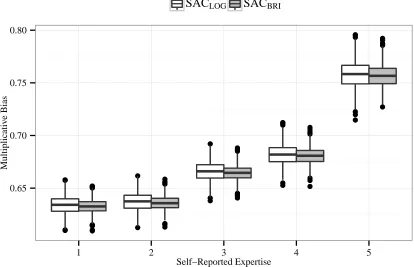
2.6 Optimal transformationaagainst self-reported expertise . . . 34
3.1 Probability forecasts for two IARPA events . . . 42
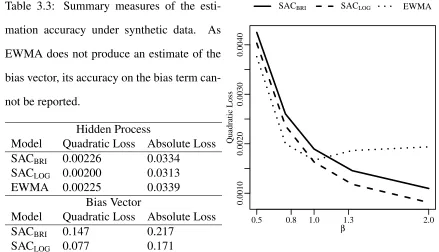
3.2 The marginal effect ofβon the average quadratic loss . . . 51
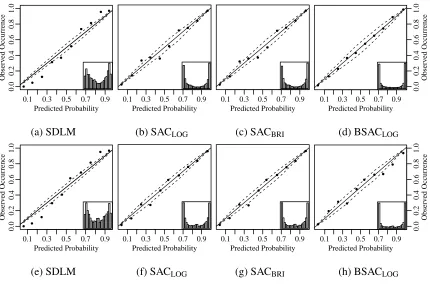
3.3 In- and out-of-sample calibration and sharpness . . . 61
3.4 Posterior distributions ofbj forj = 1, . . . ,5 . . . 63
4.1 Illustration of information distribution amongN forecasters . . . 83
4.2 Marginal distribution ofpi under different levels ofδi . . . 83
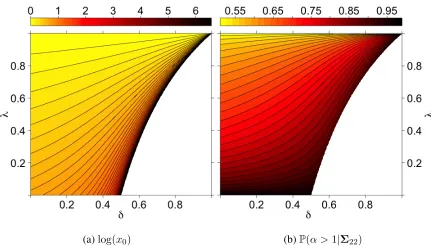
4.3 Levelplot of the extremization ratio . . . 90
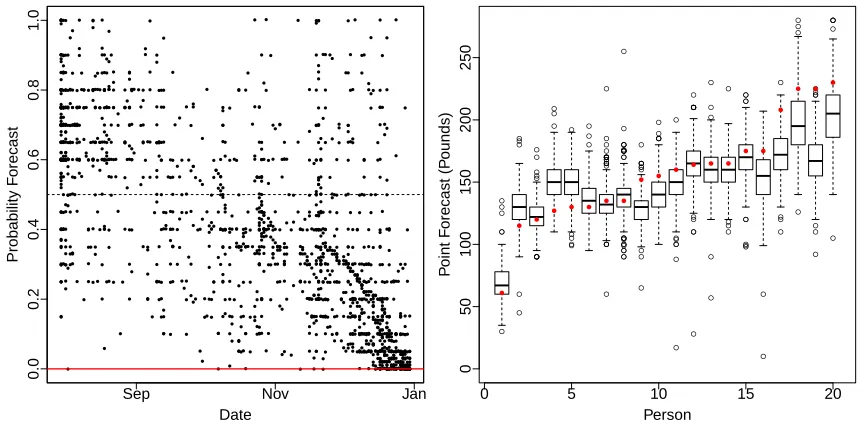
5.1 Probability forecasts of an IARPA event . . . 101
5.2 Point forecasts of the weights of20different people . . . 101
5.3 Average prediction accuracies of the competing probability aggregators . . 128
5.4 The estimatedΣfor the100GJP forecasters . . . 131
5.5 Average prediction accuracy of the competing real-valued aggregators . . . 134
5.6 The estimatedΣcov for the416CMU undergraduates . . . 134
6.1 Marginal distribution ofpj under different levels ofβ . . . 145
6.2 Comparisons of the aggregators’ behavior . . . 148
6.3 Illustration of two forecasters’ information partition . . . 149
6.4 DeSart predictions, Silver predictions, and Bayesian aggregation predictions 151 6.5 Predictions for the aggregators . . . 152
7.2 Out-of-sample reliability under no information overlap and synthetic data . 171 7.3 Out-of-sample reliability under high information overlap and synthetic data 171
7.4 Out-of-sample reliability of the individual models under real-world data . . 177
7.5 Out-of-sample reliability under no information overlap and real-world data 177 7.6 Out-of-sample reliability under high information overlap and real-world data 178 A.1 Summary comparison of the aggregators . . . 198
A.2 Estimation accuracy and the condition numbers . . . 215
A.3 Prediction accuracy under different values ofN andK . . . 217
A.4 Illustration a) for the proof . . . 224
1
Introduction
A new form of polling has emerged from the recent development of computer and social
networks; it is called prediction polling (Atanasov et al., 2015). In a prediction poll a group
of participants collectively make predictions about some future quantity of interest. For
instance, consider a policy maker who is interested in the probability of Brexit. Instead of
collecting data and aiming to build a statistical model, the policy-maker may reach out to
a group of European Union experts and ask them for their subjective probabilities of the
event. After this, the decision-maker must choose how to use the forecasts. The first idea
may be to simply follow the most accurate or informed forecaster’s advice. Unfortunately,
however, it is often not possible to know ex-ante who this forecaster is, and even if one
somehow could know, simply following a single forecaster’s advice would ignore
poten-tially a large amount of information that is being contributed by the rest of the forecasters.
Therefore a better option is to combine the forecasts into a single consensus forecast that
re-flects all forecasters’ information. Unfortunately, there are many ways one could combine
the predictions, and the final combination rule will largely determine the out-of-sample
performance of the consensus forecast.
The past literature has distinguished two general approaches to forecast aggregation:
1. Empirical. Overall, this approach is by far the more widely studied one. It is akin to
aggre-gators and within that class chooses the aggregator that performs the best over some
training set of past predictions on known outcomes. The chosen aggregator is then
used for combining any future predictions of unknown outcomes.
2. Model-based. This approach begins with a probability model of forecast
hetero-geneity, that is, the way the predictions differ from each other and the outcome. The
model-based aggregator is then the optimal aggregator under this assumed
outcome-forecast link. Note that applying the aggregator in practice may or may not involve
estimating some model parameters from the forecasts – but not from the outcomes.
Both of these approaches are important and serve somewhat different purposes. More
specifically, the empirical techniques are often simpler and work very well when one has
access to a training set that is representative of the future aggregation tasks. There are,
however, many forecasting applications where a training set is not available. For instance,
in prediction polling obtaining a training set would require a lot of time and effort on behalf
of the forecasters and polling agency. For this reason, many prediction polls do not yield
a training set. Instead, the participants are typically handed out a single questionnaire that
solicits their predictions about one or more future outcomes. Fortunately, the model-based
aggregation approach can be applied directly to the forecasts even when no knowledge
of the outcomes is available. Therefore the model-based approach is much more broadly
applicable than the empirical approach. Furthermore, the model-based aggregators are
based on theory which provides a clear direction for improvement. Of course, this all
comes at a cost. In particular, the model-based approach relies on modeling assumptions.
If these assumptions are no appropriate, the resulting aggregators are, unfortunately, only of
limited use. Therefore it is important to perform careful model evaluation of any proposed
model-based aggregators.
This dissertation was largely motivated by the lack of an appropriate framework for
fore-cast heterogeneity has been explained with measurement error: the forefore-casts are assumed
to be equal to the true outcome plus some mean zero idiosyncratic error. While this
as-sumption may make sense when modeling estimates arising from repeated applications
of a sensitive yet somewhat imprecise instrument, it is hardly reasonable when the
esti-mates arise from multiple, often widely different sources. Furthermore, the measurement
error based aggregators are different types of measures of central tendency such as the
(weighted) average or median. Unfortunately, such simple aggregators do not behave as if
they are collecting information from the different forecasters. To illustrate, consider a
pa-tient who is worried about his or her health and hence goes to the hospital. At the hospital
both a blood test and an MRI are taken. Both tests come back with no evidence of poor
health. Suppose there are two doctors who decide to look at the patient’s case: doctorsA
andB. DoctorAonly looks at the blood test results and provides a probability of0.9of the
patient being healthy. DoctorB, on the other hand, only looks at the MRI results but also
provides a probability of0.9of the patient being healthy. Now, the patient has two0.9s that
are based on very different information. How should they be aggregated? Surely, if one
were to see the good news both from the blood test and the MRI, one would be even more
convinced of the patient’s good health and hence predict something greater than 0.9. In
other words, in this simple example the combined evidence should yield a forecast
some-what greater than0.9. Unfortunately, however, all measures of central tendency aggregate
precisely to0.9. Therefore they fail to account for the doctors’ differing information sets
and hence cannot collect information from the different forecasters. Of course, this is only
a simple example. The result, however, is much more general than this. In fact, as will be
shown in Chapter 7, this result holds for any number of forecasters despite whether their
forecasts are equal or not.
In order to fix this shortcoming, it is necessary to revisit the fundamentals. In particular,
appropri-ate than measurement error and it should lead to aggregators that do behave as if they
were collecting information from the different forecasters. Such an alternative is precisely
what is introduced in this dissertation; it is calledinformation diversity. Under information
diversity, the differences in the predictions are fully explained by differences in the
infor-mation used by the respective forecasters. For instance, consider two forecasters predicting
the chances of some global crisis. One of these forecasters lives in USA and follows the
American news. The second forecaster, on the other hand, lives in Russia and reads the
Russian news. Given these descriptions, it is likely that the two forecasters have different
information and hence provide different predictions. This intuition is mathematically
for-malized in a new modeling framework called thepartial information framework. Overall,
the partial information framework is very general and can be applied to a broad range of
different forecasting applications, allowing the practitioner to construct application-specific
aggregators instead of always relying on the usual average and median. The partial
infor-mation aggregators also behave as if they collect inforinfor-mation from the forecasters and often
outperform the state-of-the-art measurement error aggregators in real-world applications.
Given that information diversity is a contribution at the root of statistical theory, it gives
rise to a large amount of new theory and methodology. This dissertation discusses several
such projects. In particular, each chapter is a separate paper discussing a different aspect
of the partial information framework. The chapters have been ordered chronologically in
the order they were written. The following enumeration briefly describes each chapter and
provides citations of the corresponding papers.
Chapter 2. Satop¨a¨a et al. (2014) introduces a new empirical aggregator for
prob-ability forecasts. Overall, the aggregator is very simply: it involves only a single
tuning parameter which determines how much the average log-odds forecast should
be extremized. Here extremization refers to the process of transforming a measure of
(typi-cally at0.5for probability forecasts) and closer to the nearest extreme (at0.0or1.0).
This extremizing aggregator is then shown to outperform simple measurement-error
aggregators on real-world predictions. Furthermore, the amount of extremization
was observed to decrease in the forecaster’s self-reported expertise.
Note:At this point the benefits of extremizing were merely an empirical observation.
In particular, it was not clear why it helps or how much extremization should be
performed.
Chapter 3. Satop¨a¨a et al. (2014)1 was largely motivated by the data collected by
the Good Judgment Project (GJP) (Mellers et al., 2014). More specifically, the GJP
recruited 1,000s of experts to make probability forecasts of hundreds of future events
deemed important by the Intelligence Advanced Research Projects Activity (IARPA).
Each event was succeeded by a period of time during which the forecasters were
allowed to make predictions and update them if they felt that the likelihoods had
changed. Therefore each forecaster gave a time-series of predictions. To aggregate
such streams of forecasts, this paper develops an empirical aggregator that extremizes
and combines predictions over time. Furthermore, the amount of extremization is
al-lowed to vary across different self-reported expertise groups. Overall, the aggregator
outperforms classical exponentially-weighted aggregators on real-world predictions
from the GJP.
Note: Even though this paper contributes to a common forecasting setup where the
forecasters are allowed to update their forecasts over time, all methodology is
empir-ical and hence requires the decision-maker to conduct a rather large study in which
the forecasters are making and updating forecasts for multiple events. Also, given
that the aggregator is learned over a training set, the decision-maker must wait for
1This is the thesis for my Master of Arts in Statistics degree received in December 2014. It is included
each of the events to be resolved. This illustrates the limitations of the empirical
ag-gregation approach. In some sense, the benefits of extremizing suggest a bias in the
underlying probability model, namely the measurement error model that motivates
the simple aggregators applied before extremization.
Chapter 4. Satop¨a¨a et al. (2015) introduces the partial information framework for
probability forecasts. The framework motivates two benchmarks for aggregation:
the oracular and revealed aggregators. The oracular aggregator has access to all
the details of the forecasters’ information and hence is only useful for theoretical
analysis. The revealed aggregator, on the other hand, can be used in practice as it
only depends on information revealed through the reported forecasts. As a practical
specification of the framework the first version of the Gaussian partial information
model is developed. This version describes full information by some closed interval.
Each forecaster then observes some Borel subset of this interval. The variance of the
forecast is the size of the corresponding Borel set, and the covariance between any
two forecasters is the size of the overlap between their Borel sets. This motivates
a structure for the covariance matrix that has to be in a convex set known as the
correlation polytope. In the paper the oracular aggregator under the Gaussian model
is used as benchmark to analyze the amount of required extremization under different
information structures. In particular, it is found that extremization increases in two
separate measures: the total amount of information and the amount of information
diversity among the forecasters. This motivates a spectrum of aggregators, ranging
from averaging (full information overlap) to summing (no information overlap).
Note:While information diversity is intuitively much more appealing than
measure-ment error, this paper was mainly theoretical and contained very little empirical
evi-dence in favor of information diversity. Furthermore, the focus was entirely on
information diversity is a much more general concept: it is an alternative to
measure-ment error and hence suggests a more general modeling framework.
Chapter 5. Satop¨a¨a et al. (2016) introduces information diversity as a general
alter-native to measurement error and shows how the partial information framework can
be used in practice to model different types of outcome-forecast pairs, such as
proba-bility forecasts of binary outcomes or real-valued forecasts of real-valued outcomes.
Such applications are made more tractable by modifying the Gaussian model. In
par-ticular, it turns out that applying the partial information framework in practice only
needs a choice of a parametric family of distributions for the outcome and forecasts
– nothing else. The multivariate Gaussian distribution here leads to our second
ver-sion of the Gaussian model. This time the form of the forecasts’ covariance matrix
is motivated solely by the general partial information framework instead of
overlap-ping Borel sets. Most importantly, however, the revised form is much more tractable
than the one introduced by the first version of the Gaussian model. The paper then
develops a procedure for estimating these covariance matrices and applies the
re-vised Gaussian model to two real-world applications. The analysis leads to several
observations. First, in both cases the revealed aggregator significantly outperforms
the state-of-the-art measurement error aggregators. Second, unlike the measurement
error aggregators, the revealed aggregator behaves as if it is collecting information
from the forecasters. Third, the estimated information structure aligns well with prior
knowledge about the forecasters’ information.
Note: This paper provides much empirical evidence in favor of information
diver-sity as the more important source of forecast heterogeneity. The estimation
pro-cedure therein, however, requires the forecasters to make predictions for multiple
related outcomes. Unfortunately, in many forecasting setups multiple outcomes are
information structure cannot be assumed to remain constant among them. Ideally,
one would have a partial information aggregator that can operate directly on a set of
forecasts of a single outcome.
Chapter 6.Ernst et al. (2016) introduces the notion of Bayes-Gaussian aggregation.
The motivation relies on previous applications that have inputted a point estimate
of the information structure to the revealed aggregator. Such plug-in aggregators,
however, can be unstable. To avoid this, a Bayes-Gaussian aggregator computes a
posterior-weighted mixture of the plug-in aggregators under all possible information
structures. In this paper a Bayes-Gaussian aggregator is developed for two
probabil-ity forecasts of a single event. To simplify the computations, each of the forecasters
is assumed to know half of the total information. Their information overlap, however,
is considered unknown and is analytically integrated out with respect to its posterior
distribution. The final form is a simple aggregator that is free of any model
parame-ters and hence can be applied directly to any two probability forecasts. Even though
the literature on Bayesian statistics offers many numerical procedures for
integra-tion, the model parameters here are integrated out analytically in order to arrive at
a closed-form aggregator. The hope is that such a simple closed-form encourages
practitioners to abandon the usual average and median aggregators.
Chapter 7. Satop¨a¨a and Ungar (2015) begins by proving and discussing some
gen-eral results under the partial information framework. For one, it makes the notion
of information collection precise: an information collector is a calibrated
aggrega-tor, as this shows that it is consistent with some information set about the outcome,
and its variance is at least as large as the maximum variance among the individual
forecasts. The paper then proceeds to show that the revealed aggregator does
col-lect information. In contrast, the weighted average of calibrated forecasts is shown
tendency generally reduce variance, these simple aggregators can be intuitively seen
to not collect information either. Furthermore, the weighted average tends to be too
close (as compared to the revealed aggregator) to the marginal mean. This motivates
extremization of the weighted average under any type of forecast-outcome pair. The
paper concludes by showing how extremizing real-valued forecasts improves both
2
Combining Multiple Probability Predictions Using
a Simple Logit Model
∗Abstract
This paper first presents a simple model of how experts estimate probabilities. The model
is then used to construct a likelihood-based aggregation formula for combining multiple
probability forecasts. The resulting aggregator has a simple analytic form that depends on
a single easily-interpretable parameter. This makes it computationally simple, attractive
for further development, and robust against overfitting. Based on a large-scale dataset in
which over 1,300 experts tried to predict 69 geopolitical events, our aggregator is found to
be superior to several widely used aggregation algorithms.
2.1
Introduction
Experts are often asked to give decision makers subjective probability estimates on whether
certain events will occur or not. After collecting such probability forecasts, the challenge
is to construct an aggregation method that produces a consensus probability for each event
by combining the probability estimates appropriately. If the observed long-run empirical
distribution of the events matches the aggregate forecasts, the aggregation method is said to
be calibrated. This means that, for instance, 30% of the events, which have been assigned
a aggregate forecast of 0.3, occur. According to Ranjan (2009), however, calibration is
not sufficient for useful decision making. The aggregation method should also maximize
sharpnesswhich increases as the aggregate forecasts concentrate closer around the extreme
probabilities 0.0 and 1.0. Therefore it can be said that the overall goal in probability
es-timation is to maximize sharpness subject to calibration (for more information see, e.g.,
Gneiting et al. 2007; Pal 2009).
The most popular choice for aggregation islinear opinion pooling, which assigns each
individual forecast a weight reflecting the importance of the expert. Ranjan and Gneiting
(2010), however, show that any linear combination of (calibrated) forecasts is uncalibrated
and lacks sharpness. Furthermore, Allard et al. (2012) show in several simulations
stud-ies that linear opinion pooling performs poorly relative to other pooling formulas with a
multiplicative instead of an additive structure.
Previous literature has introduced a wide range of methods that aggregate
probabili-ties in a non-linear manner (see, e.g., Ranjan and Gneiting 2010; Bordley 1982; Polyakova
and Journel 2007). Many of these methods, however, involve a large number of
param-eters making them computationally complex and susceptible to over-fitting. By contrast,
parameter-free approaches such as the median or the geometric mean of the odds are too
simple to optimally incorporate the use of training data. In this paper, we propose a novel
aggregation approach that is simple enough to avoid over-fitting, straightforward to
imple-ment, and yet flexible enough to make use of training data. Therefore our aggregator retains
the benefits of parsimony from parameter-free approaches without losing the ability to use
training data.
of the data. The log-odds representation is convenient from a modeling perspective. Being
defined on the entire real line, the log-odds can be modeled with a Normal distribution.
For example, Erev et al. (1994) model log-odds with a Normal distribution centered at
the “true log-odds”2. The variability around the “true log-odds” is assumed to arise from
the personal degree of momentary confidence that affects the process of reporting an overt
forecast. We extend this approach by adding a systematic biascomponent to the Normal
distribution. That is, the Normal distribution is centered at the “true log-odds” that have
been multiplied by a small positive constant (strictly between zero and one) and are hence
systematically regressed toward zero.
To illustrate this choice of location, assume that 0.9 is the most informed probability
forecast that could be given for a future event with two possible outcomes. A rational
fore-caster who aims to minimize a reasonable loss function, such as the Brier score3, without
any previous knowledge of the event, gives 0.5 as his initial probability forecast. However,
as soon as the forecaster gains some knowledge about the event, he produces an updated
forecast that is a compromise between his initial forecast and the new information acquired.
The updated forecast is therefore conservative and necessarily too close to 0.5 as long as
the forecaster remains only partially informed about the event. If most forecasters fall
somewhere on this spectrum between ignorance and full information, their average
fore-cast tends to fall strictly between 0.5 and 0.9 (see Baron et al. (2014) for more details).
This discrepancy between the “true probability” and the average forecast is represented in
our model by using the regressed “true log-odds” as the center of the Normal distribution.
Both Wallsten et al. (1997) and Zhang and Maloney (2012) recognize the presence of
this systematic bias. Wallsten et al. (1997) discuss a model with a bias term that regresses
2In this paper, we use quotation marks in any reference to a true probability (or log-odds) to avoid a
philosophical discussion. These quantities should be viewed simply as model parameters that are subject to estimation.
3The Brier score is the squared distance between the probability forecast and the event indicator that
the expected responses towards 0.5. Zhang and Maloney (2012) provide multiple case
studies showing evidence for the existence of the bias. Neither study, however, describe a
way of correcting the bias or a potential aggregation method to accompany the correction.
Zhang and Maloney (2012) estimate the bias at an individual level requiring multiple
prob-ability estimates from a single forecaster. Even though our approach can be extended rather
trivially to correct the bias at any level (individual, group, or collective), in this paper we
treat the experts as being indistinguishable and correct the systematic bias at a collective
level by shifting each probability forecast closer to its nearest boundary point. That is, if
the probability forecast is less (or more) than 0.5, it is moved away from its original point
and closer to 0.0 (or 1.0).
This paper begins with the modeling assumptions that form the basis for the derivation
of our aggregator. After describing the aggregator in its simplest form, the paper presents
two extensions: the first one generalizes the aggregator to events with more than two
pos-sible outcomes, and the second one allows for varying levels of systematic bias at different
levels of expertise. The aggregator is then evaluated under multiple synthetic data
scenar-ios and on a large real-world dataset. The real data were collected by recruiting over 1,300
forecasters ranging from graduate students to forecasting and political science faculty and
practitioners, and then posing them 69 geopolitical prediction problems (see the Appendix
for a complete listing of the problems and Ungar et al. 2012 for more details on the data
collection process). Our main contribution arises from our ability to evaluate competing
ag-gregators on the largest dataset ever collected on geopolitical probability forecasts made by
human experts. With such a large dataset, we have been able to develop a generic
aggrega-tor that is analytically simple and yet outperforms other widely used competing aggregaaggrega-tors
in practice. After presenting the evaluation results, the paper concludes by exploring some
2.2
Theory
Using the logit function
logit(p) = log
p
1−p
a probability forecast p ∈ [0,1]can be uniquely mapped to a real number called the
log-odds, logit(p) ∈ R. This allows us to conveniently model probabilities with well-studied
distributions, such as the Normal distribution, that are defined on the entire real line. In
this section, assume that we have N experts each giving one probability forecast for a
binary-outcome event. We consider these experts as interchangeable. That is, no forecaster
can be distinguished from the others either across or within problems. Denote the experts’
forecasts with pi and let Yi = logit(pi) for i = 1,2, . . . , N. As discussed earlier, we
model the log-odds with a Normal distribution centered at the “true log-odds” that have
been regressed towards zero by a factor ofa. More specifically,
Yi = log
p
1−p
1/a
+i,
where a ≥ 1 is an unknown level of systematic bias, p is the “true probability” to be
estimated, and eachi i.i.d.
∼ N(0, σ2)is a random shock with unknown varianceσ2 on the
individual’s reported log-odds. If the model is correct, the event arising from this model
would occur with probabilityp. Thereforepshould be viewed as a model parameter that is
subject to estimation.
The largerais, the more the log-odds are regressed towards0or, equivalently, the more
the probability estimates are regressed towards 0.5. Therefore we associate a = 1 with
an accurate forecast and anya > 1with a partially informed and under-confident forecast
(Baron et al., 2014). It is certainly possible for an expert to be overconfident (see, e.g.,
be the case among forecasters at the highest level of self-reported expertise. In Section
2.3.3.3 we provide empirical evidence that the forecasters as a group, however, tend to be
under-confident. We therefore treat group-level under-confidence as a reasonable modeling
restriction that we do not need to impose in our simulations (see Section 2.3), where we
allow the data to speak for themselves by lettinga ∈[0,∞).
Notice that, unlike the systematic bias terma, the random error componentiis allowed
to vary among experts. Putting this all together gives
log
pi
1−pi
i.i.d.
∼ Normal log
p
1−p
1/a
, σ2
!
⇔ pi
1−pi
i.i.d.
∼ Log-Normal log
p
1−p
1/a
, σ2
!
⇔ pi
i.i.d.
∼ Logit-Normal log
p
1−p
1/a
, σ2
!
This model is clearly based on an idealization of the real world and is therefore an
over-simplification. Although performing a formal statistical test to determine whether the
log-odds in our real-world dataset follow a Normal distribution lead to rejection of the null
hypothesis of normality, this result simply reflects the inevitability of slight deviation from
normality and the sensitivity of the statistical tests involving large sample sizes. Assuming
normality, however, turns out to be a good enough approximation to be of practical use.
While Zhang and Maloney (2012) did not model log-odds with a Normal distribution, they
argue in favor of using the logit-transformation with a linear bias term to model
probabil-ities. Di Bacco et al. (2003) use the Logit-Normal distribution to jointly model experts’
probabilities under different levels of information. For our purposes, the Logit-Normal
model serves as a theoretical basis for a clean and justified construction of an efficient
2.2.1
Model-based Aggregator
The invariance property of the maximum likelihood estimator (MLE) can be used to show
that the MLE ofpis
ˆ
pG(a) =
exp aY¯
1 + exp aY¯,
whereY¯ = 1
N
PN
i=1Yi. By plugging in the definition of Yi, the MLE can be expressed in
terms of the geometric mean of the odds as
ˆ
pG(a) =
N
Q
i=1
pi
1−pi
1/Na
1 +
N
Q
i=1
pi
1−pi
1/Na
, (2.1)
where the subindexG indicates the use of the geometric mean. The input argument
em-phasizes the dependency on the unknown quantitya. The estimatorpˆGis particularly
con-venient because it allows for (i) an easy extension to uneven expert weights by simply
replacing each 1/N with a weight term wi and (ii) switching the order of transformation
and aggregation operators. Notice, however, that making use of (i) would result in an
esti-mator with a total ofN parameters. Such an estimator would be computationally complex
and susceptible to overfitting. Many authors including Graefe et al. (2014a), Armstrong
(2001), and Clemen (1989) encourage the use of equal weights unless there is strong
evi-dence to support unequal weightings of the experts. For simplicity, we limit this paper to
the equally weighted aggregator.
2.2.2
Estimating Systematic Bias
Our aggregator pˆG depends on the unknown quantity a, which needs to be inferred. If
forecasts associated with these events, we can measure the goodness of fit for any awith
the mean score
¯
SK(a) =
1 K
K
X
k=1
S(ˆpG,k(a), Zk),
whereS is a proper scoring rule (see, e.g., Gneiting and Raftery (2007)),pˆG,kis the
aggre-gate probability forecast for thekth event, and the event indicatorZk ∈ {0,1}depending
on whether thekth event occurred (Zk = 1) or did not occur (Zk = 0). Optimizing this
mean score as a function ofagives theoptimum score estimator
ˆ
aOSE = arg min
a
¯
SK(a),
which according to Gneiting and Raftery (2007) is a consistent estimator ofa.
Although strictly proper scoring rules are the natural loss functions in estimating
bi-nary class probabilities (see Buja et al. (2005)), the real appeal arises from the freedom of
choosing a proper scoring rule to suit the problem at hand. Among the infinite number of
proper scoring rules, the two most popular ones are the Brier score (see Brier 1950) and
the logarithmic scoring rule (see Good 1952), which is equivalent to maximizing the
log-likelihood and hence finding the maximum log-likelihood estimator ofa. Given that it is not
clear which rule should be used for predicting social science events, we estimateaboth via
the Brier score
ˆ
aBRI = arg min
a K
X
k=1
(ˆpG,k(a)−Zk)2
and via the likelihood function
ˆ
aM LE = arg max
a K
Y
k=1
ˆ
and compare the resulting two aggregators. Notice that both equations are non-linear
op-timization problems with no analytic solutions. Fortunately, the optimizing values can be
found with numerical methods such as the Newton-Raphson method or a simple line search.
2.2.3
Extensions to the Aggregator
This section briefly discusses two extensions to the aggregator. The first one extends pˆG
to events with more than two possible outcomes. This gives a more general aggregator
withpˆGas a sub-case. The second extension allows for varying values ofaacross different
groups of expertise.
2.2.3.1 Multinomial Events
For now, assume that the event can take exactly one of a total ofM ≥2different outcomes.
Under pure ignorance the forecaster should assign1/M probability to each outcome. The
more ignorant the forecaster is, the more we would expect him to shrink his forecasts
towards1/M. See Zhang and Maloney (2012) and Fox and Rottenstreich (2003) for further
discussion.
We use this idea to generalize our aggregator. Choosing theMth outcome as the
base-line, denoting the forecast for themth outcome by theith forecaster withpi,m, and letting
Yi,m = log
pi,m
pi,M
fori = 1,2, . . . , N, we arrive at a more general version of the model
represented as
Yi,m = log
pm
pM
1/a
+i,m
where m ∈ {1, . . . , M − 1} and i,m i.i.d.
maximum likelihood estimator for thekth outcome is
ˆ
pG,k(a) =
N
Q
i=1
p
i,k
pi,M
1/Na
M
P
j=1
N
Q
i=1
p
i,j
pi,M
1/Na
Instead of analyzing this more general estimator, this paper will focus on the binary
sub-case. Notice, however, that all the properties generalize trivially to the multi-outcome sub-case.
2.2.3.2 Correction under Levels of Expertise
The reasoning in the previous subsection suggests that better forecast performance could
be achieved by correcting for systematic bias differently at different levels of expertise. To
make this more specific, assume that each forecaster can identify himself with one of C
expertise levels withC being the most knowledgeable. Leta = [a1, . . . , aC]0 be a vector
ofC different systematic bias factors, one for each expertise level. Then,
ˆ
pG,k(a) =
N
Q
i=1
p
i,k
pi,M
e0ia
N
M
P
j=1
N
Q
i=1
p
i,j
pi,M
e0
ia N
whereei is a vector of lengthC indicating which level of expertise the ith forecaster
be-longs to. For instance, if ei = [0,1,0, . . . ,0,0]0, the ith expert identifies himself with
expertise level two. The systematic bias factors can be estimated by first partitioning the
dataset by expertise and then finding the optimal value for each expert group separately.
We will return to this topic briefly at the end of the results section, where we show the
2.3
Results and Discussion
This section compares different aggregators both on synthetic and real-world data. The
aggregators included in the analysis are as follows.
(a) Arithmetic mean of the probabilities
(b) Median of the probabilities
(c) Logarithmic opinion pool
ˆ
p =
N
Y
i=1
pwi
i
, N
Y
i=1
pwi
i + N
Y
i=1
(1−pi)wi
!
,
which according to Bacharach (1972) was proposed by Peter Hammond (see Genest
and Zidek (1986)). Given that we consider the forecasters indistinguishable, we
assign equal weights to each forecaster. Lettingwi = 1/N fori= 1, . . . , N gives us
the equally weighted logarithmic opinion pool (ELOP).
(d) Our aggregatorpˆG(a)as given by Equation (2.1)
(e) The Beta-transformed linear opinion pool
ˆ
p(α, β) = Hα,β
N
X
i=1
wipi
!
,
whereHα,β is the cumulative distribution function of the Beta distribution with
pa-rameters α and β, and wi is the weight given to the ith forecast. Allard et al.
(2012) show, on simulations, that Beta-transformed linear pooling presents very good
forecast performance. Again we assign equal weights to each forecaster. Letting
wi = 1/N fori = 1, . . . , N gives us the Beta-transformed equally weighted linear
opinion pool (BELP). This aggregator, however, tends to overfit in all of our
Un-der such a restriction, the BELP aggregator can be enforced to shift any mean
prob-ability more toward the closest extreme probprob-ability 0.0 or 1.0. This one-parameter
sub-case (1P-BELP) is more robust against overfitting and is supported by the
the-oretical results by Wallsten and Diederich (2001). For these reasons, it is a good
competing aggregator in our simulations. We do not present the results associated
with the 2-parameter BELP aggregator because BELP performs much worse than
1P-BELP in all of our simulations.
As suggested by Ranjan and Gneiting (2010), the parameter αcan be fit by using
op-timum score techniques. We fit any tuning parameters using both the Brier score and the
likelihood function, and then compare the resulting aggregators. Given that Ranjan and
Gneiting (2010) only considered aggregating binary events, it is unclear how the
Beta-transformed linear pooling can be generalized to events with more than two possible
out-comes. Therefore our comparison will focus only on forecasting binary events.
Throughout this evaluation section, we will be using the Brier score as the performance
measure. As discussed earlier in Section 2.2.2, this scoring rule has some attractive
prop-erties and is in essence a quadratic penalty. It also has an interesting psychological
inter-pretation as the expected cost of an error, given a probability judgment and the truth (see
Baron et al. 2014 for the details).
2.3.1
Synthetic Data: Correctly Specified Model
In this section we evaluate the different aggregators on a correctly specified model; that is,
on data that have been generated directly from the Logit-Normal distribution described in
Section 3.3. The evaluation is done over a three-dimensional grid that expands the number
of forecasters per problem,N, from 5 to 100 (with increments of five forecasters), the true
probability, p, from 0.1 to 0.9 (with increments of 0.1), and the systematic bias term, a,
point at 1.0. The simulation was run for 100 iterations at every grid point. Each iteration
used the values at the grid point to produce a synthetic data set from the Logit-Normal
distribution. The true probability,p, was used to generate Bernoulli random variables that
indicated which events occurred and which did not. Testing was performed on a separate
testing set consisting of 1,000 problems, each with the same number of forecasters as the
problems in the original training set. The simulation was repeated for two different numbers
of problems in the training set,K = 30andK = 100. The variance for the log-odds,σ2,
was equal to5throughout the entire simulation4.
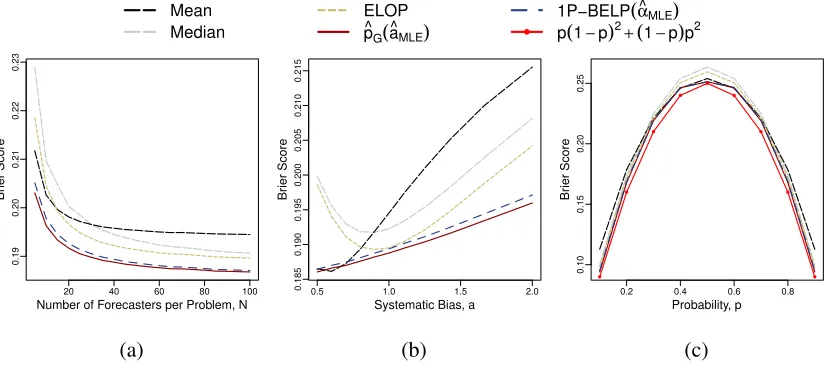
The results are summarized in two sets of figures: Figures 2.1a and 2.2a plot the Brier
scores (given by averaging over the systematic bias and the true probability) against the
number of forecasters per problem, Figures 2.1b and 2.2b plot the Brier score (given by
averaging over the number of forecasters per problem and the true probability) against the
systematic bias term, and Figures 2.1c and 2.2c plot the Brier scores (given by averaging
over the number of forecasters per problem and the systematic bias) against the true
proba-bility. Figure 2.1 presents the results underK = 30, and Figure 2.2 shows the results under
K = 100.
Given that pˆG(ˆaM LE) and 1P-BELP( ˆαM LE) performed better thanpˆG(ˆaBRI)and
1P-BELP( ˆαBRI), only the results associated with the maximum likelihood approach are
pre-sented. Comparing Figure 2.1 to Figure 2.2 shows that these two aggregators make very
good use of the training data and outperform the simple, parameterless aggregators as
the training set increases from K = 30 to K = 100 problems. Overall, our aggregator
ˆ
pG(ˆaM LE) achieves the lowest Brier score almost uniformly across Figures 2.2a to 2.2c.
This result, however, is more of a sanity-check than a surprising result as the data were
generated explicitly to match the model assumptions made bypˆG.
4This value was considered a realistic choice after analyzing the variance of the log-odds in our real-world
Mean Median
ELOP p^G(a^MLE)
1P−BELP(α^MLE)
p(1−p)2+(1−p)p2
20 40 60 80 100
0.19
0.20
0.21
0.22
0.23
Number of Forecasters per Problem, N
Br
ier Score
(a)
0.5 1.0 1.5 2.0
0.185
0.190
0.195
0.200
0.205
0.210
0.215
Systematic Bias, a
Br
ier Score
(b)
0.2 0.4 0.6 0.8
0.10
0.15
0.20
0.25
Probability, p
Br
ier Score
(c)
Figure 2.1:K = 30synthetic problems for training. 1,000 problems for testing.
Mean Median
ELOP p^G(a^MLE)
1P−BELP(α^MLE)
p(1−p)2
+(1−p)p2
20 40 60 80 100
0.19
0.20
0.21
0.22
0.23
Number of Forecasters per Problem, N
Br
ier Score
(a)
0.5 1.0 1.5 2.0
0.185
0.190
0.195
0.200
0.205
0.210
0.215
Systematic Bias, a
Br
ier Score
(b)
0.2 0.4 0.6 0.8
0.10
0.15
0.20
0.25
Probability, p
Br
ier Score
(c)
Figure 2.2:K = 100synthetic problems for training. 1,000 problems for testing.
Based on Figures 2.1b and 2.2b, correcting for the bias when the data are actually
unbiased (a = 1.0) does not cause much harm. But correcting for the bias when the
data are truly biased (a 6= 1.0), yields noticeable performance benefits especially when
K = 100. Interestingly, the mean performs better than all other aggregators when the
are under-confident (a >1). To gain some understanding of this behavior, notice that in the
highly over-confident case the distribution of the forecasts tends to be very skewed in the
probability scale. The values in the long tail of such a distribution have a larger influence on
the mean than, say, the median of the probability forecasts. Given that the median is mostly
unaffected by these values, it produces an aggregate forecast that remains over-confident.
The mean, by contrast, is drawn towards 0.5 by the values in the long tail. This produces
an aggregate forecast that is less over-confident; hence improving forecast performance.
The improved performance, however, comes at a cost: when the true probability p is
very close to the extreme probabilities 0.0 and 1.0, the mean is, on average, the worst
performer among all the aggregators in the analysis. This difference in performance, which
is clear in Figures 2.1c and 2.2c, is more meaningful when compared to the baseline given
by p(1−p)2 + (1−p)p2. Given that the expected Brier score is minimized at the true
probability, this line should be considered as the ultimate goal in Figures 2.1c and 2.2c.
Notice that all aggregators, except the mean, approach the linep(1−p)2+ (1−p)p2from
above aspgets closer to the extreme probabilities 0.0 and 1.0.
2.3.2
Synthetic Data: Misspecified Model
Next we evaluate the different aggregators on data that have not been generated from the
Logit-Normal distribution. The setup considered is an extension of the simulation study
introduced in Ranjan and Gneiting (2010) and further applied in Allard et al. (2012). Under
our extended version, the true probability for a problem withN forecasters is given by
p = Φ
N
X
i=1
ui
!
,
whereΦis the cumulative distribution function of a standard normal distribution, and each
ui
i.i.d.
process but only observesui. Then his calibrated estimate forpis given by
pi = Φ
ui
√
2N −1
Notice that the more forecasters are participating in a given problem, the less information
(proportionally) knowing ui gives the forecaster. Therefore as the number of forecasters
increases, the forecaster shrinks his estimate more and more towards 0.5. More specifically,
pi →Φ(0) = 0.5for alli= 1, . . . , N asN → ∞.
To give a real-world analogy of this setup, think of a group ofN people independently
voting on a binary event. Knowing everybody’s vote determines the final outcome. Given
that each person only knows his own vote, his proportional knowledge share diminishes
as more people enter the voting. As a result, his probability forecast for the final outcome
should shrink towards 0.5.
In our simulation, we varied the number of forecasters per problem, N, from 2 to 100
(with increments of one forecaster). Under each value ofN, the simulation ran for a total
of 10,000 iterations. Each iteration produced the true probabilities for theK problems and
their associated pools ofN probability estimates from the process described above. The
true probabilities were used to generate Bernoulli random variables that indicated which
events occurred and which did not. Testing was performed on a separate testing set
con-sisting of 1,000 problems, each with the same number of forecasters as the problems in the
training set. In the end, the resulting Brier scores were averaged to give an average Brier
score at each number of forecasters for each problem.
Figure 2.3 plots the average Brier score against the number of forecasters per problem
underK = 100problems. The same analysis was performed underK = 30. The results,
however, turned out to be almost identical to the results under K = 100 and hence, for
the sake of brevity, are not presented separately. Before discussing theK = 100 results,
Mean Median
ELOP p^G(a^MLE)
1P−BELP(α^MLE)
0 20 40 60 80 100
0.18
0.20
0.22
0.24
Number of Forecasters per Problem
Br
ier Score
Figure 2.3: 100 synthetic problems for training. 1,000 problems for testing.
many generally encountered data generating processes, having more data leads to increased
bias and is therefore harmful. As a result, we would expect the aggregators to perform
worse as the sample size increases. Based on Figure 2.3, the mean, median, and ELOP,
which do not aim to correct for the bias, in fact, degrade in terms of performance as the
number of forecasters increases. The one-parameter aggregators, pˆG and 1P-BELP, by
contrast, are able to stabilize the average Brier score despite the increasing bias in the
probability estimates. Overall, pˆG achieves the lowest Brier score across all numbers of
forecasters per problem.
2.3.3
Real Data: Predicting Geopolitical Events
We recruited over 1,300 forecasters, who ranged from graduate students to forecasting and
political science faculty and practitioners, and then asked them to give probability forecasts
centers, alumni associations, science bloggers, and word of mouth. Requirements included
at least a Bachelor’s degree and completion of psychological and political tests that took
roughly two hours. These measures assessed cognitive styles, cognitive abilities,
person-ality traits, political attitudes, and real-world knowledge. All forecasters knew that their
probability estimates would be assessed for accuracy using Brier scores. This incentivized
the forecasters to report their true beliefs instead of gaming the system. Forecasters
re-ceived $150 for meeting minimum participation requirements, regardless of their accuracy.
They also received status rewards for their performance via leaderboards displaying Brier
scores for the top 20 forecasters. Each of the 69 geopolitical events had two possible
out-comes. For instance, some of the questions were
Will the expansion of the European bailout fund be ratified by all 17 Eurozone
nations before 1 November 2011?
and
Will the Nikkei 225 index finish trading at or above 9,500 on 30 September
2011?
See the Appendix for a complete list of the 69 problems and associated summary statistics.
The forecasters were allowed to update their forecast as long as the question was active.
Some questions were active longer than others. The number of active days ranged from 2
to 173 days, with a mean of 54.7 days. It is important to note that this paper does not focus
on dynamic data. Instead we study pools of probability forecasts with no more than one
forecast given by a single expert. More specifically, we consider the first three days for
each problem because this is when the most of uncertainty is present. If an expert made
more than one forecast within these three days, we consider only his most recent forecast.
This results in 69 sets of probabilities with the number of forecasters per problem ranging
in every problem, we consider the experts completely anonymous (and interchangeable)
both within and across problems. Before we evaluate the results, however, we discuss
several practical matters that need to be taken into account when aggregating real-world
forecasting data.
2.3.3.1 Extreme Values and Inconsistent Data
For any value ofa, the aggregatorpˆGsatisfies the0/1forcing property which states that if
the pool of forecasts includes an extreme value, that is either zero or one but not both, then
the estimator should return that extreme value (see, e.g., Allard et al. (2012)). This property
is desirable if one of the forecasters happens to know the final outcome of the event with
absolute confidence. Unfortunately, experts can make such absolute claims even when they
are not completely sure of the outcome. For instance, each of the forecast pools associated
with the 69 questions in our data contained both a zero and a one. In any such dataset, an
aggregator that is based on the geometric mean of the odds is undefined.
These data inconsistencies can be avoided by adding and subtracting a small quantity
from zeros and ones, respectively. Ariely et al. (2000) suggest changing p = 0 and 1to
p = 0.02and0.98, respectively. Allard et al. (2012) only consider probabilities that fall
within a constrained interval, say [0.001,0.999], and throw out the rest. Given that this
implies ignoring a portion of the data, we take an approach similar to that of Ariely et al.
(2000) and replace p = 0 and 1 with p = 0.01 and 0.99, respectively. In the case of
multinomial events, the modified probabilities should be normalized to sum to one. This
forces the probability estimates to the open interval(0,1). The transformation will shift the
truncated values even closer to their true extreme values. For instance, ifa is larger than
two, which often is the case, 0.01 and 0.99 would be transformed at least to 0.0001 and
0.9999, respectively.
given by the arithmetic mean of the probabilities. This gives us the following estimator
ˆ
pA(a) =
h
¯
p
1−p¯
ia
1 +h1−p¯p¯ia ,
wherep¯= N1 PN
i=1pi. The subindex emphasizes the use of the arithmetic mean. The two
estimators pˆG and pˆA will differ the most when the set of probability forecasts includes
values close to the extremes. Therefore the larger the variance termσ2 of the Logit-Normal
model is the more we would expect these two estimators to differ. For comparison’s sake,
we have includedpˆAin the real-world data analysis.
A similar problem arises with the logarithmic opinion pool, where zero predictions
from experts can be viewed as “vetoes” (see Genest and Zidek (1986)). To address this, we
replacedp= 0withp= 0.01and normalized the probabilities to sum to one.
2.3.3.2 Aggregator Comparison on Expert Data
This section evaluates the aggregators on the first three days of the 69 problems in our
dataset. The evaluation begins by exploring the impact of number of forecasters per
prob-lem on predictive power. Each run of the simulation fixes the number of forecasters per
problem and samples a random subset (of this size) of forecasters within each problem.
These subsets are then used for training and computing a Brier score. The sampling
pro-cedure is repeated 1,000 times during the simulation. The resulting 1,000 Brier scores are
averaged to obtain an overall performance measure under the given number of forecasters
per problem.
Figure 2.4 plots the average Brier score against the number of forecasters per problem.
The MLE aggregatorpˆG achieves the lowest Brier score across all numbers of forecasters
per problem. The two aggregatorspˆAand P1-BELP perform so similarly that their average
Mean Median ELOP
p^A(a^BRI)
p^A(a^MLE)
p^G(a^BRI)
p ^
G(a^MLE)
1P−BELP(α^BRI)
1P−BELP(α^MLE)
20 40 60 80
0.12
0.13
0.14
0.15
0.16
Number of Forecasters per Problem
Br
ier Score
Figure 2.4: 69 real-world problems for training. The first three days; much uncertainty.
ˆ
pAappears to widen as the number of forecasters increases.
It merits note that most of the improvement across the different approaches occurs
before roughly 50 forecasters per problem. This suggests a new strategy for collecting data:
instead of having a large number of forecasters making predictions on a few problems, we
should have around 50 forecasters involved with a large number of problems. With a larger
number of problems, a more accurate estimate of the systematic bias could be acquired,
possibly leading to improved forecast performance.
A similar analysis was performed with the last three days of each problem. The average
Brier scores, however, were very close to zero. There was, in fact, so much certainty among
the forecasters, that simply taking the median gave an aggregate forecast very close to the
truth. For this reason, we decided to not present these results in this paper.
The average Brier scores in Figure 2.4 are based on the training error. No separate
in a large enough sample does not overfit significantly. Figure 2.5 plots the Brier score for
ˆ
pG under varying levels ofa. Given that the optimal level of a is around 2.0, the experts
(as a group) appear under confident, and pˆG gains its advantage by shifting each of the
probability forecasts closer to its nearest boundary point (0.0 or 1.0).
Running arepeated sub-sampling validationwith a training set of sizeK and a testing
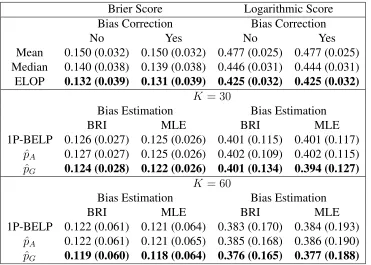
set of size69−Ksupports the results shown in Figure 2.4. Table 2.1 shows the results after
runningrepeated sub-sampling validationwithK = 30andK = 60a total of 1,000 times
and then averaging the resulting 1,000 (testing) Brier scores. For the sake of consistency,
we have also included the average logarithmic scores:
− 1
69−K
69−K
X
k=1
Zklog(ˆpk) + (1−Zk) log(1−pˆk)
wherepˆjis the probability estimate andZj is the event indicator for thejth testing problem
defined earlier in Section 2.2.2. The values given in parentheses are the estimated standard
deviations of the testing scores. Given that the mean, median, and ELOP do not use training
data, their reported scores are based on the simulation withK = 30that uses a larger testing
set.
In Table 2.1 we have also included the bias-corrected versions of the mean, median,
and ELOP. This correction was attained by applying bootstrap sampling to the pool of
probabilities for a total of 1,000 times. More specifically,
ˆ
pf,k = 2f(pk)−
1 1000
1000
X
i=1
fp(k,bsi) ,
Brier Score Logarithmic Score
Bias Correction Bias Correction
No Yes No Yes
Mean 0.150 (0.032) 0.150 (0.032) 0.477 (0.025) 0.477 (0.025)
Median 0.140 (0.038) 0.139 (0.038) 0.446 (0.031) 0.444 (0.031)
ELOP 0.132 (0.039) 0.131 (0.039) 0.425 (0.032) 0.425 (0.032)
K = 30
Bias Estimation Bias Estimation
BRI MLE BRI MLE
1P-BELP 0.126 (0.027) 0.125 (0.026) 0.401 (0.115) 0.401 (0.117)
ˆ
pA 0.127 (0.027) 0.125 (0.026) 0.402 (0.109) 0.402 (0.115)
ˆ
pG 0.124 (0.028) 0.122 (0.026) 0.401 (0.134) 0.394 (0.127)
K = 60
Bias Estimation Bias Estimation
BRI MLE BRI MLE
1P-BELP 0.122 (0.061) 0.121 (0.064) 0.383 (0.170) 0.384 (0.193)
ˆ
pA 0.122 (0.061) 0.121 (0.065) 0.385 (0.168) 0.386 (0.190)
ˆ
pG 0.119 (0.060) 0.118 (0.064) 0.376 (0.165) 0.377 (0.188)
Table 2.1: K problems for training. 69−K problems for testing. 1,000 repetitions. The
values in the parentheses are the estimated standard deviations of the testing scores.
improved the performance only by a small margin if at all.
For convenience, we have bolded the lowest scores in each column of the three boxes.
Overall, the ranking of the aggregators on relative performances is the same as in Figure
2.4. As seen before, pˆG(ˆaM LE) achieves the lowest Brier and logarithmic scores by a
noticeable margin.
2.3.3.3 Less Transformation for More Expertise
Earlier we proposed that the more expertise the forecaster has, the less systematic bias can
be found in his probability forecasts. This means that his forecasts require less
transfor-mation, i.e. a lower level of a. To evaluate this interpretation, we asked forecasters to
self-assess their level of expertise on the topic. The level of expertise was measured on a