Effects of Traditional Swaddling on Development:
A Randomized Controlled Trial
WHAT’S KNOWN ON THIS SUBJECT: Swaddling is a child care method that has been practiced for thousands of years in numerous cultures and is still used to care for millions of infants annually. Its effects on motor and mental development remain uncertain and have only been investigated in small ethnographic studies.
WHAT THIS STUDY ADDS: Traditional, tight, and prolonged swaddling has no deleterious effects on child psychomotor and mental development scores at 13 months of age, as assessed by the Bayley Scales of Infant Development in a randomized controlled trial.
abstract
+OBJECTIVE:Evidence of the effects of tight, prolonged binding of in-fants on development is inconclusive and based on small ethnographic studies. The null hypothesis was that Mongolian infants not swaddled or swaddled tightly in a traditional setting (to⬎7 months of age) do not have significantly different scores for the Bayley Scales of Infant Devel-opment, Second Edition (BSID-II).
PATIENTS AND METHODS:In a randomized controlled trial, 1279 healthy newborns in Ulaanbaatar, Mongolia, were allocated at birth to traditional swaddling or nonswaddling. The families received 7 months of home visits to collect data and monitor compliance. At 11 to 17 months of age, the BSID-II was administered to 1100 children.
RESULTS:No significant between-group differences were found in mean scaled mental and psychomotor developmental scores. The un-adjusted mean difference between the groups was⫺0.69 (95% confi-dence interval [CI]:⫺2.59 to 1.19) for psychomotor and⫺0.42 (95% CI:
⫺1.68 to 0.84) for mental scores in favor of the swaddling group. A subgroup analysis of the compliant sample produced similar results. BSID-II–scaled psychomotor and mental scores were 99.98 (95% CI: 99.03–100.92) and 105.52 (95% CI: 104.89 –106.14), respectively. Back-ground characteristics were balanced across the groups.
CONCLUSIONS:In the Mongolian context, prolonged swaddling in the first year of life did not have any significant impact on children’s early mental or psychomotor development. Additional studies in other set-tings need to confirm this finding. The Mongolian infants in this trial had scaled BSID-II mental and psychomotor scores comparable to United States norms.Pediatrics2010;126:e1485–e1492
AUTHORS:Semira Manaseki-Holland, BMedSci, MBBS, MPH, MRCP, MFPHM, PhD,aElizabeth Spier, BA, MA, PhD,b
Bayasgalantai Bavuusuren, MD, MSc, PhD,cTsogzolma
Bayandorj, MD, MSc,dSusan Sprachman, BA, MA,eand
Tom Marshall, BA, MSc,a
aDepartment of Nutrition and Public Health Intervention Research, London School of Hygiene and Tropical Medicine, London, United Kingdom;bAmerican Institutes for Research, Washington, District of Columbia;cChild Development Unit, Maternal and Child Medical Research Centre, Ulaanbaatar, Mongolia;dPublic Health Institute, Ulaanbaatar, Mongolia; and eMathematica Research Policy, Inc, Princeton, New Jersey
KEY WORDS
children, infants, BSID-II, Bayley, mental score, psychomotor score, Mongolia
ABBREVIATIONS
RCT—randomized controlled trial
BSID-II—Bayley Scales of Infant Development, Second Edition CI—confidence interval
This trial has been registered with the ISRCTN Register (http:// isrctn.org) (ISRCTN41832812).
www.pediatrics.org/cgi/doi/10.1542/peds.2009-1531 doi:10.1542/peds.2009-1531
Accepted for publication Aug 24, 2010
Address correspondence to Semira Manaseki-Holland, BMedSci, MBBS, MPH, MRCP, MFPHM, PhD, School of Health and Population Sciences, College of Medical and Dental Sciences, University of Birmingham, 90 Vincent Dr, Edgbaston, Birmingham B15 2TT, United Kingdom. E-mail: [email protected] PEDIATRICS (ISSN Numbers: Print, 0031-4005; Online, 1098-4275). Copyright © 2010 by the American Academy of Pediatrics
FINANCIAL DISCLOSURE:The authors have indicated they have no financial relationships relevant to this article to disclose.
infants are swaddled each year.1Despite
frequent speculation as to the risks and benefits of swaddling, there is a paucity of empirical evidence on the develop-mental effects of this common practice. Some evidence points to the calming or sleep-inducing effect of swaddling.2– 4
Ev-idence on infant development is mostly from observations conducted as part of small-scale, nonexperimental an-thropological, or psychological studies that did not use standardized develop-mental assessments or describe the degree or duration of swaddling with any specificity.5–13
The results of these studies have been conflicting. There is some evidence for negative effects on development.5,9,13At
16 months, swaddled Guatemalan in-fants’ motor development lagged by 3 to 4 months compared with their American peers, but their development was com-parable by 5 to 11 years of age.9In a study
of typically swaddled Navajo children, Chisholm7also concluded that initial
de-velopmental delays related to swaddling were not permanent. Others,6– 8,10–12
re-porting predominantly on Native Amer-ican cultures, have shown no effect of swaddling on infant gross motor de-velopment, and the author of a retro-spective study of Kurdistani infants6
reported no significant difference be-tween swaddled and nonswaddled in-fants with regard to the ages at which they attained sitting, standing, and walking.
Given the prevalence of swaddling inter-nationally, any association with develop-ment could have large public health im-plications. We investigated the effect of traditional tight and prolonged swad-dling on infant health and development in Mongolia in a large-scale randomized controlled trial (RCT). The first phase of this trial revealed no harmful effects of swaddling on pneumonia rates in infants
swaddled Mongolian infants would not have significantly different Bayley Scales of Infant Development, Second Edition (BSID-II) mental and motor scale scores at around 13 months of age compared with those not swaddled. There have not been any measurements of BSID-II scores at the population level in Mongo-lia. Therefore, a secondary study objec-tive was to provide data on the BSID-II scores for our trial population, which is a representative sample of Mongolian infants in Ulaanbaatar.
PATIENTS AND METHODS
Sample
The details of the recruitment and first stage of follow-up are summarized else-where.14In brief, all healthy infants
deliv-ered at the only 4 maternity hospitals in Ulaanbaatar, Mongolia, were eligible to be recruited within 48 hours of birth. More than 95% of Ulaanbaatar births took place in these 4 hospitals.15
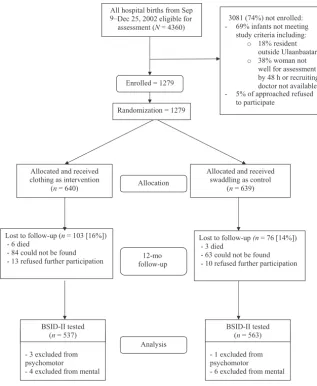
Exclu-sions were less than 36 weeks’ gesta-tion, less than 2500 g birth weight, obvi-ous congenital abnormalities, newborns with need for intensive care treatment, and residents in apartments that were kept too warm for the infant to be swad-dled during the daytime (as defined by the mothers). Written informed consent was obtained from the mother and next of kin. Random assignment to swaddling and nonswaddling groups was through a statistician who was not involved with recruitment and used a previously gen-erated Excel (Microsoft, Redmond, WA) random-study-number list (equal proba-bility, without stratification). For alloca-tion, after consent recruitment doctors telephoned a centrally located manager who allocated subjects moving down this list. The trial profile (Fig 1) summa-rizes the follow-up and attrition.
In phase 1 of the trial, 1279 infants were recruited14(Fig 1 and Table 1).
90% power and a statistical signifi-cance ofP⫽.05, we required a mini-mum sample requirement of 303 per group. A 5-point score difference be-tween the groups (or 5 SDs) was used because score differences of more than 15 are thought to be clinically significant,16 whereas
Grantham-McGregor et al17and Hamadani et al18
found a decrease in the average men-tal score with low birth weight, after adjustment, of 5.9 points. However, to take advantage of the large phase 1 sample, to account for the secondary objective and possibility of some not consenting to BSID-II testing, we con-tacted all families from phase 1. After excluding those who were lost to follow-up or did not consent to addi-tional participation, 536 from the swaddling and 564 from the nonswad-dling groups signed new consent forms and attended the testing (Fig 1).
Procedures
For infants assigned to the swaddling group, families were instructed to follow a pattern of swaddling based on the tra-ditional Mongolian method. For the first 2 months, this pattern involved wrapping the infant from head or neck down in 2 to 3 layers of thin cotton cloths, covered by layers of warm blankets (Fig 2A–D). In-fants were swaddled during the day and night, with the exception of a brief few minutes to change the infant’s soiled clothes 3 to 5 times per day. From 2 to 7 months of age, swaddling still took place during both day and night, but the number of hours in the day was gradually reduced. At this point, the infant’s arms were some-times freed in the daytime (Fig 2E).
Be-yond this age, swaddling mostly was
restricted to times when the infant was asleep. By 13 months of age, the majority of children were no longer swaddled (Table 2). Among those who
did continue swaddling, it rarely oc-curred when infants were awake.
To monitor compliance, field-workers di-rectly observed the infants during every home visit and collected retrospective 24-hour diaries of swaddling. When the
infants were 6 and 12 weeks of age, mothers completed 2 sets of 4-day pro-spective diaries. Unscheduled visits for direct observations and other data
sources were triangulated with these di-aries to confirm compliance. A “good
complier” variable was defined by using the 2 diary sources: Over the first 2 months and then from 3 to 7 months, a good complier in the swaddling group had a mean of more than 21 of 24 hours swaddled and in the nonswaddling group had a mean of less than 3 hours swaddled.
Four trained Mongolian testers con-ducted all tests at 1 center. Their rigor-ous training for test administration is de-scribed elsewhere.19 The protocol was
adapted from the model originally used in the Early Head Start Research and Evaluation Project,20 and training was
conducted by its expert staff. Accurate administration of the BSID-II was moni-tored weekly through random videotap-ing and supervisor observation. Ameri-can trainers reviewed the performance of each tester by assessing the videotap-ing of a random 10% proportion of the tests. The effect of tester variation was assessed statistically, and to eliminate any such effect, “tester,” as an interac-tion and then as an independent term, was applied in multivariate analysis. All project staff who administered the BSID-II, computed BSID-II scores, supervised, and cleaned the data were blind to ran-domization groups. An Access database (Microsoft) was used for data entry, and Stata (Stata Corp, College Station, TX) was used for intention-to-treat univari-ate analysis and linear multiple regres-sion analyses.
For secondary analysis, in which the effect of exposure was examined, first compliance (good-compliers variable) was tested as an interaction term and then as a confounder for the whole sample in a multivariate regression analysis. Subsequently, it was used to define a per-protocol subgroup (good-complier group) in which the hypothe-sis was further tested.
BSID-II Instruments, Translation, and Adaptation
The BSID-II has been extensively vali-dated and standardized in the United Analyzed (n = 537)
- 3 excluded from psychomotor
- 4 excluded from mental
Analyzed (n = 563)
- 1 excluded from psychomotor
- 6 excluded from mental Analysis
All hospital births from Sep Dec 25, 2002 eligible for assessment (N = 4360)
3081 (74%) not enrolled: - 69% infants not meeting
study criteria including:
o 18% resident outside Ulaanbaatar
o 38% woman not well for assessment by 48 h or recruiting doctor not available - 5% of approached refused
to participate
BSID-II tested (n = 537) Lost to follow-up (n = 103 [16%]) - 6 died
- 84 could not be found - 13 refused further participation
Allocated and received clothing as intervention
(n = 640)
Lost to follow-up (n = 76 [14%]) - 3 died
- 63 could not be found - 10 refused further participation
Allocated and received swaddling as control
(n = 639)
BSID-II tested (n = 563) Allocation
12-mo follow-up Enrolled = 1279
Randomization = 1279 9–
FIGURE 1
Trial profile.
States16and validated and translated
for other cultural settings.21–23 The
BSID-II mental scale evaluates chil-dren’s sensory/perceptual acuities, discriminations, and response; acqui-sition of object constancy; memory
learning and problem-solving; vocal-ization and beginning of verbal com-munication; basis of abstract thinking; habituation; mental-mapping; complex language; and mathematical concept formation. The BSID-II psychomotor
and fingers, dynamic movement, pos-tural imitation, and stereognosis (abil-ity to recognize objects by sense of touch). Test scores are reported as scaled scores based on the infant’s age, with a normed mean of 100 (SD: 15 points).16Both scales have high
corre-lation coefficients (0.83 and 0.77 for psychomotor and mental tests, re-spectively) for test-retest reliability.16
The BSID-II training materials were me-ticulously translated into Mongolian (in-cluding back-translations), and transla-tions were further refined in the course of tester training to ensure comparabil-ity with original BSID-II instructions. Al-though concerns about cross-cultural variation cannot be eliminated, minimal test adaptation was required, because items administered to children younger than 18 months embodied few linguistic or conceptual features that could vary by culture.
This project was approved by the Min-istry of Health of Mongolia and the eth-ics committee of the London School of Hygiene and Tropical Medicine.
RESULTS
The BSID-II was successfully adminis-tered to 1100 of the trial children. Table 1 lists the characteristics of the groups.
Intention-to-treat linear regression analyses revealed that there were no significant differences between the swaddling and nonswaddling groups in their mental and psychomotor scores (Table 3). Mean scaled BSID-II mental and psychomotor scores for the swaddling versus nonswaddling groups were 105.73 (95% confidence interval [CI]: 104.85–106.62) versus 105.31 (95% CI: 104.41–106.21) and 100.34 (95% CI: 98.99 –101.42) versus 99.64 (95% CI: 98.31–100.92), respec-tively. With “good-complier” as an inde-pendent term and its interaction with a
(SD Range) (SD Range) Age of BSID-II testing
11–12 mo 5 (1) 2 (0.5)
13 mo 422 (79) 465 (83)
14 mo 98 (18) 79 (14)
15–17 mo 12 (2) 17 (3)
Gestational age at birth 36–376⁄
7wk 17 (3) 19 (4)
ⱖ38 wk 519 (97) 543 (96)
Type of delivery
Vaginal 447 (83) 461 (82)
Cesarean 85 (16) 97 (17)
Birth weight
2400–2950 g 58 (11) 66 (12)
3000–3450 g 233 (43) 233 (41)
3500–3950 g 186 (35) 191 (34)
⬎4000 g 57 (11) 68 (12)
Gender of infant
Female 265 (49) 286 (51)
Male 264 (49) 274 (48)
Breastfeeding 0–4 mo
Not breastfed 39 (7) 51 (9)
Nonexclusively breastfed 485 (90) 500 (89)
Exclusively breastfed 7 (1) 9 (1)
No. of children admitted for severe pneumonias defined by IMCI
71 (13) 78 (14)
Anemia, ever diagnoseda 33 (6) 37 (7)
Rickets, ever diagnoseda 204 (38) 295 (35)
Maternal age, y 27 (26–27) 27 (26–27) Parity
0 231 (43) 263 (47)
1 or 2 90 (17) 86 (15)
⬎3 143 (27) 154 (27)
Maternal marital status
Single 15 (3) 12 (2)
Common law 235 (44) 264 (47)
Married 279 (52) 282 (50)
Maternal education
Primary school 60 (11) 60 (11)
Secondary school 291 (54) 305 (54) Tertiary education 178 (33) 193 (34) Mother’s employment
Ever worked 410 (76) 439 (77)
Paternal education
Primary school 76 (14) 72 (13)
Secondary school 285 (53) 302 (54) Tertiary education 135 (25) 156 (28) Father’s employment
Ever worked 389 (73) 419 (74)
Type of residence at recruitmenta
Ger/wood-cement house 170 (32) 191 (34) Ger/apartment mixed 165 (36) 158 (28)
Apartment 195 (36) 208 (37)
No. of people sleeping in the infant’s room 4.2 (4.0–4.5) 4.3 (4.1–4.4)
All variables remained not statistically different between the 2 arms. IMCI indicates the World Health Organization and United Nations Children’s Fund Integrated Management of Childhood Illnesses.
randomized group in a regression model, neither was statistically signif-icant (P⫽.7 and 0.5, respectively), giv-ing no evidence for any impact of dif-ferential compliance on psychomotor or mental scores. Per-protocol analy-ses of the separate good-complier sub-sample (see Table 3) also revealed no difference between the 2 groups in terms of their scaled scores. As ex-pected, there were fewer
nonswad-dling infants who were
good-compliers compared with swaddling
infants (Table 3), but power still was preserved at more than 90%.
Mean BSID-II mental scale scores (105.52 [95% CI: 104.89 –106.14] vs
100) for the Mongolian children par-ticipating in this trial were slightly higher than those in the US normal sample,24 and BSID-II psychomotor
scores (99.98 [95% CI: 99.03–100.92] vs 100) among this Mongolian
sam-ple were essentially equivalent to US norms.
Randomization and Bias
At recruitment, in 3 hospitals 25% and in the fourth 26% of births between September and December 2002 were recruited. No differences were found between hospitals or mean date of re-cruitment according to allocation to groups. Randomization was success-ful, and univariate analyses, applying a FIGURE 2
A–D, Series of photographs showing the sequence of swaddling a newborn infant; E, a 6-month old infant swaddled from the waist down.
large range of variables (see Table 1), demonstrated that the only back-ground or risk-factor characteristic that was slightly different between the groups at recruitment was the fathers’ education.14In the phase 2 trial
popu-lation (Table 1), fathers’ education was balanced between the groups. Partici-pant attrition rates (Fig 1) did not differ on the basis of any sample char-acteristics. Survival analysis (Cox re-gression modeling) compared non– acute respiratory illness and all acute respiratory illness cases as well as pneumonia cases in the 2 groups and revealed no difference of rates be-tween the 2 arms of the trial.
Test scores did not vary significantly according to the tester. On the basis of BSID-II age calculations, a total of 883 children were assessed at 13 months of age, 176 children at 14 to 16 months of age, and the remaining 41 children at 11, 12, or 17 months of age. Age of testing did not vary according to group assignment. Almost all of the children (n⫽1049 [95.5%]) were tested at an assessment center, and the remaining 51 children were tested at home.
DISCUSSION
In this first large-scale RCT of the ef-fects of tight and prolonged swaddling, we found no significant impact of swaddling on children’s mental or
psy-chomotor development. This finding is relevant to many developing countries in which millions of infants are swad-dled annually. In most of these coun-tries, swaddling resembles the Mongo-lian practice in that the infant is bound in a straight position almost continu-ously in the first few months of life through the use of sheets and blankets or with a cradleboard and thereafter increasingly let free for waking hours and eventually stopping swaddling.
The findings of this trial mirror those found in smaller ethnographic and ob-servational studies6– 8,10–12by
suggest-ing that tight and prolonged swaddlsuggest-ing (traditional style) neither harms nor enhances infant mental and psy-chomotor development.
Despite having fewer stimulating objects (ie, toys) to experiment with than their American counterparts and less free-dom of motion for many of the initial months of life, the Mongolian infants in our sample performed as well as Amer-ican infants on the BSID-II psychomotor scale and mental scale. The slightly bet-ter mean mental scale score was less than 10 points and, therefore, was not considered to be clinically significant in an individual child.16However, such a
rel-atively small shift in population mean will correspond to a definite change in the proportion of those whose excess
Never swaddled 0 (0) 301 (53)
0 to end of 3rd month of life 17 (3) 239 (42)a
4th to end of 5th month of life 17 (3) 9 (2) 6th to end of 7th month of life 322 (60) 5 (1) 8th to end of 11th month of life 155 (29)a 6 (1)
12th month of life until BSID-II testing was performed between 13th and 14th month
24 (5) 4 (1)
No data 1 (0.1) 0 (0)
Total 536 (100) 564 (100)
aCompliance data demonstrated that the majority of the nonswaddling-group children (198 of 239) who were swaddled in the early months spent an average of less than 3 hours per 24 hours swaddled and usually did so during the sleeping period. The majority of the swaddling-group children (465 of 536) were swaddled more than 21 hours per 24 hours until 6 months, and then swaddling was gradually reduced during waking hours.
over the American norm was 10 or more points.25
The findings that swaddled Guatemalan infants from a remote region had the same levels of development as non-swaddled American children7 were
ex-plained by Lewis and Freedle,26who
de-scribed Guatemalan infants as being spoken to or played with 25% of the time compared with 6% of the time for middle-class American children. Our ob-servations in Mongolia indicate that the infant (swaddled or not) is rarely out of a caretaker’s arms during waking hours and is at the center of family interac-tions. The typical Mongolian household contains an extended family, and similar to many non-Western swaddling cul-tures,27Mongolian culture is oriented
to-ward providing infants with a high amount of social attention. These and other contributing explanatory factors in Mongolian infants’ care practices have enabled infant development that is com-parable to US norms despite intense mo-tor restriction and a minimal exposure to toys.
Such findings raise fundamental ques-tions in developmental child health re-garding the importance and the nature of early motor stimulation and experi-ence with object manipulation required for normal infant mental and psychomo-tor development to occur, at least in a cultural context with a high degree of so-cial stimulation. Our results suggest that the promotion of positive infant mental and psychomotor development may need to focus on social interactions rather than emphasizing the availability of motor and sensory stimulation. Find-ings also would be of particular impor-tance to Western families who may not be able to afford early childhood toys but who may live in extended family units. Driven by rigorous publicity and social pressures linking good parenting to pro-vision of toys, these families may feel disempowered in contributing to their children’s development. Although the
stressors of poverty exist in Mongolia just as they do in Western countries, the impact of this poverty on development in young children seems to be mitigated by their high exposure to child-friendly and child-focused social interactions.
This article primarily presents the re-sults of an RCT that investigated the ef-fect of swaddling on the psychosocial de-velopment of children. Given the RCT nature of the study, like is compared with like, because randomization was successful for both the recruited sam-ples in phase 1 and because low attrition before the second phase still left the arms balanced in all background and risk-factor characteristics (Table 1). This design eliminates the effect of an-ticipated and unknown factors.
However, for the secondary study ques-tions, generalizability may be questioned when presenting the overall mean scores for BSID-II in this study and com-pared with the US norms. A limitation of our trial includes an inability to identify the characteristics of families who re-fused to participate during recruitment. However, given the small number of re-fusals, it is unlikely that this introduced biases to the overall developmental sta-tus of the infants in the sample relative to the entire Mongolia population. The ur-ban Ulaanbaatar setting may make gen-eralizability to rural populations ques-tionable. Although differences in child care cannot be excluded, recent political changes have meant that a large num-ber of residents of Ulaanbaatar are re-cent migrants from the rural areas living in gers or wooden-cement housing dis-tricts. The high rate of these participants in our trial demonstrates the high repre-sentation of rural families and, thus, ru-ral practices. It is important to note that despite the high rate of literacy of moth-ers, our population was poorer than av-erage in Ulaanbaatar because those liv-ing in better apartment housings (warm) were not included. A high liter-acy rate is a feature of Mongolia as a
postsocialist country in which more than 98% of women are literate (in rural and urban settings) and have a higher rate of tertiary education than men.28,29
In terms of the inclusion and exclusion criteria, perhaps if our sample included children with gross congenital abnor-malities, with newborn illness, or born at less than 36 weeks’ gestation or less than 2500 g birth weight, BSID-II scores would have been slightly lower. However, we do not speculate a large effect if such a cohort were included because Mongo-lian infants who have severe prematu-rity, very low birth weight, or major neo-natal problems rarely survive to 13 months given the relative lack of ad-vanced neonatal and pediatric medical services in Mongolia. Furthermore, in-creased rates of infant morbidities in Mongolia compared with those in the United States would be expected to delay development and scores, thus balancing out the effect of a higher percent of in-fants being healthy at birth in our sam-ple. Summarizing issues of generalizabil-ity, it can be concluded that the effect of swaddling on development can be gener-alized, whereas the inclusion and exclu-sion criteria in our population may have slightly improved the overall mean score of our sample compared with the real mean in Mongolia. The effect of our se-lection criteria on the comparison of our total study population score with the to-tal Mongolian population’s BSID-II score cannot be ascertained through the cur-rent study.
CONCLUSIONS
Our trial was the first RCT of the health effects of tight and prolonged tradi-tional swaddling. We demonstrated no harmful effect of swaddling on child-hood mental and psychomotor devel-opment at 11 to 17 months of age among Mongolian children, which is a significant finding for millions of par-ents in developing countries in which swaddling is a convenient and cheap
ACKNOWLEDGMENTS
This project was funded by the Clinical Epidemiology Program of the Well-come Trust, Canada Fund, and United Nations Children’s Fund Mongolia Country Office. These funders had no other involvement with the details of trial implementation or analysis.
months, to the 22 who did the same during the BSID-II testing stage of the work, and to the following Mongolian collaborators: Prof Jarghansaikhan and Dr Soyogerel at the Ministry of Health and Dr Narnatuya, the Director of Public Health Institute, who sup-ported and provided local supervision for this project. We are grateful for the
Centre Hospital, without the facilita-tion of whom this project would not have been supported. Furthermore, we are indebted to the expert advice and direction of Prof Sally McGregor and Mrs Betty Hutchinson at the start of this trial, training assistance from Dr Amy Damast and Mrs Margie Stone, and statistical advice of Dr Kim Boller.
REFERENCES
1. Nelson EAS, Schiefenhoevel W, Haimerl F. Child care practices in unindustrialized societies.Pediatrics. 2000;105(6). Avail-able at: www.pediatrics.org/cgi/content/ full/105/6/e75
2. Franco P, Seret N, van Hees J, Scaillet S, Groswasser J, Kahn A. Influence of swad-dling on sleep and arousal characteristics of healthy infants.Pediatrics. 2005;115(5): 1307–1311
3. Gerard CM, Harris KA, Thach BT. Spontane-ous arSpontane-ousals in supine infants while swad-dled and unswadswad-dled during rapid eye movement and quiet sleep.Pediatrics. 2002;110(6). Available at: www.pediatrics. org/cgi/content/full/110/6/e70
4. Ohgi S, Akiyama T, Arisawa K, Shigemori K. Randomised controlled trail of swaddling versus massage in the management of ex-cessive crying infants with cerebral inju-ries.Arch Dis Child. 2004;89(3):212–216 5. Baker PT, Little MA.Man in the Andes: A
Mul-tidisciplinary Study of High-Altitude Que-chua Natives. Strousburg, PA: Dowden, Hutchinson and Ross; 1976
6. Bloch A. The Kurdistani cradle story: a mod-ern analysis of this centuries-old infant swaddling practice.Clin Pediatr (Phila). 1966;5(10):641– 645
7. Chisholm JS.Navajo Infancy: An Ethological Study of Child Development. New York, NY: Aldine, Hawthorne; 1983
8. Dennis W, Dennis MG. The effect of cradling practices upon the onset of walking in Hopi children.J Genet Psychol. 1940;56:77– 86 9. Kagan J, Klein RE. Cross-cultural
perspec-tives on early development.Am Psychol. 1973;28(11):947–961
10. Kluckhohn C. Some aspects of Navajo in-fancy and early childhood.Psychoanal Soc Sci. 1947;1(1):37– 86
11. Leighton D, Kluckhohn C.Children of the
People. Cambridge, MA: Harvard University Press; 1948
12. Lipton EL, Steinschneider A, Richmond JB. Swaddling, a childcare practice: historical, cultural and experimental observations. Pe-diatrics. 1965;35(suppl):519 –567 13. Tronick EZ, Thomas RB, Daltabuit M. The
Quechua manta pouch: a caretaking prac-tice for buffering the Peruvian infant against the multiple stressors of high alti-tude.Child Dev. 1994;65(4):1005–1013 14. Manaseki-Holland S.Investigation of the
Ef-fect of Swaddling on Lower Respiratory Tract Infection in Infants From Mongolia
[PhD thesis]. London, United Kingdom: Lon-don University; 2005
15. World Health Organization, Mongolian Gov-ernment.Mongolia Health Sector Review (HSR). Ulaanbaatar, Mongolia: World Health Organization and the Government of Mongolia; 1999
1 6 . B a y l e y N . B a y l e y S c a l e s o f I n f a n t Development: Second Edition Manual. New York, NY: Psychological Corporation; 1993 17. Grantham-McGregor SM, Lira PIC, Ashworth
A, Morris SS, Assuncao MAS. The develop-ment of low birth weight term infants and the effects of the environment in northeast Brazil.J Pediatr. 1998;132(4):661– 666 18. Hamadani J, Fuchs G, Osendarp S, Huda S,
Grantham-McGregor S. Zinc supplementa-tion during pregnancy and effects on men-tal development and behavior of the infants: a randomized placebo controlled trial. Lan-cet. 2002;360(9329):290 –294
19. Spier ET, Sprachman S, Rowand C. Imple-menting large-scale studies of children us-ing clinical assessments. In:Children and the Mediterranean: Health, Culture and Ur-ban Settings. Genoa, Italy: Fondazione Insti-tuto Mediterraneo per L’Infanzia; 2004 20. Love JM, Kisker EE, Ross C, et al.Making a
Difference in the Lives of Infants and
Tod-dlers and Their Families: The Impact of Early Head Start. Princeton, NJ: Math-ematica Policy Research; 2002
21. International Centre for Diarrhoeal Disease Research, Bangladesh. Effect of psychoso-cial stimulation on mental development and behaviour of malnourished children: a ran-domised control trial.Head Sci Bull (Bang-ladesh). 2005;3
22. Ogi S, Fukada M, Takahaski T, et al. The Ef-fects of Kangaroo Care on Neurobehavioral Organization, Infant Temperament and De-velopment in Healthy Low-Birth-Weight In-fants Over the First Year of Life: The Na-gasaki University Hospital Study.Boston, MA: Ab Initio International; 2001–2002. Avail-able at: www.brazelton-institute.com/ abinitio2002/art1.html. Accessed November 11, 2010
23. Wright RO, Hu H, Silverman EK, et al. Apoli-poprotein E genotype predicts 24-month Bayley Scales Infant Development score. Pe-diatr Res. 2003;54(6):819 – 825
24. Bayley N.The Bayley Scales of Infant Devel-opment. New York, NY: Psychological Corporation; 1969
25. Ross DA, Vaughan JP. Health interview surveys in developing countries: a methodological re-view.Stud Fam Plann. 1986;17(2):78 –94 26. Lewis M, Freedle MR.Mother-Infant Dyad.
Princeton, NJ: Educational Testing Service; 1972
27. Masataka N. On the function of swaddling as traditional infant-care practiced by native South Americans [in Japanese].Shinrigaku Kenkyu. 1996;67(4):285–291
28. United Nations Children’s Fund.The State of The World’s Children. New York, NY: United Nations Children’s Fund; 2004
DOI: 10.1542/peds.2009-1531
2010;126;e1485
Pediatrics
Bayandorj, Susan Sprachman and Tom Marshall
Semira Manaseki-Holland, Elizabeth Spier, Bayasgalantai Bavuusuren, Tsogzolma
Trial
Effects of Traditional Swaddling on Development: A Randomized Controlled
Services
Updated Information &
http://pediatrics.aappublications.org/content/126/6/e1485 including high resolution figures, can be found at:
References
http://pediatrics.aappublications.org/content/126/6/e1485#BIBL This article cites 13 articles, 2 of which you can access for free at:
Subspecialty Collections
al_issues_sub
http://www.aappublications.org/cgi/collection/development:behavior Developmental/Behavioral Pediatrics
following collection(s):
This article, along with others on similar topics, appears in the
Permissions & Licensing
http://www.aappublications.org/site/misc/Permissions.xhtml in its entirety can be found online at:
Information about reproducing this article in parts (figures, tables) or
Reprints
DOI: 10.1542/peds.2009-1531
2010;126;e1485
Pediatrics
Bayandorj, Susan Sprachman and Tom Marshall
http://pediatrics.aappublications.org/content/126/6/e1485
located on the World Wide Web at:
The online version of this article, along with updated information and services, is
by the American Academy of Pediatrics. All rights reserved. Print ISSN: 1073-0397.