Published online April 30, 2014 (http://www.sciencepublishinggroup.com/j/ajep) doi: 10.11648/j.ajep.20140302.19
Measuring progress toward urban sustainable
development using a quantitative model (Case study:
Cities in Iran)
Saeed Soleymani Sardu
1, Mohssen Torabi
2, Shahrbanoo Vafaei Varmazabadi
31
MSC in Regional Planinig, Azad University, Science and Research Branch, Tehran, Iran
2
MSc student in urban management, university of Tehran, Tehran, Iran
3
Undergraduate Student, Azad University, Karaj Branch, Karaj, Iran
Email address:
[email protected] (S. S. Soleymani), [email protected] (M. Torabi), Shahrbano. [email protected] (S. V. Varmazabadi)
To cite this article:
Saeed Soleymani Sardu, Mohssen Torabi, Shahrbanoo Vafaei Varmazabadi. Measuring Progress toward Urban Sustainable Development Using a Quantitative Model (Case Study: Cities in Iran). American Journal of Environmental Protection.
Vol. 3, No. 2, 2014, pp. 96-102. doi: 10.11648/j.ajep.20140302.19
Abstract:
Sustainable development offers a new concept for the world economy in the twenty-first century. Rather than focusing solely on income, sustainable development encourages cities, countries, and the world to focus simultaneously on three goals: economic prosperity, social inclusion, and environmental sustainability. Cities will be in the front lines of the battle for sustainable development. Not only do they face direct threats; they also have the best opportunities to identify and deliver solutions. As high-density, high-productivity settlements, cities can provide greater access to services of all kinds– including energy, water, health, education, finance, media, transport, recycling, and research – than can most rural areas. In this study first, ten indicators of Sustainable Development, some with positive relationship with sustainable development and some with negative relationship were chosen and information related to performances of 8 indices of 28 cities of Iran’s country in years 1995, 2000, 2005 and 2010 extracted. After extracting indices and processing them, indices were standardized. In the next step and after standardizing, using McGranahan method, correlation matrix of indices was calculated by SPSS software and weight of each index was determined. After this step, weight of each index was multiplied on each standardized index and at the end composite index for each city was calculated for 1995, 2000, 2005 and 2010. Then, these composite indexes were sorted by descending. Stability numbers obtained using this method for Tehran for these years are 364, 369, 347 and 344 respectively, which was always higher than the average of 28 cities. Tehran’s rank was always between 4 and 9 showing undesirable performance which requires suitable actions.Keywords:
Sustainable Development, Quantitative, Progress, McGranahan Method, Indicator1. Introduction
With the growth of knowledge and technology and the beginning of agriculture and domesticating the animals, human supply his needs which usually is connected with the environment. The human has made some changing on the ecosystem of the earth in comparison with the other animals. And With the growth of industry and blooming of it the same as industrial revolution, many changing has been done by the human in the ecosystem. However, in many parts of the world the ecosystem has been destroyed by the human. In recent researches, the connections of earth capacity for supporting humans with the economic,
environment, culture and population were found which were completely limited [1]. So some opinions and actions for correcting the relation between human and environment has been done, that it caused the forming of sustainable development.
the growth of sustainable development depends on human needs and without making any damage to needs of new generation [4]. Meaning the sustainable development is a long time model development [5], in the position of sustainable development it consists on preventing from damage to the environment, destroying the ecosystem preventing from agnostic, pollution, high population, and decreasing the quality of living for humans in reality the complete sustainable conditions is prepared when a total sustainable of environmental with equal aim of ecological, sustainable in economy, social sustainable with the aim of social justice and sustainable frame for sustainable aim of morphological be fixed [6].
Sustainable development is development that meets the needs of the present without compromising the ability of future generations to meet their own needs [7]. The primary objective of sustainable development is to reduce the absolute poverty of the world’s poor through providing lasting and secure livelihoods that minimize resource depletion, environmental degradation, cultural disruption and social instability.
The Earth Summit (UNCED), which took place in Rio de Janeiro in 1992, recognized the pressing environment and development problems of the world and, through the adoption of Agenda 21, produced a global programme of action for sustainable development in the 21st century. Agenda 21 stresses the importance of partnerships in improving social, economic and environmental quality in urban areas. It suggests renewed focus on effective land use planning to include adequate environmental infrastructure, water, sanitation, drainage, transportation and solid waste management, in addition to a sound social infrastructure capable of alleviating hunger. According to Afonja (1999), the Earth Summit broadened environmental issues and emphasized the synergies with other social and economic policy issues [8].
The 1997 Special Session of the UN General Assembly set a target date of 2002, for the formulation and elaboration of national strategies for sustainable development. National governments are to integrate environmental, economic and social objectives into decision-making by either elaborating new policies or strategies for sustainable development, or by adapting existing policies and plans. It also reaffirmed that all sectors of the society should be involved in their development and implementation. The World Summit for Sustainable Development (WSSD), held in August 2002, urged in its Plan of Implementation that nations should take steps to make progress in the formulation and elaboration of national strategies for sustainable development and begin their implementation [9].
Sustainable development offers a new concept for the world economy in the twenty-first century. Rather than focusing solely on income, sustainable development encourages cities, countries, and the world to focus simultaneously on three goals: economic prosperity, social inclusion, and environmental sustainability [10].
In the other word, sustainable development is joining of bio ecosystem and social with economic subjects (Bio environment and society). Such developing is against with unsustainable growth economic and states this reality that, the kind of living is equal with some hazards [11]. If we consider the three elements of sustainable developing (social, economy and environment) the results would be more accurate as it has been shown. Nevertheless (Figure 1) stating so developments, that it is not very good, because the ingredients of sustainable development are not in equal with each other [12].
Figure 1. Stability of undesirable(Enayati,2009)
Figure 2. Optimal stability (Enayati, 2009)
sustainable development. Not only do they face direct threats; they also have the best opportunities to identify and deliver solutions. As high-density, high-productivity settlements, cities can provide greater access to services of all kinds – including energy, water, health, education, finance, media, transport, recycling, and research – than can most rural areas [14].
Urban development is especially important within the broader context of sustainability The reality of "accelerated urbanization growth in the south countries (like Iran) overrides its damaging influence in local and global scales; "e.g. environmental, social, economical and political problems such as an increase in resource demands, waste production, air pollution, poverty, inequity, housing shortages, crimes, narcotic use… caused concerns about urban sustainable development.
The need for sustainable urban planning and development reached an important point in 2007, when half of the world’s population was defined as living in cities [15]. Therefore the aim of this research is measuring progress toward Urban Sustainable Development in Iran.
2. Materials and Methods
In order to prepare compiled indexes, first we extracted and classified urban sustainable development indexes for a number of cities from sustainable development index database of United Nations. Since the indicators used in sustainable development are not in the same scale and some are in percent and some in tons, thus adding these indicators with different scales to achieve a combined index is not possible. Therefore it is essential to convert these indices to standard units so it is possible to collect them. Although the methods for achieving standard scales, which is called normalization, are not without problems, but they are ways used for achieving combined indices. In this research, for normalization we used "Division by Mean" method. In this method, after extraction of selected indicators and cities, values of each indicator was divided by the mean of all indicators in the column, resulting a new indicator without scale. To implement this method, the following formula is used [16]:
Y=Xij/X
=the amount fixed by the scale =value of index in city j
=mean of each index in every column
After normalization of each column, it is necessary to calculate appropriate weight of each indicator. In this study, we used McGranahan method (1970) for weighting which calculated using SPSS package. After calculation of weight of each indicator, it was multiplied by previously calculated scale-less indices. Then, calculated values in each row were added to get combined indicator (sustainability number) for each city. Combined indicators are sorted in descending order based on which we can determine the ranking of selected cities [17].
2.1. Urban Sustainable Development Indexes
In 2010 the government published its strategy for main streaming sustainability and in it gave an undertaking to publish a revised set of Sustainable Development Indicators (SDIs).
The SDI set consisted of 68 indicators comprising 126 measures. This set is formed of fewer indicators: 12 headline and 23 supplementary indicators, comprising 25 and 41 measures respectively. The reduced size of the set follows the example of other international institutions in identifying a core set of headline indicators to highlight sustainable development priorities for users and government. It was also in part prompted by the need for alignment with the Office for National Statistics‟ development of national wellbeing measures, which are closely related to measures of sustainable development. Where appropriate the measures used in the indicator set also aligns with other indicator frameworks, such as those which measure progress against government departments‟ business plans and the Public Health Outcomes Framework.
The indicators provide an overview of national progress towards a more sustainable economy, society and environment. The SDIs are used as a means of assessing whether the nation as a whole is developing sustainably, and as a means for policy-makers to identify more sustainable policy options. They are not used to evaluate individual policies due to their high-level nature.
The SDIs are designated National Statistics by the Iran’s Statistics Authority. Assessments of compendium publications against the Code of Practice for Official Statistics relate to the processes involved in preparing the publication and its presentation. This can broadly be interpreted as meaning that the statistics meet identified user needs, are well explained and readily accessible, are produced according to sound methods and are managed impartially and objectively in the public interest.
2.2. Statistical Analysis and Calculation of Composite Indicators for Urban Sustainable Development, for Selected Cities in Years 1995, 2000, 2005 and 2010
In this study, first, ten indicators of urban sustainable development, some with positive relationship with sustainable development and some with negative relationship were chosen as follows:
- Air Quality
- Economic prosperity
- Land Use
- Poverty
- Waste Disposal and Recycling - Water Use
- Water Quality
- Healthy Life Expectancy - Population Demographics - Energy from Renewable Source
data for some of them, also due to different definitions of the indicators was not possible and for this reason among 10 indicators above, 8 of them were chosen as follows: - X1: Air Quality (positive relationship with sustainable
development)
- X2: Economic prosperity (positive relationship with sustainable development)
- X3: Land Use (positive relationship with sustainable development)
- X4: Poverty (negative relationship with sustainable development)
- X5: Disposal and Recycling (positive relationship with sustainable development)
- X6: Water Use (positive relationship with sustainable development)
- X7:Water Quality (positive relationship with sustainable development)
- X8:Population Demographics (positive relationship with sustainable development)
After selecting indicators, the raw data for each of the indices were collected for 28 cities from different regions of the Iran from Sustainable Development database, in the
four-period 1995, 2000, 2005 and 2010. After extracting the data, the table (Cities in rows and indicators in columns) was prepared. As from eight indicators, one was in negative relationship with sustainable development; first we transform it so that it has positive direction. For this purpose, the values of each of the indicators were deducted from a constant. After this, related indicators for each city standardized by dividing each value by the average to allow comparison. After standardization, the weight of each indicator should be calculated for each of the years studied. In this study, McGranahan method for weighting indicators is used. The McGranahan method assumption is this that the weights should be indicative of importance of an indicator among other indicators which is determined through the correlation of each indicator with others. In other words, in this method the more the correlation of a variable with other variables is, the more it weighted and vice versa. On this basis, to determine the weight of each indicator, correlation matrix was calculated for each of the indicators and the average correlation coefficient, as an indicative of importance of each indicator was calculated (Tables 1, 2, 3 and 4).
Table 1. Correlation matrix of indicators in 1995.
Mean weight x8 x7 x6 x5 x4 x3 x2 x1 0.28867 0.193 0.327 0.202 0.145 0.178 -0.171 0.378 1 X1 0.29983 0.401 0.133 0.142 0.082 0.341 -0.144 1 0.378 X2 0.10383 0.076 -0.131 -0.099 -0.025 0.062 1 -0.144 -0.171 X3 0.30383 0.081 0.372 0.213 0.029 1 0.062 0.341 0.178 X4 0.32217 0.057 0.118 0.702 1 0.029 -0.025 0.082 0.145 X5 0.36000 0.116 0.221 1 0.702 0.213 -0.099 0.142 0.202 X6 0.325667 0.029 1 0.673 0.122 0.008 0.04 0.118 0.115 X7 0.313167 1 0.12 0.677 0.081 0.01 -0.023 0.065 0.15 X8
Table 2. Correlation matrix of indicators in 2000.
Mean weight x8 x7 x6 x5 x4 x3 x2 x1 0.244167 0.115 0.145 0.128 0.15 -0.167 0.08 0.274 1 X1 0.218 0.118 0.082 0.158 0.065 -0.322 0.133 1 0.274 X2 0.224 0.04 -0.025 0.098 -0.023 0.056 1 0.133 0.08 X3 0.071833 0.008 0.029 -0.146 0.01 1 0.056 -0.322 -0.167 X4 0.313167 0.081 0.12 0.677 1 0.01 -0.023 0.065 0.15 X5 0.319167 0.673 0.702 1 0.677 -0.146 0.098 0.158 0.128 X6 0.336 0.202 1 0.677 0.658 0.116 -0.076 0.234 0.084 X7 0.3375 1 0.158 0.658 0.145 0.057 0.086 0.122 0.102 X8
Table 3. Correlation matrix of indicators in 2005.
Mean weight x8 x7 x6 x5 x4 x3 x2 x1 0.278167 0.178 0.333 0.111 0.115 0.197 -0.081 0.327 1 X1 0.317833 0.341 0.158 0.221 0.118 0.372 -0.131 1 0.327 X2 0.123167 0.062 -0.113 -0.097 0.04 0.008 1 -0.131 -0.081 X3 0.284167 0.133 0.401 0.12 0.008 1 0.008 0.372 0.197 X4 0.325667 0.029 0.122 0.673 1 0.008 0.04 0.118 0.115 X5 0.338 0.213 0.234 1 0.673 0.12 -0.097 0.221 0.111 X6 0.36000 0.116 1 0.221 0.702 0.213 -0.099 0.142 0.202 X7 0.30383 1 0.372 0.213 0.029 0.081 0.062 0.341 0.178 X8
Table 4. Correlation matrix of indicators in 2010.
Mean weight x8 x7 x6 x5 x4 x3 x2 x1 0.307167 0.178 0.01 0.116 0.057 1 0.076 0.401 0.193 X4 0.3375 0.145 0.158 0.658 1 0.057 0.086 0.122 0.102 X5 0.336 0.202 0.677 1 0.658 0.116 -0.076 0.234 0.084 X6 0.313167 0.081 1 0.677 0.12 0.01 -0.023 0.065 0.15 X7 0.278167 1 0.333 0.111 0.115 0.197 -0.081 0.327 0.178 X8
After an average weight of each index was calculated, obtained numbers was multiplied by standardized indicators. After these steps, sustainability number of each of the cities based on eight indicators in four-period 1995, 2000, 2005 and 2010 was calculated by adding the numbers
in each row. In order to better comparison the final numbers was multiplied by 100 (Tables 5 to 8).
3. Results
Table 5. Rank and sustainable development number 1995.
Sustainability number City Rank Sustainability number City Rank 254 Yazd 15 456 Sari 1 254 Ahvaz 16 424 Mashhad 2 252 Ardabil 17 390 Tabriz 3 251 Ghom 18 364 Tehran 4 245 Zanjan 19 339 Esfahan 5 243 Khoramabad 20 339 Shiraz 6 241 Sanandaj 21 332 Kermanshah 7 239 Arak 22 328 Hamedan 8 238 Kerman 23 327 Ghazvin 9 238 Shahrekord 24 324 Rasht 10 236 Bushehr 25 321 Bandarabas 11 232 Yasoj 26 314 Orumie 12 227 Ilam 27 306 Semnan 13 227 Zahedan 28 303 Gorgan 14
Table 6. Rank and sustainable development number 2000.
Sustainability number City Rank Sustainability number City Rank 288 Yazd 15 464 Sari 1 279 Ahvaz 16 439 Mashhad 2 272 Ardabil 17 412 Tabriz 3 267 Ghom 18 374 Esfahan 4 261 Arak 19 369 Tehran 5 257 Zanjan 20 345 Shiraz 6 253 Sanandaj 21 342 Kermanshah 7 251 Khoramabad 22 338 Hamedan 8 249 Bushehr 23 334 Rasht 9 247 Shahrekord 24 331 Ghazvin 10 244 Kerman 25 328 Bandarabas 11 239 Yasoj 26 325 Gorgan 12 236 Ilam 27 317 Orumie 13 229 Zahedan 28 312 Semnan 14
Table 7. Rank and sustainable development number 2005.
Table 8. Rank and sustainable development number 2010.
Sustainability number City
Rank Sustainability number
City Rank
302 Semnan
15 459
Mashhad 1
296 Ghom
16 454
Sari 2
294 Ahvaz
17 414
Tabriz 3
283 Sanandaj
18 374
Shiraz 4
280 Zanjan
19 362
Esfahan 5
270 Arak
20 357
Kermanshah 6
266 Bushehr
21 353
Rasht 7
259 Khoramabad
22 349
Hamedan 8
256 Ardabil
23 344
Tehran 9
254 Shahrekord
24 331
Ghazvin 10
252 Kerman
25 329
Bandarabas 11
249 Yasoj
26 327
Gorgan 12
241 Ilam
27 306
Yazd 13
237 Zahedan
28 304
Orumie 14
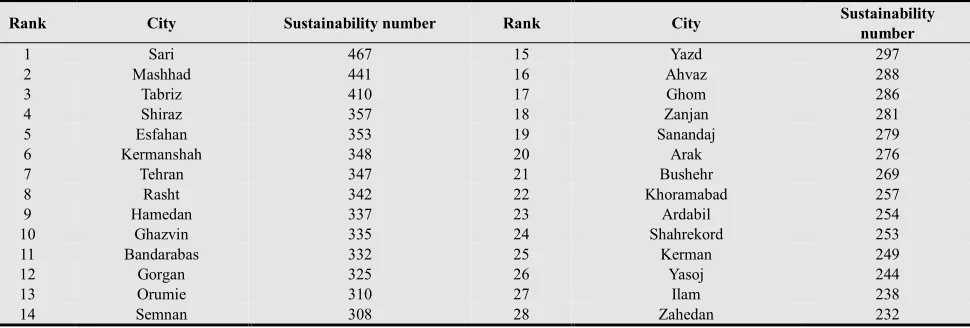
Base on analysis of combined indices of 28 cities in 1995, three cities Sari, Mashhad and Tabriz with respective sustainability numbers of 456, 424 and 390 have the highest sustainability numbers and three cities Zahedan, Ilam and Yasoj with respective sustainability numbers of 227,227 and 232 have lowest sustainability numbers and were at the bottom of the list. Average number of sustainability for these cities was 267. In this list Tehran’s rank with sustainable number 364, were 4. That show good performance in this area.
In 2000 the three cities, Sari, Mashhad and Tabriz have also topped the table and sustainability numbers for them respectively were 464, 439 and 412. Zahedan, Ilam and Yasoj, respectively with sustainability numbers 229, 236 and 239 have lowest numbers. Average sustainability number of these cities in 2000 was equivalent to 278. Tehran’s rank with sustainable number 369, were 5.
In 2005, still Sari, Mashhad and Tabriz, with sustainability numbers 467, 441 and 410 were at the top of the list and three cities Zahedan, Ilam and Yasoj, respectively with sustainability numbers 232,238 and 244 were in the bottom of the list. Average sustainability number for the mentioned countries in 2005 was 281. Tehran’s rank with sustainable number 347, were 7.
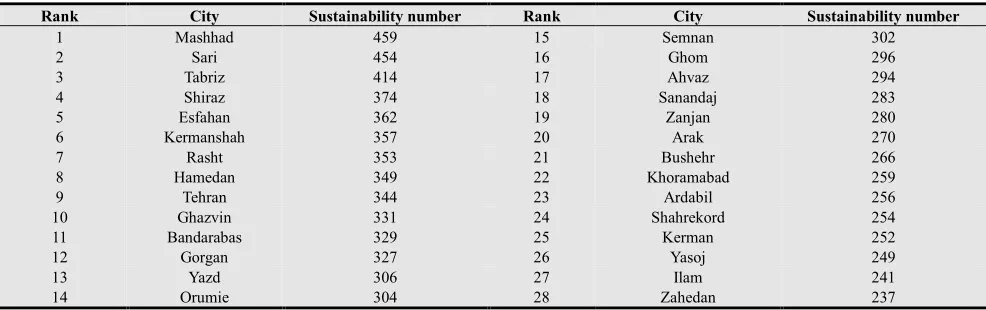
In 2010, Mashhad, Sari and Tabriz, with sustainability numbers 459, 454 and 414 were at the top of the list and three cities Zahedan, Ilam and Yasoj, respectively with sustainability numbers 237,241 and 249 were in the bottom of the list. Average sustainability number for the mentioned countries in 2010 was 284. Tehran’s rank with sustainable number 344, were 9.
According to the results, the average "sustainability indicators" have increase in 2000, 2005 and 2010 (first 267 and then the number is284) which expresses the fact that steps are taken toward sustainable development indexes by the cities and we hoped to achieve sustainable development in urban area. The objections against this indexes is that some cities are trying to reflect unrealistic information to international authorities to more to benefit from sources which usually provided to them by developed Government. Furthermore, based on composite indicators, some cities gain high stability number and have scored high, while the
available evidence reveals other facts. In this way, and despite the structural problems of calculation of sustainability, using composite indexes, this method can show the performance of the cities in the field of Sustainable development. In fact, the use of composite index to calculate stability indices are considered an appropriate method and the main drawback for these method is mainly on the nature of the sub-indices, therefore, if appropriate sub-indices are selected, using the composite indexes we can better analyze and evaluate the performance of cities and even regions and provide more realistic planning and policies to implement. For example, indicators of utilization and use of water in some arid and dry cities of the country is more important than the indicator of Land Use of the city and therefore it is necessary, these indicators to be considered further and raised as sustainable development for that cities.
4. Conclusion
Environmental protection and maintaining its stability, emphasized on the sustainable Development policy, require the acquisition of new patterns of development and exploitation of environmental and natural resources in which the basic needs of the present generation fulfilled, and also provide mechanisms to allow future generations to take advantage of these blessings. This new approach of development, which placed the maintenance and sustainability of environment along with other components of development in the center of attention, and in the development literature, is known as sustainable development, tries to strike a balance between resources and tolerable capabilities of earth, and human needs and purposes.
programs and review of past development policies and programs, which typically only have economic growth targets is critical and it is necessary for environmental protection, in the framework of goals the sustainable development, to be supported more in the planning and policies of cities. Establishment of national committee and the provincial Sustainable Development, promote popular participation and strengthening pro-environmental NGO, insert the Sustainable Development Goals in various economic, social and environmental development programs, strengthen systems to collect statistics and information on the Sustainable Development Goals, holding training courses and national conferences, facilitate communication of national organizations with international organizations, review policies and utilization of natural resources and environmental programs, etc. are among actions that cities can do to promote the goals of the Sustainable Development. In response to international and regional challenges related to goals of the Sustainable Development, new letters of agreement for coordination of national policies with international programs should be developed and the principle of shared but differentiated responsibilities, should be followed seriously by the United Nations in a way that the obligations of developed countries for Sustainable Development take more practical aspects and on the other hand, developing countries should also mobilize the resources in a way that these resources can be used best in line with goals of the Sustainable Development. This issue, especially about Sustainable Development, which is a public commodity, and therefore less incentive to invest in by people and cities is more important and need more support than other goals from the governments.
References
[1] M. Gharakhloo, S.H Hoseini, Indicators for sustainable urban development, Journal of Geography and Regional Development, No 8, Page 157-177, 2005.
[2] E. Hanff, M.H. Dabat and J. Blin, Are biofuels an efficient technology for generating sustainable development in oil-dependent African nations? A macroeconomic assessment of the opportunities and impacts in Burkina Faso, Renewable and Sustainable Energy Reviews, Vol. 15, Pp: 2199–2209. 2011.
[3] Y. Lui, D. He, S. Buchanan. and J. Liu, Ecological Footprint Dynamic of Yunnan China. Journal of Mountain Science. Vol. 6, No. 3, Pp: 286-292, 2009.
[4] K. Mori and A. Christodulou, Review Of Sustainability Incidences and Indicators: Towards A New City Sustainability Index (CSI). Journal of Environmental Impact Assessment Review. Pp 1-13. 2011.
[5] D. Olj, M. Ivanovic, M.T. Golusiz, S.N. Dodic, and J.M. Dodic, Perspectives sustainable development in countries of Southeastern Europe, Renewable and Sustainable Energy Reviews, Vol. 13, Pp: 2079–2087. 2009.
[6] M.R. Poorjafar, Z. Khodaee, Geological indicators of sustainable urban development, National Conference on Contemporary Iranian Architecture and Urbanism, 15 pages, Beyza, 2010.
[7] World Commission on Environment and Development (WECD), Our Common Future. Oxford/New York: Oxford University Press. 1987
[8] S. Afonja, “Gender, Culture and the Environment”, Paper presented at National Workshop on Nigerias Endangered Environment: Agenda for a New Millenum. Lagos 1999
[9] United Nations Department of Economic and Social Affairs, National Sustainable Development Strategies 2004 www.un.org/esa/desa.html
[10] S. Moreno Pires, T. Fidélis, T.B. Ramos, Measuring and comparing local sustainable development through common indicators: Constraints and achievements in practice, Cities, Volume 39, August 2014, Pages 1-9
[11] S.A. Khatoonabadi, Aspects of sustainable development (From thought to action), Jahad University Unit of Technology Esfahan, Esfahan, Management, 2006.
[12] A.A. Enayati, FAQ and methodology of sustainable development indicators, Secretariat of the National Committee on Sustainable Development, Tehran. 2007, http:/www./irandoe.org/doeportal/ncsd
[13] L.M. Raak, Think Globally, Act Locally, and Plan Nationally An Evaluation of Sustainable Development in Indonesia at National, Regional, and Local Levels, Global Sustainable Communities Handbook, 2014, Pages 125-215
[14] L. Dvořáková, J. Zborková, Integration of Sustainable Development at Enterprise Level, Procedia Engineering, Volume 69, 2014, Pages 686-695.
[15] Susan Kinnear, Ian Ogden, Planning the innovation agenda for sustainable development in resource regions: A central Queensland case study, Resources Policy, Volume 39, March 2014, Pages 42-53.
[16] kh. Kalantari, Regional Planning and Development, Tehran, khoshbin press, 2002, p73.