International Journal of Medical Reviews Systematic Review
International Journal of Medical Reviews, Volume 2, Issue 4, Autumn2015; 317-321
All rights reserved for official publication of Baqiyatallah university of medical sciences©
Barriers to Reporting Medication Errors in Iran: A Systematic Review
Amir Mirsadeghi 1, MarziehPazokian2*
Abstract
Barriers to medication error reporting in Iran: a systematic review
Detection of errors is known as the basis for maintaining and improving patient safety. Although, service providers have moral and professional commitments to disclose error cases, reporting errors among nurses is much less than the actual amount(1). On the other hand, one of the strategies to reduce medication errors is reporting whichprevents possible damages and is considered as a valuable information source for preventing similar medication errors in the future. However, studies have shown that unlike the countless benefits and ethical standards of error reporting, nurses may have doubts and hesitate in detecting error for a patient in order to protect themselves from punishment and administrative rules(2). The first reports related to medication errors were prepared in 1940 and drew the attention of practitioners and stakeholders. Unfortunately, there is no exact statistics about medication errors in Iran,
but the lack of statistics does not indicate the absence of medication errors (3).
In a study in the context of incidents of abuse of drugs in two educational hospitals in Boston, it was showed that 1% of the incidents was fatal, 12% was life-threatening, 30% was serious and 57% was important and dangerous, among which 42% were preventable with a variety of ways, including reporting occurred errors (4). Since harming a patient or someone who is striving to regain his health, is incompatible with the philosophy of health care (5), reporting medical errors prevents potential harm to the patient. This is while patient safety is a key priority in the health system and are raised with the aim of prevention of medical errors, before such errors cause death, injury or damage patients (6). In fact, safety and risk management are meant to minimize the risk to an acceptable level (7). The Institute of Medicine (IOM) in the United States by publishing something under the title of “to error is
Introduction: Detection of errors is known as the basis for maintaining and improving patient
safety. In this regard, patient safety is a key priority in the health system. Reporting medication errors, in addition to preventing potential harm to the patient, is also considered as a valuable information source for preventing further similar mistakes in the future. Although, there are many benefits and high ethical standards for medication error reports, nurses may have often some doubts in detecting errors for a patient in order to protect themselves from punishment and administrative rules. Thus, paying attention to barriers of reporting and resolving them is essential to the possible extent. This review study has been conducted with the aim of investigating the reasons why nurses refuse to report medication errors in Iran.
Materials and Method: This review study was conducted by surveying the studies between
1387-1393 using the keywords reporting medication errors, Iran, barriers to reporting, and systematic review. All possible combinations of key words have been used in the databases such as Iran Medex, SID, Iran doc and Magiran using the Google search engine. These combination were searched for according to Cochran's seven-step model regarding the inclusion criteria, including descriptive articles published in credited journals on the subject of barriers of nurses to report medication errors and the exclusion criteria, including qualitative studies, case reports, review studies, studies irrelevant to nurses’ medication errors, seminars as well as joint studies with other members of the treatment team.
Findings: From among 18 studies retrieved, a number of eight studies were excluded from the
study regarding the exclusion criteria, and finally 10 articles were analyzed. After analysis of the studies, reporting barriers were divided in three areas related to reporting, management factors, and fear from the reporting consequences.
Conclusion: The results showed that the main barrier for not reporting medication errors is
fear from managers and nurse educators’ inappropriate feedbacks as well as fear from financial and legal matters. Therefore, medication errors can be reduced by proper planning and management, away from punishment and reprimands, encouragements such as financial rewards, vacation incentives and so on, along with academic and in-service training, and creating a positive learning environment. Moreover, the implementation of a reporting error system in which the personnel feel safe is among other duties of this field.
Keywords:Barriers, Reporting, Medical Errors, Nurse, Iran, Review, Systematic
1. Critical Care Nursing MSc student
College Of Nursing University Of
Bagiyatallah Tehran,Iran2.School of
Nursing and Midwifery , Faculty of Nursing, Shahid Beheshti University of Medical Sciences , Tehran, Iran
* Corresponding Author
MarziehPazokian, Assistant Professor,
School of Nursing and Midwifery, Shahid Beheshti University of Medical Sciences, Tehran, Iran
E-mail: [email protected]
human”,has suggested that annually, between 44,000 to 98,000 patients in the United States of America lose their lives due to preventable medical errors. This is while 8% of hospital treatments lead to drug adverse effects, which is more than in America (4.2 to 5.6 percent)(8).
As mentioned before, medication errors can cause various damages to patients, hospitals, financial and insurance systems.Hence,reporting medication errors as an important and inevitable issue can prevent the mentioned damages and in other words, it can be said that, reporting medication errors increases patient safety (9). On the other hand, due to the current situation and the domineering atmosphere of hospitals, reporting medical errors can have negative consequences, including legal issues, being blamed by colleagues and managers, financial difficulties and being labeled as incompetence(2, 3, 9).It is said that, error report can increase patient safety which is the goal of all healthcare organizations. Thus, one of the ways to strengthen reporting without fear is recording an error withoutmentioning any name for reducing the burden of responsibility (2). So, since to harm the patient is incompatible with the philosophy of health care, all harmful measures harming a patient must be removed, which makes it necessary to identify these measures and to deal with them effectively.As mentioned, one of the greatest medical errors is medication errors, and nurses are at the tip of the arrow. Although, many studies have been done on medication errors, few studies have investigated a comprehensive reporting of barriers to medication errors in Iran. Therefore, the aim of this article was to conducta systematic study of articles related to barriers forreportingmedication errors by nurses in Iran.
Methods
This study examines the factors affecting the barriers to reporting medication errors by nurses using systematic
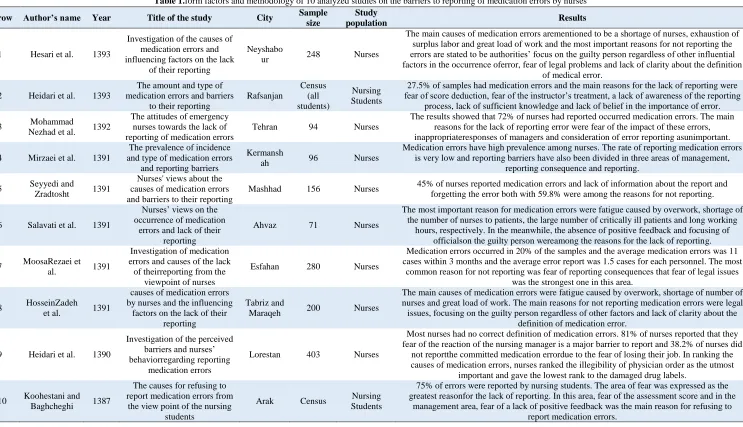
review based on domestic resources and documents between the years 1387-1393.This was done according to the seven-step Cochran’s model, including specifying the year, determining the inclusion criteria, selecting studies, assessing quality of studies, extracting data, and analyzing and presenting the results. To find the articles, a number of key words such as reporting medication errors, Iran, barriers to reporting, and systematic review were used. All possible combinations of key words were used in the databases such as Iran Medex, SID, Iran doc and Magiran using the Google search engine. Moreover, the bibliographies of the specified research were screened to find relevant articles. Inclusion criteria included descriptive articles published in creditable local journals on the subject of barriers to reporting medication errors by nurses. After conducting a thorough search in the mentioned databases, 18 articles were found, eight of which were excluded due to the inclusion and exclusion criteria of the study. Inclusion criteria included descriptive articles, barriers to reporting medication errors only by nurses in educational hospitals in Iran. Exclusion criteria included qualitative studies, case reports, reviews, studies unrelated to medication errors of nurses, seminars and joint studies with other members of the treatment team. A number of eight studies were excluded according to the exclusion criteria which included: one qualitative study, one joint study with other nurses’ errors, one review study, one repetitive study, and four existing studies in the conferences. Finally, according to the inclusion criteria, 10 articles were selected and organized and analyzed in the End note software. Then, the relevant articles were entered into the cycle independently. At the end, the required key data were extracted from the articles and were recorded in the data extraction form. The data extraction form included general information related to the article (title and time of conducting the study), the profile of the study (intervention and control group sample size, type of intervention) and the results (Table 1).
PRISMA 2009 Flow Diagram
Inclu
d
ed
E
li
g
ib
il
it
y Full-text articles assessed for eligibility(n =11) Full-text articles excluded,
with reasons(n =4)
Studies included in qualitative synthesis(n =1)
Studies included in quantitative synthesis (meta-analysis)(n =10) Records identified through database searching(n =14)
S
cr
ee
n
in
g
Id
en
ti
fi
ca
ti
o
n Additional records identified through other sources(n =4)
Records after duplicates removed(n = 1)
Mirsadeghi A, et al. Barriers to Reporting Medication Errors in Iran
International Journal of Medical Reviews, Volume 2, Issue 4, Autumn2015 319
Table 1.form factors and methodology of 10 analyzed studies on the barriers to reporting of medication errors by nurses
row Author’s name Year Title of the study City Sample
size
Study
population Results
1 Hesari et al. 1393
Investigation of the causes of medication errors and influencing factors on the lack
of their reporting
Neyshabo
ur 248 Nurses
The main causes of medication errors arementioned to be a shortage of nurses, exhaustion of surplus labor and great load of work and the most important reasons for not reporting the errors are stated to be authorities’ focus on the guilty person regardless of other influential factors in the occurrence oferror, fear of legal problems and lack of clarity about the definition
of medical error.
2 Heidari et al. 1393
The amount and type of medication errors and barriers
to their reporting
Rafsanjan
Census (all students)
Nursing Students
27.5% of samples had medication errors and the main reasons for the lack of reporting were fear of score deduction, fear of the instructor’s treatment, a lack of awareness of the reporting
process, lack of sufficient knowledge and lack of belief in the importance of error.
3 Mohammad
Nezhad et al. 1392
The attitudes of emergency nurses towards the lack of reporting of medication errors
Tehran 94 Nurses
The results showed that 72% of nurses had reported occurred medication errors. The main reasons for the lack of reporting error were fear of the impact of these errors, inappropriateresponses of managers and consideration of error reporting asunimportant.
4 Mirzaei et al. 1391
The prevalence of incidence and type of medication errors
and reporting barriers
Kermansh
ah 96 Nurses
Medication errors have high prevalence among nurses. The rate of reporting medication errors is very low and reporting barriers have also been divided in three areas of management,
reporting consequence and reporting.
5 Seyyedi and
Zradtosht 1391
Nurses' views about the causes of medication errors and barriers to their reporting
Mashhad 156 Nurses 45% of nurses reported medication errors and lack of information about the report and
forgetting the error both with 59.8% were among the reasons for not reporting.
6 Salavati et al. 1391
Nurses’ views on the occurrence of medication
errors and lack of their reporting
Ahvaz 71 Nurses
The most important reason for medication errors were fatigue caused by overwork, shortage of the number of nurses to patients, the large number of critically ill patients and long working
hours, respectively. In the meanwhile, the absence of positive feedback and focusing of officialson the guilty person wereamong the reasons for the lack of reporting.
7 MoosaRezaei et
al. 1391
Investigation of medication errors and causes of the lack
of theirreporting from the viewpoint of nurses
Esfahan 280 Nurses
Medication errors occurred in 20% of the samples and the average medication errors was 11 cases within 3 months and the average error report was 1.5 cases for each personnel. The most
common reason for not reporting was fear of reporting consequences that fear of legal issues was the strongest one in this area.
8 HosseinZadeh
et al. 1391
causes of medication errors by nurses and the influencing
factors on the lack of their reporting
Tabriz and
Maraqeh 200 Nurses
The main causes of medication errors were fatigue caused by overwork, shortage of number of nurses and great load of work. The main reasons for not reporting medication errors were legal issues, focusing on the guilty person regardless of other factors and lack of clarity about the
definition of medication error.
9 Heidari et al. 1390
Investigation of the perceived barriers and nurses’ behaviorregarding reporting
medication errors
Lorestan 403 Nurses
Most nurses had no correct definition of medication errors. 81% of nurses reported that they fear of the reaction of the nursing manager is a major barrier to report and 38.2% of nurses did
not reportthe committed medication errordue to the fear of losing their job. In ranking the causes of medication errors, nurses ranked the illegibility of physician order as the utmost
important and gave the lowest rank to the damaged drug labels.
10 Koohestani and
Baghcheghi 1387
The causes for refusing to report medication errors from
the view point of the nursing students
Arak Census Nursing
Students
75% of errors were reported by nursing students. The area of fear was expressed as the greatest reasonfor the lack of reporting. In this area, fear of the assessment score and in the
As shown in Table 1, 10 studies were found regarding barriers to reporting that divided barriers to reporting in 3 groups of administrative factors, fear from consequences of reporting, and reporting.
In a study in Neyshabur, which was carried out by Hesari et al., reporting barriers were divided into three areas like other studies. In the area of fear from consequences of reporting, the overall mean of fear from legal issues (3.79), in the area of administrative factors, the overall mean of officials’ focus only on the guilty person regardless of other factors involved in the occurrence of such errors (3.86) and in the area of reporting, the overall mean of unclear definition of medication error (3.34) has been reported as the main barriers to the lack of reporting medication errors. In this study, Hesari suggests a reporting system error to be implemented with a change in the way managers treat guilty nurses in order to increase patient safety(10).
In a study in Rafsanjan by Heidari et al., in which the population were students, they found that the main reasons for refusing to report medication errors were fear from losing scores and fear from the way they were to be treated by the instructor (62.5%,). Moreover, Heydari stated the lack of awareness of medication errors and their importance as other reasons for not reporting medication errors(11). In a study conducted in Tehran, Mohammad Nejad et al. stated that the greatest causes of not reporting due to fear from the reporting consequences is the negative impacts on the financial issues (50%) and in the area of administrative factors is the lack of positive feedback from the nursing management (33.3%) and in the area of reporting is considering reporting errors as unimportant issues (38%). Moreover, the study emphasized to change the way of dealing with the guilty person to report errors more easily and to reduce errors as well as to increase patients' safety(2). In a study in Kermanshah, Mirzaee et al. reported that in the area of administrative factors, the lack of a system for recording medication errors (42.7%) and in the area of fear from the consequences of reporting, the fear from legal issues (70.8%) and in the area of reporting, lack of clarity about the definition of medication errors (50%) are among the greatest causes of the barriers to reporting. Moreover, Mirzaee claims that holding in-service courses regarding medication therapy and changing the approach of nursing managers are among the solutions to increase patient safety(12).
In another study in Mashhad conducted by Seyyedi and Zardtosht, the highest barriers to reporting were stated to be shortage of information on how to report errors (59.8%) and forgetting errors (59.8%), and unlike the studies in Lorestan
and Rafsanjan, fear from the reaction of colleagues and nursing officials are expressed to be at the last level.(13). Salvati et al. in a study in Ahvaz stated that the major barriers to report medication errors are administrative factors. In this area, the overall mean of not receiving positive feedback from the nursing managers is stated as the greatest cause (4.33). In the area of reporting, the overall average of considering error reporting as insignificant (3/36) and in the area of fear from the reporting consequences, the overall average of fear from a negative impacts in the annual assessment (3.81) are stated to be the greatest reasons which are in line with the results of the study by Mohammadnezhad. Moreover, identifying the factors leading to the occurrence of errors and changing managers’ treatment approach have been among the solutions proposed by Salvati et al(1).
Rezai et al. in a study conducted in Isfahan, reported that in the area of fear from the consequences of reporting, fear from legal issues (87.5%) and in the area of administrative factors, lack of support of personnel (70/71%) and in the area of reporting, the time-consuming nature of error reporting (72.5%) are among the main causes of the lack of error reporting. Moreover, Rezaei stated that in-service training of medication errors and changing how to deal with the guilty person arethe most important issues in the area of patient health and safety.(3).
Yet in another study in Tabriz conducted by Hosseinzadeh et al. on the nurses, the results indicated that in the area of fear from the consequences of reporting, fear from legal issues (73.5%) and in the area of administrative factors, officials’ focus only on the guilty person regardless of other factors being involved in the occurrence of an error (76%).Also,in the area of reporting, the lack of clarity about the definition of medication error (44.5%) are among the greatest causes of barriers to reporting. Moreover, this study, like the study conducted in Neyshabur, considers developing a reporting error system and changing the nursing managers’ treatment approach to be necessary in order to increase patient safety.(9).
In astudy in Lorestan, conducted by Heydari et al., the results showed that the greatest barriers to reporting medication errors had been fear from the way the nursing manager would react (81.6%). Furthermore, this study, like the study in Rafsanjan showed that more than 80% of nurses do not have the educational background regarding medication errors(14).
Mirsadeghi A, et al. Barriers to Reporting Medication Errors in Iran
International Journal of Medical Reviews, Volume 2, Issue 4, Autumn2015 321
context, the item of "fear from the assessment score and training consequences" obtained the highest frequency (49%). Regarding the management factors, the item of "the lack of positive feedback on error reporting" (28%) was the most frequently selected item on reporting impediments. Regarding the report area, the item of "unimportance of reporting medication errors" had the highest frequency (1%). The study suggests that barriers on reporting errors can be minimized by changing the way nurse educators treat medical students' errors and by reacting appropriately to errors and enhance patient's safety(15).
Conclusion
Reviewing the studies shows that although accurate statistics is not available with regards to the medication errors in the country, these errors exist and they intentionally or unintentionally damage the health system as well as the financial and insurance systems. On the other hand, the majority of these errors can be prevented. As it was mentioned, the main way to deal with these medication errors, in addition to observing the due prescription process in accordance with the principles described in the literature, is to report these errors in order to identify the strengths and weaknesses. The study also showed that three areas are involved in case and focusing on them and modifying management systems can bring about a safe, secure, and comfortable environment in which, in addition to the voluntary reports of the errors, we create conditions in a way that we learn from these errors and prevent them happening again. Thus, medication errors would be reduced through using proper planning and management as well as creating a positive learning environment away from punishment and rebuke accompanied by academic and in-service education. Moreover, implementing an online system for reporting errors in which the personnel feel safe is essential. In addition to the main centers of decision making, such as the Ministry of Health and Medical Education and University of Medical Sciences, this should be implemented at the lowest levels, such as hospitals and health centers, so that medication errors can further be reduced not only by controlling some individual factors such as fatigue and forgetfulness but also by improving organizational factors.
Acknowledgements
This study was extracted from a MS dissertation of Faculty of Nursing with financial and moral support provided by the Health Sciences Research Center of the University of Baqiyatallah Medical Sciences and the Department of the Baqiyatallah Hospital.
References
1.Salavati S, Hatamvand F, Tabesh H, Salehi nasab M. Nurses’ Perspectives on Causes of Medication Errors and Non- Reporting at ED. Iran Journal of Nursing. 2012;25(79):72-83.
2.Mohammad Nejad E, Ehsani S, Salari A, et al. Refusal in Reporting Medication Errors from the Perspective of Nurses in Emergency Ward. J gbfnm. 2013; 10: 61-68 [In Persian]. 3.Musarezaie A, Momeni Ghale Ghasemi T, Zargham-Boroujeni A, et al. Survey of theMedication Errors and Refusal to Report
Medication Errors from the Viewpoints of Nurses inHospitals Affiliated to Isfahan University of Medical Sciences, Iran. J Health Syst Res 2013; 9: 76-85. [In Persian].
4.Bates DW. Using information technology to reduce rates of medication errors in hospitals. BMJ: British Medical J. 2000;320:788-91.
5.Marin HF. Improving patient safety with technology. International journal of medical informatics. 2004;73:543-6. 6.Hov R, Hedelin B, Athlin E. Good nursing care to ICU patients on the edge of life. J Intensive and Critical Care Nursing. 2007;23:331-41.
7.Rozich J, Haraden C, Resar R. Adverse drug event trigger tool: a practical methodology for measuring medication related harm. Quality and Safety in Health Care. 2003;12:194-200.
8.Moghaddasi H, Sheikhtaheri A, Hashemi N. Reducing medication errors:Role of computerized physician order entry system. J of Health Administration. 2007; 10 :57-67 .[In Persian]. 9.Hosseinzadeh M, Ezate Aghajari P, Mahdavi N. Reasons of Nurses' Medication Errors and Persepectives of Nurses on Barriers of Error Reporting. J hayat. 2012; 18: 66-75 [In Persian] 10.Hesari B, Ghodsi H, Hoseinabadi M, et al. A Survey of Nurses' Perceptions of the Causes of Medication Errors and Barriers to Reporting in Hospitals Affiliated to Neyshabur University of Medical Sciences, Iran. J of Kerman University of Medical Sciences, 2015; 22: 105-111 [In Persian]
11. Heidari S, Shahabi nejad M, Soltani A, et al. Rate and type of medication errors and factors in preventing the report of them in the nursing students of Rafsanjan University of Medical Sciences in 2009. J salamat jame'e. 3. 2013; 7: 48-55 [In Persian]. 12.Mirzaei M, Khatony A, Safari Faramani R, et al. Prevalence, Types of Medication errors and Barriers to Reporting Errors by Nurses in an Educational Hospital in Kermanshah. J hayat. 2014; 19 :28-37 [In Persian].
13. Seidi M, Zardosht R. Survey of Nurses' Viewpoints on Causes of Medicinal Errors and Barriers to Reporting in Pediatric Units in Hospitals of Mashhad University of Medical Sciences. J FUMS. 2012; 2 :142-147