Published online January 19, 2015 (http://www.sciencepublishinggroup.com/j/ijmsa) doi: 10.11648/j.ijmsa.s.2014030601.16
ISSN: 2327-2635 (Print); ISSN: 2327-2643 (Online)
Ab initio study of defects in CdMnTe: Electronic structure
and related properties
M. A. Mehrabova
1, H. S. Orujov
2, N. H. Hasanov
3 1Institute of Radiation Problems of Azerbaijan National Academy of Sciences, Baku, Azerbaijan 2
Institute of Physics of Azerbaijan National Academy of Sciences, Baku, Azerbaijan 3
Physics Faculty,Baku State University, Baku, Azerbaijan
Email address:
[email protected] (M. A. Mehrabova)
To cite this article:
M. A. Mehrabova, H. S. Orujov, N. H. Hasanov. Ab Initio Study of Defects in CdMnTe: Electronic Structure and Related Properties.
International Journal of Materials Science and Applications. Special Issue: Materials Science. Vol. 3, No. 6-1, 2014, pp. 24-32. doi: 10.11648/j.ijmsa.s.2014030601.16
Abstract:
Band structure, density of states, total energy and magnetic moment are calculated for ideal and defective supercell CdTe and CdMnTe by ab initio method. The optimization of crystal structure and atom relaxation has been carried out. The band gap, local levels in the band gap and magnetic moments are defined for various defective supercell CdTe and CdMnTe in ferromagnetic and antiferromagnetic states. It has been defined that as Mn atoms, the vacancy, interstitial atom and Frenkel pair in the crystal structure form magnetic moment.Keywords:
Semimagnetic Semiconductor, Electron Structure, Defect, Vacancy, Interstitial Atom, Frenkel Pair, Ab Initio, Magnetic Moment, Density of States1. Introduction
Semimagnetic semiconductors (SMS) are the new class materials, including the properties of both ordinary and magnetic semiconductors. The main qualitative difference between SMS and ordinary semiconductors is the exchange interaction between magnetic ions and band charge carriers, which start to appear only within the external magnetic field [1]. The injection of manganese ions to the crystal lattice of AIIBVI compounds and formation of solid solutions AIIMnBVI lead to increase of band-gap width. Thus it is possible to manage these materials’ photosensitivity by Mn ions concentration in SMS. These features cause strengthening of a number of effects, as well as Faraday effect in these materials [2, 3]. On the other hand, there are unusual changes of electron structure of these materials in magnetic field, which allows managing properties of these materials with magnetic field and temperature.
The energy spectrum and wave functions of electrons for arbitrary wave vector as well as Faraday effect for Cd1-X MnxTe thin films were obtained in our previous works [3]. We calculated interband Faraday effect in Cd1-X MnxTe in the framework of two band model with taking into account the exchange interaction in a nonquantizing magnetic field.
Cd1-xMnxTe SMS are promising materials for γ- and x-ray detectors, solar cells, optic insulator etc. [4]. To obtain high-sensitive and radiation-resistant materials, as well as creation of devices based on them, it is necessary to know the influence of defects on physical properties of Cd1-xMnxTe. Defects in semiconductors not only influence on electrical and optic properties of these materials, but also display their interesting physical properties.
Ab initio calculations of electron structure and magnetic properties of Cd1-X MnxTe were carried out in some works [5-8]. Unlike these works we carried out first principle calculations based on density functional theory (DFT) by using Atomistix ToolKit (ATK) programme for study of defects on structural and magnetic properties of supercell CdTe and Cd1-X MnxTe. In this work we have theoretically investigated electronic band structure (EBS), density of states (DOS) and magnetic moment (MM) for various ideal and defective supercells CdTe and Cd1-xMnxTe.
2. Electronic Structure of Ideal and
Defective Supercell CdTe
DFT are performed in the local spin density approximation with regard to Hubbard-U correction (LSDA+U) on double zeta double polarized (DZDP) basis set using licensed program software ATK [9].
In this section it was given the results of calculations of EBS, DOS and MM of ideal and defective supercell Cd32Te32.
2.1.
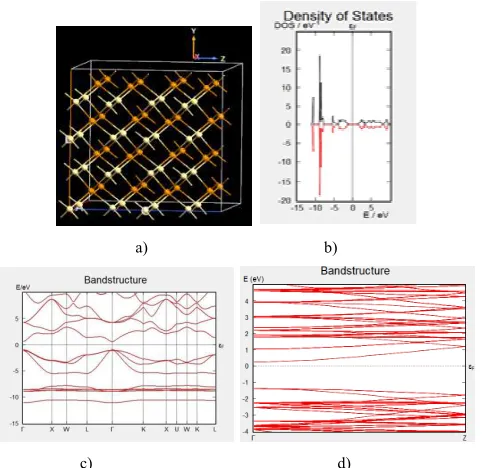
Ideal Supercell Cd32Te32The electronic structures of ideal supercell Cd32Te32 is calculated. It was defined the band gap of ideal supercell Cd32Te32 Eg = 1.64eV, the lower level of conductivity band Еc↑=0.25 eV and the upper level of valence band Еv↓=-1.39 eV. The axes indicate to the spin states. The calculated value of the energy gap corresponds to experimentally measured one. In so doing, we have been able to reproduce the experimental value of the energy gap only if Hubbard_U corrections were accounted for. It has been taken the value of Hubbard-U parameter for 5p-states of Te, UTe= 3.7 eV [10]. DOS analysis shows that upper levels of valence band located in the range of [-5; 0] eV, mainly comes from 5p-states of Te atoms, and lower levels of conductivity band - from 5s-states of Cd atoms (Fig.1). The total energy of the ideal supercell Cd32Te32 is Et=-68285.96eV.
The Cd atoms in bulk configuration (Fig.1a) is indicated by yellow color, Te atoms by red color.
a) b)
c) d)
Fig. 1. Ideal supercell Cd32Te32 a) Bulk configuration b) DOS c) EBS for CdTe d) EBS for supercell Cd32Te32
2.2.
Defective Supercell Cd32Te322.2.1. Vacancy in the Supercell Cd32Te32
The Cd vacancy (VCd) in supercell Cd32Te32 leads to rupture of Cd bonds with nearest four Te atoms. The main contribution to the MM give these four anionic atoms with 4 dangling bonds totally 4.864µB, where µB is the Bohr magneton. The MM of all 32 Te atoms is 11.276µB, and all
31 Cd atoms is -9.271µB. Finally the total MM of all atoms is 2.005µB. The total amount of electrons is 564, spins of 283 of them directed upward, 281 downward.
Thus, the main contribution to the MM gives 5p orbitals of Те atoms in the upper of the valence band. The contribution from px, py, pz orbitals are the same. Calculations were performed with an accuracy of 0.001 µB.
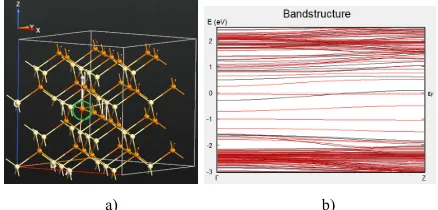
The electronic structure of supercell Cd32Te32 having VCd is calculated (Fig.2). The band gap is changed from Eg=1.64eV to Eg=1.22eV. It is formed no local level in the band gap. The top of valence band and the bottom of conductivity band are shifted towards the energy levels Ес↓=1.47еV, Ev↑=0.25eV. The total energy of the supercell Cd32Te32 with VCd is Et=-66730.36eV.
a) b)
Fig. 2. Supercell Cd32Te32 with VCd a) Bulk configuration b) EBS
The contribution to MM of Cd vacancy (VCd) in the supercell Cd32Te32 was defined. 4 anion atoms which have 4 broken bonds near the Cd vacancy, acquires MM 4.864µB. The MM of all 31 Cd atoms is -9.271µB, and all 32 Te atoms is 11.276µB. The total MM of all atoms is 2.005µB.
The green circle in the Fig.2a indicates to the vacancy site. The contribution to MM of Te vacancy (VTe) in the supercell Cd32Te32 is insignificant. 4 cation atoms which have 4 broken bonds near the Te vacancy, acquires insignificant value of MM 0.004µB. The MM of all 31 Te atoms is 0.004µB, and all 32 Cd atoms is 0.011µB. The total MM of all atoms is 0.015µB.
The band gap is changed from Eg=1.64eV to Eg=1.97eV. It is formed 1 local level in the band gap: Е↑=0.21eV. The top of valence band and the bottom of conductivity band are shifted towards the energy levels Ес↑=1.53еV, Ev↑=-0.44eV (Fig.3). The total energy of the supercell Cd32Te32 having VTe is Et=- 67692.97eV. The total amount of electrons is 568 and spins of 284 of them directed upward, 284 downward.
a) b)
Thus, VCd decrease the band gap in the supercell Cd32Te32 but VTe increase it and forms 1local level in the band gap.
2.2.2. Interstitial Atom in the Supercell Cd32Te32
The electronic structure of supercell Cd32Te32 having interstitial Cd atom (ICd) has been calculated. The band gap doesn’t changed. It is formed no local level in the band gap. The top of valence band and the bottom of conductivity band are shifted towards the energy levels Ес↑=Ес↓=0.58еV, Ev↑= Ev↓=-1.05eV (Fig.4). The total energy of the supercell Cd32Te32 having VCd is Et=-69844.74eV.
ICd atom has 3 bonds: 2 bonds with Cd atoms and 1 bond with Te atom. ICd leads to forming MM. The main contribution to the MM give interstitial Cd atom 0.489µB, two Cd atoms each of them is 0.399µB and Te atom 1.516µB having bonds with interstitial Te atom. The MM of all 33 Cd atoms is -1.469µB and all 32 Te atoms is 1.464 µB. Finally the total MM of all atoms is -0.005µB .
a) b)
Fig. 4. Supercell Cd32Te32 with ICd a) Bulk configuration b) EBS
The electronic structure of supercell Cd32Te32 having interstitial Te atom ITe has been calculated. The band gap doesn’t changed. It is formed 1 local level in the band gap: Е↑=0.29eV. The top of valence band and the bottom of conductivity band are shifted towards the energy levels Ес↑=1.2еV, Ev↑=-0.44eV (Fig.5). The total energy of the supercell Cd32Te32 with VCd is Et=-68890.2eV.
ITe atom has 5 bonds: 2 bonds with Te atoms and 3 bonds with Cd atoms. ITe leads to forming large MM. The main contribution to the MM give interstitial Te atom 5.467µB, two Te atoms each of them 2.521µB and 3 Cd atoms each of them 2.9µB having bonds with interstitial Te atom. The MM of all 32 Cd atoms is -15.264µB and all 33 Te atoms is 19.891 µB. Total MM of all atoms is 4.627 µB.
a) b)
Fig. 5. Supercell Cd32Te32 with ITe a) Bulk configuration b) EBS
Thus, ICd and ITe atoms in the supercell Cd32Te32 don’t change the band gap. It is formed large MM and 1local level in the band gap in the supercell Cd32Te32 having ITe.
2.2.3. Frenkel Pair in the Supercell Cd32Te32
The displaced Cd atom has 5 bonds with neighboring 2 Cd atoms and 3 Te atoms in the case of Frenkel pair FCd in the supercell Cd32Te32. FCdin the supercell Cd32Te32 leads to forming 2 local levels in the band gap: Е↑=0.57eV, Е↓=0.43eV. The band gap doesn’t changed. The top of valence band and the bottom of conductivity band are shifted towards the energy levels Ес↓↑=1.0еV, Ev↓↑=-0.64eV (Fig.6). The total energy of the supercell having FTe is Et=-68283.4eV.
Frenkel pair FCd leads to forming MM. The main contribution to MM give interstitial Cd atom -2.36µB, two Te atoms each of them 1.768µB and 2 Cd atoms each of them 0.751µB having bonds with interstitial Cd atom and neighboring Te atom 0.7451µB. The MM of all 32 Cd atoms is -4.351µB and all 32 Te atoms is 4.35 µB. Totally MM’s of all atoms compensate each other.
a) b)
Fig.6. Supercell Cd32Te32 with FCd a) Bulk configuration b) EBS
In the case of Frenkel pair FTe in the supercell Cd32Te32 the displaced Te atom has 5 bonds with neighboring 2 Te atoms and 3 Cd atoms. FTein the supercell Cd32Te32 leads to forming 4 local levels in the band gap: Е↑=-0.05eV, Е↓=-0.3eV, Е↑=-0.7eV, Е↑=-1.0eV. The band gap doesn’t changed. The top of valence band and the bottom of conductivity band are shifted towards the energy levels Ес↑=0.25еV, Ev↓↑=-1.35eV (Fig.7). The total energy of the supercell Cd32Te32 having FTe is Et=-68286.9eV.
a) b)
Fig. 7. Supercell Cd32Te32 with FTe a) Bulk configuration b) EBS
is -5.35µB and all 32 Te atoms is 6.133 µB. Finally the total MM of all atoms is 0.783µB .
FCd and FTe atoms in the supercell Cd32Te32 don’t change the band gap. FCd forms 2 local levels and FTe forms 4 local levels in the band gap in the supercell Cd32Te32. It is formed MM in the supercell Cd32Te32 having FCd or FTe atom.
3. Electronic Structure of Defective
Supercell Cd
1-xMn
xTe
The calculations are performed in ATK program within the spin-polarized DFT and LSDA+U on DZDP basis. We have used UMn = 3.59 eV for 3d states for Mn atoms and UTe = 3.7 eV for 5p states of Te atoms [10, 11]. It has been given the results of calculations of EBS, DOS and MM of defective supercell Cd30Mn2Te32 in both ferromagnetic and antiferromagnetic states.
3.1. Supercell Cd30Mn2Te32
MM of supercells Cd3MnTe4 and Cd15Mn2Te16 was calculated by ab initio method in the work [13].
We have investigated supercell Cd30Mn2Te32 and have obtained that DOS of supercell Cd30Mn2Te32 consist of three parts in the valence band: 1) the upper part of the valence band is mainly formed from p-states of Te atoms with some contribution of Cd s-states at bottom of the upper part 2) the middle part is formed from d-state of Mn atoms and from s-states of Cd atoms, which are below the valence band maximum on 7eV 3) the main peak at 10 eV below of the valence band maximum is formed mainly from s- states of Te atoms,.
The bottom of the conductivity band is formed from s states of Cd atoms and p states of Te atoms. The peak of 2 eV above the conductivity band minimum is formed mainly from d states of Mn atoms [12].
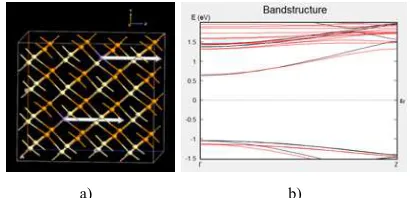
The calculated band gap in ferromagnetic supercell Cd30Mn2Te32 is Eg=1.73eV, the lower level of conductivity band is Ес↑=0.632еV and the upper level of valence band is Ev↑=-1.05eV (Fig.8). The total energy of the supercell Cd30Mn2Te32 in ferromagnetic supercell Cd30Mn2Te32 is Et=-66403.14eV.
a) b)
Fig. 8. Supercell Cd30Mn2Te32 in ferromagnetic state a) Bulk configuration b) EBS
For the ferromagnetic supercell Cd30Mn2Te32 the main contribution to the ММ give 3d-orbitals of two Mn atoms, the total MM of them is 10,30µB. The MM of all 30 Cd atoms is -0.311µB and all 32 Te atoms is 0.406 µB, they are
practically compensate each other.
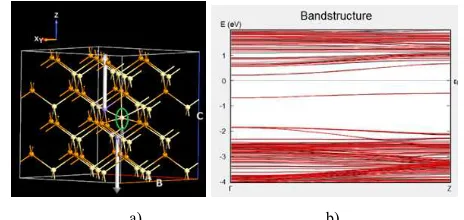
The calculated band gap of supercell Cd30Mn2Te32 in antiferromagnetic state is Eg=1.73eV, the lower level of conductivity band is Ес↑=0.31еV and the upper level of valence band is Ev↓=-1.42eV (Fig.9). The total energy of supercell Cd30Mn2Te32 in antiferromagnetic state is Et=-66403.1eV.
For the supercellCd30Mn2Te32 in antiferromagnetic state the main contribution to the MM give two Mn atoms, each of them leads to formation of MM 5.113µB. The MM of all 30 Cd atoms -0.02 µB, and all 32 Te atoms 0.024 µB. The total MM’s of all atoms practically compensate each other. The total amount of electrons is 556 and spins of 278 of them directed upward, 278 downward.
a) b)
Fig. 9. Supercell Cd30Mn2Te32 in antiferromagnetic state a) Bulk configuration b) EBS
Thus, impurity of two Mn atoms into the supercell Cd30Mn2Te32 leads to forming large MM. Comparison of total energies for ferromagnetic and antiferromagnetic states shows that the antiferromagnetic state is more stable.
3.2. Defective Supercell Cd30Mn2Te32
3.2.1. Vacancy in the Supercell Cd30Mn2Te32
VCd in the supercell Cd30Mn2Te32 in antiferromagnetic state forms insignificant value of MM. The main contribution to MM give two Mn atoms, each of them leads to formation of MM 5.321µB. The MM which is acquired by four broken Te atoms with dangling bonds near the Cd atom is 0.319µB. The MM of all 29 Cd atoms is -0.119µB and all 32 Te atoms is 0.186µB. Finally the total MM of all atoms is -0.008µB .
The band gap doesn’t changed Eg=1.73eV. The top of valence band and the bottom of conductivity band are shifted towards the energy levels Ес↓=1.25еV, Ev↓↑=-0.5eV. It is formed 3 local levels in the band gap Е↑=0.eV, Е↑=0.2eV, Е↑=0.6eV (Fig.10).
a) b)
Fig. 10. Supercell Cd30Mn2Te32 with VCd inantiferromagnetic state a) Bulk
The total energy of supercell Cd30Mn2Te32 having VCd in antiferromagnetic state is Et=-64848.24eV.
VCd in the supercell Cd30Mn2Te32 in ferromagnetic state forms large MM due to the two Мn atoms, each of them leads to formation of MM 5,065µB, and 4 broken Te atoms with dangling bonds near the Cd atom. The MM of all 29 Cd atoms is 6.309 µB and all 32 Te atoms is -4.463 µB. Finally the total MM of all atoms is 11.997µB .
The band gap doesn’t changed Eg=1.73eV. The top of valence band and the bottom of conductivity band are shifted towards the energy levels Ес↓=1.377еV, Ev↓=-0.35eV. It is formed 3 local levels in the band gap Е↑=0.3eV, Е↑=0.13eV, Е↑=-0.132eV (Fig.11). The total energy of the supercell Cd30Mn2Te32 in ferromagnetic state with VCd is Et=-64847.4eV.
Thus, in the supercell Cd30Mn2Te32 having VCd it is formed 3 local levels in the band gap. It is formed MM due to the Mn atoms and Te and Cd vacancies. Comparison of total energies for ferromagnetic and antiferromagnetic states shows that the ferromagnetic state is more stable.
a) b)
Fig. 11. Supercell Cd30Mn2Te32 with VCd in ferromagnetic state a) Bulk
configuration b) EBS
VTe in the supercell Cd30Mn2Te32 in antiferromagnetic state doesn’t form large MM. The main contribution to MM give two Mn atoms, each of them leads to formation of MM 5.108µB. The MM of all 30 Cd atoms is -0.024µB and all 31 Te atoms is 0.011 µB. Finally the total MM of all atoms is -0.011µB .
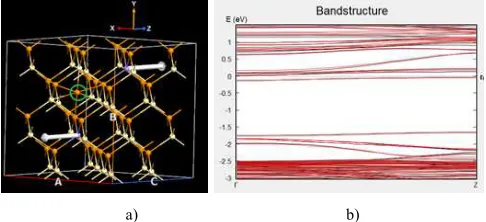
The band gap is changed from Eg=1.73eV to Eg=2.1eV. It is formed 1 local level in the band gap: Е↑=-0.731. The top of valence band and the bottom of conductivity band are shifted towards the energy levels Ес↓=0.283еV, Ev↓=-1.83eV. The total energy of the supercell Cd30Mn2Te32 in antiferromagnetic state having VTe is Et=-65817.21eV (Fig.12).
a) b)
Fig. 12. Supercell Cd30Mn2Te32 with VTe in antiferromagnetic state a) Bulk
configuration b) EBS
VTe in the supercell Cd30Mn2Te32 in ferromagnetic state doesn’t form large MM. The main contribution to MM ferromagnetic supercell Cd30Mn2Te32 give two Mn atoms each of them is 5.095µB. The MM of all 30 Cd atoms is -0.248 µB and all 31 Te atoms is 0.06 µB. The total MM of all atoms is 10.002µB .
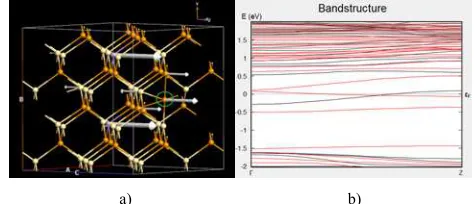
The band gap is changed from Eg=1.73eV to Eg=2.08eV It is formed 1 local level in the band gap below the Fermi level Е↑↓=-0.73eV. The top of valence band and the bottom of conductivity band are displaced to the energy levels Ес↓=0.3еV, Ev↓=-1.78eV (Fig.13). The total energy of the supercell Cd30Mn2Te32 in ferromagnetic state having VTe is Et=-65817.15eV.
a) b)
Fig. 13. Supercell Cd30Mn2Te32 with VTe in ferromagnetic state a) Bulk
configuration b) EBS
Thus, in the supercell Cd30Mn2Te32 having VTe it is formed 1 local level in the band gap and band gap is increased. Contribution of VTe to MM ts insignificant. The main contribution to MM gives two Mn atoms. Comparison of total energies for ferromagnetic and antiferromagnetic states shows that the ferromagnetic state is more stable.
3.2.2. Interstitial Atom in the Supercell Cd30Mn2Te32
Interstitial Cd (ICd) atom in the supercell Cd30Mn2Te32 in antiferromagnetic state leads to formation of 1 local level in the band gap: Е↑↓=-0.68 eV. The band gap is changed from Eg=1.73eV to Eg=2.03eV. The top of valence band and the bottom of conductivity band are shifted towards the energy levels Ес↓=0.2еV, Ev↓=-1.83eV (Fig.14). The total energy of the supercell Cd30Mn2Te32 in antiferromagnetic state having ICd is Et=-67953.46eV.
a) b)
Fig. 14. Supercell Cd30Mn2Te32 with ICd in antiferromagnetic state a) Bulk
configuration b) EBS
The MM of all 31 Cd atoms is -0.023 µB and all 32, Te atoms is 0.079 µB. The total MM of all atoms is 0.006µB .
ICd atom in the supercell Cd30Mn2Te32 in ferromagnetic state forms 1 local levels in the band gap: Е↓=-1.1eV. The band gap doesn’t changed from. The top of valence band and the bottom of conductivity band are shifted towards the energy levels Еv↑=-2.31еV, Ec↑=-0.58eV (Fig.15). The total energy of the supercell Cd30Mn2Te32 in ferromagnetic state having ICd is Et=-67953.26eV.
ICd atom has 6 bonds: 3 bonds with Te atoms and 3 bonds with Cd atoms. The main contribution to the MM give two Mn atoms each of them is 5.153µB, interstitial Cd atom -2.143µB and 3 Te atoms having bonds with interstitial Cd atom, each of them 2.049µB. The MM of all 31 Cd atoms is -4.709 µB and all 32 Te atoms is 4.689 µB. The total MM of all atoms is 10.005µB .
a) b)
Fig. 15 Supercell Cd30Mn2Te32 with ICd in ferromagnetic state a) Bulk
configuration b) EBS
Thus, in the supercell Cd30Mn2Te32 having ICd it is formed 1 local level in the band gap. Band gap is increased in antiferromagnetic state and doesn’t changed in ferromagnetic state. The contribution of ICd atom to MM in antiferromagnetic state ts insignificant. The main contribution to MM give two Mn atoms and ICd atom in ferromagnetic state. Comparison of total energies for ferromagnetic and antiferromagnetic states shows that the ferromagnetic state is more stable.
ITe in the supercell Cd30Mn2Te32 in antiferromagnetic state it is formed nolocal level in the band gap. The band gap doesn’t changed. The top of valence band and the bottom of conductivity band are shifted towards the energy levels Ес↑=-0.1еV, Ev↓=-1.6eV. The total energy of the supercell Cd30Mn2Te32 in antiferromagnetic state having ITe is Et=-66981.54eV (Fig 16).
a) b)
Fig. 16. Supercell Cd30Mn2Te32 with ITe in antiferromagnetic state a) Bulk
configuration b) EBS
Main contribution to the MM give two Mn atoms each of them is 5.64 µB. ITe doesn’t lead to formig large MM. The MM of all 30 Cd atoms is 0.107 µB and all 33 Te atoms is - 0.491 µB. The total MM of all atoms is -0.006µB .
ITe in the supercell Cd30Mn2Te32 in ferromagnetic state leads to forming 2 local levels in the band gap: Е↑=0.4eV, Е↑=-0.54eV. The band gap doesn’t changed Eg=1.73eV. The top of valence band and the bottom of conductivity band are shifted towards the energy levels Ес↓=0.783еV, Ev↓=-0.955eV (Fig 17). The total energy of the supercell Cd30Mn2Te32 in ferromagnetic state with ITe is Et=-66997.02eV.
To move Te atom from its position to the interstitial one it is have to break 4 bonds with Cd atoms. After the displacement the interstitial Te atom has 6 bonds - 3 bonds with Te atoms and 3 bonds with Cd atoms. Contribution to MM give these 6 atoms, each Cd atom -2.443µB and each Te atom 2.823µB, interstitial Te atom itself 4.632µB and two Mn atoms each of them 4.806µB. The MM of all 30 Cd atoms is -9.16 µB and all 33 Te atoms is 13.52 µB. The total MM of all atoms is 12.994µB .
a) b)
Fig. 17. Supercell Cd30Mn2Te31 with ITe in ferromagnetic state a) Bulk
configuration b) EBS
Thus, in the supercell Cd30Mn2Te32 having ITe it is formed no local level in the band gap in antiferromagnetic state and 2 local levels in ferromagnetic state. Contribution of ITe atom to MM in antiferromagnetic state is insignificant. The main contribution to MM give two Mn atoms and ITe atom in ferromagnetic state. Comparison of total energies for ferromagnetic and antiferromagnetic states shows that the antiferromagnetic state is more stable.
3.2.3. Frenkel Pair in the Supercell Cd30Mn2Te32
Frenkel pair FCd in the supercell Cd30Mn2Te32 in antiferromagnetic state leads to forming of 1local level in the band gap: Е↓↑=0.38eV. The band gap is changed from Eg=1.73eV to Eg=1.9eV. The top of valence band and the bottom of conductivity band are shifted towards the energy levels Ес↓=1.4еV, Ev↓=-0.5eV (Fig.18). The total energy of the supercell Cd30Mn2Te32 in antiferromagnetic state having ITe is Et=-66400.55eV.
a) b)
Fig. 18. Supercell Cd30Mn2Te31 with FCd in antiferromagnetic state a) Bulk
configuration b) EBS
Displacement of Cd atom in the supercell Cd30Mn2Te32 in ferromagnetic state leads to forming FCd. Cd atom breaks 4 bonds with Te atoms displaces to the interstitial and forms 4 new bonds with 2 Cd atoms and 2 Te atoms. FCd in the supercell Cd30Mn2Te32 in ferromagnetic state leads to forming of 2 local levels in the band gap: Е↓=0.51eV, Е↑=0.62eV. The band gap is changed from Eg=1.73eV to Eg=1.89eV. The top of valence band and the bottom of conductivity band are shifted towards the energy levels Еv↓↑=-0.67еV, Ec↓↑=1.215eV (Fig.19). The total energy of the supercell Cd30Mn2Te32 in antiferromagnetic state having ITe is Et=-66400.88eV.
Frenkel pair FCd in ferromagnetic state leads to forming MM. The main contribution to MM give two Mn atoms, each of them 5.081µB , interstitial Cd atom with MM of 1.372µB and two Te atoms with MM of 1.91µB and 0.3964µB. The MM of all 30 Cd atoms is -2.663 µB and all 32 Te atoms is 2.623 µB. The total MM of all atoms is 10.002µB .
a) b)
Fig. 19. Supercell Cd30Mn2Te31 with FCd in ferromagnetic state a) Bulk
configuration b) EBS
Thus, in the supercell Cd30Mn2Te32 having FCd it is formed 1 local level in the band gap in antiferromagnetic state and 2 local levels in ferromagnetic state. The band gap is increased. Contribution of FCd atom to MM is insignificant. The main contributionto MM give two Mn atoms. Comparison of total energies for ferromagnetic and antiferromagnetic states shows that the antiferromagnetic state is more stable.
Displacement of Te atom leads to formation of FTe in the supercell Cd30Mn2Te32. Te atom brakes 4 bonds with Cd atoms displace to the interstitial position and forms 4 new bonds with 2 Cd atoms and 2 Te atoms.
Frenkel pair FTe in the supercell Cd30Mn2Te32 in antiferromagnetic state leads to formation of 4local levels in the band gap: Е↑=0,8 Е↓=-0.1eV, Е↑=-0.25eV, Е↓=-0.3eV.
The band gap is changed from Eg=1.73eV to Eg=2.0 eV. The top of valence band and the bottom of conductivity band are shifted towards the energy levels Еv↓↑=-1.5еV, Ec↓↑=0.5eV (Fig.20). The total energy of the supercell Cd30Mn2Te32 in antiferromagnetic state with FTe is Et=-66398.475eV.
FTe forms insignificant MM. The main contribution to MM gives two Mn atoms each of them 5,241µB. The MM of all 30 Cd atoms is -0.221 µB and all 32 Te atoms is 0.707 µB. The total MM of all atoms is 1.022µB .
a) b)
Fig. 20. Supercell Cd30Mn2Te31 with FTe in antiferromagneticstate a) Bulk
configuration b) EBS
Frenkel pair FTe in the supercell Cd30Mn2Te32 in ferromagnetic state leads to formation of 3local levels in the band gap: Е↑=0.1, Е↓=-0.3eV, Е↑=-0.5eV. The band gap is changed from Eg=1.73eV to Eg=2.0eV. The top of valence band and the bottom of conductivity band are shifted towards the energy levels Ес↑=0.5еV, Ev↑=-1.5eV. The total energy of the supercell Cd30Mn2Te32 in ferromagnetic state having ITe is Et=-66405.26eV.
Frenkel pair FTe in the supercell Cd30Mn2Te32 in ferromagnetic state leads to forming MM. The main contribution to MM give two Mn atoms each of them have MM 5.113 µBand 4 broken bonds of Cd atoms with Te atom -1.717 µB, -2.175 µB, -1.667µB, -0.919 µB, and 3 Te atoms 2.445 µB, 2.42 3 µB, 3.495 µB. The MM of all 30 Cd atoms is -9.279 µB and all 32 Te atoms is 9.9 µB. The total MM of all atoms is 10.821µB .
a) b)
Fig. 21. Supercell Cd30Mn2Te31 with FTe in ferromagnetic state a) Bulk
configuration b) EBS
Thus, in the supercell Cd30Mn2Te32 having FTe it is
ferromagnetic and antiferromagnetic states shows that the antiferromagnetic state is more stable.
4. Conclusion
It was calculated band structure, density of states and magnetic momentum for ideal and defective supercell CdTe and CdMnTe by ab initio method. The band gap, local levels in the band gap and magnetic momentum are defined for various defects in ferromagnetic and antiferromagnetic states. It has been defined, that as Mn atoms, the vacancy, interstitial atom and Frenkel pair in the crystal structure form magnetic moment.
It has been defined that VCd decrease the band gap in the supercell Cd32Te32 but VTe increase it and forms 1local level in the band gap.
ICd and ITe atoms in the supercell Cd32Te32 don’t change the band gap. It is formed large MM and 1local level in the band gap in the supercell Cd32Te32 having ITe.
FCd and FTe atoms in the supercell Cd32Te32 don’t change the band gap. FCd forms 2 local levels and FTe forms 4 local levels in the band gap in the supercell Cd32Te32. It is formed MM in the supercell Cd32Te32 having FCd or FTe atom.
Impurity of two Mn atoms into the supercell Cd30Mn2Te32 leads to forming large MM. The antiferromagnetic phase is more stable in the supercell Cd30Mn2Te32.
In the supercell Cd30Mn2Te32 having VCd it is formed 3 local levels in the band gap. It is formed MM due to the Mn atoms, Te and Cd vacancies. The antiferromagnetic state in the supercell Cd30Mn2Te32 having VCd is more stable.
In the supercell Cd30Mn2Te32 having VTe it is formed 1 local level in the band gap and band gap is increased. The contribution of VTe to MM tsinsignificant. The main contribution to MM give two Mn atoms. The ferromagnetic state is more stable in the supercell Cd30Mn2Te32 having VTe.
In the supercell Cd30Mn2Te32 having ICd it is formed 1 local level in the band gap. The band gap is increased in antiferromagnetic state and doesn’t changed in ferromagnetic state. The contribution of ICd atom to MM in antiferromagnetic state ts insignificant. The main contribution to MM give two Mn atoms and ICd atom in ferromagnetic state. Comparison of total energies for ferromagnetic and antiferromagnetic states shows that the ferromagnetic state is more stable.
In the supercell Cd30Mn2Te32 having ITe it is formed no local level in the band gap in antiferromagnetic state and 2 local levels in ferromagnetic state. The contribution of ITe atom to MM in the supercell Cd30Mn2Te32 in antiferromagnetic state having ITe is insignificant. The main contribution to MM give two Mn atoms and ITe atom in ferromagnetic state. The antiferromagnetic state is more stable.
In the supercell Cd30Mn2Te32 having FCd it is formed 1 local level in the band gap in antiferromagnetic state and 2 local levels in ferromagnetic state. The band gap is increased.
Contribution of FCd atom to MM is insignificant. The main contribution to MM give two Mn atoms.. The antiferromagnetic state is more stable in the supercell
Cd30Mn2Te32 having FCd.
In the supercell Cd30Mn2Te32 having FTe it is formed 4 local levels in the band gap in antiferromagnetic state and 3 local levels in ferromagnetic state. The band gap is increased. Contribution of FTe atom to MM in the supercell Cd30Mn2Te32 in antiferromagnetic state having FTe is insignificant. The main contribution to MM give two Mn atoms and FTe in erromagnetic state. The antiferromagnetic state is more stable the supercell Cd30Mn2Te32 having FTe.
Acknowledgment
This work was supported by the Science Foundation of the State Oil Company of Azerbaijan Republic, 2013
References
[1] P.I. Nikitin, A.I. Savchuk, The Faraday effect in semimagnetic semiconductors, Sov. Phys. Usp. v.160, 11, 1990, pp.167-196
[2] M.A. Mehrabova, I.R. Nuriyev, R.N. Hasanli. Obtaining of perfect Cd1-хMnхTe epitaxial thin films and their use potentials, 5th WSEAS Internat. Conf. on Nanotechnology, Cambridge, UK, February 20-22, p.316-320, 2013
[3] B.M. Askerov, T.G. Ismailov, M.A. Mehrabova Interband Faraday rotation in semimagnetic semiconductors. Phisica status solidi (b), 1991, v.163, pp.k117-k121
[4] M.A. Mehrabova, H.R. Nuriyev, H.S. Orujov, A.M. Nazarov, R.M. Sadigov, V.N. Poladova. Defect formation energy for charge states and electrophysical properties of CdMnTe, The 7th Internat.Conf. on Photonics, Devices and Systems. Photonics Prague 2014, August 27-29, Czech Republic.
[5] B. Belgoumène, S. Kouidri, M. Driss Khodja. Pseudopotential calculations for the electronic structure of Cd1-xMnxTe.
Physics Letters A, Volume 261, Issue 3-4, p. 191-196.
[6] A.E. Merad, M.B. Kanoun, S. Goumri-Said. Ab initio study of electronic structures and magnetism in ZnMnTe and CdMnTe diluted magnetic semiconductors. Journal of Magnetism and Magnetic Materials,Volume 302, Issue 2, 2006, p. 536–542,
[7] B.J. Min. First-Principles Pseudopotential Total-Energy Calculations of CdTe. Journal of the Korean Physical Society, Vol. 30, No. 3, 1997, p. 647_650
[8] K.Y.Ko, M.G. Blamire. Temperature-induced magnetic phase transition in bulk Cr-Doped CdTe Crystals. Journal of the Korean Physical Society, v.49, №2, 2006, p.591-595
[9] ATK, http//quantumwise.com
[10] Mehrabova M.A., Nuriyev I. R., Orujov H.S., Electron structure and optical properties of Cd1-хMnхTe thin films. International Journal of Materials, 1, 2014, p.63-70
[12] Mehrabova M.A., Orujov H.S., Poladova V.N., First principles calculations for the electronic structure of Cd 1-хMnхTe diluted magnetic semiconductors. 8th Internat. Conf.on “Circuits, systems, signal and telecommunications”, Tenerife, Spain, January 10-12, 177-182 (2014).