INTERNATIONAL JOURNAL OF PHARMACEUTICAL, CHEMICAL AND BIOLOGICAL SCIENCES
Available online at www.ijpcbs.com
DEVELOPMENT AND VALIDATION OF RP-HPLC METHOD FOR
QUANTITATIVE ANALYSIS VOGLIBOSE IN PURE AND
PHARMACEUTICAL FORMULATIONS
V. Sai kishore1, P. Jitendrakumar2*, T. Kalyan chakravarthy2, S.Venkatesh Naik2,
M. Harshavardan Reddy2 and E. Nagarjuna Babu2
1Bapatla college of Pharmacy,Bapatla,Guntur, Andhra Pradesh, India.
2Nalanda Institute of Pharmaceutical sciences, Kantepudi, Guntur, Andhra Pradesh, India.
INTRODUCTION
Voglibose, a potent α-glucosidase inhibitor is used for the treatment of diabetes mellitus1-2.
It acts as glucosidase inhibitor, remaining active within the gastrointestinal tract of humans by delaying the glucose absorption thereby preventing the sudden surge of glucose in the
human body after meals3-4. Most commonly used
glucosidase inhibitors include acarbose,
mitglitol& voglibose5. Voglibose is the safest and
most effective of them all. It is most
commonly available in the form of tablets with the dosages of 0.2 mg to 0.3 mg per tablet. Structure of voglibose is similar to that of carbohydrate6. Inspite of the fact thatvoglibose
has already been established as an important pharmaceutical active, the alreadypublished work on voglibose, describes this molecule in different manner7-9. For determining the content
of voglibose in the formulations, not many analytical methodshave been reported10-18.In the
present study, a new RP-HPLC method was developed which shown high reproducibility and sensitivity. The developed method was validated as per ICH guidelines.
Instrumentation
To develop a High Pressure Liquid
Chromatographic method for quantitative estimation of Voglibosean isocratic PEAKHPLC instrument with Zodiac C18 column (250 mm x 4.6 mm, 5μ) was used. Theinstrument is equipped with a LC 20AT pump for solvent
delivery and variable wavelength
programmable LC 7000 UV-detector. A 20μL Rheodyne inject port was used for injecting the samples. Data was analyzed by using PEAK software.
Standards and chemicals used
Voglibose was provided by
Ranbaxylaboratories,Guargon.All the chemicals Acetonitrile, Methanol were HPLC grade, Merck Specialties Private Limited, Mumbai, India.
Commercial tablets of Voglibose were
purchased from local market.
Preparation of the mobile phase
Into a 1000ml cleaned volumetric flask, HPLC grade methanol 750ml, acetonitrile 250ml (which are filtered through 0.25mm membrane filters by vacuum filtration) were slowly added , mixed well and sonicatedupto 20min. Cool the
Research Article
ABSTRACT
A Validated simple, sensitive, specific and precise RP-HPLC method was developed for the determination of Voglibosein pure and pharmaceutical formulations. Method was carried on
Zodiac C18 column(250mm×4.6mm×5µ particle size) using Methanol: Acetonitrile(75:25) as
mobile phase.Detection was carried out by U.V at 215nm. The proposed method obeyed linearity in the range of 20-140 µg/mland met all specifications as per ICH guidelines. Statistical analysis revealed that this method can be used in routine quality control studies of Voglibose in pure and its formulations
solution to room temperature and use for chromatography method.
Preparation of Standard drug solutions 100mg of Voglibose was accurately weighed and is dissolved in few ml of the mobile phase andsonicated for few min to dissolve the drug completely. Then it is filtered through 0.2µ ultipore filter paper and the volume is made upto 100ml with mobile phase to get a concentration of1mg/ml (free base) stock solution. This solution is further diluted with same solvent to obtain required working standard concentrations.
Sample Preparation
20 commercial tablets of Voglibose were finely powdered and the powder equivalent to 0.3mg of Vogliboseaccurately weighed to 50ml volumetric flask and dissolved in few ml of mobile phase. The above solution was subjected to sonication for 15min. After getting clear solution it is filtered through 0.25µm membrane filters and the solution is made upto 50ml with mobile phase resulting in preparation of 1 mg/ml solution. This is further diluted so as to obtain required concentration of Voglibose pharmaceutical dosage form.
Methodology
The HPLC system was stabilized for thirty min. by passing mobile phase, detector was set at 215nm, flow rate of 1.0ml/min to get a stable base line. One blank followed by six replicates of a single standard solution was injected to check the system suitability. Eight replicates of each standard solutions 20, 40, 60, 80, 100, 120,140µg/ml were injected. Calibration graph was plotted by concentration of Voglibose on X-axis and peak area on Y-X-axis. The amount of drug present in sample was computed in calibration graph.
Pharmaceutical formulations
Prepared dilution of pharmaceutical
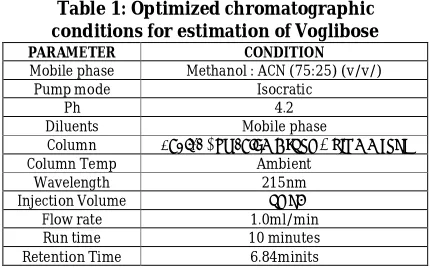
formulation is injected and the procedure described under bulk samples was followed. The amount of drug present in sample was computed in calibration graph.Chromatographic conditions for estimation of Voglibose were described in
table 1.
RESULTS AND DISCUSSION
The objective of the present work is to develop simple, precise and reliable HPLCmethod for the analysis of Voglibose in bulk and pharmaceutical
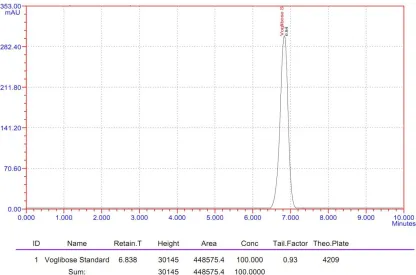
detection at 218snm. The representative chromatogram indicatingVoglibose is shown in fig. 1.
Parameter fixation
In developing this method, a systemic study of effects of various parameters was undertaken by varying one parameter at a time and controlling all other parameters. The following studies were conducted for this purpose.
Stationary phase characteristics
Based onnature and solubility characteristics of Voglibose, reverse phase mode of HPLC was selected for chromatography. Among different RP-HPLC stationary phases tried C18 column
was found to be optimum.
Mobile phase characteristics
In order to get sharp peak with base line separation from interfering peaks carried out a number of experiments by varying the composition of solvents and mobile phase flow rate. To have an ideal separation of the drug under isocratic conditions, mixtures of solvents like methanol,waterand aceertonitrile with or
without different buffers in different
combinations were tested as mobile phase. A mixture of Methanol : ACN ( 75:25) (v/v) was proved to be the most suitable of all the combinations, since the chromatographic peak obtained was better defined and resolved and almost free from tailing.
VALIDATION OF THE PROPOSED METHOD As an integral part of analytical method development is validation. The proposed method was validated as per ICH guidelines.
1. Linearity
It is the ability of the method to elict test results directly propotional to analyate concentration with in a given range11.Linearity was performed
by preparing standard solutions of Vogliboseat different concentration levels, twenty micro liters of each concentration was injected in into the HPLC system. The peak responses were read
at 215nm and the corresponding
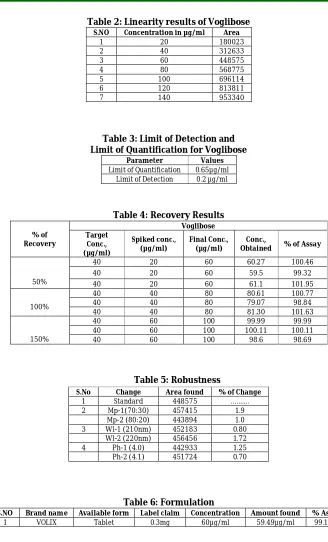
chromatograms were recorded. Linearity plots of concentration over areas were constructed individually. Linearity results wereobtained in the concentration range of 60-200µg/ml .The results were presentedinTable.2.
2. Precision
performed as intraday precision, Inter day precision.
Intraday precision
To study the intraday precision, six replicate standard solutions (60ppm)ofVoglibose was injected. The percent relative standard deviation (% RSD) was calculated and it was found to be 0.15 which are well within the acceptable criteria of not more than0.53.
Inter Day precision
To study the interday precision, six replicate standard solutions (60ppm) of Voglibosewas injected on third day of sample preparation. The percent relative standard deviation (% RSD) was calculated and it was found to be1.58which are well within the acceptable criteria of not more than 2.0.
3. Specificity
The effect of wide range of excipients and other additives usually present in the formulation of Voglibose in the determinations under optimum conditions were investigated infact, may have
no observation at this UV Maximum.
Chromatographic parameters maintained are specific for Voglibose.
4. Ruggedness
The ruggedness of the method was determined by carrying out the experiment on different instruments like Shimadzu HPLC(LC2010 A HT), Aglient HPLC and water’s Breeze HPLC By different operators using different columnsof
similar type like Hypersil
C18,PhenomenexyGemini C18 and HichronC18and
didn’t show any significant change.
5. Limit of Detection and Limit of Quantification
A Calibration curve was prepared using concentrations in the range of 20-140 µg/ml (expected detection limit range). The standard deviation of Y-intercepts of regression line was determined and kept in following equation for the determination of Detection limit and Quantitation limit.
The results were reported in table-3.
6. Accuracy
The accuracy of the method was determined by standard addition method. A known amount of standard drug was added to the fixed amount of pre-analyzed Standard solution. The standard addition method was performed at 50%, 100% and 150% level of40ppm. The solutions were analyzed in triplicate at each level as per the proposed method. The percent recovery and % RSD was calculated and results are presented in Table.4.Satisfactory recoveries ranging from 98% to 102% were obtained by the proposed method. This indicates that the proposed method was accurate.
7. Robustness
Robustness of the method was determined by making slight changes in the chromatographic conditions. It was observed that there were no marked changes in the chromatograms, which demon started that the RP-HPLC method developed is robust. The results of robustness were given in table no.5.
Table 1: Optimized chromatographic conditions for estimation of Voglibose
PARAMETER CONDITION
Mobile phase Methanol : ACN (75:25) (v/v/)
Pump mode Isocratic
Ph 4.2
Diluents Mobile phase
Column Zodiac C18 column (250 X 4.6 mm, 5μ)
Column Temp Ambient
Wavelength 215nm
Injection Volume 20 μl
Flow rate 1.0ml/min
Run time 10 minutes
Table 2: Linearity results of Voglibose
Table 3: Limit of Detection and Limit of Quantification for Voglibose
Parameter Values
Limit of Quantification 0.65µg/ml Limit of Detection 0.2 µg/ml
Table 4: Recovery Results
% of Recovery
Voglibose Target
Conc., (µg/ml)
Spiked conc., (µg/ml)
Final Conc., (µg/ml)
Conc.,
Obtained % of Assay
50%
40 20 60 60.27 100.46
40 20 60 59.5 99.32
40 20 60 61.1 101.95
100%
40 40 80 80.61 100.77
40 40 80 79.07 98.84
40 40 80 81.30 101.63
150%
40 60 100 99.99 99.99
40 60 100 100.11 100.11
40 60 100 98.6 98.69
Table 5: Robustness
S.No Change Area found % of Change
1 Standard 448575 ……….
2 Mp-1(70:30) 457415 1.9
Mp-2 (80:20) 443894 1.0
3 Wl-1 (210nm) 452183 0.80
Wl-2 (220nm) 456456 1.72
4 Ph-1 (4.0) 442933 1.25
Ph-2 (4.1) 451724 0.70
Table 6: Formulation
S.NO Brand name Available form Label claim Concentration Amount found % Assay
1 VOLIX Tablet 0.3mg 60µg/ml 59.49µg/ml 99.15%
S.NO Concentration in µg/ml Area
1 20 180023
2 40 312633
3 60 448575
4 80 568775
5 100 696114
6 120 813811
Fig. 1: chromatogram of Voglibose
REFERENCES
1. Chen X, Zheng Y and Shen Y. Curr Med Chem. 2006;13:109-116.
2. Kawamori R, Tajima N, Iwamoto Y,
Kashiwagi A, Shimamoto K and Kaku K. The Lacent. 2009;373, 1607-1614.
3. Yamasaki Y, Katakami N,
Hayaishi-Okano R, Matsuhisa M, Kajimoto, Kosugi K, Hatano M and Hori M. Diabetes Res ClinPract., 2005;67:204-210.
4. Watanabe K, Uchino H, Ohmura C,
Tanaka Y, Onuma T and Kawamori R. Diabetes Complicat. 2004;18:183-186. 5. Vichayanrat A, Ploybutr S, Tunlakit M
and Watanakehorn P. Diabetes
Research andClinical Practice.
2002;55(2):99-103.
6. Zhang H, Sun CR, Ishurd O, Pan YJ and
Ding LS. Carbohydr Res,
2004;339:2027-2030.
7. http://www.chembase.com/compound
_voglibose.htm, Chemical Compound Database,CAS No. 83480-29-9
8. The Merck Index [Merck &Co., Inc. Whitehouse Station Nj. USA], 14 Edition 2006, 1727.
9. Japanese Pharmacopoeia XV, Official
Monographs, p1231.
10. Rao NM, Bagyalakshmi J and Ravi TK.
Development and validation of
spectrofluorimetricmethod for the
estimation of voglibose in bulk and pharmaceutical dosage form. Int JPharm Sci Res. 2010;1(6):95-102.
11. Rao NM, Bagyalakshmi J and Ravi TK. Development and validation of UV spectroscopicmethod for estimation of voglibose in bulk and tablets. J Chem Pharm Res. 2010;2(2):350-56.
12. www.pickeringlabs.com/lib/pdf/MA32
7%20Voglibode.pdf; Method Abstract/ 327,Pickering Laboratory, Space-Park Way, CA.
13. Shimadzu Application News, L295,
LAAN-A-LC-E000.
14. Raman NVVSS, Reddy KR, Prasad AVSS
and Ramakrishna K. Talanta,
15. Woo J S and Ryu J K. J Pharm Biomed Anal. 2006;42:328-333.
16. MithleshRajput, Meenakshi Dahiyaet.
Development and Validationfor
Determination of VogliboseinTablet
Formulation Using LC-MS/MS,
E-Journal of Chemistry. 2011;8(4):1770-1783.
17. Raj N, Nargund R, Kabra P, Kimbahune R, Patel A, Nargund LVG. Simultaneous
Quantification of Voglibose and
Metformin by validated analytical
method in tablet dosage
form,International journal of
institutionalPharmacy and Life
Sciencesscie,1(3):Nov-Dec,58-63. 18. Mallikarjuna Rao N. RP-HPLC method
development and validation for