INTERNATIONAL JOURNAL OF PHARMACEUTICAL, CHEMICAL AND BIOLOGICAL SCIENCES
Available online atwww.ijpcbs.com
ANALYTICAL METHOD DEVELOPMENT AND VALIDATION FOR THE
SIMULTANEOUS ESTIMATION OF FEBUXOSTAT AND KETOROLAC IN
TABLET DOSAGE FORMS BY RP-HPLC
B. Raja
1and A. Lakshmana Rao
2*1Anurag Pharmacy College, Ananthagiri- 508 206, Andhra Pradesh, India.
2V. V. Institute of Pharmaceutical Sciences, Gudlavalleru- 521 356, Andhra Pradesh, India.
INTRODUCTION
Febuxostat (Fig. 1) is a novel xanthine oxidase inhibitor indicated for the chronic management
of hyperuricemia in patients with gout1.
Chemically it is 2-[3-cyano-4-(2-methylpropoxy)
phenyl]-4-methylthiazole-5-carboxylic acid2.
Febuxostat is a non-purine analogue inhibitor of both the oxidized and reduced forms of xanthine oxidase. It was found to be more than 10-30
times potent than allopurinol in animal studies3.
Ketorolac (Fig. 2) is a non-steroidal
anti-inflammatory drug, when administered
systemically, has demonstrated analgesic,
anti-inflammatory and anti-pyretic activity4.
Chemically it is
(±)-5-benzoyl-2,3-dihydro-1H-pyrrolizine-1-carboxylic acid,
2-amino-2-(hydroxymethyl)-1,3-propanediol5. Ketorolac
acts by inhibiting the bodily synthesis of
prostaglandins6-7.
Literature survey reveals that few
spectrophotometric8 and HPLC9 methods have
been reported for simultaneous estimation of Febuxostat and Ketorolac. A successful attempt has been made for simultaneous determination of Febuxostat and Ketorolac in combined dosage form by using HPLC. Therefore, it was thought worthwhile to develop simple, accurate, precise and reliable RP-HPLC method for simultaneous estimation of both the drugs Febuxostat and Ketorolac in combined dosage form and
validated in accordance with ICH guidelines10.
EXPERIMENTAL Materials and reagents
The working standards of Febuxostat and Ketorolac were provided as gift samples from Chandra Labs, Hyderabad, India. Febuxostat and Ketorolac tablets were purchased from local market. Potassium dihydrogen phosphate and
Research Article
ABSTRACT
A simple, accurate, precise and rapid reversed-phase high performance liquid chromatographic (RP-HPLC) method has been developed and validated for the simultaneous estimation of Febuxostat and Ketorolac in pure and tablet dosage form. The proposed method is based on the separation of the two drugs in reversed-phase mode using C18 column (150 mm x 4.6 mm I.D., 5 µ particle size). The optimum mobile phase consisted of phosphate buffer: acetonitrile in the ratio of 50:50 V/V was selected as a mobile phase, flow rate of 0.7 mL/min and UV detection was set at 299 nm. The retention times were 2.648 min and 5.389 min for Febuxostat and Ketorolac. The method was validated according to ICH guidelines. Linearity was obtained in the concentration range of 10-60 µg/mL for Febuxostat and 3.75-22.5 µg/mL for Ketorolac. Mean percent recovery of samples for both drugs were found in the range of 100.62 for Febuxostat and 100.67 for Ketorolac. The relative standard deviation (%RSD) was found to be 0.09 for Febuxostat and 0.03 for Ketorolac. The proposed method is rapid, accurate, precise and selective for the simultaneous estimation of Febuxostat and Ketorolac and can be successfully applied in the quality control of bulk and pharmaceutical dosage forms.
orthophosphoric acid of AR Grade were obtained from S.D. Fine Chemicals Ltd., Mumbai, India. HPLC grade acetonitrile was purchased from E. Merck (India) Ltd., Mumbai, India. HPLC grade water obtained from Milli Q water purification system was used throughout the study.
Chromatographic conditions
Separation was performed with Waters HPLC equipped with a pump 2695, auto sampler and UV detector. Empower2 software was applied for data collecting and processing. The separation was achieved on a C18 column (150 x 4.6 mm, 5 µ). The mobile phase consisted of phosphate buffer: acetonitrile in the ratio of 50:50 V/V. The flow rate was 0.7 mL/min and UV detection was performed at 299 nm. The mobile phase was shaken on an ultrasonic bath for 30 min. The resulting transparent mobile phase was filtered through a 0.45 µ membrane filter. The injection volume was 20 µL and all the experiments were performed at temperature
30◦C. The run time was set at 12 min.
Preparation of standard solution
Standard stock solution was prepared by dissolving 40 mg of Febuxostat and 15 mg of Ketorolac in 100 mL mobile phase respectively. From this stock solution 10 mL was diluted in 100 mL mobile phase.
Preparation of sample solution
Weigh accurately 20 tablets and crushed into powder, powder equivalent to about 40 mg of Febuxostat and 15 mg of Ketorolac by dissolving in 100 mL mobile phase to prepare stock solution. From this stock solution 10 mL was diluted in 100 mL mobile phase.
Method validation
The method was validated in accordance with ICH guidelines. The parameters assessed were linearity, accuracy, limit of detection (LOD),
limit of quantification (LOQ), precision,
reproducibility and robustness etc.
Linearity
Several aliquots of standard solutions of Febuxostat and Ketorolac were taken in different 10 mL volumetric flasks and diluted up to the mark with mobile phase such that the final concentrations were 10 to 60 µg/mL and 3.75 to 22.5 µg/mL of Febuxostat and Ketorolac respectively. Evaluation of the two drugs was performed with UV detector at 299 nm, peak area was recorded for all the peaks. The
correlation coefficient values were R2=0.999 for
Febuxostat and R2=1 for Ketorolac. The results
show that an excellent correlation exists between peak area and concentration of drugs within the concentration range indicated.
Limit of detection and limit of quantification
The limit of detection (LOD) and limit of quantification (LOQ) were calculated according to Equation 1 & 2, respectively.
LOD = 3.3 x SD/S……….. (1)
LOQ = 10 x SD/S……….. (2)
Where SD is the standard deviation of response (peak area) and S is the average of the slope of the calibration curve.
The limit of detection (LOD) and limit of quantification (LOQ) of the developed method were determined by injecting progressively low concentrations of the standard solutions using the developed HPLC method. The LOD for Febuxostat and Ketorolac were found to be 1.167 µg/mL and 0.646 µg/mL respectively. The LOQ for Febuxostat and Ketorolac were found to be 3.644 µg/mL and 2.018 µg/mL respectively.
Accuracy
The accuracy of the method was assessed by recovery studies of Febuxostat and Ketorolac in the dosage form at three concentration levels. A fixed amount of preanalyzed sample was taken and standard drug was added at 50%, 100% and 150% levels. Each level was repeated three times. The contents of Febuxostat and Ketorolac per tablet were calculated. The mean recoveries of Febuxostat and Ketorolac were in the range of 100.62% and 100.67% that shows there is no interference from excipients and the lower values of RSD of assay indicate the method is accurate.
Precision
The precision was determined for both the drugs Febuxostat and Ketorolac in terms of
intra-day and inter-day precision.For intra-day
precision evaluation, a standard solution of fixed concentration was injected at various time intervals and %RSD for Febuxostat and Ketorolac were 0.12% and 0.04% respectively (limit %RSD < 2.0%). In addition, the inter-day precision was studied by injecting the same
concentration of standard solution on
consecutive days and the %RSD for Febuxostat and Ketorolac were 0.09% and 0.03% respectively (limit %RSD < 2.0%).
Ruggedness
instruments by different operators using different columns of similar types, which demonstrated that the developed HPLC method is rugged.
Robustness
Robustness of the method was determined by making slight changes in the chromatographic conditions like mobile phase composition and flow rate. It was observed that there were no marked changes in the chromatograms, which demonstrated that the HPLC method so developed is robust.
Specificity
Specificity is the ability of the analytical method to measure the analyte response in the presence of interferences including degradation products and related substances. No interference from any of the excipients was found at retention times of the examined drugs. These results demonstrate the absence of interference from
other materials in the pharmaceutical
formulations and therefore confirm the specificity of the proposed method.
Assay
20 µL of each standard and sample solution were injected and from the peak area of Febuxostat and Ketorolac, amount of each drug in samples were computed. The result of assay undertaken yielded 99.09% and 99.66% of label claim of Febuxostat and Ketorolac respectively.
RESULTS AND DISCUSSION
The HPLC procedure was optimized with a view to develop accurate assay method in tablet dosage form using C18 column (150 x 4.6 mm, 5
μ) in isocratic mode with mobile phase
composition of phosphate buffer: acetonitrile in the ratio of 50:50 V/V. The use of phosphate buffer: acetonitrile in the ratio of 50:50 V/V resulted in peak with good shape and resolution. The flow rate was 0.7 mL/min and both the components were measured with UV detector at 299 nm. The results of optimized HPLC conditions were shown in Table 1. The method was linear in the range of 10 to 60 µg/mL for Febuxostat and 3.75 to 22.5 µg/mL for Ketorolac with correlation coefficient of 0.999 for Febuxostat and 1 for Ketorolac. Linear
regression data for the calibration curves are given in Table 2.
The %mean recoveries were found to be 100.62% for Febuxostat and 100.67% for Ketorolac, which indicate the method is accurate. The %RSD for intra-day precision and inter-day precision for Febuxostat were found to be 0.12 and 0.09 and for Ketorolac were found to be 0.04 and 0.03 respectively, which indicate the method is precise.
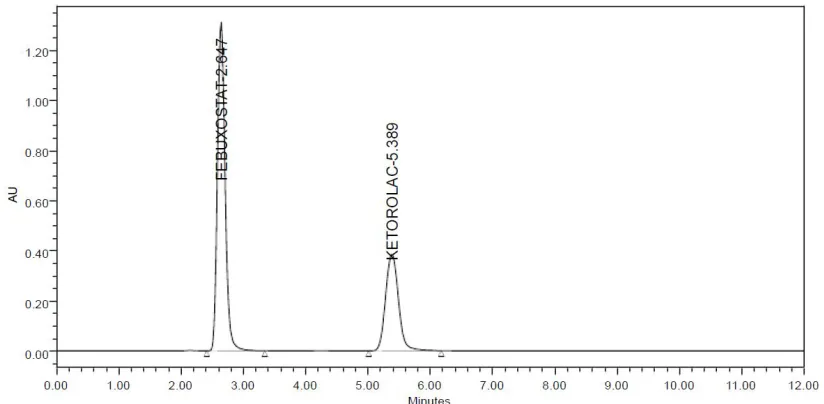
The retention time of Febuxostat and Ketorolac was 2.648 min and 5.389 min respectively. The number of theoretical plates calculated was 4286 for Febuxostat and 5408 for Ketorolac and tailing factor was 1.16 for Febuxostat and 1.11
for Ketorolac, which indicates efficient
performance of the column. The LOD for Febuxostat and Ketorolac were found to be 1.167 µg/mL and 0.646 µg/mL respectively. The LOQ for Febuxostat and Ketorolac were found to be 3.644 µg/mL and 2.018 µg/mL respectively, which indicate the sensitivity of the method. The summary of system suitability parameters and validation parameters were shown in Table 3 and Table 4. Validated method was applied for the determination of Febuxostat and Ketorolac in commercial formulations. The %assay was found to be 99.09% and 99.66% for Febuxostat and Ketorolac respectively and the assay results were shown in Table 5.
Typical chromatograms of standard and sample showing the separation of the drugs Febuxostat and Ketorolac was shown in Fig. 3 and Fig. 4. No
interfering peaks were found in the
chromatogram of the formulation within the run time indicating that excipients used in tablet formulations did not interfere with the estimation of the drug by the proposed HPLC method.
CONCLUSION
Fig. 1: Chemical structure of Febuxostat
Fig. 2: Chemical structure of Ketorolac
Fig. 4: Typical chromatogram of sample containing Febuxostat and Ketorolac
Table 1: Optimized HPLC conditions
Parameter Condition
Mobile phase Phosphate buffer: acetonitrile, 50:50 V/V
pH 6.8
Diluent Mobile phase
Column C18 (150 mm x 4.6 mm, 5 )
Column temperature 30◦C
Wave length 299 nm
Injection volume 20 L
Flow rate 0.7 mL/min
Run time 12 min
Table 2: Linear regression data
Concentration
of Febuxostat (µg/mL) Mean peak area of Febuxostat
Concentration of Ketorolac (µg/mL)
Mean peak area of Ketorolac
10 2870216 3.75 1408716
20 5658391 7.5 2792346
30 8422083 11.25 4169720
40 11097429 15 5521892
50 13833637 18.75 6908816
60 16676268 22.5 8379597
Table 3: System suitability parameters
Parameter Febuxostat Ketorolac
Retention time (tR) 2.648 min 5.389 min
Theoretical plates (N) 4286 5408
Tailing factor (T) 1.16 1.11
Resolution (Rs) 0.00 9.19
Table 4: Validation parameters
Parameter Febuxostat Ketorolac
Linearity range 10 to 60 µg/mL 3.75 to 22.5 µg/mL
Correlation coefficient 0.999 1
Limit of detection (LOD) 1.167 µg/mL 0.646 µg/mL
Limit of quantification (LOQ) 3.644 µg/mL 2.018 µg/mL
Recovery 100.62% 100.67%
Intra-day precision (%RSD) 0.12 0.04
Table 5: Assay results
Formulation Label claim Amount found %Assay Febuxostat Ketorolac Febuxostat Ketorolac Febuxostat Ketorolac
Formulation 1 40 mg 15 mg 39.63 mg 14.94 mg 99.09 99.66
REFERENCES
1. Horiuchi H, Ota M and Kobayashi M. A
comparative study on the hypouricemic activity and potency in renal xanthine calculus formation of two xanthine
oxidase/xanthine dehydrogenase
inhibitors: TEI-6720 and allopurinol in
rats. Res Commun Mol Pathol
Pharmacol. 1999;104:307-319.
2. Bisht M and Bist SS. Febuxostat: a novel
agent for management of
hyperuricemia in gout. Ind J Pharm Sci. 2011;73(6):597-600.
3. Takano Y, Hase-Aoki K, Horiuchi H,
Zhao L, Kasahara Y, Kondo S and Becker MA. Selectivity of Febuxostat, a novel
non-purine inhibitor of xanthine
oxidase/xanthine dehydrogenase. Life Sci. 2005;76:1835-1847.
4. Handley DA, Carvoni P, McCray JE and
McCullough JR. Preclinical
enantioselective pharmacology of (R)- and (S)- Ketorolac. J Clin Pharmacol. 1998;38:25-35.
5. Burd RS and Lobias JD. Ketorolac for
pain management after abdominal surgical procedures in infants. South Med J. 2002;95:331-333.
6. Lynn AM, Bradford H and Kantor ED.
Ketorolac tromethamine:
stereo-specific pharmacokinetics and single-dose use in postoperative infants aged 2-6 months. Pediatr Anesth. 2011;21: 325-334.
7. The Merck Index, 14th edition, Merck
and Co. 2006; Monographs, 491, 4781.
8. Kumara Swamy G, Kumar JMR and
Seshagiri Rao JVLN. Simultaneous estimation of Febuxostat and Ketorolac in pharmaceutical formulations by spectroscopic method. Int J Chem Tech Res. 2012;4(2):847-850.
9. Kumara Swamy G, Kumar JMR,
Bhikshapathi DVRN, Venkatesh G and Spandana R. A validated RP-HPLC method for simultaneous estimation of
Febuxostat and Ketorolac
tromethamine in pharmaceutical
formulations. J Drug Del Ther. 2012; 2(3):173-176.
10. ICH Harmonised Tripartite Guideline,
Q2(R1), Validation of Analytical
Procedures: Text and Methodology.
International Conference on