INTERNATIONAL JOURNAL OF PHARMACEUTICAL, CHEMICAL AND BIOLOGICAL SCIENCES
Available online at www.ijpcbs.com
SYNTHESIS AND CHARACTERIZATION OF SUBSTITUTED
1,3,4 THIADIAZOLE AS POTENTIAL ANTIMICROBIAL AGENTS
Manimaran T
1*, Anand Raj M
2, Jishala MI
2,
Gopalasatheeskumar K
1, Parthiban S
1and Boopathi T
11
KMCH college of Pharmacy, Kovai Estate , Kalapatti Road,
Coimbatore-641 048, Tamil Nadu, India.
2
JKK Nataraja College of Pharmacy, Komarapalayam,
Namakkal-638 183. Tamil Nadu, India.
1. INTRODUCTION
Because of the diversity in synthetic procedures, physiological and industrial significance, hetero cyclic chemistry has been and continues to be one of the most active areas of organic chemistry. As a result numerous heterocyclic compounds such as thiazoles, thiadiazoles, indoles, oxadiazoles, benzisoxazoles and pyrroles have been successfully used as antibacterial, anticancer, antipyretic, schistosomicidal, hypoglycemic, antihypertensive, antitubercular, anti-inflammatory and anti-HIV4 agents. In addition, they have also been used in agriculture, plastics, polymers, dyes and textiles. Hence heterocyclic chemistry still continues to draw the attention of synthetic organic chemists and is of great scientific interest. All large number of organo -
sulfur compounds occur in living and non-living object. They belong to open chain, alicyclic, aromatic and heterocyclic types of compounds containing sulfur atoms or atoms as a part of chain/ring or both in the structure. Isolation, identification and applications of these organo – sulfur compounds lead to the fact that some of the compounds are useful in scientific, technical and industrial growth. During the last three decades organo-sulfur chemistry developed at a much faster pace than any other branches of organic chemistry.1,2 The role of organic sulphides in rubber vulcanization, hair curling, muscle contraction, natural aromas, vitamins, hormones, antibiotics, radio-protective agents, dye stuffs, binding materials organic semiconducting materials and organic light emitting diodes etc. may be cited.
Research Article
ABSTRACT
Background: Heterocyclic chemistry continues to draw the attention of synthetic organic chemists and is of great scientific interest. Objective: The present study was undertaken to assess the synthesis and characterization of substituted 1,3,4 thiadiazole as potential antimicrobial agents. Materials and Methods: synthesis of three (TDZ1, TDZ2, TDZ3) substituted hetero cyclic compounds and the study its Physio-chemical properties and structural interpretation by IR spectroscopy and NMR spectrum. And in vitro antifungal and antibacterial activities performed by nutrient agar medium. Results: All the compounds were screened for antibacterial activity. However the compounds TDZ 1 and TDZ 2 have shown promising antibacterial activity, while the remaining compound such as TDZ 3 have also shown moderate antibacterial activity, when compared with the standard drug Ciprofloxacin. Compounds TDZ 1 and TDZ 2 have shown promising antifungal activity, while the remaining compound such as TDZ 3 have also shown moderate antifungal activity, when compared with the standard drug Griseofulvin. Conclusion: In this work is concluded that there exists ample scope for the medicinal chemists to further study in this class of compounds and used for the treatment of various types of deadly microbial infections.
Among the sulfur containing heterocyclic compounds, lot of research in the field of 1,3,4-thiadiazoles and imidazo [2,1-b][1,3,4] thiadiazoles has been reported. Some salient features regarding structure, chemical reactivity, spectral studies, synthetic pathways and biological interest of 1,3,4-thiadiazole and condensed imidazo [2,1-b][1,3,4] thiadiazole are discussed briefly as background information.3,4
2. MATERIALS AND METHODS 2.1. Analytical Techniques 2.1.1. Physical data
Melting points of the synthesized compounds were determined using Microcontroller based melting point apparatus CL 725/726 were found corrected.
2.1.2. Thin Layer Chromatography (TLC)
Purity of the compounds was checked by thin layer chromatography using alumina as stationary phase and various combinations solvent, as mobile phase. The spots resolved were visualized by using UV chamber and iodine chamber5,8.
2.1.3 Instrumentation
The techniques employed for the characterization of the synthesized compounds were IR spectra (Fourier transform IR spectrometer model Shimadzu using KBr pellets, Bangalore), Mass spectra (GC-MS spectrophotometer, University Science Instruments Centre, Karnataka University, Dharawad).6,7
2.2. Chemicals and Reagents
Diethyl ether, Dimethyl sulphoxide, N,N-dimethyl formamide, 1,4-dioxon, Ethyl acetate, Thiosemicarbazide. The chemicals and reagents used in the present project were of LR grade, purchased from S.D. Fine Chem. Ltd., Mumbai, India.
2.2.1. 4-Hydroxyphenyl-1-(4-pyridine carboxyamido)-thiosemicarbazide (INTC 1)
Isoniazid 2.74g (0.02 mol) and 4-hydroxyphenyl isothiocyanates 2.35g (0.02 mol) was dissolved in 15 ml of ethanol. The resulting mixture was refluxed on a boiling water bath for 6 hr with occasional stirring. The reaction completion was monitored by TLC and the reaction mixture was concentrated and kept overnight at room temperature.9,10 The needle shaped crystals of substituted thiosemicarbazides obtained was filtered & dried. Recrystallized from methanol. The yield is 2.38 g, m.p was found to be 142-145.
2.2.2. 4-aminoyphenyl-1-(4-pyridine carboxy amido)-thiosemicarbazide (INTC 2)
Isoniazid 2.74g (0.02 mol) and 4-aminophenyl isothiocyanates 2.35g (0.02 mol) was dissolved in 15 ml of ethanol. The resulting mixture was refluxed on a boiling water bath for 6 hr with occasional stirring. The reaction completion was monitored by TLC and the reaction mixture was concentrated and kept overnight at room temperature. The needle shaped crystals of substituted thiosemicarbazides obtained was filtered & dried. Recrystallized from methanol. The yield is 2.38 g, m.p was found to be 157-159.
2.2.3. 4-Bromophenyl-1-(4-pyridinecarboxy amido)-thiosemicarbazide (INTC 3)
Isoniazid 2.74g (0.02 mol) and 4-bromophenyl isothiocyanates 2.35g (0.02 mol) was dissolved in 15 ml of ethanol. The resulting mixture was refluxed on a boiling water bath for 6 hr with occasional stirring. The reaction completion was monitored by TLC and the reaction mixture was concentrated and kept overnight at room temperature.11,12 The needle shaped crystals of substituted thiosemicarbazides obtained was filtered & dried and Recrystallized from methanol. The yield is 2.38 g, m.p was found to be 134-136.
2.2.4. Synthesis of (5-(pyridin-yl)-1, 3, 4-thiadiazol-2-ylamino) phenol (TDZ 1)
4-hydroxyphenyl thiosemicarbazides (INTC 1) 2.10 g (0. 02 mol) was added with sulphuric acid slowly and the mixture was cooled at 0-5oC. The reaction mixture was powered in to ice cold water, filtered and washed with water and recrystallized from methanol. The yield is 1.83 g, m.p was found to be 116-118.
2.2.5. Synthesis of N-(5-(pyridin-yl)-1, 3, 4-thiadiazol-2-yl) benzene-1, 4-diamine (TDZ 2)
4-aminophenyl thiosemicarbazides (INTC 2) 2.10 g (0. 02 mol) was added with sulphuric acid slowly and the mixture was cooled at 0-5oC. The reaction mixture was powered in to ice cold water, filtered and washed with water and recrystallized from methanol. The yield is 1.65 g, m.p was found to be 125-128.
2.2.6. Synthesis of N-(4-bromophenyl)-5-(pyridin-4-yl)-1, 3, 4-thiadiazol-2-amine (TDZ 3)
recrystallized from methanol. The yield is 1.48 g, m.p was found to be 112-115.
2.3. BIOLOGICAL ACTIVITY
The inhibition of microbial growth under standardized conditions may be utilized for demonstrating the therapeutic efficacy of antibiotics. Any subtle change in the antibiotics molecule which may not be detected by chemical methods will be revealed by a change in the antimicrobial activity and hence microbiological assays are very useful for resolving doubts regarding possible change in potency of drugs and their preparation. The microbiological assay is based upon a comparison of the inhibition of growth of microorganisms by measured concentrations of the antibiotics to be examined with that produced by known concentrations of a standard preparation of the antibiotic having a known activity. (13)
The cylinder-plate method depends upon diffusion of the antibiotic from a vertical cylinder through a solidified agar layer in a Petri dish or plate to an extent such that growth of the added micro-organisms is prevented entirely in a zone around the cylinder containing a solution of the antibiotic. The newly synthesized compounds were tested in vitro for their antibacterial activity against four microorganisms viz., Staphylococci for gram + ve and E. coli, Entireo cocci for gram – ve and at 100, 200 and 300 μg/ml concentration using Ciprofloxin as reference standard and antifungal activity against two microorganisms Penicillium and A. niger at 100, 200 and 300 μg/ml concentration, using control as reference.
2.3.1. MATERIALS USED
Nutrient Agar.
18 - 24 hr growth culture in nutrient agar.
Sterile test tubes. Sterile micropipettes. Sterile cotton swabs. Sterile inoculating needle. Sterile glass rod.
2.3.2. Culture
The media required for the preparation of test organism inoculation are made from the ingredients like agar, peptone, yeast extract, beef extract, dextrose and pancreatic digest of casein i.e., nutrient agar medium, etc. For antibacterial activity and use sabouraud dextrose agar for antifungal activity. (14) Where agar is specified in a formula, use agar that has a moisture content of not more than 15%. Purified water is used. Unless otherwise indicated, the
media should be sterilized by heating in an autoclave at 115 °C for 30 min. Dissolve the soluble solids in the water, using heat if necessary, to effect complete solution and add solutions of hydrochloric acid or sodium hydroxide in quantities sufficient to yield the required pH in the medium when it is ready for use.
2.3.3. Nutrient broth
For the preparation of nutrient agar broth for bacteria 5 g of nutrient agar is dissolved in the 100 ml of distilled water and adjust the pH at 7.2±0.2. Pour in test tubes as per requirement and then sterilized by autoclave at 121 °C, 15 lb pressure. For antifungal activity: 3 g Sabouraud dextrose in 100 ml of distilled water.
2.3.4. Preparation of test solution
Each test compound (5 mg) was dissolved in dimethyl sulphoxide (5 ml) to give stock solution of concentration 1000 μg/ml. Then 0.10, 0.20 and 0.30 ml of this solution were used for testing.
2.3.5. Preparation of standard solution
Standard drug, Ciprofloxin was used at the concentration of 100 µg/ml for antibacterial activity.
2.3.6. Protocol for antibacterial activity
The sterilized (autoclaved at 120 °C for 30 min) nutrient agar medium (40-50 °C) was inoculated (1 to 100 ml) with the suspension of microorganisms and mixture was transferred to sterile petri dishes and allowed to solidify.(16) Specified concentration solution of synthesized compounds and standard were placed on surface of the agar plates. DMSO was used as control. The plates were left for 1 hr at room temperature as period of pre incubation diffusion to minimize effects of variations in time between applications of different solutions. The plates were incubated at 37±2 °C for 18 hr and observed for antibacterial activity. The diameters of zone of inhibition were measured and compared with that of standard, the values were tabulated.
2.3.7. Protocol for antifungal activity
of pre incubation diffusion to minimize effects of variations in time between applications of different solutions. The plates were incubated at 37±2°C for 18 hr and observed for antibacterial activity. The diameters of zone of inhibition were measured and compared with that of standard, the values were tabulated.
3. RESULTS AND DISCUSSION
The synthesized compounds were subjected to various antibacterial and antifungal activities by the standard methods. All the compounds were screened for antibacterial activity. However
the compounds TDZ1 and TDZ2 have shown promising antibacterial activity, while the remaining compound such as TDZ 3 have also shown moderate antibacterial activity, when compared with the standard drug Ciprofloxacin. All the compounds were also screened for antifungal activity. However compounds TDZ 1 and TDZ 2 have shown promising antifungal activity, while the remaining compound such as TDZ 3 have also shown moderate antifungal activity, when compared with the standard drug Griseofulvin.
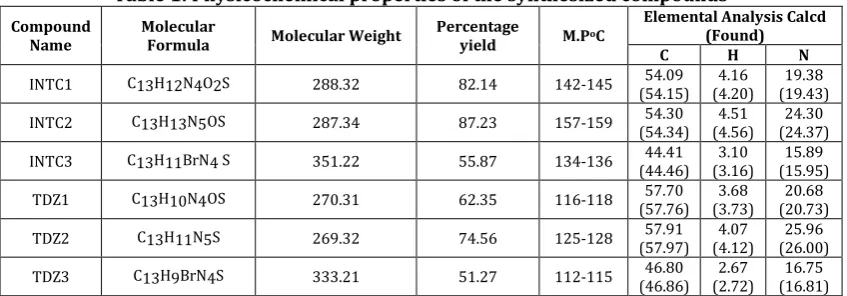
Table 1: Physicochemical properties of the synthesized compounds Compound
Name Molecular Formula Molecular Weight Percentage yield M.PoC
Elemental Analysis Calcd (Found)
C H N
INTC1 C13H12N4O2S 288.32 82.14 142-145 (54.15) 54.09 (4.20) 4.16 (19.43) 19.38
INTC2 C13H13N5OS 287.34 87.23 157-159 (54.34) 54.30 (4.56) 4.51 (24.37) 24.30
INTC3 C13H11BrN4 S 351.22 55.87 134-136 (44.46) 44.41 (3.16) 3.10 (15.95) 15.89
TDZ1 C13H10N4OS 270.31 62.35 116-118 (57.76) 57.70 (3.73) 3.68 (20.73) 20.68
TDZ2 C13H11N5S 269.32 74.56 125-128 (57.97) 57.91 (4.12) 4.07 (26.00) 25.96
TDZ3 C13H9BrN4S 333.21 51.27 112-115 (46.86) 46.80 (2.72) 2.67 (16.81) 16.75
Table 2: Interpretation of IR and NMR spectral values
S. No Compound Name IR Spectra values cm-1 1HNMR Spectra values (ppm)
1 INTC 1 CH-str; 1715 C=O-str; 1300, C-N str; 625, C-S 3521, OH-str; 3327 NH-str, broad; 3086 Ar-str;
9.06 2H, Ar-CH; 8.13 1H, NH; 7.96 2H, Ar-CH; 6.48 2H, Ar-CH; 6.29 2H, Ar-CH; 4.42 1H, NH;
2.23 1H, NH; 5.07 1H, OH.
2 INTC 2 3455, NH2 str; 3335, NH-str; 3086, Ar-CH-str; 1715, C=O-str; 1300, C- N str; 625, C=S-str.
9.12 2H, Ar-CH; 8.09 1H, NH; 7.96 2H, Ar-CH; 6.21 4H, Ar-CH; 4.24 1H, NH; 2.56 1H, NH;
4.06 2H, NH2.
3 INTC 3 3288, NH-str; 3086, Ar-CH-str; 1710, C=O-str; 1300, C-Nstr; 651, C=S-str. 7.18 2H, Ar-CH; 6.35 2H, Ar-CH; 4.32 1H, NH; 9.20 2H, Ar-CH; 8.26 1H, NH; 7.96 2H, Ar-CH; 2.30 1H, NH.
4 TDZ 1 3530, OH-str1300, C-N str; 625, C=S-str. ; 3327, NH-str; 3086, Ar-CH-str;
8.56 2H, Ar-CH-str; 7.60 2H, Ar-CH- str; 6.48 2H, Ar-CH-str; 6.29 2H, Ar- CH-str; 5.07 1H,
OH; 4.12 1H, NH. m/e : 270.31.
5 TDZ 2 3485, NH2- str; 3385, NH-str; 3086, Ar-CH-str; 1300, C-Nstr; 729, C=S- str.
8.61 2H, Ar-CH-str; 7.63 2H, Ar-CH- str; 6.21 4H, Ar-CH-str; 5.07 1H, OH; 4.12 1H, NH;
4.06 2H, NH2. m/e : 269.36.
6 TDZ 3 3251, NH-str; 3086, Ar-CH-str; 1300, C-Nstr; 651, C=S-str. 8.65 2H, Ar-CH-str; 7.60 2H, Ar-CH- str; 7.18 2H, Ar-CH-str; 6.35 2H, Ar- CH-str; 4.15 1H, NH. m/e: 330.21.
Table 3: Antibacterial activity of substituted thiadiazole derivatives against Gram positive bacteria ((TDZ 1-3))
S. No Name of the compounds
Mean zone of inhibition (in mm) Staphylococcus aureus 100 µg 200 µg 300 µg
1 Ciprofloxacin 9 11 12
2 TDZ-1 4 5 6
3 TDZ-2 2 4 5
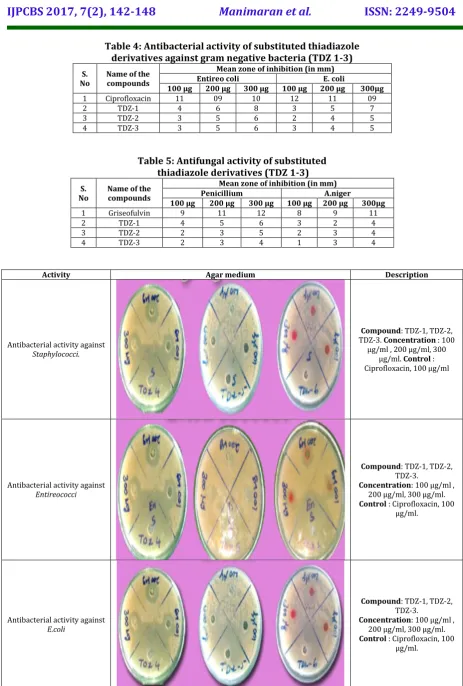
Table 4: Antibacterial activity of substituted thiadiazole derivatives against gram negative bacteria (TDZ 1-3) S.
No Name of the compounds
Mean zone of inhibition (in mm)
Entireo coli E. coli
100 µg 200 µg 300 µg 100 µg 200 µg 300µg
1 Ciprofloxacin 11 09 10 12 11 09
2 TDZ-1 4 6 8 3 5 7
3 TDZ-2 3 5 6 2 4 5
4 TDZ-3 3 5 6 3 4 5
Table 5: Antifungal activity of substituted thiadiazole derivatives (TDZ 1-3) S.
No Name of the compounds
Mean zone of inhibition (in mm)
Penicillium A.niger
100 µg 200 µg 300 µg 100 µg 200 µg 300µg
1 Griseofulvin 9 11 12 8 9 11
2 TDZ-1 4 5 6 3 2 4
3 TDZ-2 2 3 5 2 3 4
4 TDZ-3 2 3 4 1 3 4
Activity Agar medium Description
Antibacterial activity against
Staphylococci.
Compound: TDZ-1, TDZ-2, TDZ-3. Concentration : 100
μg/ml , 200 μg/ml, 300 μg/ml. Control : Ciprofloxacin, 100 μg/ml
Antibacterial activity against
Entireococci
Compound: TDZ-1, TDZ-2, TDZ-3.
Concentration: 100 μg/ml , 200 μg/ml, 300 μg/ml. Control : Ciprofloxacin, 100
μg/ml.
Antibacterial activity against
E.coli
Compound: TDZ-1, TDZ-2, TDZ-3.
Concentration: 100 μg/ml , 200 μg/ml, 300 μg/ml. Control : Ciprofloxacin, 100
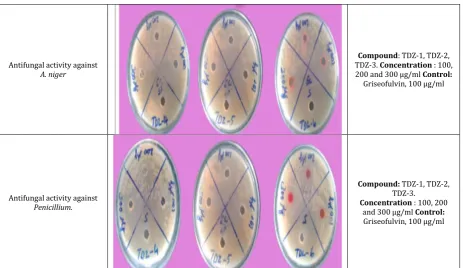
Antifungal activity against
A. niger
Compound: TDZ-1, TDZ-2, TDZ-3. Concentration : 100, 200 and 300 μg/ml Control:
Griseofulvin, 100 μg/ml
Antifungal activity against
Penicillium.
Compound: TDZ-1, TDZ-2, TDZ-3.
Concentration : 100, 200 and 300 μg/ml Control: Griseofulvin, 100 μg/ml
Fig. 1-5: Antibacterial activity of synthesized thiadiazole derivatives
4. CONCLUSION
There are millions of patients worldwide who are sufferings from microbial infections and most of them die because of this so there must an antimicrobial therapy to effectively control such fatal infections. In this connection, a series of novel 1, 3, 4-thiadiazole derivatives were synthesized and the structures of the entire compounds were confirmed by recording by their IR, 1H NMR and Mass spectra. In conclusion, we feel that the preliminary in vitro activity results of this class of compounds may possess potential for design of future molecules with modifications on the aryl substituent’s as well as pyridine moiety. All the synthesized compounds showed moderate activity against bacteria and fungi. In particular, the compound TDZ1 and TDZ 2 showed good anti-bacterial as well as antifungal activities, while other compound such as TDZ 3 shows moderate activity. Therefore, the detailed literature survey and screening studies have demonstrated that the newly synthesized compounds exhibit promising antibacterial and antifungal properties. Hence, it is concluded that there exists ample scope for the medicinal chemists to further study in this class of compounds and used for the treatment of various types of deadly microbial infections.
5. REFFERENCES
1. Khosrow Zamania. Sythesis of some new 2,5- disubstituted 1,3,4- thiadiazole containing isomeric pyridyl as potent
antimicrobial agents. Pol j pharmacol. 2003;55:1111-1157.
2. Mohd Amir. synthesis pharamaceutically important 1,3,4thiadiazole and imidazolione derivatives as antimicrobials. Indian Journal of chemistry. 2009;48:1288-1293.
3. OtiliaPintilie. Synthesis and Antimicrobial Activity of Some New Moiety1,3,4- Thiadiazole and 1,2,4-Triazole Compounds Having a D,L-Methionine. Molecule. 2007;12:103-113.
4. Parmar Kokila. A Simple and Efficient Procedure for Synthesis of Biologically Active 1,2,4- Triazolo-[3,4-b]-1,3,4-thiadiazole -2-aryl-thiazolidine-4-one Derivatives, Research Journal of chemical sciences. 2011;1:18-26. 5. Bijo Mathew. Synthesis, molecular
properties and anthelmintic activity of some Schiff bases of 1, 3, 4thiadiazole derivatives. Der pharmachemica. 2010; 2(5):337-343.
6. Varandas LS. Design, Synthesis and Pharmacological Evaluation of New Nonsteroidal Antiinflammatory 1,3,4-Thiadiazole Derivatives, Letters in drug design and discovery.2005;62-67. 7. Silvia Schenone.
Agents. bioorganic and medicinal chemistry. 2001;2149-2153.
8. Mohammad Amir. Synthesis and evaluation of anti-inflammatory, analgesic, ulcerogenic and lipid peroxidation properties of ibuprofen derivatives, Acta pharm. 2007;31-45.
9. Zhuo Chen. Synthesis and Antiviral Activity of 5-(4-Chlorophenyl)-1,3,4- Thiadiazole Sulfonamides. Molecules. 2010;9046-9056.
10. Fredrick. G. Oral LY217896 for Prevention of Experimental Influenza A Virus Infection and Illness in Humans, Antimicrobial agents and chemotherapy. 1994;1178-1181.
11. Michael Jones. synthesis and characterization of thiadiazole and their anti-viral activity, journal of medicinal chemistry. 2009;6588-6598.
12. Letterio Bonina. Structure-Activity Relationships of New Antiviral Compounds,Antimicrobial agents and chemotyerapy. 1982;22:1067-1069. 13. EF da Silva, MM Canto-Cavalheiro, VR
Braz, LCysne-Finkelstein, LL Leon and A
Echevarria. European Journal Medicinal Chemistry. 2002;37:979.
14. Firas Abdullah Hassan. Synthesis and biological evaluation of 1, 3, 4-thiadiazole derivative on some parameters of immunity and liver enzymes. Int J Res in pharmacy and chemistry. 2012;2(1):58-60.
15. Ravindra KC, Vagdevi HM, Vaidya VP and Padmashali B. Synthesis, antimicrobial and anti-inflammatory activities of 1,3,4-oxadiazoles linked to naptho [2,1-b] furan. Indian J Chem. 2006;45B:2506-2511.