R E S E A R C H
Open Access
Complex modified generalized projective
synchronization of fractional-order complex
chaos and real chaos
Jian Liu
1*, Shutang Liu
2and Wei Li
3*Correspondence: [email protected]
1School of Mathematical Sciences, University of Ji’nan, Ji’nan, Shandong 250022, P.R. China Full list of author information is available at the end of the article
Abstract
This paper introduces a type of modified generalized projective synchronization with complex transformation matrix (CMGPS) for fractional-order complex chaos and real chaos with the same dimension and different structures. The transformation matrix in this type of chaos synchronization is a non-diagonal square matrix, and its elements are complex numbers. Based on the stability theory of fractional-order systems, necessary and sufficient criteria are established to guarantee CMGPS for the fractional-order complex chaos and fractional-order real chaos, and for two fractional-order complex chaotic systems, respectively. Numerical examples are provided to illustrate the feasibility and effectiveness of our theoretical results.
PACS Codes: 05.45.Gg; 05.45.Xt; 05.45.Pq
Keywords: fractional-order chaos; chaos with complex variable; modified generalized projective synchronization
1 Introduction
In the last thirty years, with the development of interdisciplinary applications, it was found that many systems in interdisciplinary fields can be elegantly described with the help of fractional derivatives, for instance, viscoelastic systems [], dielectric polarization [], quantitative finance [], quantum evolution of complex systems [], and so forth. Due to the above wide scope of applications, many researchers devoted much effort to chaotic behaviors, chaotic control, and synchronization of fractional-order dynamical systems in a real space. For example, Hartleyet al.introduced the fractional-order continuous Chua-Hartley’s system [], Arenaet al.considered the fractional-order cellular neural network [], Gao and Yu presented the fractional continuous Duffing’s systems [], Wuet al. ad-dressed discrete chaos and synchronization of the fractional logistic, sine and standard maps recently [–]. The projective synchronization (PS) [] has been especially exten-sively studied because it can be used to obtain faster communication with its proportional feature, and the unpredictability of the scaling factor can additionally enhance the security of communication. In [], Wu and Lu presented a modified projective synchronization (MPS) method for fractional-order Chen hyperchaotic systems, which associates with the projective synchronization and the generalized one, where the drive and response systems could be synchronized up to scaling factorsδi. Liuet al.[] introduced modified
ized projective synchronization (MGPS) of fractional-order chaotic systems with different structure, where the drive and response systems could be asymptotically synchronized up to a desired non-diagonal transformation matrix.
In , several research results were proposed about the dynamic properties and syn-chronization of fractional-order chaotic systems in a complex space. The fractional-order complex Lorenz system was proposed and dynamics of the system was investigated in detail []. Luo and Wang introduced the fractional-order complex Chen system and its application to digital secure communication, the complex variables (doubling the number of variables) increase the content of transmitting information signals and enhance their security further [].
However, all the scaling factors in the above synchronization are real numbers. That is to say, the drive and response systems evolve in the same or inverse direction simul-taneously. In fact, for complex dynamical systems, the scaling factors can be complex [–], the drive and response systems may evolve in different directions with a con-stant intersection angle, for example,ζ =ρejγη, whereρejγ =ρ(cosγ +jsinγ),ζ andη denote the complex state variables of drive and response systems, respectively,ρ> de-notes the zoom rate,γ ∈[, π) denotes the rotate angle. Moreover, as the complex scal-ing factors are arbitrary and more unpredictable than real scalscal-ing factors and the oper-ations of complex numbers are complicated, the possibility that an interceptor extracts the information from the transmitted signal is greatly less than real scaling factors, which will also increase security and variety of communications. However, complex synchro-nization of fractional-order complex chaos and fractional-order real chaos is less. Only in [], Liu introduced modified hybrid projective synchronization with complex trans-formation matrix (CMHPS) for different dimensional fractional-order complex chaos and fractional-order real hyper-chaos. Naturally, a question may be put forth: Does there exist another kind of complex synchronization, where the same dimensional fractional-order complex chaos and real chaos could be synchronized up to a non-diagonal complex trans-formation matrix=r+ji? In the practical applications, there does exist this type of synchronization, called modified generalized projective synchronization with complex transformation matrix (CMGPS). By means of the complex state transformation matrix, every state variable in the response system will be involved in multiple state variables of the drive system, which will increase the complexity of the synchronization and further increase the diversity and the security of communications. Therefore, it is interesting and significant to study CMGPS of two fractional-order complex chaotic systems and that of fractional-order complex chaos and real chaos. However, to the best of our knowledge, this type of CMGPS for fractional-order chaotic systems has rarely been reported.
Motivated by the above discussion, CMGPS is addressed for fractional-order complex chaos and real chaos with the same dimension and different structures based on the sta-bility theory of fractional-order systems. In addition, CMGPS will contain MPS with real constant scaling matrix and MGPS with real transformation matrix and extend previous works.
systems are presented in Section , Section and Section , respectively. Three numerical examples are provided in Section . Finally, some conclusions are drawn in Section .
Notations Rnstands forn-dimensional real vector space,Cnstands forn-dimensional complex vector space. Ifz∈Cnis a complex vector, thenz=zr+jzi,j=√– is the imag-inary unit, superscriptsrandistand for the real and imaginary parts ofz, respectively,
zTare the transpose ofz, respectively, andzimplies the -norm ofz. Ifzis a complex scalar,¯zis the conjugate ofz.
Assumeα> , thenαis just the valueαrounded up to the nearest integer,Jαdenotes Riemann-Liouville type fractional integral of orderα,Dαdenotes Riemann-Liouville type fractional derivative of orderα,Dα
∗denotes Caputo type fractional derivative of orderα, (·) denotes the gamma function(x) =∞tx–e–tdt,x> .
2 Preliminaries
2.1 The definition of fractional derivative
There are many definitions of fractional derivative []. The definition of the Riemann-Liouville derivative is given as
Dαf(t) = d m
dtmJ
m–αf(t), ()
whereα> ,m:=α,Jβis theβ-order Riemann-Liouville integral operator as described by
Jβf(t) = (β)
t
f(τ)
(t–τ)–βdτ, ()
where <β≤.
The Caputo fractional derivative is defined as
Dα ∗f(t) =
dm
dtmJ
m–αf(t) =
(m–q)
t
f(m)(τ)
(t–τ)(q–m+)dτ, m– <q<m, dm
dtmf(t), q=m,
()
whereα> ,m:=α.
Generally speaking, there are two numerical methods suitable for chaos synchronization of fractional differential systems. One is the frequency-domain method [], another is the time-domain method. Here, the Caputo version and an improved predictor-corrector algorithm, i.e., the Adams-Bashforth-Moulton predictor-correctors scheme are chosen for fractional differential equations, where the numerical approximation is a time-domain approach that is more accurate, and the computational cost is greatly reduced [, ].
2.2 Numerical algorithms
The fractional predictor-corrector algorithm [] is based on the analytical property of the following fractional differential equation:
Dα
∗x(t) =f(t,x(t)), ≤t≤T, x(k)() =x(k)
, k= , , . . . ,m– (m=α),
which is equivalent to the Volterra integral equation
where the predicted valuexθ
h(tn+) is determined by
The estimation error in this method is
ε=maxx(tj) –xh(tj)=O
hθ (j= , , . . . ,N), ()
whereθ=min(, +α).
2.3 The stability of fractional-order systems
For a given fractional-order linear time-invariant system
Dα∗x=Mx ()
withx() =x, where <α< andx∈Rn,Mis a constant matrix.
Lemma ([]) System()is
(i) asymptotically stable if and only if
argλ(M)>απ
(= , , . . . ,n), ()
(ii) stable if and only if
argλ(M)≥απ
(= , , . . . ,n), ()
and those critical eigenvaluesλithat satisfy|arg(λ(M))|=απ/(= , , . . . ,n),
have geometric multiplicity one.
Fractional-order differential equations are at least as stable as their integer order coun-terpart because systems with memory are typically more stable than those without mem-ory [].
3 CMGPS scheme of fractional-order chaotic real drive system and complex response system
3.1 Mathematical model and problem descriptions
First, a class ofn-dimensional fractional-order chaotic real drive systems is considered as
Dα
∗x=Mx+h(x), ()
wherex= (x,x, . . . ,xn)T∈Rnis a real state vector,M∈Rn×nis the coefficient matrix ofx, whileh= (h,h, . . . ,hn)Tis a vector of complex nonlinear function.
The fractional-order complex chaotic response system with the controller is written as
Dα
∗w=Dα∗wr+jDα∗wi=Bw+g(w) +v, ()
where w=wr+jwi∈ Cn and wr = (wr
,wr, . . . ,wnr)T∈Rn, wi = (wi,wi, . . . ,win)T∈Rn,
B∈Rn×nis the coefficient matrix ofw, whileg= (g
,g, . . . ,gn)T is a vector of complex nonlinear function,v=vr+jvi∈Cnis the controller to be designed.
Next the definition of CMGPS with complex transformation matrix is introduced for the fractional-order real chaotic drive system and the complex chaotic response system based on that of MGPS with real transformation matrix for two fractional-order real chaotic systems [].
Definition For the fractional-order real chaotic drive system () and the complex chaotic response system (), it is said to be CMGPS with complex constant matrix =r+jibetweenx(t) andw(t) if there exists a controllerv=vr+jvi∈Cnsuch that
lim
t→+∞ w(t) –x(t) = , ()
i.e.,
lim
t→+∞ w
r(t) –rx(t) = ,
and
lim
t→+∞ w
i(t) –ix(t) = ,
If the error of CMGPS is defined as
e(t) =er(t) +jei(t) =w(t) –x(t), ()
then
er(t) =wr(t) –rx(t),
ei(t) =wi(t) –ix(t), ()
the objective of this section is to design a controllervto ensure that synchronization error tends to zero asymptotically,i.e.,
lim
t→+∞ e
r(t) = ,
and
lim
t→+∞ e
i(t) = .
Remark Most of the classical fractional-order real chaotic systems can be formed as
system (), such as fractional-order real Chua-Hartley’s system [], fractional-order real chaotic Lorenz-like system [, –], and most of the classical fractional-order complex chaotic systems can be formed as system (), such as fractional-order complex Lorenz system [], fractional-order complex Chen system [].
Remark Several types of synchronization are special cases of CMGPS, such as
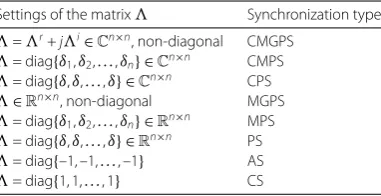
com-plex modified projective synchronization (CMPS), comcom-plex projective synchronization (CPS), modified generalized projective synchronization (MGPS), modified projective syn-chronization (MPS), projective synsyn-chronization (PS), anti-synsyn-chronization (AS), com-plete synchronization (CS); see Table .
Therefore, the CMGPS will contain most existing works and extend previous works.
Remark In particular, if the transformation matrixis zero, the CMGPS problem de-generates to the control problem of the fractional-order complex chaotic system ().
Table 1 Types of synchronization
Settings of the matrix Synchronization type
=r+ji∈Cn×n, non-diagonal CMGPS = diag{δ1,δ2,. . .,δn} ∈Cn×n CMPS = diag{δ,δ,. . .,δ} ∈Cn×n CPS ∈Rn×n, non-diagonal MGPS = diag{δ1,δ2,. . .,δn} ∈Rn×n MPS = diag{δ,δ,. . .,δ} ∈Rn×n PS = diag{–1, –1,. . ., –1} AS
3.2 General method of CMGPS
Theorem For the given complex transformation matrix=r+jiand initial condi-tions x(),w(),if the controller is designed as
v=vr+jvi= (M–B)x–g(w) +h(x) –Ke
=rM–Brx–gr(w) +rh(x) –K er
+jiM–Bix–gi(w) +i+h(x) –K ei, ()
then CMGPS between the fractional-order complex chaotic response system()and the real chaotic drive system()can be achieved with the desired complex transformation matrixasymptotically if and only if all the eigenvalues of B–K satisfy|arg(λ(B–K))|>
απ
(= , , . . . ,n),where K∈R
n×nis the control gain matrix.
Proof Equation () can be written as
e(t) =er(t) +jei(t) =wr(t) –rx(t)+jwi(t) –ix(t). ()
Substituting Eq. () and Eq. () into Eq. (), one can get the derivative of the error system
Dα∗e=Dα∗er+jDα∗ei
=Dα
∗wr(t) –rDα∗x(t)
+jDα
∗wi(t) –iDα∗x(t)
=Bwr+gr(w) –rMx+h(x)+vr
+jBwi+gi(w) –iMx+h(x)+vi. ()
Insertion of () into Eq. () and separation of the real and imaginary parts give
Dα
∗er= (B–K)er, Dα
∗ei= (B–K)ei.
()
Due to Lemma , the error system () is asymptotically stable if and only if all the eigenvalues ofB–Ksatisfy|arg(λ(B–K))|> απ
(= , , . . . ,n), whereK∈Rn×nis the control gain matrix. That is, limt→+∞er(t)= , and limt→+∞ei(t)= . Therefore,
limt→+∞e(t)= , CMGPS between the fractional-order systems () and () is
real-ized. This completes the proof.
4 CMGPS scheme of fractional-order chaotic complex drive system and real response system
4.1 Mathematical model and problem descriptions
Now, a class ofn-dimensional fractional-order complex chaotic drive systems is consid-ered as
Dα∗z=Dα∗zr+jDα∗zi=Az+f(z), ()
wherez=zr+jzi∈Cnandzr= (zr
The fractional-order real chaotic response system with the controller is written as
Dα∗y=Hy+p(y) +v, ()
wherey= (y,y, . . . ,yn)T∈Rnis a real state vector,H∈Rn×nis the coefficient matrix ofy, whilep= (p,p, . . . ,pn)Tis a vector of complex nonlinear function,v= (v,v, . . . ,vn)T∈ Rnis the controller to be designed.
Next the definition of CMGPS with complex transformation matrix is introduced for the fractional-order complex chaotic drive system and the real chaotic response system based on that of MGPS with real transformation matrix for two fractional-order real chaotic systems [].
Definition For the fractional-order complex chaotic drive system () and the real chaotic response system (), it is said to be CMGPS with constant matrix=r+ji betweenz(t) andy(t) if there exists a controllervsuch that
lim
t→+∞ y(t) –
rzr(t) +izi(t) = , ()
while the matrix∈Cn×nis defined as a complex transformation matrix of the fractional-order complex chaotic drive system ().
If the error of CMGPS is defined as
e(t) =y(t) –rzr(t) +izi(t), ()
the objective of this section is to design a controllervto ensure that synchronization error () tends to zero asymptotically,i.e.,
lim
t→+∞ e(t) = .
4.2 General method of CMGPS
Theorem For the given complex transformation matrix=r+jiand initial
condi-tions z(),y(),if the designed controller is
v=rA–Hrzr–iA–Hizi–p(y) +rfr(z) –ifi(z) –Ke, ()
then CMGPS between the fractional-order real chaotic response system()and the com-plex drive system()can be achieved with the desired complex transformation matrix
asymptotically if and only if all the eigenvalues of H–K satisfy|arg(λ(H–K))|> απ (= , , . . . ,n),where K∈Rn×nis the control gain matrix.
Proof Substituting Eq. () and Eq. () into Eq. (), one can get the derivative of the error system
Dα∗e=Dα∗y–rD∗αzr+iDα∗zi=Hy+p(y) +v–rAzr+fr(z)+iAzi+fi(z)
Insertion of Eq. () into Eq. () gives
Dα∗e= (H–K)e. ()
Due to Lemma , the error system () is asymptotically stable if and only if all the eigen-values ofH–Ksatisfy|arg(λ(H–K))|>απ
(= , , . . . ,n), whereK∈R
n×nis the control gain matrix. That is,limt→+∞e(t)= , the fractional-order real chaotic response sys-tem () and the complex chaotic drive syssys-tem () realize CMGPS . This completes the
proof.
5 CMGPS scheme of two fractional-order chaotic complex systems
5.1 Mathematical model and problem descriptions
Now, the definition of CMGPS with complex transformation matrix is introduced for two fractional-order complex chaotic systems based on that of MGPS with real transformation matrix for two fractional-order real chaotic systems [].
Definition For the fractional-order complex chaotic drive system () and the response system (), it is said to be CMGPS with complex matrix=r+jibetweenz(t) and
w(t) if there exists a controllerv=vr+jvi∈Cnsuch that
lim
t→+∞ w(t) –z(t) = , ()
i.e.,
lim
t→+∞ w
r(t) –rzr(t) +izi(t) = ,
and
lim
t→+∞ w
i(t) –rzi(t) –izr(t) = ,
while the matrix∈Cn×nis defined as a complex transformation matrix of the fractional-order complex chaotic drive system ().
If the error of CMGPS is defined as
e(t) =er(t) +jei(t) =w(t) –z(t), ()
then
er(t) =wr(t) –rzr(t) +izi(t),
ei(t) =wi(t) –rzi(t) –izr(t), ()
the objective of this section is to design a controllervto ensure that synchronization error tends to zero asymptotically,i.e.,
lim
t→+∞ e
and
lim
t→+∞ e
i(t) = .
5.2 General method of CMGPS
Theorem For the given complex transformation matrix=r+jiand initial
condi-tions z(),w(),if the controller is designed as
v=vr+jvi
= (A–B)z–g(w) +f(z) –Ke
=rA–Brzr–iA–Bizi–gr(w) +rfr(z) –ifi(z) –Ker
+jiA–Bizr+rA–Brzi–gi(w) +ifr(z) +rfi(z) –K ei, ()
then CMGPS between the fractional-order complex chaotic response system()and the drive system ()can be achieved with the desired complex transformation matrix
asymptotically if and only if all the eigenvalues of B–K satisfy |arg(λ(B–K))|> απ (= , , . . . ,n),where K∈Rn×nis the control gain matrix.
Proof It is similar to the proof in Theorem and thus is omitted.
Corollary If the structure of systems()and()is identical,i.e.,A=B,and f =g,and
the controller is designed as
v=vr+jvi= (A–A)z–f(w) +f(z) –Ke
=rA–Arzr–iA–Aizi–fr(w) +rfr(z) –ifi(z) –Ker
+jiA–Aizr+rA–Arzi–fi(w) +ifr(z) +rfi(z) –K ei, ()
then CMGPS between the fractional-order complex chaotic response system()and the drive system ()can be achieved with the desired complex transformation matrix
asymptotically if and only if all the eigenvalues of B–K satisfy |arg(λ(B–K))|> απ (= , , . . . ,n),where K∈Rn×nis the control gain matrix.
Remark In particular, if the transformation matrix=diag{, , . . . , }, then CMGPS in Corollary is reduced to complete synchronization (CS) of identical fractional-order complex chaotic systems in [].
6 Numerical examples
Now, three examples are worked out to illustrate the theoretical results in this paper.
6.1 CMGPS of fractional-order chaotic real Chua-Hartley’s drive system and complex Lorenz response system
(a) The chaotic attractor of system () whenα= . (b) The chaotic attractor of system () whenα= .
(c) The chaotic attractor of system () whenα= . (d) The dynamics of CMGPS error whenα= .
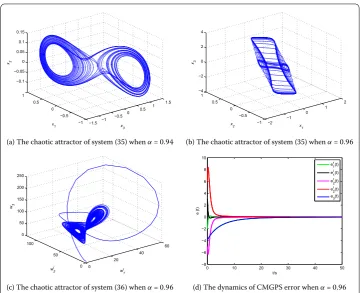
Figure 1 The CMGPS of fractional-order real chaotic Chua-Hartley’s drive system (35) and complex chaotic Lorenz response system (36).
real Chua-Hartley’s system [] drives the fractional-order chaotic complex Lorenz system []. Therefore, the drive system is given in the form
⎧ ⎪ ⎨ ⎪ ⎩
Dα
∗x=m(x+ x–x
),
Dα
∗x=x–x+x,
Dα
∗x= –mx,
()
wherex= (x,x,x)T∈Ris a real state vector. Whenm= .,m= , the fractional order Chua-Hartley’s system () is chaotic as in Figure (a) and Figure (b) atα= . andα= ., respectively.
The response system with the controller is written in the form
⎧ ⎪ ⎨ ⎪ ⎩
Dα
∗w=b(w–w) +v,
Dα
∗w=bw–w–ww+v,
Dα
∗w= –bw+ (/)(w¯w+ww¯) +v,
()
The complex transformation matrix can be taken as
The control gain matrix is chosen as
K=
and the controller is designed according to () in Theorem as follows:
v=
The parameters of drive system () and response system () are selected asα= .,
m = ., m= , and b= , b = , b= , respectively. The initial values are randomly chosen as x= (., –., .)T andw=wr +jwi= (– + j, – + j, –)T, respectively. Therefore, all of the eigenvalues ofB–K areλ = – + j,λ= – – j, λ= –, which satisfies|arg(λ(B–K))|>απ (= , , ). The errors of CMGPS converge asymptotically to zero as in Figure (d). Hence, CMGPS has been achieved between the fractional-order real chaotic Chua-Hartley’s drive system () and the complex chaotic Lorenz response system ().
6.2 CMGPS of fractional-order chaotic complex Chen drive system and real Chua-Hartley’s response system
In order to illustrate CMGPS behaviors of a fractional-order complex chaotic drive sys-tem and a real chaotic response syssys-tem, it is assumed that the fractional-order complex chaotic Chen system [] drives the fractional-order real chaotic Chua-Hartley’s system []. Therefore, the drive system is written in the form
(a) The chaotic attractor of system () (b) The dynamics of CMGPS error
Figure 2 The CMGPS of fractional-order complex chaotic Chen drive system (39) and real chaotic Chua-Hartley’s response system (40) whenα= 0.96.
wherez=zr+jzi,z=zr+jziare complex state variables andzis a real state variable. System () is chaotic whena= ,a= ,a= ,α= . in Figure (a), see [] for more details.
The response system with the controller is given in the form
⎧ The complex transformation matrix can be taken as
=
The control gain matrix is chosen as
K=
The parameters of drive system () and response system () are selected asα= .,
a= ,a= ,a= , andh= .,h= , respectively. The initial values are ran-domly chosen asz=zr+jzi= ( + j, + j, )Tandy= (., –., .)T, respectively. Therefore, all of the eigenvalues ofH–Kareλ= – +j,λ= – –j,λ= –, which satisfies
|arg(λ(H–K))|>απ (= , , ). The errors of CMGPS converge asymptotically to zero as in Figure (b). Hence, CMGPS has been achieved between the fractional-order complex chaotic Chen drive system () and the real chaotic Chua-Hartley’s response system ().
6.3 CMGPS of fractional-order chaotic complex Chen drive system and complex Lorenz response system
In order to illustrate CMGPS behaviors of two fractional-order chaotic complex sys-tems, it is assumed that the fractional-order complex chaotic Chen system () drives the fractional-order complex chaotic Lorenz system (). The parameters of drive system () and response system () are selected asα= .,a= ,a= ,a= , andb= ,
b= ,b= , respectively.
The complex transformation matrix can be taken as
=
The control gain matrix is chosen as
K=
and the complex controller is designed according to () in Theorem as follows:
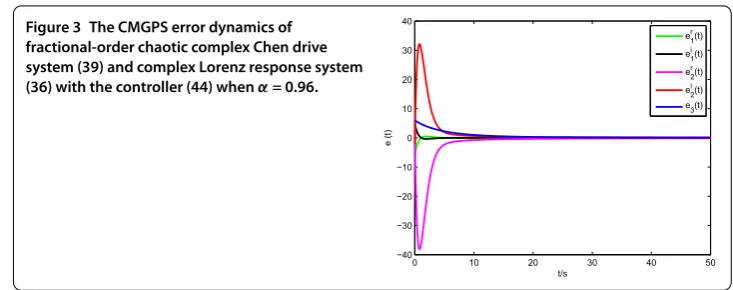
Figure 3 The CMGPS error dynamics of fractional-order chaotic complex Chen drive system (39) and complex Lorenz response system (36) with the controller (44) whenα= 0.96.
the errors and the red line presents the imaginary parts of the errors. Hence, CMGPS has been achieved between the fractional-order chaotic complex Chen drive system () and the complex Lorenz response system ().
7 Conclusions
In this paper, the definitions of modified generalized projective synchronization with com-plex transformation matrix (CMGPS) are introduced, where the drive and response sys-tems could be asymptotically synchronized up to a desired complex transformation ma-trix, not a diagonal matrix. Moreover, general methods of CMGPS are designed for the fractional-order real chaotic drive system and the complex chaotic response system, and for the fractional-order complex chaotic drive system and the real chaotic response sys-tem, and for two fractional-order complex chaotic systems, respectively. It should be no-ticed that the Lyapunov function is not required to be calculated in this scheme; it is really simple and feasible in practical applications. Three numerical examples are worked out to illustrate the feasibility and effectiveness of the theoretical results.
The complex transformation matrix not only establishes a link between fractional-order real chaotic systems and complex chaotic systems, but also sets up a bridge between two order complex chaotic systems. It increases the range of choosing fractional-order chaotic generators in the transmitters and receivers, thus an interceptor is harder to crack information sources.
Competing interests
The authors declare that they have no competing interests.
Authors’ contributions
The authors declare that the study was realized in collaboration with the same responsibility. All authors read and approved the final manuscript.
Author details
1School of Mathematical Sciences, University of Ji’nan, Ji’nan, Shandong 250022, P.R. China.2School of Control Science and Engineering, Shandong University, Ji’nan, Shandong 250061, P.R. China.3Public Basic Department, Shandong Radio and TV University, Ji’nan, Shandong 250010, P.R. China.
Acknowledgements
This research was partially supported by the National Nature Science Foundation of China (Grant Nos. 61273088, 61473133), the Nature Science Foundation of Shandong Province, China (No. ZR2014FL015), and the Foundation for University Young Key Teacher Program of Shandong Provincial Education Department, China.
Received: 20 January 2015 Accepted: 27 July 2015
References
2. Sun, HH, Abdelwahad, AA, Onaral, B: Linear approximation of transfer function with a pole of fractional-order. IEEE Trans. Autom. Control29(5), 441-444 (1984)
3. Laskin, N: Fractional market dynamics. Physica A287(3-4), 482-492 (2000)
4. Kunsezov, D, Bulagc, A, Dang, GD: Quantum Levy processes and fractional kinetics. Phys. Rev. Lett.82(6), 1136-1139 (1999)
5. Hartley, TT, Lorenzo, CF, Qammer, HK: Chaos in a fractional-order Chua’s system. IEEE Trans. Circuits Syst. I42(8), 485-490 (1995)
6. Arena, P, Caponetto, R, Fortuna, L, Porto, D: Bifurcation and chaos in noninteger order cellular neural networks. Int. J. Bifurc. Chaos8(7), 1527-1539 (1998)
7. Gao, X, Yu, J: Chaos in the fractional order periodically forced complex Duffing’s oscillators. Chaos Solitons Fractals24, 1097-1104 (2005)
8. Wu, GC, Baleanu, D: Discrete fractional logistic map and its chaos. Nonlinear Dyn.75(1-2), 283-287 (2014) 9. Wu, GC, Baleanu, D: Chaos synchronization of the discrete fractional logistic map. Signal Process.102, 96-99 (2014) 10. Wu, GC, Baleanu, D, Zeng, SD: Discrete chaos in fractional sine and standard maps. Phys. Lett. A378(5-6), 484-487
(2014)
11. Wang, XY, He, YJ: Projective synchronization of fractional order chaotic system based on linear separation. Phys. Lett. A372(4), 435-441 (2008)
12. Wu, XJ, Lu, Y: Generalized projective synchronization of the fractional-order Chen hyperchaotic system. Nonlinear Dyn.57(1-2), 25-35 (2009)
13. Liu, J, Liu, ST, Yuan, CH: Modified generalized projective synchronization of fractional-order chaotic Lü systems. Adv. Differ. Equ.2013, Article ID 374 (2013)
14. Luo, C, Wang, XY: Chaos in the fractional-order complex Lorenz system and its synchronization. Nonlinear Dyn.71, 241-257 (2013)
15. Luo, C, Wang, XY: Chaos generated from the fractional-order complex Chen system and its application to digital secure communication. Int. J. Mod. Phys. C24(4), 1350025 (2013)
16. Mahmoud, GM, Mahmoud, EE: Complex modified projective synchronization of two chaotic complex nonlinear systems. Nonlinear Dyn.73(4), 2231-2240 (2013)
17. Zhang, FF, Liu, ST, Yu, WY: Modified projective synchronization with complex scaling factors of uncertain real chaos and complex chaos. Chin. Phys. B22, Article ID 120505 (2013)
18. Liu, J, Liu, ST, Zhang, FF: A novel four-wing hyperchaotic complex system and its complex modified hybrid projective synchronization with different dimensions. Abstr. Appl. Anal.2014, Article ID 257327 (2014)
19. Liu, J, Liu, ST, Yuan, CH: Adaptive complex modified projective synchronization of complex chaotic (hyperchaotic) systems with uncertain complex parameters. Nonlinear Dyn.79, 1035-1047 (2015)
20. Liu, J: Complex modified hybrid projective synchronization of different dimensional fractional-order complex chaos and real hyper-chaos. Entropy16, 6195-6211 (2014)
21. Podlubny, I: Fractional Differential Equations. Academic Press, New York (1999)
22. Deng, WH, Li, CP: Chaos synchronization of the fractional Lü system. Physica A353, 61-72 (2005)
23. Diethelm, K, Ford, NJ, Freed, AD: A predictor-corrector approach for the numerical solution of fractional differential equations. Nonlinear Dyn.29(1-4), 3-22 (2002)
24. Li, C, Peng, GJ: Chaos in Chen’s system with a fractional order. Chaos Solitons Fractals22(2), 443-450 (2004) 25. Matignon, D: Stability results for fractional differential equations with applications to control processing. In: