STUDY OF THE STRESS-STRAIN STATE OF THE VIBRATING EQUIPMENT
Zhauyt Algazy
Department of Applied Mechanics and Basics of Machine Design, Kazakh National Technical University, Almaty 050013, Kazakhstan. E-mail: [email protected] Tel.: +77072075141
Abstract In this paper is studied a vibratory conveyor that is placed on an elastic base. Using the closed contours method it was determined
the system that needs to be solved to obtain graphical representation for the generalized coordinates determining the position of the mechanical system elements. The shaking conveyor represents the chase hanged or supported to the fixed section. The chase commits oscillating motions hereupon the cargo which is in the chase, migrates concerning to the chase. The nature of the flow and its parameters are determined by the nature of the oscillating committed by the chase. Justifying the dynamic parameters of the shaking conveyor and a study of the stress-strain state. Installation causes fluctuations fixed tray. Uniformly distributed load on the tray acts in each element of the mechanism. On the basis of the program APM structure 3D investigated the stress-strain state and determined movement of each link mechanism with results and calculations.
KEY WORDS: STRESS-STRAIN STATE, VIBRATING CONVEYOR, EQUATION
1.
Introduction
The big application in various fields of the industry was received by the vibrating conveyors applied to transportation of hot, poisonous, chemical aggressive cargoes by the supplement of complete tightness of their relocation [4], and also for transportation of the metallic cuttings damped with emulsion and oil, hot earth which has been beaten out from casting forms, small casting, foundry fusion mixture, etc. The vibrating conveyor represents the chase hanged or supported to the fixed section. The chase commits oscillating motions hereupon the cargo which is in the chase, migrates concerning to the chase [5-8]. The nature of the flow and its parameters are determined by the nature of the oscillating committed by the chase. Vibrating conveyors on the conditions of the chase flow and nature of cargo movement are subdivided on inertial (with variable and constant stress of cargo to the chase) in which [9] cargo under the influence of inertia force glides on the chase, and on vibrating in which cargo tears off the chase and migrates along the chase. The vibrating conveyors [1-3] are widely applied owing to a number of advantages in these latter days. The questions of the kinematic and dynamic study of the vibrating
feeder intended for dosing of the fusion mixture loading of the melting furnaces of foundry production are considered in the presented work [11-16]. The principle of operation of the vibrating conveyor is described, and it is devoted the kinematic analysis of the action. The differential equation of the link move of the reduction of the vibrating conveyor is considered in the difference method (the approximate method) solutions of the equation of move of the vibrating conveyor is resulted [10]. It is devoted to the analysis of the equations solutions of conveyor move. Here tables of the results and relocation drawing and velocity of the leading link depending on time are resulted.
2. Materials and Methods
2.1. Differential equations of the link move of the reduction of the vibrating conveyor
It is the action of the III class. The crew ВЕD basic crew from which there are three leads ҒЕ, АВ, GD. The link ОА is a leading link.
Table 1. The action has following performances.
№ 1 2 links 3 4 5
mass, kg
m
1=
30
m
2=
65
m3 =1160m
4=
59
m5 =59length units, mm
l
1=
60
l
2=
430
l3 =1100l
4=
440
l5 =440Fig. 1. Kinematic scheme of the vibrating conveyor mechanism
k k k
K
M
М
d
d
dt
d
I
=
I
=
−
1 1 2 1 1 1
)
(
2
)
(
ϕ
ϕ
ω
ω
ϕ
(1)It is known to us dependence
M
P(
ω
)
andM
R(
ϕ
1)
. We determineM
R(
ϕ
1)
the resulted moment of resistance forces frompower equalling of the resulted moment of force resistance and the sum of powers of the moments [5] of resistance forces of operating in links E, D, F, G.
5 4
5 4
1
ω
ω
ω
ω
ω
кед G кед F кед Д кед Ек
M
M
М
M
M
=
+
+
+
=
+
+
+
=
1 5 1 4 1 5 1 4ω
ω
ω
ω
ω
ω
ω
ω
кед G кед F кед Д кед Ек
M
М
М
М
M
k кед G кед F кед Д кедE
u
М
u
M
u
M
u
u
M
M
41+
51+
41+
51=
4
⋅
41=
Let's find resulted moment of the flywheel actions ( )
1
ϕ
kI from equalling condition of kinematic energy of reduction link to the kinematic energy sum of all links of the action.
2 41 5 4 2 3 3 2 22 2 2 2 1
1
)
(
)
(
1
1
u
m
l
m
S S S F GS
k
=
I
+
+
I
+
+
I
+
I
⋅
I
ϕ
ϑ
ϕϑ
ϕ (2)We determine inertia moments of the first, second, fourth and fifth links.
2
2 1 1 1l
m
S
=
⋅
I
2
2 2 2 2l
m
S
=
⋅
I
4
2
2 4 4 2 4 4 4 4 4 4l
m
l
m
l
m
SF
=
I
+
⋅
′
=
⋅
+
⋅
I
4
2
2 5 5 2 5 5 5 5 5 5l
m
l
m
l
m
SG
=
I
+
⋅
′
=
⋅
+
⋅
I
We differentiate the resulted inertia moment on
ϕ
1: For this purpose we substituted all above found values in the equation.⋅
⋅
⋅
′
+
+
⋅
′
+
⋅
=
I
1 2 21 2 2 1 1 2 21 2 2 1 1 2 11
)
2
(
sin
sin
)
(
cos
cos
)
(
ϕ
ϕ
ϕ
ϕ
ω
ϕ
ϕ
u
l
l
u
l
l
m
d
d
k(
)
(
)
[
]
(
)
(
) (
)
(
)
(
−
)
⋅
−
+
⋅
′
+
+
⋅
′
+
+
′
+
−
⋅
′
+
−
⋅
1 2 1 4 2 1 2 2 21 2 2 1 1 2 21 2 2 1 1 2 2 1 21 2 2 2 2 21 2 1 1 1 1sin
sin
2
cos
cos
sin
sin
cos
sin
sin
cos
sin
cos
ϕ
ϕ
ϕ
ϕ
ϕ
ϕ
ϕ
ϕ
ϕ
ϕ
ϕ
ϕ
ϕ
ϕ
ϕ
ω
l
l
I
u
l
l
u
l
l
d
du
l
u
l
l
S(
)
(
)
(
)
[
(
)
(
(
)
)
]
(
)
+
−
−
⋅
−
−
−
−
−
−
−
−
⋅
2 4 2 1 4 2 4 41 2 4 21 2 4 1 4 1 4 41 2 1sin
sin
cos
cos
sin
cos
cos
ϕ
ϕ
ϕ
ϕ
ϕ
ϕ
ϕ
ϕ
ϕ
ϕ
ϕ
ϕ
ϕ
ϕ
u
u
u
l
l
(
)
(
)
(
)
(
)
+
⋅
−
⋅
+
−
+
−
⋅
−
+
−
+
a
t
b
t
d
du
d
du
l
u
l
l
m
5 51 51 2 2 1 21 2 2 2 2 21 2 1 1 1 2 1
3
cos
sin
cos
sin
cos
sin
cos
sin
2
ω
ω
ϕ
ϕ
ϕ
ϕ
ϕ
ϕ
ϕ
ϕ
ω
(
)
(
)
(
)
(
)
[
(
)
(
(
)
) (
)
]
=
−
−
−
−
−
−
−
−
−
−
−
−
⋅
+
+
)
sin(
)
sin(
sin
sin
cos
cos
sin
cos
cos
2
4 2 1 2 4 1 4 2 2 1 2 2 1 21 2 1 4 2 2 1 21 2 1 4 1 54
ϕ
ϕ
ϕ
ϕ
ϕ
ϕ
ϕ
ϕ
ϕ
ϕ
ϕ
ϕ
ϕ
ϕ
ϕ
ϕ
ϕ
ϕ
l
l
u
u
l
l
I
I
F G(
)
(
)
(
)
+
−
′
+
−
⋅
′
+
−
⋅
⋅
⋅
=
2 21 21 2 2 2 21 2 1 1 1 2 1
2
cos
sin
cos
sin
sin
cos
2
ϕ
ϕ
ϕ
ϕ
ϕ
ϕ
ϕ
ω
d
du
l
u
l
l
m
(
)
(
)
(
)
[
(
)
(
(
)
)
]
(
)
−
−
−
−
−
−
−
−
−
−
−
−
−
⋅
I⋅
+
2 4 2 1 4 2 4 41 2 4 21 4 2 1 4 4 1 41 4 2 1 4 2 2 2 1 2sin
sin
cos
cos
sin
cos
cos
)
sin(
)
sin(
2
ϕ
ϕ
ϕ
ϕ
ϕ
ϕ
ϕ
ϕ
ϕ
ϕ
ϕ
ϕ
ϕ
ϕ
ϕ
ϕ
ϕ
ϕ
u
u
u
l
l
(
)
(
)
(
)
(
)
+
⋅
−
⋅
−
−
−
−
⋅
′
+
+
−
a
t
b
t
d
du
d
du
l
u
l
l
m
5 51 51 2 2 1 21 2 2 2 2 21 2 1 1 1 2 1
3
cos
sin
cos
sin
sin
cos
cos
sin
2
ω
ω
ϕ
ϕ
ϕ
ϕ
ϕ
ϕ
ϕ
ϕ
ω
(
)
(
)
(
)
(
)
[
(
)
(
)
]
(
)
(
)
;
sin
sin
cos
cos
sin
cos
cos
)
sin(
)
sin(
2
4 2 2 1 2 2 1 21 2 1 4 2 2 1 21 2 1 4 2 1 2 2 4 2 1 5 4
−
−
⋅
−
−
−
−
−
−
−
−
⋅
−
−
⋅
+
+
ϕ
ϕ
ϕ
ϕ
ϕ
ϕ
ϕ
ϕ
ϕ
ϕ
ϕ
ϕ
ϕ
ϕ
ϕ
ϕ
ϕ
ϕ
u
u
l
l
I
I
F GThe move equation of the reduction link of the action looks like:
(
) (
)
[
]
+
−
−
I
+
⋅
′
+
+
⋅
′
+
⋅
+
I
)
(
sin
)
(
sin
cos
cos
sin
sin
4 2 2 1 4 2 2 2 2 1 2 2 21 2 2 1 1 2 21 2 2 1 1 2 1 21
ϕ
ϕ
ϕ
ϕ
ϕ
ϕ
ϕ
ϕ
ω
l
l
u
l
l
u
l
l
m
S S(
)
[
−
−
⋅
+
⋅
⋅
]
+
[
(
+
⋅
−
⋅
⋅
)
]
+
⋅
+
2 5 51 21 2 2 1 1 2 5 51 21 2 2 1 1 2 13
l
sin
l
sin
u
a
u
cos
t
l
cos
l
cos
u
b
u
sin
t
m
ω
ϕ
ϕ
ω
ϕ
ϕ
ω
+
′
+
⋅
⋅
⋅
′
+
⋅
⋅
+
⋅
−
−
I
+
I
+
2
(
sin
sin
)
(
cos
sin
)
2
)
(
sin
)
(
sin
)
(
1 21 2 2 2 21 1 1 21 2 2 1 1 2 1 2 2 1 1 4 2 2 1 2 2 2 4 2 1 54
ω
ϕ
ϕ
ϕ
ϕ
ϕ
ω
ω
ϕ
ϕ
ϕ
ϕ
d
du
l
u
l
u
l
l
m
dt
d
l
l
G F+
′
+
⋅
′
−
−
⋅
′
+
+
(
cos
cos
)(
sin
sin
cos
)
1 21 2 2 2 21 2 2 1 1 21 2 2 1
1
ϕ
ϕ
ϕ
ϕ
ϕ
ϕ
d
du
l
u
l
l
u
l
l
(
[
+
⋅
−
−
+
−
−
+
−
+
I
⋅
+
2 1 1 2 2 211 3 4 2 2 4 1 4 1 4 1 2 2 2 1
2
2
sin
sin
)
(
sin
)
sin(
))
cos(
)
(cos(
2
m
l
l
u
l
l
S
ϕ
ϕ
ω
ϕ
ϕ
ϕ
ϕ
ϕ
ϕ
ϕ
ϕ
)
+
+
−
−
−
⋅
+
1 51 5 1 21 2 1 2 21 2 2 1 1 551
cos
ω
cos
ϕ
cos
ϕ
sin
ϕ
ϕ
cos
ω
ϕ
d
du
t
a
d
du
l
u
l
l
t
u
a
+
−
+
⋅
+
−
⋅
⋅
−
⋅
+
+
1 51 5 1 21 2 2 2 21 2 2 1 1 5 51 21 2 2 11
cos
cos
sin
)
sin
sin
cos
sin
(
ϕ
ω
ϕ
ϕ
ϕ
ϕ
ω
ϕ
ϕ
d
du
t
b
d
du
l
u
l
l
t
u
b
u
l
l
[
]
=
−
−
−
−
+
⋅
I
+
I
+
)
(
sin
)
sin(
)
cos(
)
cos(
2
)
(
4 2 2 1 2 2 1 2 1 2 2 2 1 54
ϕ
ϕ
ϕ
ϕ
ϕ
ϕ
ϕ
ϕ
l
l
G F(
0 5)
411
4
ϕ
ω
α
ο
u
M
K
М
k−
⋅
−
k′
+
=
(3)For solution of the equation (3) there are following initial conditions: at
t
=
0
,
ω
1=
0
,
ο
ϕ
1=
60
2.2 The approximate method of the equation solutions of the vibrating conveyor
For constructing on the piece
t
∈
[
0
,
T
]
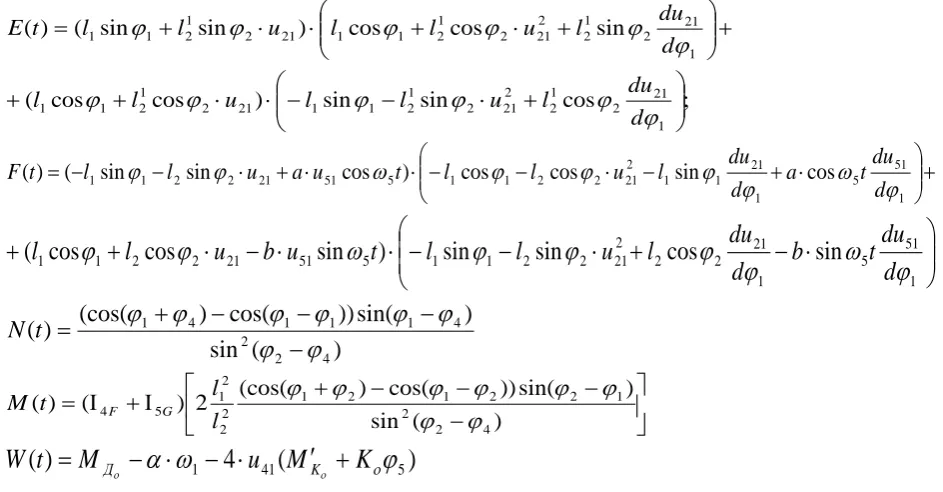
of the approximate solution of the move equation (3), we copy it in the following kind:)
(
)
(
)
(
)
(
1 2t
W
t
t
Q
dt
d
t
R
ω
+
⋅
ω
=
(4)where
(
)
(
2(
)
3(
)
12(
)
(
)
1
m
A
t
m
H
t
B
t
D
t
t
R
=
I
S+
+
ω
+
+
2 21 2 2 21 2 1 2 1 2 1 2
1
2
(sin
sin
cos
cos
)
)
(
t
l
l
l
u
l
u
A
=
+
′
ϕ
⋅
ϕ
+
ϕ
⋅
ϕ
⋅
+
′
⋅
.+
⋅
+
⋅
+
+
⋅
−
=
2 1 2 21 1 251 5 2 2 5 2 2 2 21 2 2 2
1
(
cos
sin
)
2
(sin
sin
)
(
t
l
l
u
a
ω
t
b
ω
t
u
l
l
u
ϕ
ϕ
H
+
⋅
⋅
−
⋅
+
⋅
⋅
−
+
cos
ϕ
1cos
ϕ
2)
2
l
1u
51(
a
sin
ϕ
1cos
ω
5t
b
cos
ϕ
2sin
ω
5t
)
2
l
2u
21(
a
cos
ω
5t
sin
ϕ
2)
cos
sin
ω
5⋅
ϕ
2⋅
+
b
t
)
(
sin
)
(
sin
)
(
4 2 2 2 2 1 4 2 2 12
ϕ
ϕ
ϕ
ϕ
−
−
I
=
l
l
t
B
S ;)
(
sin
)
(
sin
)
(
)
(
4 2 2 2 4 1 2 2 2 1 54
ϕ
ϕ
ϕ
ϕ
−
−
I
+
I
=
l
l
t
D
F G)
(
)
(
2
2
))
(
)
(
(
)
(
2 2 2 1 2 1 32 2
N
t
M
t
l
l
t
F
m
t
E
m
t
+
+
⋅
+
⋅
⋅
+
=
1 21 2 1 2 2 21 2 1 2 1 1 21 2 1 2 1
1
sin
sin
)
cos
cos
sin
(
)
(
ϕ
ϕ
ϕ
ϕ
ϕ
ϕ
d
du
l
u
l
l
u
l
l
t
E
;
cos
sin
sin
)
cos
cos
(
1 21 2 1 2 2 21 2 1 2 1 1 21 2 1 2 1
1
+
⋅
−
−
⋅
⋅
+
+
ϕ
ϕ
ϕ
ϕ
ϕ
ϕ
d
du
l
u
l
l
u
l
l
+
⋅
+
−
⋅
−
−
⋅
⋅
+
⋅
−
−
=
1 51 5 1
21 1 1 2 21 2 2 1 1 5 51 21 2 2 1
1
sin
sin
cos
)
cos
cos
sin
cos
(
)
(
ϕ
ω
ϕ
ϕ
ϕ
ϕ
ω
ϕ
ϕ
d
du
t
a
d
du
l
u
l
l
t
u
a
u
l
l
t
F
⋅
−
+
⋅
−
−
⋅
⋅
−
⋅
+
+
1 51 5 1
21 2 2 2 21 2 2 1 1 5
51 21
2 2 1
1
cos
cos
sin
)
sin
sin
cos
sin
(
ϕ
ω
ϕ
ϕ
ϕ
ϕ
ω
ϕ
ϕ
d
du
t
b
d
du
l
u
l
l
t
u
b
u
l
l
)
(
sin
)
sin(
))
cos(
)
(cos(
)
(
4 2 2
4 1 1
1 4
1
ϕ
ϕ
ϕ
ϕ
ϕ
ϕ
ϕ
ϕ
−
−
−
−
+
=
t
N
−
−
−
−
+
I
+
I
=
)
(
sin
)
sin(
))
cos(
)
(cos(
2
)
(
)
(
4 2 2
1 2 2
1 2
1 2
2 2 1 5
4
ϕ
ϕ
ϕ
ϕ
ϕ
ϕ
ϕ
ϕ
l
l
t
M
F G)
(
4
)
(
t
M
οα
ω
1u
41M
οK
οϕ
5W
=
Д−
⋅
−
⋅
K′
+
3. Results and Discussion
The system of differential equations modeling the movement of the material particle on the vibrating plate belonging to the conveyor was solved using Zinovyeva method. Our goal was to find
the optimal values of some parameters that allow the obtaining of maximum speed of a vibratory movement on the plate. The basis of the program APM structure 3D investigated the stress-strain state and determined movement of each link mechanism with results and calculations.
Fig. 2. Vibrating conveyor mechanism 3D model
Fig. 4. Computed plot of the moving.
Fig. 5. Computed plot of the
F
X andT
X.Fig. 7. Computed plot of the stress-strain state
τ
YZ.Fig. 8. Computed plot of the margin fatigue.
Fig. 9. Computed plot of the main deformation.
Table 2. The reactions in the supports №
joint № node
Reaction
X
R
[H]Reaction
R
Y [H]Reaction
R
Z [H]Moment
X
M
[нм]Moment
Y
M
[нм]Moment
Z
M
[нм]1 18 0,0046 0,2484 0,6074 -3,6181 0,6038 -0,3482
2 20 0,0057 0,2141 0,7151 7,2149 0,7702 -0,3027
3 27 0,0045 -0,4624 0,3450 19,72251 0,5502 0,2877
4 47 0 0,0004 0,0001 0 0 0
Tube 45x2.5 GOST 8732-78 Options section
The area of 333.70 square millimeters The center of mass: X = 69.000, Y = -13.000mm
Moment of inertia: rel. X axis 75605.68mm4
rel. Y axis 75605.68mm4
polar 151211.35mm4
The angle of the principal central axes 0.00 gradus
Tube 28 x 2.5 GOST 8732-78 Options section
The area of 200.23 square millimeters The center of mass: X = 75.001, Y = -8.999mm
Moment of inertia: rel. X axis 16434.12mm4 rel. Y axis 16434.12mm4
polar 32868.25mm4
The angle of the principal central axes 0.00 gradus
Fig.10. Model information: List of cross section and options section. The center of gravity model (-0.000000, 919.880834, 469.928355) [мм].
The moments of inertia model (1280707.633013, 159169646.605358, 28044219.772722) [кг*мм*мм].
4. Conclusions
1. Formulas for the position determination and velocity of conducted links depending on position and velocity of the leading link are received.
2. The differential equations of the link move of the action reduction are received.
3. On the basis of the profiles variation analysis of the angular rate of the leading link it is possible to make the following concluding:
• with the growth of the starting driving moment middle angulator of the action grows;
• with reduction of the starting driving moment middle angular rate of the action is decays;
• with coefficient increase
α
0,ω
ср grows;4. The basis of the program APM structure 3D investigated the stress-strain state and determined movement of each link mechanism with results and calculations.
Acknowledgments
The first author likes to acknowledge JSC Center of Republic of Kazakhstan for supporting his PhD study and research at LARM in the University of Bielsko-Biala in Poland, in the academic year 2014-2015.
References
[1] Andrea, V., Nicolae, U. and Loana, A. M., Determining the maximal relative motion speed considering the influence of
55 65 75 85
-30
-20
-10
0
65 70 75 80 85
-20
-15
-10
-5
0
two parameters, using a new optimization method. ACTA Technica napocensis,№4 (55) (2012) 949-954.
[2] Wyk, A. J., Snyman J. A., Heyns, P. S., Optimization of a vibratory conveyor for reduced support reaction force. N&O Journal,№1 (10) (1994) 12-17.
[3] Andrea, V., Nicolae, U. and Loana, A. M., Contribution to the optimization of relative motion on a vibrating conveyor.
ACTA Technica napocensis,№2 (55) (2012) 519-522.
[4] Yiqing Chu., Cuiying Li., Helical vibratory conveyors for bulk materials. Bulk solid handling, №1 (7) (1987) 103-112.
[5] Dinu, I. S., Miorita, U., Nicu, U. and Mihai, B., Computer model for sieves vibrations analysis, using an algorithm based
on the false-position method. American Journal of Applied Sciences, №6 (1) (2009) 48-56.
[6] Dülger, L. C., Erdoğan, H. and Kütük, M. E., Matlab’s GA and optimization toolbox: a fourbar mechanism application.
International Journal of Intelligent Systems and Applications in Engineering, №2 (1), 10-15.
[7] Cabrera, J. A., Simon, A. and Prado, M., Optimal synthesis of mechanisms with genetic algorithms, Mechanism and Machine theory, №37 (2002) 1165-1177.
[8] Bulatovic, R. R., and Djordjevic, S. R., Optimal synthesis of a four bar linkage by method of controlled deviation,
Theoretical Appl. Mech, №1 (31), 3-4 (2004) 264-280.
[9] Laribi, M. A., Mlika, A., Romdhane, L., and Zeghloul, S., A combined genetic algorithm-fuzzy logic method (GAFL) in mechanisms synthesis, Mechanism and Machine Theory,№39
(2004) 717-735.
[10] Penunuri, F., Escalante, R. P., Villanueva, C., and Pech-Oy, D., Optimum synthesis of mechanism for single and hybrid task using differential evolution’, Mechanism and Machine Theory, №10 (46) (2011) 1335-1349.
[11] Xie, J., and Chen, Y., Application back propagation neural network to synthesis of whole cycle motion generation mechanism, 12thIFToMM World Congress-Besancon France, June (2007) 18-21.
[12] Liu, Y., and McPhee, J., Automated kinematic synthesis of planar mechanisms with revolute joints, Mechanics Based Design of Structures and Machines, 35 (2007) 405-445.
[13] Erkaya, S., and Uzmay, I., A Neural-Genetic (NN-GA) approach for optimizing mechanisms having joints with clearance, Multibody System Dynamics, 20 (2008) 69-83.
[14] Zadeh, N. N., Felezi, M., Jamali, A., and Ganji, M., Pare to optimal Synthesis of four-bar mechanisms for path generation,
Mechanism and Machine Theory, 22 (2009) 180-191.
[15] Archaryya, S. K., and Mandal, M., Performance of EAs for four-bar linkage synthesis, Mechanism and Machine Theory,