Election Voting Machine - A Review
Sanket M. Gawade, Ninad S. Mandavkar, Sanket S. Mane, Chinmayee N. Manjarekar
UG Scholar Department of Electronics SAKEC Chembur, Mumbai 42, INDIA
Abstract - Electronic Voting Machine (EVM) is a simple electronic machine used to record votes in place of ballot papers and boxes which were used earlier in conventional voting system. The problem with conventional voting machine is unreliable use of ballot papers which makes process time consuming and costlier. These problems solved by using biometrics identifier which is more reliable for person identification than traditional voting technology methods. The focus of this paper is to summarize the emerging election voting machine, presents these new election voting machine and survey the recent trends for EVM for advance voting machine. This paper also discusses the issues and comparison among the different voting machines.
Keywords- Voting, Electronic voting machine (EVM), Biometric EVM, Finger prints.
I. INTRODUCTION
Elections allow the populace to choose their
representatives and express their preferences for how they will be governed. India is the largest democratic country in the world, with the electorate of more than 814.5 million. In democratic countries, populace decides the government through election process; hence it is purely a responsibility of citizens to give a capable leader to that country.[7]But irrespective of citizen’s choice, if there is any hidden problem in the voting machine itself then the decisions made by citizens however effective will not be implemented. This will cause development of negative attitude among citizens about voting and democracy. The integrity of voting system decides the integrity of government which is going to be established on basic technological level. As the technology evolved, voting system of "Ballot Paper” is replaced by EVM. There are many voting schemes which have contributed in domain of EVM systems such as Direct Recording machines at designated polling, Internet voting (online and at designated polling stations) and Optical scanner machines(stand alone and networked).[1]
The primary objective of the voting systems is to provide Accuracy, Privacy, Flexibility and Transparency to the voter. But each of the above schemes lags in some of the required criteria. Like traditional paper-ballot systems provides transparency to voters but it was time consuming and required man power. It also had to deal with a lot of accuracy issues. Online voting system fails to provide that much security and goes down when heavy traffic is there Today’s EVMs gives accuracy, saves man power and is eco-friendly but it also fails
to provide transparency. Hence to overcome all the problems which are being faced by the voters, current system is proposed in which majority of these problems can be resolved. This proposed system has few distinct characteristics which add to the reliability, transparency and user friendliness of voting system.
II. TAXONOMYOFVOTINGDEVICES
There is different election voting machines used across the world. The different types of EVM are as follows.
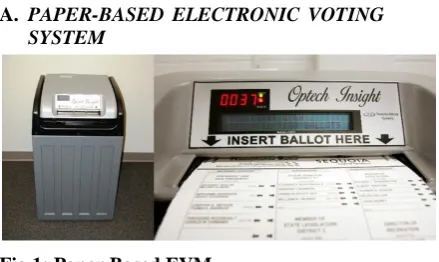
A. PAPER-BASED ELECTRONIC VOTING SYSTEM
Fig 1: Paper Based EVM
A paper-based voting method that attempts to achieve the privacy of voters and election universal verifiability and integrity with only paper ballots and without using any cryptography method. The voting procedure is easy and it needs only selecting the intention of voter over screen of an electronic device. The rest of the voting procedure will be carried out by the device. Voter gets a receipt that can be used to verify that his vote has been counted in final tally as he intended. However the receipt cannot help voter to reveal who he voted for. Also vote selling or coercion is not possible even with the voter’s cooperation. The ballot in our voting method has two sides, one positive and one negative. Ballots have been prepared for voting in pre-packaged form (i.e. 5 ballots per package).[2]
B. DIRECTRECORDINGELECTRONIC MACHINE
Fig 2: Direct Recording EVM
Like all voting machines, DRE systems increase the speed of vote counting. They can also incorporate the broadest assistive technologies for the largest classes of handicapped people, allowing them to vote without forfeiting the anonymity of their vote. These machines can use headphones and other adaptive technology to provide the necessary accessibility. DRE's can also provide the most robust form of immediate feedback to the voter detecting such possible problems as under voting and over voting which may result in a spoiled ballot. This immediate feedback can be helpful in successfully determining voter intent.
Additionally, with DRE voting systems there is no risk of exhausting the supply of paper ballots, and they remove the need for printing of paper ballots, a significant cost. When administering elections in which ballots are offered in multiple languages (in some areas of the United States, public elections are required to by the National Voting Rights Act of 1965), DRE voting systems can be programmed to provide ballots in multiple languages on a single machine. For example, King County, Washington's demographics require them under U.S. federal election law to provide ballot access in Chinese. With any type of paper ballot, the county has to decide how many Chinese-language ballots to print, how many to make available at each polling place, etc. Any strategy that can assure that Chinese-language ballots will be available at all polling places is certain, at the very least, to result in a lot of wasted ballots.[3]
Disadvantages of Electronic Touch Screen (DRE) systems: Ergonomic, Logistic, Security, Fraud, and Mechanical Problems with VVPB DREs, Voters Complain DREs Provide Inadequate Privacy, Logic and Accuracy Tests on DREs Are Cumbersome and Opaque, VVPB Printers Increase the Complexity and Cost of DREs, In Recounts, DREs Could Result in a Legal Catch-22.
C. HARTINTERCIVICESLATE
In this particular voting system initially the voter needs to make a valid entry into the poll book. On making a valid entry the system will generate an access code specifying the date, time, and location coupled with the vital information within it. On execution of it the voter needs to visit the eSlate – a kind of online portal specially designed for voting. The portal will specify certain protocols to be followed by the voter during the process of casting a vote. Standard headphones are provided which are responsible for providing audio narration of all the guidelines required to execute the given process. Once the narration is over the system asks for the access code delivered to us by the poll worker. On specifying the access code, the ‘Judge’s Booth Controller’ (JBC) verifies the same and displays the very first page of the process. This process page is namely called as ‘Ballot page’. After filling up the essential details on this page, the control shifts to verification screen of Ballot called as ‘Ballot Summary Page’.[4]
If a particular voter feels to make certain alterations, his feedback is readily encouraged by this system. A printer is interfaced to the system to acknowledge the process, but if a visually challenged person is made to cast his vote then a cogent alternative is provided. The system provides with an audio channel that narrates the entire acknowledgment to the voter. If the voter feels to reject his selection a negative acknowledgement called ‘Ballot Rejected’ is sufficed to the voter followed by printing of a barcode. This barcode will contain every information regarding the activities performed by a voter on the estate machine. The system takes an extra care regarding the fact that the vote casted by a particular voter is not visible to another one. The vote casted by the voter is kept strictly confidential. This is done by terminating the ballot by changing the contents and by replacing the current ballot by a void ballot.
D. INDIANEVM
Fig 3: Indian EVM
five-meter cable. Balloting unit facilitates voting by voter via labelled buttons while control unit controls the ballot units, stores voting counts and displays the results on 7 segment LED displays. The controller used in EVMs has its operating program etched permanently in silicon at the time of manufacturing by the manufacturer. No one (including the manufacturer) can change the program once the controller is manufactured.
An EVM can record a maximum of 3840 votes and can cater to a maximum of 64 candidates. There is provision for 16 candidates in a single balloting unit and up to a maximum of 4 units can be connected in parallel. The conventional ballot paper/box method of polling is used if the number of candidates exceeds 64. It is not possible to vote more than once by pressing the button again and again. As soon as a particular button on the balloting unit is pressed, the vote is
recorded for that particular candidate and the machine gets locked. Even if one presses that button further or any other button, no further vote will be recorded. This way the EVMs ensure the principle of "one person, one vote".
Limitations
A candidate can know how many people from a polling station voted for him. This is a significant issue particularly if lop-sided votes for/against a candidate are cast in individual polling stations and the winning candidate might show favouritism or hold grudge on specific areas. The Election Commission of India has stated that the manufacturers of the EVMs have developed a Totalize unit which can connect several balloting units and would display only the overall results from an Assembly or a Lok Sabha constituency instead of votes from individual polling stations.[6]
The control units do not electronically transmit their results back to the Election Commission, even though a simple and unconditionally secure protocol for doing this exists. The Indian EVMs are purposely designed as stand-alone units to prevent any intrusion during electronic transmission of results. Instead, the EVMs are collected in counting booths and tallied on the assigned counting day(s) in the presence of polling agents of the candidates.
E. VVPAT :
Fig 4: VVPAT
The Voter Verified Paper Audit Trail is a method that provides feedback to voters. It is an independent verification printer machine and is attached to electronic voting machines. It allows voters to verify if their vote has gone to the intended candidate.[8] A 'voter verified paper audit trail' (VVPAT) consists of physical paper records of voter ballots as voters have cast them on an electronic voting system. In the event that an election recount or audit is called for, the VVPAT provides a supporting record. The 'voter-verified' part of the VVPAT refers to the fact that the voter is given the opportunity to verify that the choices indicated on the paper record correspond to the choices that the voter has made in casting the ballot. Thus, the result of an election is an electronic tally of the votes cast and a paper record of the individual votes that have been cast.
F. Biometric EVM:
prerequisite to convert it into a digital form for further processing. This digital data is stored temporarily in DSP processor and the process will continue till all the relevant data is transferred to the central host. The data is temporarily stored in ROM memory. For faster execution of memory, FLASH memory is used. For timely reception and retrieval of data DSP chip is used and it is further interfaced
to real time applications via a USB port. The sole purpose of a USB port is to establish a duplex link between the DSP processor and Database.
III.MAJORISSUES
1. System becomes rigid as more and more technology involves in Voting systems as rate of illiteracy is high.
2. Ergonomic, Logistic, Security, Fraud, and Mechanical Problems with VVPB DREs. 3. In VVPAT use of paper makes it
environmentally hostile as lot of paper gets waste.
4. Appearance of the biometric sample in which it is physically changed or replaced is known as Presentation attack.
5. Biometric processing attacks, in which an understanding of the biometric algorithm is used to cause incorrect processing and decisions.
6. Software and networking vulnerabilities, based on attacks against the computer and networks on which the biometric systems run.
IV.CONCLUSION
The review revolves around different methodologies implemented in EVM and discusses loopholes about the same. These discrepancies are overlapped by the advancements made in EVM throughout the period. The method that is proposed deals with making the voting system more convenient by putting on limelight several unique traits like biometric features. It also comprises of APIs to make the system user-friendly. This system will abort malpractices carried out under the name of elections and will ensure unique allocation of votes.
V. ACKNOWLEDGMENTS
We would like to thanks SAKEC Electronics Department for their valuable support.
VI. REFERENCES
[1] D. Ashok Kumar, T. Ummal Sariba Begum ,Proceedings of the International Conference on Pattern Recognition, Informatics and Medical Engineering, March 21-23, 2012. "Electronic Voting Machine – A Review."
[2] https://eprint.iacr.org/2013/284
[3] Frank S.Wood, Electric voting-machine, U.S.Patent 616,174, Granted Dec. 20, 1898.
[4] https://googleweblight.com/i?u=https://www.verifiedvoting.
org/resources/voting-equipment/hart-intercivic/eslate/&grqid= aJMtfOAf&hl=en-IN [5] https://googleweblight.com/i?u=https://
www.edgefx.in/fingerprint-recognition-based-biometric-voting-machine/&grqid=h1bXNwf0&hl=en-IN. [6] https://en.wikipedia.org/wiki/Electronic_voting_in_India [7] Bhuvanapriya. R,Rozil banu.S,
Sivapriya.P,Kalaiselvi.V.K.G 2017 Second International Conference On Computing and Communications Technologies(ICCCT’17), "SMART VOTING".