59
Improving Students’ Cognitive Abilities And
Creative Thinking Skills On Temperature And
Heat Concepts Through An Exelearning-Assisted
Problem Based Learning
Saeful Nurdin, Wawan Setiawan
Abstract: This study was aim to investigate the improvement of students’ cognitive abilities and creative thinking skills who was taught using an exelearning-assisted problem based learning model. A quasi-experimental method was used to engage 48 ninth-grade science students of an Islamic Senior High School at Bandung. Data were collected by using a cognitive test and creative thinking skills test that administered at the beginning and the end of the instruction, analyzed by using the normalized gain. Students who had an exelearning-assisted project based learning model demonstrated significantly higher average normalized gain on cognitive test and creative thinking skills test than those who did not have. Correlation coefficient between the experimental group students’ cognitive abilities and creative thinking skill was rxy = 0,55 with determination coefficient R=30.67%. The findings showed statistically significant differences between the improvement of the experimental group compare to the control group. Most students responded excited and motivated when they was taught using an exelearning-assisted problem based learning model.
Index Terms: exelearning, problem based learning, cognitive abilities, creative thinking skills
————————————————————
1
I
NTRODUCTIONLearning by using web or electronic learning (e-learning) has unlimited space and time to provide an effective learning whenever we want to access it if we have computer, tablet, and mobile phone that connected to the internet. As well as student-teacher interaction become easier in real time. Some previous studies have showed that Moodle as an e-learning media give positive contributions to help students build their knowledge and to promote students’ positive attitude in direct the discussion and cooperating with their partners [1]. One of supporting facilities in conducting a study using the web online is to provide highly bandwidth connectivity to avoid a problem when accessed simultaneously by users, student and teacher. To solve that bandwidth connectivity, a free service provider engaged in education create an innovation program named the Elearning HTML Editor (exelearning), an environment of authoring to help teacher and academics in designing, developing, and publishing teaching web-based learning materials without being highly mastered an HTML program or complicated web-publishing application [2]. Web-based exelearning program is built under an open source licensed program which dedicated to the creative and innovative learning media development that easily without mastering xhtml program, a web-based authoring offline which does not require bandwith capacity to connect internet. The use and development of authoring program, exelearning as free software alternative becomes something that should be mastered by the creative teacher in learning.
Those developments certainly should appropriate with mandated curriculum and the goals to be achieved. Creating learning media by using exelearning has an education value to develop students’ achievement and motivation should be mastered by teacher [3]. iDivice provides basic format and editing functions that consist of a series of reading activity, foreknowledge, download materials and interactive exercise. The use of educational features in exelearning can develop student’s achievement, both individually or in groups, compared to the traditional method. In addition, exelearning also help to develop teacher’s skill in designing learning materials to provide high quality teaching and learning. Some teaching skills that should be mastered by teacher, such as good interactive publication, connectedness between teaching method, encouraging students to understand clearly cognitive abilities through discussion, social interaction that often supported by computer device and helping students compare their understanding with their friends to be scientifically accepted [4]. One of cognitive processes (remembering, understanding, analyzing, evaluating, and creating) that is emphasized in the high school and the university is understanding. Students who have good understanding would be able to construct a meaning from learning messages, in oral, written or graphics, which present through teaching, textbook, or computer[5]. Creative thinking is a thinking process that focuses on exploring an idea, creating the probability and finding the correct answer, not only one corrected answer [6]. In Physics, creative thinking is used to derive the basic principles of physic and its following problem [7]. A preliminary study to obtain students’ prior cognitive thiking skills was conducted by providing a learning video that demonstrate heat transfer phenomena by heating a soda can with gas stove and student was asked to observe and explain the process. Students showed the average of each creative thiking skills indicator resperctively fluently 50.05%, flexibility 43.24%, originality 10.81%, and elaboration 18.92%. Lower average on originality and elaboration indicator need to develop by implementing an innovative learning materials of physic in order that it probably makes students using their creative thinking abilities actively [8]. Problem based learning
_______________________
Saeful Nurdin is currently a widyaiswara at BDK Bandung, Jl. Soekarno-Hatta No 716 Bandung. E-mail:
intentionally was developed to help students in enhancing their thinking ability, problem solving ability, and intellectual skills; learning adult person roles with experience through various real situations or simulated situation; and becoming an independent and autonomous learner [9]. Previous study that compare online problem based learning with Moodle and traditional problem based learning with lecture showed that online problem based learning with Moodle is able to develop creative thinking skills, particularly flexibility, originality, and elaboration indicator. However, traditional problem based learning is able to develop fluency indicator higher than online problem based learning [10]. Another study using authoring environment to improve creative thinking suggest that hypermedia authoring is an alternative to facilitate the development of students’ cognitive abilities and motivate them to learn. Students’ involvement in making assignment has great potential to improve their creative thinking [11].
2 EXELEARNING-ASSISTED PROBLEM BASED LEARNING
2.1 Exelearning: An electronic textbook
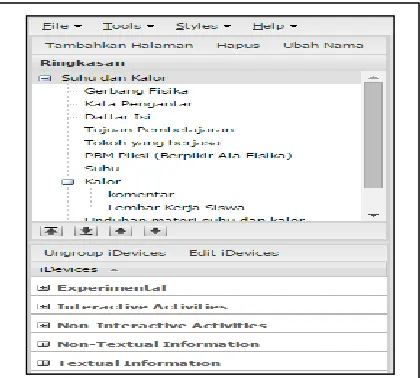
Exelearning has developed to solve some bandwidth limitations. There are many web authoring softwares requires fairly steep learning curve, not intuitive or not designed to publish the learning content. As a result, teacher and academics cannot adopt the technology to publish online learning material. Exelearning was built to provide intuitive and easy tool for teachers to publish professional webpage for teaching and learning. Most of content management and learning system management utilize a web server centered model, so it need to connectivity for authoring. This problem gives an obstacle to the writer who has low connection in bandwidth or does not have connectivity. Exelearning has been developed as an authoring offline tool without requirement to connect with bandwidth. Exelnearning facilitates user to create an appropriate learning structure fit with their content needed and build the flexible, easy, and renewable resources. Following Fig.1 describes more clearly the exelearning homepage window which consist of experimental, interactive activities, non-interactive activities, non-textual information, and textual information.
Fig. 1. exelearning homepage window
2.2 Problem Based Learning on Temperature and Heat Concepts
According to Arend [9], Problem Based Learning stages can be sorted in the Table 1, as follows:
TABLE1
PROBLEM BASED LEARNING STAGES
Stage Learning Process
Stage 1
Giving an orientation about the problem to students
Teacher explains learning purpose and logistic required, and motivate the students to involve in selected problem solving activities
Stage 2
Organizing students to learn
Teacher helps the students define and organize learning assignment that related to the problem
Stage 3
Individual and group guided investigation
Teacher encourages students to collect appropriate information, conduct the experiment to get the explanation and problem solving Stage 4
Developing and providing attainments
Teacher helps students to design and prepare the an appropriate creation, and help them communicate each other
Stage 5
Analyzing and evaluating problem solving process
Teacher helps student to reflect and evaluate their investigation and any processes used.
The role of teacher in this research as facilitator to make students can do the activity in constructing their knowledge through the previous knowledge. In particular, the role of teacher and student in problem based learning as follows:
1. Teacher gives motivation and stimulus to the students using picture
2. Teacher introduces a problem to the students in the beginning of the instruction
3. Student learns to create necessary things to solve problems
4. Student builds the knowledge and develop the problem solving skills during problem solving process,
5. Student set their learning independently to find out the solution of the given problem
6. Teacher acts as a facilitator in series of activities with the indicator:
a. Provide cognitive support, by asking a question that explores the knowledge and procedures required to solve the problem
b. Metacognitive support by asking the question on related topics, planning, monitoring, controlling, and evaluation of problem solving process.
c. Procedural support in the suitable form between challange problem and students’ ability, monitoring group’s development, supporting students in problem solving process and evaluating students’ performance.
61
further readings. A file can be downloaded by clicking on the underlined text that is available in flash format, document, and power point. The third block is the assignment stage, where in this stage student explains about heat problem, then communicate it. This assignment block can be divided into case study and exercise. In case study is presented a problem. In analyzing and evaluating students’ performance, students’ cognitive abilities and creative thinking skills exercises is presented in the quiz block. The quiz is presented in the multiple-choice form and completely completion solution and feedback available.
2.3 The implementation stage of exelearning-assisted PBL
Student in the experimental group have an exelearning-assisted problem based learning model during three lesson meetings, with the PBL stage as follows:
1. In this stage, students are taught how to open an exelearning learning materials through Wi-Fi that available on computer, laptop or Android-based smartphone, Windowsphone. Choose Wi-Fi connectify-me, enter the password 12345678. Then open internet
browser and type an IP
address.192.168.67.1/ebukuajar
2. First block starts with learning objectives and concept maps, activity stages, student motivation and problem orientation.
3. Second block is the stage of organizing students, where it delivered the presentation of learning material; 4. Third block is the stage of assignment, where student
was asked to explain and communicate the problem. 5. Last, the stage of analyzing and evaluating students’
performance provided the exercise.
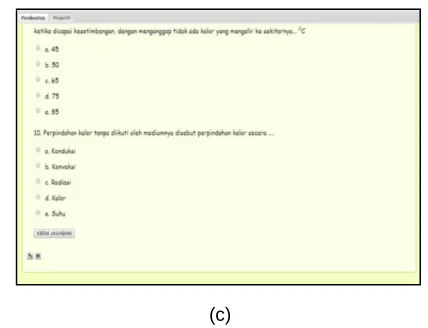
All of those stages were shown respectively in Fig. 2(a),(b),(c).
(a)
(b)
(c)
Fig. 2. Exelearning page of (a) problem orientation, (b) learning material on temperature and heat concept,
and (c) multiple choice quiz
3
M
ETHODA quasi experimental method with the static group pretest-posttest design [14] was used to involve randomly selected 48 ninth-grade students of Islamic Senior High School in Bandung, which divided into two groups, respectively 24 students each experimental and control group in academic year 2014/2015. Sample was given cognitive and creative thinking test in the beginning and the end of the instruction. Student in the experimental group who have exelearning-assisted problem based learning model, while in the control group who have problem based learning without exelearning on the temperature and heat concepts. The improvement of students’ cognitive abilities and creative thinking skills on temperature and heat concept was calculated by using normalized gain score. It is intended to avoid misinterpretation of the acquisition students’ gain score. To obtain normalized gain score was used the formula that proposed by Hake [12] as follow:
(Eq. 1)
where:
<g> = average normalized gain <Ti> = ideal score <Sf> = posttest score <Si> = pretest score
The averaged normalized gain are interpreted to determine the learning effectiveness criteria as shown in Table 2.
TABLE2
THE AVERAGE NORMALIZED GAIN INTERPRETATION
Average normalized gain <g> Criteria
(<g>) ≤ 0,7 High
0,3 ≤ (<g>) < 0,7 Medium (<g>) < 0,3 Low
contribution of two specific variables can use the determination coefficient (R) by Eq. 4
(Eq. 2)
2
1
2
r
n
r
t
(Eq. 3)R = (rxy) 2
x 100% (Eq. 4)
4 RESULT AND DISCUSSION
In this section, we describe the comparation of students’ cognitive ability and creative thinking skills between students who had exelearning-assisted problem based learning and they have not. Cognitive and creative thinking test was administered in the beginning and the end of the instruction.
TABLE3
THE AVERAGE NORMALIZED GAIN SCORE OF COGNITIVE ABILITY
FOR EXPERIMENTAL AND CONTROL GROUP
Group
Cognitive ability test
<g> Pretest Posttest
Mean S.D. Mean S.D
Experiment 21.46 6.83 48.75 8.24 0.34 Control 21.88 8.82 41.04 11.70 0.24
Based on the data presented in the Table 3, the average normalized gain score of students’ cognitive ability was 0.34 and 0.24, respectively for experimental and control group.While, the average normalized gain score of students’ creative thinking for experimental and control group was 0.34 and 0.25, resperctively. The experimental group n-gain score was significantly higher than the control group n-gain score. Comparation between students’ creative thinking score for both groups can be shown in the Table 4.
TABLE4
THE AVERAGE NORMALIZED GAIN SCORE OF CREATIVE THINKING
SKILL FOR EXPERIMENTAL AND CONTROL GROUP
Group
Creative Thinking Skills
<g> Pretest Posttest
Mean S.D Mean S.D
Experiment 50.82 11.73 67.66 11.61 0.34 Control 45.57 15.80 60.68 14.45 0.25
The improvement of fluency indicator in creative thinking skill, particularly in the experimental group, showed that student was able to ask a lot of question as much as possible through the given problem description. The ability to write the cause of an event was improved as 19%, while for original thinking, particularly guessing the impact indicators, where the students give an authentic/unique answer was also improved as 18%. As for complex thinking, 43% student can write changes or addition to develop a product. While for control group, the increased of creative thinking indicator which consist of fluency indicator in asking question, originality in guessing the
impact, and complex thinking to develop a product were 44%, 17%, 32%, in respectively. Then flexibility thinking in the guessing a cause showed an inconsistencies concept was 6%. The correlation between students’ cognitive abilities and creative thinking showed Pearson Product Moment coefficient rxy = 0.55 with tcount = 3.089 which is bigger than ttable =1.717. Thus, it can be said that the cognitive ability and creative thinking skills has significant correlation. To find out how much the contribution of the cognitive abilities that influence creative thinking skills process was calculated by using the coefficient determination, R=(0.55)2 x 100%= 30.67%. It means that students’ cognitive abilities influenced their creative thinking skills as much 30.67%, while the rest comes from the other variables outside studied variables.
5
C
ONCLUSIONBased on the discussion above, it showed that the improvement of students’ cognitive abilities and creative thinking skills that is taught by using exelearning-assisted problem based learning was significantly higher than student who had problem based learning without exelearning. There is also positive correlation between students’ cognitive abilities and creative thinking skills which lies in medium level of significant. Most of students also demonstrate highly motivation and excitement when they was taught using an exelearning-assisted problem based learning model.
6
A
CKNOWLEDGEMENTAuthor greatly thank to the SPs UPI’s faculty members and all persons who have given many contributions to this study. This research was funded by The Research & Development and Training & Education Agency of Ministry of Religious Affairs, Republic of Indonesia, 2015.
REFERENCES
[1] T.M. Blas & A.S Fernandez, The Role Of New Technologies In The Learning Process: Moodle As A Teaching Tool In Physics. Journal Computers & Education 52. 35-44. (2009).
[2] A.M. Fernandez, et.al. exelearning 2.0.1 portabel (windows)-zip (2012). Availabel online at http://exelearning.net/downloads/ [accessed on November 28, 2014]
[3] O. Akdemir, K. Kunt, & I. Tekin, The Effects of Interactive Exercises on Students’ Achievement: Using the Open Source Authoring Application. Procedia - Social and Behavioral Sciences 55, 1009 – 1013 (2012).
[4] S. Yeo, & M. Zadnik, Introductory Thermal Concept Evaluation: Assessing Students’ Understanding. The Physics Teacher 39, 496-504 (2001).
[5] L.M. Anderson, & D.R. Krathwohl, A taxonomy for learning, teaching and assessin: A revision of bloom’s taxonomy of educational objective. A bridged edition. Addison Wesley Longman, Inc. (2001). In A. Prihantoro (Translator) Kerangka landasan untuk, Pembelajaran, Pengajaran, dan Asesmen. Yogyakarta: Pustaka Pelajar.
[6] R. Harris. Introduction to Creative Thinking. (2012).
63
http://www.virtualsalt.com/crebook1.htm. [accessed on Maret 14, 2015].
[7] R.J. Sternberg. The Assessment of Creativity: An Investment-Based Approach. Creativity Research Journal 24(1), 3–12 (2012).
[8] S. Nurdin. Analisis Didaktik Pembelajaran Kalor Untuk Melatihkan Kemampuan Berpikir Kreatif Siswa Kelas X. Jurnal Tatar Pasundan Balai Diklat Keagamaan Bandung IX(24) (2015).
[9] R.I. Arends. Learning To Teach (Belajar untuk Mengajar) (2012). In H. P. Soetjipto, & S. M. Soetjipto (translator) Belajar untuk Mengajar. Yogyakarya: Pustaka Pelajar
[10]F. Sulaiman, R.K. Coll & S. Hassan. Comparison using PBL and Online Learning for Undergraduate Physics’ Students for Creative Thinking. Recent Technological Advances in Education Journal, 109-114 (2013).
[11]M. Liu. The Effect of Hypermedia Authoring on Elementary School Student’s Creative Thinking, J. Educational Computing Research 19(1) 27-51 (1998).
[12]R.R. Hake. Interactive-Engagement Methods in Introductory Mechanics Courses. Departement of Physics. Indiana University, Bloomingtoon (1998). Available online at: http://www.physics.indiana.edu/hake [accessed on Januari 12, 2015].
[13]Sugiyono. Metode Penelitian Pendidikan. Bandung: CV Alfabeta (2010).