IJEDR1701006
International Journal of Engineering Development and Research (www.ijedr.org)27
Locality Information based Routing Protocols in
Wireless Sensor Networks: A Literature Survey
1
Yuvraj Sahu,
2Chandrakant Mahobia,
3Devendra Kumar
1M.Tech. Scholar,2Assistant Professor,3M.Tech. 1CSE Department,
1School of Engg. & IT, MATS University, Gullu-Aarang Campus, Raipur (C.G.), India.
________________________________________________________________________________________________________ Abstract- There are several locality information based routing protocols focused by scientific community and all those have different approaches and performance. These protocols are well suited to specific kind of applications only. In this survey paper, an emphasis is made on locality information based routing to help researchers and potential users to choose the protocol best suited to their point of interest. However, though numerous, very few location based algorithms have actually been adopted for commercial purposes which may be clarified as a more restrictive and more efficient type of locality based routing protocol. In this survey paper, some locality information based routing protocols have been discussed with their advantages and disadvantages.
Index Terms - Locality information based routing protocols, geographic routing, wireless sensor networks (WSN).
________________________________________________________________________________________________________
I. INTRODUCTION
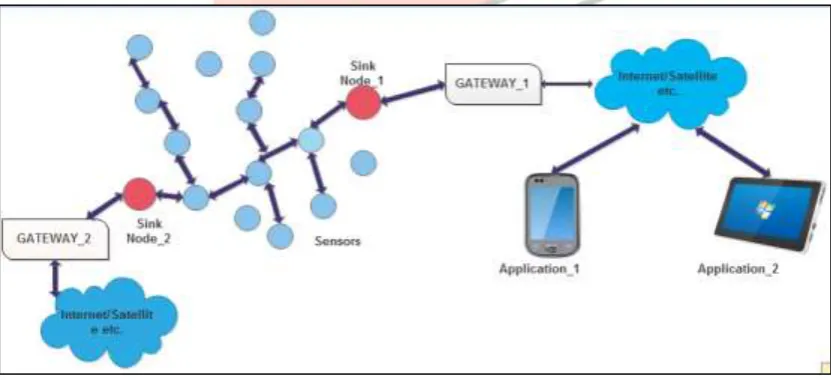
A wireless sensor network (WSN) consists of sensor nodes organized in a cooperative manner to form a network. WSN consists of sensor nodes deployed over a geographical area for monitoring physical phenomena like temperature, humidity, vibrations, seismic events, environment monitoring, military surveillance, and industrial process control and so on. These sensor nodes should communicate and send data packets to each other, over short distance by means of a wireless medium and work together to carry out a representative assignment or particular work. The sensor nodes are autonomous devices which combine with routers and a gateway to create a typical WSN architecture. The data packets are collected at the wireless sensor node, compressed and transmitted to the gateway directly or if required, they may use other sensor nodes to forward data to the gateway, which provides a connection to the wired world where it can collect, process, analyze and present the analyzed data via different application platforms (Laptop, Mobiles etc.). The following figure 1 depicts the overview of Wireless Sensor Networks (WSNs).
Figure 1: Typical Wireless Sensor Networks
IJEDR1701006
International Journal of Engineering Development and Research (www.ijedr.org)28
between a pair of sensor nodes so that messages may be delivered in a timely manner. The location based routing scheme is used to locate nodes within range of each other and thus pass messages or files as and when required. In this paper various location-based routing protocols for wireless sensor network are discussed.II. WSN ROUTING PROTOCOL CLASSIFICATION
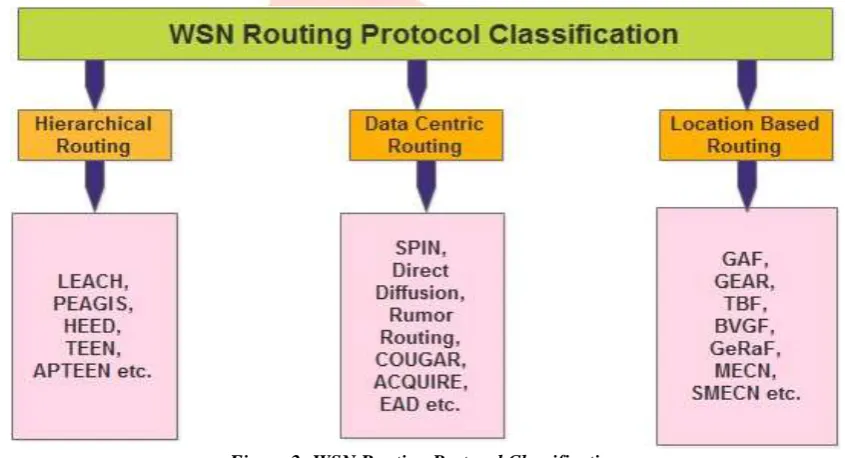
WSN routing protocols are categorized mainly into following three categories [1]; Hierarchical Network Routing, Flat Network Routing and Location Based Routing. The figure 2 depicts the classification of WSN routing Protocols.
In hierarchical network routing, the sensor nodes are restricted to communicate over each other on directly basis. In this type of routing, the sensor nodes send their collected information to the local base station, also known as Cluster Head. The basic idea behind such routing is that the bigger network is divided into clusters, each cluster has own cluster heads and these CHs are interconnected to precede the communication of the network. Large networks can be divided into clusters and interconnect through CH. Paths are defined by CHs. Some hierarchical network routing protocols are LEACH, PEAGIS, APTEEN, TEEN etc. In flat network routing [1], also known as data-centric routing; the sensor nodes need to know only its neighboring nodes. The sensor node communicate in an ad-hoc way and they reach the base station (BS) by multi-hop routing. The basic idea behind such routing is that the sink node sends queries to the certain regions and waits for data from the sensors located in the selected regions. Some flat network routing protocols are SPIN, Direct, Diffusion, Rumor routing etc.
Location based routing [1], also known as geographic routing; it utilizes the geographical location of nodes. The basic idea behind such routing is that each node knows it location by using the global positioning system (GPS) or some other indirect localization technique; in addition every node picked up locations of its immediate neighbors by exchanging hello messages. The localization algorithms impart principally three basic stages; Distance Estimation, Position Computation, Localization Algorithm. Some location based routing protocols are GAF, GEAR, TBF, BVGF etc.
Figure 2: WSN Routing Protocol Classification
III. IMPORTANT PROTOCOLS BASED ON LOCALITY INFORMATION
In this type of routing protocols, the sensor nodes are addressed by their location information. The following section describe some important locality information based routing protocols and they are described with advantages and disadvantages of each at the end.
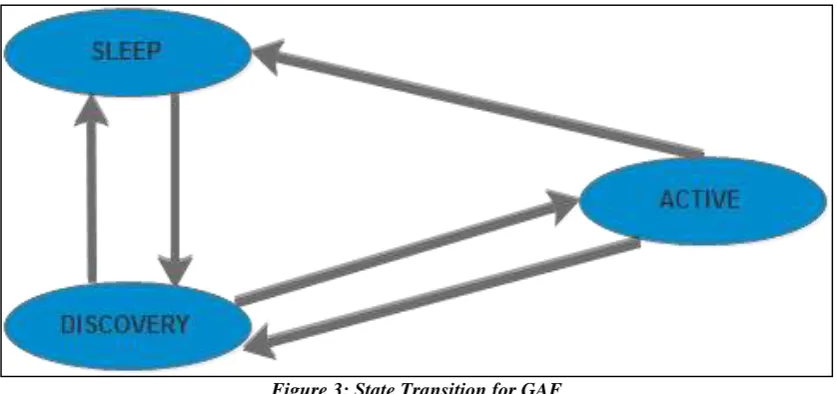
Geographic Adaptive Fidelity (GAF):
IJEDR1701006
International Journal of Engineering Development and Research (www.ijedr.org)29
Figure 3: State Transition for GAFGeographic and Energy-Aware Routing (GEAR):
GEAR stands for Geographic and Energy Aware Routing protocol. GEAR protocol uses the energy aware and geographically informed neighbor selection heuristic to route a packet towards the destination node or region. The key idea behind working of GEAR protocol is to restrict the number of interests in direct diffusion by only considering a certain region rather than sending the interests to the whole network. By doing so, GEAR can conserve more energy. The sensors can know about its location, their residual energy as well as neighbors too. The concept is comprises of two concepts; firstly, to route the data packets towards a target region through geographical and energy aware neighbor selection and secondly, disseminate the data packets within the region.
SPAN Protocol:
SPAN is also known as coordination of power saving with routing protocol. Earlier SPAN protocol is proposed for mobile ad hoc networks and later it is applied to wireless sensor networks because its aim is to reduce the energy expenditure. Since the sensor networks consume more energy; so the SPAN protocol is motivated using the concept and design is focused to consume the energy of sensor nodes during routing phase only. In this protocol, sensor nodes switch off the antenna even during ideal state in order to reduce the energy consumption; also doesn’t require the sensors to know their location information. This protocol uses a kind of geographic forwarding protocol which requires every sensor node to present its status to neighbor nodes along with the coordinators. In addition to this, when a sensor node receives a packet then a coordinator node forwards the data packet to next neighbor coordinator node if any; which would be closest to the destination node.
Trajectory-Based Forwarding (TBF):
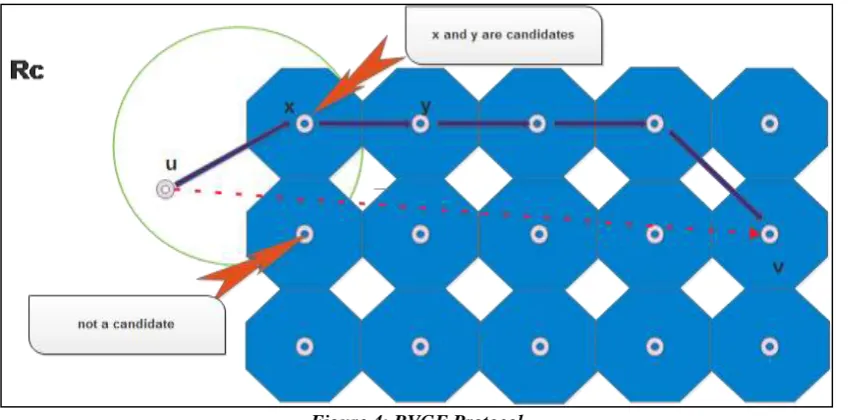
TBF stands for Trajectory Based Forwarding routing protocol. This kind of routing protocol is applied for dense wireless sensor networks and requires the coordinate based system among sensor nodes. The sensor nodes position themselves using GPS embedded on them and guesstimate the distance to their neighbor nodes. The source node sends the packet which follows the specific trajectory path towards destination, but it could not indicate the path based on hop-by-hop manner. Since all the sensor nodes are having location information of their neighbor nodes, so a forwarding sensor node makes a insatiable judgment to establish the next hop for forwarding the packet which is closer to the trajectory decided by the source node. The main key it includes is that the route maintenance process is unaffected when sensor nodes are moving in arbitrary directions because the source node sends packets which follow a trajectory path always, which does not include the name and position of sensor nodes. Bounded Voronoi Greedy Forwarding [BVGF]:
IJEDR1701006
International Journal of Engineering Development and Research (www.ijedr.org)30
Figure 4: BVGF ProtocolGeographic Random Forwarding (GeRaF):
GeRaF stands for Geographic Random Forwarding routing protocol. It was proposed by Zorzi and Rao. In this protocol, all sensor nodes act as relay node without knowing prior information about source node forwarding data packets in geographic routing manner. It reflects that this protocol does not guarantee that a source node would always be able to forward the data packet or message to its destination node. Although, GeRaF routing protocol combines geographical routing algorithm and awake sleep scheduling routing algorithm, this is the reason that sensor node does not require to keep track of their physical location as well as their awake sleep schedules. Whenever a source node wants to send the data packet to the destination node, firstly it checks whether the wireless channel is free or not, in order to avoid collision of data packets. When a source node assumes that the channel is at idle mode, and then it broadcast a request-to-send (RTS) encapsulated with information of its location and destination node to all of its active neighbor nodes of the network. When active neighbor node receive RTS message, they evaluate their preference based on their location and that of destination node. During this time period the source node waits for clear-to-send (CTS) message from any one of the sensor node located in high preference zone. The algorithm then chooses the best relay sensor node closest to the destination node making improvement in power topology which contains energy saving path from source node to destination node. Finally, the source node starts sending data packets to relay sensor node which in turn replies with the acknowledgement (ACK) messages.
Minimum Energy Communication Network (MECN):
MECN stands for Minimum Energy Communication Network routing protocol. It is a location-based protocol for attaining least energy for randomly deployed wireless sensor networks. Its main characteristic is that of self-configuring in nature which manages whole network connectivity instead of having sensors mobility. It figures out optimal spanning tree at the destination node, also known as minimum power topology which contains the multiple paths having minimum power from each sensor node to the sink node. It basically involves two phases; namely enclosure graph construction and cost distribution. In enclosure graph construction phase, it constructs a sparse graph based on immediate locality information of sensor nodes, i.e. a sensor node does not consider sensed location in its relay region as potential candidate forwarders to the destination node. In cost construction phase, non-optimal links of the enclosure graph are eliminated and a minimum power topology graph is resulted. Such graph formed has a direct path from each sensor node to the destination node which consumes minimal energy. Following figure 5 depicts that in MECN, how sensor nodes relies on localized search of each node through a relay region concept with node pair (I,r).
IJEDR1701006
International Journal of Engineering Development and Research (www.ijedr.org)31
Small Minimum-Energy Communication Network (SMECN):SMECN stands for Small Minimum Energy Communication Network routing protocol. This protocol is the improvement of MECN protocol which adds the resulted minimal graph as a minimum energy property. This property ensures that path obtained has lowest energy consumption among all other paths between sensor pairs. In this protocol, all the sensor nodes are initialized with some initial power ‘P’ and each sensor discover nearby neighbor nodes by broadcasting a neighbor discovery message, which is been later updated and incremented with some usage of power computed analytically. Then it checks whether the theoretical set of immediate neighbor node is a subset of the set of sensor nodes that replied in neighbor discovery message. The sensor node uses corresponding power ‘P’ to communicate with its neighbor nodes; if fails then it increments power ‘P’ and again broadcasts the neighbor discovery message to the network.
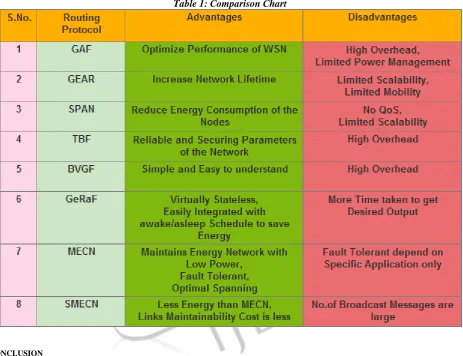
Following Table 1 shows the comparison chart of discussed locality information based routing protocols with their advantages and disadvantages.
Table 1: Comparison Chart
IV. CONCLUSION
Routing is an indispensable constituent of communication protocols in MANET. The blueprint of the protocols are driven by specific goals and requirements based on respective assumptions about the network properties. In this survey paper it is tried to report a study on the reactive routing protocols for MANET and reveal the characteristics and trade-offs. Each of the protocols studied performs well in some cases and has certain drawbacks in others. Hence, security and power awareness mechanisms should be built-in features for all sorts of applications based on ad hoc network. As a future work, effort will be made to propose a solution for routing in Ad Hoc networks by tackling core issues of secure and power aware/energy efficient routing.
REFERENCES
[1] ICICES2014 - S.A.Engineering College, Chennai, Tamil Nadu, India, ISBN No.978-1-4799-3834-6/14/$31.00©2014 IEEE,“A Survey of Reactive Routing Protocols in MANET”, Daxesh N. Patel, Sejal B. Patel, Hemangi R.Kothadiya,Pinakin D. Jethwa, Rutvij H. Jhaveri.
[2] C.S. Murthy, B.S. Manoj, Ad hoc Wireless Networks Architectures and Protocols, Prentice Hall, NJ, USA, 2004.
[3] S. Basagni, M. Conti, S. Giordano, I. Stojmenovic, Mobile Ad Hoc Networking, John Wiley & Sons, Inc., Hoboken, New Jersey, 2004.
IJEDR1701006
International Journal of Engineering Development and Research (www.ijedr.org)32
[5] C. Schurgers and M.B. Srivastava: Energy efficient routing in wireless sensor networks,in the MILCOMProceedings on Communications for Network-Centric Operations: Creating the Information Force, McLean, VA (2001).
[6] Y. Yao and J. Gehrke: The cougar approach to in network query processing in sensor networks, in SIGMOD Record (September 2002).
[7] C. Toh, A novel distributed routing protocol to support ad-hoc mobile computing, in: IEEE 15th Annual International Phoenix Conf., 1996, pp. 480–486.
[8] Y.-B. Ko, N.H. Vaidya, Location-aided routing (LAR) in mobile ad hoc networks, in: Proceedings of the Fourth Annual ACM/IEEE International Conference on Mobile Computing and Networking (Mobicom’98), Dallas, TX, 1998.
[9] G. Aggelou, R. Tafazolli, RDMAR: a bandwidth-efficient routing protocol for mobile ad hoc networks, in: ACM International Workshop on Wireless Mobile Multimedia (WoWMoM), 1999, pp. 26–33.
[10]M. Jiang, J. Ji, Y.C. Tay, Cluster based routing protocol, Internet Draft, draft-ietf-manet-cbrp-spec-01.txt, work in progress, 1999.
[11]J. Raju, J. Garcia-Luna-Aceves, A new approach to on-demand loop-free multipath routing, in: Proceedings of the 8th Annual IEEE International Conference on Computer Communications and Networks (ICCCN), Boston, MA, October 1999, pp. 522–527.
[12]M. Günes, U. Sorges, I. Bouazizi, Ara––the ant-colony based routing algorithm for manets, in: ICPP workshop on Ad Hoc Networks (IWAHN 2002), August 2002, pp. 79–85.