Understanding Students’ Prior Knowledge On The
Process Of Seeing And Perception Of Colors
Using The Grounded Theory: Implications To
Science Teaching
Ian Phil Canlas
Abstract: The foregoing is a part of a developmental study that attempted to investigate the prior knowledge of students on the process of seeing and perception of colors using the Grounded theory approach. One hundred twenty-two (122) university students in their first year taking programs under the College of Education and College of Arts and Sciences enrolled in a course on biological sciences took part in the study. Explanations of the students related to light absorption in photosynthesis were analyzed to establish an illustration on how they understand the process of seeing and perception of colors. Results revealed that a gap in their understanding of these concepts existed despite its introduction during their basic education. The use of common phenomena and daily context as a form of diagnostic assessment and the importance of integrated lessons were also discussed in this paper.
Keywords: prior knowledge, Grounded theory, light, process of seeing, perception of colors, integration, daily context
————————————————————
1 INTRODUCTION
The basic concepts of light and color are usually introduced to children as early as their first year of formal schooling in the kindergarten or the pre-elementary. Through the principle of spiral progression, concepts related to light that are more complex are introduced as they progress from one level to another higher level in the basic education and general education in the university level. Along this line, an increasing number of literature has enumerated and described how students understand the different concepts of light across different levels and races using standardized concept inventories and assessment. A number of these studies have attempted to address alternative conceptions using research-based teaching pedagogies. The foregoing study attempted to illustrate how university students understand the process of seeing and perception of colors using the Grounded theory approach knowing that light-related concepts are discussed not only in physics but as well as life sciences, art education and health education. This study made use of common phenomena and daily context as a technique for diagnostic assessment. Moreover, it discussed the importance of integration of disciplines in lessons as well.
2
T
HEORETICAL FRAMEWORKTwo theories were considered in the conceptualization of this study. In view of the teaching and learning perspective, it was anchored on the Constructivist theory. Meanwhile, Grounded theory was considered in the methodology of this study. An increasing number of recent studies on teaching and learning science were anchored on the Constructivist theory.
This learning theory offers a sound explanation as to how students learn especially in the sciences. It proposes that students create their own understanding based on the interaction of prior knowledge and the new knowledge and the ideas to which they come into contact [1]. As such, it argues that students successfully learn through experience-based activities rather than activities directed by the teacher [2]. It emphasizes the importance of knowing the prior knowledge as one of the factors that determine and shape the understanding of students when taught with new concepts in science [3]. In that, this research work was conceptualize. On the other hand, the Grounded Theory is a methodology in research that allows one to seek out and conceptualize patterns and structures from a specific area of interest [4]. This methodology allows the processing of qualitative and quantitative data in order to develop insights, theories among others that would best explain certain phenomena. An increasing number of studies in teaching and learning were anchored on the Grounded Theory. Along qualitative research in teaching and learning, this theory have allowed a number of researchers to gain insights and develop theoris based on the data they have gathered which have been helpful in redefining the perspective of the different aspects of teaching and learning. Hence, this study employed a methodology of gathering and analyzing data anchored in this theory in the hope of understanding better the prior knowldege of students on the process of seeing and perception of colors through light absorption in photosynthesis.
3 LITERATURE REVIEW
The teaching of light-related concepts is one of the themes in physics that is well studied. Several number of literatures in the past and recently have documented the teaching and learning of these concepts across different levels in the basic education and higher education. Three (3) categories were formed from these studies. First, were studies on students’ understanding and conceptions, which attempted to find out and enumerate prior knowledge and alternative conceptions of students. Another, were studies that attempted to develop and implement effective pedagogies to address alternative conceptions and increase students’ understanding. Finally, were studies that led to the development of standardized tool ____________________________
IAN PHIL CANLAS is a graduate of Master of Arts in Science Education-Physics Education and is currently teaching Physics at Nazarbayev Intellectual School of Physics and Mathematics in Kostanay, Kostanay City, Republic of Kazakhstan.
for assessment of students’ understanding of light-related concepts across different level.
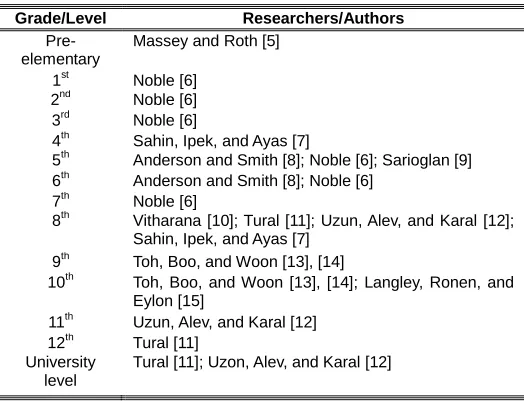
Table 1
Summary of reviewed studies on students’ understanding and conceptions of light-related concepts across different levels
Grade/Level Researchers/Authors
Pre-elementary
Massey and Roth [5]
1st Noble [6] 2nd Noble [6] 3rd Noble [6]
4th Sahin, Ipek, and Ayas [7]
5th Anderson and Smith [8]; Noble [6]; Sarioglan [9]
6th Anderson and Smith [8]; Noble [6] 7th Noble [6]
8th Vitharana [10]; Tural [11]; Uzun, Alev, and Karal [12]; Sahin, Ipek, and Ayas [7]
9th Toh, Boo, and Woon [13], [14]
10th Toh, Boo, and Woon [13], [14]; Langley, Ronen, and Eylon [15]
11th Uzun, Alev, and Karal [12] 12th Tural [11]
University level
Tural [11]; Uzon, Alev, and Karal [12]
Table 1 shows a summary of studies that attempted to find out how students understand light-related concepts across different age group and level that were reviewed for this paper. Notably, cross-age and level studies have been conducted from various groups. Massey and Roth [5] did a study in the pre-elementary (4-5 years old) while Noble [6] conducted a study in the primary level (1st to 3rd grade). Sahin, Ipek, and Ayas, [7], Anderson and Smith [8] and Noble [6] did a study in the intermediate level (4th to 6th grade) while Uzun, Alev, and Karal [12], Sahin, Ipek, and Ayas [7], Toh, Boo, and Woon [14] in the junior high school. Further, Uzun, Alev, and Karal [12] and Tural [11] conducted similar studies in the senior high school and university level. Accordingly, Sahin, Ipek, and Ayas [7] and Watts [16] reported and enumerated a number of alternative conceptions along light, sight, vision, and source of light. Anderson and Smith [8] and Noble [6] reported two (2) remarkable findings in separate studies conducted more than two (2) decades apart. These were the belief of the students that color is a property of an object rather than the color/s of light reflected by the object and seeing as a process of extramission or seeing the object directly rather than detecting the colors of the light reflected by the objects. Meanwhile, a number of studies used specific phenomena and material/instrument to find out how students understand light-related concepts. In the work of Tural [11], lenses were used to compare students’ conceptual understanding of geometric optics. Rice and Feher [17] made use of pinholes and images in finding out students conceptions of light and vision while Massey and Roth [5] and Barrow [18] used the formation of shadows to investigate the changes in conceptions of children on light. Two (2) factors were identified to have an effect in the understanding of students on light-related concepts. This include level and gender [13], [19]. The study of Toh, Boo, and Woon [13] specifically revealed a clear description as to how students’ understanding of light-related concepts progressed with increasing level. However, the same study found out that students have shown no concrete mastery of these concepts
even after formal teaching across levels. Langley, Ronen, and Eylon [15] confirmed the same in their study along light propagation and visual patterns. Meanwhile, to address alternative conceptions and increase students’ understanding of light-related concepts, a number of strategies have been developed and tested for its effectiveness. Barrow [18] proposed the use of three (3) principles of learning to help students construct understanding about light specifically the occurrence of shadows. It included knowing students’ prior knowledge, development of conceptual knowledge and application of metacognition. Ambrose [20] on the other hand, proposed to teach light-related concepts through questioning to enhance students’ understanding of light as an electromagnetic wave. Similarly, student-centered pedagogies anchored on constructivism and conceptual change model were also developed by Anderson and Smith [8], Sadler [21] and Sarioglan [9].
4 OBJECTIVES OF THE STUDY
The main objective of the study is to find out how students understand the process of seeing and perception of colors using the Grounded theory approach. Specifically it attempted to:
1. Illustrate students’ prior knowledge on the process of seeing and perception of colors using light absorption in photosynthesis;
2. Discuss the use of common phenomena and daily context in assessing for prior knowledge such as light absorption in photosynthesis; and
3. Explain the need of integration of lessons such as physics and biology in the case of photosynthesis.
5
M
ETHODOLOGYTable 2
Questionnaire used in the study
The visible light (white light) from the sun is a small fraction of the electromagnetic spectrum of the electromagnetic waves emitted by the sun. It is made-up of red, orange, yellow, green, blue, indigo, and violet. For plants, to be able to make its own food, it needs to absorb light from the sun. Of these colors, which is/are:
Questions Options
1. Useful in photosynthesis 1. Least useful in photosynthesis Explanations:
Table 3
Distribution of student respondents according to gender
Group Gender
Male Female Total
Class A 16 25 41
Class B 18 23 41
Class C 14 26 40
Total 48 74 122
Table 4
Distribution of student respondents according to age
Group Age Total
17 18 19 20
Class A 30 7 3 1 41
Class B 35 5 1 0 41
Class C 32 5 2 1 40
Total 97 17 6 2 122
Table 5
Distribution of student respondents according to program in the baccalaureate
Baccalaureate degree program
Class A
Class B
Class
C Total
College of Education
Elementary Education* 25 23 16 64
Secondary Education* 10 11 7 28
College of Arts and Sciences
Biology* 0 1 2 3
Social Work* 0 3 0 3
Information Technology* 2 0 5 7
Library Science* 1 1 2 4
Communications+ 2 1 3 6
Political Science+ 0 0 3 3
English+ 1 1 2 4
Total 41 41 40 122
Bachelor of Science (*) Bachelor of Arts (+)
Individual and group interviews were necessary to verify, confirm and affirm the written explanations of students. About twenty (20) randomly selected students underwent an in-depth interview. These students were considered representatives of the intended groups as identified from the responses of the two (2) questions. In this study, these were the students who answered green and shades of yellow as useful colors and indigo, violet, and blue as least useful colors in
photosynthesis. During the interview, another picture was used for purposes of cross-examination in confirming their understanding of the process of seeing and perception of colors.
Figure 1. Picture used during the in-depth interview
All data gathered were analyzed using the simple Collaizi method to find out themes and patterns from the explanations. Frequency counts and percentages were used in determining the occurrence of similar explanations.
6
R
ESULTS ANDD
ISCUSSIONS6.1 Results
After evaluation and analysis of the explanations, these results were obtained. Table 6 was a summary from the responses of students in Class A along useful color/s in photosynthesis.
Table 6
Summary of responses of students from Class A (Color/s of light useful in photosynthesis)
Responses Percentage
all colors 7%
all except green 5%
red 2%
yellow 5%
green 28%
blue 2%
violet 2%
combinations of color 49%
Total 100%
Table 7
Summary of responses of students from Class B (Color/s of light least useful in photosynthesis)
Responses Percentage
All colors 2%
Green 2%
Indigo 20%
Violet 13%
Red 5%
Blue 5%
Orange 5%
Yellow 5%
Combination of colors 43%
Total 100%
From this group, 43% of the students answered nineteen (19) combination of colors apart from those who answered all colors (2%). Although less than 50% of the total color combinations, its analysis revealed that, a remarkable number of these combinations included indigo (in 8 combinations), violet (in 7 combinations) and blue (in 7 combinations).
Table 8
Summary of responses of students from Class C to the two (2) questions
Useful color/s in
photosynthesis Percentage
Least useful color/s in photosynthesis
Percentage
all colors 2% all colors 2%
all except green 2% indigo 20%
green 30% violet 14%
yellow 7% blue 10%
blue 2% red 2%
violet 2% yellow 2%
red 2% combination of
colors 45%
combination of
colors 53% Total 100%
Total 100%
Meanwhile, table 8 summarized the responses of Class C. Similar pattern was obtained from this class upon comparing their answers to Class A and Class B. From the combination of useful colors, which comprise 53% of the answers, fifteen (15) combinations were enumerated. All of these combinations included green while majority included yellow (in 13 combinations), red (in 9 combinations), and orange (in 9 combinations). Meanwhile, from the same group, for least useful colors, seventeen (17) color combinations were recorded from the 45% of the answers. A number of these combinations included violet (in 15 combinations), indigo (in 10 combinations), and blue (in 9 combinations).
Table 9
Summary of responses of students from the interview using the picture in Figure 1
Responses Percentage
Red is absorbed 85% Red is reflected 15%
Total 100%
.
On the other hand, table 9 was the summary of the responses of the students who were interviewed using the picture in figure 1. It was revealed that 85% of this group believed that the color manifested by the object is the color being absorbed. In this case, the absorbed color was red; hence, the bag appeared red. Remarkably, 15% of this group correctly explained that the red color is reflected; hence, they see the bag as red.
6.2 Students’ prior knowledge on the process of seeing and perception of colors
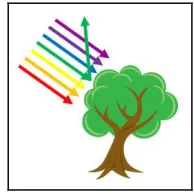
From the answers and responses of the questions and interviews respectively, it was revealed that students understanding on the process of seeing and perception of colors can be summarized as: (1) seeing as a process of extramission or seeing the objects directly and (2) perceived colors are the colors absorbed by the object. Figure 2 is a representation of the scientific worldview on the process of seeing and perception of colors while figure 3 is a representation of students’ prior knowledge on these concepts.
Figure 2. Scientific worldview on the process of seeing and
perception of colors
Figure 3. Illustration of students’ prior knowledge on the
process of seeing and perception of colors
Meanwhile, in Class B and C, the least useful color in photosynthesis was indigo. Violet and blue also were among the shades identified. Notably, these colors are among the colors that are not usually seen in plants. The following are some excerpts from the follow-up interview.
This confirms the interpretation of the findings from Class A and C along useful colors. In that, the colors that the students do not see were the colors not absorbed by the plants such as indigo, violet and blue. These colors were believed to be reflected. Meanwhile, the colors that the students see were considered useful and absorbed by the plants such as green and yellow. This were confirmed further when picture in figure 1 was used in the interview. It was revealed that 85% of those
who were interviewed thought that colors seen are the colors absorbed by the object.
Figure 4. Illustration of students’ prior knowledge on the
process of seeing and color perception using the picture in figure 1.
Figure 4 is an illustration on how students think they see and perceive colors. The following were excerpts from the interview of this group.
Student: An red an ginabsorb han bag amu nga an atun pagkita han bag red. (The red was absorbed by the bag so we see the bag as red.)
Student: Other colors are reflected and red is absorbed so we see the red bag.
Remarkably, 15% of these group who previously argued that green was useful in photosynthesis while shades of indigo, violet, and blue were least useful, have changed their point of view. They clearly explained that red is reflected, hence, they see the bag as colored red. This confirms the existence of inconsistency in their understanding on the process of seeing and perception of colors.
Table 10
Comparison of responses of students between light absorption in photosynthesis and the red bag
Stu
dent Explanation from photosynthesis Explanation on the red bag
1
An green amu an useful kay asya an ginaabsorb han leaves para magka-ada hin photosynthesis (The green is useful because it is the one
absorbed by the leaves for
photosynthesis to occur.)
The bag reflects the red color amu nga nakikita natun an bag na red. (The bag reflects the red color that is why we see the bag as red.)
2
Indigo and violet are least useful kay dire hiya gin aabsorb han plants. An green an gin aabsorb amu nga an dahon green liwat. (Indigo and violet are least useful because these are not absorbed by the plants. Green is being absorbed hence, leaves are green too.
It red amu an ginrereflect han bag asya nga an atun pagkita han bag red. An iba na color gin aabsorb han bag. Amu an ak nanumduman han ak high school teacher. (The red is reflected by the bag so we see the bag as red. Other colors are absorbed. I think that is what I recall from my high school teacher.)
3
Green it useful sir kaya amu an gin
aabsorb han plant para
photosynthesis. (Green is useful sir because it is the one being
absorbed by the plant for
photosynthesis.)
Red is reflected sir so we see the bag as red. It iba na colors iya gin aabsorb. (Other colors are being absorbed.) Student: Green is the most useful color.
Teacher: Why do you think so?
Student: Kay an dahon green it color. Ha dahon man nagkakaada hin photosynthesis. An green amu an gin aabsorb han dahon. (Because the leaves are green. It is in the leaves where photosynthesis takes place. Green is being absorbed by the leaves.)
Student: It should be the shades of green and yellow that are important.
Teacher: Why green and yellow?
Student: Kay usually an leaves it color green or yellow. Danay mayda gad liwat red. An green ngan yellow amu ito an ginaabsorb han plants para magkamayada photosynthesis. (Because leaves are usually green and yellow. Although at times there are red leaves. Green and yellow are being absorbed by the plants for photosynthesis to occur.)
6.3 Probing students’ prior knowledge using common phenomena and daily context: photosynthesis as an exemplar
The foregoing study made use of photosynthesis, a theme introduced as early as fourth grade in finding out students’ prior knowledge on the process of seeing and perception of colors. Results revealed that the technique was successful in revealing students’ prior knowledge along these light-related concepts. Likewise, its effectiveness can be proven when the results and findings of this study were compared to similar studies that made use of other methodologies. The alternative conceptions found in this study were similar to the work of Anderson and Smith [8] and Noble [6]. This include color being an objects’ property and extramission or seeing the objects directly. Similarly, along the level of scientific literacy described by Biological Science Curriculum Studies [22], the use of light absorption in photosynthesis in this study have revealed that majority of the students have only developed a nominal scientific literacy, in that, students only recognize the concepts as related to science, but alternative conceptions were present in their understanding. A few achieved a functional scientific literacy such that they were capable of describing the concept correctly but the level of understanding is limited. This confirms the work of Toh, Boo, and Woon [13] and Langley, Ronen, and Eylon [15] noting that students have not developed concrete mastery of the light-related concepts across levels. As a reflection from this study, the teacher-researcher and external observers noted and agreed that the utilization of common phenomena and daily context such as photosynthesis makes learning more relevant to students. Studies in the past suggested that using daily context may increase the conceptual attainment of the students to certain subject matter [23]. It may remove the barrier that isolates science from everyday contexts, which is a common experience from students of different levels. Literature suggests that it could increase the opportunity for students to develop greater competence in science-based decision-making [24]. Moreover, the technique provided the students clear and practical examples. It rekindled and sustained their interest in the lesson because by using photosynthesis, the theme related to light in the physics context become more familiar to them. In the later part of the study, participation of the students were elicited since the question given in the diagnostic test made them curious on something that in the beginning they though was so familiar and they did not pay attention. It was able to stimulate students to think and start questioning their own understanding. The following is an excerpt from the interview with one of the students.
“I know photosynthesis. Diri la ak maaram na an light na gin aabsorb han plants pwede ngay an may color.” (I know photosynthesis. I just do not know that the light being absorbed by the plants could possibly have colors.)
The use of this technique has achieved the first goal of the Conceptual Change model of learning which is to reveal and challenge the prior knowledge of students.
6.4 Integration of disciplines in lessons such as physics and biology in the case of photosynthesis High school and university sciences introduce photosynthesis as among the learning competencies in biology or natural sciences. However, as revealed in the study, introducing the said concept in the biological sciences perspective alone is not enough to develop a multidimensional scientific literacy, a level of literacy that allows students to develop an understanding and appreciation of science regarding its relationship with their daily life [22]. Interviews have revealed the inconsistencies in the understanding of students on the different light-related concepts as represented by the 15% who correctly explained the picture in figure 1. The same students have failed to explain correctly the perception of colors and light absorption in photosynthesis. The continuation of this study has revealed how boundaries between and among disciplines were removed through integration. It allowed the students to develop a more holistic understanding on the nature of science. An understanding that concepts in the sciences were interconnected and not bounded or divided. A number of studies in the past have supported the importance of integration of disciplines in lessons. Ann, Capraro and Tillman [25] proved that integration might increase the level of understanding of the students on the subject matter. Harwood and McMahon [26] noted that integration could result to an improved attitude of the students toward the discipline or the course. In addition, it allows the students to synthesize and make connections between multiple perspectives [27] and avoid the fragmented and irrelevant acquisition of isolated facts and allows the transformation of knowledge into personally useful tools for learning new information [28], [29], [30].
7
IMPLICATIONS
A number of implications can be derived from this study. Firstly, despite the introduction of light-related concepts in the basic education curriculum, it revealed that among university students, their exist a number of alternative conceptions on light-related concepts specifically on the process of seeing and perception of colors. These include seeing as a process of extramission or seeing the object directly and color being a property of an object. These findings were similar to a number of past studies conducted across levels and races. Secondly, the use of common phenomena and daily context such as light absorption in photosynthesis is possible in diagnosing students’ prior knowledge on light-related concepts. This technique was proven to be effective upon comparing the result of this study to past related studies on students’ understanding of light-related concepts. The said technique was particularly successful in revealing inconsistency on students’ understanding of these concepts. Lastly, the integration of disciplines in lessons is important if we want to achieve a multidimensional level of scientific literacy among students.
8
RECOMMENDATIONS
teaching strategy may be effective in addressing the alternative conceptions identified in this study and increase students understanding of these concepts. However, as these alternative conceptions tend to be persistent, the reason for its persistence across levels may be investigated and studied too. Moreover, it is suggested to make use of common phenomena and daily context as a technique in diagnostic assessment in other themes not only in the sciences but also across disciplines and have its effectiveness tested. In addition, a number of literatures suggested that the use of common phenomena and daily context maybe effective as an approach to teaching, hence, this context can be explored. Meanwhile, the later part of this study proved the importance of integration of disciplines in lessons. Although the concept of integration is quite young, an increasing number of literatures have proven the effectiveness of integration to increase students’ achievement and develop positive attitude towards the discipline among others. It is therefore recommended to investigate and document the effectiveness of integrating a number of disciplines among different themes and its long-term effects to students, its advantages and disadvantages. On the other hand, along the conduct of this study, it is recommended to utilize a larger population in the data gathering process. As this study was anchored on the Grounded theory, other quantitative methodology and statistical strategy to analyze the data gathered may be used for comparison of results. In addition, other common phenomena or daily context maybe used as an assessment tool and have its result compared to results of other related literatures.
REFERENCES
[1] L. B. Resnick, “Introduction” Knowing, learning, and instruction, L.B. Resnick, ed., Hillsdale, NJ: Lawrence Erlbaum; pp. 1-24, 1989.
[2] M. D. Roblyer, “Integrating educational technology into teaching”. 4th
ed., Upper Saddle River, NJ: Pearson Prentice Hall; 2006.
[3] I. Yuksel, “Activating Students’ Prior Knowledge: The Core Strategies,” World Applied Sciences Journal, vol. 20, no. 8, pp. 1197-1201, 2012.
[4] B. G. Glaser and A. L. Straus, “The Discovery of Grounded Theory. Strategies for Qualitative Research,” USA: Aldine Transaction; 1967.
[5] C. Massey, and Z. Roth, “Conceptual Change in Pre-school Science: Understanding Light and Shadow,” Biennial meeting of the Society for Research in Child Development, Denver, Colorado; April 2009 available at
www.ircs.upenn.edu/pennlincs/referenc/SRCD%20200 9_Massey%20&%20Roth.pdf
[6] A. M. Noble, “Primary-school children’s conceptions of light and their relation to the historical progression of optics,” Ph. D. Thesis. The University of Auckland, New Zealand, 2008.
[7] C.Sahin , H. Ipek , and A. Ayas, “Students’ understanding of light concepts primary school: A
cross-age study,” Asia-Pacific Forum on Science, Learning and Teaching, vol. 9, no. 1-7, 2008.
[8] C. W. Anderson, and E. L. Smith, “Children’s conceptions of light and Color: Understanding the role of unseen rays.” Michigan: The Institute for Research
on Teaching, 1986, available at
education.msu.edu/irt/PDFs/ResearchSeries/rs166.pdf
[9] A. B. Sarioglan, “The Effects of Instruction on 5th Grade Students’ Conceptual Understanding about Light,” Athens ATINER Conference Paper Series. No: EDU2014-0955, 2014.
[10]P. R. K. A. Vitharana, “Students’ Understanding of Light Concepts in the Secondary School,” International Journal for Innovation Education and Research, vol. 3, no. 6, pp. 36-49, 2015.
[11]G. Tural, “Cross-Grade Comparison of Students’ Conceptual Understanding with Lenses in Geometric Optics, “ Science Education International, vol. 26, no. 3, pp. 325-346, 2015.
[12]S. Uzun, N. Alev, and I. S. Karal, “A cross-age study of an understanding of light and sight concepts in physics,” Science Education International, vol. 24, no. 2, pp. 129-149, 2013.
[13]K. A. Toh, H. K. Boo, and T. L. Woon, “Gender Differences in Students’ Understanding of Light and Sight,” Joint ERA/AARE Conference Singapore, 1996,
available at
www.aare.edu.au/data/publications/1996/woont.96410 pdf
[14]K. A. Toh, H. K. Boo, and T. L. Woon, “Students’ perspective in understanding light and vision,” Educational Research, vol. 41, no. 2, pp. 155-162, 1999.
[15]D. Langley, M. Ronen, and B. S. Eylon, “Light Propagation and Visual Patterns: Preinstruction Learners’ Conceptions,”Journal of Research in Science Teaching, vol. 34, no. 4, pp. 399-424, 1997.
[16]D. M. Watts, “Student conceptions of light: a case study,” Physics Education, vol. 20, no. 4, pp. 183-187, 1985.
[17]K. Rice, and E. Feher, “Pinholes and images: Children’s conceptions of light and vision,” Science Education, vol. 71, no. 4, pp. 629-639, 1987.
[18]L. H. Barrow, “Helping Students Construct Understanding about Shadows,” Journal of Education and Learning, vol. 1, no. 2, pp. 188-191, 2012.
[20]B. Ambrose, “Using Research to Investigate and Enhance Student Understanding of Light as an Electromagnetic Wave,” Faculty Scholarly Dissemination Grants. Paper 230, 2011, available at http://scholarworks.gvsu.edu/fsdg/230
[21]P. M. Sadler, “Students’ conceptions of light and color and how they change,” American Astronomical Society, vol. 32, p. 1572, 2000.
[22]Biological Science Curriculum Studies (BSCS), “Developing biological literacy”, Dubuque, IA: Kendall Hunt Publishing Company, pp. 1-25, 1993.
[23]H. Dahncke, H. Behrendt, and P. Reiska, “A comparison of STS teaching and traditional physics lessons-On the correlation of physics knowledge and taking action”. In H. Dahncke and H. Behrendt, eds., Research in Science Education-Past, present, and future, pp. 77-82, 2001.
[24]C. C. Tsai, “The progression towards a constructivist epistemological vies of science: A case study of the STS instruction effects of Taiwanese high school female students,” International Journal of Science Education, vol. 21, pp. 1201-1222, 1999.
[25]S. An, M. M. Capraro, and D. A. Tillman, “Elementary Teachers Integrate Music Activities into Regular Mathematics Lessons: Effects on Students’ Mathematical Abilities,” Journal for Learning through the Arts: A Research Journal on Arts Integration in Schools and Communities, vol. 9, no. 1, 2013, available at http://escholarship.org/uc/item/0js732gf
[26]W. S. Harwood, and M. M. McMahon, “Effects of Integrated Video Media on Student Achievement and Attitudes in High School Chemistry,” Journal of Research in Science Teaching, vol. 34, no. 6, pp. 617-631, 1997.
[27]V. Boix Mansilla and E. Duraising, “Targeted Assessment of Students’ Interdisciplinary Work: An Empirically Grounded Framework Proposal,” Journal of Higher Education, vol. 78, no. 2, pp. 215-237, 2007.
[28]H. S. Atwa, and E. M. Gouda, “Curriculum Integration in Medical Education: A Theoretical Review,” Intellectual Property Right: Open Access, vol.2, no. 2, p. 113, 2014.
[29]L. Wafula, “Teachers’ Exposure, Training and Professional Preparedness on the Use of the Integrated Method of Teaching oral Literature in Uasin-Gishu County, Kenya,” Journal of Emerging Trends in Educational Research and Policy Studies, vol. 3, no. 4, pp. 410-41, 2012.