I uoor<^
Early processes in recognition , A
John R. Skoyles
Thesis submitted to the University of London for the
Degree of
Doctor of Philosophy
Department of Psychology, U n i v e r s i t y College London, U n i v e r s i t y of London,
ProQuest Number: 10609138
All rights reserved
INFORMATION TO ALL USERS
The qu ality of this repro d u ctio n is d e p e n d e n t upon the q u ality of the copy subm itted.
In the unlikely e v e n t that the a u th o r did not send a c o m p le te m anuscript and there are missing pages, these will be note d . Also, if m aterial had to be rem oved,
a n o te will in d ica te the deletion.
uest
ProQuest 10609138
Published by ProQuest LLC(2017). C op yrig ht of the Dissertation is held by the Author.
All rights reserved.
This work is protected against unauthorized copying under Title 17, United States C o d e M icroform Edition © ProQuest LLC.
ProQuest LLC.
789 East Eisenhower Parkway P.O. Box 1346
Abstract
Recent work in psychophysics and neurophysiology suggests
that vision is divided into two channels magno (transient)
and parvo (sustained). What relationship do the two vision
channels have to the recognition of written words? Two
theories have been suggested: first, that the magno
(transient) channel inhibits the visual persistence of words
seen in the parvo (sustained) channel; and second, that
dyslexics have a defective magno (transient) channel which
disrupts this persistent inhibition and causes a low level
visual problem seeing words. None of these theories is
supported by direct research upon the two channels and
reading.
Neurophysiologists have developed techniques for selectively
blocking the two channels. They are noninvasive and enable
the direct investigation of the role of each channel in
stimulus processing. These depend upon manipulating the
visual characteristics of the stimuli. These techniques were
adapted for use in reaction time experiments displayed on a
PC fitted with a VGA graphics card.
Preliminary research uncovered a previously unreported
luminosity artifact which affects the boundaries of images
presented on, at least some, PC monitors. A correction was
The technique for blocking parvo channel stimulus perception
while permitting magno channel stimulus perception involves
presenting images in counterphase: the magno channel unlike
the parvo one can resolve fast alternating images. It was
found that counterphase stimuli can be recognised through a
process which side steps temporal resolution. Experiments in
this thesis show that this process can be blocked by
preceding counterphase stimuli by premasks.
Lexical decision and letter matching were investigated using
magno and parvo blocking techniques. There were indications
that word vs nonword classifications and letter length were
affected. However other variables such as word frequency and
imageability were not. There is evidence in letter matching
that positive identity matches between letters were affected
Acknowledgements
When I started this thesis I had two ideas, one good
and one bad. One was published in N a t u r e , and solicited as
the basis of a book. This thesis is not that idea. I
t h a n k . ..
Chris McManus, Alan Johnson, Semir Zeki, Dr. Kenneth
Knoblauch, V. S. Ramachandran, Frank Vellutino and Jackie
Masterson for various kinds of technical help and advice;
for those friends and fellow humans who supported and
tolerated me in their own ways during the preparation of
this thesis; to those that suffered my experiments
particularly to Caroline Christie and Mary Ward whose work
while not included in this thesis did much to inspire it.
And finally completing a thesis is a difficult task — I
thank Brian Butterworth for his uncanny and unique talent to
saying the right thing at the right time in the right
manner. Lastly to my extraordinary father who never doubted
my capacity to complete this thesis and more importantly
CONTENTS
Page
Abstract ii
Acknowledgements iv
List of Tables xiii
List of Figures xiv
List of Appendixes xix
Prolegomena xxvii
CHAPTER 1 VISION AND READING — A REVIEW OF PRESENT
RESEARCH.
1.1 Introduction 1
1.2 . Transient and sustained channels 7
1.3. Breitmeyer's theory of reading 8
1.4. Lovegrove's theory of dyslexia 16
1.4.1. Introduction 16
1.4.2. Preliminary observations
upon implausibility 19
1.4.3. Lovegrove's research 23
1.4.4. Problems with Lovegrove's
research 25
1.4.5. Lovegrove's data for normal
readers and low level visual
transient problems 30
1.4.6. Lovegrove's mistake 32
CHAPTER 2
1.6. Lessons from Breitmeyer and
Lovegrove 43
Postscript 44
notes 47
THE TWO VISUAL CHANNELS: THE NEUROANATOMICAL
AND NEUROPHYSIOLOGICAL DIMENSION.
2.1 Introduction: the importance of neuroanatomy and neurophysiology of the
two channels. 51
2.2. Overview: division in the visual
system 54
2.3. The two visual channels 56 2.3.1. Retinal Pa and P/3 ganglions. 56
2.3.2. Lateral geniculate nucleus. 58
2.3.3. Primary visual cortex 59
2.3.4. Beyond the primary visual
cortex 60
2.3.5. Conclusions 64
2.4. Experimental blocking of the two
channels 65
2.4.1. Livingstone and Hubei
approach to blocking. 65
2.4.1.1. Heterochromatic
photometry. 66
2.4.2. Counterphase blocking 72
CHAPTER 3: TECHNICAL FACTORS
3.1. Experimental set-up. 82
3.2. Reaction time measurement 82
3.2.1. Accuracy 82
3.3.2. Timers 83
3.2.3. Synchronisation. 84
3.2.4. Registering responses. 86
3.3. Screen and luminosity control 87
3.3.1. Monitor Calibration 87
3.3.2. Gamma function 88
3.3.3. Contrast 89
3.3.4. Phosphor persistence 92
3.3.5. Mean luminosity 92
3.4. Luminosity artifacts 93
3.4.1. The cold pixel effect. 94
3.5. Isoluminosity point 96
3.5.1. Isoluminosity values. 96
3.5.2. Evaluation 97
3.6. The flicker and static stimuli 99
3.7. The stimuli 100
CHAPTER 4 EXPERIMENTS ON THE PERCEPTIBILITY OF COUNTERPHASE LETTERS.
4.1. Introduction 4.2. Experiment 1.
4.2.1. Introduction
4.2.2. The grid paradigm
4.2.3. M e t h o d .
4.2.4. Procedure.
4.2.5. Grid reading.
4.2.6. Tachistoscopic reading.
4.2.7. Results
4.2.7.1. Grid reading.
4. 2.7.2. Errors.
4. 2.7. 3. Reaction times.
4.2.8. Discussion.
4.3. Perception side-stepping counterphase
4.3.1. Grid reading
4.3.2. Tachistoscopic reading
4.4. Experiment 2
4.4.1. Method and p rocedure.
4.4.2. The mask
4.4.3. Results.
4.4.4. Discussion
CHAPTER 5:
4.5. Experiment 3
4.5.1. Introduction 139
4.5.2. Methods and procedures 141
4.5.3. Results 143
4.5.4. Discussion 149
4.6. Conclusions 150
notes 153
LEXICAL DECISION EXPERIMENTS
5.1. Introduction 156
5.2. Three lexical decision experiments 158
5.2.1. Aim. 158
5.2.2. Lexical decision and lexical
processing. 158
5.2.3. Word frequency 161
5.2.4. Imageability 165
5.2.5. Letter length 168
5.3. Experimental design 171
5.3.1. Factoring 171
5.3.2. Stimuli 172
5.3.3. Subjects 173
5.3.4. General description of
Method 174
5. 3. 4.1. Experiment procedure 174
5.4. Results 177
5.4.1. General 177
5.4.2. Experiment 4. 178
5.4.3. Experiment 5. 186
5.4.4. Experiment 6. 192
5.5. 'Magno' and 'Parvo' — A new
interpretation. 196
5.5.1. Problems 196
5.5.2. Experiments 4 and 6: In the
light of the new interpretation. 204
5.6. Letter length effects. 208
5.6.1. Experiment 4 208
5.6.2. Experiment 5 211
5.6.3. Experiment 6 213
5.6.4. Experiments 4 and 6 compared. 216
5.6.5. Conclusions: Letter length. 217
5.7. Conclusions. 219
5.7.1. The 'magno1 and 'parvo'
stimuli and the two visual
channels. 220
5.7.2. The two visual channels and
lexical processing. 223
CHAPTER 6: EARLY VISUAL PROCESSES IN READING.
6.1. Introduction 226
6.2. The letter matching task 228 6.2.1. Posner's contribution 228
6.2.2. Abstract letter identities
in the letter matching task 232
6.3. Experiment 7 235
6.3.1. Rationale 235
6.3.2. Stimuli 236
6.3.3. Method 237
6.4. Analysis of results — Experiment 7 238 6.4.1. Fallacy of language-as-a-
fixed-effect 238
6.4.2. Terminology 239
6.4.3. Contrasts 240
6.5. Findings — Experiment 7 240
6.5.1. Double static 240
6.5.2. All presentation conditions 245
6.5.3. Cross factor 250
6.5.4. Side factor 254
6.5.5. Double flicker (fl+fl) and
double static (S+S) 257
6.5.6. Side of flicker factor 258
6.5.7. Laterality effects 259
6.6. Conclusions 260
6.6.1. Counterphase 260
6.6.2. Abstract letter identities 262
6.6.3. Magno channel
and letter matching 262
CHAPTER 7 CONCLUSIONS
7.1. Resume 266
7.2. Further work 277
7.2.1. Reaction time research and
magno blocking 277
7.2.2. Magno blocking and reading 278
7.2.3. Magno blocking and dyslexia 278
References 281
List of Tables
CHAPTER 4 EXPERIMENTS ON THE PERCEPTIBILITY OF COUNTERPHASE
LETTERS.
Table 4.1. Counterphase letters Experiment l. Time to read 20 grid
letters. 121
Table 4.2. Counterphase letters
Experiment 1. Mean reaction times and
errors for tachistoscopic presented
letters. 121
Table 4.3. Counterphase letters Experiment 2. Time to read 20 grid
letters. 133
Table 4.4. Counterphase letters
Experiment 2. Mean reaction times and
errors for tachistoscopic presented
letters. 133
Table 4.5. Counterphase letters
Experiment 3. Means, SDs, and error scores. 145
CHAPTER 5 LEXICAL DECISION EXPERIMENTS
Table 5.1. Differences in the three lexical decision experiments between means for the
two visual conditions for various lexical
factors compared. 199
CHAPTER 6: EARLY VISUAL PROCESSES IN READING.
Table 6.1. Experiment 7: means, Sds and percentage errors for the four letters
List of Figures
CHAPTER 1 VISION AND READING — A REVIEW OF PRESENT
RESEARCH.
Figure 1.1. Outline of organisation of this
Figure 1.2. The perceptual blurring of
sustained images across fixations; taken with
slight adaptations from Breitmeyer (1980) who
modelled the illustration after Hochberg,
Figure 1.3. Hypothetical channel interaction
during reading fixations. Sequence of
fixations, top panel, Sustained responses,
second down, Transient responses, third down,
resultant interaction, bottom. Taken with
slight adaptation from Breitmeyer (1980). 10
Figure 1.4. Contrast between the disruption
of sustained channel activation (metacontrast
in the fovea) and that of the transient
channel (the jerk effect in the periphery).
From Breitmeyer (1984). 11
CHAPTER 2 THE TWO VISUAL CHANNELS: THE NEUROANATOMICAL
AND NEUROPHYSIOLOGICAL DIMENSION.
Figure 2.1. Magno and parvo channels cortical
connections and interactions. Copied from
DeYoe & Van Essen (1988). Some connections
and the following chapter 6
1978 9
CHAPTER 3 TECHNICAL FACTORS
Figure 3.1. Gamma function curves (luminosity
in candela per meter squared against control
units) for the red (bottom) and green (top)
phosphors on the NEC Multisync 3D a monitor
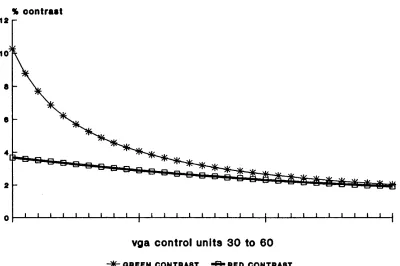
Figure 3.2. Contrast between adjacent vga
control units for the red (bottom) and green
(top) phosphors. Note, that since the
original luminosities were sampled every two
units it have been calculated from the
quadratic formula given above. 91
CHAPTER 4 EXPERIMENTS ON THE PERCEPTIBILITY OF COUNTERPHASE
LETTERS.
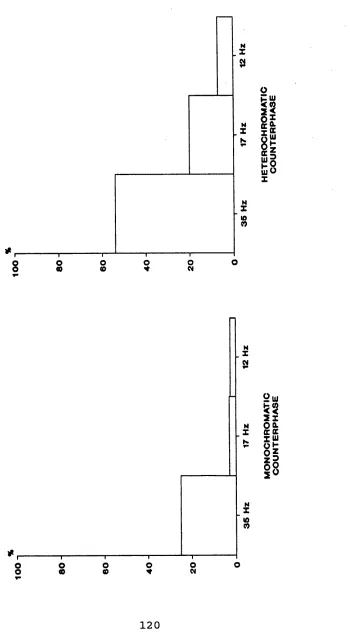
Figure 4.1. Counterphase letters experiment
1. Error data (tachistoscopic presentation).
Left side: monochromatic letters; right side:
Figure 4.2. Counterphase letters experiment
2. Error data (tachistoscopic presentation).
Left side: monochromatic letters; right side:
measured with an optometer. 89
heterochromatic letters. 120
heterochromatic letters. 133
Figure 4.3. Experiment 3. Error data
(tachistoscopic presentation). Left side:
monochromatic letters; right side
CHAPTER 5 LEXICAL DECISION EXPERIMENTS
Figure 5.1. Summary of the two visual
presentations 'magno' and 'parvo' and
theoretical rationale.
Figure 5.2. Illustration of Ellis, Young and
Anserson's (1988) model of processes which
give rise to length effects. With
alternations from their illustration on page
269.
Figure 5.3. Experiment 3. Graph illustrating
the main effect of 'channel' upon word
nonword reaction times and errors.
Figure 5.4. Experiment 4. Graph illustrating
the main effect of 'channel' upon lexical
factors.
Figure 5.5. Experiment 5. Lexical factors and
the two channels. Reaction times and errors.
Figure 5.6. Experiment 5. Word and nonwords.
Reaction times and errors.
Figure 5.7.a. Experiment 6. Graphs
illustrating the main effect of 'channel'
upon word and nonwords reaction times and
e r r o r s .
Figure 5.7.b. Experiment 6. Graphs
illustrating the main effect of 'channel'
upon lexical factors.
Figure 5.8.a. Lexical factors and spatial
frequency effects in Experiments 4 and 6
157
169
184
185
190
191
194
compared.
Figure 5.8.b. Interaction between
counterphase (Experiments 4)/ static
(Experiment 6) and 'magno' and 'parvo'.
Nonwords and words.
Figure 5.9. Illustration of the 'magno' and
'parvo' channel effects between the first and
third experiments in terms of the various
factors blocking and permitting visual
perception.
Figure 5.10. Experiment 4: Letter length
effects for reaction times. Words vs
nonwords.
Figure 5.11. Experiment 5: Letter length
effects for reaction times. Words vs
nonwords.
Figure 5.12. Experiment 6: Letter length
effects for reaction times. Words vs
n o n words.
Figure 5.13. Length effects for counterphase
and static nonwords compared.
CHAPTER 6: EARLY VISUAL PROCESSES IN READING.
Figure 6.1. Posner and Mitchell (1968) data
for the name identity match rule (left) and
physical match rule right.
Figure 6.2 Experiment 7. Reaction times
(left) and errors (right) to the all static
presentation of letters.
195
198
204
210
212
215
218
231
Figure 6.3. Experiment 7: both letters static
presentation; reaction times (left) and
errors (right) for the four letters.
Figure 6.4. Experiment 7. Reaction times
(left) and errors (right) for the four letter
presentations.
Figure 6.5. Experiment 7: L e t t e r s ; Reaction
times (left) and errors (right) all
conditions collapsed.
Figure 6.6. Experiment 7: Cross factor,
reaction times left graph; errors right.
Figure 6.7. Experiment 7: Cross factor by
letters; same (left); crossed (right).
Figure 6.8. Experiment 7: Crossed factor:
reaction times (left); errors (right).
Figure 6.9. Experiment 7: Crossed factor:
Reaction times (left) and errors (right) for
the four letters.
244
247
248
252
253
255
List of Appendixes
Section Is ANOVA tables.
Table 4.1. Experiment is Repeat measures ANOVA, Errors (lum = monochromatic/
heterochromatic factor).
Table 4.2. Experiment Is Repeat measures ANOVA, Errors, contrast for monochromatic
counterphase.
Table 4.3. Experiment 1: Repeat measures ANOVA, Errors, contrast for heterochromatic
counterphase.
Table 4.4. Experiment is Repeat measures ANOVA, Reaction times
Table 4.5. Experiment 1: Repeat measures ANOVA, Reaction times, contrast for
monochromatic counterphase.
Table 4.6. Experiment 1: Repeat measures ANOVA, Reaction times, contrast for
heterochromatic counterphase.
Table 4.7. Experiment 2: Repeat measures ANOVA, Errors.
Table 4.8. Experiment 2: Repeat measures ANOVA, Errors, contrast for monochromatic
counterphase.
Table 4.9. Experiment 2: Repeat measures ANOVA, Errors, contrast for heterochromatic
counterphase.
311
311
311
312
312
312
313
313
Table 4.10. Experiment 2: Repeat measures ANOVA, Reaction times
Table 4.11. Experiment 2: Repeat measures ANOVA, Reaction times, contrast for
monochromatic counterphase.
Table 4.12. Experiment 2: Repeat measures ANOVA, Reaction times, contrast for
heterochromatic counterphase.
Table 4.13. Experiments 1 and 2: Repeated measures ANOVA, Errors
Table 4.14. Experiments 1 and 2: Repeated measures ANOVA, Errors, contrast for
monochromatic counterphase.
Table 4.15. Experiments 1 and 2: Repeated measures ANOVA, Errors, contrast for
heterochromatic counterphase.
Table 4.16. Experiments 1 and 2: Repeat measures ANOVA, Reaction times
Table 4.17. Experiments 1 and 2: Repeat
measures ANOVA, Reaction times, contrast for
monochromatic counterphase.
Table 4.18. Experiments 1 and 2: Repeat
measures ANOVA, Reaction times, contrast for
heterochromatic counterphase.
Table 4.19. Experiments 1 and 2: Split plot repeated measures ANOVA, Time taken to read 20
grid letters.
314
314
314
315
315
315
316
316
316
Table 4.20. Experiments 1 and 2. Split plot ANOVA. Percentage of errors which were
missing responses to other errors.
Table 4.21. Experiment 3. Errors. Repeated measures ANOVA comparison between the
counterphase mask and the unmasked condition.
Table 4.22. Experiment 3. Errors. Repeated measures ANOVA comparison between the static
mask and unmasked condition.
Table 4.23. Experiment 3. Errors. Repeated measures ANOVA comparison between the
counterphase mask and the static mask.
Table 4.24. Experiment 3. Reaction time. Repeated measures ANOVA comparison between
the counterphase mask and the unmasked
condition
Table 4.25. Experiment 3. Reaction time. Repeated measures ANOVA comparison between
the static mask and the unmasked condition.
Table 4.26. Experiment 3. Reaction time. Repeated measures ANOVA comparison between
the counterphase mask and the static mask.
Chapter 5 (Experiments 4, 5 and 6).
Table 5.1. Experiment 4: Reaction times and word factor. Repeated measures ANOVA.
Table 5.2. Experiment 4. Errors and word factor. Repeated measures ANOVA.
317
318
318
318
319
319
319
320
Table 5.3. Experiment 4: Reaction times and lexical factors. Anova with subjects as
random factor.
Table 5.4. Experiment 4. Errors and lexical factors. Repeated measures ANOVA.
Table 5.5. Experiment 5. Reaction time and word factor. Repeated measures ANOVA.
Table 5.6. Experiment 5. Errors and word factor. Repeated measures ANOVA.
Table 5.7. Experiment 5. Reaction time and lexical factors. Repeated measures ANOVA.
Table 5.8. Experiment 5. Errors and lexical factors. Repeated measures ANOVA.
Table 5.9. Experiments 4 and 5, Split Plot ANOVA on reactions times and Lexical factors.
Table 5.9. Experiment 6: Reaction time repeated measures ANOVA.
Table 5.10. Experiment 6. Errors and word factor. Repeated measures ANOVA.
Table 5.11. Experiment 6. Reaction times and lexical factors. Repeated measures ANOVA.
Table 5.12. Experiment 6. Errors and lexical factors. Repeated measures ANOVA.
Table 5.13. Experiment 4 and 6: Reaction time and words and nonwords factor, Split plot
ANOVA.
Table 5.14. Experiment 4 and 6: Errors, words and nonwords factor, Split plot ANOVA.
Table 5.15. Experiments 4 and 6. Reaction
times and lexical factors. Split plot ANOVA.
Table 5.16. Experiment 4 and 6: Errors and
lexical factors. Split plot ANOVA.
Table 5.17. Experiment 4: Letter length
effects (four, five and six letter stimuli).
Repeated measures ANOVA for reactions times.
Table 5.18. Experiment 5: Letter length
effects (four, five and six letter stimuli).
Repeated measures ANOVA for reactions times.
Table 5.19. Experiment 6: Letter length
effects (four, five and six letter stimuli).
Repeated measures ANOVA for reactions times.
Table 5.20. Experiments 4 and 6. Reaction
time length effects: Split Plot ANOVA
Table 5.21. Experiment 4 and 6: Errors and
lexical factors. Split plot ANOVA.
Table 5.22. Experiments 4 and 6: Errors,
words and nonwords, split plot ANOVA.
CHAPTER 6: EARLY VISUAL PROCESSES IN READING.
Table 6.1. Experiment 7: static only condition
Reaction times ANOVA with subjects as random
factor.
Table 6.2. Experiment 7: static only
condition; Errors ANOVA with subjects as
random factor.
328
329
330
331
332
333
334
335
336
Table 6.3. Experiment 7: static only condition; Reaction times ANOVA with
characters as random factor.
Table 6.4. Experiment 7: static only
condition; Errors ANOVA with characters as
random factor.
Table 6.5. Experiment 7. Reaction times with subjects as random factor.
Table 6.6. Experiment 7: errors with subjects as random factor.
Table 6.7. Experiment 7: reaction times with items (characters) as random factors.
Table 6.8. Experiment 7: errors with items (characters) as random factors.
Table 6.9. Experiment 7: Reaction times; flicker vs static judgements, subjects as
random factor.
Table 6.10. Experiment 7: Errors; flicker vs static matches; subjects as random factor.
Table 6.11. Experiment 7: reaction times; left vs right flicker, subjects as random
factor.
Table 6.12. Experiment 7: Errors, left vs right flicker, subjects as random factor.
Table 6.13. Experiment 7: reaction times, flicker vs static matches, letters as random
Table 6.14. Experiment 7: Errors, flicker vs static matches, letters as random factor.
Table 6.15. Experiment 7: reaction times, left vs right flicker, letters as random
factor.
Table 6.16. Experiment 7: Errors, left vs right flicker, letters as random factor.
Section 2: Stimuli data
Table C.l.a. The lexical decision task words, their frequency and imageability
values (from the MRC data base) and the
their mean reaction time in milliseconds
and error rate in ^percentage for each of
three experiments.
Table C.l.b. The lexical decision task nonword stimuli, and the their mean reaction
time in milliseconds and error rate in
percentage for each of the three experiments.
Note experiment 5 used a different set of
nonwords (created by insertion of randomly
chosen consonants in the vowel letters of the
wordlike nonwords on the le f t ) . These
nonwords and their experiment 5 means and
errors are on the right. Note both lists of
nonwords are matched for length with the
words which appear in the previous table.
Table C.2.a. Experiment 4. Means and error rates for words and nonwords.
343
344
344
345
349
Table C.2.b. Experiment 4: Subject means, standard deviations and percent errors across
conditions
Table C.3.a. Experiment 5. Means and error rates for words and nonwords.
Table C.3.b. Experiment 5: Subject means, standard deviations and percent errors across
conditions
Table C.4.a. Experiment 6. Means and error rates for words and nonwords.
Table C.4.b. Experiment 6: Subject means, standard deviations and percent errors across
conditions
Table D.l. Experiment 7. Individual means, SDs and error percentages for the ten
subjects in the four conditions.
Section 3: Programs.
A. Timer program (Brysbaert, Bovens, d'Ydewalle
& Calster, 1989).
Program for Experiment 3 (Chapter 4)
Programs for Experiment 4 (Chapter 5)
Isoluminosity evaluation
Experiment
Program for Experiment 7 (Chapter 6)
354
355
356
357
358
359
360
361
374
379
Prolegomena
What is a thesis?
'A thesis should be ... an original
contribution to knowl e d g e '. Instructions to PhD candidates.
But what is an original contribution? A s u p e r v i s o r s
pet idea they have not time for? Original in idea but not in
method or in execution? Even where the candidate contributes
ideas the means and methods used to explore them are
frequently well worn from the experience of others.
There is a place for the thesis which attempts serious
originality — that which asks novel questions and explores
novel techniques for answering them. Such work may
frequently fail — untrodden paths are liable to be
difficult though they may turn out to be passable.
This thesis reports an attempt to answer new questions
in new ways using (for reading research) new techniques with
previously unused hardware.
I have tried to develop new ways of exploring the
reading process by borrowing ideas from neurophysiology
(Livingstone & Hubei, 1987; Ramachandran & Ramachandran,
As Peter Medawar notes, scientific papers (and surely
it is true of theses) are fictions. Part of the real story
unwritten in the main part of this thesis is the extensive
development and debugging of programmes and techniques.
'The bicrcrest cost of computerized
research is software development. In an informal survey of some of colleagues who conduct extensive computerized research it is estimated that software development runs around 80% of the total data-acquisition cost in funds and t i m e 1
(Schneider, 1991, page 114).
Moreover discoveries were made not relevant to the
purpose of the thesis though pertinent to its execution. As
chapter 3 narrates, the commercial monitor used (one which
will be increasingly used by psychologists) is subject to a
previously undocumented artifact. An artifact that seems to
have been responsible for the intriguing results of one
paper that contradicted previous research (Knoblauch, Arditi
& Szlyk, 1991; Kenneth Knoblauch, personal correspondence).
In chapter 4, I narrate the discovery and overcoming of
problems of presenting stimuli in counterphase (flicker).
Like the above mentioned artifact, the difficulties and
wrong turns they represent is left out of their description.
The experimental content of this thesis may disappoint but
it is the product of a long arduous trek.
Why the trek? In chapter 1, I show that visual science
has not contributed as much as it could do to the
have shown the existence of two visual pathways or channels.
It is not implausible that these two channels may have some
connection with reading both normal and disabled. Bruno
Breitmeyer and William Lovegrove from a psychophysical
perspective have tried to link them to reading and dyslexia.
I argue their approach is severely flawed. This is partially
because they did not know enough about reading or dyslexia
and partially because their evidence is indirect. But there
are good questions (ignored by Breitmeyer and Lovegrove) to
be asked about the linkage between the two visual channels
and reading and the two visual channels and dyslexia. In
chapter 2, I argue the techniques used by neuroanatomists
and neurophysiologists to study these channels2 may be used
to directly investigate their role in reading (and dyslexia
but the present work regrettably did not get so far ) . The
rest of thesis is the story of the attempt to use these
Notes.
1. This is a generalisation. I consider the work of Legge
and colleagues very highly. Unfortunately it not widely
cited by reading psychologists.
2. I discuss their work separately from that of
psychophysicists because while it is logically connected to
their work it has developed in isolation to it. I have not
found one reference to the psychophysical work reviewed in
chapter 1, in the publications of the neuroanatomists and
neurophysiologists reviewed in chapter 2 (the converse is
not true: psychophysicists frequently cite the work where
CHAPTER 1 VISION AND READING — A REVIEW OF PRESENT RESEARCH
1.1 Introduction
Except for braille we read through our eyes. How does
the channel of vision affect reading. Is it a neutral
conduit which can be ignored by those trying understand the
processes of reading (much as they ignore the effect of
wearing or not wearing glasses). Or, are visual processes
(those carried out between and within the eye and the visual
cortex) integral to reading?
Evidence exists for a possible linkage between reading
and visual processes. Positron emission tomography (PET)
research (Petersen, Fox, Posner, Minton & Raichle, 1988?
Posner, Petersen, Fox & Raichle, 1988) suggests that the
occipital (visual) cortex is activated during written word
recognition. This activation has been claimed (Petersen,
Fox, Posner, Minton & Raichle, 1988; Posner, Petersen, Fox &
Raichle, 1988) to relate to the recognition of words not
just to their perception. Saccade-related brain potentials
associated with reading confirmed this finding: the lexical
responses following word recognition occur simultaneous with
visual ones (Marton & Szirtes, 1988).
The nature of this connection is unknown. However, in
giving rise to new possibilities by which vision may
interact with reading. One discovery is that vision has
become recognised as being divided into two visual
'channels' (Breitmeyer, 1984; DeYoe & Van Essen, 1988;
Livingstone, 1988; Livingstone & Hubei, 1987; 1988; Schiller
& Logothetis, 1990; and Zeki & Shipp, 1988). Loosely, one of
them is concerned with perceiving things, the other with
seeing motion.
This situation suggests a need for a:
■ Theoretical linkage between present models of the
visual system and present models of reading processes.
Such theoretical models need not specify linkages,
given present limitations upon our knowledge of the
processes involved it may be limited to mapping terra
incognita for future research.
■ Experimental research linking reading processes and
visual processes, particularly in regard to the
contribution to reading of the two visual channels.
Such a theoretical and empirical linkage has been made
by two visual psychophysicists, Bruno Breitmeyer (1980;
1982; 1983; 1984; in press; Breitmeyer & Ganz, 1976) and
William Lovegrove. Their work is reviewed later in this
Dyslexia makes the linkage between vision and reading
important. Until recently, dyslexia was attributed to visual
problems. But starting in the seventies, this view was
revised in view of studies which demonstrated a strong
contribution of phonological deficits to the reading
difficulties in the majority of dyslexics with only a
minority of dyslexics suffering visually related problems,
rather than phonological ones (Boder, 1973; Mattis, French &
Rapin, 1975). However, in spite of evidence to the contrary
many non-scientists particularly teachers (Allington, 1982)
maintain visual problems underlie the reading problems of
the majority of dyslexics.
The idea that visual problems underlie the problems of
the majority of dyslexics could be ignored if it was not
also that the same vision scientists linking the above
mentioned visual channels to reading also explain dyslexia
in terms of low level visual problems (Breitmeyer 1989?
1991; Lovegrove, Martin & Slaghuis, 1986; Lovegrove, Garzia,
& Nicholson, 1990).
Their work it should be emphasised does not link the
two visual channels with reading problems of the minority of
dyslexics thought by other reading researchers to have
visual problems (they specifically exclude this
possibility), but the reading problems of the majority
This is unfortunate since theoretical and empirical
studies linking vision and reading would seem to be required
to further understand the problems of the minority of
dyslexics with visual related difficulties rather than the
problems of the majority whose problems are well accounted
for by phonologically related ones.
Of potential relevance is that their work lacks strong
connections with non-psychophysical reading research. It
might be that their psychophysical methods have enabled them
to probe aspects of dyslexia overlooked by reading
researchers. Alternatively, their lack of familiarity with
reading research may have caused them to underestimate or
ignore aspects of reading and dyslexia which could negate
their model.
Their work therefore presents for reading researchers
an interesting challenge. If their account linking vision
with reading and dyslexia is correct then the phonological
account of dyslexia needs reexamining and perhaps replacing.
However if their theoretical and empirical explanation of
reading is flawed then a new attempt, (learning from their
m i s t a k e s ) , might be required to begin to link vision and
reading. This chapter will review both their contribution to
the understanding of reading both in normals and dyslexics.
I shall draw from their work conclusions about the
research linking visual channels and reading carried out
later in this thesis.
Bruno Breitmeyer and William Lovegrove have had their
ideas and research about reading and dyslexia concerning the
two visual channels widely published: S cience.
Neuropsvchologia. Cognitive Neuropsychology and the Journal
of Experimental Psychology. Bruno Breitmeyer is chiefly
concerned with linking the two visual channels to reading
and William Lovegrove is concerned with making the further
link with dyslexia (though in recent years Breitmeyer has
also contributed to this a r e a ) .
My review of their work first discusses the
psychophysics of the two visual channels in sufficient
detail to enable their ideas to be understood (a much fuller
account of them is given in the next chapter). Second, I
outline and discuss the work of Breitmeyer followed by
Lovegrove's work upon dyslexia. Third, as part of my comment
upon Lovegrove's theory of dyslexia, I discuss whether
alternative non-visual explanations of dyslexia,
theoretically and experimentally provide a better account.
Fourth, I propose requirements for future research upon
vision and reading. This leads on to my own approach in the
next chapter (for synoptic view of the organisation of this
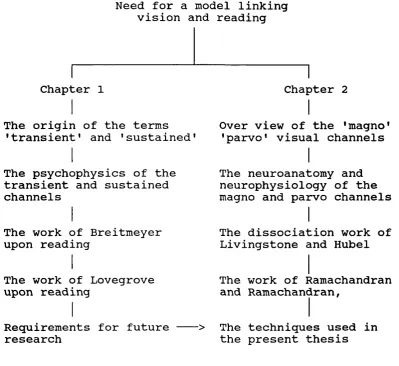
Figure 1.1. Outline of organisation of this and the following chapter.
Need for a model linking vision and reading
Chapter 1 Chapter 2
The origin of the terms 'transient' and 'sustained'
Over view of the 'magno' 'parvo' visual channels
The psychophysics of the transient and sustained channels
The work of Breitmeyer upon reading
The work of Lovegrove upon reading
Requirements for future --- > research
The neuroanatomy and neurophysiology of the magno and parvo channels
The dissociation work of Livingstone and Hubei
The work of Ramachandran and Ramachandran,
The techniques used in the present thesis
A terminological warning is needed. Reasons (discussed
in chapter 2) exist for believing that the 'transient' and
'sustained' channels of the visual psychophysicists are
equivalent to the magno and parvo visual channels discussed
by neuroanatomists and neurophysiologists. After this
chapter, I will use the terms 'magno' and 'parvo'. However,
whose work I review, I will use the terms 'transient* and
's u s t a i n e d 1.
1.2. Transient and sustained channels
Visual psychophysics has identified two component
channels in vision: (Breitmeyer, 1984, chapter 6? Cleland,
Dubin, & Luvick, 1971; Enroth-Cugell & Robson, 1966;
Kulikowski & Tolhurst, 1973; Legge, 1978; Lennie, 1980).
Within psychophysics they are known as the 'transient' and
'sustained' channels. The origin of this work and these
terms lies with research upon the response characteristics
of cat retinal ganglion cells (Cleland, Dubin & Luvick,
1971). These response characteristics have also been found
for the cells they project to in the lateral geniculate
nucleus. Two types of cells were found characterised by
different responses to prolonged stimulus exposure (a review
of this neuroanatomical and neurophysiological work is left
to the next chapter — the present reference is to explain
the origin of psychophysical terminology). The cells
differed in two distinct ways. Some of the cells Y recorded
responded throughout the stimu l u s ' presentation in a manner
that was sustained. Others, X cells, responded to the onset
or offset of stimulus presentation in a manner that was
transient. These characteristics led to the terms
'transient' and 'sustained' (though cat vision researchers
situation since human and cat ganglion cells have different
properties1) .
Psychophysicists following on from this work have
inferred the existence of two similar cell types underlying
human vision (Kulikowski & Tolhurst, 1973). These
investigations do not involve recoding directly from
ganglion or geniculate cells (which would be unethical) but
examining their effects on vision using appropriate
psychophysical techniques. Some of these techniques and
characteristics of the two visual channels will be described
below with the ideas of Breitmeyer.
1.3. Breitmeyer*s theory of reading
Breitmeyer (198 0; 198 2; 1983; 1984; in press;
Breitmeyer & Ganz, 1976) brought together several properties
of the transient and sustained channels in a low level
visual theory of written word perception.
Breitmeyer observed that psychophysical research had
found that brief stimuli produced a short transient channel
response but a long sustained channel response. The long
duration of the sustained channel response had moreover the
effect of causing the image in the sustained channel to out
last its physical presence. Breitmeyer identifies this
persistence (1984, pp 67 - 76) with neural persistence
system led Breitmeyer to assume that no direct role exists
for the transient channel in word recognition with word
recognition happening exclusively in the sustained channel.
Figure 1.2. The perceptual blurring of sustained images across fixations? taken with slight adaptations from Breitmeyer (1980) who modelled the illustration after H o c h b e r g , 1978.
V IS IG ^3 l© iN C ™ o m W IlJ® 8 J([m JO C L A S T IC (T h re e fix a tio n s )
VISICmJSI£)INTmGOINAOT©STIC (Two fix a tio n s )
VISION IS ICONOCLASTIC
The persistence of word images in the sustained
channel, Breitmeyer suggested, might cause problems for
readers when reading text. In reading, a reader constantly
brings new word images with each fixation on to their
retina. The visual system up to the primary visual cortex is
organised retinocentrically (Fox, Miezin, Allman, Van Essen
& Raichle, 1987). Thus there is a risk that visual
persistence in the sustained channel may impair the
processing of word images as the eye repeatedly moves to new
words. Breitmeyer suggests that the effect of persistence
would be to superimpose words from different fixations upon
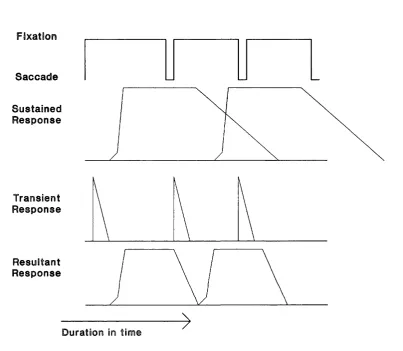
Figure 1.3. Hypothetical channel interaction during reading fixations. Sequence of fixations, top panel, Sustained responses, second down, Transient responses, third down, resultant interaction, bottom. Taken from Breitmeyer (1980).
Fixatio n
S a ccad e
S u stain ed R esponse
T ran sien t R esponse
R esu ltan t R esponse
Duration in time
This does not happen. We see words in a text without
superimpositions. Breitmeyer offers a reason. He suggests
that the channels interact to inhibit each other. The
transient channel is activated by the eye scan to mask and
so remove the image in the sustained channel (see figure
1.3). This transient-upon-sustained inhibition if true would
to functional vision (Breitmeyer, Rudd & Dunn, 1981).
(Metacontrast is the reduction in the visibility of one
briefly presented image by another image presently next to
it shortly and briefly afterwards.)
Figure 1.4. Contrasts between the disruption of sustained channel activation (metacontrast in the fovea) and that of the transient channel (the jerk effect in the periphery). From Breitmeyer (1984).
Relative Magnitude
Jerk effect
Metacontra8t
Periphery Fovea Periphery
Breitmeyer offers two accounts how this happens. First,
the transient channel in the fovea has a non-recognition
role in reading. When new words fall on the retina during
reading fixations the transient channel is temporarily
block for a moment visual persistence in the sustained
channel wiping out its residual image2. In effect, the scan
of the eye to a new word triggers the transitory channel to
clear the sustained channel of its old word image so
preparing it for perceiving the new one. (See figure 1.3).
This theory is elegant. Unfortunately, as Breitmeyer
emphasises the transitory-upon-sustained effect and
persistence vary in the eye. Persistence is strongest in the
fovea and weaker in the periphery while the transitory-upon-
sustained effect is strongest in the periphery but weakest
in the fovea (see figure 1.4.). Therefore he has to
acknowledge that the transient-upon-sustained effect
following an eye scan is insufficient to clear the sustained
channel. As Breitmeyer (1980, page 63) notes:
'Visual persistence is particularly long and strong in
the fovea, therefore, it is in the fovea that saccadic
suppression ought to be the most potent. However
several studies clearly show that metacontrast is
weaker [the references to four studies follow] and of
shorter duration [another reference] in the fovea than
in the parafovea or periphery. [He concludes, after a
sentence why this is the case that] .. the problem for
visual processing can be stated in the following
manner: Metacontrast, as a short-range mechanism of
And again, Breitmeyer (1983, page 11): 'In view of the
stronger and longer response persistence of foveal sustained
channels noted earlier, foveal metacontrast, as a short-
range mechanism of saccade suppression is too w e a k 1.
Breitmeyer's theory to be credible has to find a way in
which the reading process increases foveal transient-upon-
sustained inhibition. Therefore he proposes another account
of reading. He notes that in reading a text, a reader moves
his or her eyes. This leads him to postulate that saccadic
eye movements in addition to changing the foveal image
enhance through another mechanism, the ierk effect, the
transient channel suppression in the fovea. (The ierk effect
occurs when the transient channel is stimulated by the
images in the visual periphery jerking as the eye changes
its place on a page with new fixations). In Breitmeyer
(1984, pp 331-335) he expands upon this suggestion by adding
that saccades also 'activate central corollary discharges
which reinforce this suppression [transient-upon-sustained
inhibition]'. These conclusions it should be emphasised are
based upon simple psychophysical stimuli and situations,
Breitmeyer has never worked as far as I am aware with real
words or reading eye movements.
This second mechanism for clear reading vision requires
that readers make (1) eye saccades, and (2) (for the jerk
effect to work) these eye movements occur when reading texts
in the visual periphery which will visually change position
and so ierk with eye movements). Thus it directly predicts
that people will have problems reading words in
circumstances which do not require them to move their eyes
particularly in the absence of text surrounding their
fixation point. A form of reading which does not need eye
movements exists, RSVP (rapid, serial, visual presentation)
(Foster, 1970; Potter, 1983). In RSVP, written words rapidly
appear in succession at a location where the reader keeps a
constant fixation. Normally, this location is the centre of
a visually blank screen or tachistoscopic field. People have
no problems reading words and texts presented in these
circumstances. Further, not only do they lack problems
reading such texts they can achieve higher rates of
reading — 12 words per second — compared to the scanning
of normal text of about 6 words per second (Potter, 1983
page 432, 1984).
If RSVP reading had been developed as a test of
Breitmeyer's theory his theory would have been considered
refuted. A corollary of this is that it should be considered
refuted even though RSVP was well studied in the reading
literature some years before Breitmeyer proposed his theory.
It is a curiosity of science why Breitmeyer's work has never
been criticised (at least publicly in the published
literature) on this point. Both Breitmeyer's theory and RSVP
are not only logically connected but have been described in
Moreover, chapters by both Bruno Breitmeyer (1983) and Mary
Potter (1983) are in the same volume edited by Keith Rayner.
Why did not its editor, Breitmeyer or Potter or its other
contributors; its book reviewers and its many readers
(chapters in it are well cited? the copy in the University
of London library in the Senate House is worn heavily with
use) spot the incongruity? It seems unlikely that Breitmeyer
is aware of RSVP since he has never even tangentially
mentioned the problems RSVP might pose for his theory.
Though Breitmeyer does not mention research directly
concerned with the persistence of images between eye
movements some relevant research has been carried out.
Though some early research (Davidson, Fox & Dick, 1973) was
thought to show the existence of visual masking by the
persistence of previously seen images this work has not been
replicated and is now questioned by more recent and careful
work (Irwin, Brown & Sun, 1988). Irwin has carried out
research (though not with reading material) aimed at
discovering the role of transsaccadic persistence during
reading and has found no evidence for it (Irwin, Brown &
Sun, 1988? Irwin & Yeomans 1986; Sun & Irwin, 1987).
Clearly, Breitmeyer's theory is in some respect
deficient: either word images in the sustained channel are
cleared by some non-saccade dependent process or visual
persistence does not affect the perception of images seen
1.4. Lovegrove*s theory of dyslexia
1.4.1. Introduction
Breitmeyer1s theory has been expanded by himself (1989;
1991) and Lovegrove (Lovegrove, Martin & Slaghuis, 1986?
Lovegrove, Garzia, & Nicholson, 1990) into a theory of
dyslexia. Their line of argument has been this: if
psychophysical research has shown that the clear perception
of successive images in the sustained channel requires
transient channel inhibition what happens if the transient
channel is defective? This line of reasoning has led to a
theory of dyslexia as a transient channel defect. I shall
now review evidence for it.
William Lovegrove and colleagues published a series of
papers (Lovegrove & Brown, 1978; Lovegrove, Slaghuis
Bowling, Nelson & Geeves, 1986; Martin & Lovegrove, 1987?
Martin & Lovegrove, 1988; May, Lovegrove, Martin & Nelson,
1991; Slaghuis & Lovegrove, 1986a; 1986b; 1987) claiming to
show dyslexics suffer a transient channel defect. Other
groups have confirmed some of their findings (Brannan &
Williams, 1988a; 1988b; Williams, LeCluyse & Bologna, 1990;
Williams, Molinet & LeCluyse, 1989; Winters, Patterson &
Shontz, 1989) though not all, (Howell, Smith & Stanley,
Lovegrove and his colleagues summarised their
theoretical and empirical arguments in a paper in Cognitive
Neuropsychology (1986). There have been further reviews by
Lovegrove (Lovegrove, Garzia, & Nicholson, 1990) and
Breitmeyer (1989, 1991). Charles Hulme gave a critical
response to Lovegrove's Cognitive Neuropsychology paper in
the same journal (1988). Lovegrove has a reply (in p r e s s ) .
Like Hulme, my review of Lovegrove's ideas is critical.
However, and surprisingly given the apparent rigour of
Hulme's attack, I find many weaknesses Hulme overlooked.
Nonetheless I am indebted to Charles H u l m e 1s paper for some
of the following comments and observations. However, most of
them are my own: where not, this is indicated.
Breitmeyer's theory suggests that the clear perception
of print depends upon the transient channel suppressing
visual persistence in the sustained channel. Since the late
seventies, William Lovegrove and colleagues (Lovegrove &
Brown, 1978; Lovegrove, Slaghuis, Bowling, Nelson & Geeves,
1986? Martin & Lovegrove, 1987; Martin & Lovegrove, 1988?
Slaghuis & Lovegrove, 1986a; 1986b? 1987? May, Lovegrove,
Martin & Nelson, 1991) have been publishing work claiming to
show that specific-reading-disabled readers (whom I shall
call dyslexics) have a defective transient channel. They
observe that a defective transient channel according to
Breitmeyer's theory would cause dyslexics to suffer problems
seeing words and this could be the cause of their reading
disability without perceptual deficit" by and large may be
an empty diagnostic category (Breitmeyer, 1983 page 23
citing with approval Badcock and Lovegrove, 1981).
The transient channel theory of dyslexia is a low level
visual account of the problems of dyslexics. It claims that
dyslexics cannot read because a defective transient channel
makes it difficult to see written words. The transient
channel theory of dyslexia unlike other visual theories of
reading difficulties it has the merit that it is supported
by well designed psychophysical research. Further, their
specific-reading-disabled group seem a proper dyslexic group
(defined as 2.5 years [a difference sufficient to suggest
reading problems rather than general delay] below expected
grade level reading with average or above average non-verbal
IQ and performance in other subjects) with their performance
compared to a properly matched control group. Lovegrove and
colleagues have carried out many studies which show that the
majority of dyslexics have what they claim to be defective
transient visual channels. Whether they have found evidence
for a defective channel or merely a slightly differently
performing one to normals, I shall question below.
It needs to be emphasised that Lovegrove's theory
concerns the vast majority of dyslexics. Lovegrove is not
suggesting that a transient defect is responsible for the
problems of the minority of dyslexics thought by dyslexia
majority of our subjects would not be considered as visual-
spatial by Mattos et al (1975) or by Pirozzolo (1979)1
Lovegrove et al (1986) page 255. Instead, they identify
their dyslexic group clearly with those with recognised
phonological defects. Towards this end they carried out a
nonword naming task to show their dyslexics had impaired
phonological reading. On this nonword naming task, their
control subjects obtained over 90% correct, while none of
their dyslexic subjects got more then 50% right. As they
conclude 'This failure shows an inability in phonology.
Consequently it is likely that many SRDs (Specific Retarded
Dyslexics) tested here have some form of both language and
visual deficits' Lovegrove et al (1986) page 255. Whether
their dyslexic subjects in fact had any visual deficits
which contribute to their reading difficulties I shall
question.
1.4.2. Preliminary observations upon implausibilitv
Before discussing Lovegrove and colleagues' case (and
the relevant papers they cite) several comments upon the
intrinsic implausibility of their hypothesis need to be
noted.
First, dyslexics have been found to perform no
differently from controls on a wide range of visual tasks
(Ellis & Large, 1987 page 14; Vellutino, 1979). It is
visual skills which contribute to unimpaired reading.
Because it is not totally implausible, Lovegrove and his
colleagues are correct in suggesting that they may have
found a defect in a visual skill unrelated to previously
tested visual skills. However, their argument against the
ease with which people read in spite of visual handicaps is
not valid. People have a remarkable ability to read in spite
of severe ophthalmological handicap, (for comments by
ophthalmologists on this point see Critchley, 1970, and
Linz, 1973). Moreover, several studies have failed to find
an association between static ocular problems (such as
myopia and astigmatism) and reading handicap (Bedwell, Grant
& McKeown, 1980? Bishop, Jancey & Steel, 1979? Evans &
Drasdo, 1990, note the latter is a r eview). Lovegrove fails
to grasp the importance of the absence of an effect of
visual impairment upon reading for their theory implausible.
He attributes it to the wrong problem. It is not, as they
imply, that 'because some visual deficits do not correlate
with reading disabilities, no visual deficits d o 1 page 228.
It is because their theory requires that distorted and
blurred words disturb the process of reading. People with
static ophthalmic problems can have blurred and distorted
vision. Nonetheless these problems do not make them
dyslexic. If optical blur does not prevent people learning
to read why should one caused more centrally have this
Second, the majority of dyslexics suffer one or several
of a range of language problems: rapid automatized naming
(Denckla & Rudel, 1976; Wolff, Michel & Ovrut, 1990); naming
unfamiliar words (Kamhi, Catts & Mauer, 1990); syntactic
competence (Bentin, Deutsch & Liberman, 1990); hearing words
masked by white noise (Snowling, Goulandris, Bowley &
Howell, 1986) ; short term memory for spoken letter names
(Shankweiler, Liberman, Mark, Fowler & Fischer, 1979); word
strings and sentences (Mann, Liberman & Shankweiler, 1980)
and digits (Campbell & Butterworth, 1985); language
development and narrative speech defects (Davenport, 1986).
Lovegrove completely ignores these deficits even though on
his own data the dyslexics he studied suffered a
phonological decoding problem while this was not the case
with his normal readers. (Interestingly, the relationship
between 'transient' deficits and reading was much weaker: a
quarter of the dyslexics lacked a 'transient' deficit while
it afflicted eight percent of normal readers. This point is
discussed in greater detail later). Not only are dyslexics
poor at language tasks but training children to enhance
their phonological abilities enhances their reading
acquisition (Bradley & Bryant, 1985). This suggests a causal
relationship between phonological skills and reading
development. Lovegrove has to offer some explanation for the
strong association of dyslexia with language related
Third, as Charles Hulme (1988) notes, dyslexics have
more problems reading single words than reading text
(presumably because their problems are confined to
recognising individual words and this is to some extent
avoided when reading text through the use of context for
word identification). Lovegrove1s theory predicts the
opposite pattern: problems reading texts where images can
superimpose upon each other and none for single word reading
for which no residual images exist to affect reading.
Fourth, as noted, the theory of Breitmeyer it develops
is questionable in view of RSVP reading. Thus doubts must be
raised on logical grounds about any theory deriving from it.
Breitmeyer's theory would predict RSVP reading would be
particularly difficult for dyslexics. No published studies
on dyslexia and RSVP reading exist: however one unpublished
technical report (Chen, 1983) has been described by Potter
(1984, page 104). According to Potter this study found that
RSVP compared to conventional text aided poorer readers
while having no effect for normal readers. If these poorer
readers were dyslexic then this would suggest that a
technique that should make word recognition harder for
1.4.3. Lovegrove1s research
Lovegrove and colleagues find that compared to normal
controls dyslexics perform differently on three tasks
sensitive to the integrity of the transient channel. There
is some limited support for their work from other
researchers (Brannan & Williams, 1988; Winters, Patterson &
Shontz, 1989).
The transient and sustained channels differ in three
measurable characteristics: (1) visible persistence, and
sensitivity across spatial frequencies for (2) luminosity
contrast and (3) flicker. The transient and sustained
channel have different specialisations in processing
different spatial frequencies: the transient channel
processes low spatial frequencies and the sustained channel
high ones (Breitmeyer, 1984). In brief, the large visual
components of an image are made up of low spatial
frequencies e.g. | | | |. While the fine details are made up
of high spatial frequencies e,g, SffjS, (a more exact
definition is given in the methods chapter).
First, visual persistence, as noted above, is a
sustained not a transient channel characteristic. Therefore
visual persistence should be greater for high spatial
frequencies (processed by the sustained channel) than for
low spatial frequencies (processed by the transient