
W and Z precision physics
M.Isabel Josa1,afor the ATLAS, CMS and LHCb collaborations
1CIEMAT, Centro de Investigaciones Energéticas, Medioambientales y Tecnológicas. Avda. Complutense 40, 28040 - Madrid,
Spain
Abstract.Recent results on W and Z physics from LHC experiments are presented. Measurements reviewed include total W and Z cross sections, W lepton charge asymmetry, and Z differential cross sections. Production of Z bosons is studied as a function of rapidity, transverse momentum and angular variables. The Drell-Yan differential distribution with the dilepton mass and the double differential distribution with the dilepton mass and rapidity are shown. Finally, measurements of several electroweak observables, the forward-backward Drell-Yan asymmetry and the sinθWare also presented. The measurements are compared with theoretical predictions using the most accurate theoretical predictions and modern parton distribution functions. A general agreement is observed.
1 Introduction
The high production rate of W and Z and their clean de-cay signatures, mainly in the leptonic channels make these processes an excellent tool for Physics commissioning at the LHC energy regime. Detector performance, in terms of lepton reconstruction (trigger, reconstruction and iden-tification efficiencies) and calibration of lepton energy and momentum is now routinely studied with samples of Z candidates. The presence of a neutrino in the final state from the decay of a W boson, and hence of a natural source of missing transverse energy in the event is also employed for the characterization of this physical quantity. From the theory side they are well known processes and precise pre-dictions are available, making them an excellent testbench of the Standard Model at the LHC energy. Furthermore, W and Z bosons are produced in numerous relevant pro-cesses being studied at LHC and constitute one of the most copious backgrounds for BSM searches, thus a detailed knowledge of their kinematic and dynamic characteristics is needed.
W and Z production proceeds at Leading-Order (LO) through the scattering of a u or d valence quark with a sea-antiquark. At the LHC energy, the accessible range of the momentum fraction of the proton carried by the interacting partons (x), increases significantly with respect to previ-ous experiments, and the contribution from quark sea-antiquark starts to be significant. In this sense, W and Z production gives access to probe and constrain Parton Dis-tribution Functions (PDF) in enlarged regions. The three LHC experiments: ATLAS and CMS, and LHCb provide complementary information. Vector boson production in ATLAS and CMS covers anxrange∼(0.5×10⁻⁴−10−1)
ae-mail: [email protected]
and the forward design of LHCb extends the coverage down tox∼10−4.
The large statistical samples collected during the 2011 LHC run: 40M W → `ν, 3M Z → `` (0.6M, 50k in the very forward region) opened the possibility to per-form rather detailed differential measurements. System-atic uncertainties are of the order of 1% for inclusive mea-surements and of few % for differential ones, excluding the uncertainty arising from the determination of the in-tegrated luminosity, that ranges from∼ 2.2% to 4% de-pending on the experiment and period. Better precision is achieved in ratios where some of the systematic uncer-tainties cancel out completely (the one due to the lumi-nosity determination) and the effect from the other sources is reduced. Measurements are usually performed in a re-stricted phase space where detection is optimal. They are extrapolated to the full phase space by means of correc-tion factors computed with the theoretical tools available, that are determined with∼1−2% uncertainty. Therefore experiments also quote their results in the restricted fidu-cial phase space to minimize uncertainties and to allow a precise comparison with theoretical predictions.
Several tools are available to produce theoretical predictions at Next-to-Next-to-Leading-Order (NNLO) (FEWZ [1] and DYNNLO [2]) with a precision already comparable to the experimental one (few percent). Signal modeling is significantly improved in Montecarlo genera-tors such as POWHEG [3] or MC@NLO [4] that incorpo-rate a NLO description of the process.
Selection of W and Z candidates is relatively simple. Both ATLAS and CMS base their selection on high pT
isolated leptons that in the case of the W candidates is accompanied by an apparent imbalance in the energy of the event. Typically pT(µ) > 20 (25) GeV for ATLAS
(CMS) and pT(e) > 25 GeV both for ATLAS and CMS.
© Owned by the authors, published by EDP Sciences, 2013
Figure 1. Summary of the W and Z production cross section times the leptonic branching fractions at √s = 8 TeV. Mea-surements in the electron and muon channels, and combined, are compared to the theoretical predictions computed at the NNLO in QCD with FEWZ and MSTW2008 PDF set.
The angular coverage in pseudorapidity1 of the lepton is |η(µ)|<2.4 (2.1) for ATLAS (CMS) and|η(e)|<2.5 both for experiments. Some analysis are extended to the most forward region|η(e)| <5 where the electron is identified in the endcap calorimeters, but with no tracking informa-tion. Transverse momentum thresholds in LHCb are sim-ilar, pT(`) > 20 GeV although its forward configuration
provides coverage for muon and electron identification in the range 2 < |η(`)| < 4.5. The Z peak region is de-fined as the interval 66 < M`` < 116 GeV for ATLAS (60 < M`` < 120 GeV for CMS and LHCb) to minimize
the contribution fromγ∗exchange.
Several selected results obtained recently by the LHC experiments are briefly described in the following para-graphs. Most of them come from the analysis of the data collected at √s=7 TeV in 2011. Few results are from the first data taken at √s=8 TeV in 2012.
2 Total cross sections and cross section
ratios
CMS has measured the inclusive W and Z cross section at 8 TeV [5]. A dedicated machine configuration was deployed at the beginning of the 2012 LHC run to ac-cumulate a dataset with low pileup and low transverse momentum trigger thresholds in experimental conditions similar to those in 2010 run. The instantaneous luminos-ity was reduced and hence the pileup, by separating the LHC beams in the transverse plane to diminish the eff ec-tive overlap between them. A dataset corresponding to an integrated luminosity of 18.7 pb−1 was recorded. The analysis strategy followed closely the analysis carried out at √s=7 TeV [6]. The numerical results for the total W and Z cross sections times the relevant leptonic branch-ing fractions are shown graphically in figure 1. The sys-tematic uncertainty is∼3.8% in the electron channel and
∼2.5% in the muon channel (excluding the luminosity un-certainty). Measured cross sections are in agreement with theoretical predictions computed with FEWZ at NNLO and MSTW08NNLO [7] set of PDF, the precision of the prediction is of the order of 2−3%.
1The pseudorapidity is defined asη=−ln(tan(θ/2)) whereθis the
polar angle of the track.
Figure 2.Invariant mass distributionsτµτe(left) andτµτh(right) for Z→ττcandidates selected by the LHCb experiment.
Figure 3. Cross section ratios σ(W+)/σ(W−
) (left) and σ(W)/σ(Z) (right) in the fiducial phase space of the measure-ment. Experimental values are compared with the theoretical predictions computed at NNLO with several sets of PDF.
LHCb has analyzed the full data set collected in 2011 (∼ 1 fb−1) and measured the Z total cross section in the three leptonic decay modes (Z→µ+µ−[9], e+e−[10] and τ+τ−[11]). Final states where theτdecays into an elec-tron or a muon, and also hadronically, are selected. Fig-ure 2 illustrates the invariant mass distribution of the decay products of the twoτcandidates, for two differentττfinal states. Results obtained in the three different leptonic de-cay modes are compatible and are in agreement with the theoretical prediction derived with FEWZ at NNLO.
Cross section ratios are measured with a higher preci-sion as some uncertainties cancel in the ratio. Figure 3 shows the cross section ratios W+/W− and W/Z mea-sured by ATLAS with the data set collected in 2010, at
√
s= 7 TeV and corresponding to an integrated luminos-ity of 36 pb−1 [8]. The total uncertainty is 0.9% for the W+/W−ratio and 1.3% for the W/Z ratio. Measurements in the figure are compared with four different sets of PDF and one can observe some significant differences among them, specially for the W+/W−ratio as it is more sensitive to the differences between the up and down quark distribu-tions.
3 W charge asymmetry
Figure 4. Measured electron charge asymmetry (pT >35 GeV) and comparison to the predictions of different PDF models.
observable, defined as:
A(η)=(σ(η)(W
+)−σ(η)(W−))
(σ(η)(W+)+σ(η)(W−))
The measurement of the asymmetry provides constraints on the u, d, ¯u and ¯d in the range 10−3<x<10−1.
Most recent measurements come from CMS [12] from the analysis of a data sample corresponding to 840 pb−1 of data in the electron channel. The analysis strategy is the same followed in the inclusive analysis but with the data further separated according to the sign and pseudo-rapidity of the electron from the W candidate. Figure 4 shows the measured asymmetry, together with the theoret-ical predictions obtained with MCFM [13] at NLO, and various sets of parton distribution functions. There is a general agreement with the predictions. Discrepancies ob-served in the central region|η|.1 with predictions using MSTW (also observed in the comparison with the ATLAS results [8]) are understood and solved, and updated ver-sions of MSTW08 PDF [14] exhibit a good agreement with the experimental results. LHCb has recently pro-vided [15] extrapolated values of their published asymme-tries to the fiducial region of ATLAS and CMS for com-parison and an excellent agreement between the different experiments in the common region is observed.
4 Z differential distribution with rapidity
The LHCb collaboration has also measured the Z diff eren-tial cross section as a function of the rapidity of the dilep-ton system in the very forward region in the dimuon and dielectron channels [9, 10]. Figure 5 shows the diff eren-tial cross section in the dimuon channel. Measured values are in agreement with NNLO calculations computed with FEWZ and various sets of PDF (Figure 5) and also with predictions computed with RESBOS [16] and POWHEG. It is in very good agreement with all three predictions. Extrapolated values to the fiducial region of ATLAS are also in agreement with the measurements from this exper-iment [8].
Figure 5.Differential cross-section for Z→µµas a function of rapidity of the Z boson. Superimposed are the fixed order NNLO predictions from FEWZ using several PDF sets.
Figure 6. Drell-Yan differential cross-section measured by AT-LAS.
5 Drell-Yan differential cross section
The Drell-Yan process produces dilepton pairs over a wide range of invariant massM``. It constitutes an excellent test of pQCD within the Standard Model and gives access tox
regions where PDF are poorly known. In addition, measur-ing the Drell-Yan spectrum is important as it is a copious background for many other measurements at the LHC and for searches for new physics beyond the Standard Model, such as the production of high mass dilepton resonances.
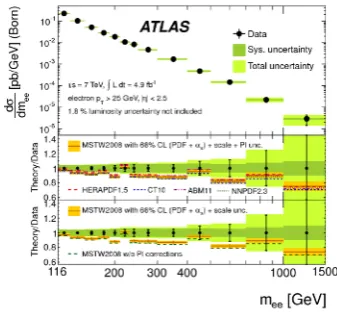
ATLAS has measured the absolute differential cross section in the dielectron channel [17]. It concentrates in the high mass region 116 < Mee < 1500 GeV. The
dif-ferential cross section is given in the fiducial region of the measurement after correction for lepton reconstruc-tion, identification and trigger efficiencies. Systematic un-certainties are about 4% forMee =116 GeV and are
dom-inated by lepton reconstruction and energy measurements effects. It is of the order of 5−6% forMee ∼400 GeV, and
increases up to∼ 10% for the highestMee bin. Figure 6
shows the differential cross section at Born level, i.e. after correction for QED FSR effects within the fiducial region. It is compared with theoretical predictions at NNLO from FEWZ using several sets of PDF. A general agreement is observed.
chan-Figure 7. (Left) Combined Drell-Yan differential cross section measurement in the dimuon and dielectron channels normalized to the Z-peak region. (Right) Double differential cross section as a function of dimuon rapidity in the range 20< Mµµ<30 GeV and comparison with theory expectations at NLO and NNLO from FEWZ using CT10 PDF set.
nel in a very large range of dilepton invariant masses, 15 GeV<M``<1500 GeV. The measurement is normal-ized to the cross section in the Z peak region (60, 120) GeV to diminish the associated uncertainties. Figure 7 (left) shows the combined Drell-Yan spectrum fully unfolded for detector resolution and FSR effects and extrapolated to the full phase space. Uncertainties in the dimuon channel are dominated by the uncertainties in the efficiency correc-tions (1%), and in the FSR correction (0.3%). The most important source of systematic uncertainties in the dielec-tron channel is associated to the energy scale corrections (0.7%). There is an excellent agreement with the theo-retical predictions at NNLO pQCD (FEWZ+CT10 [19]) over several orders of magnitude. A NNLO description is essential to describe the low mass region since a large fraction of the events selected in the low mass bins corre-sponds to high-pT lepton pairs accompanied by hard jets.
The analysis is extended in the dimuon channel to mea-sure the normalized double differential cross section with respect to the mass and rapidity of the dimuon system. The rapidity bins are optimized to reduce event migrations be-tween bins. The double differential cross section is quoted in the detection fiducial region to reduce any model depen-dences and to increase the constraining power of the mea-surement. Normalized distributions are compared with theoretical predictions from FEWZ using CT10 PDF set, at two different orders of evolution in pQCD (NLO and NNLO). From the comparison in the first mass bin (Fig-ure 7 (right)) it is clear that the NLO theoretical prediction does not describe properly the observed spectrum whereas the NNLO calculation is able to restore the agreement with data. Normalized double differential distributions are also compared with predictions using several sets of NNLO PDF sets. These data is useful for future PDF analysis, specially for large-xregions where PDF are poorly known.
The measurement of the Drell-Yan differential cross section, dσ/dMµµ by LHCb [20] in the forward rapidity region and in the low mass range (5 < Mµµ < 120 GeV)
complements the previous ones as it probes down to re-gions ofx=8×10⁻⁶. Measurements are successfully
re-with a transverse momentum re-with respect to the beam axis balancing initial state QCD radiation of quarks and glu-ons. The highpTregion (pT >MZ), is determined by hard
parton emission and a perturbative QCD description at a fixed order ofαsis adequate. At low pT, contributions at
higher orders ofαsdescribing the production of soft
glu-ons grow in importance and resummation of the divergent logarithmic terms is needed to derive a finite cross section. Other approaches like Parton Shower aim to describe this low pT region tuning certain parameters that govern the
underlying event description.
The dataset collected at 8 TeV in the dedicated run with low luminosity has been analyzed by CMS to study the shape of the Z differential cross section, 1/σdσ/dpT[21] in the dimuon channel up to a pT of the
dimuon system of 600 GeV. The measuredpTdistribution
is corrected for bin migration effects due to detector reso-lution and from final state radiation using a matrix based unfolding procedure. The measurement is dominated by statistical uncertainties. The spectrum in the reduced fidu-cial phase space is compared with the predictions from several Montecarlo codes and it is found that RESBOS provides a good description of the data, better than MAD-GRAPH [22] or POWHEG associated to a parton shower as described by PYTHIA [23]. The lowpTregion is
scru-tinized to establish the performance of several underlying event descriptions.
The study of the Z boson dynamics in terms of angular variables of the lepton tracks, which are reconstructed with very high precision, has been proposed recently [24]. Re-sults are available for the Z differential cross section with respect to the variableφ∗η = tan(φacop/2)×sinθ∗η, where φacop =π−∆φand∆φis the difference in the azimuthal
angle of the two leptons from the Z decay. The angleθ∗η
defined as cosθ∗
η = tanh[(η−−η+)/2] whereη− andη+
are the pseudorapidities of the two leptons, is a measure-ment of the scattering angle of the leptons with respect to the proton beam direction in the rest frame of the dilepton system. Theφ∗
ηvariable is correlated withpZT/M``.
ATLAS has measured [25] the normalized differential cross section 1/σdσ/dφ∗
η in the φ∗η range (10−3,3)
(Fig-ure 8, left). After correction for bin-migration effects and FSR the spectrum is compared with theoretical predictions and it is found that RESBOS reproduces the data within 2% (5%) for φ∗η < (>) 0.1. Predictions [26] provided by the same authors that proposed this optimal value are also compared, and they are in agreement within the un-certainty of the prediction, still quite large. The spectrum in the regionφ∗η >0.1 is compared with predictions
Figure 8. (Left) Ratio of the combined normalized differential cross section 1σfiddσfid/dφ∗
measured in ATLAS to predictions from RESBOS and from [26] as a function ofφ∗
. (Right) Ratio of the QCD predictions (RESBOS, FEWZ and POWHEG+PS) to data for the differential cross section dσ/dφ∗
measured by LHCb.
Similar conclusions are reached in the LHCb analy-sis [9] where the differential cross section dσ/dφ∗ηis
pre-sented (Figure 8, right). The theoretical calculation at NNLO from FEWZ overshoots the observation forφ∗
η <
0.1 and undershoots it for φ∗
η > 0.1. RESBOS correctly
predicts the spectrum over the whole range. Other predic-tions, as POWHEG+Parton Shower lays within 10% of the observed values.
7 Electroweak observables
The angular distribution of the leptons from the Drell-Yan process is determined by the vector and axial-vector cou-plings of the quarks and leptons to the Z boson and on the electric charge of the fermions. An asymmetry parameter can be defined asAFB=(σF−σB)/(σF+σB) whereσFand σB are the total cross sections for forward and backward
events, depending on the angle of emission of the lepton relative to the quark momentum in the dilepton center of mass system.AFBis small near the Z peak.
The forward-backward asymmetry in the dimuon and dielectron channels has been measured recently by CMS [27], in the mass range: 40< M`` <400 GeV. The analysis is done in several rapidity bins of the dilepton sys-tem as the sensitivity to the asymmetry is larger for dilep-tons produced at large rapidities. Raw asymmetries are corrected for FSR, mass resolution, efficiencies and other detector effects, and unfolded to Born level, where the un-folding is done independently for each rapidity bin. The effect of the unfolding is maximal just below and above the Z peak. A good agreement with the standard model is observed (Figure 9).
ATLAS has published recently [28] the asymmetry measured in the dimuon and dielectron channels. Elec-trons detected in the forward region (2.5 < |η(e)| < 4.9) are also included in the analysis giving access to a region where the dilution due to the impossibility to define pre-cisely the direction of the incoming quark is minimized. The asymmetry is already visible at raw level in the data sample with one forward electron (Figure 10). The asym-metry is measured in a wide range of dilepton invariant mass 66 < M`` < 1000 GeV (<250 GeV for the cate-gory with a very forward electron) and unfolded to Born level correcting for FSR, detector and dilution effects. All of the resulting AFB spectra are consistent with the
cor-Figure 9.Combined (µ+µ−
and e+e−
) measurement ofAFBat the Born level in four|yZ|bins from CMS.
Figure 10.Distribution of the scattering angle of the electron in the dielectron channel where one of the electrons is detected in the very forward region of the ATLAS experiment.
responding Standard Model predictions. Several Stan-dard Model parameters can be extracted from the mea-suredAFBdistribution. One of them is the effective weak
mixing angle, sin2θeff
W. ATLAS has extracted the value
of sin2θeff
W from the measuredAFB spectra by comparing
the raw asymmetry in the mass range (70, 250) GeV to Montecarlo predictions produced with varying initial val-ues of the weak mixing angle. The final combined value sin2θeWff=0.2297±0.0004±0.0009, has already a precision comparable with the ultimate measurements of Tevatron experiments and is found to be in agreement with previous determinations.
Acknowledgements
[2] S. Catani, L. Cieri, G. Ferrera, D. de Florian and M. Grazzini,Vector boson production at hadron colliders: a fully exclusive QCD calculation at NNLO, Phys. Rev. Lett. 103 (2009) 082001, arXiv:0903.2120.
[3] S. Alioli, P. Nason, C. Oleari and E. Re,NLO vector-boson production matched with shower in POWHEG, J. High Energy Phys. 07 (2008) 060, arXiv: 0805.4802. [4] S. Frixione and B.R. Webber, Matching NLO QCD
computations and parton shower simulations, J. High Energy Phys. 06 (2002) 029, arXiv:0805.4802. [5] CMS Collaboration, W and Z inclusive cross
sections at 8 TeV, CMS-PAS-SMP-12-011, https://cdsweb.cern.ch/record/1460098.
[6] CMS Collaboration, Measurements of Inclusive W and Z Cross Sections in pp Collisions at √s = 7TeV with the CMS experiment, J. High Energy Phys. 10 (2011) 132, arXiv:1107.4789.
[7] A.D. Martin, W.J. Stirling, R.S. Thorne and G. Watt,
Parton distributions for the LHC, Eur. Phys. J. C63 (2009) 189, arXiv: 0901.0002.
[8] ATLAS Collaboration,A measurement of the total W and Z/γ∗cross sections in the e andµdecay channels in pp collisions at √s =7TeV with the ATLAS detector, Phys. Rev. D85 (2012) 072004, arXiv:1109.5141. [9] LHCb Collaboration,Measurement of the
cross-section for Z → µ+µ− production with 1 fb−1 of pp collisions at √s = 7TeV. LHCb-CONF-2013-007, http://cds.cern.ch/record/1537825.
[10] LHCb Collaboration, Measurement of the cross-section for Z → e+e− production in pp collisions at √
s=7TeV. J. High Energy Phys. 02 (2013) 106. [11] LHCb Collaboration, A study of the Z production
cross-section in pp collisions at √s=7TeV using tau final states, J. High Energy Phys. 01 (2013) 111. [12] CMS Collaboration, W differential lepton charge
asymmetry at 7 TeV, Phys. Rev. Lett. 109 (2012) 111806, arXiv:1206.2598.
[13] J. M. Campbell and R. Ellis,MCFM for the Tevatron and the LHC, Nucl. Phys. Proc. Suppl. 205 (2010) 10, arXiv: 1007.3492.
[14] A.D.Martin et al., Extended Parameterisations for MSTW PDFs and their effect on Lepton Charge Asym-metry from W Decays, Eur. Phys. J. C (2013) 73:2318, arXiv:1211.1215.
arXiv: hep-ph/9703405.
[17] ATLAS Collaboration, Measurement of the high-mass Drell-Yan differential cross-section in pp colli-sions at √s=7TeV with the ATLAS detector, CERN-PH-EP-2013-064, arXiv:1305.4192.
[18] CMS Collaboration, Drell-Yan differential cross sections at 7 TeV, CMS-PAS-SMP-13-003, https://cdsweb.cern.ch/record/1543468.
[19] H.-L. Lai, M. Guzzi, J. Huston, Z. Li, P. Nadolsky, J. Pumplin and C.-P. Yuan, New parton distributions for collider physics, Phys. Rev. D82 (2010) 074024, arXiv:1007.2241.
[20] LHCb Collaboration, Inclusive low mass Drell-Yan production in the forward region at √
s = 7TeV, CERN-LHCb-CONF-2012-016, http://cdsweb.cern.ch/record/1434424.
[21] CMS Collaboration, Z transverse momentum distribution at 8 TeV, CMS-PAS-SMP-12-025, https://cdsweb.cern.ch/record/1528579.
[22] J. Alwall, M. Herquet, F. Maltoni, O. Mattelaer and T. Stelzer,MadGraph5: Going Beyond, J. High Energy Phys. 06 (2011) 128, arXiv: 1106.0522.
[23] T. Sjöstrand, S. Mrenna, S. and P.Z. Skands,PYTHIA 6.4 Physics and Manual, J. High Energy Phys. 05 (2006) 26, arXiv: hep-ph/0603175.
[24] A. Banfi et al.,Optimisation of variables for studying dilepton transverse momentum distributions at hadron colliders, Eur. Phys. J. C 71 (2011) 1600, arXiv: 1009.1580.
[25] ATLAS Collaboration,Measurement of angular cor-relations in Drell-Yan lepton pairs to probe Z/γ∗
bo-son transverse momentum at √s = 7TeV with the ATLAS detector, Phys. Lett. B 720 (2013) 32-51, arXiv:1211.6899.
[26] A.Banfi et al., Predictions for Drell-Yanφ∗and QT observables at the LHC, Phys. Lett. B 715 (2012) 152, arXiv:1205.4760.
[27] CMS Collaboration, Drell-Yan differential forward-backward asymmetry at 7 TeV, Phys. Lett. B 718 (2013) 752, arXiv:1207.3973.
[28] ATLAS Collaboration, AF B of Z/γ into muon and electron pairs and extrac-tion of sin2θW, ATLAS-CONF-2013-043,


![Figure 8. (Left) Ratio of the combined normalized difrom RESBOS and from [26] as a function ofof the QCD predictions (RESBOS, FEWZ and POWHEGdata for the differentialcross section 1σfiddσfid/dφ∗ measured in ATLAS to predictions φ∗](https://thumb-us.123doks.com/thumbv2/123dok_us/8642520.1432228/5.595.356.490.294.467/combined-normalized-predictions-powhegdata-dierentialcross-sddsd-measured-predictions.webp)
