Social Spider Optimization (SSO) for Tuning PID
Controller on DC Motors
N.D. Yaacob,
*W.A.F.W. Othman, A.A.A. Wahab & S.S.N. Alhady
School of Electrical & Electronic Engineering, Universiti Sains Malaysia, Malaysia
*Corresponding author | email:
[email protected]
Abstract:
This paper presents an optimization algorithm for tuning proportional-integral-derivative (PID) controller parameters in order to achieve a desired transient response. In order to find optimal PID controller parameters, it is rather a complicated task such that the best proposed methods or techniques may lead to a better performance. Artificial intelligence optimization approach is observed as a complement solution to improve the performance of the PID controller designed by conventional method. Hence, an offline tuning PID controller design scheme is proposed, which is able to deal with engineering problems, such that Social Spider Optimization (SSO) is chosen for this work. The step response of the controller were analyzed and described in terms of minimization of the system peak overshoot, Mp, steady-state error, ess, rise time, Tr and settling time, Ts. This algorithm able to obtain accurate solution and efficiency to solve such complex computational calculations especially for optimization problems as it have a fast convergence speed, results are very promising as optimal solutions to real-world problems are obtained.
Keywords
PID; Social spider optimization; firefly
algorithm; optimization algorithm; swarm
intelligence; artificial intelligence
1.
Introduction
Recently, with the fast growing size and complexity of modern optimization problems, evolutionary computing is becoming increasingly attractive as an efficient tool for optimization. PID controller's is the most widely used control strategy in many industrial processes due to their functional simplicity, reliability and broad applicability [1]. PID controller consists of three coefficients, namely: proportional, integral and derivative which are varied to get optimal response. A PID controller continuously calculates the error value obtain in the system as the difference between a desired set point and a measured variables. The control parameters are
set in the algorithm and methods proposed to achieve the objectives of this research were explained.
The main objective of optimization algorithm is to ensure that some subsequence of iterations converges to an optimal solution by finding values of the variables that minimize or maximize the objective function while satisfying the constraints [2]. The Ziegler-Nichols method is another popular method of tuning a PID controller. It is very similar to the trial and error method. Due to the computational drawbacks of mathematical calculation for instance, complex derivatives, large amount of desired enumeration memory, researchers depend on meta-heuristic algorithms on simulations and stochastic optimization technique to achieve optimum solutions [3]. Nevertheless, these methods tend to obtain inaccurate result and in any case do not give the optimal result with less effort and time [4].
In essence, Social Spider Optimisation (SSO) was modeled based on the mating behavior among the colony of spiders in the communal web. They interact between each other to share the information with follow the predetermined procedures [4-6]. Apart from that, the performance of this algorithm is studied and successfully applied in parameters searching.
2.
Background Works
Objective of this work is finding a method to tune PID controller. Basically, a proportional–integral– derivative controller (PID) is a control loop feedback mechanism which is commonly used in industrial control systems, and also in robotics research [7-11]. A PID controller continuously calculates the error value obtain in the system as the difference between a desired set point and a measured variables.
2.1.
PID controller
and desired speed. While, integral control, adjustments are based on recent errors. In derivative control, adjustments are based on the rate change of errors [12].
The tuning approaches can be divided into two categories which are the conventional and the alternative approaches. The conventional approaches include the empirical methods and the analytical methods which widely used by control designers. The alternative approaches are limited to methods that employ the stochastic process in the tuning rules. Stochastic process refers to one whose behavior is non-deterministic, where any of its sub-system determined by the process of deterministic action and a random behavior.
Referring to certain conditions, the existing of tuning PID method is not capable to tune the combination of PID parameters when facing different conditions. Thus, this research proposes an algorithm that automatically gives the researchers or engineers the optimized PID parameters for the objectives such as the basic requirements of the output which is stability, desired rise time, peak time and overshoots.
Equation (1) represent as the ideal version of proportional, integral and derivative is given by the formula as the output of the PID controller such that the small changes occurs in the system plant less sensitive.
(1)
where Kp, Ki and Kd are proportional, integral and differential gain respectively.
2.2.
Closed-loop system
In closed-loop system, it is necessary to have of transfer plant function. Hence, refer to research paper reviewed by Pareek et al. in [13], Gp1 (System A). The plant used here is a hood and ball system model which is a forth order system given as equation (2).
Another system used in this work, namely System B, 𝐺𝑝2 plant transfer function is based on research paper by Wadhwani and Verma [14]. The DC servo motor can be considered as linear SISO plant model having third order transfer function given as equation (3).
Thus, equation (2) and equation (3) illustrate as transfer plant function used. The integrated PID controller proposed in these design, is in the Laplace form as the transfer function, as shows in Equation (4).
(2)
(3)
(4)
The general transfer function, T(s) of the systems are as follows:
(5)
where H(s) is a unity feedback. Hence, the transfer function of System A and System B are as represented by equation (6) and (7).
(6)
(7)
2.3.
Optimisation Algorithms
Definition of optimization means searching for an alternative options that promising most cost effective or better feasible performance under different constraints. Optimization has been applied in many fields of science, including engineering, economics and logistics where optimal decisions need to be chosen. In essence, optimization means the selection of a best element with regard to some criterions or issues from variety set of available alternatives solutions. In addition, algorithm would continuously search for the best solution until certain criteria are met. Nevertheless, in order to tend totally exploit and explore the search space, the optimization algorithm must have a system to balance between local search and global search [3].
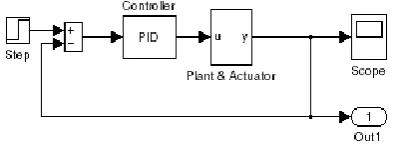
Figure 1. Closed-loop system with PID controller.
2.4.
Social Spider Optimization (SSO)
3.
Methodology
3.1.
Objective Function
To obtain the optimum PID controller parameters, the design variables will be selected to produce minimal overshoot, rise time, settling time and the steady-state error of terminal voltage step response.
The best parameters were determined by the minimum value evaluated by cost the function, F [15-16]. By using an optimization algorithm to find the PID gain parameters, such as the Social Spider Optimization (SSO) algorithm, these objective functions are combined in a single weighted sum objective function. Equation (8) below shows the cost function that was chosen because it displays good dynamic performance criteria stated in the function,
(8) where 𝜌 is the scaling factor of designer’s choice.
According to Lee in [15], if the 𝜌 value larger than 0.7, it tends for a lesser overshoot and steady-state error; while if 𝜌 is smaller than 0.7, the response tends to get a shorter rise time, Tr and settling time, Ts. Thus, for this work, two choices of values is examined i.e. ρ=0.5 and ρ=1.5.
3.2.
Setting of SSO
Social-spider optimizer (SSO) is chosen to fine tune the proposed proportional-integral-derivative (PID) controllers by generating their optimal settings. The integral time multiplied the summation of absolute deviations thus the gains of PID controllers define the fitness function and control variables respectively [17]. Basically, SSO is inspired by mating behavior and movement in nature that occurs till convergence to the optimal solution is met. Using the SSO algorithm where each Spider location is a candidate solution to the Proportional-Integral-Derivative parameters.
The algorithm control parameter that can be set based on the optimization problem in order to achieve the cost and objective function. Table 1 shows the set of control parameters for SSO used in this work.
In this work, the number of agents, spidn is set to 50. While the number of iterations, itern is set to 200. Since this study uses 3 different parameters to be optimized, thus the dimension space, dims is set to 3. Whereas the PID variables are limited by the parameters xd and xu, namely the lower bound and upper bound of decisions variables, or in other words, represent as the lower and upper bounds of Kp, Ki and Kd parameters respectively.
Table 1. SSO control parameters used in this work
Description Parameter Initial Value
Number of spiders spidn 50
Number of iteration itern 200
Lower space dimension xd 0
Upper space dimension xu 10
Lower female percent fpl 0.65
Upper female percent fpu 0.9
Dimension space dims 3
Attraction PF 0.7
Random number rand [0, 1]
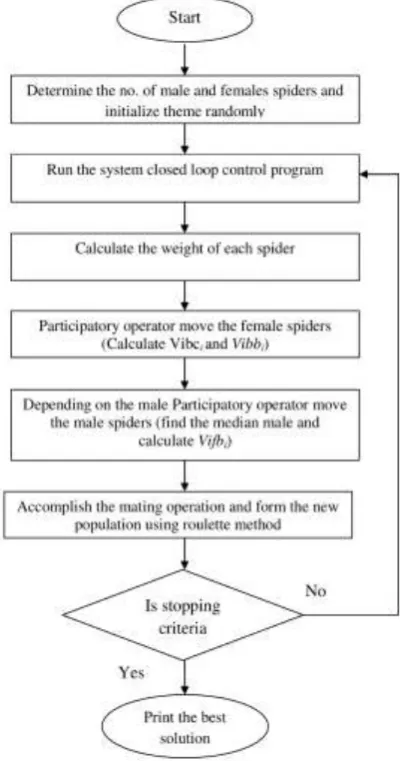
Figure 2 shows the work flowchart of SSO used in this study. SSO works initially by generating the initial population of spider, spidn including two types of agent, which is females, fsp, males, msp. Next, it will initialize the location of the male and female spiders randomly, and calculate the radius of mating. Then, it will calculate the weight if each spider in the entire population.
Once the weight of each spider has been calculated, then the system will move female spiders according to female cooperative operator to emulate the cooperative behavior of female spider, considers the position change of the female spider (i) at each iteration process. The male spiders on the other hand will move according to the male cooperative operator with nearest female individuals to male member (i).
Mating operator usually occurs between dominant male and female. The iterative process updates the best solution continuously by evaluating the fitness function. Then, the fitness spider will be ranked based on the fitness function with resulting in current best quality solution and fitness value. This process continues till the termination criterion is met, in this work the maximum number of iterations is set to 200.
3.3.
Stopping criteria of each algorithm and
number of agents
In this study, for the selection of set of control parameters, each algorithm was executed at a certain number of iterations. Next, to determine the stopping criterion, one-third or two-third of the iterations executed was taken as the standard deviation is much less as when a steady cost value is obtained.
3.4.
Data gathering
After all the best set of control parameters were selected, the m.file was executed to extract data of cost values and parameters of Kp, Ki and Kd. The number-of-runtime also included as one of the stopping criteria in this algorithm. In this work, 20 runtimes were set. Each runtime is an independent experiment which does not affect the other experiment. Runtime which returned lowest cost value with the best optimal solutions is chosen from all the runtimes. Apart from that, 20 runtimes were set, so that to check the robustness of SSO. Each runtime will run for 200 iterations as we set number of iteration, itern is 200.
The last or final iteration usually returns the smallest cost value of the objective function. The data of cost values and solutions obtained are saved in .csv file format for analysis purposes. The last cost (function) value obtained from each iteration and runtime are compared to get the smallest cost value.
The smallest cost value obtained from the previous step is chosen, and the PID controller parameters are tested on Gp1 (System A) and Gp2 (System B) to examine the transient response of the system.
Hence, the step response produced by the combination from this research is analyzed to discover the performance either closely as reference
input or vice versa. The combination of parameters continues for second smallest cost value if the first one does not produce desirable output.
Referring to the cost function (equation 8), there are four important criteria that correspond to cost value are evaluated. The smaller the value obtained, the better the solution produced. From the first iteration, the best cost value will be kept and transferred to next iteration for comparison. The solutions are evaluated and continued until the termination condition is met.
The average of cost values from all the simulation run is calculated and plotted. In addition, the cost is improved as the number of iteration is increasing, and it will converge towards best value. An average cost function is plotted against iterations in order to analyze the convergence of cost values. In order to analyze the trend of variance between the data, standard deviation versus iterations is plotted. Other than that, high standard deviation shows that the data has a large variance from the average value while low standard deviation shows that the data obtain a small variance from the average value.
Finally, errors bars were plotted to visualize the variability of data. The performance of SSO is studied in terms of computational time, cost function values and convergence. The step response was analyzed based on the data obtained for the combination of parameters for this algorithm.
4.
Results and Discussion
4.1.
Cost Analysis
Two cases were conducted in this work which is on both System A and B with ρ=0.5 and ρ=1.5.
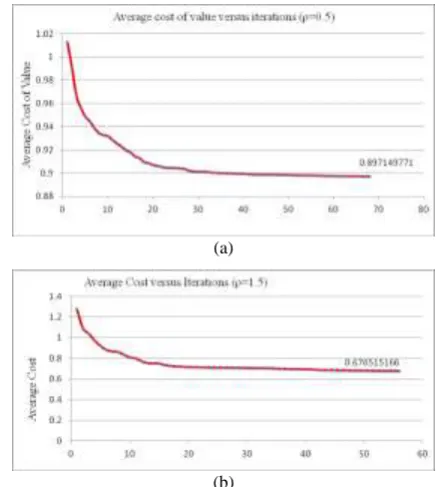
Figure 3(a) and (b) represent the plots of average
cost versus iterations for System A with ρ=0.5 and ρ=1.5 respectively. While Figure 4(a) and (b) depict the plots of average cost versus iterations on System B with ρ=0.5 and ρ=1.5 respectively.
As can be seen in Figure 3(a) and (b), SSO is having fast convergence rate as before reaching 20th iteration. SSO managed to search and obtain the lowest cost value towards zeros for both systems. Hence, System A is able to achieve an optimal solution and well performed when implementing with SSO algorithm.
From Figure 4(a) and (b), it shows that SSO managed to return lowest cost value for both ρ=0.5 and ρ=1.5. Thus, it can be concluded that the set of control parameters matched well with the system B.
4.2.
Comparative on Step Response
best optimal solutions for each system. The performance of the tuned PID parameters has been compared with the best PID parameters tuned with Firefly Algorithm extracted from Hameed works [18]. Table 2 and Table 3 show the chosen runtime with the corresponding PID parameters for both algorithms. The chosen runtime were tested with 2 different cases i.e. System A ρ=0.5 and ρ=1.5 respectively in order to analyze the step responses obtained.
Table 3 depicts the corresponding dynamic performance specifications of system A with ρ=0.5
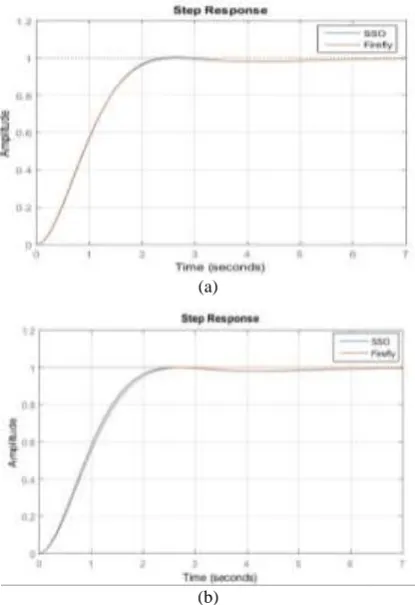
and ρ=1.5. Figure 5 shows the plot of transient response of System A using PID parameters tuned by SSO in comparison with parameters tuned by Firefly Algorithm.
Table 3: Dynamic performance specifications of System A using Optimized PID Parameters Tuned by SSO and Firefly Algorithms
Description ρ = 0.5
SSO Firefly
Peak overshoot Mp (%) 0 0
Settling time Tr (s) 2.14905 2.1142
Rise time Ts (s) 1.3820 1.3808
Steady-state error ess (s) 0.5000 0.5000
Peak time (s) 2.6094 2.6279
ρ = 1.5 Peak overshoot Mp (%) 0 0
Settling time Tr (s) 2.1500 2.2153
Rise time Ts (s) 1.3820 1.4275
Steady-state error ess (s) 0.5000 0.5000
Peak time (s) 2.6100 2.7280
As can be seen from the simulation results, the output response of the system to a step input has a lower rise time and lower overshoot than the output response of the conventional PID controller. It has better dynamic properties and steady-state properties. The simulation results shows that when we compare the performance between Social Spider Optimization (SSO) and Firefly Algorithm for tuning
(a)
(b)
Figure 4: Plots of average cost value versus iterations over 20 simulation-run of system B using SSO (a) ρ=0.5
and (b) ρ=1.5
Table 2: Cost (F) and PID Parameters for Testing on System A
Description ρ=0.5
SSO Firefly
Cost (F) 0.6602 0.6598
Kp 9.9940 10.00
Ki 5.9738 5.9639
Kd 2.4409 2.5369
ρ=1.5
Cost (F) 0.5598 0.5646
Kp 9.9948 9.5594
Ki 5.9654 5.7740
Kd 2.5396 2.2989
(a)
(b)
Figure 3: Plots of average cost value against iterations over 20 simulation-run of system A using SSO (a) ρ=0.5 and (b)
PID controller of System A with ρ=0.5 and ρ=1.5, both algorithms equally performed well in terms of dynamic response curve, short response time, small overshoot, high steady precision, good static and dynamic performance.
Both algorithms were also managed to find nearly optimal solutions with minimizing cost value, hence showed that System A matched well with selected control parameters and chosen objective function.
5.
Conclusions
This work was conducted in order to study the performance of Social Spider Optimization (SSO) to optimize and to tune PID Controller parameters by analyzing the minimization of the objective function and step responses of the closed-loop systems. The algorithm was tested and validated by using the tuned PID controller parameters Kp, Ki and Kd. In order to make a comparison, the cost value and step responses of the systems were analyzed. Based on the analysis, Social Spider Optimization (SSO) outperformed for System A in terms of convergence rate which can be attributed as the advantage of the
automatic subdivision. While Firefly Algorithm performed well too for System B as it managed to find optimal solution with shorter convergence rate as compared to SSO.
6.
Declaration
All authors have disclosed no conflicts of interest, and authors would like to thank the Ministry of Education Malaysia and Universiti Sains Malaysia for supported the work by Fundamental Research Grant Scheme (Grant number: USM/PELECT/6071239).
7.
References
[1] T. Sokunphal, W.A.F.W. Othman, S.S.N. Alhady and W
Rahiman, “PI controller design for velocity control of a mobile robot”. Journal of Fundamental and Applied Sciences, 10(3S), pp. 890-902, (2018).
[2] A. A. A. Wahab, S. S. N. Alhady, N. H. B. Sofik, W. A. F.
W. Othman, “Optimization of PID Controller Using Crow Search Algorithm and Bat Algorithm”. International Journal of Research and Review, 5(10), pp. 101-107, (2018).
[3] G. A. E.-N. A. Said, A. M. Mahmoud, and E.-S M.
El-Horbaty, “A Comparative Study of Meta-heuristic Algorithms for Solving Quadratic Assignment Problem,” International Journal of Advanced Computer Science and Applications(IJACSA),vol. 5, p. 6, (2014).
[4] K.S. Lee and W.G. Zong, "A new meta-heuristic algorithm
for continuous engineering optimization: harmony search theory and practice." Computer methods in applied mechanics and engineering ,194.36 (2005): 3902-3933, (2005).
[5] T. R. Chandran, A. V. Reddy, and B. Janet, "A social spider
optimization approach for clustering text documents," in 2016 2nd International Conference on Advances in Electrical, Electronics, Information, Communication, and Bio-Informatics (AEEICB), pp. 22-26, (2016).
[6] J. J. Q. Yu and V. O. K. Li, "A social spider algorithm for
global optimization," Applied Soft Computing, vol. 30, pp. 614-627, 5// (2015).
[7] M.A. Mustapa, W.A.F.W. Othman, E. Abu Bakar, A.R.
Othman, “Development of Pole-Like Tree Spiral Climbing Robot”. In: Hassan M. (eds) Intelligent Manufacturing & Mechatronics. Lecture Notes in Mechanical Engineering. Springer, Singapore, pp. 285-293, (2018)
[8] A. A. M. Zahir, S. S. N. Alhady, W. A. F. W. Othman and
M. F. Ahmad, “Genetic Algorithm Optimization of PID Controller for Brushed DC Motor”. In: Hassan M. (eds) Intelligent Manufacturing & Mechatronics. Lecture Notes in Mechanical Engineering. Springer, Singapore, pp 427-437, (2018)
[9] MI Nor Faizal, WAFW Othman, SSNA Syed Hassan,
“Development of pole-like tree climbing robot”, In. Proc. 2015 IEEE International Conference on Control System, Computing and Engineering (ICCSCE), IEEE, pp. 224-229, (2015)
[10] S.C. Lau, W.A.F.W. Othman, Elmi Abu Bakar,
“Development of slider-crank based pole climbing robot”, In. Proc. 2013 IEEE International Conference on Control System, Computing and Engineering (ICCSCE), IEEE, pp. 471-476, (2013).
[11] YC Koo, AB Elmi, Wan Amir Fuad Wajdi, “Piston
Mechanism Based Rope Climbing Robot”, Procedia Engineering, Vol. 41, pp. 547-553, (2012).
(a)
(b)
Figure 5: Comparison of transient response of System A for SSO and Firefly algorithm with (a) ρ=0.5 and (b)
[12] P. Ankur, V. Savani, “Performance Analysis of PID Controller and its significance for closed loop system”, International Journal of Engineering Research & Technology (IJERT). ISSN: 2278-0181, Vol. 3 (3), pp. 1843-1847, (2014).
[13] S. Pareek, M. Kishnani, and R. Gupta, "Optimal Tuning of
PID Controller Using Meta Heuristic Algorithms," in Advances in Engineering and Technology Research (ICAETR), 2014 International Conference, Unnao, pp 1-5, (2014).
[14] S.Wadhwani and V.Verma, "Evolutionary Computation
Techniques Based Optimal PID Controller Tuning," International Journal of Engineering Trends and Technology (IJETT), vol. 4, pp. 2529-2534, (2013).
[15] G.Z. Lee, "A Particle Swarm Optimization Approach for
Optimum Design of PID Controller in AVR System," IEEE Transactions on Energy Conversion, vol. 19, pp. 384-391, (2004).
[16] C.C.Wong, S.A.Li, and H.Y.Wang, "Optimal PID Controller
Design for AVR System," Tamkang Journal of Science and Engineering, vol. 12, pp. 259-270, (2009).
[17] A. A. El-Fergany and M. A. El-Hameed, "Efficient
frequency controllers for autonomous two-area hybrid microgrid system using social-spider optimiser," IET Generation, Transmission & Distribution, vol. 11, pp. 637-648, (2017).
[18] N.S.S. Hameed, “Comparison of Bees Algorithm and Firefly