170
Development Of Entrepreneur Learning Model
Based On Problem Based Learning To Increase
Competency, Independence And Creativity
Students Of Industrial Engineering
Leola Dewiyani, M. Kosasih
Abstract: Currently, it is undeniable that the competition to get a job is very tight and of course universities have an important role in printing human resources that can compete globally, not least with the Department of Industrial Engineering Faculty of Engineering, Muhammadiyah University of Jakarta (FT UMJ). Problems that occur is based on the analysis obtained from the track record of graduates, researchers found that 60 percent of students of Industrial Engineering (FT UMJ) work not in accordance with the level of education owned so financially their income is still below the standard. This study aims to improve the competence of students of Industrial Engineering Department FT UMJ in entrepreneurship courses, especially through the development of Problem Based Learning based learning model. Specific targets of this research were conducted with the aim to identify and analyze the need to implement learning model based on Problem Based Learning Entrepreneurship and to design and develop the model of entrepreneurship based on Problem Based Learning to improve the competence, independence and creativity of Industrial Engineering students of FT UMJ in Entrepreneurship course. To achieve the above objectives, this research uses research and development (R & D) method. The product produced in this research is the detail of learning model of entrepreneurial model based on Problem Based Learning; entrepreneurship model based on Problem Based Learning; and international journals
Index Terms: competence, learning model, problem based learning
————————————————————
1 INTRODUCTION
Indicators The progress of a nation is seen from its country's economic growth. Therefore, every country always makes improvements in order to create a conducive economic climate to accelerate the movement of economic growth, not least Indonesia. For Indonesia, Asean Economic Community (AEC) is very big influence on the development of domestic industry because it will create a tighter "competitiveness" where the countries of Southeast Asia region can freely go out into the Indonesian market. For the country Indonesia is actually AEC is a great opportunity to build connectivity both in terms of infrastructure, social protection and national independence. As a great nation Indonesia should be an industrial area not just as a market. The main competition that needs attention is human resources (HR), because the main economic actors are human in this case is human resources. Entrepreneurship is a mental attitude and soul that is always active, creative, independent, empowered, creative, berkartic and earthy in trying and creating something that has added value. From the above definition of application of entrepreneurship courses is one of the subjects expected to support the independence and creativity of students not only in the course but also in other subjects. But the problem here is whether the application of courses in universities including entrepreneurship courses can actually print students who will become an independent scholar, creative and innovative if the education system is implemented today still use conventional methods.Problem Based Learning (PBL) is an educational method that encourages students to learn how to learn and collaborate with groups to seek solutions to real-world problems, problem simulations are used to activate students' curiosity before embarking on an object and prepare students for critical thinking (I WayanDasna and Sutrisno, 2007). To be successful PBL method must also be supported by the use of interesting learning media such as interactive CDs, VCD and others. Faculty of Engineering University of Muhammadiyah Jakarta (FT UMJ) is one of the universities that print industrial
engineering scholars in Indonesia. Department of Industrial Engineering FT UMJ has also applied entrepreneurship courses, by applying this course is expected to generate motivation, independence and creativity of students not only in entrepreneurship courses but also in other fields. However, these hopes have not produced results because based on the results of tracer study obtained that there are many graduates of FT UMJ who work is not in accordance with its competence because it is unable to compete with other universities, especially state universities. And based on interviews the researchers obtained information that they are a lot of less confident and can not freely express opinions when the test forum group discussion (FGD). This research tries to overcome the problem so that students can improve their creativity and independence by developing Problem Based Learning model of learning in entrepreneurship subject and it is expected that this learning model implementation can improve students' independence and creativity so that in the future it can produce a bachelor of FT UMJ Creative Industry Engineering, independent, critical thinking, responsive to problems to be able to compete in the era of globalization.This research aims to improve the competence, creativity and independence of students of Industrial Engineering Department of FT UMJ University to become a bachelor who can compete in globalization era through the development of Problem Based Learning (PBL) learning model in entrepreneurship subject.
2. LITERATURE REVIEW
become independent learners, not only acquire knowledge about what they know, but also make them aware of what they do not know they really need. According to research conducted by AryantiNurhidayati et.al (2013), learning activity of Problem Based Instruction, has succeeded in increasing the independence in constructing student knowledge in the framework of achieving basic competence, student activeness has increased, and student's learning completeness is achieved which is shown not only from result learning, but also the learning process has centered on the student (student centered). Learning Problem Based Instruction implemented, also significantly decrease the number of students who have scores below the average even this method of learning can increase the average value of student learning outcomes. Budianto A.M and EuisEtiRohaeti in a study conducted in 2014 found that the application of Problem Based Learning method in the learning process turned out to improve the way of critical thinking in learners. In addition, in this study also obtained a relationship between the ability to think creatively with the independence of learning in which learners can show a positive perception of problem-based learning. In 2014, Arthur James Swart in his research entitled Using Problem-Based Learning to Stimulate Entrepreneurial Awareness Among Senior African Undergraduate Students reveals that so far engineering students are able and successful in the science of engineering but very lacking in terms of entrepreneurial skills which is a social science. With the implementation of problem-based learning method in engineering students for entrepreneurship skills get significant results where this method can build students' minds in making ideas and designing an effective sales poster. Further results revealed that students were able to meet the learning outcomes for this practical assignment and thoroughly enjoyed the problem-based learning approach. James N. Warnock and M. Jean Mohammadi-Aragh in research published in 2015 have proved that problem based learning methods have succeeded in developing professional engineering skills for engineering students. The results showed that students made significant improvements in problem-solving skills, written communication and self-study. Nowadays the world of education has utilized the problem (problem) as one of the effective learning model to provoke motivation and creativity and independence of students in this case students. This learning model is known as learning model of Problem Based Learning or PBL learning model. With PBL learning model learners are given a 'trigger' or problem that occurs in the real world that is relevant to the teaching materials that are facing, then learners are required to perform various activities that support the problem solving. According to Dewiyani (2012), Problem Based Learning is a learning model that challenges learners to 'learn how to learn', work in groups to find solutions to real-world problems. This problem is to tie learners to a deep curiosity on the intended learning. According to Arends (2007), Problem Based Learning is a learning approach where learners are faced with an authentic problem so they are expected to develop their own knowledge, develop high-level skills and inquiry, develop learners and improve students' self-confidence.
3. RESEARCH METHODS
This study uses research and development procedures (thereby) through the procedures and field trials. Borg & Gall (1979) states that research and development methods in principle are processes for the development of an educational
product and are subsequently validated. The steps of small-scale development research take three main steps: pre-development, model development and model implementation. In the first year carried out pre-development stage and model development. In the pre-development stage the following steps are taken:
1. Research and data collection covering needs analysis, literature study, and field study
2. Plan development research which includes objective formulation, research step, and test plan.
In the development phase of the model carried out the following steps:
1. Model development
2. Development of evaluation tools.
Indicators of measurable outcomes in the first year of study are as follows:
1. List of needs analysis
2. Detailed indicators of the development of
Entrepreneurship Learning Model with Problem Based Learning method
3. Model learning model of Entrepreneurship learning with Problem Based Learning method
4. RESEARCH RESULT
Test the Validity of Student Creativity Questionnaire From the results of data processing contained in table 5.6 shows that the grains of questions 1,2,3,4,5,6 an 9 of student creativity questionnaire has a significant correlation at level 1% and items 7 and 8 have a significant correlation at level 5 % while for item 10 there is no significant correlation so it can be concluded that item 10 is not valid (unrelated to other statement of matter), therefore item number 10 will be removed from the calculation. Test Reliability Student Self-Reliance Questionnaire Reliability test is done by first issuing item 10 (not valid). This reliability test is used to determine the consistency of the prepared questionnaire. The basic decision-making of the reliability test is as follows:
If alpha> r table = consistent If alpha <r table = is not consistent
Here the results are processed with SPSS software:
Case Processing Summary
N %
Cases Valid 30 100.0
Excludeda 0 .0
Total 30 100.0
a. Listwise deletion based on all variables in the procedure.
Reliability Statistics Cronbach's Alpha N of Items
.829 9
R table for n = 30 is 0.361. From the results of the spss is obtained alpha of 0829. this indicates that the questionnaire that has been made is reliable or consistent.
After the validity and reliability test of the questions contained in the questionnaire of motivation, independence and
creativity, then the questionnaire was distributed to 50
respondents who came from Industrial Engineering students of UMM Class A, B and C. And obtained the following
172 • The average score of student learning interest of
23.28 or 51.73%
• The average score of student independence of 23.44 or 52.09%
• The average score of student creativity is 23.26 or 51.69%
Therefore it can be concluded that the average interest in learning, independence and creativity of students is still less that is <70%. After the test on the point of reliability and validity of the questionnaire items then the next questionnaire distributed with the number of respondents by 50 students and also tested how much influence student interest and independence of student creativity with spss processing data as follows:
ANOVAa
Model Sum of
Squares df
Mean
Square F Sig.
1
Regression 565.481 2 282.741 67.974 .000b
Residual 195.499 47 4.160
Total 760.980 49
a. Dependent Variable: Kreativitas
b. Predictors: (Constant), Kemandirian, MinatBelajar
Coefficientsa
Model
Unstandardized Coefficients
Standardized Coefficients
t Sig. B Std. Error Beta
1 (Constant) 4.798 1.851 2.593 .013
Interest to learn .321 .147 .341 2.186 .034
Independency .504 .144 .547 3.505 .001
a. Dependent Variable: Creativity
From SPSS data above shows that the value of Sig. for each variable and the constant has a value <0.05 so it can be said that the variables above mean and have an influence on the dependent variable.
Detailed Indicators of Problem-Based Entrepreneurship Learning Model
Steps for preparing the lesson plans for entrepreneurship semester with Problem Based Learning (PBL) method: Determine the Graduation Profile of Industrial Engineering Program UMJ Determine the competence of graduates of the Study Program Select the leading competencies of Entrepreneurship courses Describe eminent competencies into several competencies Data on the number of meetings in one semester Define the PBL scenario by specifying the number of meetings to complete a single trigger ((∑
)) Count the number of triggers in 1 semester Allocate the learning topics in the trigger Determine the assessment component and the final weight of the semester. Select the appropriate feedback form and assessment formComplete RPS with class rules, references and others as per High Education Ministry standards. From the steps above then further prepared Detailed Indicators of Learning Model of Entrepreneurship Based Problem Based Learning as follows:
Establish Relationship between Graduate Profile, Graduate Competency and Entrepreneurship Subject Competence
a. IT graduate profile
Graduates who are able to contribute on a team work basis by using the principles of industrial engineering science to perform the design, installation process and process improvement of an organizational system based on the values of professionalism and Islamic.
b. Competence and Sub- competence 1. Attitude Competence
Sub Competence:
- Be cautious of Allah SWT and able to show religious attitude;
- Uphold the value of humanity in carrying out duties based on religion, morals, and ethics;
- Internalize academic values, norms and ethics.
- Contribute to improving the quality of life of society, nation, state, and progress of civilization based on Pancasila;
- Serve as a proud citizen and love the country, has nationalism and a sense of responsibility to the state and nation
- Appreciate the diversity of cultures, views, religions, and beliefs, as well as the original opinions or findings of others;
- Cooperate and have social sensitivity and concern for society and environment;
- Obey the law and discipline in the life of society and state; - Demonstrate responsible attitudes towards work in their
own field of expertise; and
- Internalize the spirit of independence, struggle, and entrepreneurship
Information:
- Internalization is the incorporation or unification of attitudes, standards of conduct, opinions and stages within the personality.
- Struggle is having a high fighting power & not easily discouraged.
2. Knowledge Competency Sub Competence:
- Able to master the theoretical concepts of natural science, application of engineering mathematics; engineering fundamentals, engineering science and engineering design required for the analysis and design of integrated systems.
- Able to master the principles and techniques of system design integrated with the system approach.
- Able to master the principles and the latest issues in economic, social, ecological in general.
- Able to master the knowledge about communication techniques and latest and latest technological developments.
3. General Skills Sub Competence:
implements the value of humanities appropriate to their area of expertise;
- Be able to demonstrate independent, quality, and measurable performance;
- Able to examine the implications of the development or implementation of the science of technology which concerns and implements the value of humanities according to their expertise based on rules, procedures and scientific ethics in order to produce solutions, ideas, design or art criticism.
- Prepare a scientific description of the results of the above study in the form of a thesis or final project report, and upload it on the college page capable of making appropriate decisions in the context of problem solving in the field of expertise, based on the results of information and data analysis
- Be able to take decisions appropriately in the context of problem solving in the field of expertise, based on the
analysis of information and data.
Able to maintain and develop networks with mentors, colleagues, colleagues both inside and outside the institution
- Be able to take responsibility for the achievement of group work and to supervise and evaluate the completion of work assigned to workers who are under their responsibility
- Able to conduct a self-evaluation process against working groupsthat are under his responsibility, and able to manage learning independently
- Able to document, store, secure, and rediscover data to guarantee validity and prevent plagiarism
Information:
The value of humanities is a humanitarian value that includes ethics, logic, aesthetics, State Philosophy education, civic education, religion and phenomenology
4. Special Skills Sub-Competence:
- Able to apply math, science and engineering principles to solve complex engineering problems in integrated systems (covering human, material, equipment, energy & information).
- Be able to identify formulate and analyze complex engineering problems in integrated systems based on analytical, computational or experimental approach. - Able to formulate solutions for complex engineering
problems in integrated systems with attention to economic, health and safety factors of public, cultural, social & environmental (environmental consideration). - Able to design an integrated system in accordance with
applicable technical, occupational safety and health standards by considering aspects of performance and reliability, ease
Skenario PBL
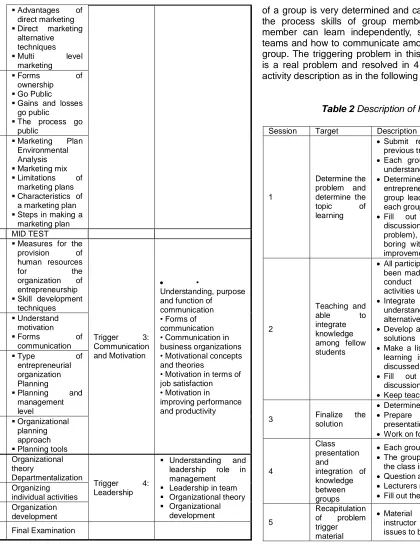
Conversion of conventional learning topics becomes a problem based learning topic In Table 1 below the following table presents the conversion of learning topics that have been done into the topic of learning when using the method of problem based learning.
Table1 PBL Topic Converted
PBL Learning Topics
No Subject
Trigger Number and Themes
Subject
1
Characteristics of entrepreneurship
Determination of entrepreneurship potential
Method of self analysis
NACH Development
Entrepreneurship management
Trigger 1: Entrepreneurial character and aspects of production
The dream of becoming an entrepreneur Understanding of entrepreneurship Entrepreneurial character
The advantages and disadvantages of the entrepreneur
Steps to start entrepreneurship Production
Needs of production process
Production control Business feasibility and factors causing the failure of the entrepreneur
2
External and internal
orientation
Sources of ideas for new products and services
Product planning and development process
Products suitable for small companies
The importance of marketing orientation
Market product matrices
Failure in choosing new business
opportunities
3
Problems in capital search
Business financing
Determination of financial relations company
Technical feasibility analysis
Finding sources of capital
Assessment of the company
4
Determination of new business feasibility
Technical feasibility analysis
Assessment of market
opportunities
Financial feasibility analysis
Assessment of organizational skills
Competition Analysis
Trigger 2: Creativity and Innovation
Find business opportunities
Choosing
business opportunities through business feasibility analysis from various aspects
The role of innovation and creativity in the development of products and services
Determination of superior product and innovation management
Marketing Orientation
Theory, marketing strategy and marketing plan 5
Franchising
Investment risk in the franchise business
Approval of the franchise
174
Advantages of direct marketing
Direct marketing alternative techniques
Multi level marketing
6
Forms of ownership
Go Public
Gains and losses go public
The process go public
7
Marketing Plan Environmental Analysis
Marketing mix
Limitations of marketing plans
Characteristics of a marketing plan
Steps in making a marketing plan 8 MID TEST
9
Measures for the provision of human resources
for the
organization of entrepreneurship
Skill development techniques
Trigger 3: Communication and Motivation
•
Understanding, purpose and function of communication • Forms of communication • Communication in business organizations • Motivational concepts and theories
• Motivation in terms of job satisfaction • Motivation in improving performance and productivity 10
Understand motivation
Forms of communication
11
Type of
entrepreneurial organization Planning
Planning and management level 12 Organizational planning approach
Planning tools
13
Organizational theory
Departmentalization
Trigger 4: Leadership
Understanding and leadership role in management
Leadership in team
Organizational theory
Organizational development 14 Organizing individual activities
15 Organization development 16 Final Examination
Learning Plan Tool for Entrepreneurship Semester Course
a. Problem Based Learning (PBL) Class Activity
In a PBL class, college students are required to work together in a team / group to learn and understand a course material. Each student can explore the knowledge in accordance with what is required by each student. They are also free to determine where and how the knowledge information is acquired. Then the knowledge gained is constructed and integrated with the previously acquired knowledge. Before solving this entrepreneurial problem students are first given the skills of the process how to learn independently that is applying self directed learning. The success and achievement
of a group is very determined and can not be separated from the process skills of group members is how each group member can learn independently, solve problems, work in teams and how to communicate among fellow students in the group. The triggering problem in this entrepreneurial learning is a real problem and resolved in 4 class meetings with the activity description as in the following table 2 :
Table 2 Description of PBL activity
Session Target Description
1
Determine the problem and determine the topic of learning
Submit reports of each group to previous triggers
Each group learns new triggers to understand the problem
Determine learning topics related to entrepreneurship subject syllabus and group leader to share the topics with each group member
Fill out the discussion group discussion form (about defining the problem), define the contents of the boring with the instructor and make improvements
2
Teaching and able to integrate knowledge among fellow students
All participants submit an MFI that has been made to the instructor and then conduct teaching and learning activities using the MFI
Integrate group knowledge and understanding in order to obtain alternative solutions
Develop alternative solutions and find solutions
Make a list of whether there are any learning issues that have not been discussed yet
Fill out the discussion group discussion form (teach teaching) Keep teaching boring teaching
3 Finalize the solution
Determine the final solution
Prepare written reports and presentation materials
Work on formative test questions
4
Class presentation and
integration of knowledge between groups
Each group submits a report
The group that will present in front of the class is appointed by the lecturer Question and answer
Lecturers recap the discussion Fill out the assessment form
5
Recapitulation of problem trigger material
Material recapitulation by the instructor and discusses possible issues to be issued during UTS / UAS
c. Scoring form
The forms used in the PBL class assessment are: 1. Discussion Group Discussion Form 1
2. Discussion Group Discussion Form 2 3. Self Assessment Form & Peer Assessment 4. Interviewing Presentation Form of Group Members
Preparation of Triggers Problem Supporting Factors Triggers Problems:
The trigger of the Entrepreneurship course issue is prepared by considering the following:
finding solutions using logical assumptions (not all information is provided) so that information seeking is required through literature studies
b) The trigger has more than one correct solution and needs to use a strategy to solve it, related to previous knowledge and contains a controversial element so that in class discussion it will feel real and live
c) Triggers include predetermined learning objectives
5. CONCLUSION
Based on research conducted so far it can be concluded things as follows:
• From requirement analysis it is found that average score of student interest is 51.73%, student's average score is 52.09% and student creativity score is 51.69%, which is still below 70 % which is the target of quality target of UMJ Industrial Engineering. This is corroborated by the results of interview researchers with lecturers of entrepreneurship courses and other relevant lecturers that only 10% of students who are active in teaching and learning activities • Design of entrepreneurial learning model based on
problem based learning is designed to improve the competence, creativity and independence of students in general and Industrial Engineering students in particular.
6. SUGGESTIONS
Teaching materials developed related to the entrepreneurial course are still limited so it needs to be added and developed in order to become more perfect. and furthermore, further development of the learning model that can improve the creativity of students in order to compete in the era of globalization.
REFERENCES
[1] Abdallah M Hasna.(2008). Problem Based Learning in Engineering Design. Proceedings of SEFI 36TH Annual Conference European Society for Engineering Education
[2] Aryanti Nurhidayati. (2013). Penerapan Model Pembelajaran Problem Based Instruction Sebagai Upaya Pembentukan Kemandirian Mahasiswa Pada Mata Kuliah Teknik Pondasi. JIPTEK, Vol. VI No.1, Januari 2013
[3] Budianto A.M danEuisEtiRohaeti. (2014).
MengembangkanBerpikirKreatifdanKemandirianBelajarSis wa SMA melaluiPembelajaranBerbasisMasalah. JurnalPengajaran MIPA Volume 19 Nomor 2, OKtober 2014 hlm 166-172
[4] Arthur James Swart. (2014). Using Problem-Based Learning to Stimulate Entrepreneurial Awareness Among Senior African Undergraduate Students. Eurasia journal of mathematics, science and technology educationVolume 10, 2 April 2014
[5] James N. Warnock and M. Jean Mohammadi-Aragh . 2015. Use of Problem-Based Learning To Develop Students' Technical And Professional Skills. European Journal of Engineering Education
[6] Leola Dewiyani. (2012). PenerapanMetodeProblem Based
LearningSebagai Usaha
PencapaianStandarKompetensiDalamPembelajaranPeng antarIlmuEkonomi. laporanpenelitian internal LPPM UMJ
[7]
Arends
, R. I.2007
. Learning to Teach. New York:McGraw-Hill.