EFFECT OF TEMPERATURE ON MOISTURE SORPTION
PhENoMENA IN AGRICULTURAL PRoDUCTS
J. Štencl
Received: April 21, 2005
Abstract
ŠTENCL, J.: Effect of temperature on moisture sorption phenomena in agricultural products. Acta univ. agric. et silvic. Mendel. Brun., 2005, LIII, No. 4, pp. 177-184
The paper demonstrates importance of temperature influence on dehydration processes using dry-ing model equations in introductory part and further presents results of water sorption tests of pars-ley leaves. Measurements were carried out under laboratory conditions in the temperature range of 10–40 °C and relative air humidity from 30 to 100%. Moisture sorption isotherms were tested using a gravimetric dynamic method with continuous recording of changes in sample weight. Five mathemati-cal models available in the literature (Chung-Pfost, gAB, Halsey, Henderson, and Oswin) were statisti-cal evaluated. The Henderson equation was found to be a good model both for moisture adsorption and desorption. Part of the sorption isotherms measured in parsley leaves show the type II BET classifica-tion shape. An increase in temperature causes an increase in water activity for the same moisture con-tent and, if water activity is kept constant, an increase in temperature causes a decrease in the amount of absorbed water.
equilibrium moisture content, modeling, sorption isotherm, water activity
Ročník LIII 20 Číslo 4, 2005
177 Reliable predictions of temperature effects on moisture sorption properties of agricultural produ-cts are needed when designing storage, packaging or drying systems, and particularly in the mathematical modelling of such systems. water transport is a basic phenomenon occurring in foods during processing. The movement of water may be by diffusion within the material or by moisture exchange between the material and the environment. Several models are used to describe the drying characteristics of bio-logical products (Ertekin and Yaldiz, 2004; Krokida et al., 2003). Among them are important for drying processes of agricultural products the one-term ex-ponential model, the Page model, and the two-term exponential model.
As early as in 1921 Lewis (1921) suggested a one--term exponential model to describe the drying rate of a particle analogous to Newton´s law of cooling:
dM
—— = – k(M – Me) (1).
dt
The solution of equation (1) is obtained after vari-able separation:
dM(t)
—————— = dt (2),
– k[M(t)– Me] or
1 1
It is possible to receive after integration and after defining boundary condition, M(t) = M0 at t = 0:
M(t) – Me
ln ————– = –kt (4)
M0 – Me
or
M(t) – Me
————– = exp(–kt) (5),
M0 – Me
where M(t) is the moisture content of the particle at the time t, Me is the equilibrium moisture content (EMC) of the particle, M0 is initial moisture content and k is the drying constant. In equation (5), there are two parameters to be estimated, k and Me. Determi-nation of the drying constant for wet materials was a subject of numerous studies (Krokida et al., 2004; Pancharyia et al., 2002; Rotz and Chen, 1985; Sa-voie, Brook and Rotz, 1982). For example Rotz and Sprott (1984) neglected equilibrium moisture content (Me = 0) when they calculated the drying constant k. The error is minimal for moisture contents above 1g water/g d.b., but becomes significant when moisture content approaches the real equilibrium moisture con-tent, as shown by Pitt (1993). In such cases, which are most important in practice, it is necessary to estimate equilibrium moisture content Me. This value is limi-ted for borderline conditions of drying processes, see equation (4) or (5). The fraction in equation (5) is cal-led moisture ratio, Mr:
M(t) – Me
Mr = ————– (6).
M0 – Me
Equation (1) is then commonly expressed as a func-tion of Mr:
Mr = exp(–kt) (7).
Page (1949) proposed a modification of the one--term exponential drying model in describing the drying of shelled corn. The model has the following form:
Mr = exp(–k0t n) (8),
where k0 and n are drying constants. Equation (8) has been successfully used to describe the drying rate of corn products (Huizhen and Morey, 1984, Chhinnan, 1984).
Two-term exponential model
Henderson (1974) suggested that thin-layer drying of biological products can be represented by a two term exponential model of the form:
Mr = A0exp(–k1t) + A1 exp(–k2t) (9),
where A0 and A1 are empirical constants, and k1 and
k22 are drying constants. Equation (9) is a simpli-fied form of the solution to Fick´s law of diffusion (Mechlová and Košťál, 1999). This model predicts the drying process of solids during the falling rate period.
The process of dehydration, equations (7), (8), and (9), is described under constant temperature and rela-tive air humidity of the environment in all cases. The limiting parameter is Mr, see equations (6), (7), (8), and (9), which primary depends on Me.
The objective of this study is to show influence of the temperature on the drying process, Me, and con-sequently on water sorption isotherms. Sorption tests of fibre material, parsley leaves, were chosen as an example. water sorption tests with samples of dried parsley leaves at different temperatures (range of 10–40 °C) and relative air humidities (range of 30 to 99%) were carried out. The relationship among Me, equilibrium relative air humidity (ERH), water acti-vity (aw), and temperature was analysed and described by existing isotherm equations available in the litera-ture sources.
MATERIAL AND METhoDS
There are numerous models for predicting the re-lationship of Me, aw, and temperature (Vitázek et al., 2003; Jouppila and Roos, 1994; Mazza and Jayas, 1991; wolf et al., 1990; Chen and Morey, 1989). These water sorption isotherm models may be theo-retical, semi-theoretical or empirical and the cho-ice of the model is depend on many factors. Chen and Moray (1989) evaluated four EMC/ERH mo-dels (Halsey, Henderson, Chung-Pfost, and Oswin) for their ability to fit data from 18 grain, fibrous, and seed crops. The modified Henderson and Chung--Pfost equations were good for fibrous and starchy materials while the modified Halsey fitted well for oil and protein products. A European COST 90 pro-ject (wolf et al., 1990) on physical properties of ag-ricultural products revealed that the gAB (guggen-heim – Anderson – de Boer) equation was superior to four other models (Halsey, Henderson, Chung--Pfost, and Oswin) in characterising the sorption be-haviour on the level of monolayer moisture content. Similar results have been confirmed by a study of Mazza and Jayas, (1991).
These five mentioned models are:
Chung-Pfost
1 (b – t)
we = — ln ln aw ——— (10),
a c
Halsey
exp(a + bt) c
we = ————– (11),
–lnaw
Henderson
ln(1 – aw) c
we = ———— (12),
a(t + b)
Oswin
aw c
we = (a + bt) ——— (13), 1 – aw
the gAB:
Wm·C·K·aw
we = ———————————— (14),
(1 – K·aw)·(1 – K·aw + C·K·aw)
Wm1
Wm = Wm0 · exp · —— (15),
R·T
Hm – Hn
C = C0 · exp ———— (16),
R·T
He – Hn
K = K0 · exp ———— (17),
R·T
where:
we = equilibrium moisture content (EMC), %w.b.,
aw = water activity,
t = temperature, °C
a, b, c = constants for the particular equation,
Wm = mono-layer moisture content,
Wm1 = temperature coefficient,
Wm0, C0, K0 = pre-exponential constants,
C, K = equilibrium constants,
Hm = heat of sorption of mono-layer,
Hn = heat of sorption of multi-layer,
Hc = heat of condensation of multi-layer,
R = universal gas constant,
T = temperature, K.
The gravimetric dynamic method with continu-ous registration of sample weight changes was used for determining the sorption characteristics of pars-ley leaves. Freshly harvested plants were stored at room temperature conditions for two weeks. The fi-nal moisture content of leaves was about 15% (w.b.). Moisture equilibrium data for adsorption and desorp-tion of such prepared samples were investigated at a temperature range of 10–40 °C in 10 °C steps and re-lative humidities from 30 to 100% in 10% steps. The procedure of each test was as follows: after reaching the equilibrium moisture content of the sample at a certain relative air humidity (at a constant air tempe-rature, velocity and pressure), the relative humidity was automatically increased (adsorption) or decrea-sed (desorption) and the new equilibrium was obta-ined under these conditions. Each test was repeated three times. The experimental EMC data were pro-cessed using specially developed software and analy-sed using the non-linear regression procedure of UNI-STAT (1995).
The precision of fit of a model (Halsey, Hender-son, Chung-Pfost, Oswin, and gAB) was determined using several statistics: the standard error of the es-timate for EMC (s.e. of eses-timate) (Chen and Morey, 1989; Mazza and Jayas, 1991), the mean relative per-centage deviation (P) (Chen and Morey, 1989; Mazza and Jayas, 1991), the Durbin-watson statistic (d) (Draper and Smith, 1981), the plot of residuals – pro-bable Chi-squared value (Chen and Morey, 1989; Th-akor et al., 1995; Suthar and Das, 1997) and also co-efficient of determination (R2) (Lamond and graham, 1993; Menkov et al., 1999).
RESULTS AND DISCUSSIoN
Equations (Halsey, Henderson, Chung-Pfost, Oswin, and gAB), which model the dependence of EMC of leaves of parsley on aw in the temperature range of 10–40 °C were investigated and reviewed. Convergence could not be achieved for gAB model in the tested range of EMC and temperature. Analysis of residuals and goodness-of-fit tests were carried out after determining parameters. The comparisons of ac-cepted Chung-Pfost, Halsey, Henderson, and Oswin models are given in Tab. I.
I: Comparison of Chung-Pfost, Halsey, Henderson and Oswin models for adsorption and desorption of pars
-ley leaves
Model estimates.e. of P d Probable Chi-squared value R2
Chung-Pfost ads 0.8091 6.8643 1.3904 0.013 0.9442
Halsey ads 0.9757 12.8269 1.0814 0.097 0.9188
Henderson ads 0.3482 3.3633 1.8999 0.171 0.9897
Oswin ads 0.8643 10.7889 1.1167 0.001 0.9363
Chung-Pfost des 0.8045 6.9638 1.3608 0.002 0.9424
Halsey des 0.9551 12.1246 1.0814 0.085 0.9187
Henderson des 0.3540 3.3460 1.8810 0.176 0.9888
Oswin des 0.8479 10.2833 1.1178 0.194 0.9360
ads = adsorption des = desorption
The statistical values in Tab. I show, that Hender-son´s model for leaves of parsley, both for water ad-sorption and dead-sorption, has the smallest standard er-ror (s.e.) of estimate and the smallest mean relative percentage deviation. The standardized residuals of
these models are normally distributed (Chi-square test) and uncorrelated (Durbin-watson test).
Adsorption and desorption parameters estimated for Henderson´s model of EMC for leaves of parsley are presented in Tab. II.
II: Parameter values of constants in Henderson´s model of EMC for parsley
Constants for
ads Estimate s.e. Constants for des Estimate s.e.
a –0.0007 0.00005 a –0.0005 0.00004
b –2.1493 1.07180 b –2.9666 1.05750
c 0.4826 0.00790 c 0.4602 0.00790
ads = adsorption des = desorption
As an example, the experimental adsorption and
desorption isotherms of leaves of parsley at 20 °C and for aw ranging from 0.3 to 1.0 are shown in Fig. 1 and 2. Curves represent Henderson´s model.
1: Adsorption isotherm for leaves of parsley at 20 °C
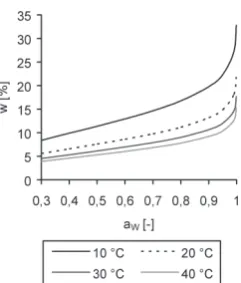
Fig. 3 and 4 was generated to illustrate predictions of the adsorption and desorption Henderson´s model given by equation (12) and using fitted parameters in
Tab. II for near ambient air temperature in the range of 10–40 °C and aw ranging from 0.3 to 1.0.
3: Adsorption isotherms for leaves of parsley (Hen
-derson´s model) 4: Desorption isotherms for leaves of parsley (Henderson´s model)
-Temperature effects the mobility of water mole-cules and the dynamic equilibrium between the va-pour and adsorbed phases. Fig. 3 and 4 show sche-matically the effect of temperature shifts on both the moisture content and aw. If aw is kept constant, an in-crease in temperature causes a dein-crease in the amount of absorbed water. This indicates that the material be-comes less hygroscopic. As pointed out by Rao and Rizvi (1995), this is necessitated by the thermodyna-mic relationship. As a result, an increase in tempe-rature represents a condition unfavourable to water sorption. An exception to this rule is shown by cer-tain sugars and other low molecular weight
constitu-ents which become more hygroscopic at higher tem-peratures because they dissolve in water. This effect is explained by an increase of the solubility of these constituents in water. The shift of sorption isotherms with temperature has an important practical effect on microbiological and chemical reactivity related to the quality deterioration of agricultural products du-ring storage. Part of the sorption isotherms measured show the type II BET classification shape. The critical EMC of parsley leaves was approximately 8% (w.b.) at 20 °C as it is in equilibrium with aw = 0.6. Below this value the growth of micro-organisms, especially moulds, does not occur (Beuchat, 1981).
SoUhRN
Vliv teploty na sorpční chování vlhkých zemědělských produktů
teploty snižovalo množství absorbované vody. Kritická hodnota rovnovážné vlhkosti testovaných lístků petržele, odpovídající vodní aktivitě 0,6, činila 8 % při 20 °C.
rovnovážná vlhkost, modelování, sorpční izoterma, vodní aktivita
The study was supported by the grant MSM 432100001 awarded through the Ministry of Education, Youth and Sports of the Czech Republic.
REFERENCES
BEUChAT, L.: Microbial stability as affected by wa-ter activity, Cereal Foods world, 1981, 26, 4: 345-351. ISSN 0146-6283.
BROOKER, D. B., BAKER-ARKEMA, F. w., HALL, C. w.: Drying cereal grains, The AVI Pub-lishing Co. westport, Connecticut, 1981.
CHHINNAN, M. S.: Evaluation of selected mathe-matical models describing thin-layer of in-shell pe-cans, Transactions of the ASAE, 1984, 27, 5: 610-615. ISSN 0001-2351.
CHEN, C. C., MOREY, R. V.: Comparison of four EMC/ERH equations, Transactions of the ASAE, 1989, 32, 7: 983-990. ISSN 0001-2351.
DRAPER, N. R., SMITH H.: Applied Regression Analysis. New York: J. wiley & Sons Publishing, 1981, pp. 72-115.
ERTEKIN, C., YALDIZ, O.: Drying of eggplant and selection of suitable thin layer drying model, Jour-nal of Food Engineering, 2004, 63, 3: 349-359. ISSN 0260-8774.
JOUPPILA, K., ROOS, Y. H.: water sorption and ti-me-dependent phenomena of milk powders, Jour-nal of Diary Science, 2004, 77, 7: 1798-1808. ISSN 0022-0302.
HENDERSON, S. M.: Progress in developing the thin-layer drying equation, Transactions of the ASAE, 1974, 17, 6: 1167-1168. ISSN 0001-2351. HUIZHEN, L. and MOREY, R. V.: Thin-layer drying
of yellow dent corn, Transactions of the ASAE, 1984, 27, 1: 581-585. ISSN 0001-2351.
IgLESIAS, H. A., CHIRIFE, J.: Equilibrium moisture contents of air dried beef: dependence on drying temperature, Journal of Food Technology, 1976, 11, 7: 565-573. ISSN 0022-1155.
KAMINSKI, w., STRUMILLO, C.: The influence of temperature on sorption isotherms of protein-con-taining mixtures, Drying Technology, 1994, 12, 12: 1263-1276. ISSN 0737-3937.
KROKIDA, M. K., KARATHANOS, V. T., MAROU-LIS, Z. B., MARINOS-KOURIS, D.: Drying kine-tics of some vegetables, Journal of Food Enginee-ring, 2003, 60, 4: 391-403. ISSN 0260-8774. KROKIDA, M. K., FOUNDOUKIDIS, E.,
MAROU-LIS, Z. B.: Drying constant: literature data
compi-lation for foodstuffs, Journal of Food Engineering, 2004, 6+, 3: 321-330. ISSN 0260-8774.
LEwIS, w. K.: The rate of drying of solid materials, Journal of Industrial Engineering, 1921, 13,5: 427-432.
LABUzA, T. P.: Typical sorption isotherms. In: Moisture sorption, published by the American As-sociation of Cereal Chemists, St. Paul, Minnesota, 1984, pp. 8-21. ISBN 0-913250-34-1.
LAMOND, w. J., gRAHAM, R.: The relationship between the equilibrium moisture content of grass mixtures and the temperature and humidity of the air, Journal of Agricultural Engineering Research, 1993, 56, 3: 327-335. ISSN 0021-8634.
MAZZA, g., JAYAS, D. S.: Equilibrium moisture characteristics of sunflower seeds, hulls and ker-nels, Transactions of the ASAE, 1991, 34, 4: 534-538. ISSN 0001-2351.
MECHLOVá, E., KOŠŤáL, K.: Výkladový slov-ník fyziky, Fick´s laws. Prometheus Praha, 1999, p. 262. ISBN 80-7196-151-5
MENKOV, N. D., PASKALEV, H. M., gALYAZ-KOV, D. I., KEREZIEVA-RAKOVA, M.: Ap-plying the linear equation of correlation of Bru-nauer-Emmett-Teller (BET) – monolayer moisture content with temperature, Nahrung, 1999, 43, 2: 118-121.
PAgE, g.: Factors influencing the maximum rates of air drying shelled corn in thin layers, M.S. Thesis, Purdue University, 1949.
PANCHARIYA, P. C., POPOVIC, D., SHARMA, A. L.: Thin-layer modelling of black tea drying pro-cess, Journal of Food Engineering, 2002, 59, 4: 349-357. ISSN 0260-8774.
PITT, R. E.: Forage drying in relation to pan evapora-tion, Transactions of the ASAE, 1993, 36, 6: 1933-1937. ISSN 0001-2351.
RAO, M. A., RIZVI, S. S. H.: Chemical potential and phase equilibria. In: Engineering properties of fo-ods, Marcel Dekker, Inc., NY, 1995, 226-241. ISBN 0-8247-8843-1.
ROTZ, C. A., CHEN, Y.: Alfalfa drying model for the field environment, ASAE paper no. 85-1025, ASAE St. Joseph, Michigan, 1985.
al-Address
Doc. Ing. Jiří Štencl, DrSc., Ústav zemědělské, potravinářské a environmentální techniky, Mendelova země-dělská a lesnická univerzita v Brně, Zemězemě-dělská 1, 613 00 Brno, Česká republika
falfa, Transactions of the ASAE, 1984, 27, 3: 715-720. ISSN 0001-2351.
SAVOIE, P., BROOK, R. C., ROTZ, C. A.: Empirical model for field drying of alfalfa, ASAE paper no. 82-1528, ASAE St. Joseph, Michigan, 1982. SUTHAR, S. H., DAS, S. K.: Moisture sorption
iso-therms for karingda seed, kernel and hull, Journal of Food Process Engineering, 1997, 20, 3: 349-366. ISSN 0145-8876.
THAKOR, N. J., SOKHANSANJ, S., PATIL, R. T., DESHPANDE, S. D.: Moisture sorption and
vo-lumetric changes of canola during hydrothermal processing, Journal of Food Process Engineering, 1995, 18, 2: 233-242. ISSN 0145-8876.
VITáZEK, I., HAVELKA, J., PIRŠEL, M.: Sorption isotherms of maize grains, Agriculture, 2003, 49,3: 137-142. ISSN 0551-3677
wOLF, w., SPIESS, w. E. L., JUNg, g.: Standardi-zation of isotherms measurements, COST - Project 90 and 90 bis, 1990. 97 p.