FORMULATIO AD EVALUATIO OF ORO DISPERSIBLE TABLETS
OF CLOAZEPAM BY DIRECT COMPRESSIO METHOD
THAKKAR HARDIK R*, A.SENTHIL, RAVIKUMAR, V.B. NARAYANA SWAMY
Karavali College of Pharmacy, Mangalore-575028, Karnataka, India.
Summary
The objective of the present investigation was to prepare oro dispersible tablets of clonazepam by direct compression method using three super disintegrants, viz., croscarmellose sodium, crospovidone and sodium starch glycolate at different concentrations with microcrystalline cellulose along with directly compressible mannitol to enhance mouth feel. Oro dispersible tablet is the fast growing and highly accepted drug delivery system, convenience of self administration, compactness and easy manufacturing. Clonazepam is an anticonvulsant, musclerelaxant and anxiolytic properties. It is completely absorb after oral administration. The bland was examined for angle of repose, bulk density, tapped density, compressibility index and hausner’s ratio. The prepared batches of tablets were evaluated for thickness, hardness, friability, and weight variation, content uniformity, wetting time, Water absorption ratio, in-vitro
dispersion time, dissolution studies and FTIR studies. Twelve formulations F1 to F12 were prepared with three super disintegrants with different concentration. The optimum formulation was choosen and their optimum results were found to be in close agreement with experimental finding.
Keywords: Oro dispersible tablets, Super disintegrants, Clonazepam, Direct compression.
Corresponding address
Thakkar Hardikkumar Rajeshbhai
Karavali College of Pharmacy,
Mangalore-575028, Karnataka, India
E-mail ID: [email protected]
Introduction
Most of the oral pharmaceutical dosage form like conventional tablets and capsules are formulated but it was difficult to swallow for elderly and children. This problem is also applicable to active working or travelling people who do not have ready access to water1. Recent advances in novel drug delivery system aims to provide rational drug therapy by enhanced safety and efficacy of drug molecule by formulating convenient dosage form to administration2. One such approach is oro dispersible tablets (ODTs). An oro dispersible tablet is a solid dosage form that disintegrates and dissolves in mouth without water within 60 seconds or less3. The various technologies used to prepare ODTs include freeze drying and sublimation4. The commonly used super disintegrants are croscarmellose sodium, crospovidone and sodium starch glycolate5. In many orally disintegrating tablet technologies based on direct compression, the addition of super disintegrants principally affects the rate of disintegration and hence dissolution and also effervescent agent also further hastens the process of disintegration.
Clonazepam is a benzodiazepine derivative with marked antiepileptic properties. It may be used in the treatment of all types of epilepsy and seizures. It is also indicated in mycoclonus and associated abnormal movements, and for the treatment of panic disorders. It was selected as drug candidate, since it is not available in such dosage form. Aim of the present study was to develop oro dispersible tablets of clonazepam by simple and cost effective direct compression method using three super disintegrants, croscarmellose sodium, crospovidone and sodium starch glycolate at different concentrations. The blend and prepared tablets were evaluated and compared with three super disintegrants, effect on the in vitro dispersion time, in vitro drug release and FTIR studies were observed. From the twelve formulations, the optimum formulations were selected.
Material and Method
Clonazepam was obtained from as a gift sample from Dr.Reddys, Hyderabad, sodium starch glycolate, croscarmellose sodium was obtained as gift sample from AET Laboratories Hyderabad. crospovidone were gift sample from LOBA chemie pvt. Ltd., Mumbai. All other chemicals used were of Analytical Reagent grade.
Preparation of clonazepam tablets
Table 1 Formulation of clonazepam tablets
Ingredients
(mg)* F1 F2 F3 F4 F5 F6 F7 F8 F9 F10 F11 F12
Clonazepam 2 2 2 2 2 2 2 2 2 2 2 2
Croscarmellose
sodium 6 9 12 15 _ _ _ _ _ _ _ _
Crospovidone _
_ _ _ 6 9 12 15 _ _ _ _
Sodium starch
glycolate _ _ _ _ _ _ _ _ 6 9 12 15 Microcrystalline
cellulose 102 38 38 38 38 38 38 38 38 38 38 38 38 Mannitol
(pearlitol SD200)
94 91 88 85 94 91 88 85 94 91 88 85
Aspartame 3 3 3 3 3 3 3 3 3 3 3 3
Magnesium
stearate 2 2 2 2 2 2 2 2 2 2 2 2
Talc 5 5 5 5 5 5 5 5 5 5 5 5
Total weight 150 150 150 150 150 150 150 150 150 150 150 150
*
All the quantities expressed are in mg/tablet.
Characterization of oro dispersible tablets
Evaluation of blends
Angle of repose
Angle of repose was determined using funnel method.6 The blend was poured through a funnel that can be raised vertically until a maximum cone height (h) was obtained. The radius of the heap (r) was measured and the angle of repose (Ѳ) was calculated using the formula.
Bulk density
Apparent bulk density (pb) was determined by pouring the blend in to a graduated
cylinder. The bulk volume (Vb) and weight of the powder (M) was calculated using the
formula.6
pb = M / Vb
Tapped density
The measuring cylinder containing a known mass of blend was tapped for a fixed time.The minimum volume (Vt) occupied in the cylinder and the weight (M) of the blend was
measured.The tapped density (pt) was calculated by using formula.
pt = M / Vt
Compressibility index
The simplest way for measuring of free flow of powder was compressibility, a indication of the ease with which a material can be induced to flow was given by compressibility index (I).6
I = (V0 - Vt / V0) 100
Where, vo is the bulk volume and vt is tapped volume.
Hausner’s ratio
Hausner’s ratio was an indirect index of ease of powder flow. It was calculated by the following method
Hausner ratio = pt / pd
Where, pt is tapped density and pd is bulk density lower hausner’s ratio (< 1.25) indicates
better flow properties than higher ones(> 1.25).8
Evaluation of tablets
Weight variation
Twenty tablets were selected at a random and average weight was determined. Then individual tablets were weighed and were compared with average weight for determination of weight variation.
Friability
dropping the tablets at a height of 6 inches in each revolution. Preweighed sample of tablets was placed in the friabilator and were subjected to 100 revolutions. Tablets were deducted using a soft muslin cloth and reweighed. The friability (f) was given by the formula.
F = (1-W0 / W) 100
Where, W0 is weight of the tablets before and W is weight of the tablets after test.
Hardness
Hardness was measured using Monsanto tablet hardness tester.6
Thickness
Thickness was measured using digital Vernier calipers.
Wetting time and water absorption ratio
The method reported by Yunixia et al 9 was following to measure the tablet wetting time. A piece of tissue paper (12 cm × 10.75 cm) folded twice was placed in a petridish containing 6 mL of simulated saliva pH 10, a tablet was put on the paper ,the time required for complete wetting was measured. The wetted tablet was taken and weighed. Water absorption ratio (R) was determined using following equation
R = 100 × (Wa - Wb) / Wb
Where Wb is weight of tablet before water absorption and Wa is weight of tablet after
water absorption.
In vitro dispersion time
Tablets were placed in 10 mL beaker containing 6 mL of pH 6.8 phosphate buffer at 37 ± 0.50C and time required for complete dispersion was determined.1
In vitro dissolution study
IR spectral analysis
Infrared spectra of drug and its inclusion complexes were recorded by KBr method using Fourier Transform Infrared Spectrophotometer. A base line correction was made using dried potassium bromide and then spectra of dried mixtures of drug and inclusion complexes with potassium bromide were recorded.
Short term stability studies
Short-term stability studies on the promising formulations were carried out by storing the tablets at 400C and 75% RH over a 6 month period according to ICH guidelines. At intervals of 1, 3 and 6 month, the tablets were visually examined for any physical changes, changes in drug content and in vitro dispersion time.
Results and Discussion
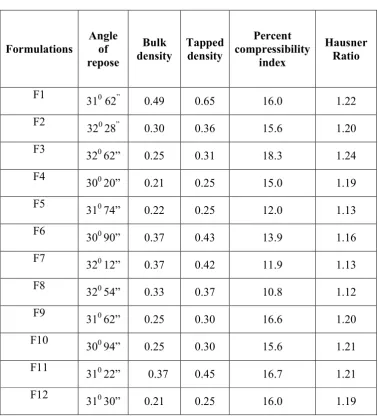
Twelve formulations of Clonazepam were prepared by direct compression method with varying concentration of three super disintegrants, sodium starch glycolate, crospovidone, croscarmellose sodium with microcrystalline cellulose. Directly compressible mannitol was used as diluents to enhance mouth feel. A total of 12 formulations were designed. The powder blend was evaluated the physical properties such as angle of repose, bulk density, tapped density, compressibility index and hausner‘s ratio for the prepared tablet blend Table 2. The angle of repose between 30 and 33, this indicates passable flowability, the percentage compressibility index and hausner’s ratio were within the limits (< 15%).
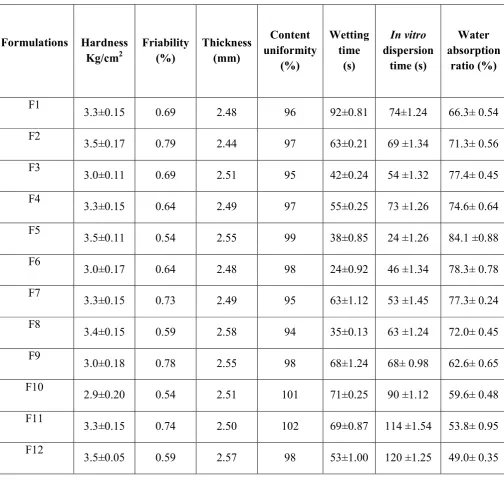
The prepared tablets were evaluated for hardness, friability, thickness, weight variation, content uniformity were shown in Table 3. For all the batches were found to be within the acceptable limits. The drug content was found to be in the range of 94 to 102% (acceptable limits) and the hardness of the tablets was found to be 2.9 to 3.5 kg / cm2 were shown in Table 3. Friability below 1% was an indication of good mechanical resistance of tablets. The wetting time was determined for all the formulations prepared. Water absorption ratio and wetting time, which are important criteria for understanding the capacity of disintegrants to swell in the precence of little amount of water were found within the limits.
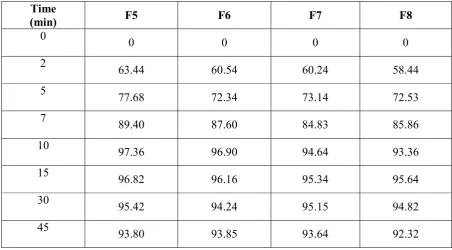
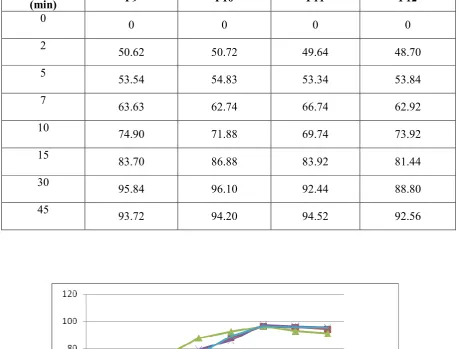
different concentrations. The drug release was found to be 97%, 96%, 95% and 96% at the end of 15 minutes were shown in Table 5 and Figure 2. It concluded that F5 formulation gives maximum drug release within 10 minutes respectively for the formulation F9, F10, F11 and F12 using sodium starch glycolate at different concentrations. The drug release was found to 84%, 87%, 84% and 81% at end of 15 minutes were shown in Table 6 and Figure 3 from these three different super disintegrating agent 3% crospovidone formulation F5 show good drug release.
Table 2 Tablet blend evaluation test
Formulations Angle of repose Bulk density Tapped density Percent compressibility index Hausner Ratio F1
310 62” 0.49 0.65 16.0 1.22
F2
320 28” 0.30 0.36 15.6 1.20
F3
320 62” 0.25 0.31 18.3 1.24
F4
300 20” 0.21 0.25 15.0 1.19
F5
310 74” 0.22 0.25 12.0 1.13
F6
300 90” 0.37 0.43 13.9 1.16
F7
320 12” 0.37 0.42 11.9 1.13
F8
320 54” 0.33 0.37 10.8 1.12
F9
310 62” 0.25 0.30 16.6 1.20
F10
300 94” 0.25 0.30 15.6 1.21
F11
310 22” 0.37 0.45 16.7 1.21
F12
310 30” 0.21 0.25 16.0 1.19
of tablet as the function time. IR spectroscopic studies indicated that the drug was compatible with all the excipients. Short term stability studies of the above formulations indicated that there were no significant changes in drug content and in vitro dispersion time at the end of 6 month period (p < 0.05).
Table 3 Prepared tablets evaluation test
Formulations Hardness Kg/cm2 Friability (%) Thickness (mm) Content uniformity (%) Wetting time (s) In vitro dispersion time (s) Water absorption ratio (%) F1
3.3±0.15 0.69 2.48 96 92±0.81 74±1.24 66.3± 0.54
F2
3.5±0.17 0.79 2.44 97 63±0.21 69 ±1.34 71.3± 0.56
F3
3.0±0.11 0.69 2.51 95 42±0.24 54 ±1.32 77.4± 0.45
F4
3.3±0.15 0.64 2.49 97 55±0.25 73 ±1.26 74.6± 0.64
F5
3.5±0.11 0.54 2.55 99 38±0.85 24 ±1.26 84.1 ±0.88
F6
3.0±0.17 0.64 2.48 98 24±0.92 46 ±1.34 78.3± 0.78
F7
3.3±0.15 0.73 2.49 95 63±1.12 53 ±1.45 77.3± 0.24
F8
3.4±0.15 0.59 2.58 94 35±0.13 63 ±1.24 72.0± 0.45
F9
3.0±0.18 0.78 2.55 98 68±1.24 68± 0.98 62.6± 0.65
F10
2.9±0.20 0.54 2.51 101 71±0.25 90 ±1.12 59.6± 0.48
F11
3.3±0.15 0.74 2.50 102 69±0.87 114 ±1.54 53.8± 0.95
F12
3.5±0.05 0.59 2.57 98 53±1.00 120 ±1.25 49.0± 0.35
*
Table 4
In vitro
drug release studies of croscarmellose sodium
Time
(min) F1 F2 F3 F4
0
0 0 0 0
2
51.84 52.30 56.35 52.74
5
59.72 75.52 68.25 60.34
7
76.60 87.83 79.30 75.93
10
87.83 92.42 85.90 89.10
15
95.90 96.15 97.48 96.38
30
95.26 92.76 96.35 95.80
45
93.80 91.14 95.74 95.16
Table 5
In vitro
drug release studies of crospovidone
Time
(min) F5 F6 F7 F8
0
0 0 0 0
2
63.44 60.54 60.24 58.44
5
77.68 72.34 73.14 72.53
7
89.40 87.60 84.83 85.86
10
97.36 96.90 94.64 93.36
15
96.82 96.16 95.34 95.64
30
95.42 94.24 95.15 94.82
45
Table 6
In vitro
drug release studies of sodium starch glycolate
Time
(min) F9 F10 F11 F12
0
0 0 0 0
2
50.62 50.72 49.64 48.70
5
53.54 54.83 53.34 53.84
7
63.63 62.74 66.74 62.92
10
74.90 71.88 69.74 73.92
15
83.70 86.88 83.92 81.44
30
95.84 96.10 92.44 88.80
45
93.72 94.20 94.52 92.56
Figure 1 Plot of In vitro drug released studies of croscarmellose sodium
Figure 2 Plot of in vitro drug released of crospovidone
Figure 3 In vitro drug release studies of sodium starch glycolate
Conclusion
References
1. Shirwaikar. Fast disintegrating tablet of atenolol by dry granulation method. Ind J Pharm Sci 2004; 66: 422-426.
2. Banker BS and Anderson GR, Lachman L, Leon Liberman HA and Kanig JL. The theory and practice of industrial pharmacy. Edition 3, Varghese publishing house 1987; 293-345.
3. Sunada H and Bi YX. Preparation evaluation and optimization of rapidly disintegrating tablets. Powder Technologies 2002; 122: 188-198.
4. Shin SC, Oh IJ, Lee YB, Choi HK, and Choi JS. Enhanced dissolution of furosemide by Co-precipitating or Cori dining with cross povidone. Int J Pharm Sci 1998; 24: 175-177. 5. Marshall, Lachaman L, Leon Liberman HA and Kanig JL. The theory and practice of
industrial pharmacy. Edition 3, Varghese publishing house. 1987; 67-85.
6. Marshall K, Lachaman L, Leon Liberman HA and Kanig JL, The theory and practice of
industrial pharmacy. Edition 3, Varghese publishing house 1987; 66-99.
7. Lindberg N, Palsson M pihl A, Freeman R, Freeman J, Zetezener H and Enstand G. Flowability Measurement of pharmaceutical powder mixture with poor flow using five different techniques. Drug Dev Ind Pharm 2004; 30(7): 785-791.
8. Levis SR and Deasy PB. Pharmaceutical application of reduced grades of surfactants co-processed Micro crystalline cellulose. Int J pharm 2001; 230: 25-33.
9. Akihikol and Masayasn S. Development of oral dosage form for elderly patient. chem
Pharm Bull 1996; 44(11): 2132-2136.
10.Peh KK and Wong CF. Polymeric films as Vehicle for buccal delivery swelling Mechanical and bio adhesive properties. J pharm pharma Sci 1999; 2(2): 53-61