1164
Development Of Stem Integrated E-Learning
Design To Improve Student’s Creative Thinking
Capabilities
Nur Rahmat Wahyuaji, Suparman
Abstract: Creative thinking is one of the essential abilities in solving problems. With the increased ability to think creatively, student achievement is also expected to increase. One effort to improve the ability of creative thinking is the integration of STEM (Science, Technology, Engineering, and Mathematics) in learning using e-learning. This study is a research development using the ADDIE model. This research begins with an analysis of the needs of the material to be delivered. The next stage then designs the appearance of learning according to the needs of students. Then make e-learning based on analysis of student needs and designs that were created. E-e-learning then validated with several experts such as media experts and material experts. Then E-learning is assessed to be known for its validity value. This study aims to make the design of e-learning with an integrated STEM approach that fits the characteristics of students to improve student’s creative thinking skills. The results of this study are flowchart and design-learning for mathematics design-learning that integrates STEM to improve students' creative thinking skills. The resulting design is; (1) home page display design; (2) material page design; (3) general page display design; and simulation design interaction.
Index Terms: ADDIE, Creative Thinking, E-learning Design, Geometry Transformation, Instructional Media, Multimedia Content, STEM Education.
—————————— ——————————
1.
INTRODUCTION
reative thinking is one of the abilities that are important for students to have in today's life. The ability to think creatively is one of the important things because it can enable students to become effective problem solvers and to work mathematically[1]. In line with this, mathematics learning is expected to focus on developing creative thinking, so students can try their own way of solving [2]. This ability is one of the important abilities in everyday life because everyone will face various problems with demands to have creative thoughts to find solutions to problems faced [3]. With the increase in student’s creative thinking skills, it is expected that students' learning achievements will also increase. The ability to think creatively is very important in classroom learning, especially in mathematics. Students who have good creative thinking skills will easily find alternative solutions to solve the problem. One way that can be used to improve student’s creative thinking skills is integrating STEM in learning. STEM was first introduced in the 1990s by the National Science Foundation (NSF). In the world of education, STEM is known as STEM education [4]. STEM is an extension of Science, Technology, Engineering, and Mathematics. Many countries have implemented STEM education, and each country applies it with variety because it depends on the conditions and needs of each country [5]. Integrating STEM in learning can be carried out in various forms [6] and various ways [4]. STEM can be integrated as an approach in learning between two or more STEM fields, one STEM field with another, and one or more subjects in school [4]. In integrating STEM, students are given support to connect their ideas [7]. Therefore, with the support of connecting each student's ideas in solving problems in the classroom, students' creative thinking skills can be
improved. One effort in integrating STEM in classroom learning is utilizing e-learning. E-learning is learning that uses computer assistance. By using e-learning, teachers can use new forms of learning and teaching [8]. Based on the results of previous research, mathematics teachers should use website-shaped learning media in teaching and learning activities. However, to develop good e-learning, consideration is needed from various other factors [9]. E-learning can be developed by incorporating very varied multimedia content. According to other studies, multimedia content can be used to develop and improve fluency [10]. So that with the integration of STEM in mathematics learning using e-learning, student’s creative thinking skills can be improved so that student learning achievement also increases.
2 METHOD
This is development research using ADDIE development model [11]. The steps on the ADDIE model, namely, Analysis, Design, Development, Implementation, and Evaluation [12],[13]. This research aim is to developing e-learning design with STEM integrated. In the analysis phase, researchers find out about the description of student's needs about STEM-based learning media to improve student's creative thinking skills. After that, the researcher made observations and interviews with students to find out the characteristics of students at school, the delivery of learning material in the classroom, and the facilities provided at the school. After that, the researchers looked for ways to integrate STEM in mathematics learning with Geometry Transformation material that matches the characteristics of students. the design stage, the learning objectives to be achieved are made and compiled, a description of the learning activities that will be implemented, the selection of media to be used, the design of instructional media and a description of tools for evaluating learning assessment for a while [11], [13]. At this stage, researchers first make and arrange learning objectives to be achieved. Then the researcher determines what activities will be carried out in learning. Then the researcher determines what media to use. After that, the researcher made a design from e-learning, which was following the characteristics of students based on the activities to be carried out in learning. Then based on the C
————————————————
Nur Rahmat Wahyuaji is a master student at the Master of Mathematics Education at Ahmad Dahlan University, Indonesia, Phone: 0818206948. E-mail: [email protected] Suparman is a lecturer at Master of Mathematics Education at
learning activities contained in e-learning design, researchers determine the temporary picture of the evaluation tool to assess the learning process. Data collection techniques in the form of observations, interviews, and instruments for assessing the feasibility of design learning media. Observations and interviews are conducted to determine the characteristics and needs of students on the learning media that will be used. The feasibility assessment instrument is used to assess the feasibility of the design that has been made to be used as a basis for making e-learning in the development stage.
3 RESULT AND DISCUSSION
3.1 Analysis
This analysis phase is part of the background of why this learning media was developed. At this stage it contains an analysis of the needs of students in STEM integrated learning media that can improve the ability to think creatively, analyze student characteristics and how teachers deliver material, analyze supporting facilities in schools, and analyze alternative solutions to integrate STEM on learning media that will be created. At this stage there are several conclusions, namely (1) Students need STEM integrated learning media that can improve their creative thinking skills as one of the varied learning alternatives, (2) Students are used to using the internet and browsing to look for material or parts that are (3) The teacher conveys the material with varied techniques on the board, such as using a ruler to draw graphics and using colorful markers so that the graph looks interesting, (4) In the school there are sufficient and complete facilities starting from classrooms, laboratories to comfortable school environments; and (5) one alternative solution for integrating STEM in learning is by utilizing e-learning.
3.2 Design
At the design stage of instructional media design is based on the analysis result. In using the integrated STEM approach, one of the things that need to be considered is that integration must be clear because students cannot spontaneously integrate concepts from different representations and material in one unit [14], [7]. Integrating STEM can be done by taking basic competencies from one subject, or other STEM field. In this regard, the integration of STEM into mathematics learning can be done by taking basic competencies from mathematics learning material to be further integrated with other STEM fields. So that the design stage is very necessary so that e-learning developed first is designed so that integration is carried out following the objectives. The first stage of design is making and compiling learning objectives. For learning
purposes that will be applied can be seen in Table 1. After the learning objectives to be achieved are completed, then the next step is to draw a picture of the learning activities that will be carried out, namely in the form of material and simulation. The material that will be used is made using multimedia content. Multimedia content can help a student to understand the concept of 3-dimensional geometry, motivate to study mathematics, and increase their interest and self-esteem in mathematics [15]. The media that will be used is e-learning, which contains multimedia content such as SCORM, Flash, embedded HTML, and other multimedia content. The design of learning media design is carried out by making a flowchart as a reference for the nets of the media to be developed. Flowchart is a graphical representation of the sequence of work activities used in making, producing, or giving something specific and unique output [16]. In line with this, the flowchart is used to describe the flow from a scene to another scene that makes it easier for the user to operate [17]. To make a flowchart it doesn't have to be left to right or top to bottom, even though the primary orientation is when the flowchart will be read by following an arrow that can have any orientation [18]. So, it is found that a flowchart is a graphical representation in the form of a work sequence that describes the flow from one scene to another to create, produce or provide something specific and unique that aims to facilitate the user in operating it. Flowcharts that have been designed can be seen in Figure 1.
TABLE1
LEARNING OBJECTIVES TO BE ACHIEVED
No. STEM Learning Objectives
Science Technology Engineering Mathematics
1 Connecting everyday life in geometry transformation
Using technology in the form of
multimedia to solve contextual problems related to geometry transformation
Design a design in the form of steps to solve a contextual problem related to geometry
transformation
Analyze and compare
transformation and composition transformations using matrix.
Learners can solve the problem of geometry transformation using their own designs with the help of technology in the form of multimedia.
1166
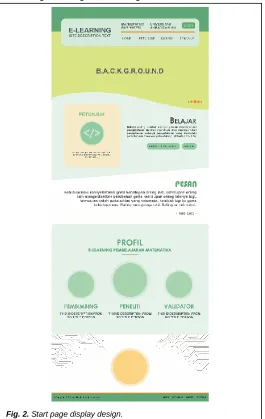
From the flowchart, it can be seen that the operation flow starts from accessing the e-learning URL. After opening, the first display that appears is "the main page". On the main page, there is a button to directly "log in" to each account, and there is also a selection of buttons to access available menus such as instructions, material, evaluation and about. In the main display and other displays can be directly moved through the menu button, and if you want to end can immediately close the browser window. After the flowchart is completed, then the next step is to create a storyboard as a display design that will be used to develop learning media. Before creating a web, researchers created a storyboard to determine the look and feel of the web [19]. There are programming instructions, audio, and descriptions of visual elements with text, video, graphics, and animation [20]. The storyboard also describes screen-to-screen descriptions of things people will see, hear, and act in the mind of the author [21]. After the flowchart and storyboard are completed, then make each display design learning media that contains a sketch of the display of learning media that will be developed. The following parts of the storyboard of e-learning design that will be developed can be seen in Figure 2, Figure 3 and Figure 4.
In the initial display plan, there are several sub-sections such as a large header section, the background section as a place
to put pictures to provide an overview of the contents of e-learning interestingly, and content sections to place some interesting information. The header on the start page is different from the header on other pages because in the header of the main page there is some additional information such as a mobile number or e-mail address that can be contacted. Besides that, it is also a place for profile menus to be more easily accessed if users have logged in using their respective accounts. In the background, images and reviews or words will be placed that can attract students to open and operate e-learning. In the content section, images, writing, audio, or video will be placed, which can make students interested in operating e-learning.
TABLE2
FEEDBACK AND SUGGESTIONS AND FOLLOW-UP
No. Feedback and Suggestions
Follow-up
1 In the message section must given in quotation marks
Quotations marks has given on the message section
2 In the simulation view, please be clearer
The simulation view has been setting to be clearer
3 The placement of the video and audio parts should be clearer
The placements of video and audio was redesigned
4 The use of the STEM approach must be reaffirmed
The use of STEM approach has been redesigned
Fig. 2. Start page display design.
In the plan for displaying material, there are several parts, namely the header section, the breadcrumb navigation section, the instruction section, and the content section. In the header section, it is designed to be smaller and more concise, but without removing the function, the goal is not to disturb students or users and be more focused on instruction and content. The header section contains logos and menus to access e-learning. The breadcrumb navigation section contains information about traces of menus that can be used if needed. In the instruction section, there are various instructions and instructions for using or operating the content. In the content section, the contents of the material are compiled from various multimedia content according to the strategy for delivering each sub-material. The content is made by referring to the STEM education approach and paying attention to the syntax to improve student’s creative thinking skills in learning mathematics subjects.
Plans for displaying sub-menus found on the material page; the parts include the submenu title, the description of the submenu which is marked with a green background, and the contents of the submenu are sorted below from the submenu description. In the description of the submenu can be placed learning steps on the submenu or other explanations that can help the course of the learning process. The description of the
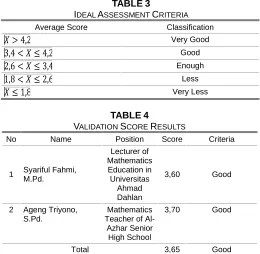
submenu is intentionally placed first and given a background that is intended for the user to be instructed to read what is written in the description, and then go to the next menu. After the design of instructional media was completed, then the design of learning media was validated by media experts. Inputs and suggestions about the design of instructional media are then compiled and followed up. For some input and suggestions about the design of instructional media can be seen in Table 2. The results of the media expert's assessment of design validation were obtained from the learning media design validation instrument using a Likert scale. Likert scale that used is scale 5. After validation of the results obtained, then the results are compared with the Ideal assessment criteria’s table, as shown in Table 3. The results of the learning media design validation can be seen in Table 4.
4 CONCLUSION
This research resulted the design of e-learning STEM integrated mathematics learning following the curriculum and characteristics of students. E-learning is designed to improve student’s creative thinking skills. The content contained in e-learning is compiled by utilizing various diverse multimedia content. Part of e-learning consists of a) Start page; b) Material pages; and c) Submenu pages. The start page is the page that first appeared when e-learning was accessed, and there is a brief description of the contents of e-learning that is made interesting. Material pages are pages that can be accessed if you have logged in first, examples of this page are profile pages, test/evaluation pages, and simulation pages. General pages are. Indicators of creative thinking ability combined with the STEM approach, are placed predominantly on the material page and simulation page. For the integration of other STEM, there are other supporting pages.
5 SUGGESTION
The e-learning design of STEM integrated mathematics learning is designed to improve the student’s creative thinking skills. This design can be used in the next stage in the ADDIE development model, the development stage, to be developed into real e-learning with STEM integrated.
ACKNOWLEDGMENT
My thanks go to Allah SWT, our Prophet Muhammad SAW, my parents and the lecturers and fellow students of the Ahmad Dahlan University Mathematics Education Masters Program.
REFERENCES
[1] S. Sanders, ―Critical and Creative Thinkers in Mathematics Classrooms,‖ J. Student Engagem. Educ. Matters, vol. 6, no. 1, Jan. 2016.
[2] Ranak Lince, ―Creative Thinking Ability to Increase Student Mathematical of Junior High School by Applying Models Numbered Heads Together,‖ J. Educ. Pract., vol. 7, no. 6, 2016.
[3] K. Suastika, ―Mathematics Learning Model of Open Problem Solving to Develop Students’ Creativity,‖ Int. Electron. J. Math. Educ., vol. 12, no. 3, pp. 569–577, 2017.
[4] M. Sanders, ―STEM, STEM education, STEMmania,‖ Technol. Teach., vol. 68, no. 4, pp. 20–26, 2009. [5] J. M. Ritz and S.-C. Fan, ―STEM and technology
education: international state-of-the-art,‖ Int. J. Technol. Des. Educ., vol. 25, no. 4, pp. 429–451, Nov.
TABLE3
IDEAL ASSESSMENT CRITERIA Average Score Classification
Very Good Good Enough
Less Very Less
TABLE4
VALIDATION SCORE RESULTS
No Name Position Score Criteria
1 Syariful Fahmi, M.Pd.
Lecturer of Mathematics Education in Universitas
Ahmad Dahlan
3,60 Good
2 Ageng Triyono, S.Pd.
Mathematics Teacher of Al-Azhar Senior High School
3,70 Good
Total 3,65 Good
1168
2015.
[6] S. S. Guzey, T. J. Moore, and M. Harwell, ―Building Up STEM: An Analysis of Teacher-Developed Engineering Design-Based STEM Integration Curricular Materials,‖ J. Pre-College Eng. Educ. Res., vol. 6, no. 1, Jun. 2016.
[7] National Research Council, STEM Integration in K-12 Education: Status, Prospects, and an Agenda for Research. National Academies Press, 2014.
[8] H. EL-Deghaidy and A. Nouby, ―Effectiveness of a blended e-learning cooperative approach in an Egyptian teacher education programme,‖ Comput. Educ., vol. 51, no. 3, pp. 988–1006, Nov. 2008.
[9] A. Andersson and Å. Grönlund, ―A Conceptual Framework for E-Learning in Developing Countries: A Critical Review of Research Challenges,‖ Electron. J. Inf. Syst. Dev. Ctries., vol. 38, no. 1, pp. 1–16, Jul. 2009.
[10] K. M. Meyrick, ―How STEM Education Improves Student Learning,‖ Meridian K-12 Sch. Comput. Technol. J., vol. 14, no. 1, pp. 1–6, 2011.
[11] M. Allen, ―Designing Online Asynchronous Information Literacy Instruction Using the ADDIE Model,‖ Distrib. Learn., pp. 69–91, Jan. 2017.
[12] H. Fardoun, F. Montero, and V. López Jaquero, ―eLearniXML: Towards a model-based approach for the development of e-Learning systems considering quality,‖ Adv. Eng. Softw., vol. 40, no. 12, pp. 1297– 1305, Dec. 2009.
[13] H. Wiphasith, R. Narumol, and C. Sumalee, ―The Design of the Contents of an e-Learning for Teaching M.5 English Language Using ADDIE Model,‖ Int. J. Inf. Educ. Technol., vol. 6, no. 2, pp. 127–131, 2016. [14] G. Pearson, ―National academies piece on integrated
STEM,‖ J. Educ. Res., vol. 110, no. 3, pp. 224–226, May 2017.
[15] A. Prabowo, R. P. Anggoro, D. Astuti, and S. Fahmi, ―Interactive multimedia-based teaching material for 3-dimensional geometry,‖ J. Phys. Conf. Ser., vol. 943, no. 1, p. 012047, Dec. 2017.
[16] R. Damelio, The Basics of Process Mapping. Productivity Press, 2016.
[17] S. Sari, R. Anjani, I. Farida, and M. A. Ramdhani, ―Using Android-Based Educational Game for Learning Colloid Material,‖ J. Phys. Conf. Ser., vol. 895, no. 1, p. 012012, Sep. 2017.
[18] A. Lemaitre, H. Mouchère, J. Camillerapp, and B. Coüasnon, ―Interest of Syntactic Knowledge for On-Line Flowchart Recognition,‖ Springer, Berlin, Heidelberg, 2013, pp. 89–98.
[19] R. Rattanawongsa and P. Koraneekij, ―A development of blended information literacy learning web for Thai high school students,‖ Procedia-Social Behav. Sci., pp. 2693 – 2699, 2015.
[20] S. K. B, ―Creating e-learning Content Storyboard Based on Instructional Design Principles,‖ J Mass Commun. Journal., vol. 3, no. 4, 2013.