Licensed under Creative Common Page 42
http://ijecm.co.uk/
ISSN 2348 0386
“THE BALANCE OF PAYMENTS AS A MONETARY PHENOMENON”
AN ECONOMETRIC STUDY OF GHANA’S EXPERIENCE
Bosson-Amedenu Senyefia
Department of Mathematics and I.C.T, Holy Child University College of Education, Takoradi, Ghana [email protected]
Theodore Oduro-Okyireh
Department of Mathematics, Statistics and Computer Studies, Cape Coast Technical University, Cape Coast, Ghana
Osei-Asibey Eunice
Department of Mathematics and I.C.T, Ada University College of Education, Ada-Foa, Accra Ghana [email protected]
Abstract
This paper examines the monetary approach to balance of payments (BoP) in Ghana using
monthly data set that spans from January 2006 to February 2018 from Bank of Ghana. The
Augmented Dickey Fuller test as well as the Phillips-Perron test was employed to assess the
presence of unit root or otherwise. The empirical results from ARDL cointegration and error
correction modeling revealed that the BoP in Ghana is a purely monetary phenomenon: both
short-run and long-run relationships exist between selected variables and Net Foreign Assets.
Exchange Rate, Net Domestic Credit, Inflation Rate and Interest Rate are found to have a
significant influence on the BoP position in the long run. Also, Net Domestic Credit and Broad
Money Supply have a highly significant effect on the BoP position in the short run. The policy
conclusion is that authorities in charge of monetary policy formulation for the Ghanaian
economy can consider prudent monetary policies aimed at correcting BoP disequilibrium in the
economy as a short-run and long run mechanism.
Licensed under Creative Common Page 43
INTRODUCTION
Long term disequilibrium in BoP is a crucial economic problem in a great number of low and middle income countries including Ghana. Factors that cause the persisting problems of disequilibrium in the BoP include abysmal export performances, very large service account deficits, external debt repayments, large fiscal deficits, and distortions of price and misappropriation of foreign aid (Ayentimi, 2013).In the attempt to come out with financial and fiscal policy, BoP is essential in providing the threshold warning signals to ensure that the underdeveloped countries practice fiscal discipline. BoP data are also of great significance in understanding changes in money stock, money-market liquidity and the exchange rate of a currency, all are salient drivers in enacting monetary regime (Merwe, 2002). Ghana’s growth
record has been sporadic; as it recorded increased GDP growth between mid-fifties and early-sixties, but stalled in growth by 1964. After this period, the growth of Ghana became jerky until the year 1981 which marked the threshold of a steady path. Ghana recorded negative growth in the ending parts of the sixties and seventies including the period 1980-1983. By 1986, Ghana’s
trade position had improved significantly, resulting in a trade surplus of 0.25% of GDP. Balance of trade turned into deficit recording 5.0% of GDP in 1995, 10.27% in 1997 and 22.03% in 1999. However, 2004-2005 witnessed a worsening trade position as the trade deficit edged up from 23.96% of GDP in 2005 to 27.94% of GDP in 2007 (Amoah and White 2009).Within the period 2009 and 2011, annual real GDP growth saw an increase from 4.8% to 14.0%. It thereafter witnessed a continuous decline to 4.0% GDP in 2014. From this point, a marginal decline in real GDP of 3.8% and 3.7% respectively during 2015 and 2016 was observed. It then shot up to 7.9% in 2017 (2017 Budget statement of Ghana). A lot of current studies professed that a country needs to efficiently tackle its deficit in order to forestall dangerous path of economic failure as experienced by Greece.
Having perused literature, it is undeniable to establish that the Monetary Approach to the Balance of Payments (MABP) is still an unsolved phenomenon. Lachman and Dhliwayo (1975) concluded their studies with concrete evidences in favour of MABP. However, Watson (1990) concluded otherwise. It is for this reason that informs the need to carry out a study in Ghana to find out if the role of excess money supply is significant in BoP disequilibrium in Ghana. The study will also identify the drivers of BoP adjustment in Ghana.
REVIEW OF RELEVANT LITERATURE
Licensed under Creative Common Page 44
The Monetary Approach to the Balance of Payments (MABP)
The MABP refers to BoP as a monetary incident. It connects a country’s BoP and the money
supply of that country (Chacholiades, 1990). MABP is a measure of the grand BoP determined by a country’s international reserves and is affected by lack of balances which is prevalent in the
money market. In a study byDhliwayo(1996), it was established that in a system of fixed exchange rates, excess money supply engender increasing expenditure, which in turn put domestic demand for foreign goods and services in an upward trend. This necessitates the reduction of towering domestic demand to be financed by reducing foreign exchange reserves, which tends to worsen the BoP. He intimated again that the outflow of reserve assets lowers money supply until it equals money demand. This restores monetary equilibrium by stalling an outflow of the reserve assets. Therefore a surplus demand for money results in contradictory adjustment, which in turns serves as a catalyst for foreign exchange reserves inflow, and results in BoP surplus. This necessitates domestic monetary expansion and later restores BoP to the equilibrium position. Fleermuys (2005) cited in a study by Bobai (2013) established that MABP equates the demand of money to that of a stock; therefore, the inflows or outflows of money are regarded as the disequilibrium is related to expected and actual stocks, which can be attuned through a surplus of income over expenditure or conversely. Fleermuys (2005) established that for a country to correct the excesses between expenditure and income, the flow of money restores the desired and actual money stock to equilibrium. He argued that although monetary authorities have influence on flow of money supply, the influence on the stock of money supply is what they lack. Hence it is inferable that countries which have exchange rates fixed have endogenous money supply system.
The Elasticity Approach
In the year 1937 Robinson found that the only effect monetary policy has on BoP is its power to drive credit creation. The approaches of elasticity stress the impact of change in exchange rate on the imports and exports of a country; for that matter on the trade account balance when other variables like income are ignored (Robinson, 1947)
Licensed under Creative Common Page 45
The Absorption Approach
The Absorption approach was developed to highlight the significance of income changes in the adjustment process. The absorption approach intends to show how devaluation might change the link between expenditures or between absorption and income – in both nominal and real terms. Great emphasis is laid on the current account balance. This approach lays emphasis that the devaluation of a currency would lead to an increase in inflationary prices, which would in turn revoke the initial effect of an increase in prices. This resulting process could be prevented if only inflation itself deflates the combined demand for goods through an income redistribution effect or through a reduction in the real value of existing money balances (Fleermuys, 2005). Coppin (1994) cited in (Bobai, 2013) iterated that one aspect that these two alternative approaches have in common is that they assume that BoP disequilibria are permanent. Furthermore, criticisms have been meted out to the two approaches particularly for not considering capital account of the BoP. The current account is the only point of focus of these mechanisms and thus the particular impacts of capital movements on BoP.
Empirical Review
Adamu (2004) did a study to determine the dynamics of BoP adjustment in the countries of the West African Monetary Zone (WAMZ). The outcome was that money highly influenced the determination of deficits of BoP. It was clear from the results that both interest rate and domestic credit had inversely relationship with net foreign asset with statistically significant coefficients. In addition, the result established a direct relationship between log of GDP and net foreign asset with significant coefficients.
Danquah (2008) used Autoregressive Distributed Lag (ARDL) approach to cointegration and error-correction representation on the annual data between the periods 1986 and 2005. The study sought to examine the effects of exchange rate on Ghana’s imports and exports demands, and also, the effects of exchange rate on Ghana’s external trade. The findings of the study indicated that flexible exchange rates have small influence on Ghana’s external trade. The
findings established that both short-run dynamics and long-run causal relationships between the demands for imports exist. Demand for exports and the trade balance on one hand and the real effective exchange rate, the real domestic product, foreign reserves, import price index, export price index and foreign income on the other hand.
Licensed under Creative Common Page 46 GDP growth commonly drift variables, making linear relationships between these variables over long period of time thus translating into equilibrium relationships of economic variables. Further test by OLS revealed that BoP in Ghana was not entirely a monetary phenomenon. In all three variables GDP growth, interest rate, and domestic credit were significant in the determination of NFA. Although the findings generally fulfilled predictions and expectations of literature, the result revealed that disequilibrium in BoP is not entirely in tandem with the effect of monetary variables. BoP was found to be strongly affected by expenditure of government.
Odili (2014) in his study examined the impact of exchange rate on balance of payment in Nigeria, using annual data from 1971 to 2012. He used ARDL co-integration estimation model to find if there was any long-run and short-run relationship between the variables of the model. The findings established a positive and statistically significant relationship in the long-run and again found a positive but statistically insignificant relationship in the short-run between BoPand exchange rate.
RESEARCH METHOD
Koutsoyiannis (1977) noted that the crucial step in attempting to study the relationship between variables is to specify the relationship in a mathematical form. In our study, the explanatory variables used include Exchange Rate, Net Domestic Credit (NDC), Broad money supply (MONEY SUPPLY), Inflation Rate and Interest Rate. Net foreign assets (NFA) was used as the dependent variable in the model. Monthly data covering the period January 2006 to February 2018 were utilised to test Ghana’s monetary approach to balance of payments. The data was
obtained from the Bank of Ghana monthly statistical bulletins covering the period under consideration. The rationale for choosing the given range of data had some considerations. In addition to the basis of data availability, most of Ghana’s debt was cancelled in 2005. Ghana
embarked on cedi redenomination from cedi to Ghana cedi in 2007. Again, Ghana adopted GDP debasement in 2011. Production of crude oil and exporting same all fall within the chosen time series. All variables were transformed into natural logarithms in order to ease the interpretation of the results and to reduce possible heteroscedasticity. Explicitly, the equation for estimation is given as
𝐼𝑛𝑁𝐹𝐴 = 𝛽0+ 𝛽1𝐸𝑋𝐶𝐻𝐴𝑁𝐺𝐸 𝑅𝐴𝑇𝐸 + 𝛽2𝑁𝐷𝐶 + 𝛽3𝑀𝑂𝑁𝐸𝑌 𝑆𝑈𝑃𝑃𝐿𝑌 + 𝛽4𝐼𝑁𝐹𝐿𝐴𝑇𝐼𝑂𝑁 𝑅𝐴𝑇𝐸
+ 𝛽5𝐼𝑁𝑇𝐸𝑅𝐸𝑆𝑇 𝑅𝐴𝑇𝐸 + 𝜀
Estimation Procedure
Licensed under Creative Common Page 47 (Pesaran and Shin, 1999; Pesaran et al, 2001).The ARDL can be used to test for a linear relationship between variables that are either I(0) or I(1) as well as for a mixture of I(0) and I(1) variables. This is superior to the Johansen cointegration technique which is only appropriate for variables integrated of the same order(Duasa, 2007; Adom et al, 2012).
The ARDL(q,p) model given by
Δ𝑦𝑡 = 𝛽0+ 𝐶0𝑡 + 𝜍𝑖Δ𝑦𝑡−𝑖 𝑞
𝑖=1
+ 𝜔𝑗
𝑝
𝑗 =0
Δ𝑥𝑡−𝑗 + 𝛾1𝑦𝑡−1+ 𝛾12𝑥𝑡−1+ 𝜀𝑡
The coefficients 𝛽0,𝐶0 are the drift and trend coefficients respectively and 𝜀𝑡 is the white noise error. The coefficients 𝜍𝑖 and 𝜔𝑗 for all 𝑗 corresponds to the short-run relationship while the 𝛾𝑗 ;
𝑗 = 1, 2 corresponds to the long-run relationship.
Unit Root Test
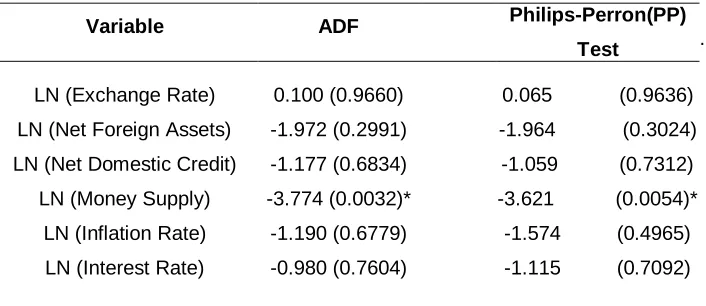
To test the time series data for stationarity a common method is to apply the Augmented Dickey-Fuller test (ADF )to test for a unit root (Dickey and Fuller, 1979; Brooks, 2014). A time series with a unit root is said to be non-stationary. There are other common methods for determining the stationary of a variable such as the Phillips-Perron (PP) test. The test are similar to the ADF test but with a few alternations in order to allow for autocorrelated residuals. Both the ADF test as well as the Phillips-Perron (PP) test wereutilised to test for stationarity of the variables under consideration.
The unit root tests for the variables are conducted by investigating the following hypothesis test:
𝐻0: Unit root is present i.e. the time series is non-stationary
𝐻0:No unit root is present i.e. the time series is stationary
Table 1: Unit Root Test of the Series
Variable ADF Philips-Perron(PP)
Test .
LN (Exchange Rate) 0.100 (0.9660) 0.065 (0.9636) LN (Net Foreign Assets) -1.972 (0.2991) -1.964 (0.3024) LN (Net Domestic Credit) -1.177 (0.6834) -1.059 (0.7312) LN (Money Supply) -3.774 (0.0032)* -3.621 (0.0054)*
LN (Inflation Rate) -1.190 (0.6779) -1.574 (0.4965) LN (Interest Rate) -0.980 (0.7604) -1.115 (0.7092)
*
Licensed under Creative Common Page 48
ANALYSIS AND RESULTS
Estimation of the ARDL model
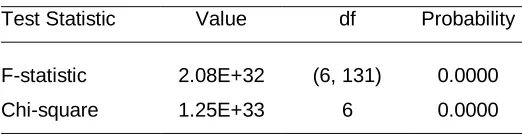
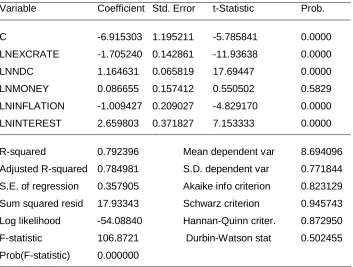
Table 4 presents the results of the co-integration status of the model employed in this study using the ARDL Bound test. The model exhibited long-run relationship when Net Foreign Assets (NFA) was redressed on the vectors of variables: Exchange Rate, Net Domestic Credit (NDC), Broad Money Supply (MONEY SUPPLY), Inflation Rate and Interest Rate. The lag structure (lag 1) was selected based on the Schwarz Information Criterion (McQuarrie, 1998). The output on Table 2 indicates that there is no serial correlation among the variables. Moreover, Table 3 shows that the variables in the model jointly have a long run relationship. Thus in the long run, we expect the variables to move in equilibrium. Table 4 is the outcome of the model for the long run relationship between the variables. It can be noticed that Exchange Rate, Net Domestic Credit, Inflation Rate and Interest Rate have significant impact on the balance of payment position in the long run.
The implication from the output in Table 4 is that, though the Money Supply in the model may have a long run effect on net foreign assets, its effect is not statistically significant. The Adjusted R-squared value which denotes the explanatory power is 78.5% and this shows that the model is statistically fit. The algebraic signs of the log of all the chosen variables are in consistent with theory. For example, the log of Inflation has a negative effect on NFA which theory predicts. Money reserves is insignificant which is not in line with what MABP by theory predicts.
Table 2: Breusch-Godfrey Serial Correlation LM Test
F-statistic 0.570256 Prob. F(2,130) 0.5668 Obs*R-squared 1.252349 Prob. Chi-Square(2) 0.5346
Table 3: Wald Test for Long Run Equlibrium
Test Statistic Value df Probability
F-statistic 2.08E+32 (6, 131) 0.0000
Licensed under Creative Common Page 49 Table 4: Estimated Long-run coefficients
Variable Coefficient Std. Error t-Statistic Prob.
C -6.915303 1.195211 -5.785841 0.0000
LNEXCRATE -1.705240 0.142861 -11.93638 0.0000 LNNDC 1.164631 0.065819 17.69447 0.0000 LNMONEY 0.086655 0.157412 0.550502 0.5829 LNINFLATION -1.009427 0.209027 -4.829170 0.0000 LNINTEREST 2.659803 0.371827 7.153333 0.0000
R-squared 0.792396 Mean dependent var 8.694096 Adjusted R-squared 0.784981 S.D. dependent var 0.771844 S.E. of regression 0.357905 Akaike info criterion 0.823129 Sum squared resid 17.93343 Schwarz criterion 0.945743 Log likelihood -54.08840 Hannan-Quinn criter. 0.872950 F-statistic 106.8721 Durbin-Watson stat 0.502455 Prob(F-statistic) 0.000000
Error correction Model (ECM)
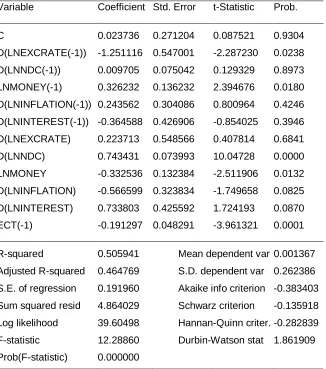
The error correction model (ECM) provides a framework for establishing links between the short-run and long-run approaches to econometric modeling. The result of the balance of payment error correction model is presented in Table 5. As expected, the error correction term for this model is both negative and significant. The system is getting adjusted towards long run equilibrium at the speed of 19.13%. Thus, about 19.13% of the disequilibrium of the previous period is adjusted back to the long-run equilibrium in the current period.
Licensed under Creative Common Page 50 Table 5: Estimated Error Correction Results for the ARDL Model
Variable Coefficient Std. Error t-Statistic Prob.
C 0.023736 0.271204 0.087521 0.9304 D(LNEXCRATE(-1)) -1.251116 0.547001 -2.287230 0.0238 D(LNNDC(-1)) 0.009705 0.075042 0.129329 0.8973 LNMONEY(-1) 0.326232 0.136232 2.394676 0.0180 D(LNINFLATION(-1)) 0.243562 0.304086 0.800964 0.4246 D(LNINTEREST(-1)) -0.364588 0.426906 -0.854025 0.3946 D(LNEXCRATE) 0.223713 0.548566 0.407814 0.6841 D(LNNDC) 0.743431 0.073993 10.04728 0.0000 LNMONEY -0.332536 0.132384 -2.511906 0.0132 D(LNINFLATION) -0.566599 0.323834 -1.749658 0.0825 D(LNINTEREST) 0.733803 0.425592 1.724193 0.0870 ECT(-1) -0.191297 0.048291 -3.961321 0.0001
R-squared 0.505941 Mean dependent var 0.001367 Adjusted R-squared 0.464769 S.D. dependent var 0.262386 S.E. of regression 0.191960 Akaike info criterion -0.383403 Sum squared resid 4.864029 Schwarz criterion -0.135918 Log likelihood 39.60498 Hannan-Quinn criter. -0.282839 F-statistic 12.28860 Durbin-Watson stat 1.861909 Prob(F-statistic) 0.000000
Table 6: Wald Test for Short run Coefficients
Null hypothesis p – value
Exchange Rate (-1) = Exchange Rate = 0 0.0513 Net Domestic Credit (-1) = Net Domestic Credit = 0 0.0000 Money Supply (-1) = Money Supply = 0 0.0390 Inflation Rate (-1) = Inflation Rate = 0 0.1659 Interest Rate (-1) = Interest Rate = 0 0.1542
Licensed under Creative Common Page 51
-40 -30 -20 -10 0 10 20 30 40
20 30 40 50 60 70 80 90 100 110 120 130 140
CUSUM 5% Significance
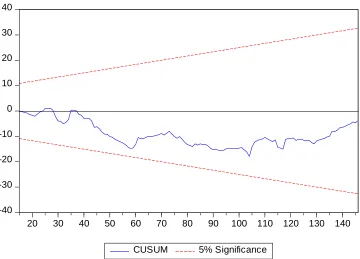
Figure 1: Cumulative sum of recursive residuals of the ARDL model
CONCLUSION AND RECOMMENDATIONS
Licensed under Creative Common Page 52 charge of monetary policy formulation for the Ghanaian economy can consider prudent monetary policies aimed at managing the money supply in the economy as a short-run and long run mechanism on the balance of payment position of the country. Future studies can consider increasing the span of the data points used in order to obtain sharper results.
REFERENCES
Adamu, P.A. (2004). The Dynamics of Balance of Payments Adjustment in Nigeria: An Error-Correction Approach. West African Financial and Economic Review, vol. 1, no. 2. December 2004.
Adom P.K., Bekoe, W. Akoena, S.K.K. (2012). Modeling aggregate domestic electricity demand in Ghana: An autoregressive distributed lag bounds cointegration approach, Energy Policy. 42,530–537.
Amoah, B. & White Loloh, F.(2009). Trade Balance and Policy Efficiency: Evidence from Ghana. Working Paper Monetary Policy Analysis and Financial Stability Department Bank of Ghana, WP/BOG-2009/02. September, 2009 6-7.
Ayentimi, D.T (2013). An Empirical Analysis of Balance of Payment in Ghana Using the Monetary Approach. European Journal of Business and Management. Vol.5, No.8.
Bobai, F.D. (2013). An Empirical Analysis of the Balance of Payments as a Monetary Phenomenon: Nigeria’s Experience. Journal of Emerging Issues in Economics, Finance and Banking, 2013, 1 (2), 1-21.
Brooks, C. (2014). Introductory Econometrics for Finance. Cambridge University Press. Chacholiades, M. (1990).International economics. New York: McGraw-Hill Publishers.
Danquah B.J. (2008). The Effects of Exchange Rate on Ghana’s External Trade. September, 2008 Published Thesis. Kwame Nkrumah University of Science & Technology, Kumasi
Dhliwayo, R. (1996). The Balance of Payments as a Monetary Phenomenon. An Econometric study of Zimbabwe’s Experience. African Economic Research Consortium, Kenya, Research Paper 46.
Dickey D.A & Fuller W. (1979).Distribution of the estimators for autoregressive time series with a unit root, Journal of the American Statistical association 1979. 74, 427-431.
Duasa, J. (2007). Malaysian Foreign Direct Investment and Growth: Does Stability Matter? Journal of Economic Cooperation, 28, 2 (2007), 83-98
Fleermuys, F. N. (2005). The balance of payments as a monetary phenomenon: An econometric study of Namibia, Windhoek, Ministry of Environment and Tourism, Directorate of Environmental Affairs.
Koutsoyiannis, A. (1977). Theory of Econometrics. London: The Macmillan
Lachman, D. (1975) A Monetary Approach to the South African Balance of Payments First published: September 1975 South African Journal of Economics. https://doi.org/10.1111/j.1813-6982.1975.tb00443.xpress.
McQuarrie, A. D. R., and Tsai, C.-L.(1998), Regression and Time Series Model Selection. World Scientific. 1998. Merwe E.J.V. (2002). Use of Balance of Payments Statistics in the Determination of Monetary and Fiscal Policy. South African Reserve Bank.
Odili, O. (2014). Exchange Rate and Balance of Payment: An Autoregressive Distributed Lag (ARDL) Econometric Investigation on Nigeria IOSR Journal of Economics and Finance, Volume 4, Issue 6. (Jul-Aug. 2014), pp 21-30 Pearson, M.H., Shin Y., & Smith, J.R. (2001). Bounds Testing Approach to the Analysis of Level Relationships. Journal of Applied economics, 16, 289-326.
Pesaran, M.H., & Shin, Y. (1999). An Autoregressive distributed Lag Modeling Approach to Co integration Analysis. DAE working Paper, No. 9514
Robinson, J. (1947). Essays in the Theory of Employment, Basil Blackwell, Oxford, UK.