C L I N I C A L T R I A L R E P O R T
A nurse-based intervention for improving
medication adherence in cardiovascular patients:
an evaluation of a randomized controlled trial
This article was published in the following Dove Press journal: Patient Preference and Adherence
Angelien Sieben1
Hein AW van Onzenoort2,3 Sandra van Dulmen4–6 CJHM van Laarhoven7 Sebastian JH Bredie8
1Department of Surgery, Division of Vascular Surgery, Radboud University Nijmegen Medical Center, Nijmegen, the Netherlands;2Department of Clinical Pharmacy, Amphia Hospital, Breda, the Netherlands;3Department of Clinical Pharmacy and Toxicology, Maastricht University Medical Center+, Maastricht, the Netherlands;4Department of Primary and Community Care, Radboud University Medical Center, Nijmegen, the Netherlands;5NIVEL (Netherlands insti-tute for health services research), Utrecht, the Netherlands;6Faculty of Health and Social Sciences, University of South-Eastern Norway, Drammen, Norway;7Department of General Surgery, Radboud University Nijmegen Medical Center, Nijmegen, the Netherlands;8Department of General Internal Medicine, Division of Vascular Medicine, Radboud University Medical Center, Nijmegen, the Netherlands
Background: Poor medication adherence is a limitation in the secondary prevention of
cardiovascular diseases (CVDs) and leads to increased morbidity, mortality, and costs.
Purpose:To examine the process and effect of a nurse-led, web-based intervention based on
behavioral change strategies to improve medication adherence in patients with CVD.
Patients and methods:In this single-center, prospective, controlled clinical trial,
cardio-vascular patients were assigned to usual care, usual care plus a personalized website, or usual care plus a personalized website and personal consultations. Primary outcome was the level of adherence to cardiovascular medication. Data collection occurred between October 2011 and January 2015.
Results:In total, 419 patients were randomized. Just 77 patients logged on the website and
half of the invited patients attended the group consultation. Due to the limited use of the website, we combined the results of usual care and the usual care plus website group in one group (usual care) and compared these with the results of the group which received the nurse intervention (intervention group). No significant difference in adherence between the usual care group and the intervention group was observed. The adherence level in the usual care group was 93%, compared to 89% in the intervention group (p=0.08). 29% (usual care) and 31% (intervention group) of the patients showed a low adherence according to the Modified Morisky Scale® (p-value=0.94). The mean necessity concern differential was 3.8 with no differences between the two studied groups (mean 3.8 vs mean 3.9,p-value =0.86).
Conclusion: Our intervention program did not show an effect. This could indicate that
structured usual care provided to all cardiovascular patients already results in high medica-tion adherence or that shortly after a cardiovascular event adherence is high. It could also indicate that the program did not have enough impact because there was not enough compliance with the intervention protocol.
Trial registration:ID number NCT01449695, approved May 2011.
Keywords:medication adherence, nurses, e-health, Health Belief Model, cardiovascular
Introduction
Cardiovascular disease (CVD) is the leading cause of death worldwide. Although lifestyle risk factors of patients with high cardiovascular risk are monitored reg-ularly as part of the risk-reducing programs, there is limited structural attention to
medication adherence.1This is startling because it is known that poor medication
adherence is a major limitation in the secondary prevention of CVDs that may lead
to increased morbidity, mortality, and costs.2–4Approximately 50% of the patients
Correspondence: Angelien Sieben Radboud University Nijmegen Medical Center, Geert Grooteplein 10, Postbus 9101, Nijmegen 6500 HB, the Netherlands
Tel +31 243 616 8234
Email [email protected]
Patient Preference and Adherence
Dovepress
open access to scientific and medical research
Open Access Full Text Article
Patient Preference and Adherence downloaded from https://www.dovepress.com/ by 118.70.13.36 on 26-Aug-2020
using medication for a chronic disorder do not adhere to
the prescribed drug regimen according to WHO.5 In
patients with CVD, adherence rates remain low, ranging
between 50 and 79%.2,6As a consequence, in Europe an
estimated 9% of preventable CVD events can be attributed
to poor adherence to vascular medications alone.7
Current methods for improving adherence are mostly complex and not very effective, and simple interventions
that are feasible in usual practice settings are preferred.8
There is, however, a need for more understanding in patient-related determinants of poor adherence to medication. These determinants can either be intentionally or unintentionally driven. Unintentional poor adherence occurs when patients are inclined to adhere but are not able to because of a lack of capacity or resources. Intentional poor adherence occurs
when patients decide not to follow the agreed
recommendations.9 To be effective, interventions should
address both unintentional and intentional determinants of
poor adherence.10Central to patients’medication adherence
is their judgment of their personal need for taking
medica-tion. Key beliefs that influence patients’judgment about their
medication are perception of personal needs for treatment (necessity beliefs) and concerns about several potential
nega-tive consequences (concern beliefs).9,11,12 Though lifelong
adherence is important in CVD, absence of symptoms in the years after an event may result in the perception that the illness is benign. This may lead to doubts about the necessity
of continuous treatment.13A patient-centered approach with
emphasis on patients’ perspectives might encourage CVD
patients to take their medication.14,15The principles of the
patients’ perspective were used in the development of the
intervention under study. The intervention was, therefore,
based on the Health Belief Model (HBM)16,17in which the
necessity–concern framework was applied9and adapted for
the specific purpose of this trial.
Material and methods
Aim
This study aimed to evaluate the process and outcomes of an intervention program consisting of a single group con-sultation, two individual follow-up consultations with a nurse, and access to an interactive personalized website, incorporating evidence-based determinants of poor adher-ent behavior in high-risk cardiovascular patiadher-ents. The
HBM18 was chosen as the central theoretical model for
the interventions. The intervention program aims to
improve patient’s necessity and concern beliefs about
medication, which is expected to lead to better adherent behavior in cardiovascular patients.
Design/methodology
The design of this study (with an acronym: the MIRROR
trial) has been described in detail earlier.19 The MIRROR
study is a single-center, prospective, three-arm randomized controlled clinical trial. Patients were randomly assigned to usual care (group I), usual care plus access to a personalized website (group II), or usual care, access to a personalized website plus a group consultation with a pharmacist and a nurse, followed by two individual nurse-led consultations at the outpatient clinic (group III).
Sample
All patients referred to the Radboud University Nijmegen Medical Center with a new diagnosis of acute coronary syndrome, myocardial infarction, peripheral arterial disease, an aneurysm of the aorta or transient ischemic attacks (TIA) or stroke over the last 6 months were included into the hospital CVD screening program. This screening program aims to identify cardiovascular risk factors and consists of screening of lifestyle (smoking, diet, and exercise), blood lipid levels, blood pressure, waist circumference, body mass index (BMI), glucose blood levels, and a family history of CVDs. If indicated, preventive therapies (medication and lifestyle interventions) are structurally initiated and followed
over time.20From this program, participants aged 18 years
and older were eligible for the MIRROR trial if they were willing to stay in a 1-year follow-up period and provided signed informed consent for an intervention on medication adherence. Exclusion criteria were pregnancy reported by the patient, severe comorbidity (eg, lung cancer, end-stage heart
failure), difficulties with Dutch language, or no access to
a computer.
Randomization
Patients who consented to participate were randomized
using block randomization stratified by department
(neu-rology, vascular surgery, and cardiology) in a 1:1:1 ratio into one of the three groups. Randomization was blinded for the principal investigator and the primary researcher. The patient, the nurse, or the pharmacist delivering the individual consultations could be blinded to the interven-tion assignment in group III.
Patient Preference and Adherence downloaded from https://www.dovepress.com/ by 118.70.13.36 on 26-Aug-2020
Power calculation
The study was powered on adherence to medication expressed as mean possession ratio (MPR). We estimated that adherence levels at the start of the study would be 65% in each group with a SD of 30%. We hypothesized that the intervention given in group II and the intervention given in group III would result in an increase of 10% and 20% in adherence to treatment, resulting in a mean adher-ence rate of 75% and 85% in group II and group III, respectively. Consequently, the estimated group size with a power of 80% and an alpha of 0.05 (two-sided) would be 200 in each group, resulting in 600 participants in total.
Timeline
The intervention period lasted 12 months. Within, on average, 6 weeks after the CVD event, baseline character-istics were collected for all patients. Follow-up outcomes were collected at 12 months after inclusion for all patients.
Data collection
Process evaluationAs recommended by the Medical Research Council
Guidance,21we included a process evaluation of this
inter-vention program. A process evaluation helps to understand the relationship between how well an intervention was delivered, the different elements of an intervention, and
the main outcomes of a trial.22,23It furthermore improves
the validity and interpretation of these outcomes and gives
information so the intervention can be replicated.24 This
intervention program was performed at an outpatient clinic for cardiovascular risk management in our academic hos-pital. Nurses, who deliver the individual consultations, already counsel cardiovascular patients in changing their lifestyle (eg, stop smoking and losing weight) through motivational interviewing techniques. In addressing the problem of nonadherence as a behavioral problem, the
intervention program could fit really well in the existing
clinical setting. There is also a broad recognition that nurses have a key role in understanding and addressing
patients ‘beliefs during consultations about their
medication.
Adherence
The primary outcome of our study was adherence to
cardio-vascular medication. Adherence was based on pharmacy refill
dates (PRD) of participants’filled prescriptions obtained from
computerized pharmacy systems. Data were collected for pre-scribed cardiovascular drugs (plated aggregation inhibitors,
lipid-modified agents, and antihypertensive drugs) for the
period of 3 years prior to a patient’s cardiovascular event and
at least 1 year after cessation of the intervention of this trial. All prescription records included the Anatomic Therapeutic Chemical code (ATC), the names of the dispensed drugs, prescribed daily dose, quantity dispensed at each pharmacy
fill, and the dates of the prescription fills. Adherence was
reported as the MPR for all cardiovascular medication. The
MPR was defined as the number of days of treatment
dis-pensed divided by the number of days prescription refills.25
We calculated adherence levels at baseline (T1), at the end of the intervention (T2), and at 1 year after ending the interven-tion (T3). Patients with an adherence level of at least 80% were considered adherent, whereas patients with an adherence level lower than 80% were considered as nonadherent.
Secondary outcomes
Clinical responsesAccording to the hospital screening program, blood was drawn from all patients to determine low-density lipopro-tein (LDL) cholesterol levels. A recorded LDL cholesterol level of 20% above the baseline level during follow-up was considered as an indication of poor adherence. If
patients used antihypertensive drugs, they were classified
adherent if the systolic blood pressure was <135 mmHg after the intervention. Target blood pressure levels were set according to the European Society of Hypertension (ESH) recommendations (ie, a systolic blood pressure level of
<135 mm Hg). These office blood pressure measurements
were performed according to the recommendations of the ESH with a validated automated device and based on
a mean of four office measurements.26
Patient outcomes
All patientsfilled out the Modified Morisky Scale (MMS®)
and the Beliefs about Medicines Questionnaire (BMQ) at baseline and at the end of the follow-up period. The MMS® is a validated questionnaire consisting of eight items aimed
at measuring adherence.27–29Each item accounts for 0 or 1
in case questions are answered by No or Yes, respectively. These scores were divided into three levels of adherence: low adherence (sum score <6), medium adherence (sum score 6 to <8), and high adherence (sum score of 8). To
evaluate patients’ beliefs and perceptions about their
med-ication, the BMQ was used.30 Respondents stated their
degree of agreement with each individual statement about
medicines on afive-point Likert scale. The necessity–
con-cern differential (NCD) was calculated as the difference
Patient Preference and Adherence downloaded from https://www.dovepress.com/ by 118.70.13.36 on 26-Aug-2020
between necessity and concern scores and had a possible
range of −20 to 20. If the difference was positive, the
patient perceived that the benefits of medication outweighed
the concerns. Contrarily, if the differential was negative, the
patient perceived more costs than benefits.13,31To separate
patients on the basis of their beliefs about the necessity of their medication and their concerns about taking
medica-tion, the total necessity and concern scores (5–25) were split
at midpoint (thus 5–12 was considered as low and 13 t/m 25
was considered as high). Patients were then classified into
four different categories: accepting (high necessity and low concerns), ambivalent (high necessity and high concerns), skeptical (high concerns and low necessity), and indifferent
(low concerns and low necessity).32–34 From all patients,
the type of CVD (acute coronary syndrome, myocardial infarction, peripheral arterial disease, an aneurysm of the aorta, or TIA) was recorded. Also, the following baseline and clinical characteristics were collected: age, sex, level of education, employment status, and the country of origin. Whether patients were new or chronic users of cardiovas-cular medication was also registered. To classify patients as a chronic medication user, they had to use a plated
aggrega-tion inhibitor and/or a lipid-modified agents more than 2
months before baseline according to PRD. All other patients
were classified as new users. The log-on information
expressed as the number of log-ins, times, and dates on the personalized website of each patient were recorded.
Ethics
Written informed consent was collected from all patients prior to entering the study. The study protocol was approved by the local ethical committee. Approval for this study was obtained by the local ethical committee, the human-related research committee of the Arnhem-Nijmegen region (CMO no 2011/062), which applied
cri-teria described in the Medical Scientific Research with
People Act (WMO), the Helsinki Declaration, the Good Clinical Practice (GCP), EU Guideline GCP, Clinical trials guidelines on medicinal products, and CCMO guidelines.
Data analysis
Data were analyzed based on the intention-to-treat principle and evaluated by using SPSS, with descriptive statistics (mean, median, and SD) being determined for all variables. Differences between the patient groups were tested by per-forming an ANOVA test on the outcome measures. All socio-demographic and disease-related factors were included so they
could be taken into account as potential confounders.14,35,36To
handle with missing data, we followed the recommendations for eHealth research and used multiple imputation techniques
in SPSS.37Multiple imputation is considered as the standard
procedure for dealing with missing data. It has the advantage of incorporating auxiliary information about missing data into
the analysis, thereby reducing bias and improving accuracy.38
Analysis of multiple imputated data shows greater power and
efficiency than complete case analyses. Multiple imputations
make better use of available data and can generate different
results from simpler techniques.39The datasets generated and
analyzed during this study are not publicly available due to the Dutch privacy laws. But they are available from the corre-sponding author on reasonable request.
Validity and reliability
This study used instruments with their validity and
relia-bility tested in previous studies.27,30,40 Participants were
randomized using block randomization. The intervention was delivered by well-trained nurses who all had a training
specific for delivering the intervention.
Results
Process evaluation
Development of the intervention program
The intervention program consisted of a nurse-based inter-vention providing structured information and motivational counseling, and a personalized visualization of cardiovas-cular risk levels on a website. The intervention was based
on evidence-based behavior change theory, the HBM16
and the necessity–concern framework.9 This necessity–
concern framework is a useful model for understanding
and addressing both unintentional and intentional
nonadherence.9 By using the BMQ,30 nurses could get
insight into the necessity and concern beliefs of their patients and were able to tailor their consultation to the needs of each individual patient. The HBM is based on the understanding that a person will take health-related action (eg, being adherent to cardiovascular medication) given
four main factors. The first two factors are perceived
susceptibility and perceived severity, reflecting the
under-standing of the high personal risk and seriousness of a condition (eg, because of the cardiovascular event in the past, I am at greater risk for another cardiovascular
event). The third factor is perceived benefits, aimed at the
belief a negative health condition can be avoided (eg, being adherent to the cardiovascular medication can help
Patient Preference and Adherence downloaded from https://www.dovepress.com/ by 118.70.13.36 on 26-Aug-2020
to prevent another cardiovascular event). The last factor
covers the perceived barriers, cue to action, and self-effi
-cacy, aimed at the belief to have the ability to successfully undertake the recommended health action (eg, I know how to take my medication on a daily base). The group con-sultation with between 10 and 12 patients was chosen for delivering knowledge and understanding of the risks. Moreover, it also provided a gathering with other patients (peers) in which patients were given the possibility to discuss adherence behavior and learn from each other. In the individual consultations, the intervention was further tailored to each individual, so nurses were able to identify objectives for change of (un)intentional nonadherence (or a mix of both) and were able to address the determinants
of patients’ beliefs, perceptions and management of their
illness and medication next to patients’ skills and
memory.8 To support the individual and group
consulta-tions, an interactive and personalized website was devel-oped. On this website, patients could see their own cholesterol levels, blood pressure, and lifestyle (smoking, physical activity, and eating habits) in a risk monitor. Patients had the opportunity to ask questions by email to their nurse and enter changes in their medication. We choose a three-arm randomized controlled trial to deter-mine if the website alone was effective or if group con-sultations and individual concon-sultations had add-on effects. The participating nurses were trained in motivational inter-viewing and had applied this as part of the usual care
program for several years.41 They received an extra
train-ing for this intervention.42,43
The website was expected to be effective on itself by creating awareness (risk monitor), providing (written) information, and tailoring of the information by the email
facility.44,45Risk communication and the feedback of
clin-ical outcome can be provided personally and patients were encouraged to be active in handling their disease and medication. The website was connected to the hospital laboratory system to provide personal clinical results. Logging in was due to high privacy levels. Patients had
to use a special personal code and had to confirm their
password with a code they received from a text message. For developing the intervention program, we used the recommended behavior change strategies of the HBM. We tailored further by using the taxonomy of Abraham
and Michie46,47 and the coding manual by de Bruin to
categorize the behavior change techniques that required
to be enclosed in the intervention.46,48
For each of the components of HBM, the determinants, techniques, and application strategy that were developed
are described inTable 1.
Uptake of the intervention
Patient enrollment and inclusionOf a total of 1,201 patients with a cardiovascular event who enrolled the screening program, 900 were eligible to partici-pate in this study. Of these, 481 declined to participartici-pate. In total, 419 patients were randomized into group I (n=133), group II (n=138), and group III (n=148). Data collection occurred between October 2011 and January 2015. After randomization, 148 patients were invited to attend the group and individual consultations, of which 79 of these participated in the group consultation. One hundred and
thirty-four and 79 of these patients visited the first
and second individual consultation, respectively. In total, 286 patients got access to the website and were requested to visit the website. Seventy-seven patients of both groups actually logged-in on the website of which only 37 logged-in more than once. Since only a small proportion of the patients in group II and group III logged-in on their personalized website (34 and 43 patients for group II and group III, respectively), it was questionable whether there could be an effect of the website when compared to usual care. Therefore, we decided to report the results based on two groups, in which group I and group II combined were compared to group III, ie, we examined the effects of the group consulta-tion plus the extra individual consultaconsulta-tions.
From the 419 randomized patients, refill data of 260
patients were available. We used multiple imputation
tech-niques for all missing data. SeeFigure 1.
Results of the intervention
Baseline characteristicsAt baseline, the mean age of the participants was 61 years and 67% were male. Forty-seven percent of the partici-pants were diagnosed with a stroke or TIA, 36% with an acute coronary syndrome, and 17% with peripheral arterial disease. Ninety-eight percent received an antithrombotic agent and 94% received lipid-lowering medication after the event. At baseline, MPR for all cardiovascular medica-tion was 72%. According to the MMS®, 20% of all patients were low adherent, 46% and 35% were medium and high adherent, respectively. Mean NCD according to the BMQ was 3.6. Mean LDL was 2.5 mmol/L and mean
systolic blood pressure was 137 mmHg. SeeTable 2.
Patient Preference and Adherence downloaded from https://www.dovepress.com/ by 118.70.13.36 on 26-Aug-2020
T able 1 Pr ocess e valuation: Method, corr esponding determinants, techniques, practical applications, and the materials of the de veloped inter vention (1=Determinants of the Health Belief Model, 2=De fi nitions accor ding to the taxonom y of beha vior change techniques by Abraham and Michie 46 and de Bruin et al 48 ) Health Belief Model Determinant 1 T echnique 2 Practical applications/strategy Materials P er ceiv ed sus-ceptibility Beliefs about the chances of getting another car diovas-cular e vent Knowledge Lack of knowledge regardin g pr escribed medications and the in fl uence on risk reduction Incr ease under
-standing Provide
general
information Risk
communi-cation Persuasiv
e communication Gr oup sessions with peers Gr oup consultation: Pr oviding general information about ather oscler osis Pr oviding written material with information about car dio-vascular medication and how it should be tak en Pr oviding general information about cholester ol and blood pr essur e and their in fl uence on car diovascular risk. Pr oviding general information about cardiovascular medica-tion and how it w orks. Discussion within a gr oup of cardiovascular patients about being adher ent and nonadherent to medication The gr oup consultation was led by a pharmacist and a nurse . A P ow erP oint was made containing information about the need for low cholester ol and low blood pr essur e and how to use the most common car diovascular medication. All these information is also given to the patients in a br ochur e. Patients ar e in vited to discuss their personal beliefs about their car diovascular medication and the practical implications of taking medication on a daily base . P er ceiv ed se v er -ity Beliefs about the seriousness of that e ve nt and its consequences Patients beliefs, per ception, and management of their illness (a war eness, outcome
expecta-tions) Personal
judgement of need for the medication in fl uenced by per ception and management of the disease: Not accepting their illness Thinking it is mor e benign than it is (because of absence of symptoms). Risk
communi-cation Feedback
of clinical out-come Re valuation of outcomes, self-e valuation P ersonalized w ebsite: Visualization of the personal cardio vascular risk thr ough a risk monitor Individual consultation: Evaluating the fi lled out questionnair es BMQ and MMS. Evaluating a medication taking diar y A w ebsite wher e patients can log in to see their own choles-ter ol and blood pr essur e lev el was built. These le vels ar e visualized as a speedometer . When at target le ve l, an arr ow is in the gr een par t of the scale and when not at target le ve l an arr ow is in the red part of the scale . An inter ve ntion chart was cr eated. It contained differ ent topics accor ding to the determinants of poor adher ence with subsequent questions the nurse can ask speci fi ed for each topic. P er ceiv ed bene-fi ts Beliefs about the effectiv eness of taking action to re duce risk. Patients beliefs, per ception, and management of their medication(a war eness) P ersonal judgement of need for the medication in fl uenced by per ception of pr escribed medi-cation. Negativ e associations with medication (in general or spe-ci fi c) and/or health car e pr oviders P ersuasiv e
communication Verbal
persua-sion Re valuation of outcomes, self-e
valuation Feedback
on clinical outcome Individual consultation: Consultations ar e giv en based on motivational inter vie wing and goal setting Evaluating the fi lled out questionnair es BMQ and MMS . Evaluating target le ve ls P ersonalized w ebsite: Pr oviding a risk monitor that will be gr een if outcome targets ar e achie ve d Nurses participating in this inter vention (alr eady trained in motivational inter vie wing) w er e trained .The pr ogram con-tained general information of poor adher ence and the most common car diovascular medication. Information was pr ovided on how to achie ve beha vioral change and what the speci fi c change objectiv es w er e in this inter vention. The nurses then performed these consultations in a role pla y and w er e give n feedback by the medical psychologist. At the end of the training da y, documents which contained all the give n infor -mation w er e pr ovided. ( Continued )
Patient Preference and Adherence downloaded from https://www.dovepress.com/ by 118.70.13.36 on 26-Aug-2020
Adherence
The intervention did not show an effect on adherence to treatment. Patients in the usual care group had an adher-ence level of 93%, compared to 89% in the intervention
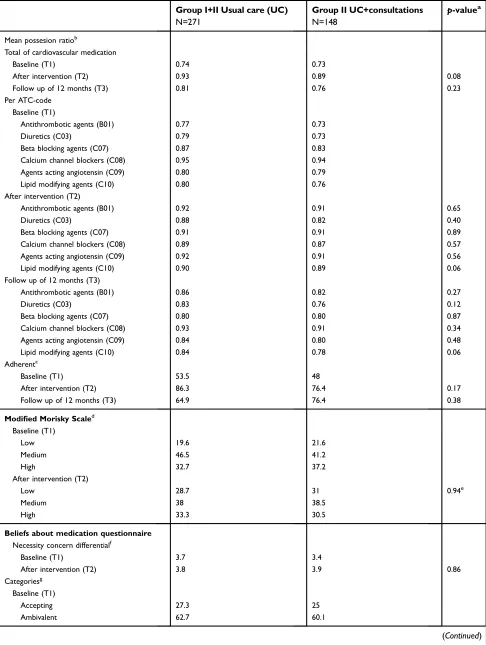
group (p-value=0.08) at T2. At T3, there also was no
significant difference detected (adherence level was 81%
and 76%, respectively, for groups I and II with ap-value
of 0.23). Percentage of adherent patients was 86.3% in the usual care group and 76.4% in the intervention
group (p-value=0.17) at T2. This was 65% and 57.4%
(p-value=0.38), respectively, at T3. Though we did not
see differences in adherence between the usual care and intervention group, we observed a difference in adher-ence in time for both groups combined. Therefore, we performed a repeated measurement ANOVA in time without differentiating in trial groups. At T1, at T2, and at T3, the overall adherence was 72%, 92% and 80%, respectively. During the study period, medication
adherence increased with 20% (95% CI 0.065–0.335).
One year after this period, it declined with 12% (95%
CI 0.073–0.17).
Clinical outcomes
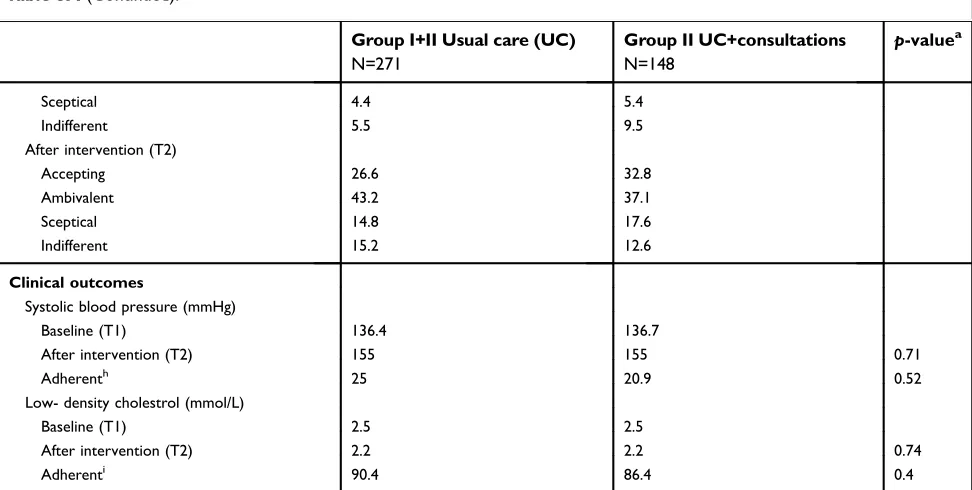
At T2, the mean LDL level was 2.2 mmol/L (2.5 mmol/L at baseline) and mean systolic blood pressure was 155 mmHg (136 mmHg at baseline) for both groups. There were no differences in LDL and blood pressure alteration between both groups. Blood pressure was above the target level in 76% of all patients and 12% showed a recorded LDL cholesterol level of 20% above the baseline LDL
level (p-value between groups was 0.52 and 0.4,
respectively).
Patient outcomes
No differences between the MMS® and the BMQ were detected at T2 between both groups. 29% (usual care) and 31% (intervention group) of the patients showed a low adherence according to the MMS®. There were no
differ-ences between the two groups studied (p-value=0.94). The
mean NCD was 3.8 at T2. Again, no differences between the two studied groups were present (mean 3.8 vs mean
3.9, p-value =0.86). We did observe a difference in the
four BMQ categories. In the intervention group, there was a shift from ambivalent (from 60% at T1 to 37% at T2) toward accepting (25% at baseline to 33% at T2). In the
usual care group, this shift was from ambivalent (63–43%)
to skeptical (4–15%) and indifferent (6–15%).
T able 1 (Continued). Health Belief Model Determinant 1 T echnique 2 Practical applications/strategy Materials P er ceiv ed bar -riers Cue to action Self-ef fi cacy Memor y loss or forgetfulness Lack of knowledge or skills how to or der ne w pr escriptions or to set up memor y cues Self-r epor t of beha vior Goal setting Plan coping responses Set graded tasks Use of cues Cope with side effects Let the patient keep a diar y of his medication taking 2 w eeks for each individual consultation Individual consultation: T alk with the patients about the barriers and effect and side effects of the medication If necessar y the nurse and patient mak e a plan together how to ov er come the barriers (eg, alarm de vices, doses of medication at visible location) or when side effects occur switch medication The patient and nurse formulate a goal at the end of each consultation re fl ecting the barriers the y e valuated In the br ochur e, ther e is a section wher e patients can fi ll in when the y took their medication. Patients ar e ask ed to do at least 10 da ys befor e their individual consultation. In the individual consultation, the inter ve ntion chart also contains topics accor ding to memor y and skills (eg, or dering medication on time, forgetting medication) and possible solu-tions (eg, help or dering a dosette bo x) ar e pr ovided. Abbre viations: MMS, Modi fi ed Morisky Scale; BMQ, Beliefs about Medicines Questionnair e.
Patient Preference and Adherence downloaded from https://www.dovepress.com/ by 118.70.13.36 on 26-Aug-2020
Differences in adherence, beliefs about medication, and
clinical outcomes are depicted inTable 3A.
The observed adherence difference expressed in time is
shown inTable 3B.
Total population eligible for CVRM-screeing between 01.10.2011 and 27.10.2013 N=1201
N=256 exclusion
N=78 co morbidity or not speaking dutch language N=45 missing (no reason described)
Patients asked to participate N=900
Patients consented N=419
Group I N=133 Group II N=138
Baseline screening: BP, LCHC, BMI, Lifestyle questionnaire, MMS/BMQ
Group consultation N=79 participated
Determine lipids and BP for website visualization
Determine lipids and BP for website visualization
Determine lipids and BP for
website visualization +
individual consultation
N=134 visited
Determine lipids and BP for website visualization + individual consultation N=79 visited
N=129 visited
N=79 visited
Logged in website
Evaluation screeing;
BP, lipid, glucoses, BMI, waist circumference, lifestyle questionnaire, MMS/BMQ
(no show 30, died 2, serious comorbidity 4, moved 1, other event 2, lost for FU 6)
Pharmacy provided PRD N=83
(no show 28, died 2, serious comorbidity 6, moved 1, other event 1, lost for FU 6)
Pharmacy provided PRD N=86
(no show 45, died 2, serious comorbidity 6, moved 2, other event 1, lost for FU 7)
Pharmacy provided PRD N=91 Group III N= 85
Group II N= 94 Group I N= 88
Logged in website
N=34 N=43
Visit one (16 weeks) Visit one (16 weeks)
Visit two (28 weeks) Visit two (28 weeks)
Group III N=148 N=188 no computer
Figure 1Patient enrollment and participation.
Note:LCHC depicts lipoprotein analysis with determination of high density lipoproteine-cholesterol and low density lipoproteine-cholesterol calculation.
Abbreviations:BMI, body mass index; PRD,pharmacy refill dates; FU, follow up; MMS, Modified Morisky Scale; BMQ, Beliefs about Medicines Questionnaire; CVRM, cardiovascular risk management; BP, blood pressure.
Patient Preference and Adherence downloaded from https://www.dovepress.com/ by 118.70.13.36 on 26-Aug-2020
T able 2 Patient characteristics at baseline Usual care (UC) N=133 UC+w ebsite N=138 UC+w ebsite+consultations N=148 Socio-demog raphic characteristics Age , in years a 60.4 (10.0) 60.2 (8.8) 60.9 (11.8) Sex Female b 36 (27.1) 38 (27.5) 49 (33.1) Education le ve l b Primar y 28 (21.9) 20 (16.4) 18 (14.4) Secondar y 65 (50.8) 65 (53.3) 55 (44) Univ ersity 35 (27.3) 37 (30.3) 52 (41.6) Labour b Paid labour 45 (33.8) 61 (44.2) 47 (31.7) Unemplo ye d 7 (5.2) 4 (3) 2 (1.3) Un fi t for w ork 21 (16.0) 24 (17.4) 28 (19) Retire d 50 (37.5) 42 (30.4) 63 (24.3) House wife 10 (7.5) 7 (5.0) 8 (5.4) Countr y of origin is the Netherlands b 110 (89.4) 108 (91.5) 109 (88.6) Clinical Characteristics Reason referral b 51 (37.0) 53 (36.0) Acute cor onar y syndr ome 46 (34.5) 64 (46.4) 69 (46.5) Str ok e or transient ischemic attack 65 (49.0) 23 (16.6) 26 (17.5) P eripheral arterial disease 22 (16.5) Blood pr essur e, mmHg a 135.5 (17.5) 136.7 (19.7) Systolic 137.3 (16.8) 78.2 (9.6) 76.5 (10.7) Diastolic 78.1 (11.3) Lipids mmol/L a 4.5 (1.0) 4.5 (1) T otal cholester ol 4.6 (1.2) 1.7 (0.9) 1.8 (1.1) T riglyceriden 1.9 (1.0) 1.1 (0.3) 1.2 (0.3) High-density cholestr ol 1.2 (0.3) 2.6 (0.9) 2.5 (0.9) Low-density lipopr otein 2.6 (1.0) 27.5 (4.0) 27.1 (4) Body mass index, kg/m 2,a 27.2 (4.0) Medication use b Medication (A TC) used Antithr ombotic agents (B01) 128 (98.5) 132 (97.1) 144 (98.0) Diur etics (C03) 36 (26.5) 36 (26.5) 37 (25.1) Beta blocking agents (C07) 72 (55.4) 85 (62.5) 82 (55.8) Calcium channel block ers (C08) 20 (15.4) 21 (15.4) 24 (16.3) ( Continued )
Patient Preference and Adherence downloaded from https://www.dovepress.com/ by 118.70.13.36 on 26-Aug-2020
T
able
2
(Continued).
Usual
care
(UC)
N=133
UC+w
ebsite
N=138
UC+w
ebsite+consultations
N=148
Agents
acting
on
the
angiotensin
system
(C09)
76
(58.5)
83
(61.0)
85
(57.8)
Lipid
modifying
agents
(C10)
120
(92.3)
129
(95.0)
138
(93.9)
Chr
onic
users
(b+c+d)
85
(64.4)
85
(62)
90
(61.2)
Questionnaires The
Modi
fi
ed
Morisky
Scale
(MMS)
Adherence
b
Low
23
(18.9)
21
(17.1)
26
(20.5)
Medium
63
(51.6)
54
(43.9)
53
(41.7)
High
36
(29.5)
48
(39)
48
(37.8)
Beliefs
about
medication
questionnair
e
Necessity
concern
differ
ential
a
3.9
(4.9)
3.9
(4.4)
3.6
(4.6)
Categories
b
Accepting
35
(28.7)
33
(26.6)
32
(25)
Ambivalent
81
(66.4)
87
(70.2)
87
(68)
Sceptical
4
(3.3)
2
(1.6)
3
(2.3)
Indiffere
nt
2
(1.6)
2
(1.6)
6
(4.7)
Mean
possesion
ratio
d,e
Car
diovascular
medication
total
0.74
0.73
0.72
Antithr
ombotic
agents
(B01)
0.79
0.75
0.73
Diur
etics
(C03)
0.77
0.81
0.73
Beta
blocking
agents
(C07)
0.86
0.87
0.83
Calcium
channel
block
ers
(C08)
0.96
0.95
0.94
Agents
acting
on
the
angiotensin
system
(C09)
0.80
0.80
0.79
Lipid
modifying
agents
(C10)
0.82
0.79
0.76
Notes:
aData
are
pres
ented
as
mean
(±SD).
bData
ar
e
pr
esented
as
number
(%).
cChr
onic
use
=starting
medication
>
2
months
befor
e
baseline.
dData
fr
om
imputated
data.
eMean
number
of
da
ys
dispended
divided
by
the
mean
number
of
da
ys
betwee
n
pres
cription
re
fi
ll.
Patient Preference and Adherence downloaded from https://www.dovepress.com/ by 118.70.13.36 on 26-Aug-2020
Table 3ADifferences in medication adherence, beliefs about medication, and clinical outcome between usual care and intervention groups at baseline, after intervention and at follow-up of 12 months (all after imputation)
Group I+II Usual care (UC) N=271
Group II UC+consultations N=148
p-valuea
Mean possesion ratiob
Total of cardiovascular medication
Baseline (T1) 0.74 0.73
After intervention (T2) 0.93 0.89 0.08
Follow up of 12 months (T3) 0.81 0.76 0.23
Per ATC-code Baseline (T1)
Antithrombotic agents (B01) 0.77 0.73
Diuretics (C03) 0.79 0.73
Beta blocking agents (C07) 0.87 0.83
Calcium channel blockers (C08) 0.95 0.94
Agents acting angiotensin (C09) 0.80 0.79
Lipid modifying agents (C10) 0.80 0.76
After intervention (T2)
Antithrombotic agents (B01) 0.92 0.91 0.65
Diuretics (C03) 0.88 0.82 0.40
Beta blocking agents (C07) 0.91 0.91 0.89
Calcium channel blockers (C08) 0.89 0.87 0.57
Agents acting angiotensin (C09) 0.92 0.91 0.56
Lipid modifying agents (C10) 0.90 0.89 0.06
Follow up of 12 months (T3)
Antithrombotic agents (B01) 0.86 0.82 0.27
Diuretics (C03) 0.83 0.76 0.12
Beta blocking agents (C07) 0.80 0.80 0.87
Calcium channel blockers (C08) 0.93 0.91 0.34
Agents acting angiotensin (C09) 0.84 0.80 0.48
Lipid modifying agents (C10) 0.84 0.78 0.06
Adherentc
Baseline (T1) 53.5 48
After intervention (T2) 86.3 76.4 0.17
Follow up of 12 months (T3) 64.9 76.4 0.38
Modified Morisky Scaled Baseline (T1)
Low 19.6 21.6
Medium 46.5 41.2
High 32.7 37.2
After intervention (T2)
Low 28.7 31 0.94e
Medium 38 38.5
High 33.3 30.5
Beliefs about medication questionnaire Necessity concern differentialf
Baseline (T1) 3.7 3.4
After intervention (T2) 3.8 3.9 0.86
Categoriesg Baseline (T1)
Accepting 27.3 25
Ambivalent 62.7 60.1
(Continued)
Patient Preference and Adherence downloaded from https://www.dovepress.com/ by 118.70.13.36 on 26-Aug-2020
Discussion
This study evaluated a nurse-led web-based intervention based
on the HBM11,16,49and the necessity–concern framework50on
medication adherence to treatment. Although we developed the intervention considering the recommendations of major
reviews on medication adherence interventions,8,51–53we did
not see an effect of the developed intervention on our main adherence outcome. There are several explanations for the absence of an effect of this intervention. First, all patients in our study received the same structural cardiovascular care according to the European Guidelines of prevention of
CVDs.20A previous evaluation of our cardiovascular
screen-ing program showed that a structural multidisciplinary evalua-tion and initiaevalua-tion of the best medical treatment in combinaevalua-tion with addressing unhealthy lifestyle reduces cardiovascular risk as indicated by a reduction in smoking, alcohol consumption,
unhealthy eating, blood pressure, and LDL-cholesterol level.54
Although medication adherence was not a structural approach in our usual care setting, the attention and screening on
CVD-risk factors may have influenced adherence to medication
adherence positively.
Second, in this study, we used pharmacy refill data as
adherence measure. Refill adherence rates have
exten-sively been used for the evaluation of medication
adher-ence. Compared to electronic monitoring, refill data
provide researchers with a relatively simple method for
investigating adherence to medication in large
populations.55However, due to the increasing availability
of automatic refills in the Netherlands, this measure may
represent high adherence levels, while patients do not
necessarily take their medication.10 By combining the
refill data with a self-reported questionnaire, we, therefore,
Table 3A(Continued).
Group I+II Usual care (UC) N=271
Group II UC+consultations N=148
p-valuea
Sceptical 4.4 5.4
Indifferent 5.5 9.5
After intervention (T2)
Accepting 26.6 32.8
Ambivalent 43.2 37.1
Sceptical 14.8 17.6
Indifferent 15.2 12.6
Clinical outcomes
Systolic blood pressure (mmHg)
Baseline (T1) 136.4 136.7
After intervention (T2) 155 155 0.71
Adherenth 25 20.9 0.52
Low- density cholestrol (mmol/L)
Baseline (T1) 2.5 2.5
After intervention (T2) 2.2 2.2 0.74
Adherenti 90.4 86.4 0.4
Notes:a
Usual care and usual care + are combined and compared with usual care ++ group.b
Mean number of days dispended divided by the mean number of days between
prescription refill.c
Percentage of patients (%) considered adherent according to PRD total of the cardiovascular medication (PRD was above or equal to 0.8).d
Percentage of
patients (%) who had low, medium, or high adherent scores.e
Low and medium adherence are combined and compared with high adherence group.f
Differences between
concern and necessity scores (means).g
Percentage of patients (%) who are classified in the four different categories of the BMQ.h
Percentage of patients (%) considered
adherent according to systolic blood pressure (<135 mmHg) and percentage (%) of patients using antihypertension drugs.i
Percentage of patients (%) considered adherent according to LDL level (the recorded LDL level after intervention was 20% lower of baseline LDL cholesterol).
Table 3BDifferences in mean medication adherence in time
All participants (N=419) Baseline (T1) After intervention (T2) Follow-up 12 months (T3)
Mean possesion ratio
Total of cardiovascular medication
0.72 0.92* 0.80**
Notes:*p-value <0.05 relative to T1. **p-value<0.05 relative to T2.
Patient Preference and Adherence downloaded from https://www.dovepress.com/ by 118.70.13.36 on 26-Aug-2020
wanted to gain a fuller understanding of the adherence behavior of the patients. The results of the used question-naire also showed no differences in medication adherence between the groups. Last, although the use of eHealth interventions is recommended to improve healthy behavior
and for tailoring adherence interventions,44,56 the website
was rarely used by our patients. Consequently, we were
not able to study the perceived benefits of our eHealth
intervention on adherence. Future studies should address this. There are several explanations as to why patients did not use the website. Patients had to use a special personal
code and had to confirm their password with a code they
received from a text message. These complicated steps
may have influenced the use of the website negatively.
High dropout rates may be a natural and typical feature
of eHealth interventions,57 as was observed in our trial.
There were fewer patients as expected who actually used the website and/or participated in the group consultation. This could be an indication that the intervention might be too intensive and experienced as a burden for patients. It could also mean that the intervention program was not
enough exposed to enough patients to show a significant
difference between the intervention group and the usual care group. We developed the intervention program by
using constructs of the HBM and the necessity–concern
framework but without involving patients. By personaliz-ing the content of the individual consultations, we believed we tailored the intervention to the personal need of the patients. On the other hand, the process in which the content of the program was delivered was not tailored at all. Maybe only tailoring the content is not enough and the process in which the intervention is delivered also should be more tailored. For further research, we highly recom-mend involving patients in designing the intervention.
The study did show a difference in adherence in time for all groups. Adherence rates were higher during the study period and declined to levels comparable to baseline 1 year after the end of the study. Several explanations can be addressed for this phenomenon. First, participation in a study may have encouraged patients to be more
adherent.9 Second, all patients who participated in this
study recently had a cardiovascular event. For these patients,
the need for adherent behavior is emerging.35,58Yet, as the
event fades and there are no more symptoms, adherence can
also decline.2This was also observed in our study. We looked
even further to see if there was a difference in new users of CVRM medication and chronic users. We did observe a relatively high cohort of chronic users in our population,
but this did not have any effect on the outcome. Although we did not establish a difference between groups in the NCD, we observed a shift in the categories from ambivalent toward accepting in the intervention group; this shift was not observed in the usual care group. In the ambivalent group, necessity beliefs are high but concern beliefs are also high. In the acceptance group, necessity beliefs are high but the con-cern beliefs are low. In order to know if the change in necessity category for the intervention group will have a positive effect on the adherence rate over time, we need to measure the adherence rate further in time.
Although overall adherence was relatively high at 12 months follow-up, only 20% of all patients had a systolic blood pressure within target. The mean blood pressure was even higher than it was at baseline. In contradiction, only 12% of all patients showed an LDL cholesterol level of 20% above the baseline LDL level. We cannot really explain this difference. Several major studies have demonstrated nonad-herence to be an important cause for not reaching target levels, as well for lipid-lowering medication as for
antihy-pertensive medication.59,60It can be suggested that not
reach-ing the target level of systolic blood pressure is not
necessarily due to nonadherence of the medication.61–63
Limitations
The study had several shortcomings. There were chal-lenges with recruitment and due to an organizational deci-sion to no longer supporting the website, we had to stop inclusion early and the original recruitment target was not met. This may have underpowered our results. However, the CI of the mean of the main outcome (the MPR)
showed only a very small interval from−0.005 to 0.082.
Therefore, we may assume that a larger population size would not have made a difference in MPR between groups. We also had to deal with missing data, especially
on the pharmacy refill data. The Dutch healthcare system
does not provide a closed pharmacy system to a point of care (like a hospital). Therefore, we were dependent on the
willingness of the pharmacists to provide us with refill
data. This led to missing data. We also had a relatively high percentage of patients who did not complete the intervention and/or did not show up at the evaluation screening. By using multiple imputation golden standard for dealing with missing data, we believe we still provided
a valid result of this study.38,39 Last, the nurses who
performed the individual usual care consultations if needed (eg, to lose weight or to quit smoking) were the same nurses as the nurses who performed the consultations
Patient Preference and Adherence downloaded from https://www.dovepress.com/ by 118.70.13.36 on 26-Aug-2020
in our intervention group. This and the fact that all patients visited the same outpatient clinic while on chronic care
support may lead to influencing among the groups. In
order to prevent such contamination among the groups, the nurses who give the usual care should be different from those in the intervention groups.
Conclusion
Our intervention to improve medication adherence in cardi-ovascular patients did not show an effect on improving poor medication adherence. The intervention program was devel-oped using the existing evidence and by applying this evi-dence. The intervention was also developed so it could easily be applied to the already existing structured usual care for secondary preventive cardiovascular care. By performing a process evaluation, we gained information that could help future researchers to include elements of this intervention. Elements of our intervention program could still lead to improving medication adherence, but we were not able to demonstrate it in this trial. This is maybe due to high adher-ence rates in both groups and/or the limited number of patients that complied with the intervention program. Adherence rates after the intervention were high in both the usual care and the intervention group. This could indicate that the structured provided care we already deliver to all cardiovascular patients has a positive effect on medication adherence. Or the effect of having a cardiovascular event was the key to better adherence.
Acknowledgments
This research received no specific grant from any funding
agency in the public, commercial, or not-for-profit sectors.
Disclosure
The authors report no conflicts of interest in this work.
References
1. Piepoli MF, Hoes AW, Agewall S, et al. European guidelines on cardiovascular disease prevention in clinical practice: the sixth joint task force of the European society of cardiology and other societies on cardiovascular disease prevention in clinical practice (constituted by representatives of 10 societies and by invited experts) Developed with the special contribution of the European association for cardiovascular
prevention & rehabilitation (EACPR). Atherosclerosis.
2016;252:207–274. doi:10.1016/j.atherosclerosis.2016.05.037
2. Ho PM, Bryson CL, Rumsfeld JS. Medication adherence: its
impor-tance in cardiovascular outcomes. Circulation. 2009;119
(23):3028–3035. doi:10.1161/CIRCULATIONAHA.108.768986
3. Bansilal S, Castellano JM, Garrido E, et al. Assessing the impact of
medication adherence on long-term cardiovascular outcomes.J Am
Coll Cardiol.2016;68(8):789–801. doi:10.1016/j.jacc.2016.06.005
4. Hennein R, Hwang SJ, Au R, et al. Barriers to medication adherence and links to cardiovascular disease risk factor control: the Framingham heart
study.Intern Med J.2018;48(4):414–421. doi:10.1111/imj.13687
5. Sabate. Adherence to Long Term Therapies. Evedince for Action.
Geneva: World Health Organization;2003.
6. Valle JA, Ho PM. Medication adherence in secondary prevention
post-myocardial infarction. Curr Treat Options Cardiovasc Med.
2014;16(12):349. doi:10.1007/s11936-014-0349-7
7. Chowdhury R, Khan H, Heydon E, et al. Adherence to cardiovascular therapy: a meta-analysis of prevalence and clinical consequences.
Eur Heart J.2013;34(38):2940–2948. doi:10.1093/eurheartj/eht295
8. Haynes RB, Ackloo E, Sahota N, McDonald HP, Yao X.
Interventions for enhancing medication adherence. Cochrane
Database Syst Rev.2008;11(2):CD000011.
9. Horne R, Weinman J, Barber N, et al. Concordance, Adherence
and Compliance in Medicine Taking. London: national
Co-ordinating Centre for NHS Service and Organisation R&D
(NCCSDO);2006.
10. Kronish IM, Ye S. Adherence to cardiovascular medications: lessons
learned and future directions.Prog Cardiovasc Dis.2013;55(6):590–600.
11. Hugtenburg JG, Timmers L, Elders PJ, Vervloet M, van Dijk L.
Definitions, variants, and causes of nonadherence with medication:
a challenge for tailored interventions. Patient Prefer Adherence.
2013;7:675–682. doi:10.2147/PPA.S29549
12. Kardas P, Lewek P, Matyjaszczyk M. Determinants of patient
adher-ence: a review of systematic reviews.Front Pharmacol.2013;4:91.
doi:10.3389/fphar.2013.00091
13. Clifford S, Barber N, Horne R. Understanding different beliefs held by adherers, unintentional nonadherers, and intentional nonadherers:
application of the necessity-concerns framework.J Psychosom Res.
2008;64(1):41–46. doi:10.1016/j.jpsychores.2007.05.004
14. Schedlbauer A, Davies P, Fahey T. Interventions to improve
adher-ence to lipid lowering medication. Cochrane Database Syst Rev.
2010;(3):CD004371.
15. Petrilla AA, Benner JS, Battleman DS, Tierce JC, Hazard EH. Evidence-based interventions to improve patient compliance with
antihypertensive and lipid-lowering medications. Int J Clin Pract.
2005;59(12):1441–1451. doi:10.1111/j.1368-5031.2005.00704.x
16. Rosenstock IM, Strecher VJ, Becker MH. Social learning theory and
the health belief model.Health Educ Behav.1988;15(2):175–183.
17. Glanz K, Bishop DB. The role of behavioral science theory in development and implementation of public health interventions. In:
Fielding JE, Brownson RC, Green LW, editors.Annual Review of
Public Health, Vol. 31. Palo Alto: Annual Reviews;
2010:399–418.
18. Rosenstock IM. Historical origins of the Health Belief Model.Health
Educ Behav.1974;2(4):328–335.
19. Sieben A, van Onzenoort HA, van Laarhoven KJ, Bredie SJ, A Multifaceted nurse-. and web-based intervention for improving adherence to treatment in patients with cardiovascular disease:
ratio-nale and design of the MIRROR trial.JMIR Res Protoc.2016;5(3):
e187. doi:10.2196/resprot.5750
20. De Backer G, Ambrosioni E, Borch-Johnsen K, et al. European guidelines on cardiovascular disease prevention in clinical practice; third joint task force of European and other societies on cardiovas-cular disease prevention in clinical practice (constituted by
represen-tatives of eight societies and by invited experts).Eur J Cardiovasc
Prev Rehabil.2003;10(4):S1–S10.
21. Moore GF, Audrey S, Barker M, et al. Process evaluation of complex
interventions: medical research council guidance.BMJ.2015;350:h1258.
22. Hulscher ME, Laurant MG, Grol RP. Process evaluation on quality
improvement interventions.Qual Saf Health Care.2003;12(1):40–46.
doi:10.1136/qhc.12.1.40
Patient Preference and Adherence downloaded from https://www.dovepress.com/ by 118.70.13.36 on 26-Aug-2020
23. Saunders RP, Evans MH, Joshi P. Developing a process-evaluation plan for assessing health promotion program implementation: a
how-to guide. Health Promot Pract. 2005;6(2):134–147.
doi:10.1177/1524839904273387
24. Oakley A, Strange V, Bonell C, Allen E, Stephenson J. Process evaluation in randomised controlled trials of complex interventions.
BMJ.2006;332(7538):413–416. doi:10.1136/bmj.332.7538.413
25. Cramer JA, Benedict A, Muszbek N, Keskinaslan A, Khan ZM. The
significance of compliance and persistence in the treatment of
dia-betes, hypertension and dyslipidaemia: a review.Int J Clin Pract.
2008;62(1):76–87. doi:10.1111/j.1742-1241.2007.01630.x
26. O‘Brien Eoin EE. European Guidelines on cardiovascular disease
prevention in clinical practice (version 2012): thefifth joint task
force of the European society of cardiology and other societies on cardiovascular disease Prevention in clinical practice (constituted
by representatives of nine societies and by invited experts).Eur
J Prev Cardiol. 2012;19(4):585–667. doi:10.1177/
2047487312450228
27. Morisky DE, Ang A, Krousel-Wood M, Ward HJ. Predictive validity
of a medication adherence measure in an outpatient setting.J Clin
Hypertens.2008;10(5):348–354.
28. Krousel-Wood M, Islam T, Webber LS, Re RN, Morisky DE, Muntner P.
New medication adherence scale versus pharmacyfill rates in seniors
with hypertension.Am J Manag Care.2009;15(1):59–66.
29. Morisky DE, DiMatteo MR. Improving the measurement of
self-reported medication nonadherence: response to authors.J Clin
Epidemiol.2011;64(3):255–257; discussion 258–263. DOI:10.1016/j.
jclinepi.2010.09.002
30. Horne R, Weinman J, Hankins M. The beliefs about medicines questionnaire: the development and evaluation of a new method for
assessing the cognitive representation of medication.Psychol Health.
1999;14(1):1–24.
31. Horne R, Weinman J. Patients‘beliefs about prescribed medicines
and their role in adherence to treatment in chronic physical illness.
J Psychosom Res.1999;47(6):555–567.
32. Menckeberg TT, Bouvy ML, Bracke M, et al. Beliefs about
medi-cines predict refill adherence to inhaled corticosteroids.J Psychosom
Res.2008;64(1):47–54. doi:10.1016/j.jpsychores.2007.07.016
33. Aikens JE, Nease DE Jr., Nau DP, Klinkman MS, Schwenk TL. Adherence to maintenance-phase antidepressant medication as
a function of patient beliefs about medication. Ann Fam Med.
2005;3(1):23–30. doi:10.1370/afm.238
34. Clatworthy J, Bowskill R, Parham R, Rank T, Scott J, Horne R. Understanding medication non-adherence in bipolar disorders using
a necessity-concerns framework.J Affect Disord.2009;116(1–2):51–
-55. doi:10.1016/j.jad.2008.11.004
35. Miller NH. Adherence behavior in the prevention and treatment of
cardiovascular disease. J Cardiopulm Rehabil Prev. 2012;32
(2):63–70. doi:10.1097/HCR.1090b1013e318235c318729
36. Brown MT, Bussell JK. Medication adherence: WHO cares?Mayo
Clin Proc.2011;86(4):304–314. doi:10.4065/mcp.2010.0575
37. Blankers M, Koeter MW, Schippers GM. Missing data approaches in eHealth research: simulation study and a tutorial for
nonmathemati-cally inclined researchers. J Med Internet Res. 2010;12(5):e54.
doi:10.2196/jmir.1587
38. Hayati Rezvan P, Lee KJ, Simpson JA. The rise of multiple imputa-tion: a review of the reporting and implementation of the method in
medical research.BMC Med Res Methodol.2015;15:30. doi:10.1186/
s12874-015-0092-0
39. Plumpton CO, Morris T, Hughes DA, White IR. Multiple imputation of multiple multi-item scales when a full imputation model is
infeasible. BMC Res Notes. 2016;9:45.
doi:10.1186/s13104-016-1938-1
40. Vink NM, Klungel OH, Stolk RP, Denig P. Comparison of various
mea-sures for assessing medication refill adherence using prescription data.
Pharmacoepidemiol Drug Saf. 2009;18(2):159–165. doi:10.1002/
pds.1698
41. Britt E, Hudson SM, Blampied NM. Motivational interviewing in
health settings: a review.Patient Educ Couns.2004;53(2):147–155.
doi:10.1016/S0738-3991(03)00141-1
42. Linn AJ, van Weert JC, van Dijk L, Horne R, Smit EG. The value of
nurses’tailored communication when discussing medicines: exploring
the relationship between satisfaction, beliefs and adherence.J Health
Psychol.2014;19:798–807.
43. Latter S, Maben J, Myall M, Young A. Perceptions and practice of
concordance in nurses‘ prescribing consultations: findings from
a national questionnaire survey and case studies of practice in
England. Int J Nurs Stud. 2007;44(1):9–18. doi:10.1016/j.
ijnurstu.2005.11.005
44. Barak A, Klein B, Proudfoot J. Defining internet-supported
therapeu-tic interventions. Ann Behav Sci Med Educ. 2009;38(1):4–17.
doi:10.1007/s12160-009-9130-7
45. Alpay LL, Henkemans OB, Otten W, Rovekamp TA, Dumay AC. E-health applications and services for patient empowerment:
direc-tions for best practices in The Netherlands. Telemed J E Health.
2010;16(7):787–791. doi:10.1089/tmj.2009.0156
46. Abraham C, Michie S. A taxonomy of behavior change techniques
used in interventions. Health Psychol. 2008;27(3):379–387.
doi:10.1037/0278-6133.27.3.379
47. Michie S, Prestwich A. Are interventions theory-based?
Development of a theory coding scheme.Health Psychol.2010;29
(1):1–8. doi:10.1037/a0016939
48. de Bruin M, Viechtbauer W, Schaalma HP, Kok G, Abraham C, Hospers HJ. Standard care impact on effects of highly active anti-retroviral therapy adherence interventions: a meta-analysis of
rando-mized controlled trials. Arch Intern Med. 2010;170(3):240–250.
doi:10.1001/archinternmed.2009.536
49. Ryan R, Santesso N, Hill S, Lowe D, Kaufman C, Grimshaw J. Consumer-oriented interventions for evidence-based prescribing and
medicines use: an overview of systematic reviews. Cochrane
Database Syst Rev.2011;(5):CD007768.
50. Horne R, Chapman SC, Parham R, Freemantle N, Forbes A,
Cooper V. Understanding patients‘ adherence-related beliefs
about medicines prescribed for long-term conditions: a
meta-analytic review of the necessity-concerns framework. PLoS
One. 2013;8(12):e80633. doi:10.1371/journal.pone.
0080633
51. Brian Haynes R, Ann McKibbon K, Kanani R. Systematic review of randomised trials of interventions to assist patients to follow
pre-scriptions for medications. Lancet. 1996;348(9024):383–386.
doi:10.1016/S0140-6736(96)01073-2
52. Haynes RB, McDonald HP, Garg AX. Helping patients follow
pre-scribed treatment. JAMA. 2002;288(22):2880–2883. doi:10.1001/
jama.288.22.2880
53. McDonald H, Garg AX, Haynes RB. Interventions to enhance patient
adherence to medication prescriptions: scientific review. JAMA.
2002;288(22):2868–2879. doi:10.1001/jama.288.22.2868
54. van Den Wijngaart LS, Sieben A, van der Vlugt M, de Leeuw FE, Bredie SJ. A nurse-led multidisciplinary intervention to improve
cardiovascular disease profile of patients.West J Nurs Res.2015;37
(6):705–723. doi:10.1177/0193945914533427
55. Krousel-Wood MA, Muntner P, Islam T, Morisky DE, Webber LS. Barriers to and determinants of medication adherence in hypertension management: perspective of the cohort study of medication
adher-ence among older adults.Med Clin North Am.2009;93(3):753–769.
doi:10.1016/j.mcna.2009.02.007
Patient Preference and Adherence downloaded from https://www.dovepress.com/ by 118.70.13.36 on 26-Aug-2020
56. Linn JA, Vervloet M, van Dijk L, Smit GE, Van Weert CMJ. Effects of eHealth interventions on medication adherence:
a systematic review of the literature. J Med Internet Res.
2011;13(4):e103. doi:10.2196/jmir.1658
57. Eysenbach G. The law of attrition.J Med Internet Res.2005;7(1):
e11. doi:10.2196/jmir.7.5.e60
58. Jackevicius CA, Li P, Tu JV. Prevalence, predictors, and outcomes of
primary nonadherence after acute myocardial infarction. Circulation.
2008;117(8):1028–1036. doi:10.1161/CIRCULATIONAHA.107.706820
59. Naderi SH, Bestwick JP, Wald DS. Adherence to drugs that
prevent cardiovascular disease: meta-analysis on 376,162
patients. Am J Med. 2012;125(9):882–887.e881. doi:10.1016/j.
amjmed.2011.12.013
60. Simpson RJ Jr., Mendys P. The effects of adherence and persistence on clinical outcomes in patients treated with statins: a systematic review.
J Clin Lipidol.2010;4(6):462–471. doi:10.1016/j.jacl.2010.08.026
61. van Onzenoort HA, Menger FE, Neef C, et al. Participation in a clinical trial enhances adherence and persistence to treatment:
a retrospective cohort study. Hypertension. 2011;58(4):573–578.
doi:10.1161/HYPERTENSIONAHA.111.171074
62. Wetzels GE, Nelemans P, Schouten JS, Prins MH. Facts andfiction of
poor compliance as a cause of inadequate blood pressure control:
a systematic review.J Hypertens.2004;22(10):1849–1855.
63. Horne R, Clatworthy J, Hankins M. High adherence and concordance
within a clinical trial of antihypertensives. Chronic Illn. 2010;6
(4):243–251. doi:10.1177/1742395310369018
Patient Preference and Adherence
Dovepress
Publish your work in this journal
Patient Preference and Adherence is an international, peer-reviewed, open access journal that focusing on the growing importance of patient preference and adherence throughout the therapeutic conti-nuum. Patient satisfaction, acceptability, quality of life, compliance, persistence and their role in developing new therapeutic modalities and compounds to optimize clinical outcomes for existing disease
states are major areas of interest for the journal. This journal has been accepted for indexing on PubMed Central. The manuscript management system is completely online and includes a very quick and fair peer-review system, which is all easy to use. Visit http:// www.dovepress.com/testimonials.php to read real quotes from pub-lished authors.
Submit your manuscript here:https://www.dovepress.com/patient-preference-and-adherence-journal
Patient Preference and Adherence downloaded from https://www.dovepress.com/ by 118.70.13.36 on 26-Aug-2020