Masking vs. Multiparty Computation:
How Large is the Gap for AES?
Vincent Grosso1, Fran¸cois-Xavier Standaert1, Sebastian Faust2
1
ICTEAM/ELEN/Crypto Group, Universit´e catholique de Louvain, Belgium. 2
Ecole Polytechnique F´ed´erale de Lausanne, 1015 Lausanne, Switzerland.
Abstract. In this paper, we evaluate the performances of state-of-the-art higher-order masking schemes for the AES. Doing so, we pay a par-ticular attention to the comparison between specialized solutions intro-duced exclusively as countermeasures against side-channel analysis, and a recent proposal by Roche and Prouff exploiting MultiParty Computa-tion (MPC) techniques. We show that the addiComputa-tional security features this latter scheme provides (e.g. its glitch-freeness) comes at the cost of large performance overheads. We then study how exploiting standard op-timization techniques from the MPC literature can be used to reduce this gap. In particular, we show that “packed secret sharing” based on a mod-ified multiplication algorithm can speed up MPC-based masking when the order of the masking scheme increases. Eventually, we discuss the ran-domness requirements of masked implementations. For this purpose, we first show with information theoretic arguments that the security guar-antees of masking are only preserved if this randomness is uniform, and analyze the consequences of a deviation from this requirement. We then conclude the paper by including the cost of randomness generation in our performance evaluations. These results should help actual designers to choose a masking scheme based on security and performance constraints.
1
Introduction
case of single-bit DPA attacks [3], then experimented by Standaert et al. in more general contexts [31], and recently shown formally by Prouff and Rivain [25], us-ing the mutual information put forward in [30] as evaluation metric.
From a theoretical point of view, the problem of masking a cryptographic implementation has strong connections with the problem of secure MultiParty Computation (MPC). This observation was already made in 2004 by Ishai et al. [16], and intuitively corresponds to the fact that both masking and MPC aim to perform computations on shared data. Their objectives are different though, as MPC protocols usually fulfill stronger security requirements (they typically remain secure after the corruption of a number of participants, in an passive or active manner). By contrast, masking only aims at ensuring the so-called d-th order security property, i.e. that everyd-tuple of intermediate values in the target implementation is independent of any sensitive variable. Since the performance overheads of masking and MPC are generally important, a natural problem is to determine the physical security advantages of MPC over masking, as well as its cost penalty. From the security point of view, an answer to this question has been put forward by Roche and Prouff in [27]. Namely, implementing MPC can lead to glitch-free implementations (in a similar sense as first described in [23]), and allows fault-tolerance if active adversaries are considered. By contrast, their performance evaluations were limited to asymptotic complexities so far.
Our contribution.In this paper, we investigate this performance gap between masking and MPC in the practically relevant case of AES implementations in an 8-bit microcontroller. We considered three different directions for this purpose.
First, we compared a number of existing schemes. Our selection was moti-vated by the two following criteria: (i) exclude “broken” proposals (i.e. with low-order weaknesses), such as the multiplicative masking in [14], the higher-order masking in [28] (broken in [4]), or Goubin and Martinelli’s proposal in [15] (broken in [5]); (ii) exclude schemes that do not systematically generalize to higher-orders, such as the affine masking in [11, 33], the threshold implementa-tions in [22], and several ideas from the “early” DPA literature (see [19] for a sur-vey)1. This essentially leaves us with Rivain and Prouff’s higher-order Boolean masking scheme from CHES 2010 [26] (next denoted asRivP), its optimization by Kim et al. using extension fields for the AES S-box implementation in [17] (next denoted asKHL), Genelle et al.’s solution based on the switching between additive and multiplicative masking [13] (next denoted asGPQ), and the MPC-inspired proposal by Roche and Prouff from CHES 2011 [27] (next denoted as
RocP). We implemented these different schemes up to the 10th security order, with results illustrating a large gap between the MPC-inspiredRocP(for which we additionally propose a slight optimization) and other masking schemes.
Motivated by the large performance gap, we then investigated a standard solution used in the MPC literature to improve performances, namely “packed secret sharing” [10]. In particular, we evaluate the extent to which the techniques
1
proposed by Damg˚ard et al. in [6] can be used to enhance the performances of shared AES implementations, and how this performance gain depends on the order d. Intuitively, the idea of packed secret sharing is to “hide” several secrets (e.g. key bytes) in a high-degree polynomial, which leads to more efficient computations if operations on these secrets can be performed in parallel. We show that such a technique is indeed useful for protecting the AES S-boxes, and exhibit the linear amortized complexity that it allows. Yet, we also show that this amortized complexity only becomes beneficial for quite large orders.
Eventually, we tackled a usually neglected problem in the literature on mask-ing, namely the randomness requirements. First, we briefly discuss the impact of slight defaults in the Random Number Generator (RNG) used to produce fresh shares. In particular, we provide an information theoretic evaluation of the cases where (i) the RNG has a small bias, and (ii) a counter was used to generate equally likely but predictable outputs. This evaluation naturally suggests that uniform randomness is a strong requirement for the security of masking (and MPC). Then, we evaluated the performances of our different masking schemes again, including the cost of (strong-enough) randomness generation.
Overall, these result allow an implementer to decide which state-of-the-art masking scheme to use and why, in function of his security goals (in terms of order of the scheme and glitch-freeness), and performance constraints.
Methodology.As clear from the previous introduction, our goal is to compare the performances of a large number of masked implementations, up to high security orders. Relying exclusively on optimized assembly language was out of reach in this context. As a result, we systematically took advantage of C language descriptions, and paid a particular attention in optimizing them in such a way that their compilation on an 8-bit device was close enough to the one of published implementations. In particular, we used the AVR-GCC compiler (with option -o2) to obtain codes for an Atmel AtMega644p 8-bit microcontroller. And for each implementation published by independent authors (e.g. in [13, 17, 26]), we made sure that our performances were comparable up to a factor two in clock cycles. For this purpose, we relied on the optimization of certain routines (e.g. for the masking of S-boxes) whenever needed. Furthermore, we systematically wrote our codes in two fashions: one unrolled version optimized for speed and one compact version without loop unrolling. As for optimization criteria, we first focused on the cycle count, and considered the 64Kb of our target device as a memory constraint to reach. In view of the larger performance differences that will be put forward between the investigated masking schemes and security orders, we believe this methodology was sufficient to support our conclusions.
2
Comparison & improvement of existing schemes
2.1 Description of selected schemes
the AES is composed of operations MixColumns, ShiftRows, AddRoundKey and
SubBytes. Since the Boolean and polynomial masking schemes on which we will focus are bytewise XOR-linear, the operations MixColumns, AddRoundKey and
ShiftRowscan be executed independently on each share. As a result, we now focus on the description of SubBytesfor efficient masking. This operation executes 16 nonlinear S-boxes in parallel, for which several representations exist.
For Boolean masked implementations and for the switching method GPQ
we used the standard representation, combining an inversion in GF(256) and an affine transform. This is naturally motivated by the fact that the Boolean masking is GF(2)-linear. In this case, the most difficult operation is the inver-sion, which is best achieved by exploiting secure multiplications for RivP, as described in [26], Algorithm 1.KHLis based on similar ideas, but exploits sub-fields to reduce the cost of field multiplications and the amount of randomness. By contrast, in the case ofGPQthe switch allows moving from a Boolean mask-ing scheme to a multiplicative-linear one, which makes the inversion easy and defers most the complexity to the switch operation. Algorithms 1 and 2 in [13] describe how to perform this change securely. The main challenge of this solu-tion is to pay attensolu-tion to the masking of the zero value in the multiplicative masking. In order to solve this issue, the authors compute the Dirac value of the secret (which can be done efficiently by computing 8 such values concurrently, as described in [12], Algorithm 4). Since these techniques are now standard in the CHES community, we refer to the original papers for the technical details.
For the polynomial maskingRocP, we note that no implementation results have been provided so far2. This solution essentially exploits core ideas from the MPC literature. In particular, it shares the sensitive values in an implementation using Shamir’s trick [29], and computes on these shares securely using the results of Ben-Or, Goldwasser and Widgerson [2]. A brief summary of these techniques is provided in Appendix A for the unfamiliar reader. In this context, an impor-tant observation is that the scheme is not GF(2)-linear. As a result, the best S-box representation is in polynomial form, namely0x63+0x5x−1+0x9x−2+
0xf9 x−4+0x25 x−8+0xf4 x−16+x−32+0xb5x−64+0x8f x−128. Again, the most difficult part of this S-box is the inversion, which can be implemented using 4 multiplications and some squarings. Roche and Prouff describe a polynomial multiplication in [27], Algorithm 1. Since the focus of their work was on glitch-freeness, they proposed to use a (2d+ 1, d)-sharing for all operations, including linear ones (which allows separating the implementation in several independent sub-circuits). However, the (2d+ 1, d)-sharing is only required to process mul-tiplications. Hence, for linear part (addition) a (d+ 1, d)-sharing is sufficient to perform operations. In the following, we suggest a slight modification of this proposal which essentially extends a (d+ 1, d)-sharing to a (2d+ 1, d)-sharing in a glitch-free manner (as described in Algorithm 1). This tweak will be denoted as
2
RocP?. It allows us to perform the linear operations with a lower degree sharing, and to divide by 2 the cost of these operations in our masked implementations.
Algorithm 1Expanding of a sharing Require: A (d+ 1, d)-sharing (xi, yi)di=1+1. Ensure: A (2d+ 1, d)-sharing (xi, ti)2i=1d+1.
1: forjfrom 1 tod+ 1do 2: tj=yj
3: end for
4: forjfromd+ 2 to 2d+ 1do 5: forifrom 1 tod+ 1do 6: mji∈RGF(256)
7: tmpji=yi⊗λji
8: tmpji=tmpji⊕mji
9: end for
10: tj= 0
11: forifrom 1 tod+ 1do 12: tj=tj⊕tmpji
13: end for
14: forifrom 1 tod+ 1do 15: tj=tj⊕mji
16: end for
17: end for
18: return (xi, ti)2i=1d+1
In this algorithm, we usem∈RGF(256) to mean thatmis uniformly randomly
chosen in GF(256). The coefficients λji = Q
0≤k≤d
xj⊕xk
xi⊕xk
(with k 6= i) are the
evaluations in xj of the Lagrangian of the (d+ 1, d)-sharing. Since the points
xi’s are chosen before the execution of the masked implementation, these λ j i can be precomputed. Interestingly, the different shares are always used one at a time in Algorithm 1. Hence, just as inRocP, no glitches can leak information on several shares and the implementation of this algorithm can be based on separate sub-circuits. Namely, a first class of sub-circuits calculates the masked values and sends the information at the right time; a second class of sub-circuits combines the information to obtain new shares. Note finally that our implementation did not take advantage of the DFT technique proposed in [5] since for the security degrees we considered, it did not lead to significant performance gains3.
3
tech-2.2 Implementation result
We now compare the performances of the selected schemes, considering both unrolled and compact implementations. As previously mentioned, the use of un-rolled codes allows reducing the execution time at the cost of increased code size. Hence, it is limited to lower security orders in our target devices. Figure 1 contains the execution times of the masked AES implementation in unrolled ver-sion (up to security order 7, for larger order the code size is lager than the 64KB program memory of the targeted device). Figure 2 exhibits similar results in the compact implementation case (up to security order 10). As can be observed, this programming style has a significant influence on the cycle counts.
2 3 4 5 6 7
2 4 6 8 10·10
6
security order
n
um
b
er
of
cycles
Fig. 1: Cycle counts for masked AES implementations: unrolled codes. The curves are forKHL, the curves are forRocP, the curves are forRivP, the curves
are forRocP?, and the curves are forGPQ.
These first figures clearly illustrate the significant performance gap between “standard” masking schemes and the MPC-based solution RocP. We also ob-serve that our tweak forRocPleads to interesting gains, in particular in the case of unrolled codes (indeed, step 4 in Algorithm 1 can be performed with a single table access in this case). Eventually, the switching method GPQprovides the
2 4 6 8 10 2
4 6 8 10·10
6
security order
n
um
b
er
of
cycle
s
Fig. 2: Cycle counts for masked AES implementations: compact codes. The curves are forKHL, the curves are forRocP, the curves are forRivP, the curves
are forRocP?, and the curves are forGPQ.
most efficient implementations, which connects with previously published results and the intuition that the AES is particularly well suited to this solution, since it alternates XOR-linear parts and multiplications. As for Boolean masking, the advantage of the subfield representation in KHLis also observed.
3
More efficient MPC with packed secret sharing
3.1 Description of the packed secret sharing techniques
Intuition. The packed secret sharing technique essentially consists in hiding several secrets in the same polynomial, in order to amortize the cost of comput-ing a function over several masked secrets in parallel. Let t be the number of secrets (e.g. corresponding to the number of S-boxes to execute in our AES case), anddthe threshold number (i.e. the security order of the masking scheme). Sup-pose that a single masked S-box has cost of O(d2) basic field operations (and assuming that all constants hidden by the O notation are small). A naive way to execute thet S-Boxes in parallel would require cost ofO(td2). By exploiting the properties of the packed secret sharing, this can be reduced toO(t+d)2. As a result, for a fixed dand in a setting where t 'doperations are executed in parallel, the complexity of the protected evaluation is increased asymptotically by a linear factor compared to an unprotected evaluation. Notice however that this improvement in complexity is only achieved for circuits of sufficient size.
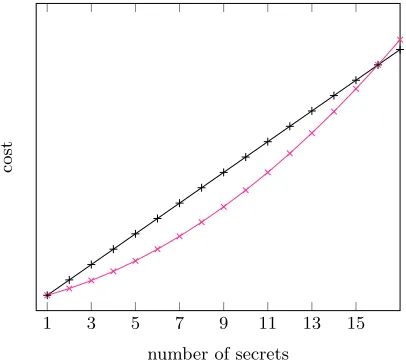
We illustrate the relationship betweendandt, by paying attention to cases where we fix one of the two parameters, and plot the (simplified) cost in function of the other parameter. For fixed d, we have a linear complexity in the number of secrets for the single secret sharing, while this complexity is quadratic when packing is used (see Figure 3). Hence, for each security level there exists an interval of number of secrets where the packing technique brings an advantage.
1 3 5 7 9 11 13 15
number of secrets
cost
Fig. 3: Cost for fixedd(hered= 4) in function of the number of secrets. For single and packed secret sharing.
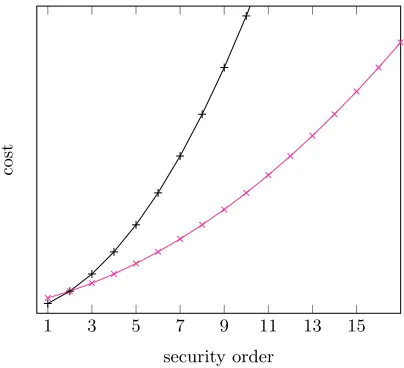
factor t in the first case. As a result, the packing technique is gaining interest when the security order is large (see Figure 4).
1 3 5 7 9 11 13 15
security order
cost
Fig. 4: Cost for fixed t(heret= 4) in function of the masking order. For single and packed secret sharing.
How to multiply. Using packed sharing prevents to use secure multiplications based on Ben-Or et al. [2]. Indeed, to reduce the degree of the polynomial their solution is to erase all the large monomials. This can be done if the secret is located in 0 (since the elimination of large monomials does not change the secret in this case). But packed secret sharing needs several locations for the secrets, which implies that the truncation of polynomials becomes difficult to realize, as best illustrated with the following example. Let s1 (resp. s2) be a secret shared by a polynomialP1(X) (resp.P2(X)).sl=Pl(0) =P
i
t(il)Q
j6=i
xi
xj−xi , for
l=1 or 2 . Remark that we can writePl(X) = P 0≤i≤d
a(il)Xi. Ben-Or et al. et al.
calculates1s2by performing the productQ(X) =P1(X)P2(X). The polynomial
Q(X) has a degree 2d, but since the secret is located in 0, it can be truncated by securely erasing all monomials larger than d. Note that this secure erasure process requires to combine different shares. Hence the information exchanged in this step needs to be masked in order to maintain the security order. Let this truncated polynomial be denoted asQ|d(X). Then we have Q(0) =Q|d(0). All other evaluations can be affected by the erasure of the largest monomials.
in Algorithm 2. In brief, this multiplication masks the result with a random polynomial, opens the result and finally removes the random polynomial, for a complexity inO(d2). More precisely, letn=d+tandOpen/Sharerefer to the
Algorithm 2Polynomial opening multiplication
Require: A (n, d)-sharing ofyandz : (xi, yi)ni=1 and (xi, zi)ni=1. Ensure: A (n, d)-sharing ofy×z : (xi, ti)ni=1 .
1: forifrom 1 tondo 2: ri∈RGF(256)
3: end for
4: Use Alg. 1 on (xi, ri)ni=1,(xi, yi)ni=1 and (xi, zi)ni=1 5: forifrom 1 to 2n−1do
6: pi=yi⊗zi⊕ri
7: end for
8: (s1, . . . , st) =Open((x1, p1), . . . ,(x2n−1, p2n−1)) 9: (t1, . . . , tn) =Share(s1, . . . , st)
10: forifrom 1 tondo 11: ti=ti⊕ri
12: end for
13: return (xi, yi)ni=1
operations that allow recovering several shared secrets and to distribute them among participants (as explained in Appendix A). The first step in Algorithm 2 is the same as in Ben-or et al, i.e. we simply calculateQ(X) =P1(X)P2(X). Then the reduction step is different. The polynomial Q(X) is masked by a random polynomialR(X), which is done by adding the sharesri’s in step 6. Afterwards, the polynomial Q+R(X) is evaluated in the positions where the secrets are located, in order to recover the masked product of the secrets (step 8). Let {vk}nk=1 be the set of the locations for the different secrets. Remark that to determineR(vk), one has to estimatenpoints ofR(X), which allows maintaining thed-th order security. Eventually, theksecrets are shared in a new polynomial
Q0(X) (in step 9), that is of degreenand corresponds to a sharing ofQ+R(vk). Hence, it just remains to remove the random polynomialRto obtain a sharing of
Q(vk) of degree at mostn(i.e. a sharing for the products of the secrets), which is done in step 11 of the algorithm.
addition chain for the inversion, in order to minimize both the number of mul-tiplications and squarings. We used the one described in [7] for this purpose, which requires 11 secure multiplications (including the squarings).
Full AES. We face one more problem when extending the packing towards the full AES. Namely the operationsMixColumnsandShiftRowsneed to move secrets that are hidden in the same polynomial. Hence, and in order to benefit both from the performance gains of packed secret sharing during the execution of the S-boxes and from the linear parts, we decided to switch to single secret polynomials after each execution of SubBytes. To switch fromtpolynomials of degreed+ 1 (with secrets located in position 0) to a single polynomial of degreed+t(with secrets located at positions vk), we first move the positions of all the secrets from 0 tovk (secret per secret). Next, we multiply the resulting polynomial by another polynomial, that cancels at positionsvj6=kand equals 1 invk. Eventually, we add all polynomials together to obtain a single polynomial of degreed+tand containingtsecrets. For the inverse operation (i.e. moving from one polynomial totpolynomials), we first move each secret from positionvk to position 0. Then we erase all monomials of high degree in order to keep a polynomial of degree
d. Eventually, we refresh the masking by adding a polynomial sharing of zero. These two operations are detailed in Appendix B, Algorithms 3 and 4.
3.2 Implementation result
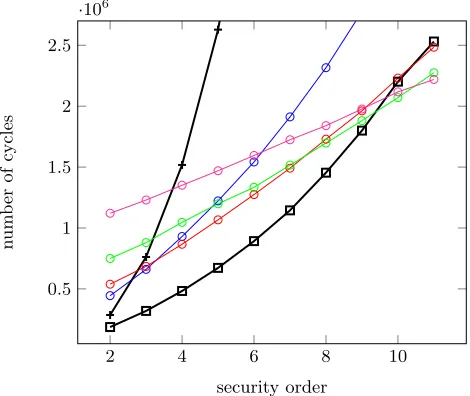
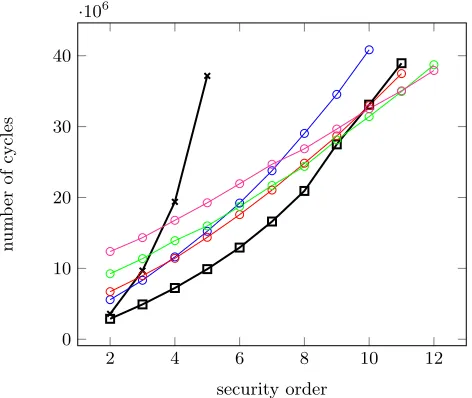
We now compareRocP?, with a MPC-inspired masking exploiting Algorithm 2, for various amounts of secrets hidden per polynomial. In order to evaluate the extent to which the packed secret sharing is exclusively useful for the execution of the AES S-boxes or if the switching between single-secret polynomials and packed secret polynomials is an efficient solution, we provide performance results both for 16 inversions and for the full AES. Besides, and in order to reflect the impact of high security orders, we focused on the compact versions of our codes (the impact of unrolling is very similar to the one in the previous section).
2 4 6 8 10 0.5
1 1.5 2 2.5
·106
security order
n
um
b
er
of
cycles
Fig. 5: Cycle counts for MPC-based masking (compact codes): 16 inversions. The curves are forRocP?, the packed secret sharing curves are represented by , , and for respectively 2, 4, 8 and 16 secrets. The curves are for the multipli-cation of Algorithm 2 with a single secret per polynomial.
that hiding a single secret per polynomial remains the best approach in most practical settings.
4
Randomness requirements and impact on performances
Before to conclude, we would like to briefly investigate the issue of random num-ber generation that is usually neglected in the evaluation of masking schemes. This is an important issue since the amount of randomness required to mask each non-linear operation within the AES while maintaining a security of order
dis again quadratic ind. For this purpose, we will start by providing some infor-mation theoretic intuition regarding why strong randomness is indeed needed. In particular, we will show that this randomness has to be uniform, and that different deviations from this requirement imply weaknesses appearing for low and high measurement noise levels, respectively. Then, we will re-evaluate the performances of the best masking schemes we analyzed in this paper, considering a realistic performance penalty for the generation of each random byte.
4.1 How good must the randomness be?
2 4 6 8 10 12 0
10 20 30 40
·106
security order
n
um
b
er
of
cycles
Fig. 6: Cycle counts for MPC-based masking (compact codes): full AES (b). The curves are forRocP?, the packed secret sharing curves are represented by , , and for respectively 2, 4, 8 and 16 secrets. The curves are for the multipli-cation of Algorithm 2 with a single secret per polynomial.
in [31]. It leads to the information theoretic curves for the unprotected S-box and the 1st-order masked one in Figure 7. As detailed in these previous works, such information theoretic curves provide an evaluation of the worst-case secu-rity level of a countermeasure (i.e. the secusecu-rity level in front of an adversary with a perfect knowledge of the leakage distribution). In the case of masking, the order of the countermeasure is reflected in the slope of the curve (i.e. one for the unprotected S-box, 2 for the 1st-order masked one). We then considered two additional scenarios where the randomness was not as perfect as expected.
Fig. 7: Information theoretic evaluation of masking schemes.
fact, depending on the strength of the bias, this first-order weakness may or not be the best way to attack. That is, as illustrated in the figure, a small first-order weakness will only dominate at the noise level for which its bias is significant in front of the second-order information that is anyway available. The lower green curve excludes 1
32 mask values, the higher 1
16 mask values. The combination of these observations naturally suggests that both for low and high noise levels, exploiting biased or predictable randomness is not an option for masking.
4.2 Implementation result
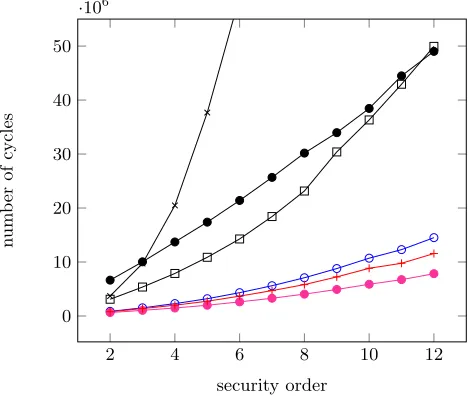
the rest, the gap betweenRivP,KHL,GPQand MPC-based masking remains large, but has been significantly reduced thanks to our optimizations.
2 4 6 8 10 12
0 10 20 30 40 50
·106
security order
n
um
b
er
of
cycles
Fig. 8: Cycle counts for masked AES implementations with time to generate random. The curve is forKHL, the curve is forRocP?, the curve is forRivP, the curve is forGPQ, the curve is for the multiplication of Algorithm 2 with a single secret per polynomial and the curve is for the best packed secret sharing.
5
Conclusions
taking advantage of a preprocessing phase to reduce asymptotic complexities can be mentioned as an example [9], in particular since it has been shown to provide efficient implementations of the AES [8]. Also, the parallelism we exploit in this work was internal to the AES (i.e. based on its 16 S-boxes). This is natural since embedded applications usually encrypt only a small amount of plaintexts. But in other scenarios where many plaintexts have to be encrypted concurrently, it would be possible to take advantage of this additional (extrernal) parallelism.
Acknowledgements.Work funded in parts by the European Commission through the ERC project 280141 (acronym CRASH) and the European ISEC action grant HOME/2010/ISEC/AG/INT-011 B-CCENTRE project. F.-X. Standaert is an associate researcher of the Belgian Fund for Scientific Research (FNRS-F.R.S.).
References
1. Josep Balasch, Sebastian Faust, Benedikt Gierlichs, and Ingrid Verbauwhede. The-ory and practice of a leakage resilient masking scheme. In Wang and Sako [34], pages 758–775.
2. Michael Ben-Or, Shafi Goldwasser, and Avi Wigderson. Completeness theorems for non-cryptographic fault-tolerant distributed computation (extended abstract). In Janos Simon, editor,STOC, pages 1–10. ACM, 1988.
3. Suresh Chari, Charanjit S. Jutla, Josyula R. Rao, and Pankaj Rohatgi. Towards sound approaches to counteract power-analysis attacks. In Michael J. Wiener, editor,CRYPTO, volume 1666 ofLecture Notes in Computer Science, pages 398– 412. Springer, 1999.
4. Jean-S´ebastien Coron, Emmanuel Prouff, and Matthieu Rivain. Side channel crypt-analysis of a higher order masking scheme. In Pascal Paillier and Ingrid Ver-bauwhede, editors, CHES, volume 4727 of Lecture Notes in Computer Science, pages 28–44. Springer, 2007.
5. Jean-S´ebastien Coron, Emmanuel Prouff, and Thomas Roche. On the use of shamir’s secret sharing against side-channel analysis. In Stefan Mangard, edi-tor, CARDIS, volume 7771 of Lecture Notes in Computer Science, pages 77–90. Springer, 2012.
6. Ivan Damg˚ard, Yuval Ishai, and Mikkel Krøigaard. Perfectly secure multiparty computation and the computational overhead of cryptography. In Henri Gilbert, editor,EUROCRYPT, volume 6110 ofLecture Notes in Computer Science, pages 445–465. Springer, 2010.
7. Ivan Damg˚ard and Marcel Keller. Secure multiparty AES (full paper). IACR Cryptology ePrint Archive, 2009:614, 2009.
8. Ivan Damg˚ard, Marcel Keller, Enrique Larraia, Christian Miles, and Nigel P. Smart. Implementing AES via an actively/covertly secure dishonest-majority MPC protocol. In Ivan Visconti and Roberto De Prisco, editors, SCN, volume 7485 of Lecture Notes in Computer Science, pages 241–263. Springer, 2012.
9. Ivan Damg˚ard, Valerio Pastro, Nigel P. Smart, and Sarah Zakarias. Multiparty computation from somewhat homomorphic encryption. In Reihaneh Safavi-Naini and Ran Canetti, editors,CRYPTO, volume 7417 ofLecture Notes in Computer Science, pages 643–662. Springer, 2012.
11. Guillaume Fumaroli, Ange Martinelli, Emmanuel Prouff, and Matthieu Rivain. Affine masking against higher-order side channel analysis. In Alex Biryukov, Guang Gong, and Douglas R. Stinson, editors, Selected Areas in Cryptography, volume 6544 ofLecture Notes in Computer Science, pages 262–280. Springer, 2010. 12. Laurie Genelle, Emmanuel Prouff, and Micha¨el Quisquater. Montgomery’s trick
and fast implementation of masked AES. In Abderrahmane Nitaj and David Pointcheval, editors,AFRICACRYPT, volume 6737 ofLecture Notes in Computer Science, pages 153–169. Springer, 2011.
13. Laurie Genelle, Emmanuel Prouff, and Micha¨el Quisquater. Thwarting higher-order side channel analysis with additive and multiplicative maskings. In Preneel and Takagi [24], pages 240–255.
14. Jovan Dj. Golic and Christophe Tymen. Multiplicative masking and power anal-ysis of AES. In Burton S. Kaliski Jr., C¸ etin Kaya Ko¸c, and Christof Paar, edi-tors, CHES, volume 2523 of Lecture Notes in Computer Science, pages 198–212. Springer, 2002.
15. Louis Goubin and Ange Martinelli. Protecting AES with Shamir’s secret sharing scheme. In Preneel and Takagi [24], pages 79–94.
16. Yuval Ishai, Amit Sahai, and David Wagner. Private circuits: Securing hardware against probing attacks. In Dan Boneh, editor,CRYPTO, volume 2729 ofLecture Notes in Computer Science, pages 463–481. Springer, 2003.
17. HeeSeok Kim, Seokhie Hong, and Jongin Lim. A fast and provably secure higher-order masking of AES S-box. In Preneel and Takagi [24], pages 95–107.
18. Chung Laung Liu. Introduction to combinatorial mathematics, 1968.
19. Stefan Mangard, Elisabeth Oswald, and Thomas Popp. Power analysis attacks -revealing the secrets of smart cards. Springer, 2007.
20. Stefan Mangard, Thomas Popp, and Berndt M. Gammel. Side-channel leakage of masked CMOS gates. In Alfred Menezes, editor,CT-RSA, volume 3376 ofLecture Notes in Computer Science, pages 351–365. Springer, 2005.
21. Amir Moradi and Oliver Mischke. On the simplicity of converting leakages from multivariate to univariate - (case study of a glitch-resistant masking scheme). In Guido Bertoni and Jean-S´ebastien Coron, editors,CHES, volume 8086 ofLecture Notes in Computer Science, pages 1–20. Springer, 2013.
22. Svetla Nikova, Christian Rechberger, and Vincent Rijmen. Threshold implemen-tations against side-channel attacks and glitches. In Peng Ning, Sihan Qing, and Ninghui Li, editors, ICICS, volume 4307 of Lecture Notes in Computer Science, pages 529–545. Springer, 2006.
23. Svetla Nikova, Vincent Rijmen, and Martin Schl¨affer. Secure hardware implementa-tion of nonlinear funcimplementa-tions in the presence of glitches.J. Cryptology, 24(2):292–321, 2011.
24. Bart Preneel and Tsuyoshi Takagi, editors.Cryptographic Hardware and Embedded Systems - CHES 2011 - 13th International Workshop, Nara, Japan, September 28 - October 1, 2011. Proceedings, volume 6917 ofLecture Notes in Computer Science. Springer, 2011.
25. Emmanuel Prouff and Matthieu Rivain. Masking against side-channel attacks: A formal security proof. In Thomas Johansson and Phong Q. Nguyen, editors, EUROCRYPT, volume 7881 of Lecture Notes in Computer Science, pages 142– 159. Springer, 2013.
27. Thomas Roche and Emmanuel Prouff. Higher-order glitches free implementation of the AES using secure multi-party computation protocols - extended version. J. Cryptographic Engineering, 2(2):111–127, 2012.
28. Kai Schramm and Christof Paar. Higher order masking of the AES. In David Pointcheval, editor,CT-RSA, volume 3860 ofLecture Notes in Computer Science, pages 208–225. Springer, 2006.
29. Adi Shamir. How to share a secret. Commun. ACM, 22(11):612–613, 1979. 30. Fran¸cois-Xavier Standaert, Tal Malkin, and Moti Yung. A unified framework for
the analysis of side-channel key recovery attacks. In Antoine Joux, editor, EU-ROCRYPT, volume 5479 of Lecture Notes in Computer Science, pages 443–461. Springer, 2009.
31. Fran¸cois-Xavier Standaert, Nicolas Veyrat-Charvillon, Elisabeth Oswald, Benedikt Gierlichs, Marcel Medwed, Markus Kasper, and Stefan Mangard. The world is not enough: Another look on second-order DPA. In Masayuki Abe, editor, ASI-ACRYPT, volume 6477 of Lecture Notes in Computer Science, pages 112–129. Springer, 2010.
32. Nicolas Veyrat-Charvillon, Marcel Medwed, St´ephanie Kerckhof, and Fran¸ cois-Xavier Standaert. Shuffling against side-channel attacks: A comprehensive study with cautionary note. In Wang and Sako [34], pages 740–757.
33. Manfred von Willich. A technique with an information-theoretic basis for pro-tecting secret data from differential power attacks. In Bahram Honary, editor, IMA Int. Conf., volume 2260 ofLecture Notes in Computer Science, pages 44–62. Springer, 2001.
34. Xiaoyun Wang and Kazue Sako, editors. Advances in Cryptology - ASIACRYPT 2012 - 18th International Conference on the Theory and Application of Cryptol-ogy and Information Security, Beijing, China, December 2-6, 2012. Proceedings, volume 7658 ofLecture Notes in Computer Science. Springer, 2012.
A
Shamir’s secret sharing & BGW
The idea of sharing a secret between several persons is a problem proposed by Liu in 1968 [18]. 11 years after, Shamir described a way to solve it [29]. His solution essentially exploits the fact that Lagrangian interpolation allows to recover the polynomial of lowest degree passing through several points. As a result, to share a secret s the person who knows the secret (usually referred to as the dealer) chooses a random polynomial P, such that P(0) = s (usually referred to as the initial condition). Let dbe the degree ofP. Then the dealer distributes the evaluations of P at different points (called the shares) to the e participants, and labels thei-th evaluation in xi 6= 0 with yi. This step is usually called the sharing. In this paper we will denote this operation by (y1, . . . , ye) =Share(s). Now iff > dparticipants want to discover the secret, they use the interpolation method to find P, and then evaluateP in 0: this step is called the opening. In this paper we will denote this operation by s= Open(y1, . . . , yf). By contrast iff ≤d, thenP cannot be recovered since not enough information is available. In practice, the interpolation can be done using the Lagrangian method. In that
case, the participants build Q(X) = P
0≤i≤f
yiQ j6=i
X−xj
xi−xj
has degree at most f and verifiesQ(xi) =yi ∀i ∈ {0, . . . , f}, we directly have that iff > d, thenQ=P according to the fundamental theorem of algebra.
The original MPC techniques in [2] essentially aim at computing on secrets shared according to Shamir’s trick. In this context, it is easy to see that the addition of two secrets can be done directly, by simply performing the addition on each pair of shares. By contrast, multiplying two shared secrets is more difficult, since the multiplication of two polynomials of degree din a field gives rise to a polynomial of degree 2d. As a result, and in order for the degrees of the polynomials to remain low enough so that MPC remains efficient, it is necessary to reduce this polynomial securely. The solution proposed by Ben-Or, Goldwasser and Wigderson is to use sharings witht >2d, perform the multiplications locally, and then securely delete in all the monomials of degree higher thand[2].
Note that when using polynomial masking (e.g. based on Shamir’s secret sharing), the square function is also a bit more difficult to implement than in the Boolean case. Indeed, lets=P(0) =Pt
iQ j6=i
xj
xj−xi
. To calculate the square
ofs, the participants have to computes2=P
yi2Q
j6=i
x2 j
x2 j−x2i
. But without special
care, this operation moves the position of the shares between participants (while the execution of linear operations can only be performed if the shares are located at the same place). In [27], the authors propose to use a setS of location points that are stable by Frobenius application to avoid this problem. That is, for our case we select points such that x2 =y and then let the participants exchange shares (which is possible in the context of masking where all participants are on the same chip and assumed to be honest - but not in the general MPC case).
B
Switch packed secret single secret
We describe how to switch from a single polynomial masking to a packed se-cret sharing (and vice versa) in Algorithms 3 and 4. Note that step 5 in Al-gorithm 1 allows to obtain a (n, d)-sharing from a (d+ 1, d)-sharing.Ak
i is the evaluation on xi of the polynomial Ak(X) = Q
i6=k X−vi
vk−vi. It easy to check that
this polynomial verifies the condition of annihilation in vi for i 6= k. Eventu-ally,mk
i =
Q
j6=i xj
vk−xj allows to move the location of a secret from 0 to vk, since
mki = Q
j6=i xj
xi−xj( Q
j6=i vk−xj
xi−xj)
−1. As a result, the reconstruction with Q
j6=i vk−xj
xi−xj will
give the same secret as the evaluation in zero of the original polynomial. Simi-larly, dki = Q
j6=i vk−xj
Algorithm 3Switch fromtsingle-secret polys to 1 packed secret poly Require: t(d+ 1, d)-sharings ofsk: (xi, yik)
d+1
i=1. Ensure: A (n, d)-sharing of{sk}t
k=1: (xi, ti)ni=1. 1: forkfrom 1 totdo
2: forifrom 1 toddo 3: yik=yki ⊗mki
4: end for
5: Use a modified Alg. 1 on (xi, yik)di=1+1 6: forifrom 1 toddo
7: yk
i =yki ⊗Aki
8: end for
9: end for
10: forkfrom 1 totdo
11: forifrom 1 tot+ddo 12: ti=ti⊕yik
13: end for
14: end for
15: return (xi, ti)ni=1
Algorithm 4Switch from 1 packed secret poly tot single-secret polys Require: A (n, d)-sharing of{sk}t
k=1: (xi, ti)ni=1. Ensure: t(d+ 1, d)-sharings ofsk :{(xi, yki)di=1+1}
t k=1. 1: forifrom 1 totdo
2: forkfrom 1 tod+tdo
3: yk
i =ti⊗dki
4: end for
5: forifrom 1 toddo 6: ri∈RGF(256)
7: end for
8: Use Alg. 1 on (xi, ri)di=1+1 9: forifrom 1 tod+tdo
10: yk
i =yki ⊕ri
11: end for
12: res=Open((x0, yk0), . . . ,(xt+d, ykt+d)
13: (t1, . . . , td+1) =Share(0) 14: forkfrom 1 tod+ 1do
15: yk
i =ri⊕res⊕ti
16: end for
17: end for
18: return {(xi, yik)di=1+1}